This may happen if you receive/have received products on which you have doubts. In this case you will most probably create a claim (see specific LU on claims above).
Claims with type “Move to Quarantine” will move the goods to the “Quarantine (analyze)” location. Claims with type “Scrap” will move the goods to the “Expired/ Damaged /For Scrap” location. Note that if a claim is created from scratch you will be able to add an event with type “Scrap” on this claim. When this event will be processed, goods will be moved to the “Expired/ Damaged /For Scrap” location.
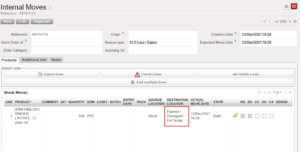
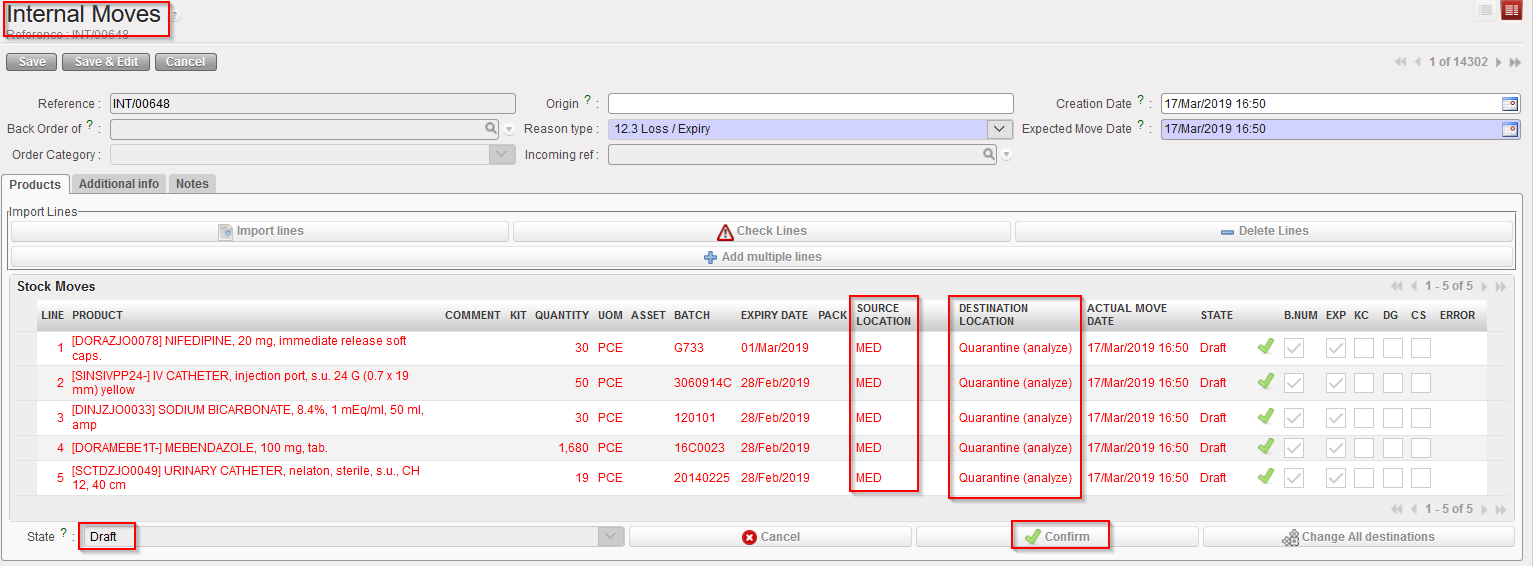
Another way to move goods to the quarantine location is via Internal Moves. This will be done when the quarantine is not related to a claim. Make sure to use the appropriate “Reason type” when you create the INT. As destination location you may choose between “Quarantine (analyze)” and “Expired/ Damaged /For Scrap)”.
Internal Move to isolate products in quarantine
Note that Internal Moves will also be used to transfer goods from Quarantine back to another location if you realize that these goods can actually be used.
They will also be used to destroy the goods as explained in the next section.
If you face problems with products, you can isolate them in quarantine or destroy them. Both options are possible in UniField where Quarantine and Destruction are defined as locations.
Quarantine is a (view) location which is part of the instance full view and this is where stock can be moved while awaiting a decision. This means that these products will not be seen as available for dispatch/use. The two types of quarantine are 1) for analysis and 2) before scrap.
In UniField, they are identified by 2 locations which are named “Quarantine (analyze)” and “Expired/ Damaged /For Scrap“. Both of them are located under the “Quarantine / For Scrap”. ” location view. The first is used when some time is needed to analyze and receive results for products before deciding if they are fit for use (commonly this will be used to analyze drugs). The second, “Expired/ Damaged /For Scrap“, is where goods will be moved while awaiting authorization that they can be disposed of or destroyed.
The “Destruction” location is a virtual location where goods will be moved once they are destroyed.
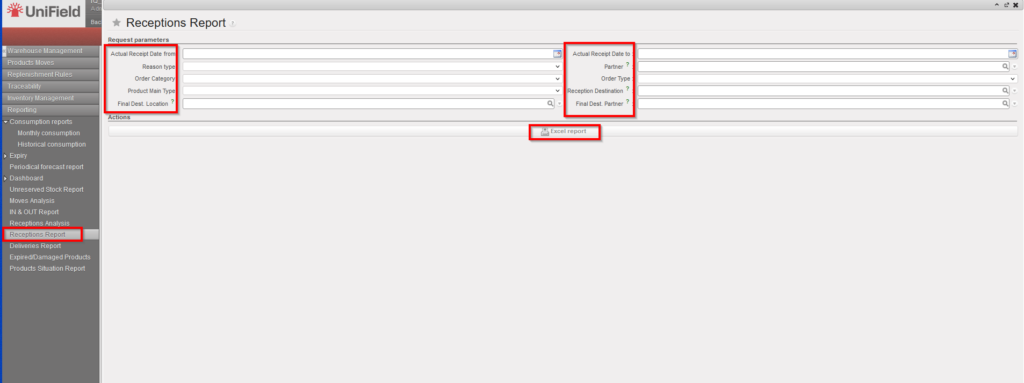
This feature is one of the latest development that enables to get the receptions information more easily thanks to the different filters and direct information.
Go to:Warehouse / Reporting / Receptions Report
Select any filter you need among the following: Actual Receipt Date from; Actual Receipt Date to; Reason type; Partner; Order Category; Order Type; Product Main Type, , Final Dest. Location, Final Dest. Partner.
Click on the “Excel report” button.
Receptions Report
Receptions Report – Excel Export
In case the user change the Destination location to “Ext CU” in the “IN” from the original location in the “IR”, this report will not reflect the new destination location.
IR > PO > IN > Ext CU which is changed is not reflected.
In case the user change the Destination location ” INT CU ” in the “IN” from the original location in the “IR”, this report will reflect the new destination location.
IR > PO > In > INT CU which is changed is reflected.
In case the user change the Destination location TO “Stock” in the “IN” from the original location in the “IR”, this report will reflect the new destination location
FO > PO > IN where destination of IN changed to Stock is reflected.
F. HOW TO PRODUCE THE “Expired/Damaged Products” REPORT
UniField offers the possibility to generate a report that will display all the INT that are sent to “Quarantine (analyze/ before scrap)” or “Destruction” locations. This will help user to better track the expired and damaged products.
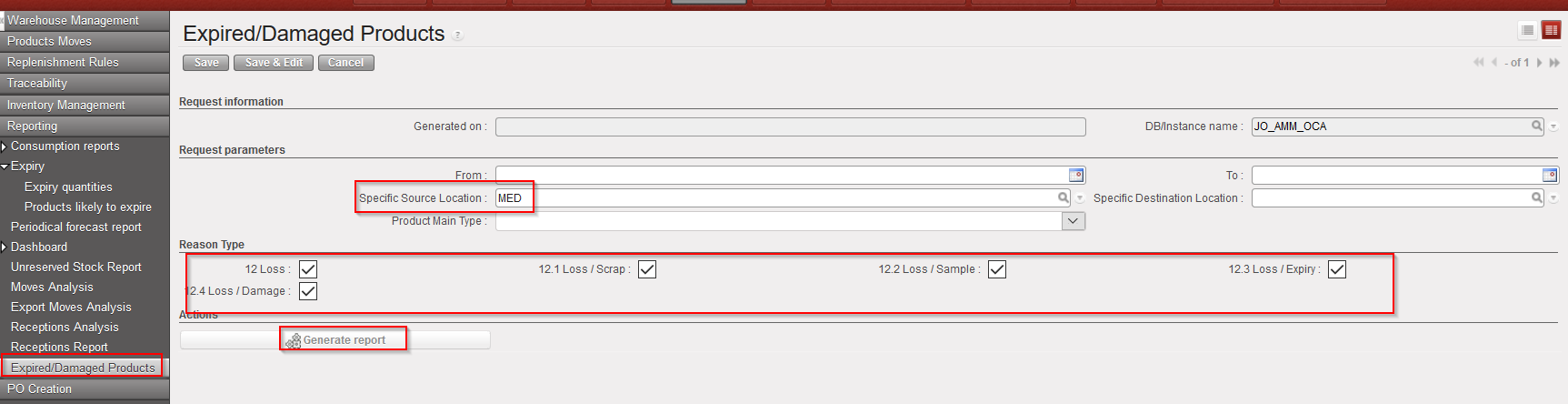
Go to: Warehouse / Reporting / Expired/Damaged Products
Click on “New”
Before generating the report user have the option to select several filters such as : “From” and “To” date; “Specific Source Location”, “Specific Destination Location”; “Product Main Type” and finally different “ReasonType” (please note that if user needs All the reason type, user will have to “untick” all the default reason type – as the list in the pop up is not exhaustive). The Reason type filter is meant at line level.
Click on “Generatereport”
Expired/Damaged Products
Expired/Damaged Products – Excel export
The excel report display all the INT reference which are Closed and with the selected “Source” and “Destination” location as well as the selected “Reasontype”( product line level).
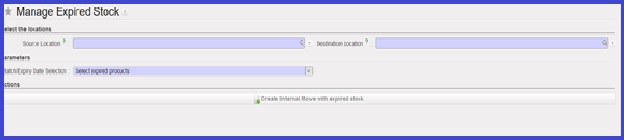
In order to ease management of Expired Stock , the “Manage Expired Stock” feature enables the user to automatically create an Internal move, INT, for products which have expired and need to be send to Quarantine or Destroyed or the second option for the products which are not yet expired but will be expiring soon: “Soon to be expired“. The selection of these expired products needs to be done per location.
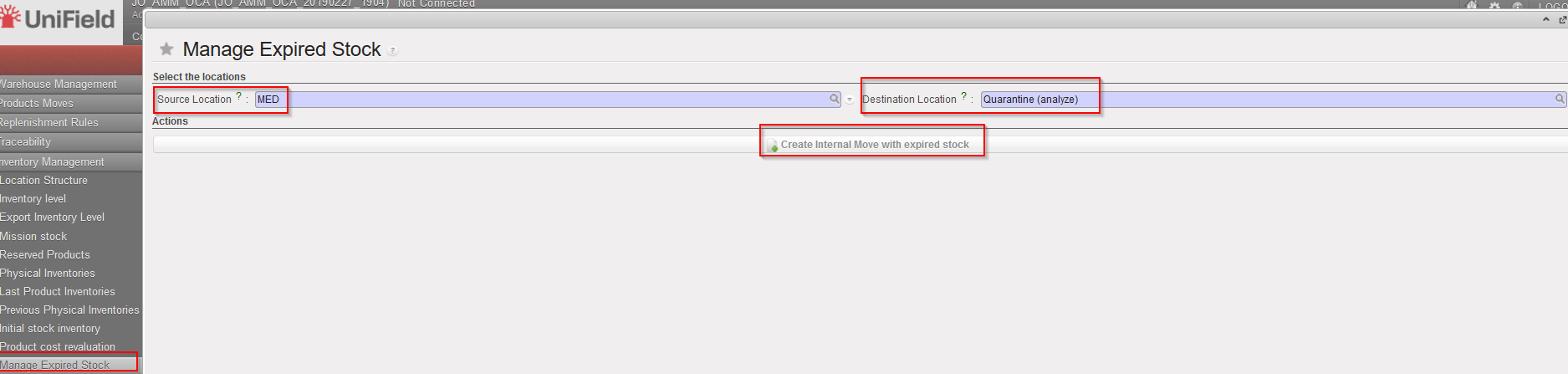
Go to:Warehouse / Inventory Management / Manage Expired Stock
In the “Source Location” field, select the location from where you want to transfer the Expired products (this is a mandatory filed).
In the “Destination location” field, the only options are: “Destruction”; “Quarantine (analyze)” and “Expired/ Damaged /For Scrap”.
Click on “Create Internal move with expired stock”
Manage Expired Stock
Manage Expired Stock – Generated INTernal move
The associated INT is automatically created with the list of Expired products in “Draft”. The “Source Location” and “Destination Location” are automatically populated as per selection.
To proceed forward user will have to Confirm the INT refer to the chapter “LU-SU4201 Internal Moves”.
There is also the second option to see also products which are not yet expired but will be expiring soon.
Function to have possibility to select products “Soon to be expired” (option for the range from 1 to 12 weeks) e.g. you can choose the product which is subject to expired in 5 , 6 weeks etc. and also there is a new possibility before creating an internal move to have option of popped up screen where you have option to move or keep internal move.
Go to:Warehouse>Inventory Management>”Manage Expired stock”
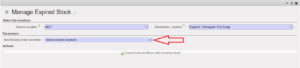
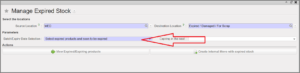
Click on the drop-down menu to get selecting options: “Select expired products” and “Select expired products and soon to be expired”
“Select expired products”
“Select expired products and soon to be expired”
In the field “Expiring in the next” select the number of the weeks in the future, and then their will be 2 buttons, “View Expired/Expiring products” & “Create Internal Move with expired stock”
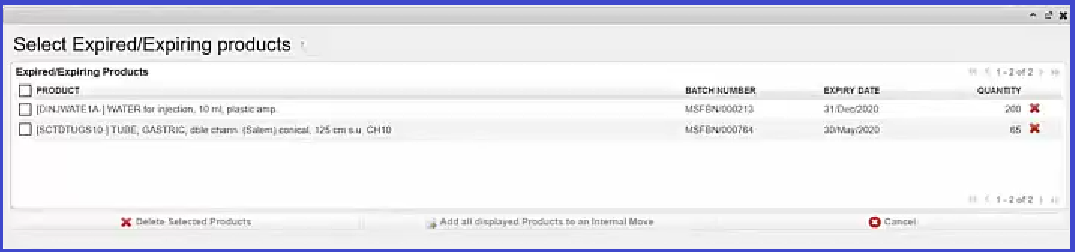
When the button “View Expired/Expiring products” is clicked , there is a pop-up window showing the possibility to review and choose the product to move before the creation of internal move “INT”
When the button “Create Internal Move with expired stock” is clicked , the “INT” will be created containing all products which are expired and soon to expire.
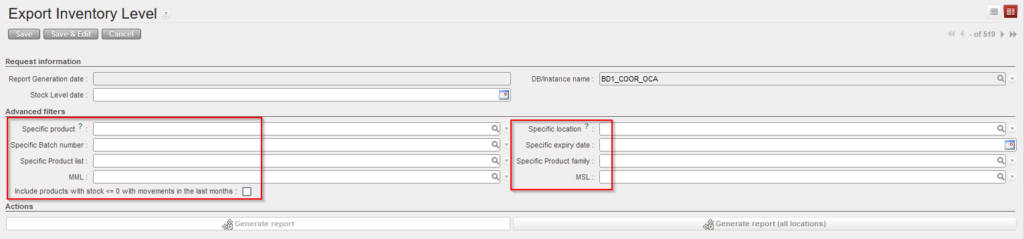
The “Export Inventory Level” functionality allows you to export to Excel the stock levels of an instance either by filtering on specific criteria such as product, batch, location or having a full view of your instance stock with all the locations displayed.
Depending on your choice, you will have two types of reports: the “Stock Inventory Global View” report or the “Stock Inventory Location View” report.
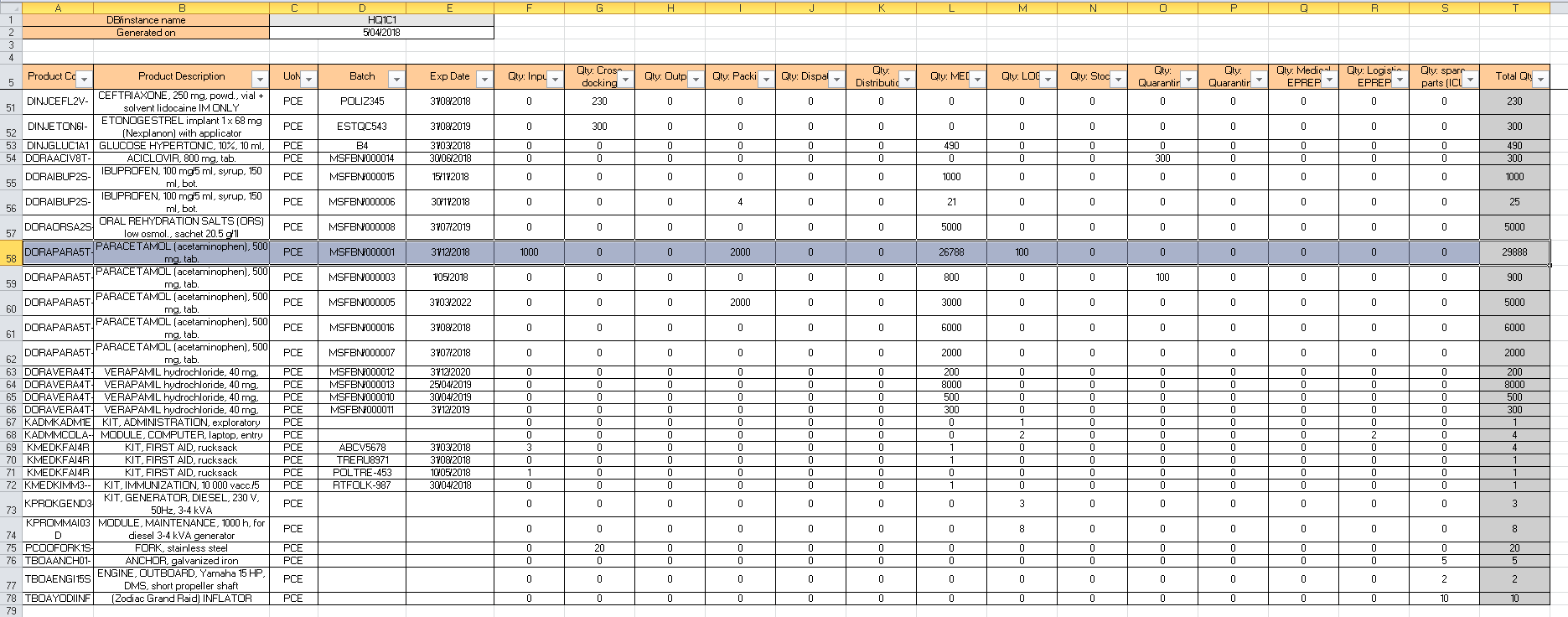
The Stock Inventory Global View displays the real stock level of each product/batch in each internal location and the total real stock level in all these locations.
The Stock Inventory Location View displays the real stock level of each product/batch in the selected location and the real stock level of each product (total of all batches) in the selected location.
One significant improvement that has been added to this export is that it can be generated in the past which allow user to have the stock level at a specific date.
Also it is now possible to filter the results in order to have as well the products <= 0 which had movements in the last X months.
Go to:Warehouse / Inventory Management / Export Inventory Level
Click on the “New” button.
Complete the parameters. If you don’t specify a location, you can only get the global view report. If you specify a location you can only get the location view report.
Click on the “Generate report (all locations)” button to get the global view report.
Export Inventory Level – Global View Report
4. Once the report is generated you may open/download it from the action menu.
Export Inventory Level – Global View Report
On top of the excel sheet, you can see the instance name and the date of the generation of the report.
The Global View report shows for each product/batch the real stock level in each internal location of the instance. The last column shows the total real stock level in all internal locations.
If a product is not batch managed, you only have one line for this product and the BN/ED columns are empty.
If you generated the Location View report, you will get a similar report but organized differently and focusing on one specific location.
Export Inventory Level – Location View Report
Export Inventory Level – Location View Report
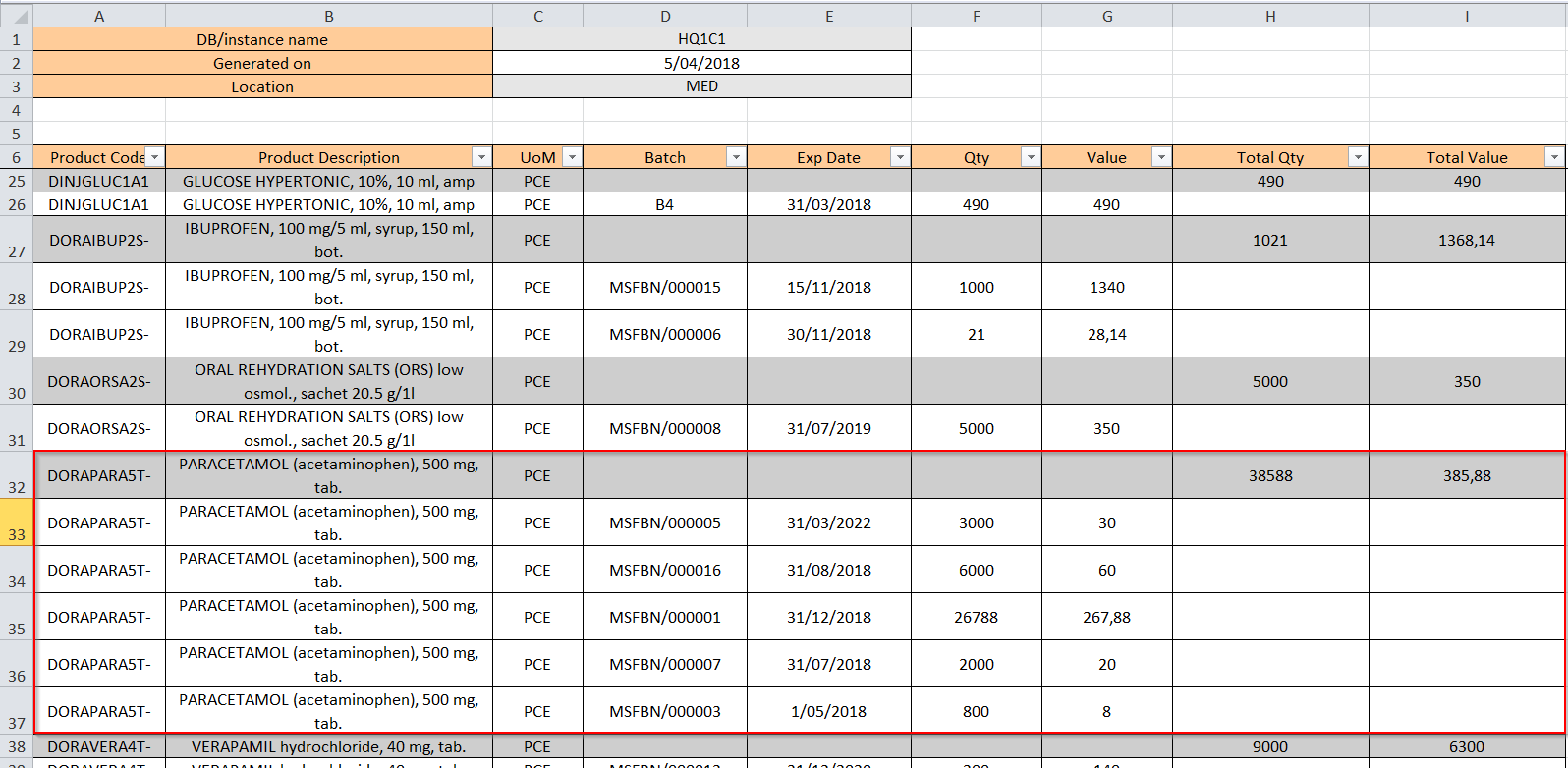
On top of the excel sheet, you can see the instance name, the date of the generation of the report and the selected location.
The Location View report shows for each product/batch the real stock level in the selected location. The grey lines show the total real stock level per product in the selected location.
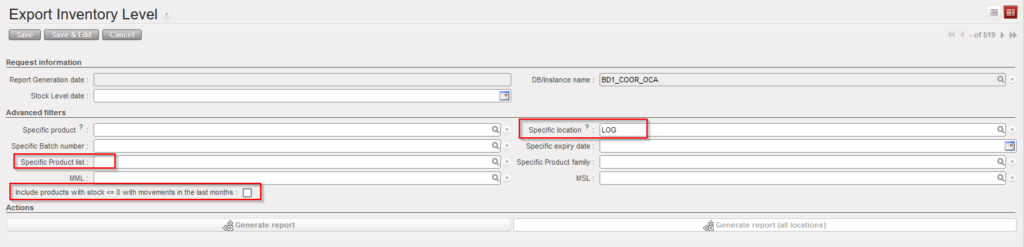
Please note that if the “Location” filter is chosen and at the same time the “Specific Product list” filter is chosen as well, only the products from the product list in that location will be displayed with quantities in that location (including product <=0 with movements in the last months)., the list will exclude the batches with 0 stocks and which have not moved in the defined value X months.
An important review of this functionality has been introduced in January 2018 (with the release UF7.0).
Physical Inventories which were done before this date can still be viewed through Warehouse / Inventory Management / Previous Physical Inventories, but this menu should not be used to create new inventories. According to you user rights you will have/not have access to this menu.
All Physical Inventories should be done through the menu Warehouse / Inventory Management / Physical Inventories.
Physical inventories (stock counts) done in the warehouse need to be recorded in the system to ensure the adequacy between physical stock levels and system stock levels.
The Physical Inventory functionality is a step by step transaction which provides all necessary features to properly support such a count.
This section explains first briefly how to do a basic Physical Inventory. At the end of the section some advanced features related to the functionality are explained. Be aware that all features available on PI are not explained in this manual.
Go to:Warehouse / Inventory Management / Physical Inventories
Click on the “New” button to create a new inventory. At this stage of the process, the PI has only one tab named “Products“.
Enter Inventory “Details“.
Select the “Location” in which you are counting the items.
Enter the name of the “Responsible” for this inventory.
To add product lines you may
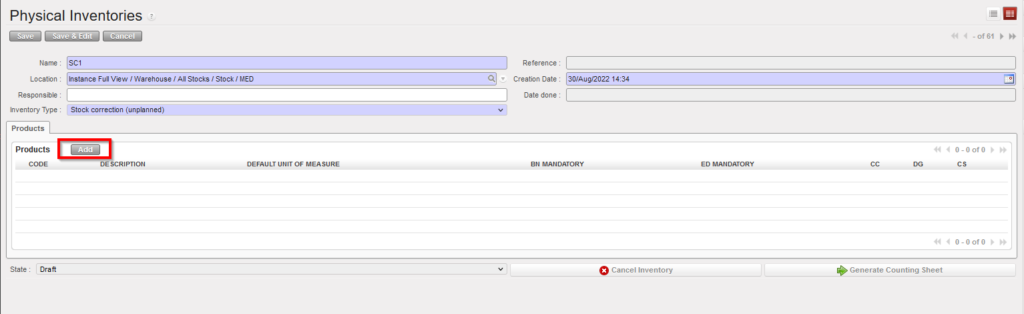
a) Use the “Add” button and select products in the “Search Products” screen.
b) Use the “Products Selection” button to include products in the PI according to various criteria.
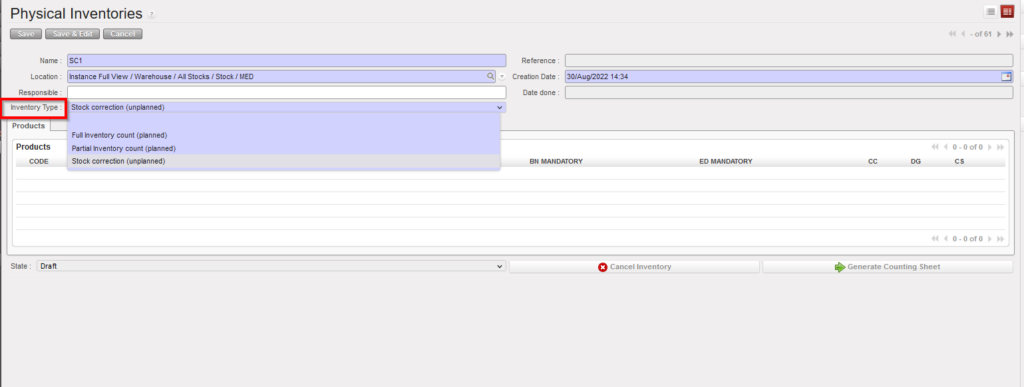
c) Use the mandatory drop-down list “Inventory Type” with below options:
Full inventory count (planned),
Partial inventory count (planned)
Stock correction (unplanned).
Including products on a Physical Inventory
If 3rd option is selected “Stock correction (unplanned)”, only the “Add” button displays to allow products to be added. The button “Products selection” is not displayed.
Drop-down list values of (Inventory Type) options can be changed as long as no products have been added yet.
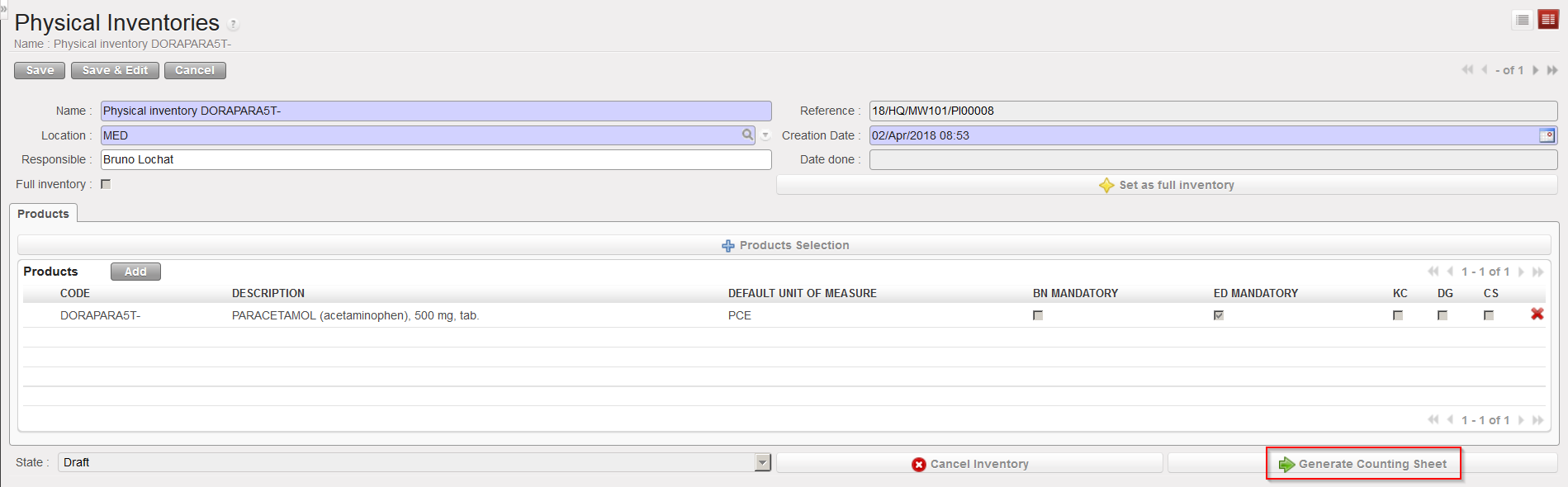
6. Once all needed product codes have been included on the PI, click on the “Generate Counting Sheet” button.
Generating Counting Sheet
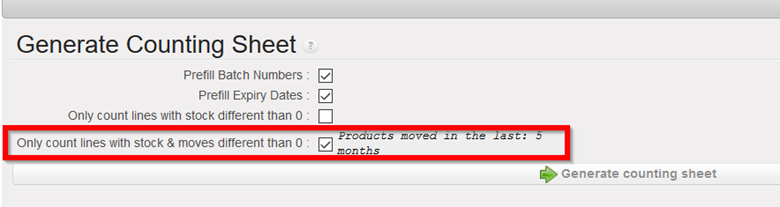
7. On the “Generate Counting Sheet” screen, you may decide if you want to include (print) in the counting sheet
BN
ED
Only items which have a stock level <> 0
Only count lines with stock & moves different than <> 0
In case of blind inventory – the B/N option is completely blind; it is not prefilled. There is just a product. On that case Unifield enables a standard number of 3 lines which are displayed per BN/ED product. This means whether there is “1” BN/ED for a product or “10”, there will always be 3 lines per BN/ED product shown (on screen and export). The user can see three lines if the box is not ticked prefilled B/N(batch no.) or ED(expiry dates).
Its possible to specify system should add products with movements in the last X months. and the same number of months specified to add products can be used to filter and display also the batches of the added products based on this timed selection. Where user has added products specifying products with movements in the last 5 months, this would be the default option ticked in the 4th checkbox on the “Generate Counting sheet” pop-up and only batches which have been moved in the last 5 months will be displayed in the counting sheet.
If the 4th checkbox is unticked, the original product selection remains unchanged, so all products with movements in the last 5 months will be displayed, but all of their batches will be displayed even those which were last moved several years before.
If the 3rd checkbox “only count lines with stock different than 0” is ticked, the 4th checkbox cannot be ticked. All previous displays of the Counting Sheet are still possible.
In the case of multiple additions of products were performed, the system will propose the greatest number of months used during the additions.
Tick/untick the check boxes according to your needs and click on the “Generate counting sheet” button.
Generating Counting Sheet
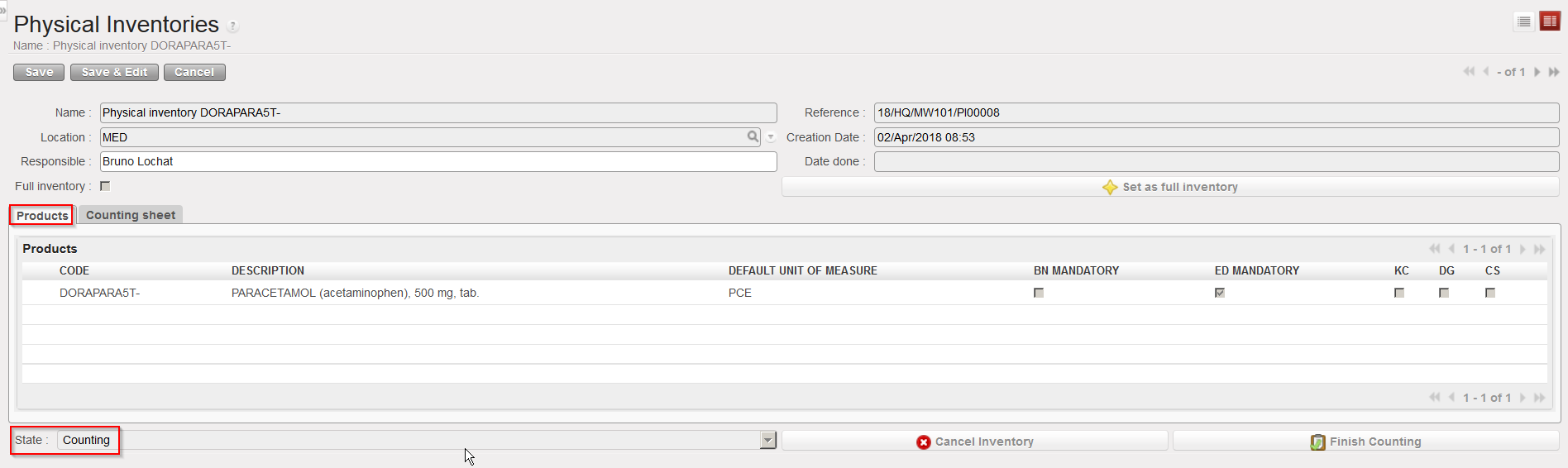
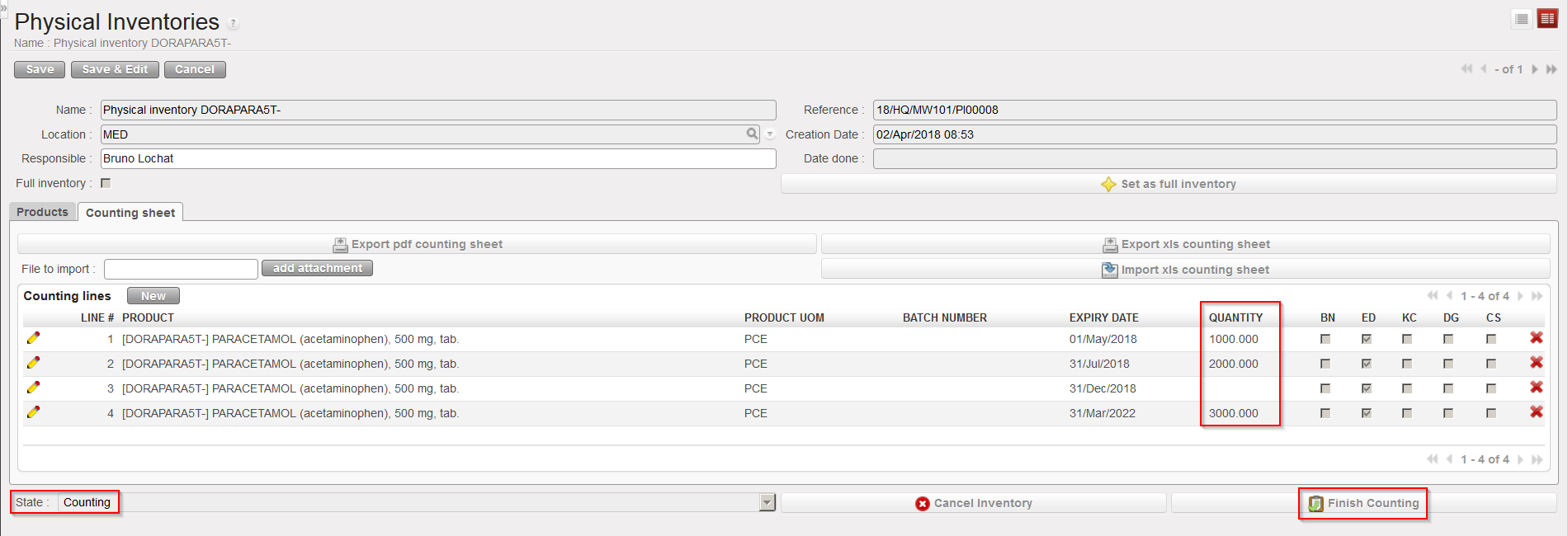
8. The PI switches to the state “Counting“. This means that the counting is currently ongoing in the warehouse. The tab “Products” (which was already present before) shows the products which have been selected. A second tab named “Counting sheet” has now appeared. According to the selection done at the previous step, this tab shows which products/batches should now be counted in the location.
Physical Inventory in state “Counting” – “Products” tab
Physical Inventory in state “Counting” –”Counting sheet” tab
9. On the “Counting Sheet” tab, the buttons “Export pdf counting sheet” and “Export xls counting sheet” allow to export the counting sheet in PDF or excel, with the objective to facilitate the counting process in the warehouse.
10. Products/batches counted may be included on the PI in two ways:
A) Manually, using the pencil icon in front of each line to edit it and /or the “New” button located on top of the “Counting lines” table
B) Via file import, using the “add attachment” and “Import xls counting sheet” buttons in order to upload the filled counting sheet (with the count) that was exported in excel at the previous step.
At import of Counting Sheet, System will check Product / BN / ED, duplicate lines, and match imported Prod/BN/ED, add new lines, etc.
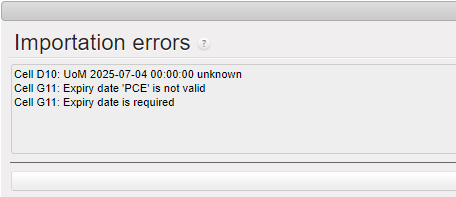
When Counting sheet contains value not recognized for UoM, or for ED import is blocked and a clearer warning message is displayed.
11. The state of the PI is still on “Counting” but you may now see on the “Counting sheet” tab for each counted product/batch, the quantity which has been counted in the warehouse. Click on “FinishCounting“.
Physical Inventory in state “Counting” – Counting sheet uploaded
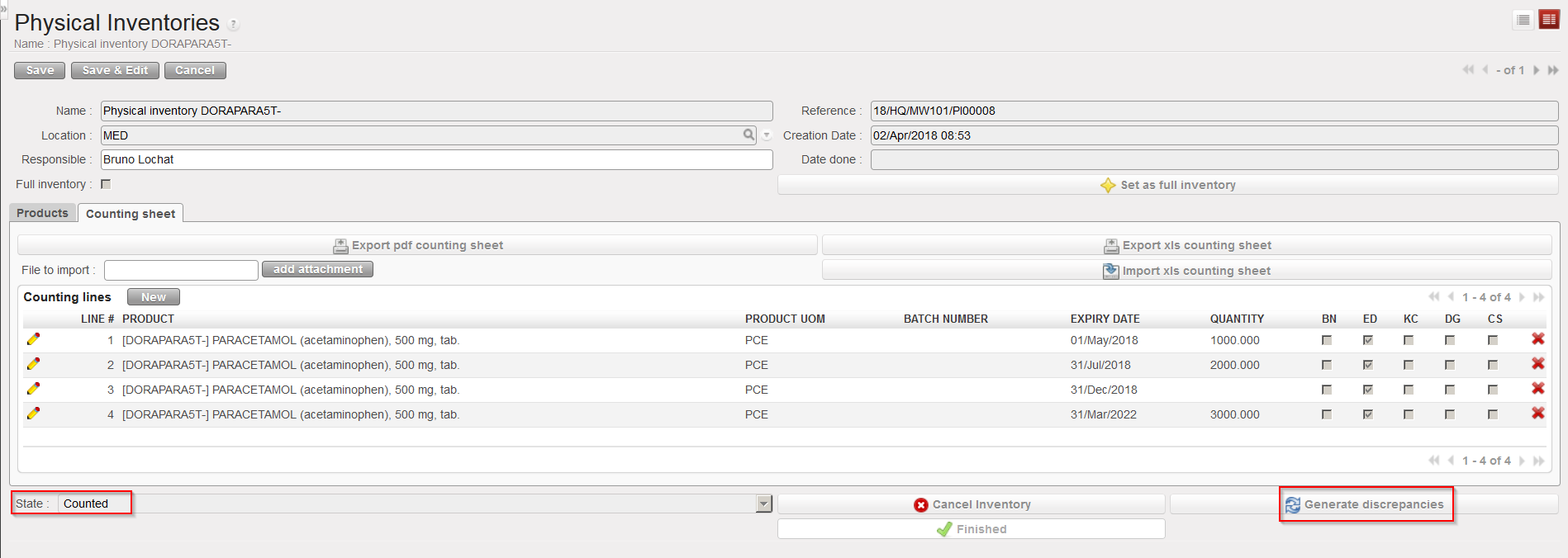
12. The PI switches to the sate “Counted“. Click on “Generate discrepancies“.
Physical Inventory in state “Counted” – Generating discrepancies
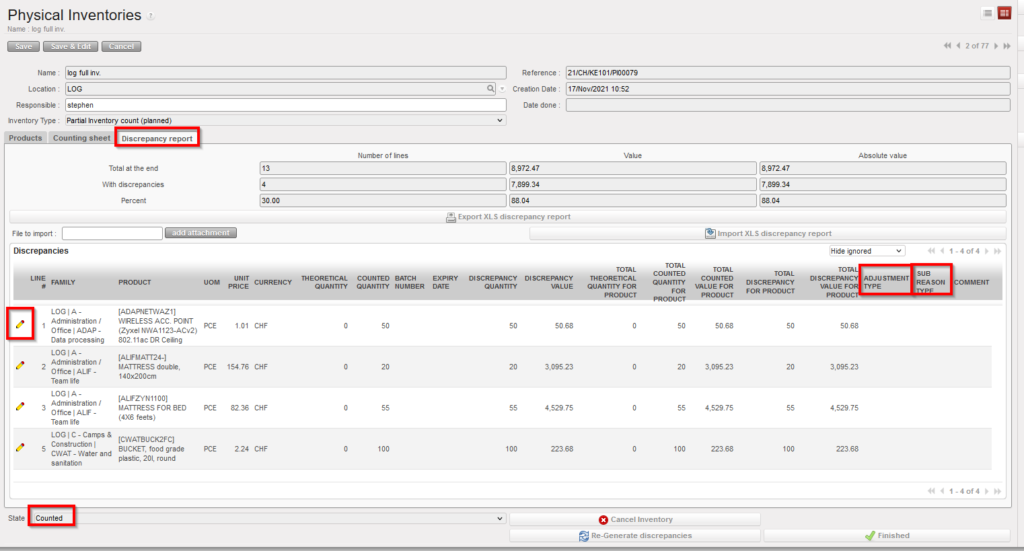
13. A discrepancy report is generated and is available on the “Discrepancy report” tab. This report shows discrepancies between the theoretical (system) quantities and the counted (physical) quantities. Each line of the discrepancy report must be edited in order to input the “ADJUSTMENT TYPE” which is mandatory in order to progress to next status of Physical Inventory. If the “Adjustment Type” selected is “Discrepancy” then it will be possible to add a ““SUB REASON TYPE” and this can be added at a later stage before the Physical Inventory is set to “Closed”. “COMMENT” can also be added before Physical Inventory is set to Closed.
Physical Inventory in state “Counted” – “Discrepancy report” tab
14. Once all counted lines and discrepancies have been analyzed and explained, if you are confident about what was inserted in the PI, you should get validation from your supervisor and click on the “Finished” button. The PI switches to the state “Validated“. The PI is ready to be confirmed.
15. Click on “Confirm Inventory” to confirm the PI.
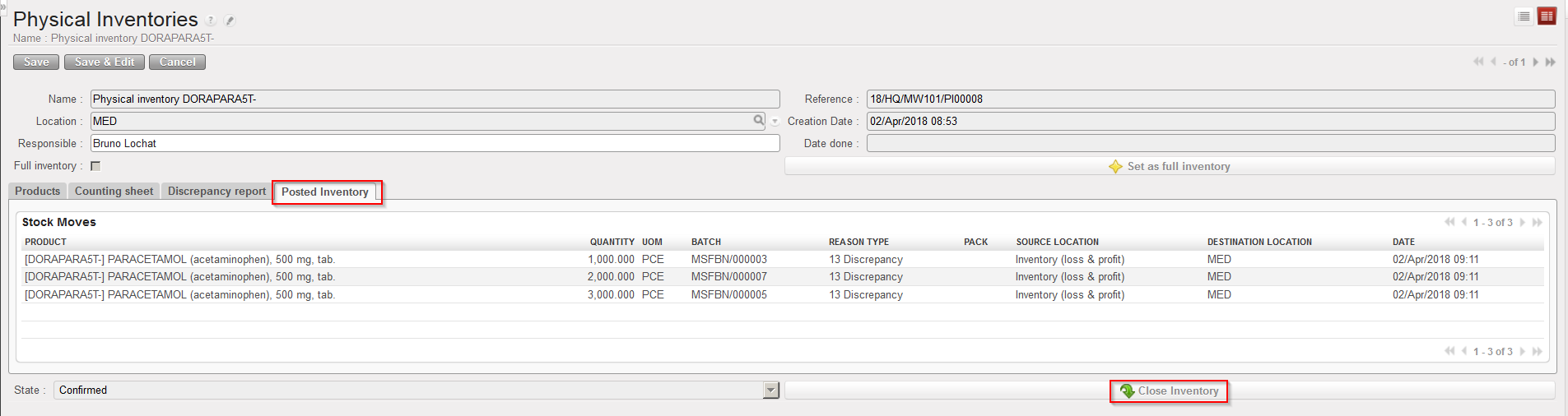
16. The PI switches to the state “Confirmed“. An additional tab called “Posted Inventory” appears, listing all movements which have been created by the PI. Click on “Close Inventory“.
Physical Inventory in state “Confirmed” – Closing the Inventory
17. The PI switches to the state “Closed“.
To end this section, we briefly comment some extra features which exist on the Physical Inventory functionality. However, it is not possible to go in all details here.
The “Set as full inventory” button allows making a full inventory (also called blanked count). The counting sheet will be empty and counters will have to count in the warehouse without any system guidance. This feature was developed to support full warehouse counts.
If you select the products to be counted via the “Products Selection” button, you may choose between:
Including the products which are currently in the location
Including the products which have recently move in/out of the location (and “recently” can be defined in month(s) between 1 and 12)
The selection of products done via one of these 2 options may also be further restricted by selecting:
All the concerned products
Products with a specific nomenclature
Products belonging to a specific list
Products which are KC/CS/DG
You may cancel a PI at any stage of its process (excepted when it is “Closed“).
When the discrepancies report is generated, if some products/batches included in the counting sheet have not been counted you may choose between:
Ignoring them (i.e. their stock level won’t be touched)
Counting them as zero (i.e. their stock level will be set to zero)
On the “Discrepancy report” tab you have the options to:
Hide ignored
Show all
Show ignored only
This allows showing/hiding ignored products/batches.
Some KPIs are available on the discrepancy report (number of lines, discrepancies value,…).
The discrepancy report can be exported/imported to/from excel. The import function is only used to import adjustment types and comments.
When the PI is in state “Counted” or “Validated“, a button allows to “re-generate the discrepancies“. This is actually a refresh button which can be useful in case you did a wrong choice on the ignore/count to zero options.
When the PI is in state “Validated“, you still have the option to click on “Recount“. This will delete the discrepancy sheet and reset the PI to the state “Counting“, allowing you to repeat the count if needed (but not to select additional products or to re-generate the counting sheet).
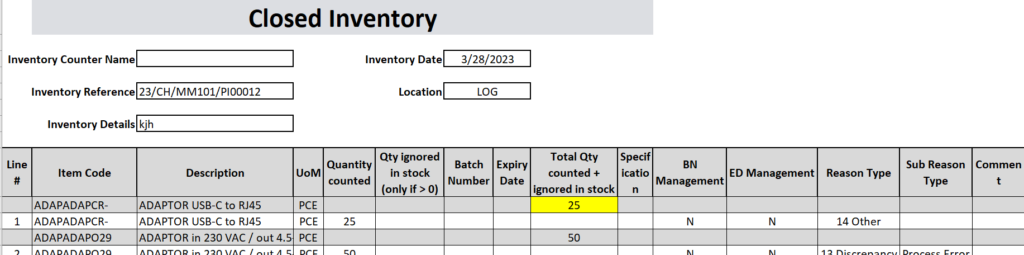
When the PI is in state “Closed” you can export a report called “Closed Inventory” via “Action menu”, similar to the Discrepancy report but with additional information: any counted qty which does not result in a discrepancy will also appear in this report.
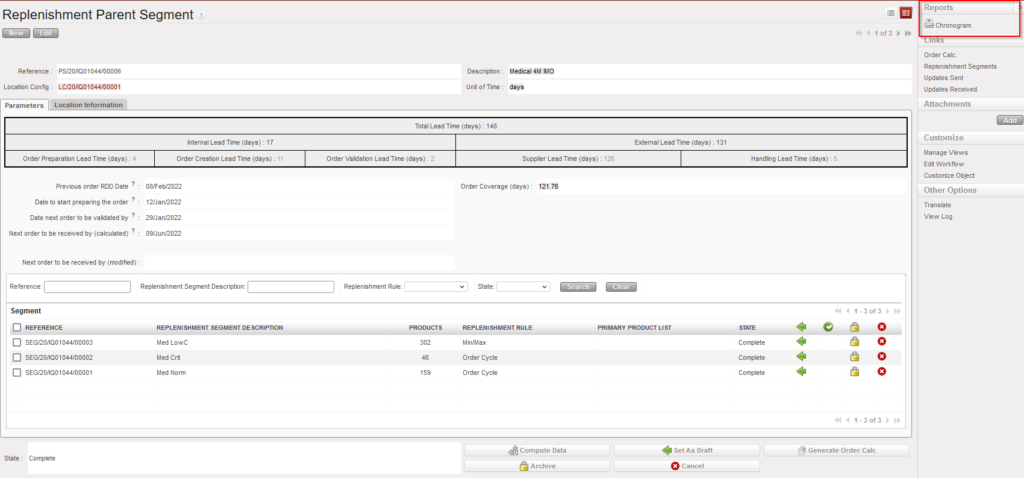
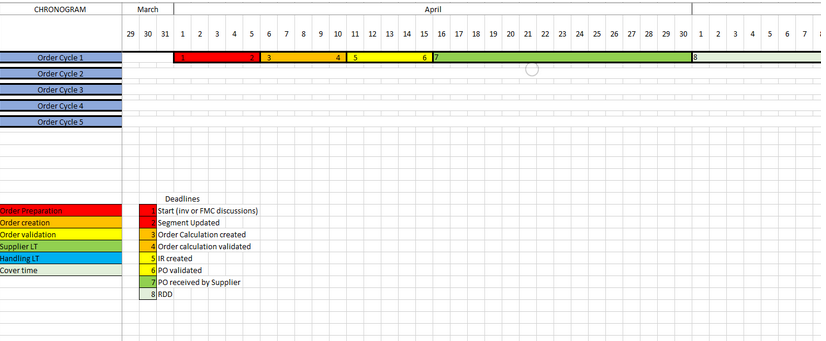
Note: its possible to export the Chronogram diagram in excel format from the Action menu of the Replenishment Parent Segment screen. It gives an overview of a 2 year planning horizon showing up to 5 order cycles based on the dates entered in the Parent segment, with indications of lead times/key dates for order preparation, order creation and order validation, Supplier and Handling lead times as well as the cover time of the order. Chronogram will be generated using Unit of time selected in segment (days/weeks/months). Some restrictions have been added to ensure unit of time selected is pertinent to lead times added along with a warning to indicate these.
Go to: Warehouse / Replenishment Rules / Configuration / Replenishment Parent Segment / Reports
K. HOW TO GENERATE ORDER CALCULATION REPORTS – Exports and on screen
From list view of Order Calculations, it is possible using the check-boxes to select multiple Order calcs and then, using some other options in the Action Menu in order to generate reports in excel files.
These exported reports can still be used as import file in order to update the Order Calc (when not Closed yet).
Go to:Warehouse / Replenishment Rules / Order Calculation
Export files from right end side Action menu
a) Order Calc Excel Export :
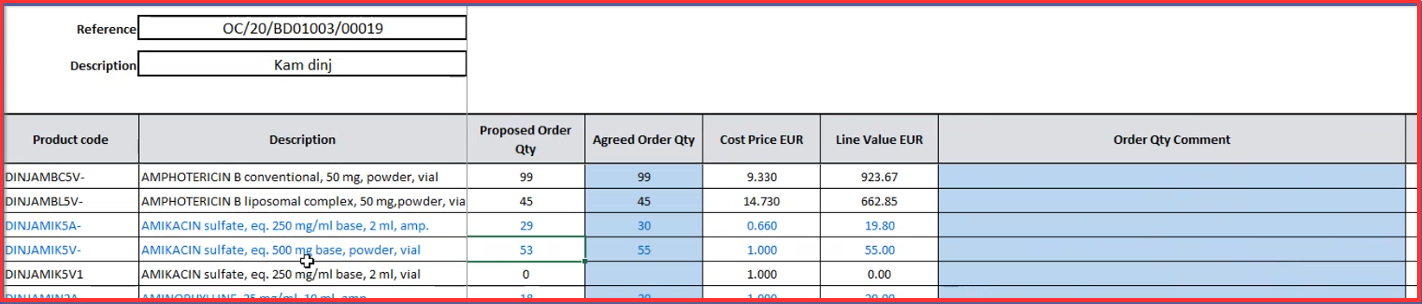
This report enables to have a visibility on what is present in our order calc. There is an option to export either a report with all lines or a report with Warning lines. If you export the excel spreadsheet file there are two columns visible (colored in blue) “Agreed Order Qty” and “Order Qty Comment”. These blue highlighted columns can be edited/updated and are accepted by the system when you import the excel spreadsheet back to Unifield system. It is possible to export all lines for selected Order Calcs into one excel file for order calcs which are in Draft Status.
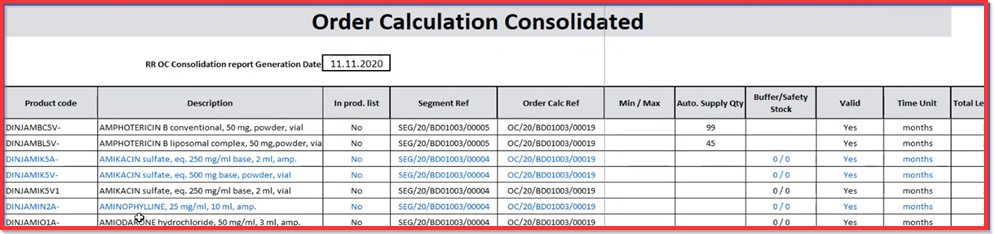
The only check made by system before exporting is that the Order Calcs are in Draft status (the order calcs can have differing OC, LTs, RDDs). The export would have the same format at line level as the current Order Calc export, with 5 additional columns: Order Calc Ref, Time Unit, Total lead time, Order Coverage and Safety Stock.
b) Draft Consolidated OC Lines :
This file (Draft consolidated) can be imported via the Action menu, with the exact same format, and like the existing singular import, this would update the 2 fields “Agreed Order Qty”, and “Order Qty Comment”, for all lines on all Order Calcs. It can be used for as many DRAFT Order Calc as you want without any limitation.
There is a column with reference of the selected Order calc (“Order Calc Ref”).
i) Select the Draft Order Calcs to consolidate
ii) Click on “Draft Consolidated OC Lines” from the right end action menu
c) Consolidated OC Lines – All Statuses:
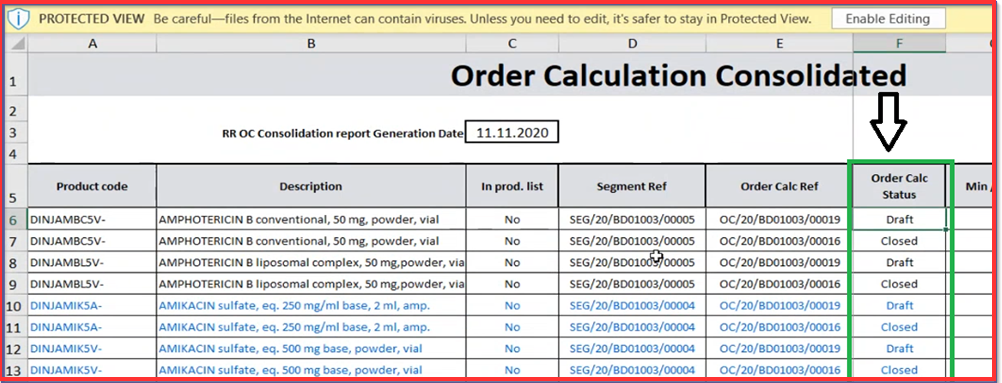
Export all lines for selected Order calc into one excel file and Order calcs can be any status (including Closed) this does not need to be importable, same format as above but with extra column for OC status. “Consolidated OC Lines – All Statuses” gives you a better overview from pharma point of view. The report layout is the same, additional column of “Order Calc Status” is visible as depicted on the picture below.
i) Select the Order Calc (any status) to consolidate
ii) Click on “Consolidated OC Lines – All Statuses” from the right end action menu
2. On screen reports available via button on main Order Calc screen
a) “Pipeline (stock moves)”/ “Pipeline (PO)”
The reason why we have two types of Pipeline is that there is an historic pipeline based on Stock moves and created at PO confirmation (i.e.: there is a new stock move with an “IN” already available); this is the “Pipeline (stock moves)”.
The second recently developed Pipeline calculation starts at PO line Validation which gives more visibility and flexibility as regard of ESC PO management processes; this is “Pipeline (PO)”.
b) “Stock by Location”
The ”Stock by Location” button is directly linked to report available in menu: Products> Product in right end action menu. It is a top-level overview which is used in Order Calculation product detailed view. Stock by Location is linked to the product.
c) “Reserved Qty”
Reserved Qty is linked to reserved stock. Basically, as soon as the product line is “Available” in the PICK, it is considered as reserved. The first PICK is reserving the stock as “available” meaning that it is available also for next location/ doc.
Generally, there are two options of Reserved Qty definition as we are sending the goods from stock to the project based on RR cycle needs (consumption wise) or second option that stock is reserved and goods are sent out to someone else (not in charge of RR).
In order to use these buttons, Order Calc view should be in Edit mode in order to be able to select the desired products. Next step is selecting of buttons (as depicted on the pictures below).
H. HOW TO REVIEW AND UPDATE A REPLENISHMENT SEGMENT
Go to: Warehouse / Replenishment Rules / Configuration / Replenishment Segment
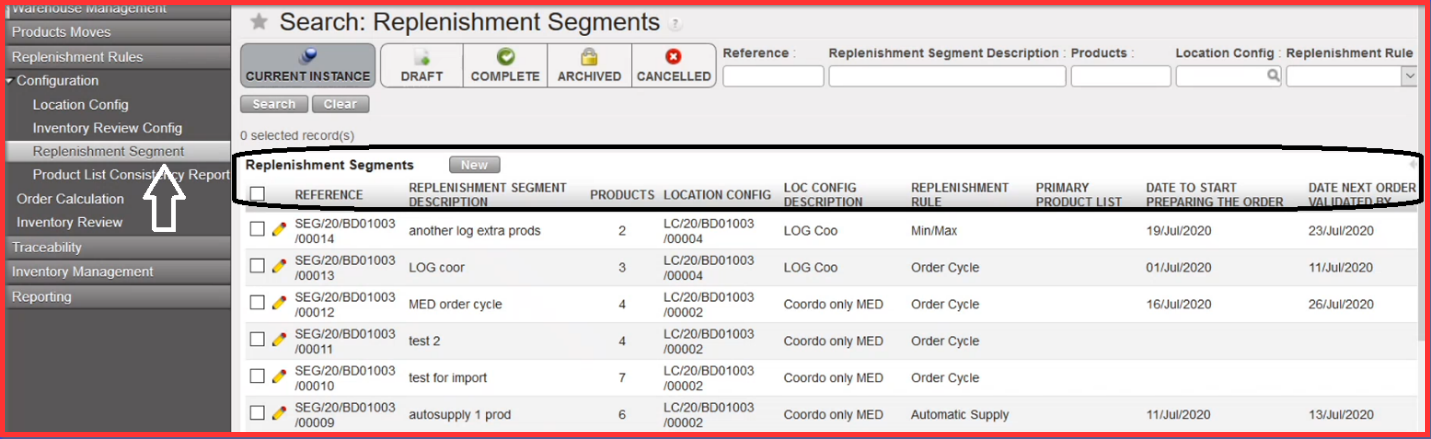
As you can see below, if you click on submenu option “Replenishment Segment” you get the general list of view) where are the created “References” of all replenishment segments, with Replenishment Segment Description, number of Products, Location Config and applied Replenishment Rule (Min/Max, Order Cycle, Automatic Supply).
If you go back to Replenishment Segment main screen you can edit and configure the lines of the products in Replenishment Segment. Not all fields will be editable though but some of them only if Segment is already in status “Complete”. However, please note that the document can still be set back to Draft in case there is a need to edit more information.
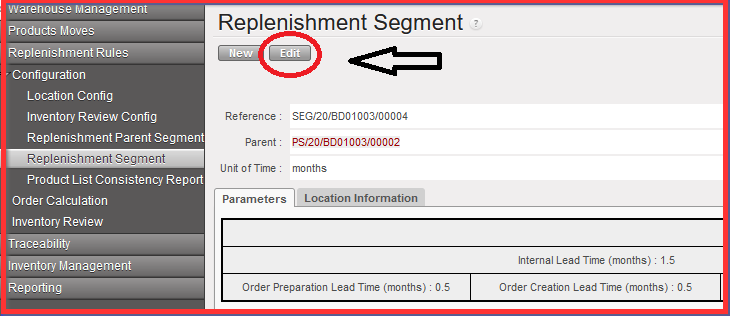
Open the Replenishment Segment Reference and click on “Edit” button on the top
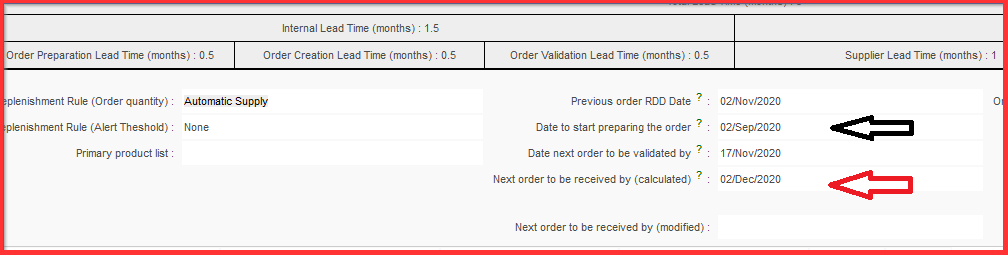
Basically the “Date next order to be validated by” is the date when the “PO” needs to be validated and “Date to start preparing the order” is the specific date when we can generate our order calc. in the system environment.
For the tracking history you can chose the LINKS on the right side action menu with Min/Max, Auto Supply, FMC History and Updates Sent and Updates Received
2. Select the products and click on MinMax, Auto Supply, FMC History
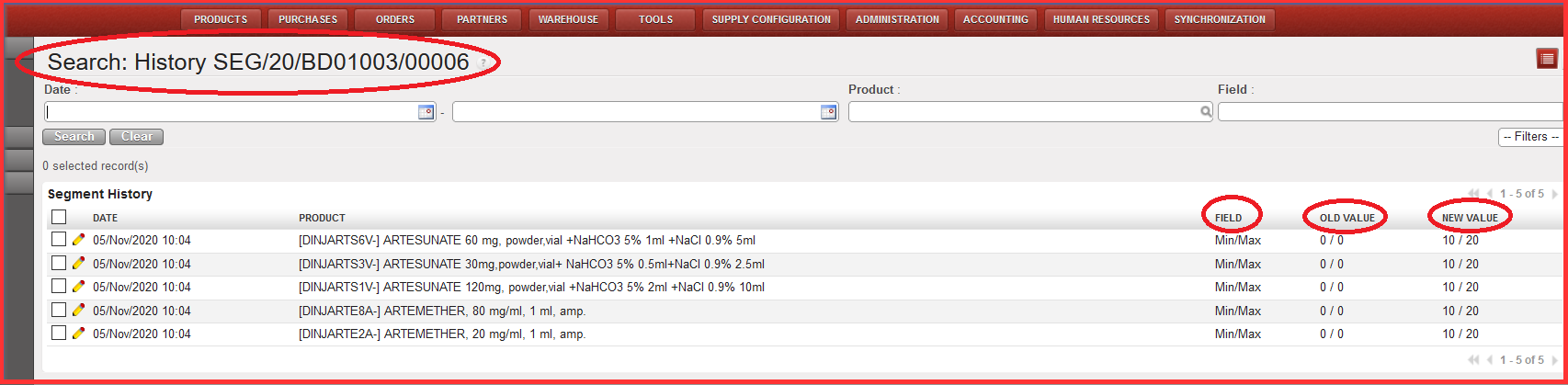
You get screen with “Search: History (Segment reference)” where you can see old and new values. The values per location / product are saved at the end of each month for the latest values present for the month on the last day of the month (if either value has been changed multiple times during the month, only that present on last day (i.e. 30th / 31st ) would be saved). AND/OR: TBC If possible, a Track Changes report would be possible from the Segment
Updating the segment
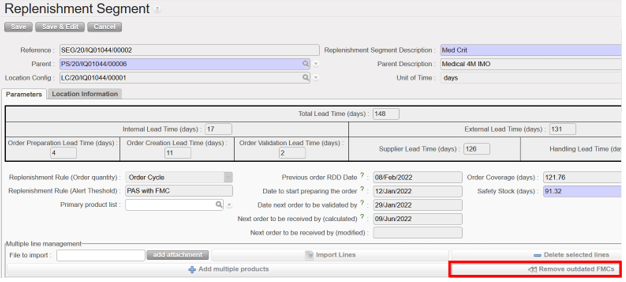
To remove any FMC values and their dates which are wholly in the past, click on “Remove Outdated FMCs” and all FMCs which are valid will be moved to the left to fill any removed ones. this button can only be used when the Replenishment Segment is in Draft status, and the type of RR is “Order Cycle”.
And the name of the file which is exportable from the RR Replenishment Segment will display “SEG_ XXDBXXXXDATE”.
We use cookies to ensure that we give you the best experience on our website. If you continue to use this site we will assume that you are happy with it.