Although a PO might be fully confirmed, the supplier could decide to deliver the confirmed items in several steps. In this case, you will partially process the Incoming Shipment to register the delivered items/quantities (but keep a back order for the missing ones).
If an Incoming Shipment is partially processed, the system will automatically create a new Incoming Shipment (in state “Closed“) on which the received items/quantities will be registered, while the original IN will stay in state “Available” with the remaining items/quantities on it (the back-order). The original IN will stay open (in state “Available“) as long as all the items have not been received.
Note that several partial receptions could be received on a single IN. In this case, the system will repeat the process described above: create a new IN for the received items (in “Closed” state) and update the original IN (in “Available” state) to keep only the items in back order on it.
Go to:Warehouse / Warehouse Management / Incoming Shipments
Click on the Incoming Shipment you wish to receive.
Click on the “Process” button.
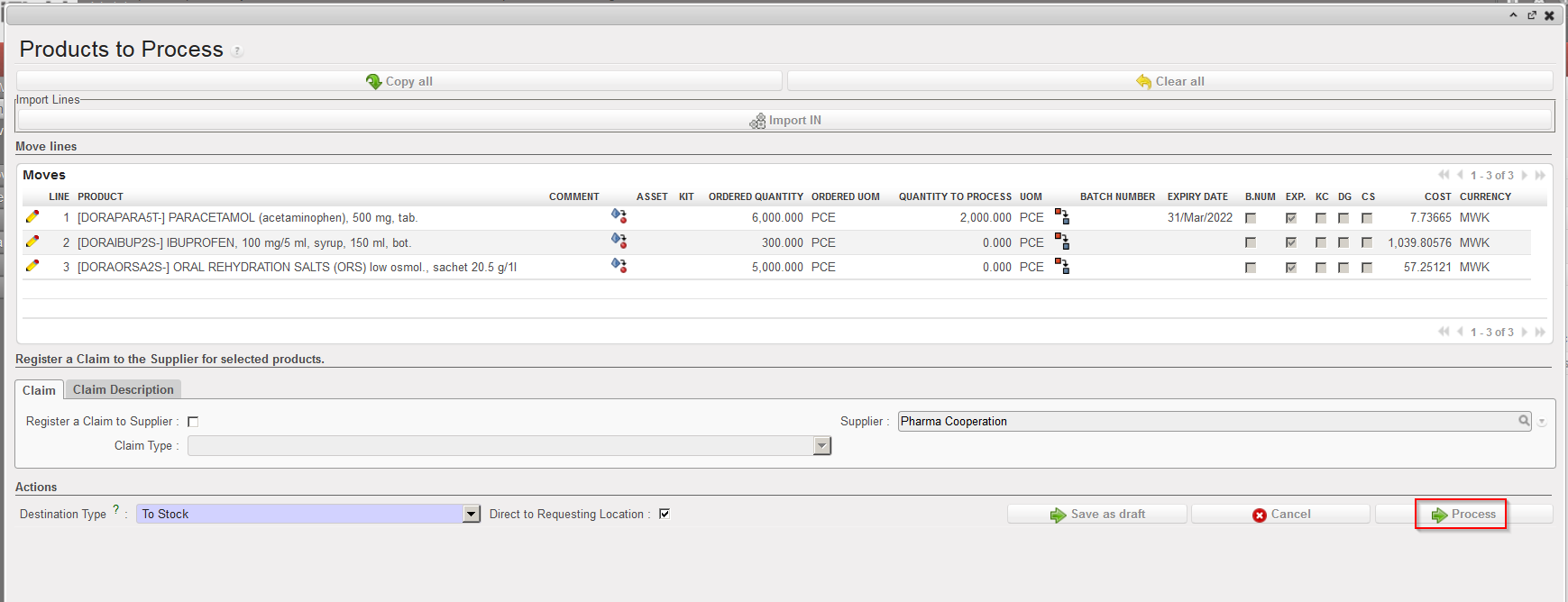
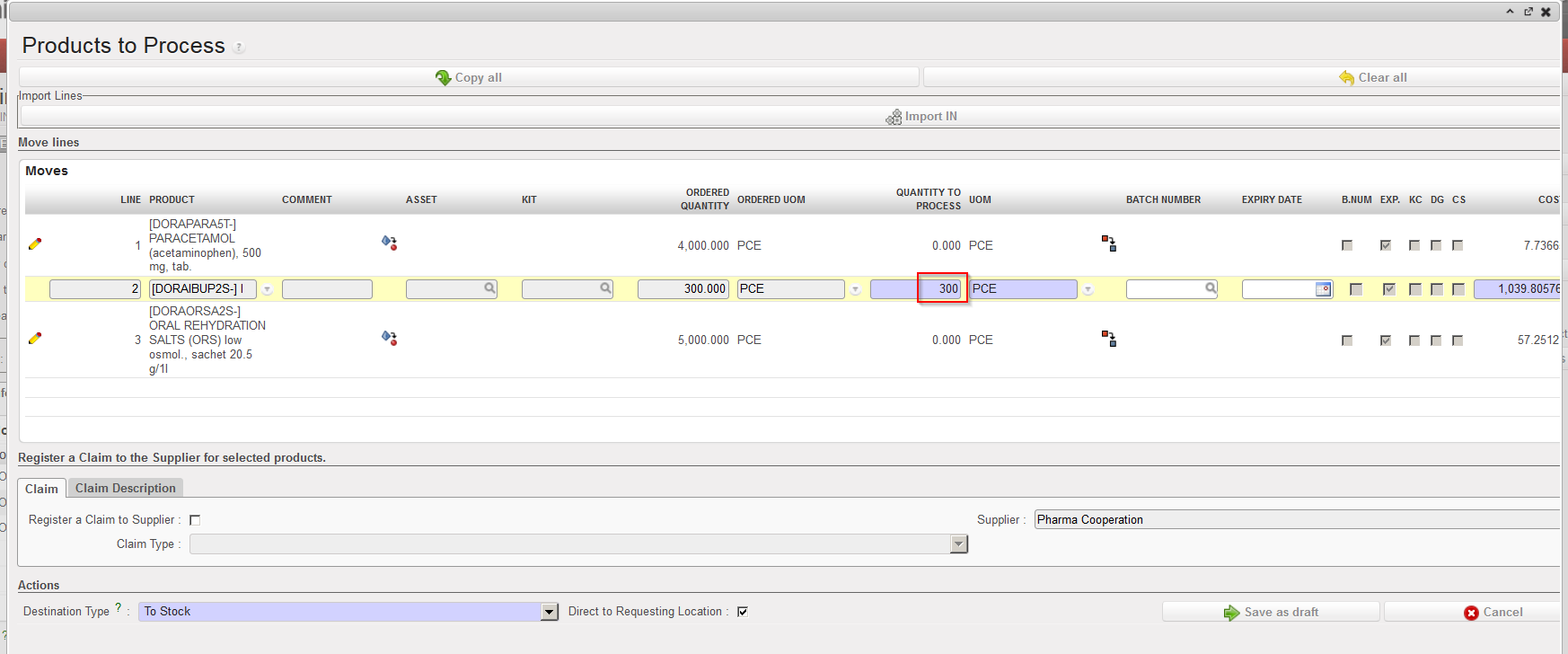
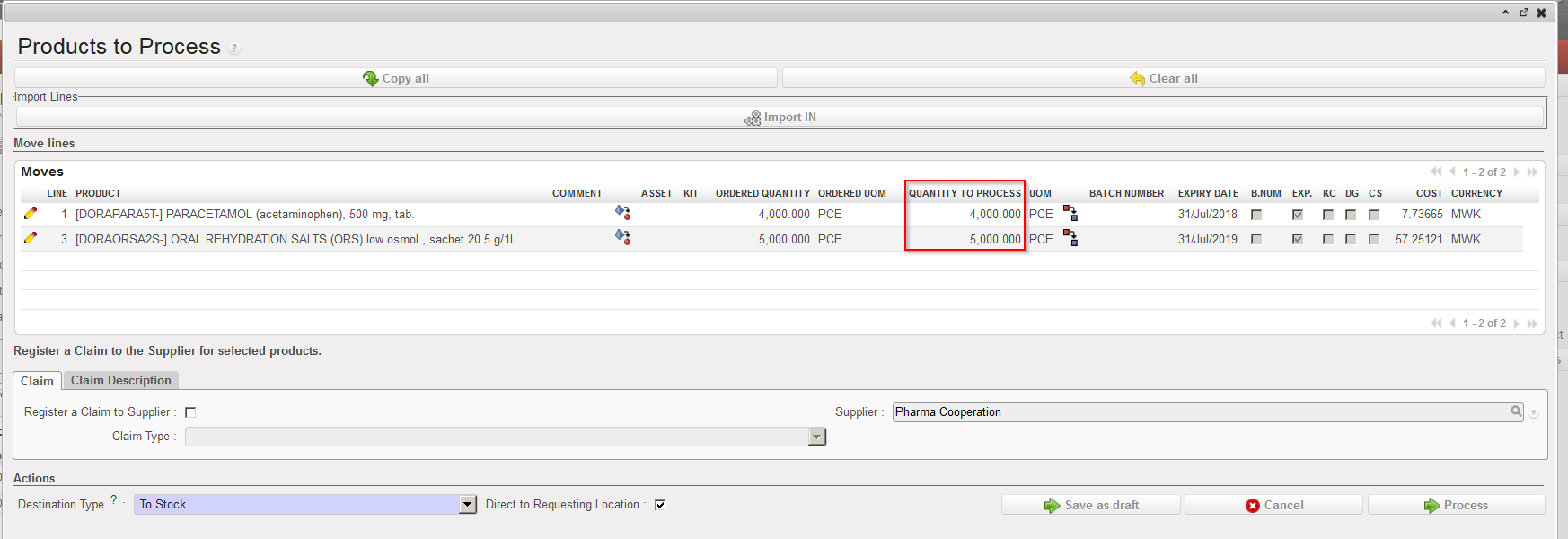
For the items that you are currently receiving, enter the received quantity using the pencil icon and save the line using the floppy icon located at the right of the line. Note that you may have to enter and BN or an ED according to the product received.
Partial reception on an Incoming Shipment
4. Once all product lines currently being received have been updated, click on the “Process” button at the bottom of the screen to register the reception. Since the “Direct to Requesting Location” checkbox is ticked by default, the products will be moved directly to their final destination. However products received for external customers will be received in the “Cross docking” location.
Partial reception on an Incoming Shipment
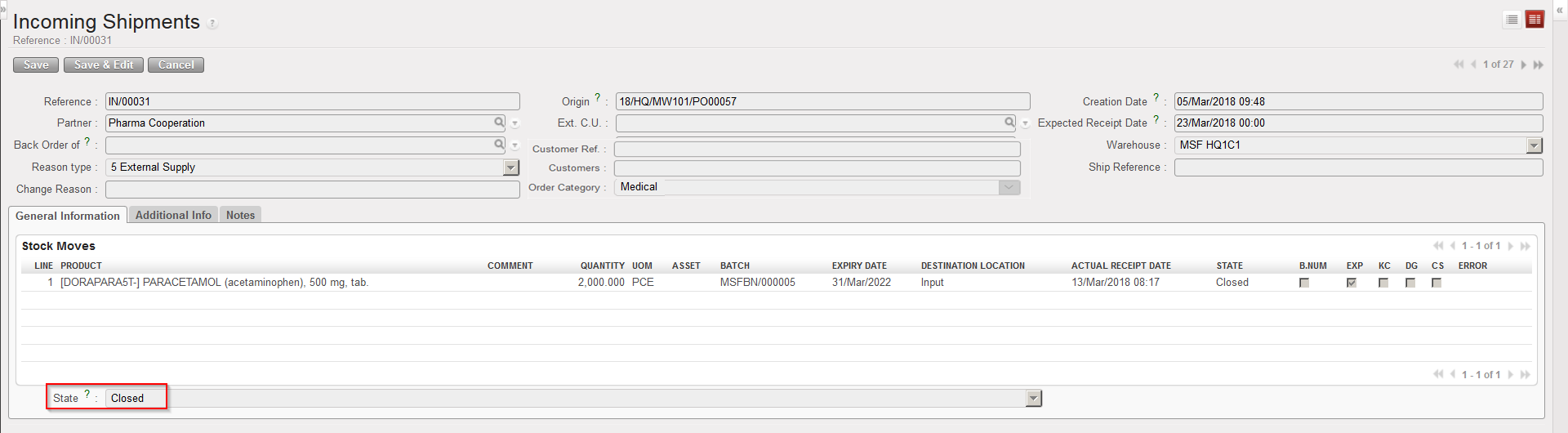
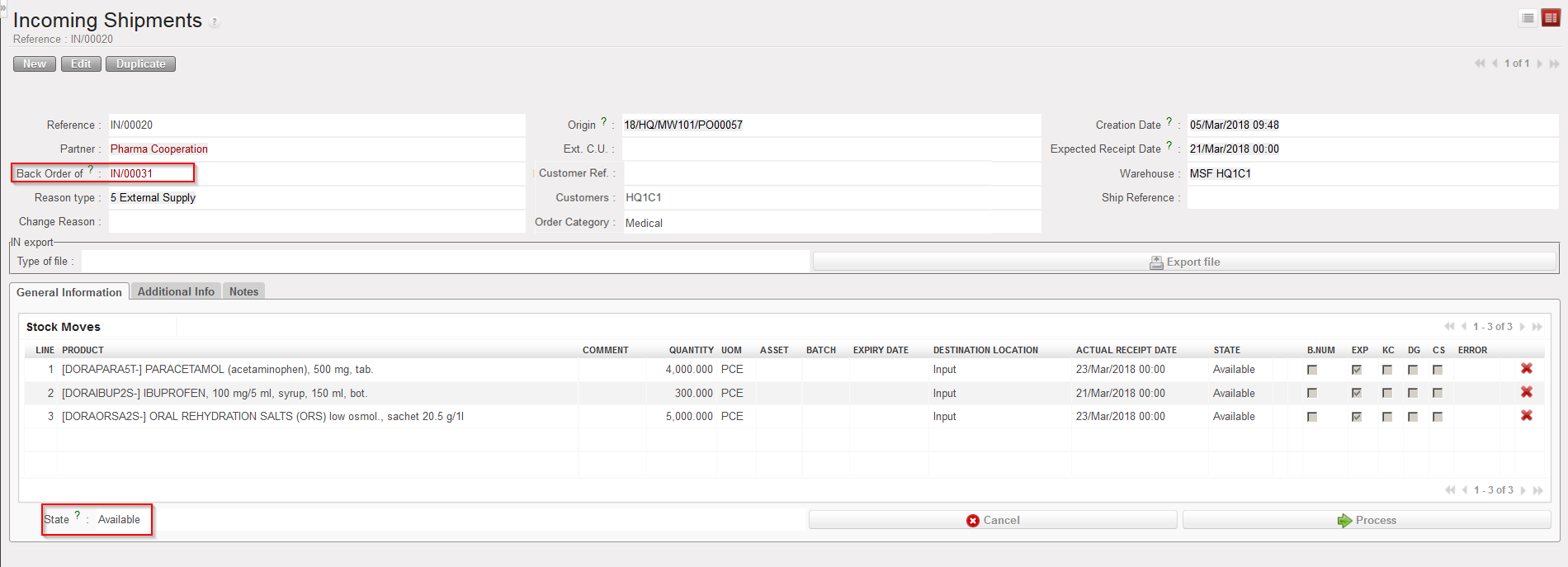
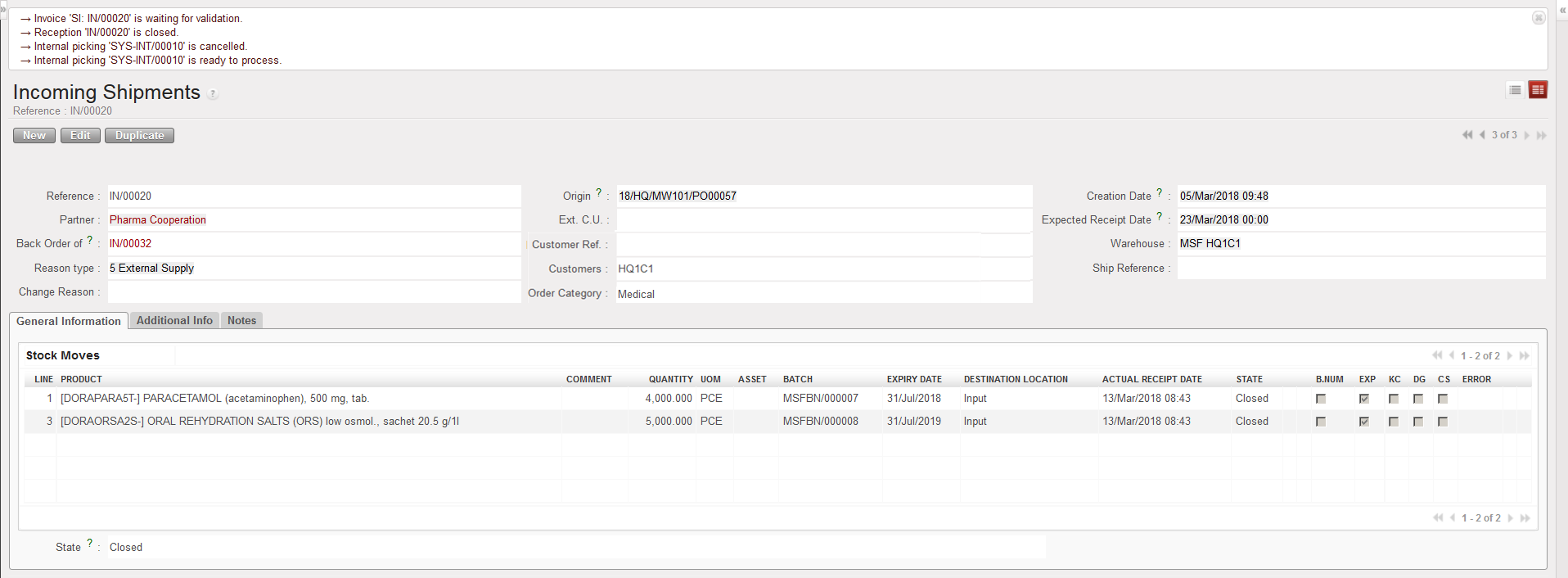
6. Because there are still some products/quantities outstanding on this Incoming Shipment, these are considered back-order (Bo). The system will give to the reception you have just processed the next sequential reference number (i.e. the system will create a new “IN” in state “Closed” for the received items), and the original reference of the Incoming shipment will be updated and remain in state “Available” for the remaining products/quantities to be processed when they will be received.
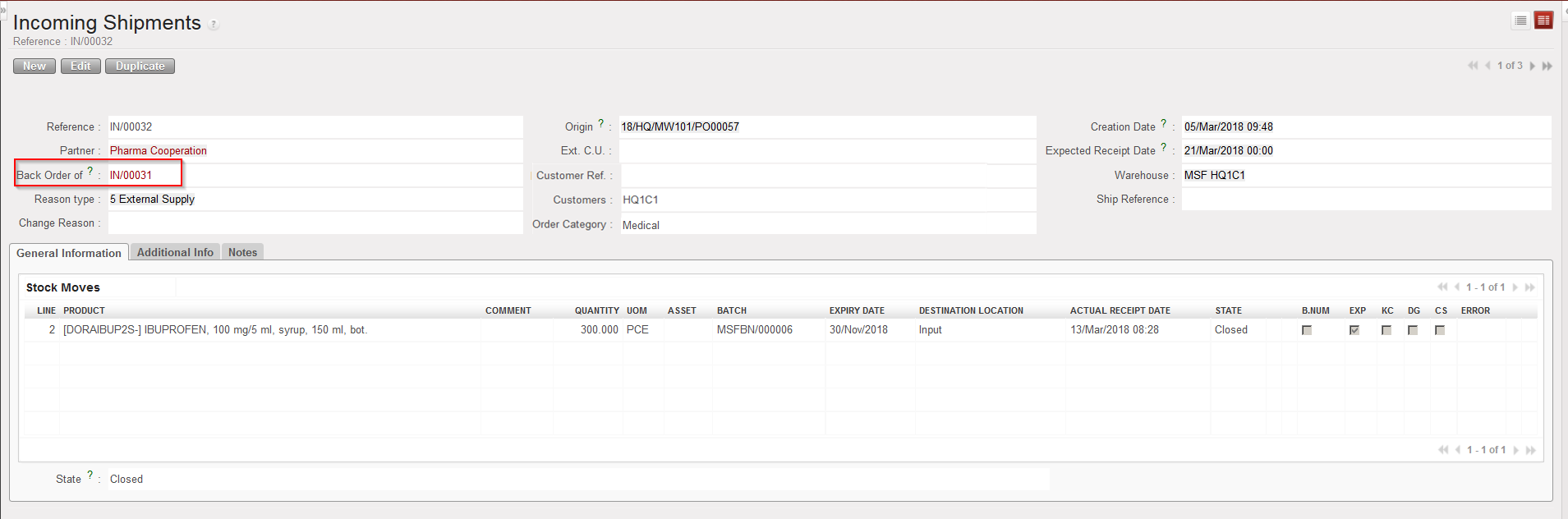
New Incoming Shipment in state “Closed” created for the received items
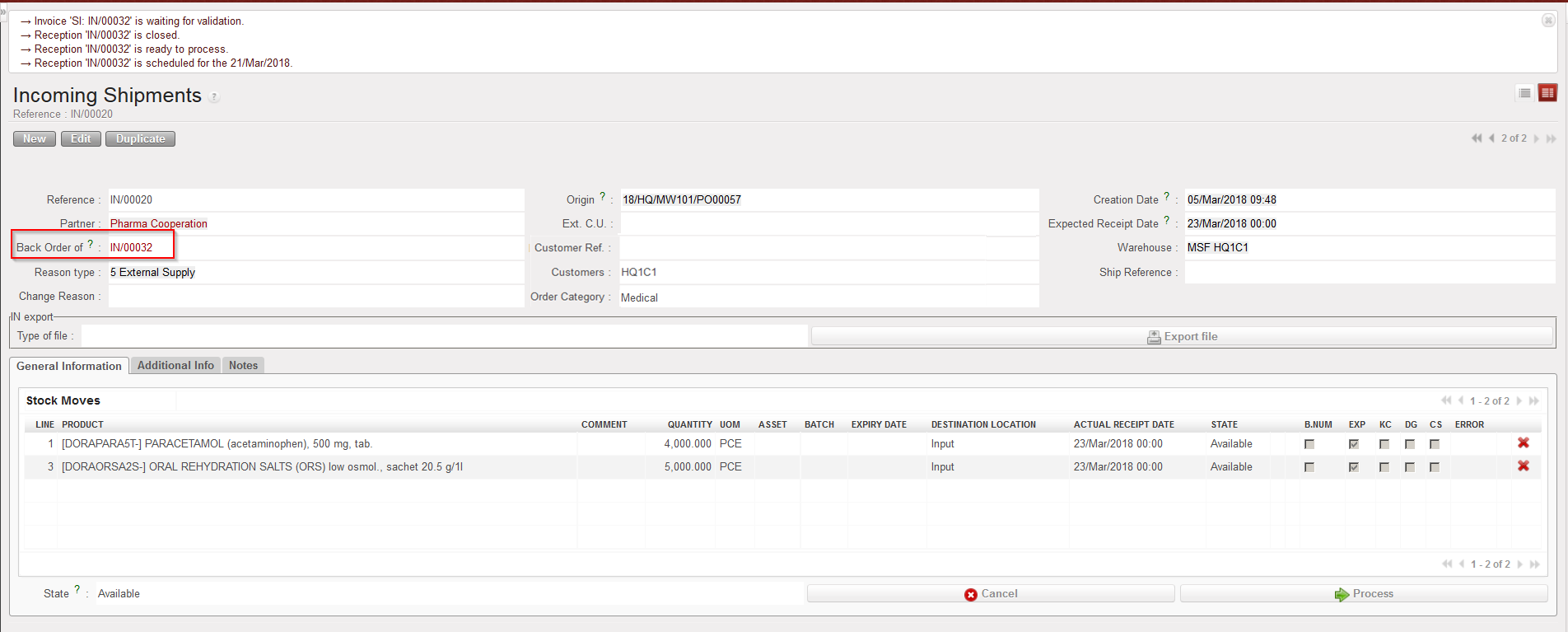
Original Incoming Shipment in state “Available” is updated to keep the items in back-order
In the export pdf of the IN, note the calculations of the QTY columns:
Qty Confirmed = Qty that was confirmed in the PO Qty Backorder = Qty confirmed minus qty received from all IN lines linked to that line of the PO/IN from scratch). Qty Received = Qty received specifically in that IN
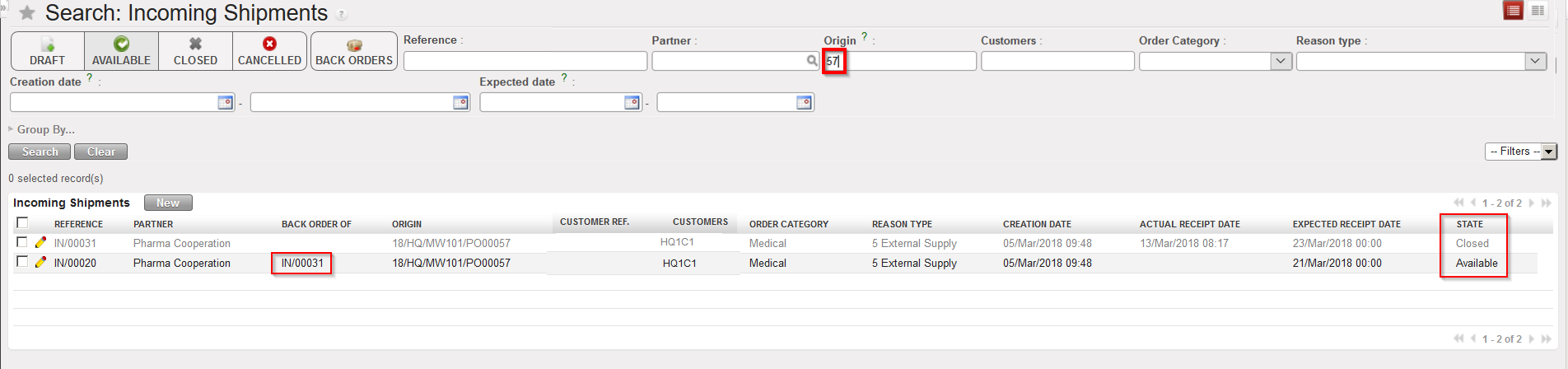
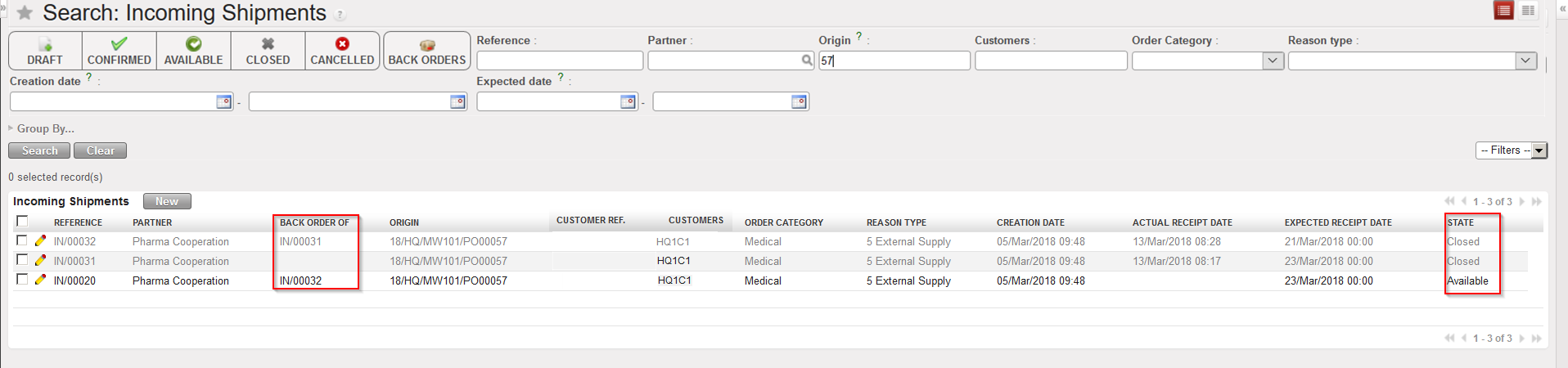
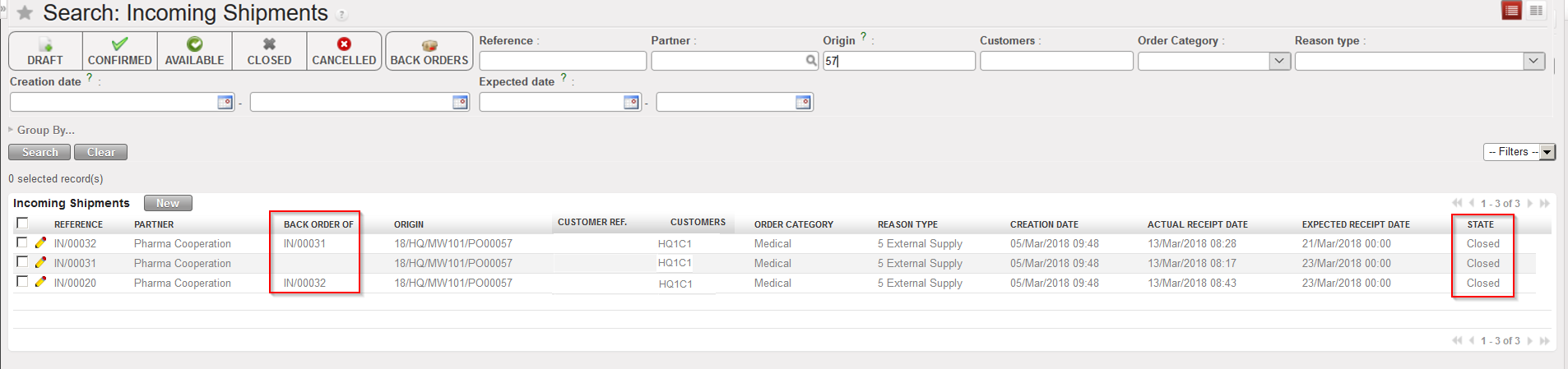
The field “Back order of” on the original IN shows the reference of the partial reception already processed. This information is also displayed on the “Search: Incoming Shipments” screen.
“Search: Incoming Shipments” screen with information related to back order
Note that if additional partial receptions are processed, the same behavior will be repeated and the back order information will be updated accordingly on the different INs.
Additional partial reception processed on an Incoming Shipment
New Incoming Shipment in state “Closed” created for an additional partial reception
Original Incoming Shipment in state “Available” is updated to keep the items in back-order
“Search: Incoming Shipments” screen showing the back order relationships
Once the Incoming shipment has been fully received (this may be after several partial receptions), the last processed partial reception won’t trigger the creation of a new IN in “Closed” state, but will simply close the original IN.
Last partial reception processed on an Incoming Shipment
Last partial reception processed on an Incoming Shipment
“Search: Incoming Shipments” screen with an IN fully received after several partial receptions
D. How to create an Incoming Shipment from scratch
Most of the Incoming Shipments will be generated automatically after confirmation of the related PO (or PO-line). This is the standard process so that continuity can be kept between the different transactions.
However, UniField offers the opportunity to create Incoming Shipments from scratch for specific cases.
Go to: Warehouse / Warehouse Management / Incoming Shipments
Click on the “New” button.
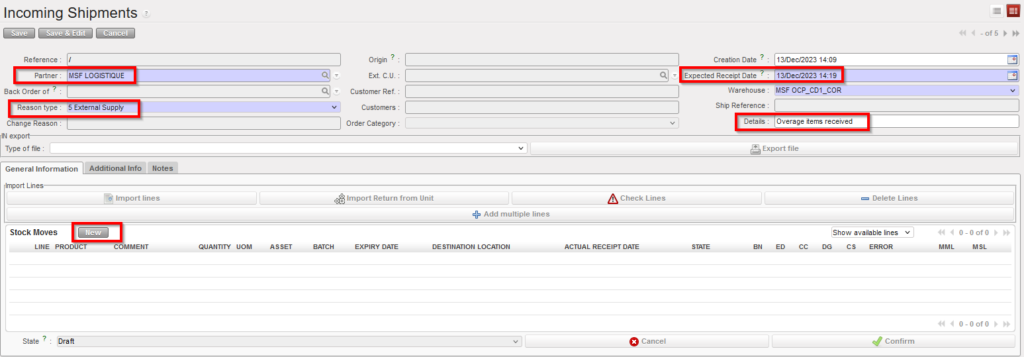
Enter an “Expected Receipt Date“.
If relevant, enter a “Partner” (supplier) or the “Ext. C.U.” , Note that this field is only editable for IN from Scratch.
Enter the IN’s name or if you have any info to explain the creation of the IN in the “Details” field, More detailed explanations can also be entered on the “Notes” tab.
Check the “Reason type” and if necessary change it. (e.g Return from unit )
Note: three Reason types are available for incoming from scratch:
1 Internal Supply
4 Return from unit
5 External Supply
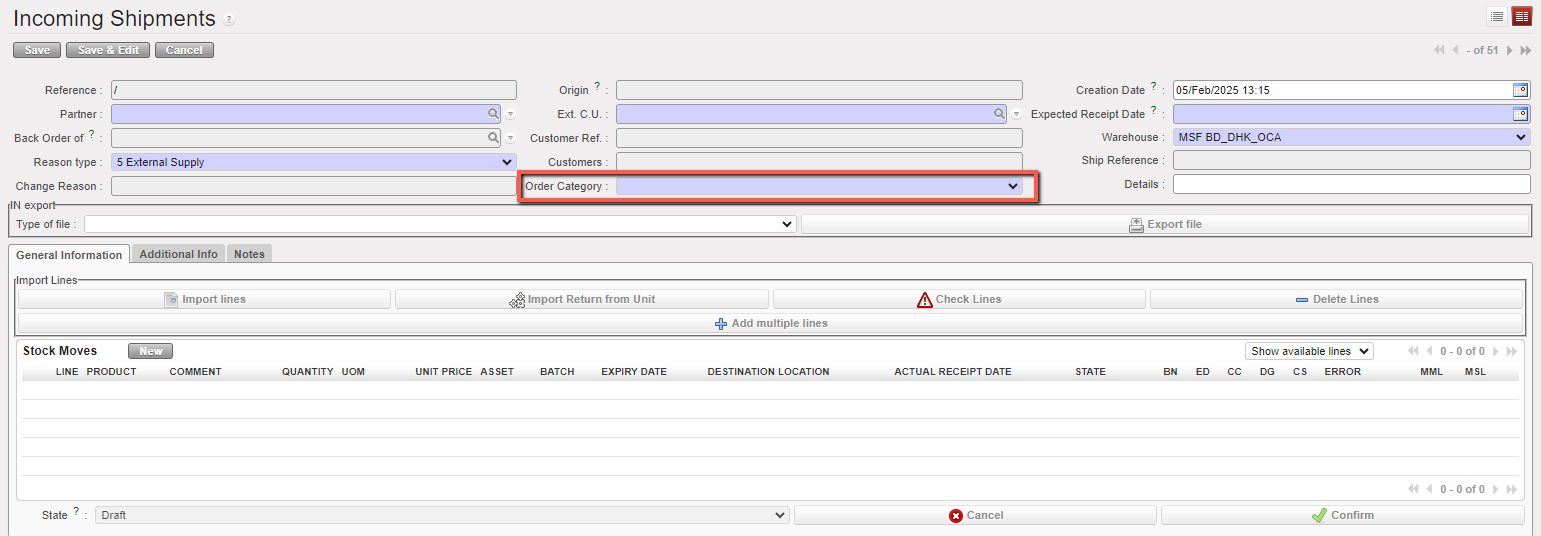
Incoming Shipment created from scratch
6. Select Order Category .The default value is empty, and the user can select one of the following options: Logistic, Medical, Service, Transport, or Other.
7. Add the products lines using the “New” button located on the top of the “Stock Moves” table (alternatively, you may use the “Add multiple lines” button to insert several lines at once).
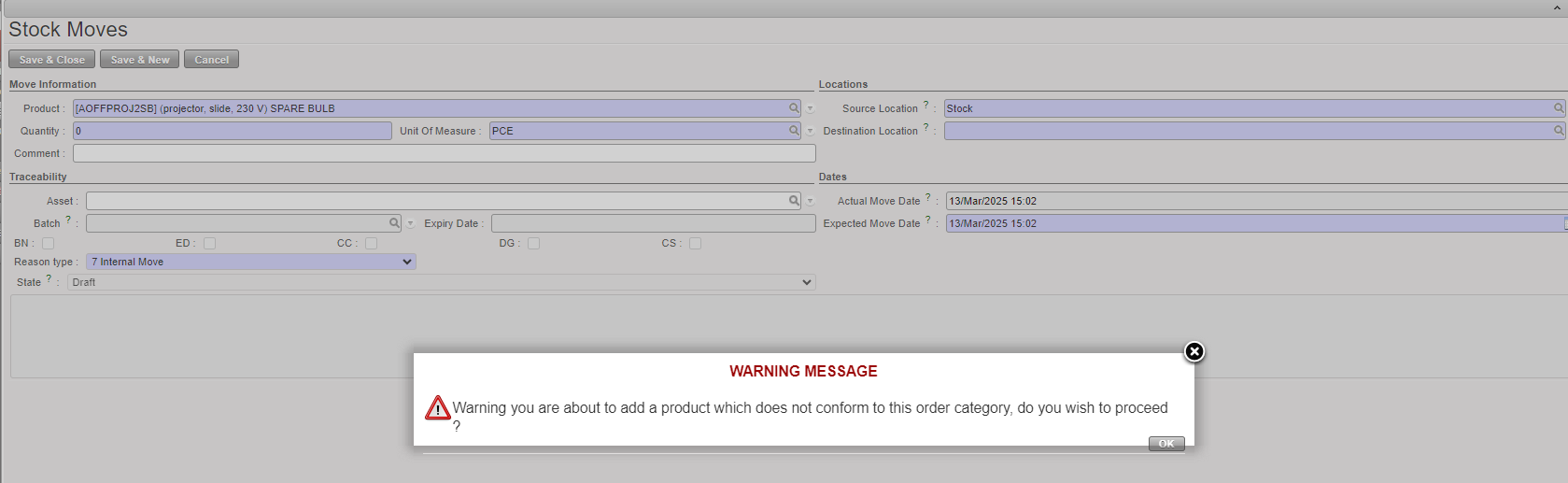
If a product does not correspond to the selected category, the user will receive a non-blocking warning message.
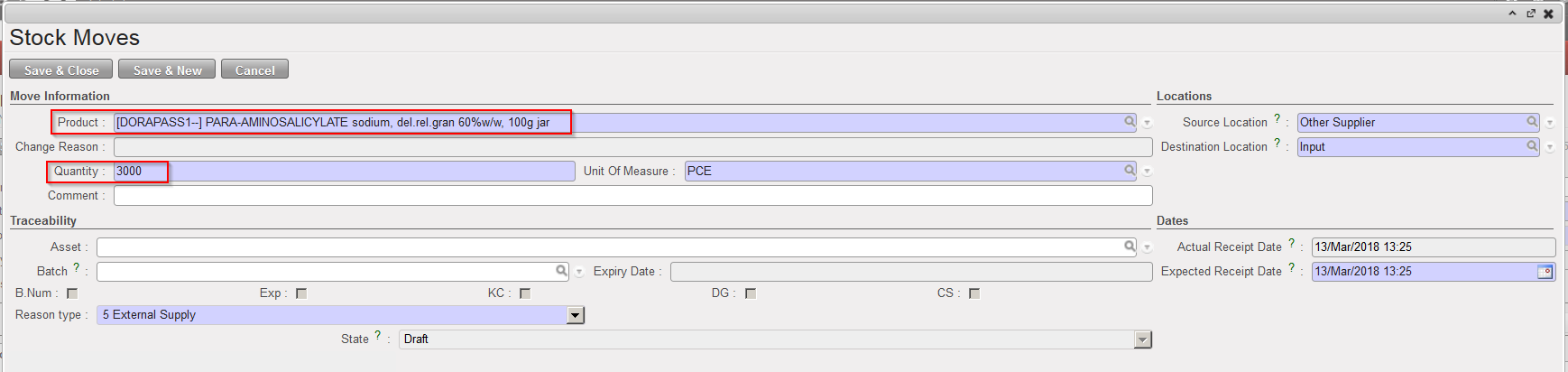
8. Enter product and quantity on the “Stock Moves” screen. The system warns you if the product is managed by batch number and/or expiry date.
9. Enter source and destination locations if needed.
10. Click on the “Save & Close” (or “Save & New“) button.
11. Repeat the steps from 6 to 9 for all the products that you wish to include in the Incoming Shipment.
Inserting a new line on an Incoming Shipment
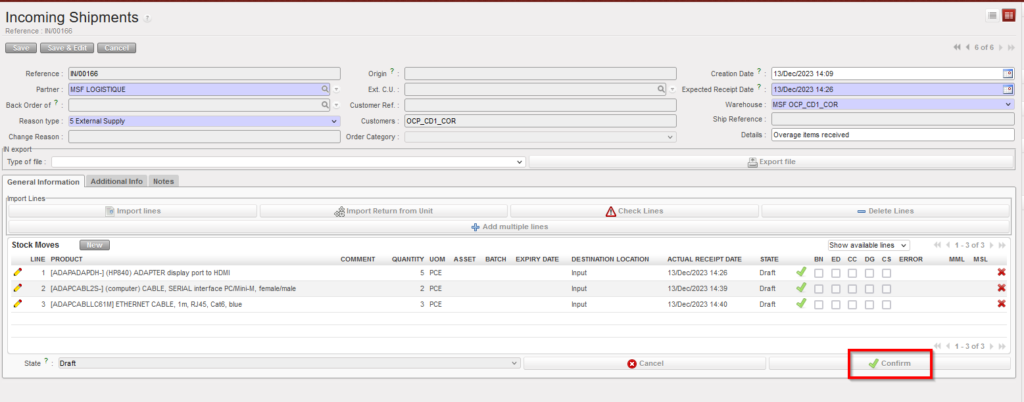
12. Confirm the Incoming Shipment by clicking on the “Confirm” button located at the bottom of the main IN screen.
Confirmation of an Incoming Shipment
13. After confirmation, the Incoming Shipment switches to the state “Available“.
Incoming Shipment in state “Available“
Note:
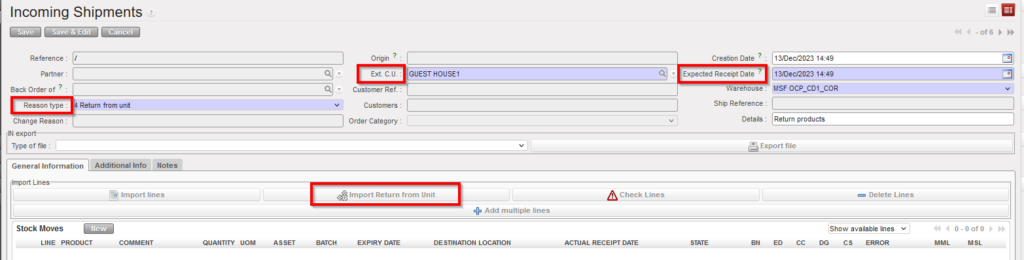
The Reason type field is mandatory to be filled in the Incoming shipment from scratch, In case user chooses “Return from Unit” as a Reason type, Ext. C.U becomes mandatory to be filled, this is to be consistent with check already done if products are added via import.
In case of the returns from external consumption units, there is a specific button for this import, and before the file can be imported, the header fields “Ext CU” and “Reason Type” and of course “Expected Receipt date” fields must be filled, Reason Type must be “Return from Unit”. The import file has a specific format, but the same checks are made as for the original import lines functionality. below screenshot showing the mandatory field to be filled and the bottom of Import Return from Unit.
By default, when an Incoming Shipment is created following the confirmation of a PO (or PO-line if the PO was partially confirmed), you will always see on the IN the expected products and quantities (corresponding to what was confirmed on the PO). However, you will have to encode the quantities that you are actually receiving when you will process the Incoming Shipment (i.e. when you will actually receive the goods).
Note that if an IN is created following the partial confirmation of a PO, this IN (in state “Available”) will contain the lines which have been confirmed on the PO. If later on, additional lines are confirmed on the PO, they will be added on the “Available” IN. As long as the IN has not been fully received, it will stay open (in state “Available”) and subsequent confirmations on the corresponding PO will be added on this IN. If the IN is fully received, it will turn to the state “Closed” and a subsequent confirmation on the PO will trigger the creation of a new IN (in state “Available”).
Unifield also enables to the user to split lines at project level on Incoming Shipments from an “InternalPartner”. Feasible for IN Available Shipped (from Synched flows) flow, enabling the possibility of splittinglines and adding different batches.
Go to:Warehouse / Warehouse Management / Incoming Shipments
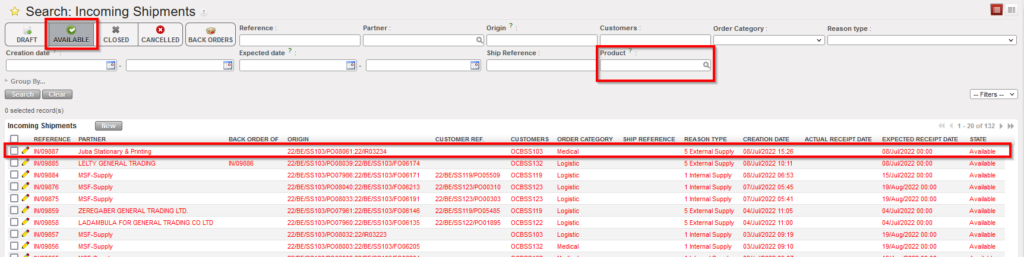
You reach the screen “Search: Incoming Shipments“. By default, the system only shows INs which have the state “Available” (filter activated). Incoming Shipments appearing in black are still within the agreed lead time while the ones appearing in red are not on time (delivery confirmed date from the PO is already passed).
Available Incoming Shipments
2. Click on the line corresponding to the Incoming Shipment (in “Available” state) that you wish to receive.
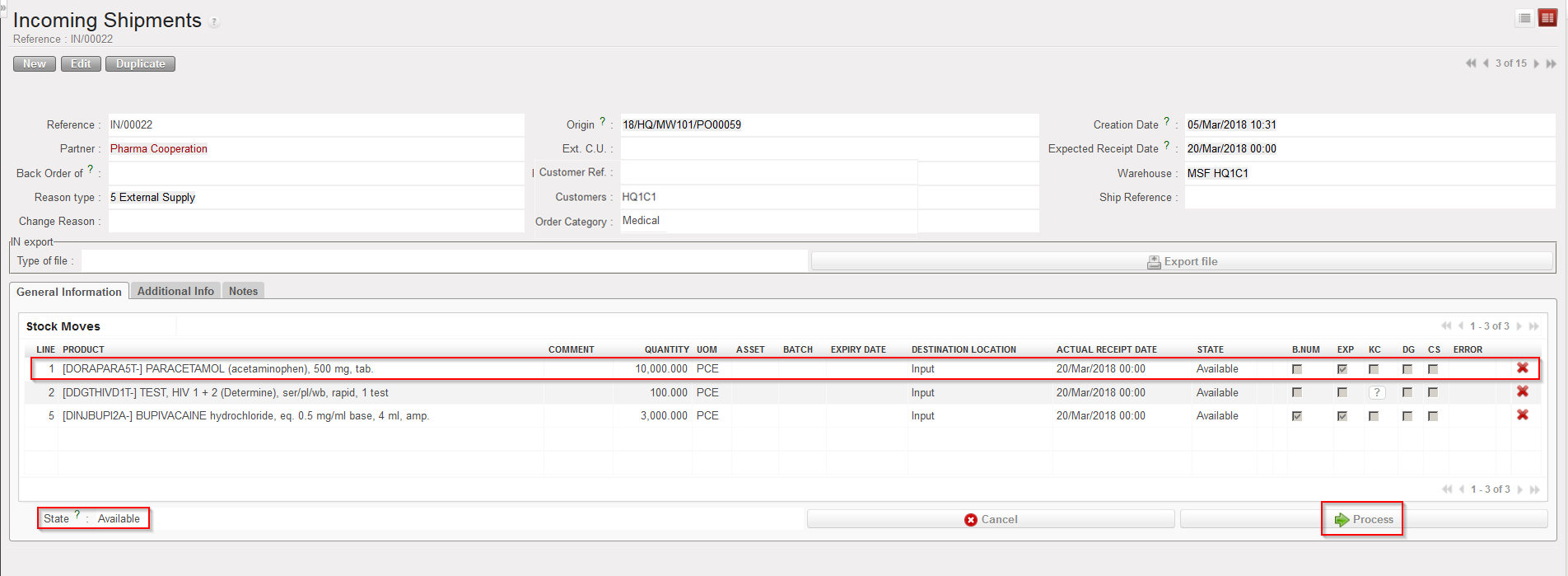
3. The IN is opened. Check if the products and the quantities match with what you are actually receiving.
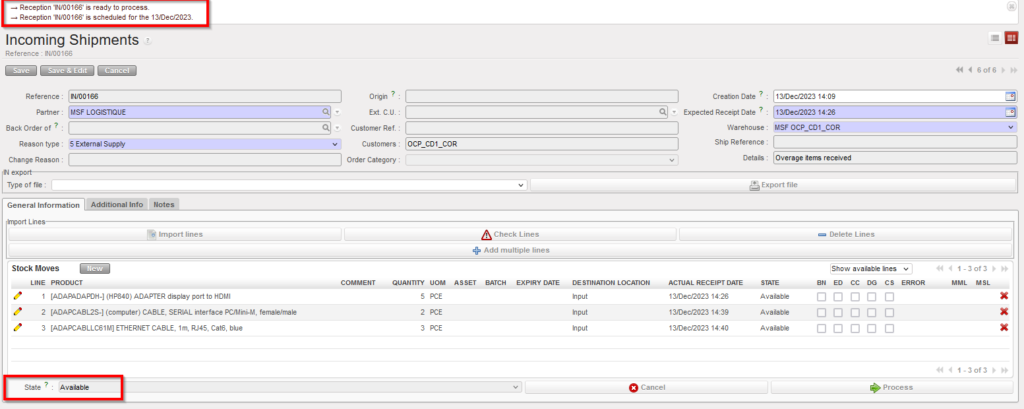
Available Incoming Shipment
On the IN header you find, among others, the reference of the Incoming Shipment in the field “Reference“, the delivering Partner (the supplier) in the field “Partner“, the reference of the PO and origin document (IR or FO) in the field “Origin” (if any), the Customer in the field “Customer”/ “Customer ref”.
On each line of the IN, you can see the product code and description, the quantity, the UoM, the destination location, the state (which should be “Available” until processed). Some checkboxes indicating if the product is managed by batch numbers, by expiry dates, should be kept cool (KC), is a dangerous goods (DG) or is a controlled substance (CS) are also available. The “Error” column indicates if the product has been deactivated (the checkbox should be blank in order to process the product).
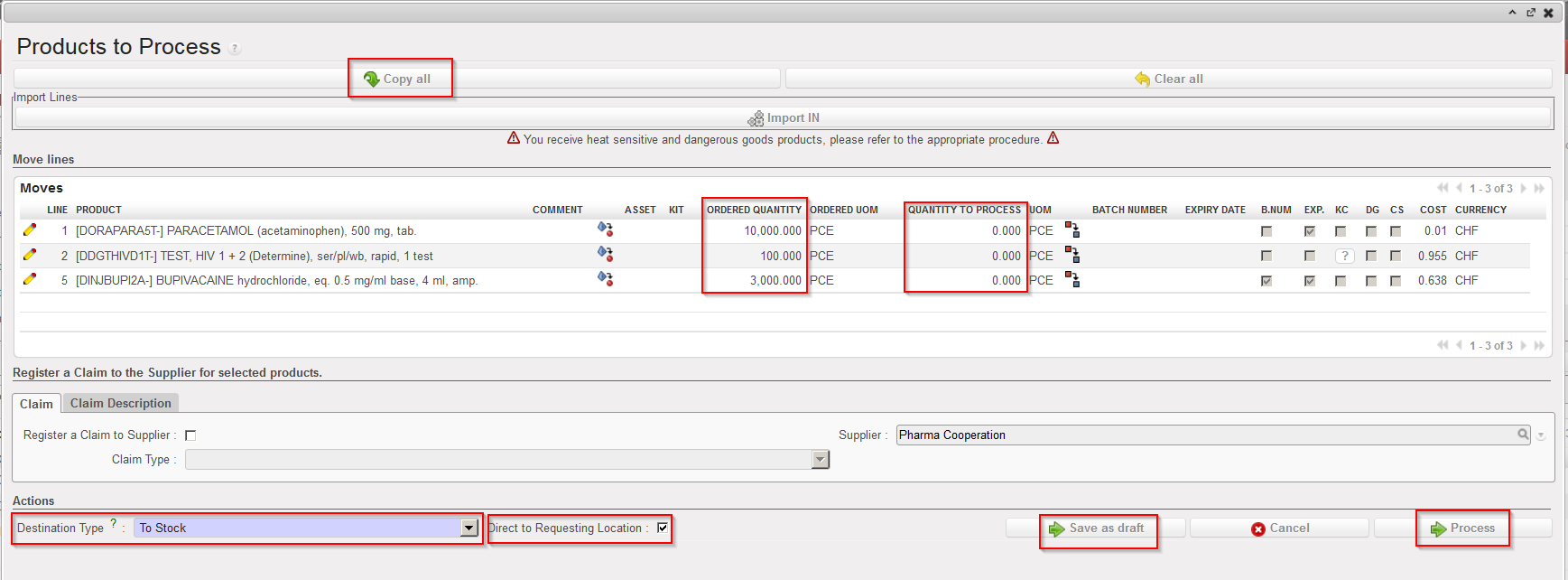
4. Click on the “Process” button at the bottom of the screen to register the reception.
Processing an Incoming Shipment
5. When you process an Incoming Shipment, you have two main options:
If you received exactly what is on the “Available” IN (i.e. no back-order), click on the “Copy all” button located on top of the screen to process the full quantities for all items of the reception.
If you received only partly what is on the “Available” IN, click on the pencil for each line that you are receiving, enter the received quantity in the “Quantity to process” field and save the line by clicking on the floppy disk icon on its far right (sometimes hidden!) or by pressing “Enter” on your keyboard. Repeat the operation for each received item.
If you are processing an IN created by the confirmation of a PO (or PO-line) which was either created from scratch either created following the sourcing of an IR (with Location requestor = Stock, Intermediate Stock or Internal Consumption Unit) on order, the checkbox “Direct to Requesting Location” will appear on this screen and be ticked by default. This means that goods will not stay in the “Input” location but will be moved directly to their final destination. For POs created from scratch, products will be moved directly to the stock (MED or LOG depending on their nomenclature). For POs created from an Internal Request (via OST) the goods will be sent automatically to the “Location Requestor” entered on the IR (if this Location Requestor is an Intermediate Stock or an Internal Consumption Unit). In both cases, an internal move is automatically processed, moving the goods from the “Input” location to their final destination.
Note that if you untick the “Direct to Requesting Location” checkbox, goods will be received in the “Input” location and you will have to process manually an Internal Move (created automatically) to move the received goods from the “Input” location to their final destination.
If you are processing an IN for goods which should be sent to a customer (related to a PO created by the sourcing of an FO on order, or related to a PO created by the sourcing of an IR whose Location Requestor = External Consumption Unit), the checkbox “Direct to Requesting Location” won’t appear and goods will be received in the “Cross docking” location, ready for dispatch.
6. Click on the “Process” button to actually receive the goods (in the system) and close the Incoming Shipment or on the “Save as draft” button in case you haven’t finished updating all your lines but wish to save what has already been encoded without processing.
Note that the “Cancel” button (with the red cross, located at the bottom of the “Products to Process” window) will simply close this window and return to the main IN screen. A “Reset” button may also appear at the bottom of the “Products to Process” window. It resets all data encoded so far on this window.
Note that on this “Products to Process” window, you may always decide to change the destination of the goods. This can be done by ticking/unticking the check box “Direct to Requesting Location” or changing the “Destination Type“. As such changes can have important consequences, the system will warn you accordingly.
Changing the destination of the goods when processing an Incoming Shipment
Warning given by the system if you try to receive goods in cross docking while stock was planned
Warning given by the system if you try to receive goods in stock while cross docking was planned
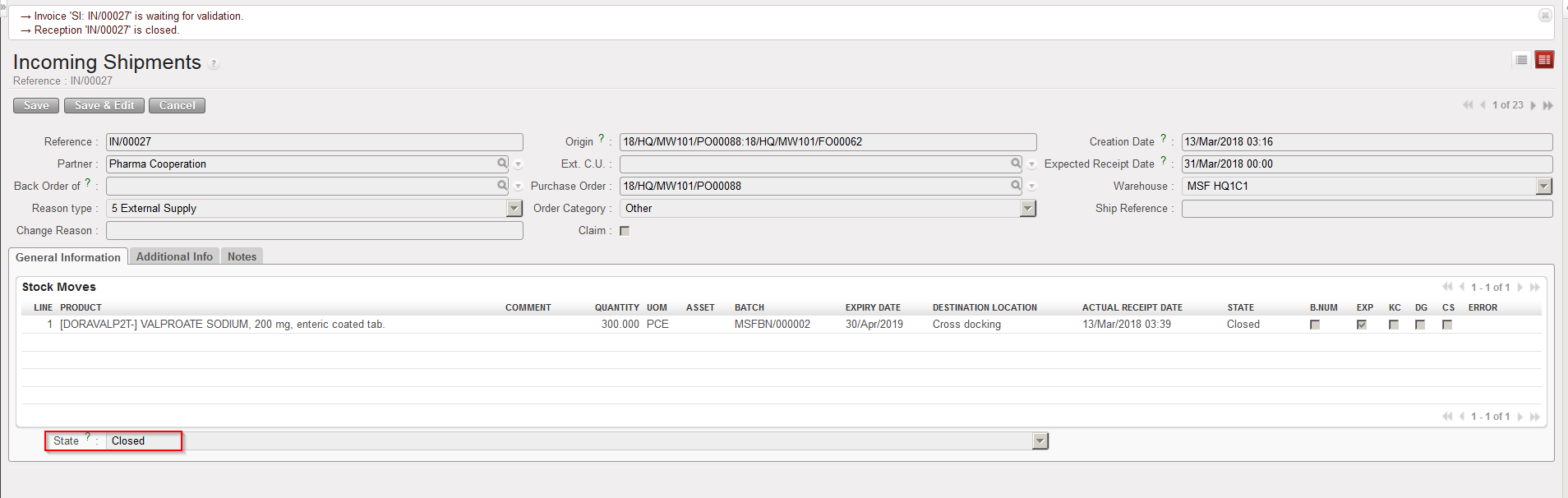
7. Once the Incoming Shipment is processed, it turns to the state “Closed“.
Incoming Shipment with the state “Closed“
As we will see later, if an Incoming Shipment is only partially processed (i.e. partially received, with some items in back order), a new IN will be created in state “Closed” to register the received products while the current IN will be updated and will stay open (“Available“) to receive the back order in the future.
We will also see later that if products managed by batch numbers (BN) and/or expiry date (ED) are received, the user will have to encode the BN/ED details at this stage (i.e. when processing the IN).
Note as well that the product cost can be changed when processing an Incoming Shipment. However, this change will only affect the average price of the product (on the PMD sheet) but it will have no impact on the PO or on the supplier invoice (if any). This feature was developed in order to be able to answer to situations when a supplier is delivering the products but also informs you at this point that prices have changed.
Please also note that change of price will not be possible for IN with status “Availableshipped” (except via Import).
In case the product price is changed when processing the IN, a icon will be displayed on the “Closed” IN and the details of the change will be visible if you click on the icon.
Closed Incoming Shipment with details of the price changed during reception
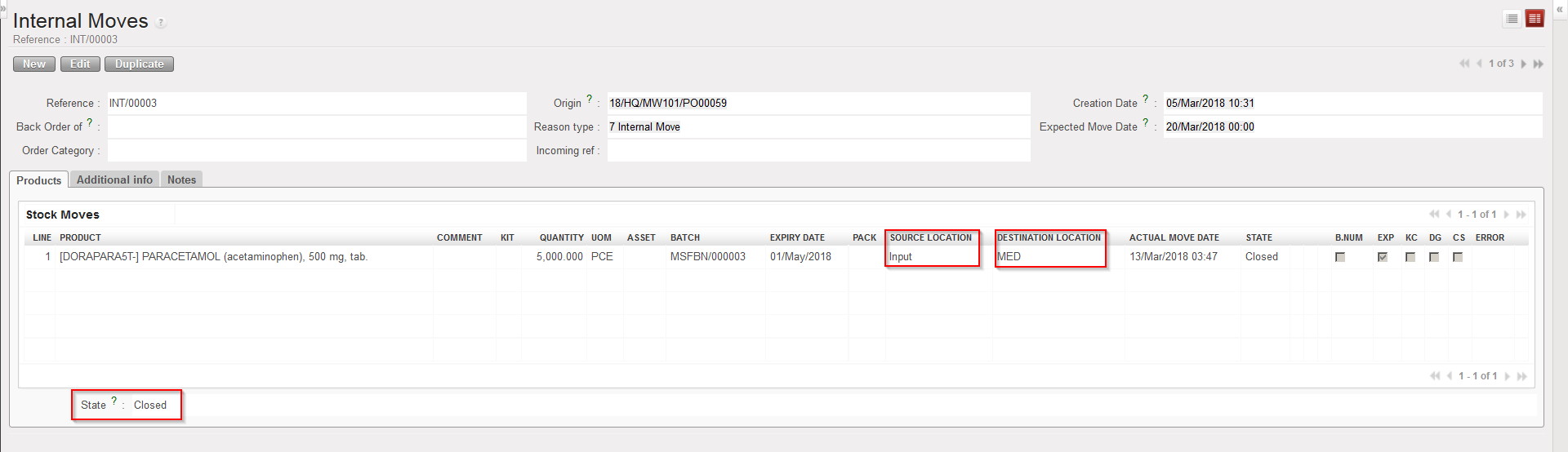
If the “Direct to Requesting Location” checkbox was left ticked, the products are now stored in their final destination. An Internal Move between the reception location (“Input“) and the final destination of the goods was automatically created, processed and closed.
Internal Move from “Input” to “MED“
If the “Direct to Requesting Location” checkbox was unticked, goods are now stored in a transitional location called “Input“. They should be moved manually to their final destination (after quality check) via the processing of an Internal Move (created by the system) from “Input” to this final destination.
See LU-SU4101“T. How to move received products from the Input location to a stock (destination location)”.
Let’s assume that an IR was sourced on order (PO).
a) If the “Location Requestor” field from the IR is a stock, an Intermediate Stock or an Internal Consumption Unit, the goods will be sent automatically (or manually if you untick the check box “Direct to Requesting Location“) to the “Location Requestor” indicated on the IR (via the automatic/manual processing of an Internal Move from “Input” to this “Location Requestor“) after processing the Incoming Shipment.
b) If the “Location Requestor” field from the IR is an External Consumption Unit, a Delivery Order (OUT) in state “Confirmed” will be generated (together with the Incoming Shipment) when the PO (or one of its line) will be confirmed in order to prepare the delivery to the customer. The state of this OUT will turn to “Available” once the IN is processed and goods are received in cross docking. The OUT will finally be processed to deliver the goods from the source location (“Cross docking“) to the destination location (ECU indicated as Location Requestor on the IR). The OUT will never be processed automatically.
In short, Internal Moves (INT) are used when delivering goods to internal locations while Delivery Orders (OUT) are used when delivering goods to external locations (also called partner locations).
At this stage, the below table can already help to understand how INs are created when a PO is confirmed and what are the consequences when INs are processed. Note that we will come back in details on this when the related topics will be introduced.
PO
Destination location on IN
Final destination location
Document for second step
PO created from scratch
Input
LOG/MED (according to product’s main type)
INT (1)
PO created from IR sourcing (with Location Requestor = stock, intermediate stock or ICU)
Input
Location Requestor from IR
INT (1)
PO created from FO sourcing
Cross docking
Partner
PICK (2)
PO created from IR sourcing (with Location requestor = ECU)
Cross docking
Location Requestor from IR
OUT (2)
(1) Automatically processed if checkbox “Direct to Requesting Location” is left ticked.
(2) Must be manually processed.
If your IN is related to a PO addressed to an internal supplier (another instance) there is an extra state possible for Incoming Shipments: “Available Shipped“. Incoming Shipments whose partner is another instance should not be processed in state “Available” but only when they are in state “Available Shipped“.
This state means that the supplying/sending instance has validated/sent the shipment (i.e. it is in “Closed” state) and synchronization has been done on both sides.
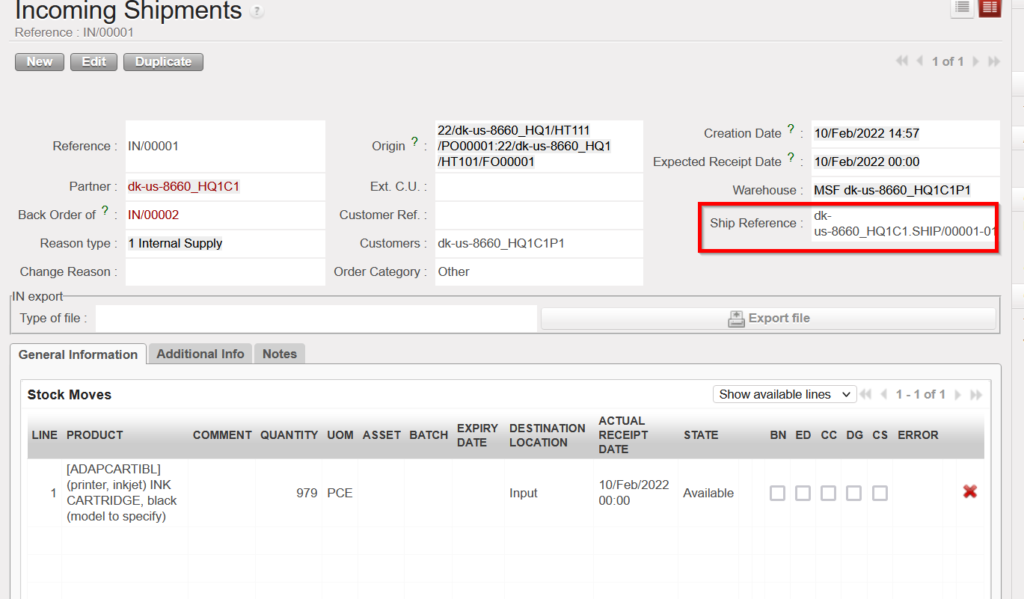
After synchronization, the state of your Incoming Shipment has changed from “Available” to “Available shipped” and the information of your Incoming Shipment (quantities, batch numbers, expiry dates, packing list…) have been updated according to what was shipped. Also, the field “Ship reference” will be automatically populated with the reference of the shipment from the sending instance (SHIP or OUT document).
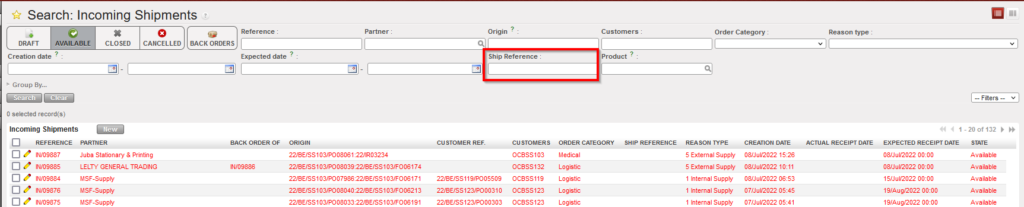
“Ship Reference” Field will be updated also when this value is filled in IN/EPacking Vertical Integration (VI) file. This will not impact how this field displays for INs which are updated by synch. there is also a filter on “Ship Reference” at header level for the IN list view.
If you try to process such an IN while it is still in state “Available“, you will get the below warning.
Warning when processing an IN which is not yet in state “Available Shipped“
Note for DPOs:
if the incoming shipment is linked to a direct purchase order (DPO) (in another instance), despite product lines not being updated (sent) from supplying instance, INs related to a DPO from a coordination will have their state updated to “Available shipped” once the DPO is confirmed on the coordination side and synchronization is performed on both sides.
If user decides to receive or cancel the related IN with status of (available shipped) in project, Status changes will be updated in the DPO in coordo level after synchro, and that will trigger changes for Finance in both commitment voucher and supplier invoice.
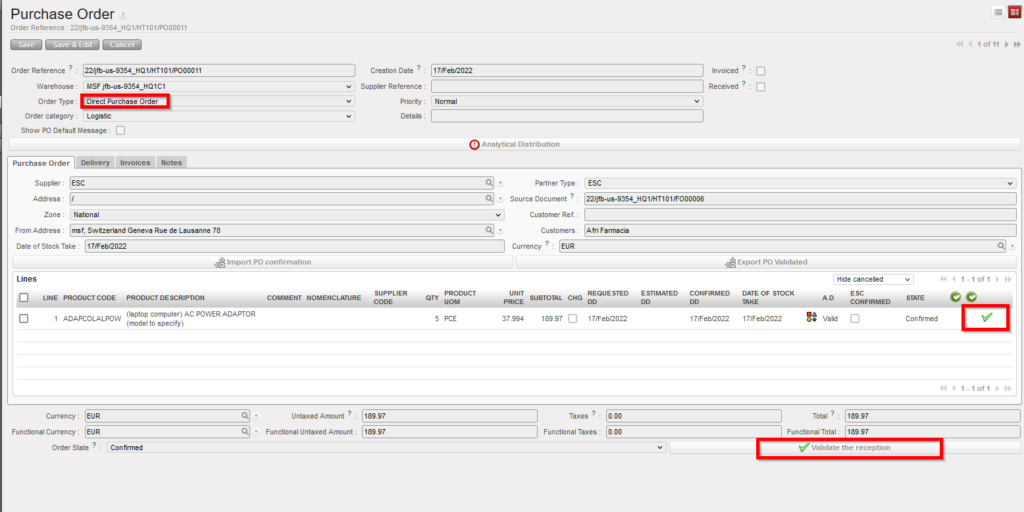
In the case that the customer of the FO is an External Partner, and if this (FO) is sourced to an external supplier through (DPO), there will not be an (IN) to receive, in this case the button to “Validate the reception” in the Confirmed (DPO) should be accessible. If this button is used, this action of confirming the (DPO) will confirm the goods have been received and close the supply flow.
For the DPO Flow coming from FO from external customer is source to an ESC or external supplier, it’s possible to confirm the reception at line level (and so close the line)
The Cancel & Resource functionality is not available for this specific case, but warning message is displayed to explain this.
An overview of changes done on Incoming Shipments by the synchronization is available in Synchronization / Monitoring / PO/FO/Shipment Logs.
Destination locations of INs have already be explained in details. If an IN is created following a PO (or PO-line) confirmation, the source location will be “OtherSupplier” if the PO was addressed to an external supplier or an ESC; it will be “MSF Supplier” if the PO was addressed to another UniField instance.
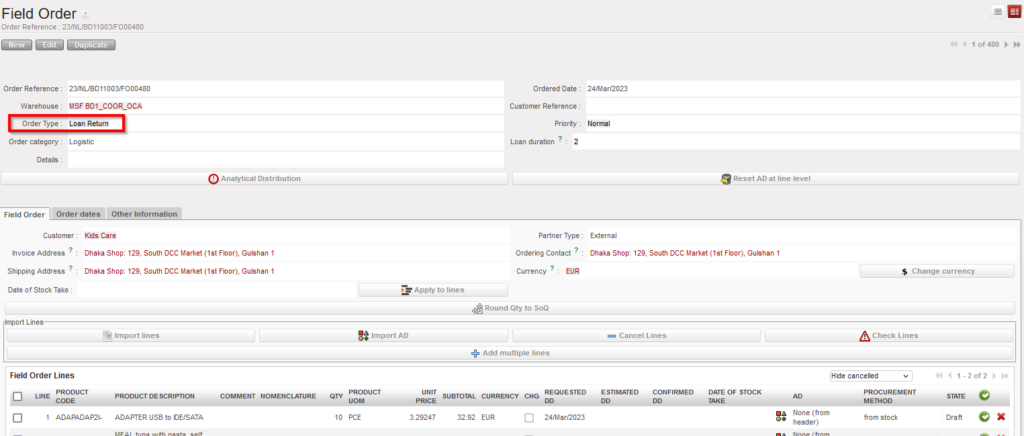
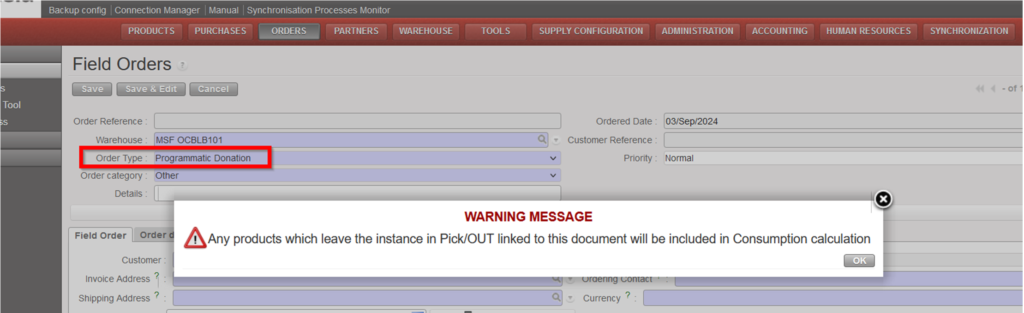
The process of creation of a “Programmatic Donation” is the same as for the “Donation to prevent losses”., the difference is that when you select Programmatic Donation from order type it will pop up with warning message “Any products which leave the instance in Pick/OUT linked to this document will be included in Consumption calculation “then click on “Ok”
This type of Field Order can only have External type partner as customer. It can be sourced to any type of procurement document (PO), and as per warning (above) any movement out of the instance will be included in the consumption calculation. Any stock movement out linked to this FO type will have the corresponding Reason Type “Programmatic Donation”.
In order to easily track Loans a report has been developed, this report shows docs and lines with stock movements, if there is no stock movement, no line record in the report.
Go to:Order / Reporting / Loan report
Select a filter to narrow down the need: Start Date, End Date; Partner; Partner Type; Product ref; Product Main Type and Origin
Optional: check the “Only unfinished loans” in case you need to see only outstanding loans (Delivered goods which are pending returns / received goods which have pending deliveries).If you leave it as default “unticked” you will see all loans those opened, closed or cancelled in the report.
Optional: check the “Display BN/ED details” box. This option will add 3 additional columns to the report: 1 for BN, 1 for ED and 1 for the line Status (since partially non sent/received line will be displayed in this case)
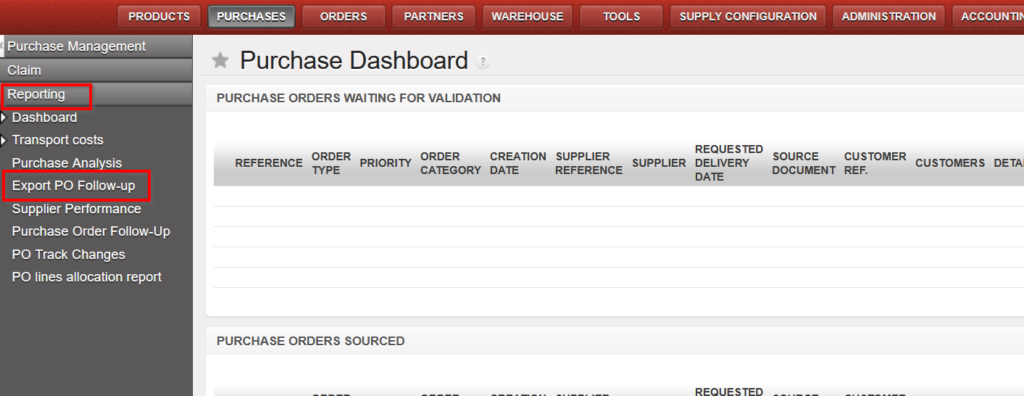
Another report allows the follow-up of POs. The result can be provided in Excel or PDF.
Go to:Purchases / Reporting / Export PO Follow-Up
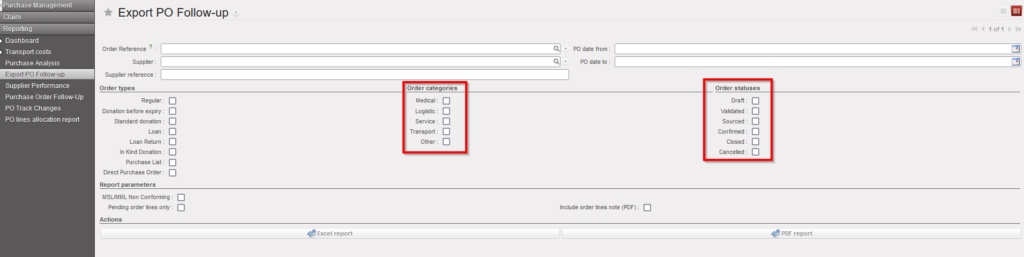
Export PO Follow Up
Complete the fields according to the information that you want to fetch. The most relevant is to complete the “Supplier” or the “Order Reference” fields. You can select one, several or no of the following fields “Order status, Order categories, Order statuses” (for this last default case, all statuses will be displayed). You can also check the “Pending order lines only” box that will display the products in back order
Click on “Excel report” or “PDF report” depending on the format you need.
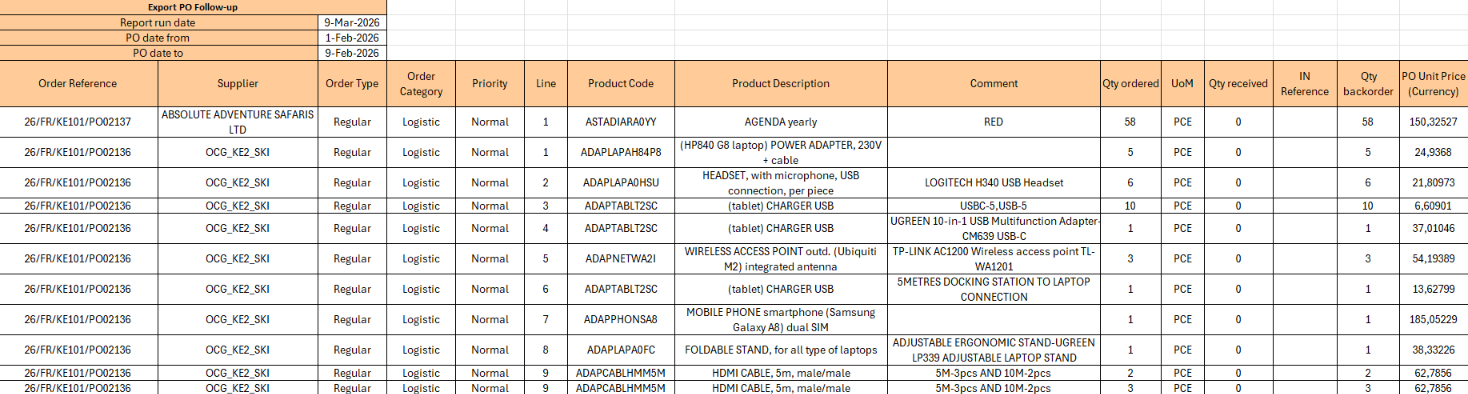
Export PO Follow Up – Excel Export
The Excel Export gives 1 Excel sheet with all lines of the selected POs and their detailed situation.
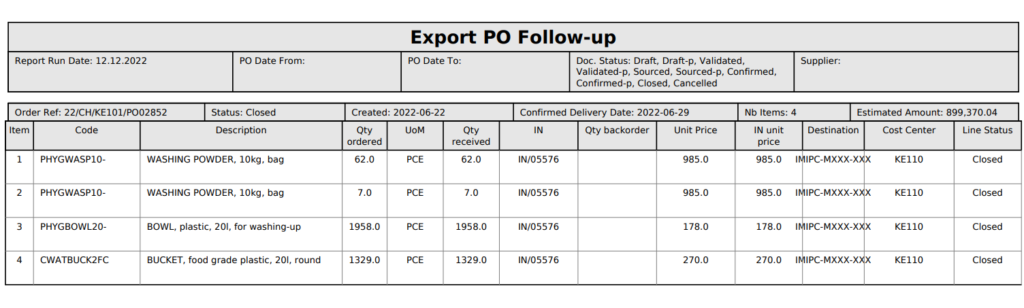
Export PO Follow Up –PDF Export
The PDF Export gives 1 PDF file with 1 PO per page including detailed situation of each PO line.
UniField offers a useful tool to analyze Field Orders. You can use this to display and analyze requests for supplies from partners according to different filters.
Field Orders have to be followed-up on a regular basis to ensure that all field requests are answered to within the requested time limits, and to avoid having any pending or “forgotten” requests.
The “Field Manager Dashboard” (first screen your reach if you click on ORDERS in the UF menu bar) and the “Search: Filed Orders” screen (which you reach through Orders/Field Orders) are already offering some information about FOs : state, picking percentage, responsible, customer, customer reference,…
FO information – Picking Percentage
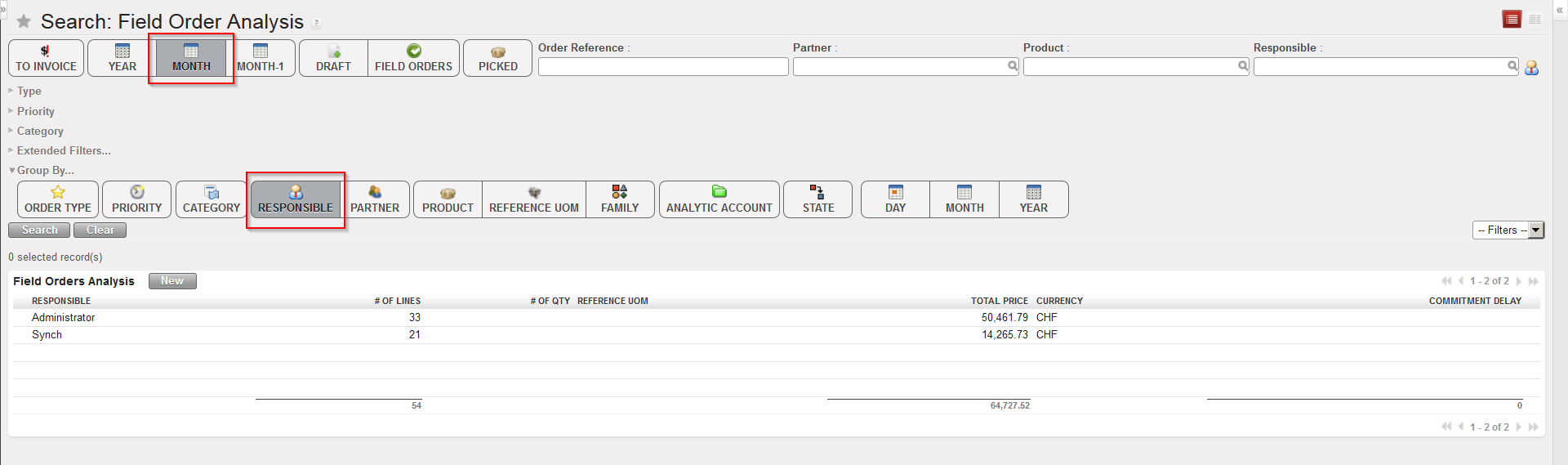
The “Field Order Analysis” gives additional information.
Go to: Orders / Reporting / Field Order Analysis
Field Order Analysis
By default, FOs created during the current month appear on the screen and are grouped by responsible (user who created the FO). Note that all FOs created by synchronization have user “Synch” as response be.
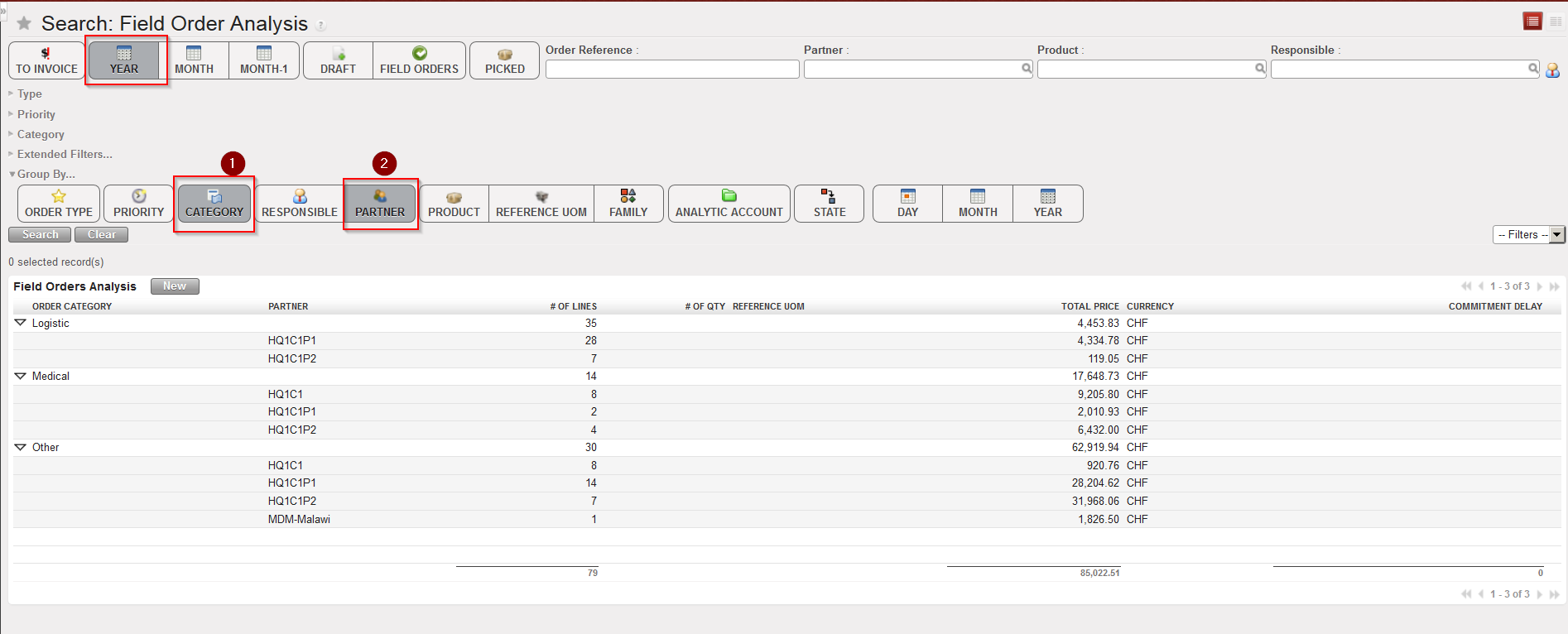
You may change these default filters and show more (or less) FOs and grouped them according to other criteria (e.g. Show all FOs created this year and group them by order category (1) and customer (2) as show in the screen below).
The details can be viewed by clicking on the “Expand All” button.
Field Order Analysis
Note that the order in which you select the “Group by” buttons directly impacts on the results displayed. For example, if you want to see Field Orders grouped by Partner then by Category, you should click the buttons in this order: Partner, Category.
Once all Requests for Quotation have been updated with the relevant supplier quotation information and are in the state “Updated“, the user will be able to compare the different suppliers’ offers and select the appropriate supplier for each requirement (in the Tender lines).
To compare the different RFQ responses, go to:Purchases / Purchase Management / Tenders
1.Click on the appropriate Tender line.
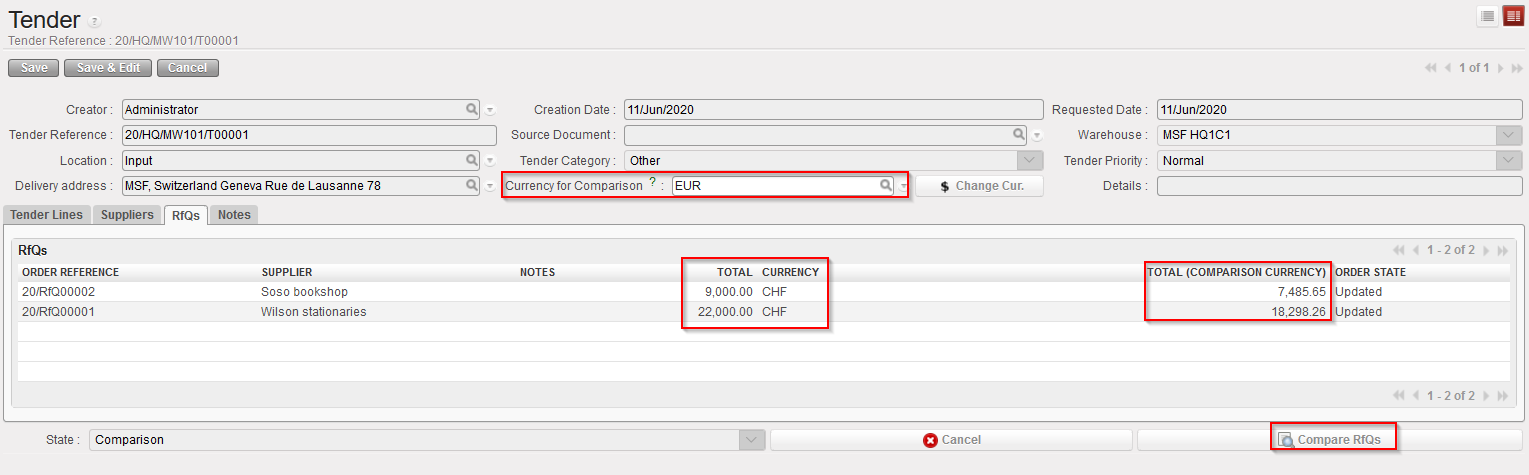
2. Click on the “RFQs” tab to see the supplier quotations with the total amount of each quotation.
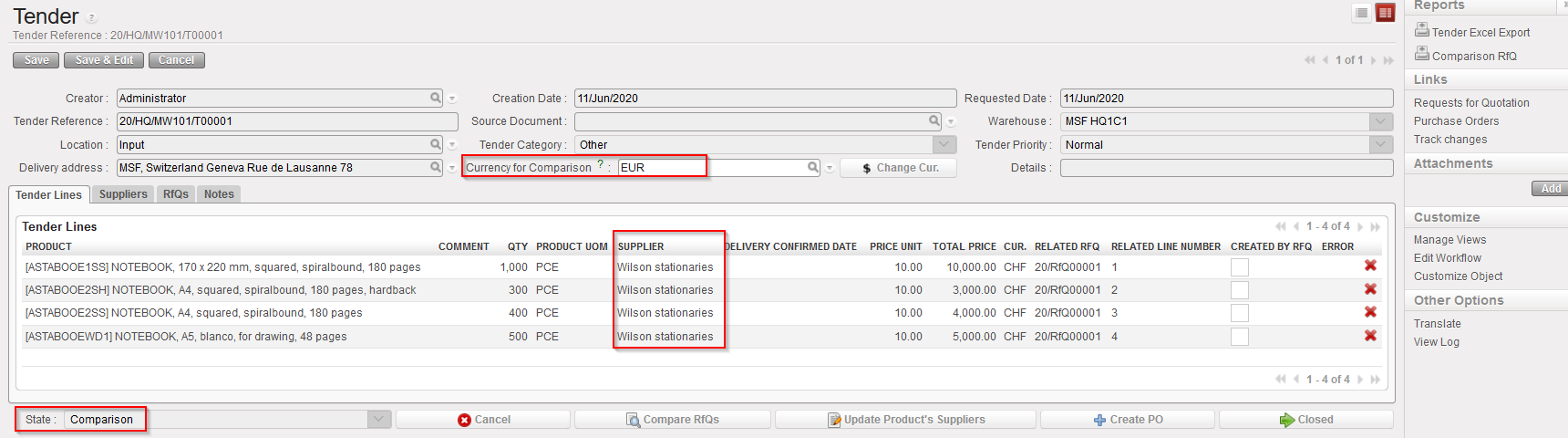
Note that “Currency for Comparison” field enables to select a currency from local currency, functional currency or a second local currency. This currency will be displayed in the “Comparison” popup once you click on “Compare RfQs” so that user can compare in his preferred comparison currency.
Comparing RFQs on a Tender
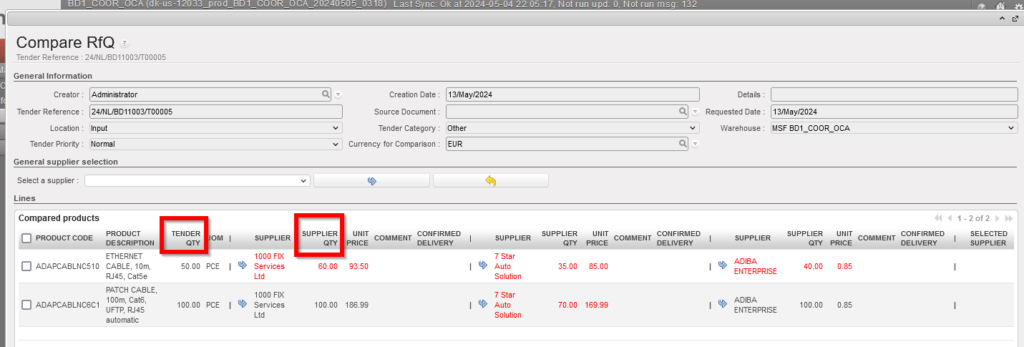
3. Click on the “Compare RfQs” button to select a supplier for each product included in the Tender.
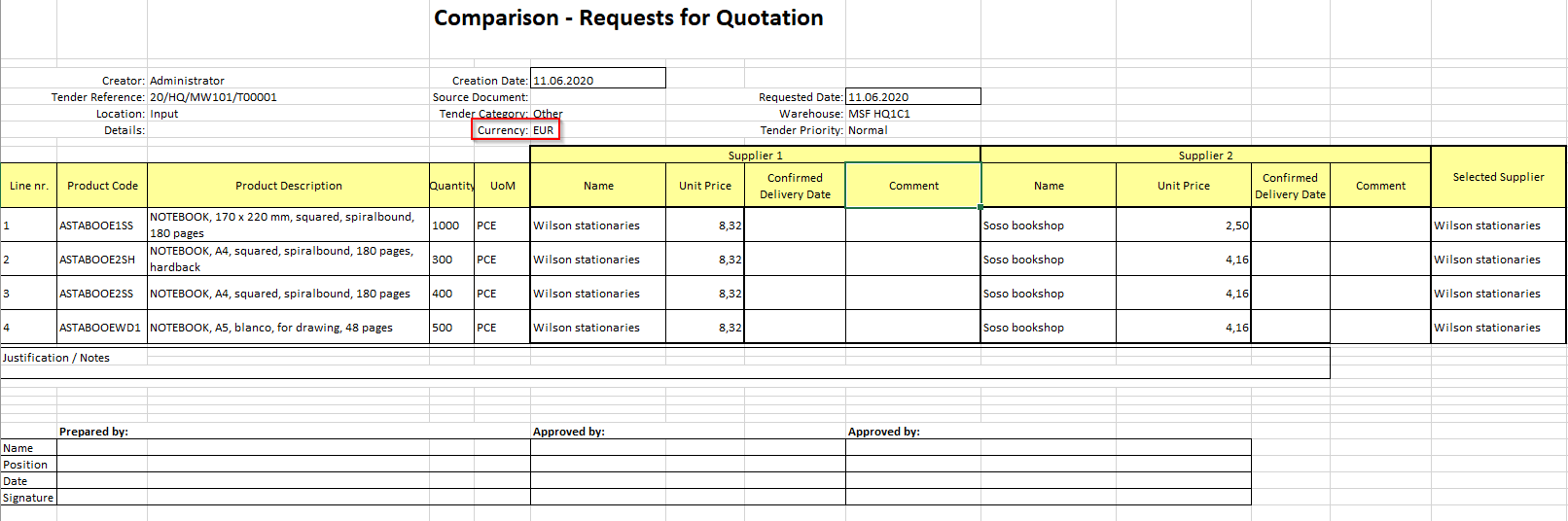
In the resulting comparison pop-up , you can see the unit price and Quantity proposed by each supplier as well as the original Tender quantity, any discrepancy for this is displayed in red. The same elements are displayed in the excel “Comparison RFQ” in the action menu.
4. Compare the quotations of each supplier and select the most appropriate one (following the supply procedure, taking into account price, quality, lead time, validity of the quotation,…)
5. You have two options to select the supplier per products:
a) Multiple selection: you can tick all the lines or only tick some specific lines then use the “Select a supplier” field, select a supplier from the drop down list and click on the “blue arrow” next to it. (1)
b) Product Line level selection : click on the “blue arrow” pointing to the supplier you want to select at product line level. Repeat for each line. (2)
6. The selected supplier will be displayed on the “Selected Supplier” column at the end of the product line with a “yellow arrow” on its left. The “yellow arrow” can be clicked if you want to unselect the supplier and change it for another one.(3)
Selecting a supplier on a Tender at header level or at line level
7. Once the supplier selection has been done (at header or line level), click on the “Update Tender” button to save the selections.
The currency displayed will be the one of the RfQ supplier selected.
Selected supplier displayed on the Tender
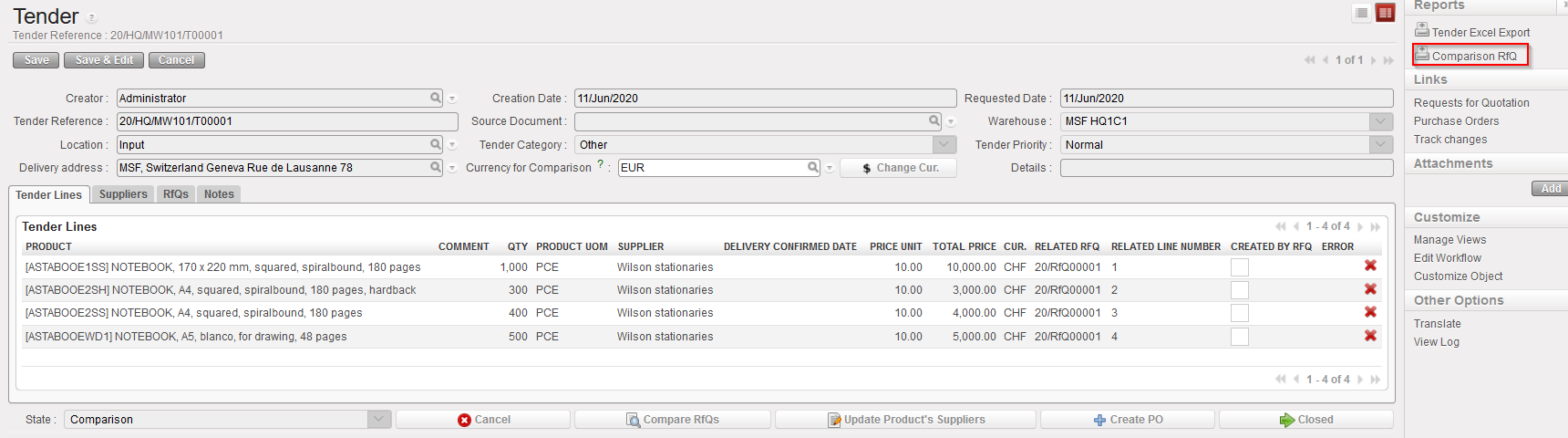
The “Comparison RfQ” option available in the action menu allows exporting the Comparison to Excel. This comparison sheet will display the currency for comparison.
F. How to create a Purchase Order for (receiving) a loan
In order to borrow stock from another instance (e.g. to cover a shortfall while more stock is ordered, or to fulfill a temporary need), or an external partner, the requesting (borrowing) instance must create a loan Purchase Order.
For internal loans, like other POs, when validated and synchronised, this PO will create an FO on the supplying (lending) instance. Additionality, to act as a reminder to the both sides, the system will also create a loan PO on the side of the lender when the FO will be sourced (usually to stock), to express their need to have the products returned by the agreed date. The corresponding FO will be created on the borrower’s side when lender validates and synchronizes the PO.
For a loan from an external supplier, the FO will be created as a reminder when the PO has been confirmed.
Loan PO should never be created by the OST; they should be created either from scratch or by the synchronization.
Go to:Purchases / Purchase Management / Purchase Orders
Click “New” to create a new Purchase Order.
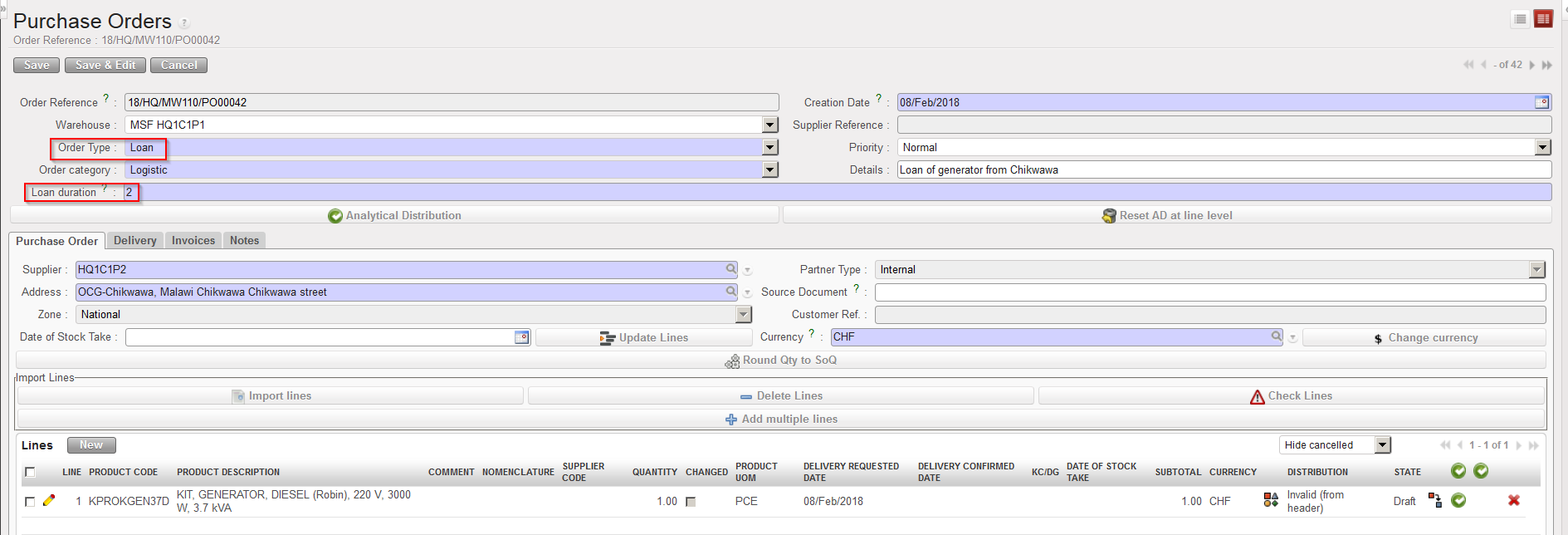
As “Order Type“, select “Loan“.
Fill in the rest of the header information (category, priority, details,…).
As “Loan duration“, enter the number of months you wish to borrow the products for. If you have multiple products which you want to borrow for different lengths of time, enter the shortest time here, or create a separate loan PO for each product. The system will use the number of months entered here to calculate the date when the loaned items should be returned, and this will be reflected in the PO/FO which will be created for this purpose.
As “Supplier“, select the instance which will be lending you the goods (or an external partner if goods are borrowed from outside MSF).
Add product lines (manually or via file import).
Enter the AD (Optional).
Loan PO
8. Confirm the PO, a “reminder” document will be automatically generated by the system (FO in this case), the system will add the reason type “Loan Return” to this document and all transport documents that follow. Same logic will be in creating Loan FO for lending goods, when the Loan FO processed, PO with Order Type “Loan Return” will be automatically created.
A Direct Purchase Order is a PO for which the goods should not be delivered not to the instance where the DPO was created (usually coordination), but directly to the instance (usually project) which needs the goods (usually requested to coordination via a regular PO). A DPO cannot be created from scratch but must be created by OST. Suppliers allowed on DPO are external suppliers or ESC (but not internal partners). Note that the sender of the DPO and the receiver of the goods should be in the same mission.
When “DPO” is received at project level, Unifield enables to a status update of DPO at coordination level to related IN. The status update is linked to “IN” fully and partially. This means that both the CV (Commitment Voucher) and Supplier invoice is created for DPOs by the same triggers as for (normal) POs. Project creates PO to Coordination level. After the Synch, COO validates “FO” and sources “FO” to “DPO” (external supplier). After the validation and confirmation of DPO, instances are synched. Project level processes “Available Shipped IN” and SYNCH. Supplier Invoice is created, OUT from stock to stock is created and closed. “IN” from the other supplier to other supplier is created and Closed
You should start from a situation where you have a validated FO. This FO may have been created from scratch (pushed–FO) or via synchronization (pulled-FO created from a PO synchronized from the requesting instance).
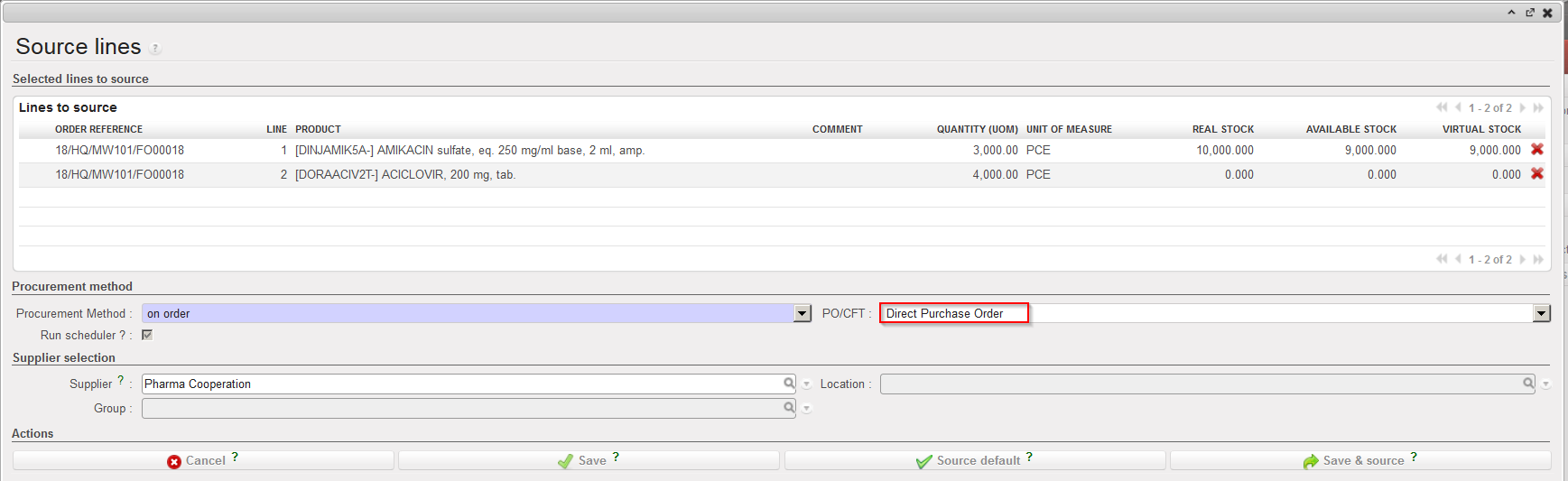
Go to:Orders / Orders / Orders Sourcing Tool
Source the FO on order to a DPO.
Sourcing an FO to a DPO
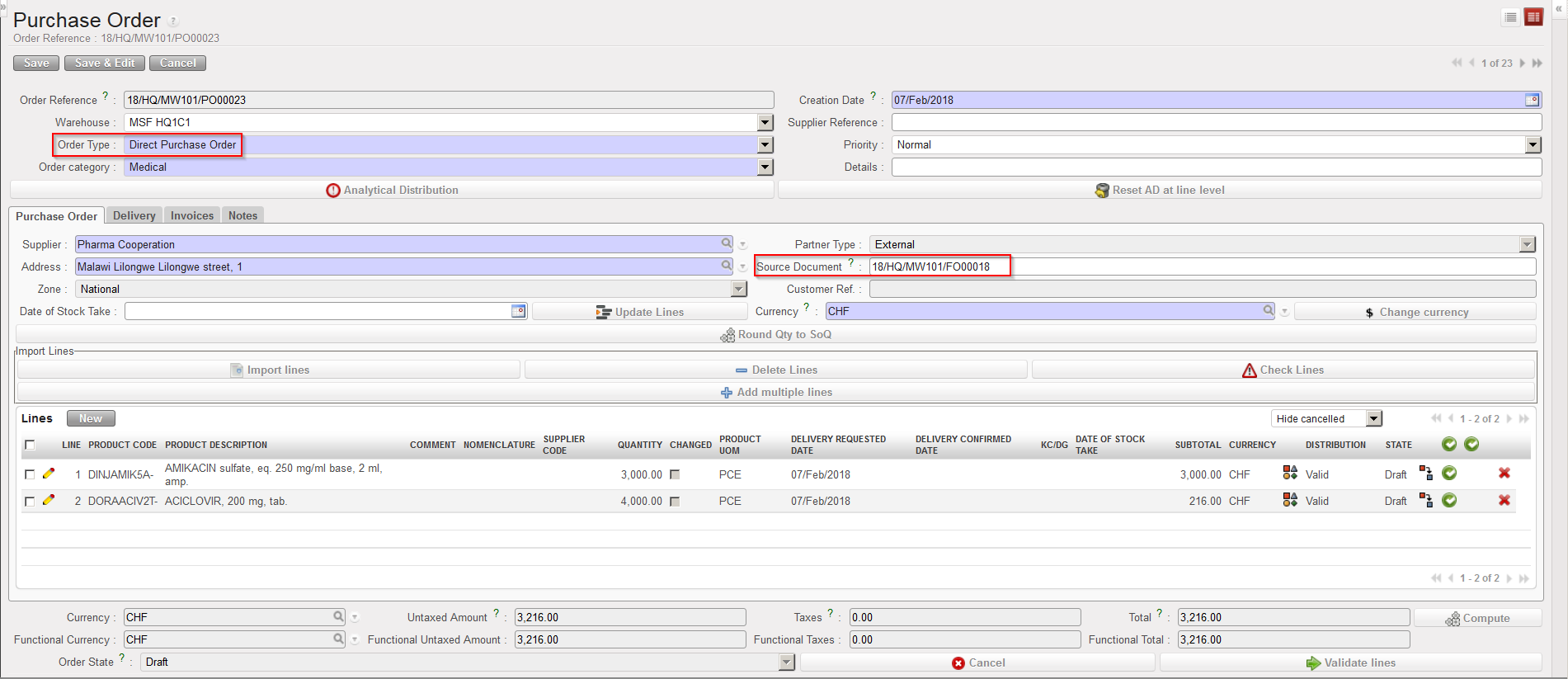
Go to:Purchases / Purchase Management / Purchase Orders
2. Find your Direct PO (it will be in “Draft” status).
3. Check that the order type is “Direct Purchase Order“.
4. Check the other header information and update if needed (order category, priority, details,…).
5. Check that the supplier is correct.
6. Check the FO indicated in the “Source Document” field.
DPO created by the OST
7. Click on the “Delivery” tab and check the details of the “Destinationpartner” (i.e. instance -usually project- where goods should be delivered directly).
DPO – Delivery tab
The next steps are exactly the same than the ones for a regular PO (validation, confirmation,…).
We will see in the Warehouse chapter how DPOs are received.
Note that a draft invoice will be created as soon as the DPO is confirmed on the instance where the DPO was created, but no IN (incoming shipment) will be created on this instance. The incoming shipment will be available at the receiving location in the state “Available shipped“. Following reception of this IN, the DPO should be closed manually.
We use cookies to ensure that we give you the best experience on our website. If you continue to use this site we will assume that you are happy with it.

 icon and save the line using the floppy
  icon located at the right of the line. Note that you may have to enter and BN or an ED according to the product received.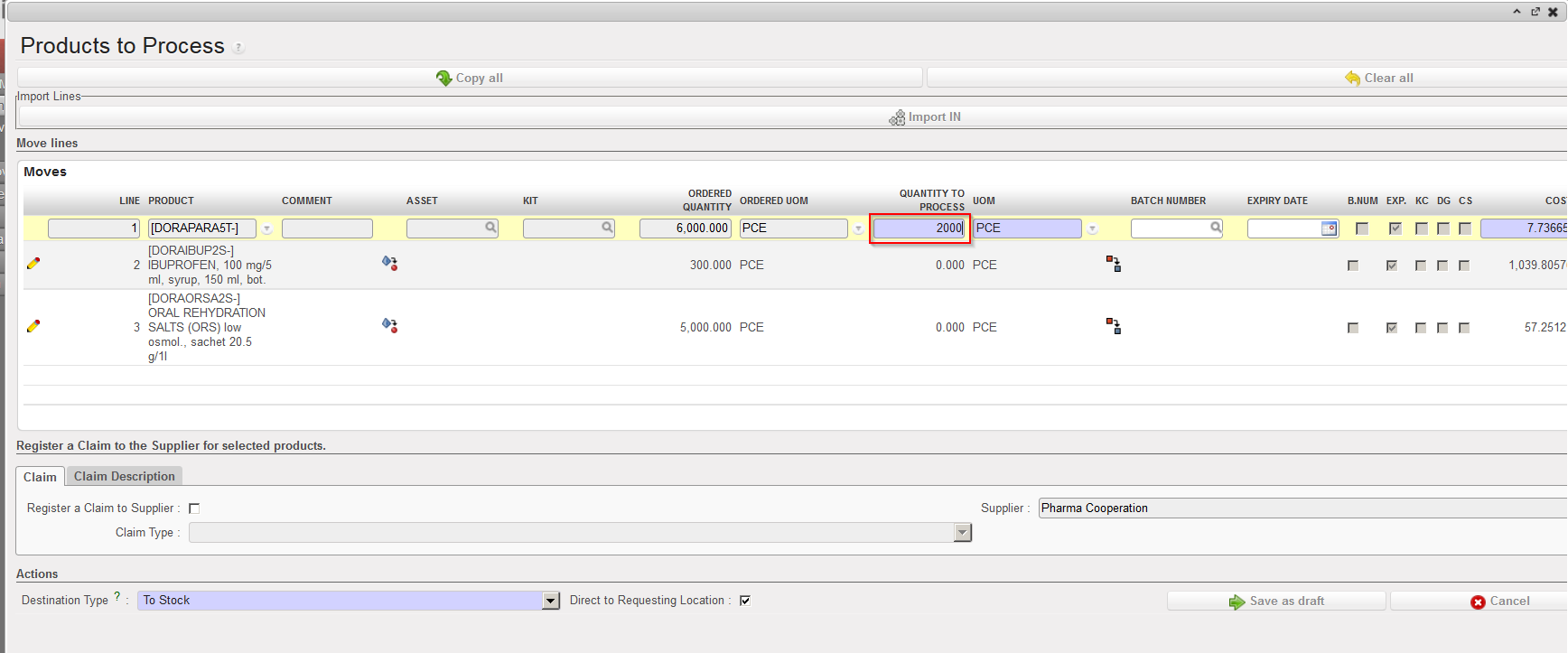
 for each line that you are receiving, enter the received quantity in the “Quantity to process” field and save the line by clicking on the floppy disk icon
  on its far right (sometimes hidden!) or by pressing “Enter” on your keyboard. Repeat the operation for each received item.


 icon will be displayed on the “Closed” IN and the details of the change will be visible if you click on the icon.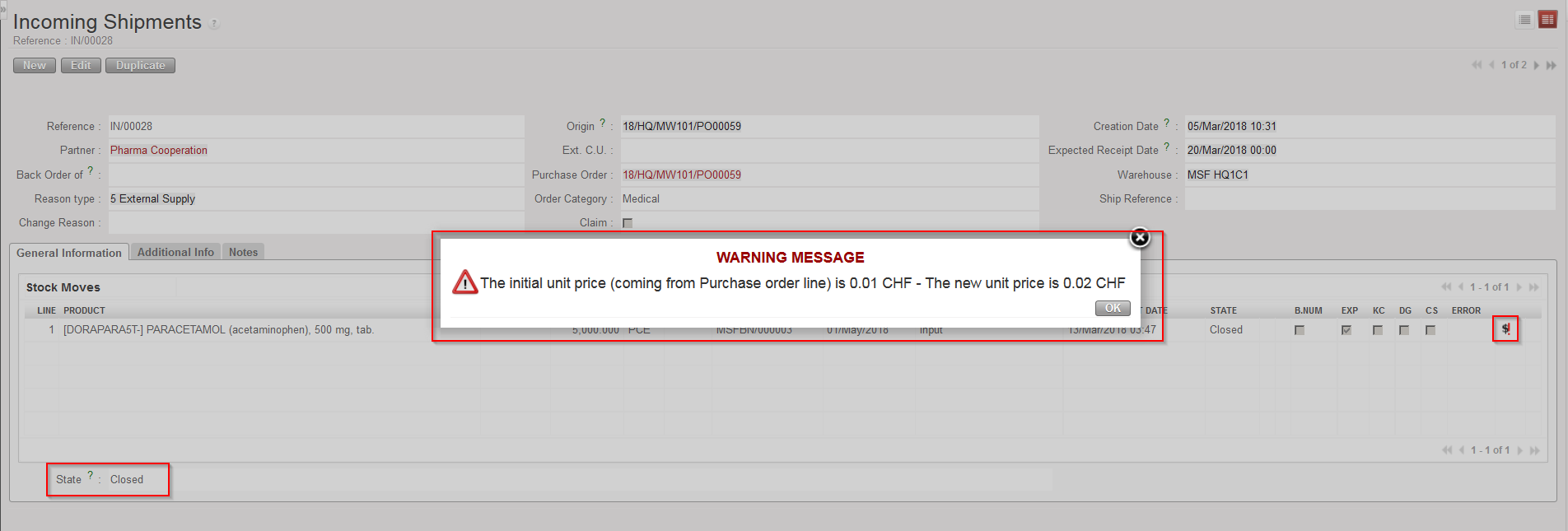



 Export PO Follow Up –PDF Export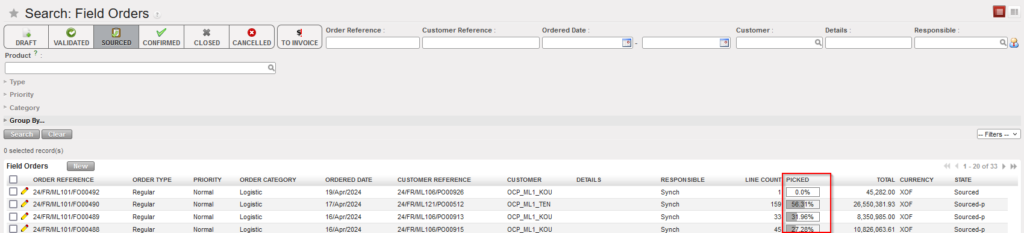
 next to it. (1)
 pointing to the supplier you want to select at product line level. Repeat for each line. (2)
 can be clicked if you want to unselect the supplier and change it for another one.(3)