N. How to export a PO to XML VI file.

Supply User Manual ENG -> 4. Procurement -> 4.6 LU-SU3201: Purchase Orders (POs) - Generals -> N. How to export a PO to XML VI file.

N. How to export a PO to XML VI file.

Go to: Purchases / Purchase Management / Purchase Orders

  1. Open the Purchase Order that you wish to export.
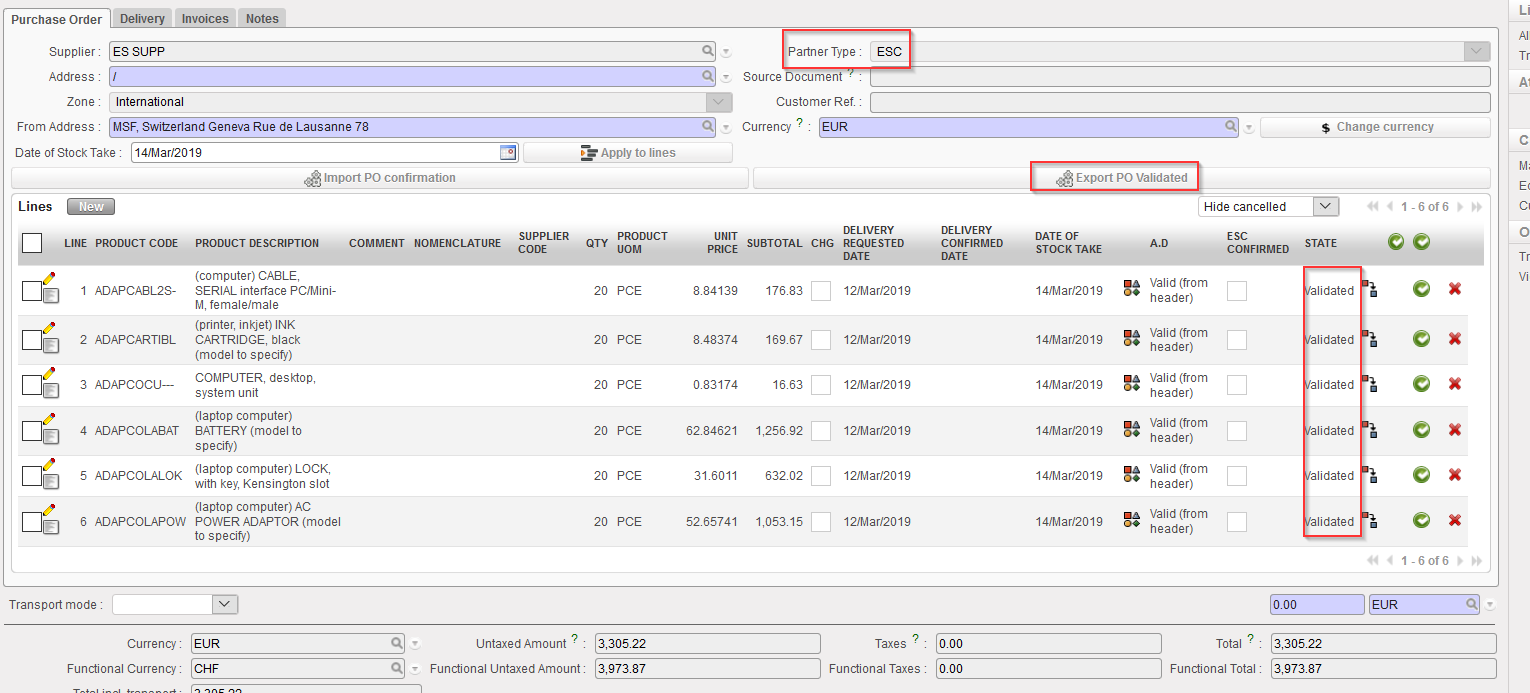
  2. Click on the “Export PO Validated” button. This button will only appear if your PO is in the state “Validated” or “Validated-p” but not if your PO is “Draft“, “Draft-p” or “Confirmed” status.
Exporting a validated PO to an XML VI file

3. Choose the “File type” required by your ESC. 2 file types are available. The “Excel file” format will generate a file in “XML 2003 Spreadsheet” format (easily editable in Excel). The “XML file format” will generate a pure XML file.

4. Click on “Download file“.

Selection of the type of file when exporting a PO to VI file
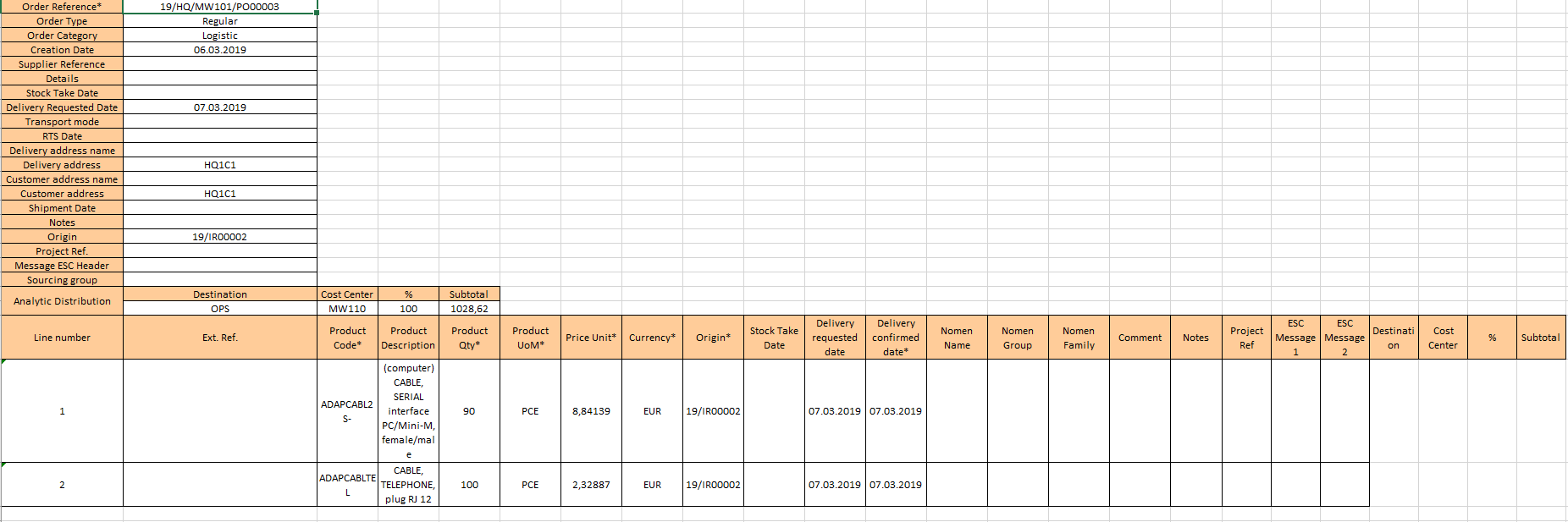
“Excel file” File type (XML 2003 Spreadsheet)
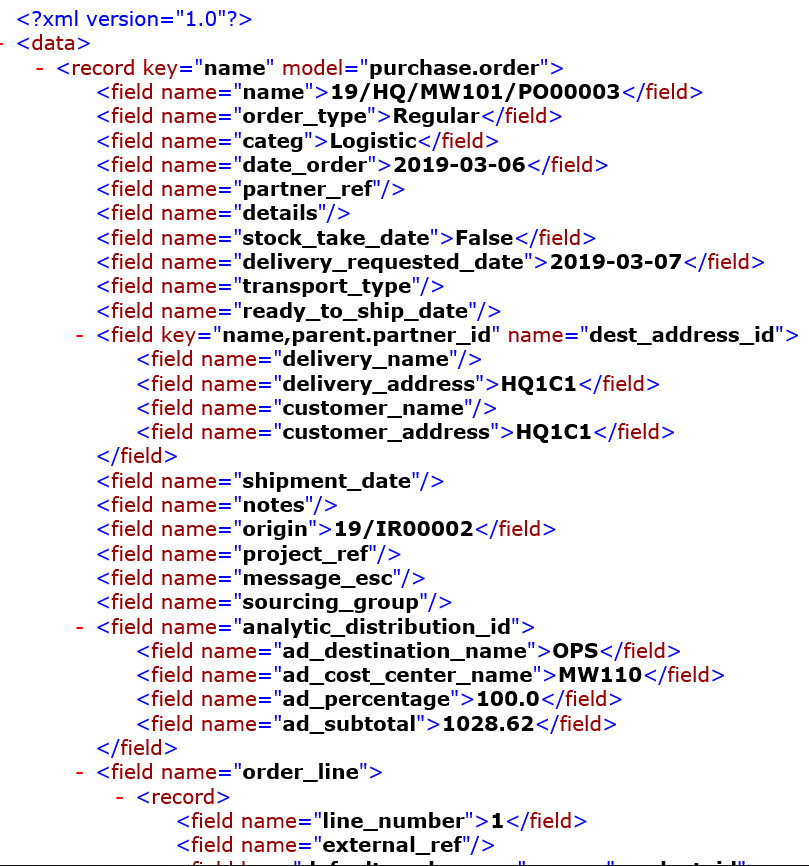
“XML file” File type (pure XML)

A file has been saved on your computer. From this point, the file should be importable into the ESC system (Portal,…) without any change. Please refer to your OC/ESC documentation for further details.

M. How to update a Purchase Order through Vertical Integration (VI)

Supply User Manual ENG -> 4. Procurement -> 4.6 LU-SU3201: Purchase Orders (POs) - Generals -> M. How to update a Purchase Order through Vertical Integration (VI)

M. How to update a Purchase Order through Vertical Integration (VI)

The main principle of Supply Vertical Integration is to facilitate the exchange of data between the different ESC systems and UniField. When ordering to ESC suppliers, missions need to send their validated POs to these suppliers who will (maybe) update and (hopefully) confirm these orders.

A PO in status “Validated” can be exported to an XML file in a specific format which can then be imported into another (ESC) system. ESCs have made the relevant development to be able to import such an XML file in their systems.

In a second phase, following the confirmation of the order at ESC level, the ESC system will generate an updated file which will then be imported on the PO in UniField and update the PO. The updates can be done on prices, quantities, products – which can be changed, split, added or even deleted –, delivery confirmed dates, … At import of this file, users will be able to see the changes which will be highlighted in a simulation screen.

Note that a UniField PO could correspond to several orders in the ESC system.

Note that the import and export can be automatically done between UF and OCs Supply system since UF9. However, not all OCs have developed the required improvement to use this automated version. The way vertical integrations are used could vary according to your OC or ESC. Please refer to the specific documentation of your OC/ESC to understand how vertical integrations should actually be used on your mission.

Note that this system of files exchange has been developed for POs sent to and confirmed by ESCs but could also be used for other external suppliers if needed.

L. How to confirm a Purchase Order.

Supply User Manual ENG -> 4. Procurement -> 4.6 LU-SU3201: Purchase Orders (POs) - Generals -> L. How to confirm a Purchase Order

L. How to confirm a Purchase Order

Once the supplier has confirmed the PO terms and conditions (products, quantities, unit prices, delivery date,…), the Purchase Order needs to be updated accordingly and will then be “frozen” as a contract.

If changes have to be made after the confirmation of an order (supplier unable to deliver exactly the same item, change of quantities, change of prices,…) those changes will have to be made in the “Incoming Shipment” document while doing the reception.

Confirming an order means that no more editing or changes can be made to that order (except for DCD via VI import).

Purchase Orders sent to the coordination will be automatically confirmed through the synchronization engine once the corresponding Field Order will be confirmed at coordination level. The POs sent to another UniField instance will therefore not have to be confirmed manually.

Confirming a Purchase Order has an impact on the budget thanks to the Analytical Distribution encoded on this order.

The confirmation of a Purchase Order to a supplier is a commitment from MSF to purchase the described products from the supplier at the agreed price. Even if the supplier has not yet been paid, that part of the budget will no longer be available to be spent on other purchases. This is why a “Commitment Voucher” (CV) is created during the confirmation process, and this CV will later be replaced by the final invoice paid to the supplier.

Note that the confirmation of a PO is only possible if a confirmed delivery date has been entered on this PO.

Note that a PO can be confirmed at header level (for the whole PO) or at line level (for 1 specific line or for several lines). Unlike PO validation at line level, PO confirmation at line level does not require any specific user right. Confirmation at line level is extremely useful as it often happens that suppliers confirm (and deliver) part of the goods from a PO. ESCs often do it on large orders.

J. a) How to confirm a PO at header level

J. b) How to confirm a PO at line level

K. How to check the impact of a Purchase Order on the budget.

Supply User Manual ENG -> 4. Procurement -> 4.6 LU-SU3201: Purchase Orders (POs) - Generals -> K. How to check the impact of a Purchase Order on the budget.

K. How to check the impact of a Purchase Order on the budget.

Once a PO is validated, before confirming a PO, you may want to check its impact on the budget.

Go to: Purchases / Purchase Management / Purchase Orders

  1. Click on the pencil on the left part of the screen of the line of the relevant Purchase Order.
  2. Open the action menu if needed (right part of the screen via the double arrow).
  3. Select the option “Order impact vs. Budget” in the action menu (under “Reports“).
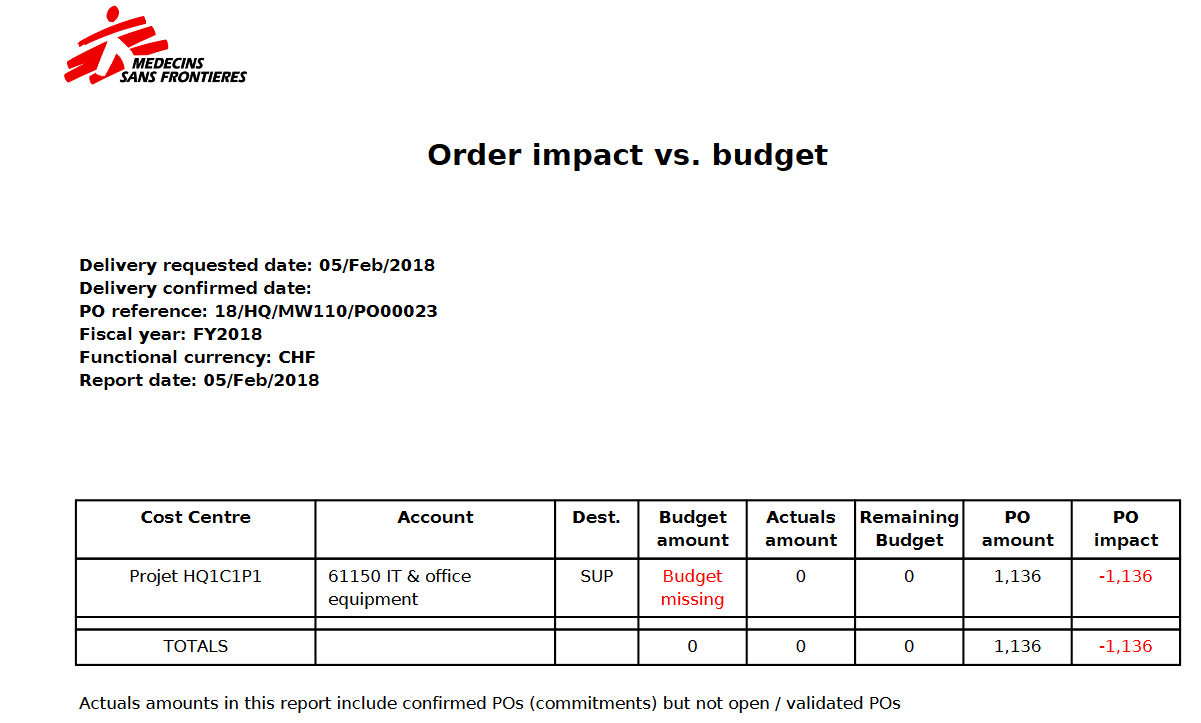
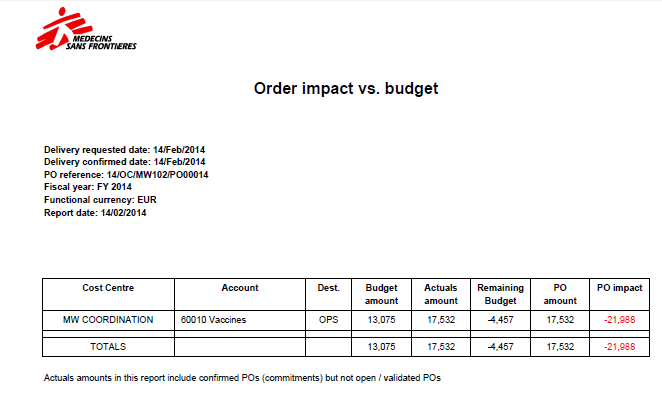
  4. A PDF document is opened. If a budget was entered for the corresponding AD, you may see the impact of your PO on the budget.
Impact of the PO on the budget


In the above example the PO is worth 17532 EUR and is allocated to one cost center MW COORDINATION.

All amounts presented are in functional currency (HQ consolidation currency vs booking currency used in the field).

  • {Budget amount} is retrieved from the budget uploaded in the system and corresponding to the cost center the PO was assigned to. If several versions of a budget have been uploaded, the report will pick the latest version that is not Draft.
  • {Actuals amount} are expenses already recorded; this column also includes pending commitments which are confirmed but not validated POs.
  • {Remaining budget} is a calculated column equal to “Budget amount – Actuals amount“.
  • {PO amount} is a subtotal by cost centers, expenses accounts and destination. To retrieve these figures the system takes the analytic distributions defined at header/line level of the PO as well as expense accounts linked to each product/product category and destination.
  • {PO impact} is a calculated column equal to Remaining budget – PO amount.

H. b) How to validate a PO at line level

H. b) How to validate a PO at line level

b) i. How to validate several lines of a PO

If the user has the appropriate user rights, he will be able to validate a PO at line level. This can be done for 1 line or for some lines.

According to the OC procedure in place this validation could/could not be allowed (refer to your OC procedures) How to validate 1 line of a PO

Go to: Purchases / Purchase Management / Purchase Orders

  1. Open the PO that you wish to validate (in edit or display mode). This PO should not yet be fully validated but still draft (or draft-p).
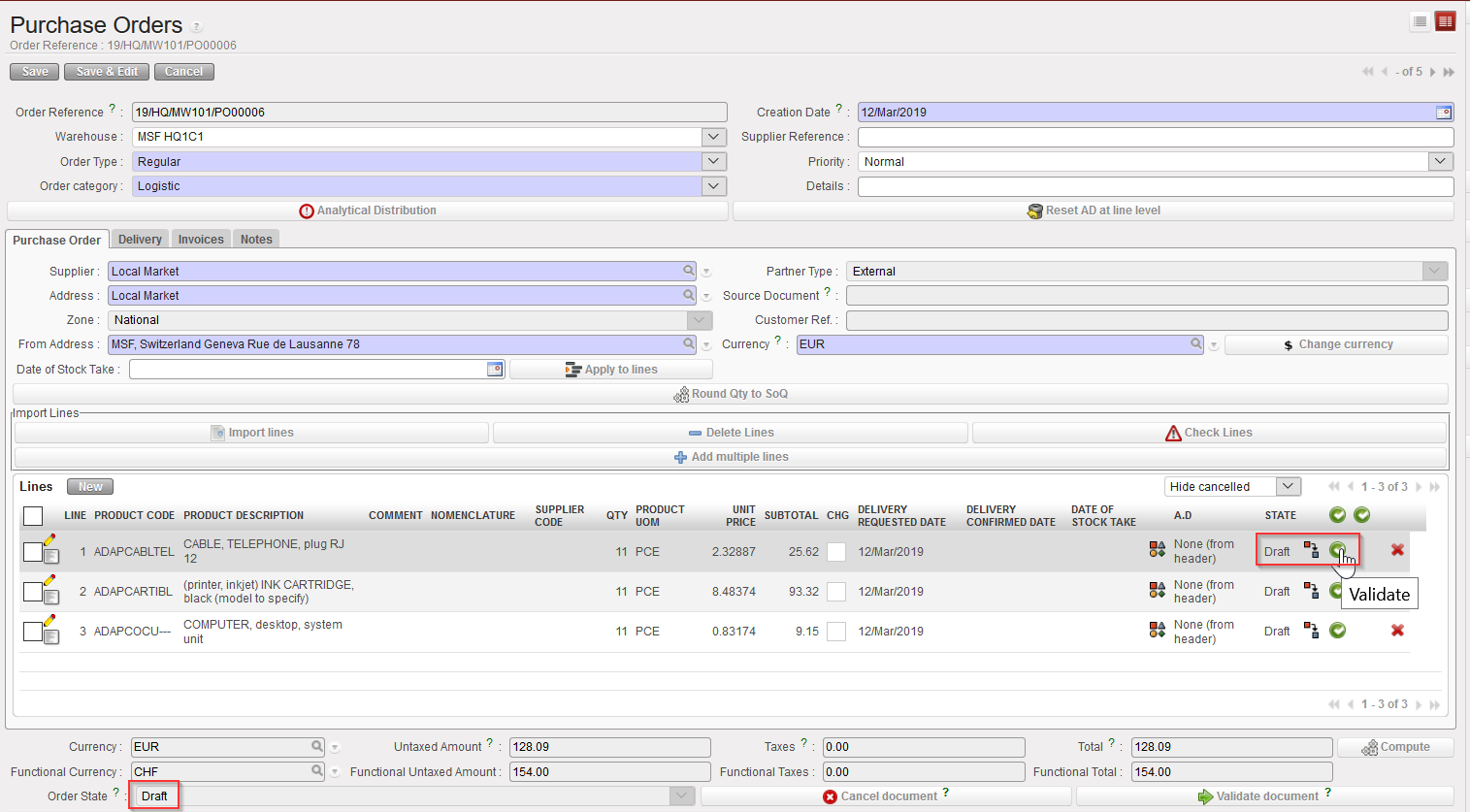
  2. Click on the green button (Validate) located at the right of the line you wish to validate.

Validating 1 line of a PO

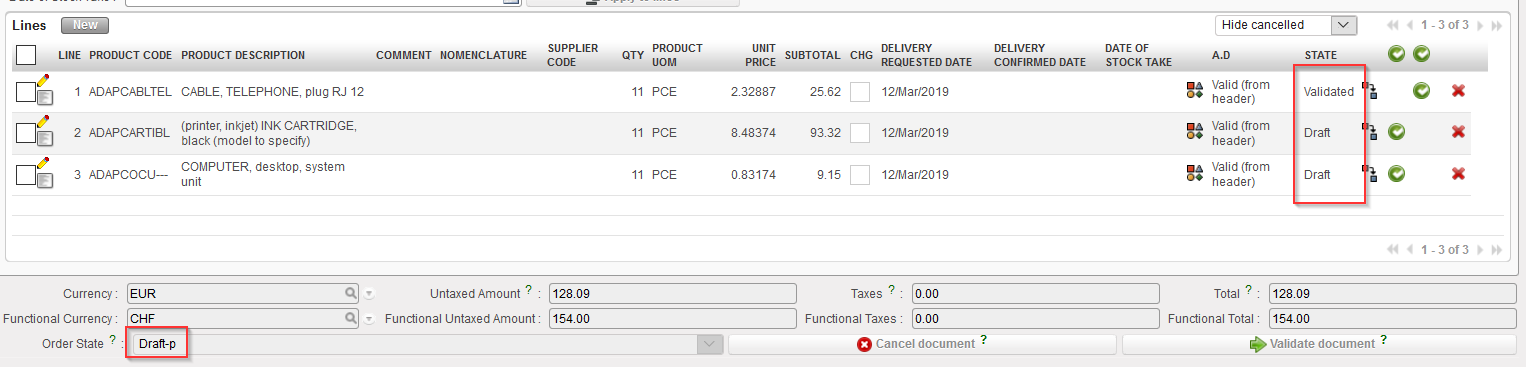
       3. The PO switches to “Draft-p” (partially validated). The validated PO-line switches to “Validated” while the other lines stay in status “Draft“.

1 line of a PO validated

H. a) How to validate a PO at header level

H. a) How to validate a PO at header level

According to OC procedures, before validating a Purchase Order, the document should be printed and signed (validated) by the content responsible (and the validator should also check the Analytical Distribution before validating).

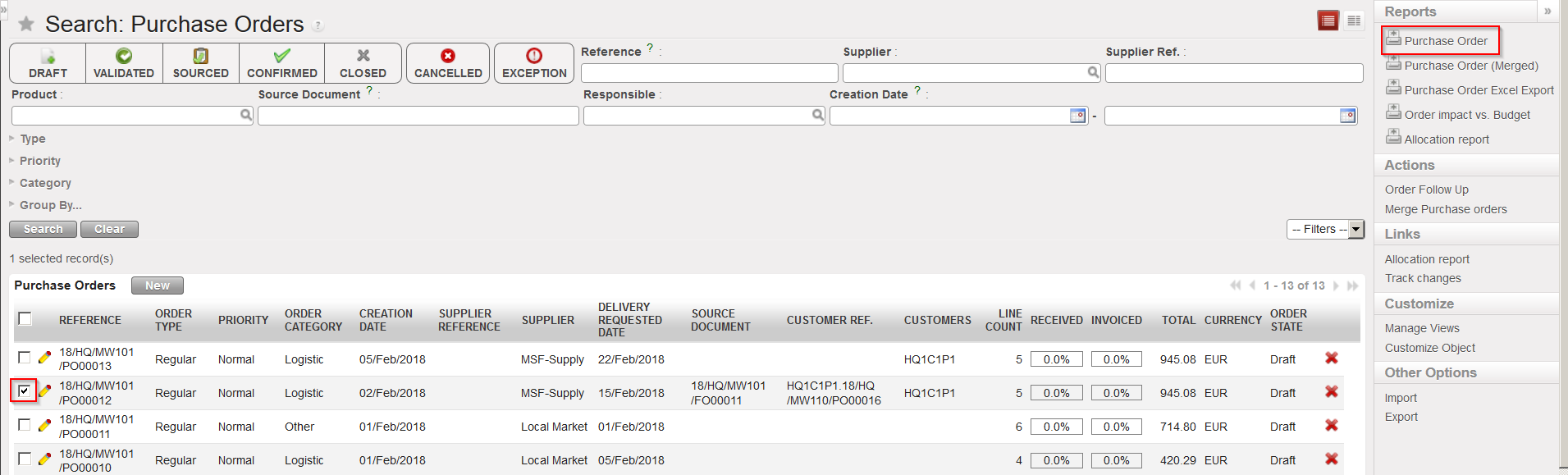
To print the PO, select the check box corresponding to the PO to be printed and click on the “Purchase Order” option in the action menu. A PDF file ready to be printed will open.

PO print out

Once the PO has been validated (on paper) it can be validated in the system.

Go to: Purchases / Purchase Management / Purchase Orders

  1. Open the PO that you wish to validate (in edit or display mode). This PO should not yet be validated but still draft (or draft-p).
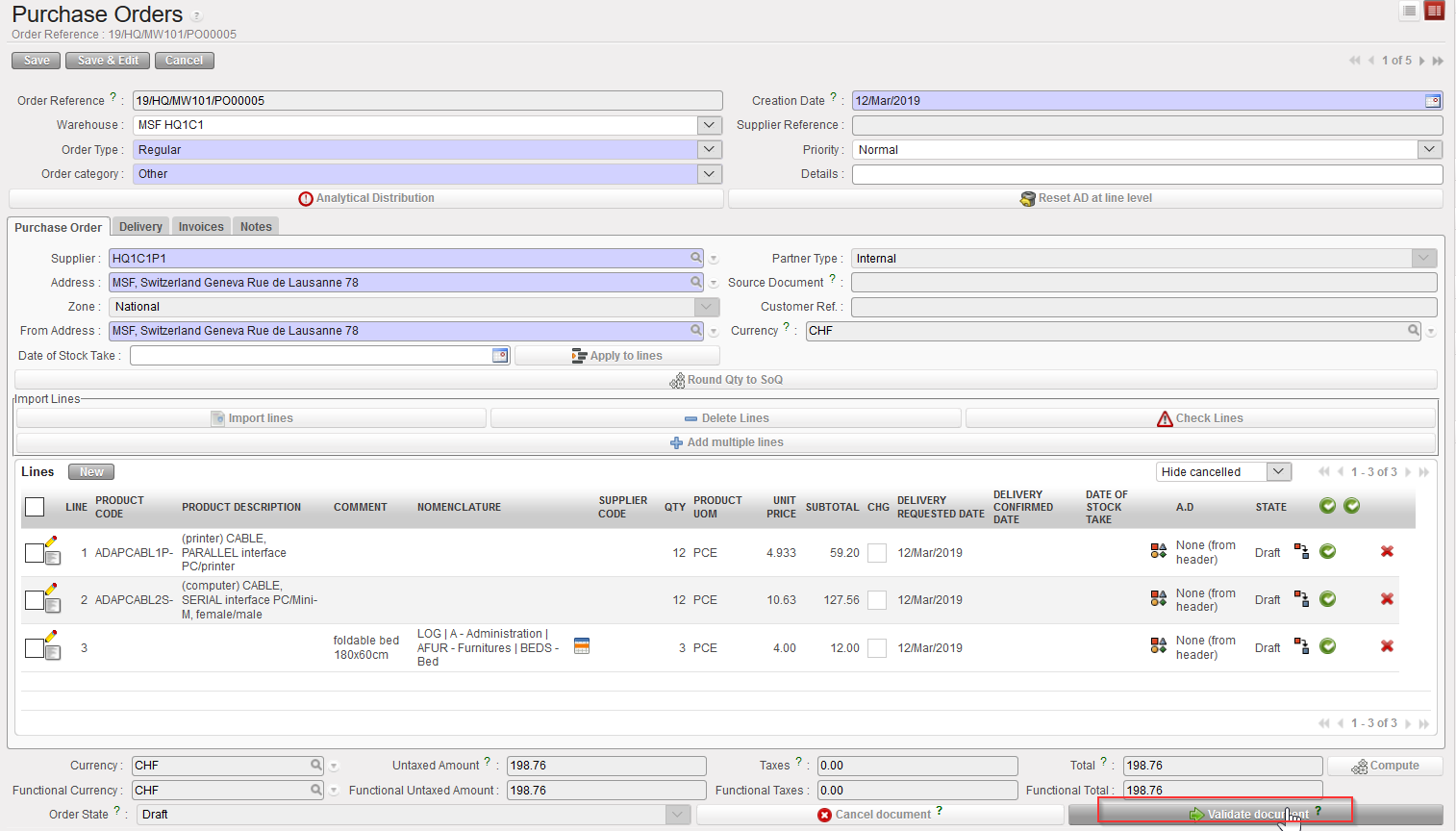
  2. Click on the “Validate document” button at the bottom of the screen.
Purchase Order validation at header level

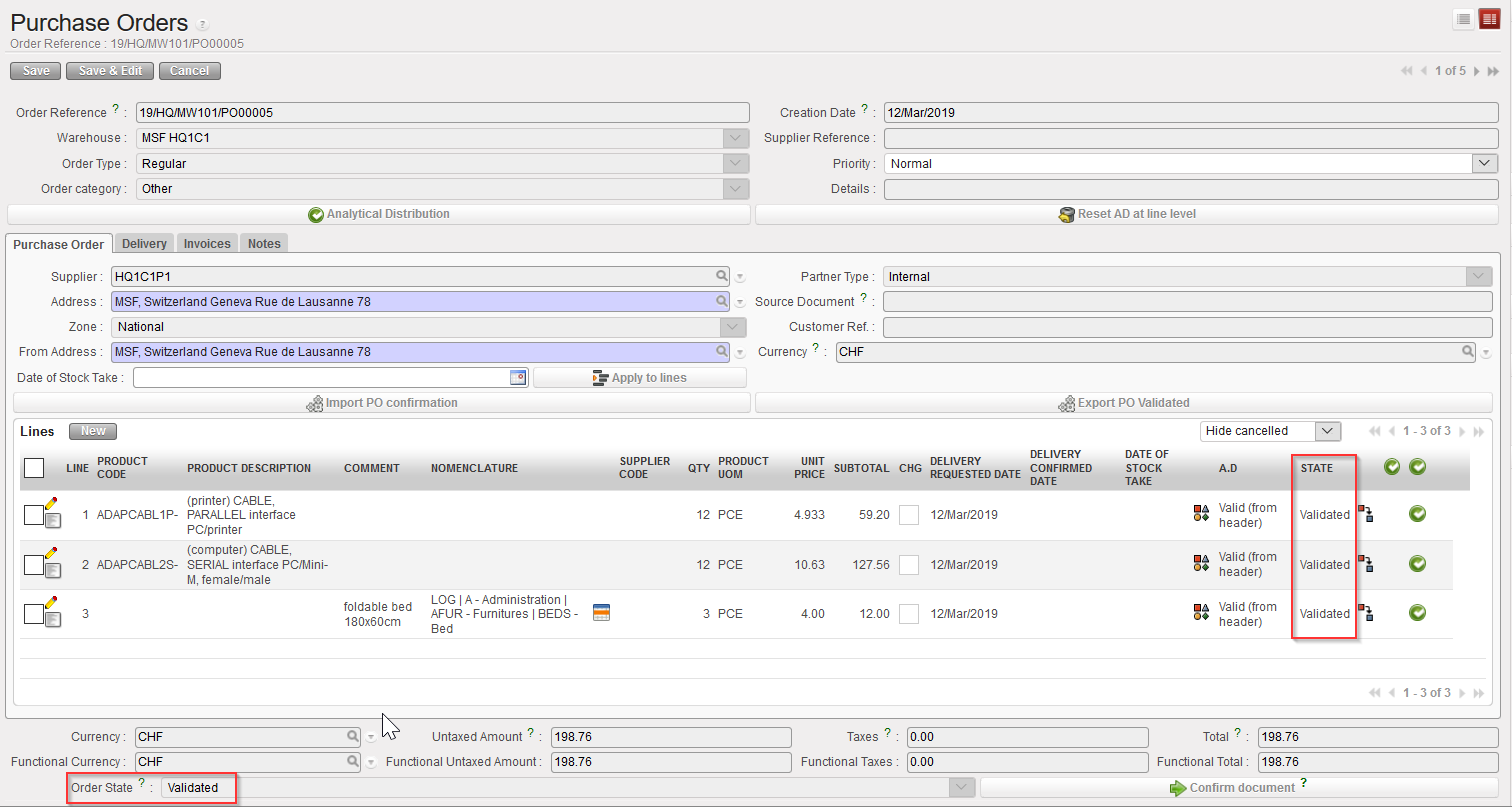
All the lines of the PO are validated. The PO state changed to “Validated“.

Purchase Order validated at header level

Note that for validated POs addressed to internal partners (i.e. POs which trigger the creation of FOs via synchronization), the system will show a warning message if they are opened (in edit or display mode) to inform the users that modification won’t be considered (as they should be done on the supplier instance). These PO can now be in local currency (if necessary) if all internal partners of the mission have been set accordingly.

Warning message on validated PO sent to internal partner

J. How to validate a Purchase Order.

Supply User Manual ENG -> 4. Procurement -> 4.6 LU-SU3201: Purchase Orders (POs) - Generals -> J. How to validate a Purchase Order.

J. How to validate a Purchase Order.

A Purchase Order can be validated at header level (the whole PO is validated) or at line level (1 or some lines of the PO are validated, while the others are left in draft).

Note that the validation at line level is only possible if your user has the appropriate user rights (i.e.the user should have the access group Sup_Valid_Line_PO).

H. a) How to validate a PO at header level

H. b) How to validate a PO at line level

I. How to Duplicate a Purchase Order.

Supply User Manual ENG -> 4. Procurement -> 4.6 LU-SU3201: Purchase Orders (POs) - Generals -> I. How to Duplicate a Purchase Order 

I. How to Duplicate a Purchase Order

UniField offers the possibility to duplicate a PO. This can be useful if you create similar POs on regular (e.g.monthly) basis.

The duplication creates a new PO in draft which is a copy of the duplicated PO with a new order reference. Most of the information is copied from the duplicated PO but some is not. Analytical distribution is not copied, source document reference is not copied, customer reference is not copied,… The creation date is set to today’s date.

Go to: Purchases / Purchase Management / Purchase Orders

  1. Click on the line of the Purchase Order to be duplicated (open the PO in display mode).
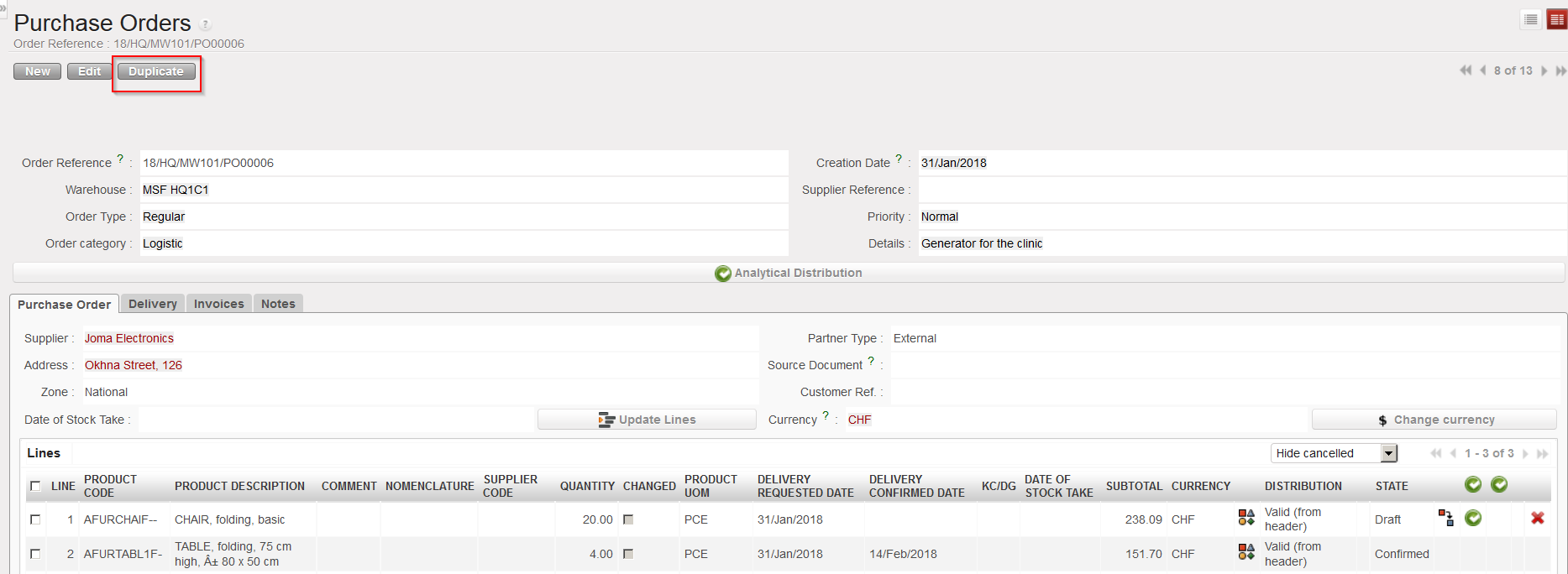
  2. Click on the “Duplicate” button at the top of the screen.
  3. A new draft PO will be created, which you can continue to process.
Purchase order, Duplicate button

G. How to update a Purchase Order.

Supply User Manual ENG -> 4. Procurement -> 4.6 LU-SU3201: Purchase Orders (POs) - Generals -> G. How to update a Purchase Order.

G. How to update a Purchase Order.

A Purchase Order may need to be updated, if the products, quantities, prices, supplier or any other information has changed after the PO has been created. Please note, if a PO-line has been validated and then synchronized to a supplier instance, it should not be changed after this at the point of origin. Similarly, once a PO-line has been confirmed by the supplier, any change on products, quantity, price,… should be made at the point of reception, not on a confirmed PO-line.

Purchase orders which have been addressed to an internal partner will usually be updated automatically via synchronization, when the supplier (internal partner) will update the corresponding FO.

You will often update manually Purchase Orders addressed to external partners (or ESC). After validation, the PO will be sent to the supplier. The supplier should then send you his order confirmation which should include correct prices, correct product codes, correct quantities, confirmed delivery date,… The PO should then be updated with this information before confirmation in the system.

If details of what needs to be ordered change significantly after confirmation, a new PO should be created, and the original PO should be cancelled (after communication with the supplier and when agreement has been reached on these cancellation terms).

PO sent to ESC can be updated (after validation, upon reception of the order confirmation from the ESC) via vertical integration. See specific paragraph on vertical integration in PO specifics.

Go to: Purchases / Purchase Management / Purchase Orders

  1. Select the Purchase Order to be updated by clicking on the pencil at the left of the appropriate row
  2. Make the appropriate changes
  • Change the supplier, enter the confirmed delivery date or update any information in the header of the order if needed.
  • Change a product, a quantity or a unit price if needed. (note that a change of quantity can impact a price change when in Draft and product is linked to a supplier catalogue)

Please note that there are now 2 options to “Edit” a PO product line: user can either click the pencil icon to update product directly on line or use the sheet icon which will open a product line pop up with a bit more information.

Updating a Purchase Order

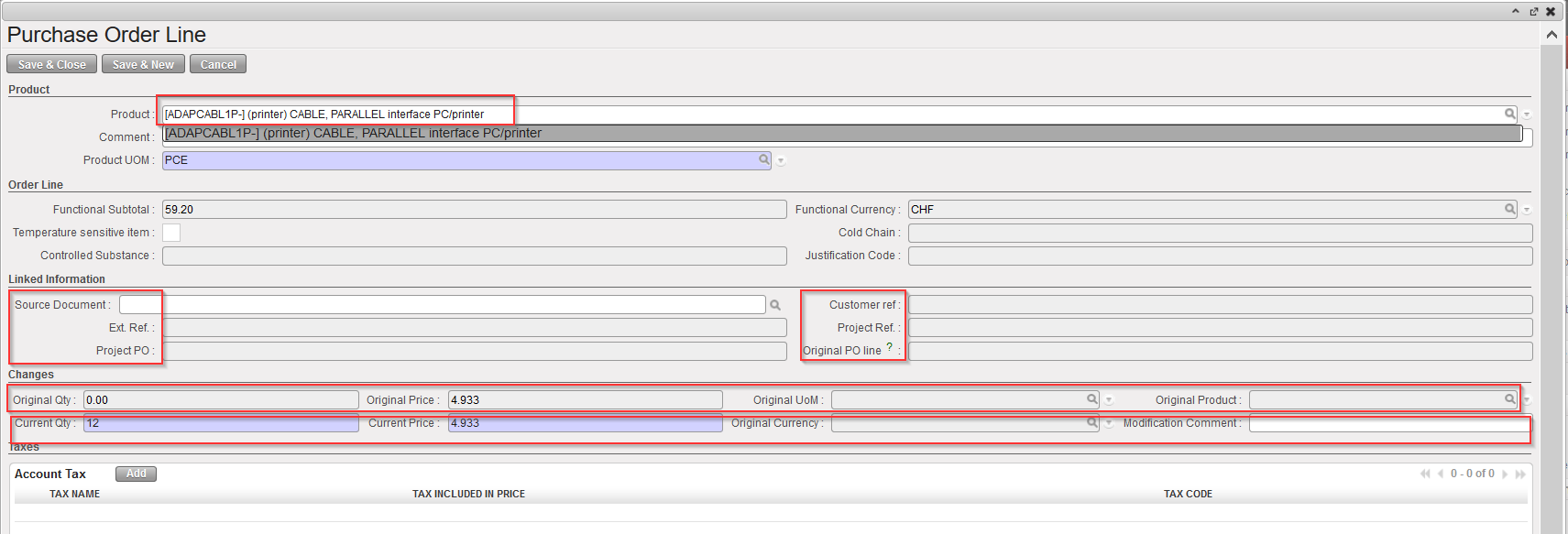
Among the additional information that can be found on the pop up are the one regarding the change, “CHG”, checkbox. This feature enables to track any change done on the PO line by comparing “current value” vs “original value” (Qty,Price,UoM or Product).

Optional to update currency if needed as below:
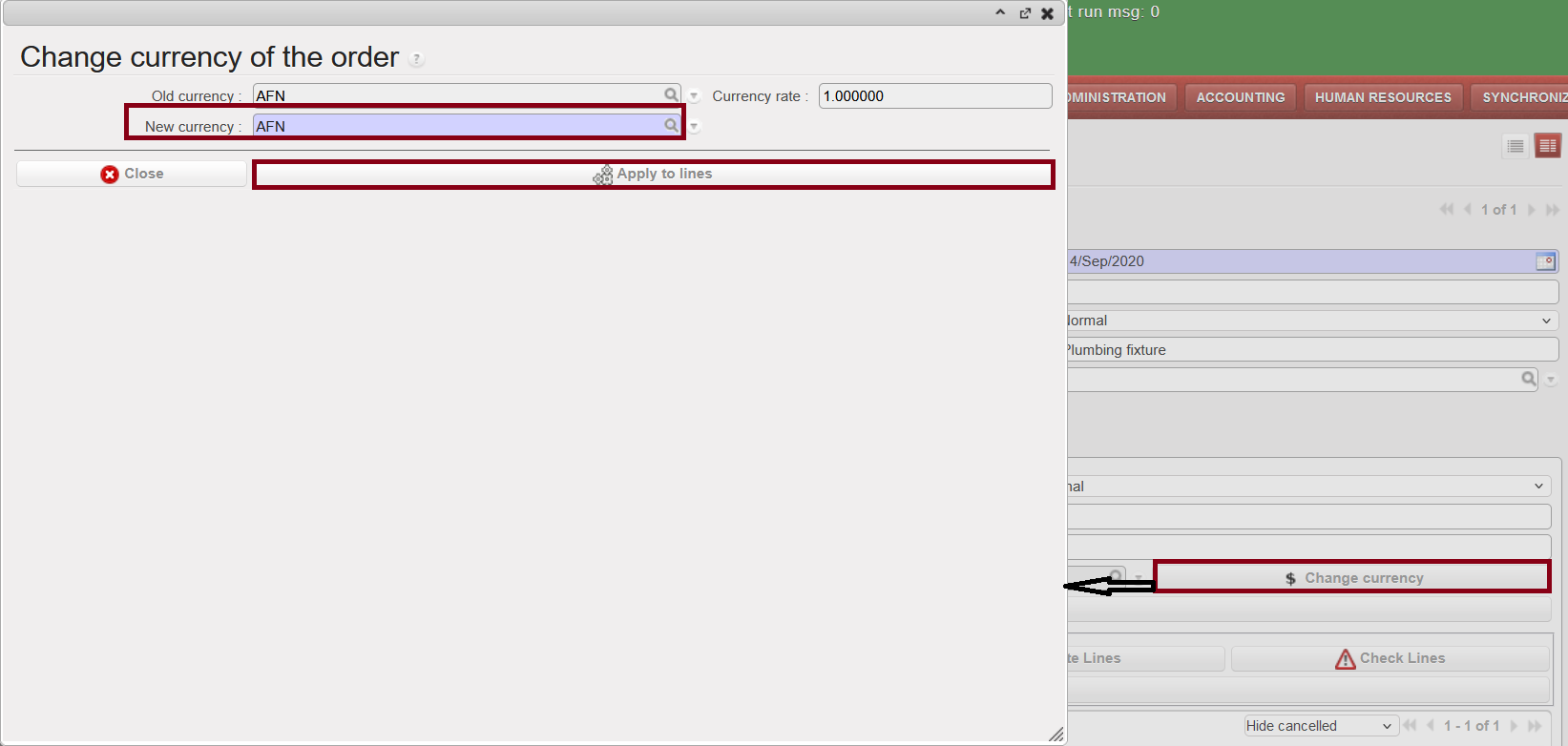

Updating a Purchase Order

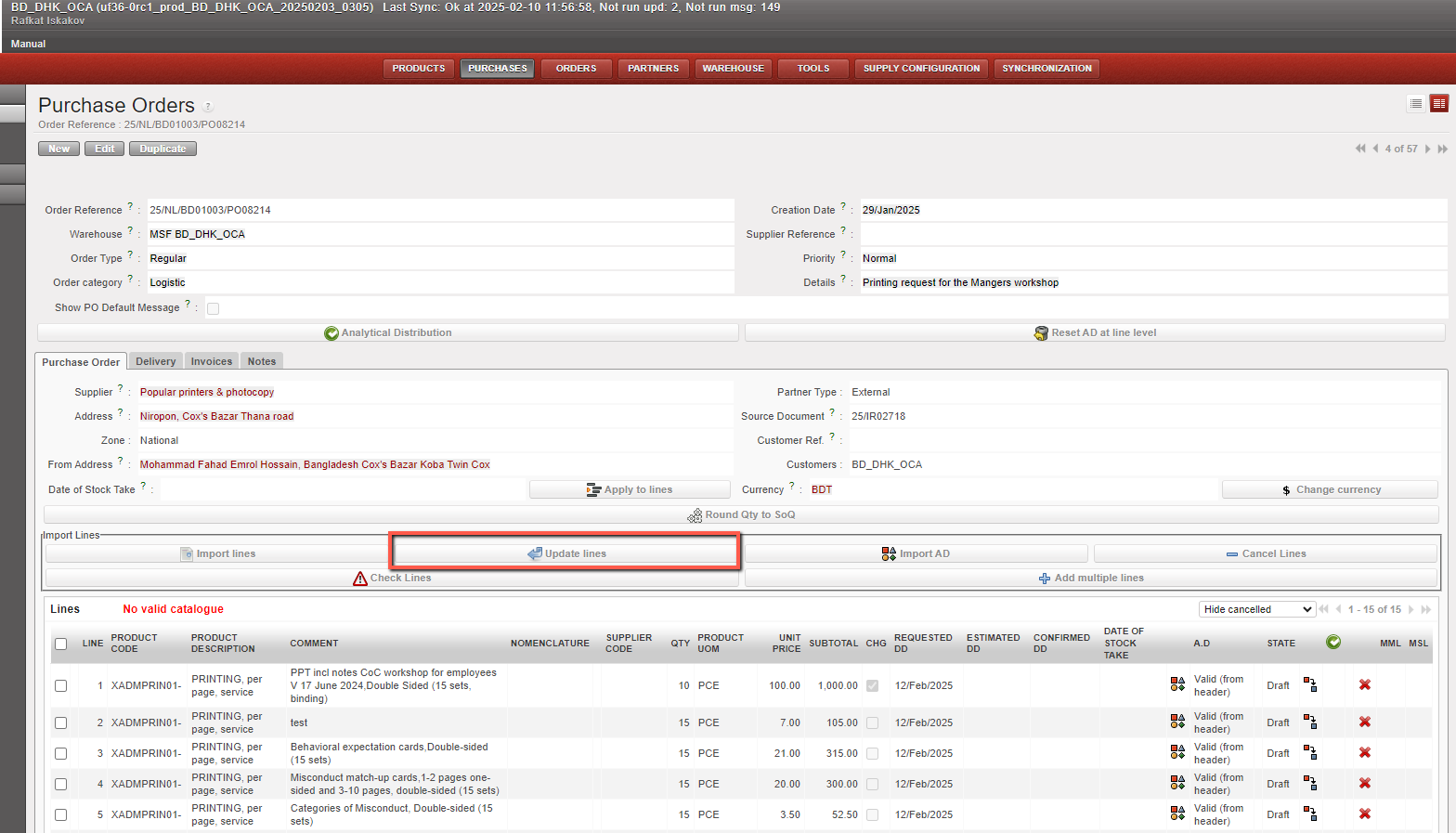
PO can be updated by Using Import functionality.

Button, “Update Line,” allows users to update the price, quantity, and comments of a line via import. The “Update Line” functionality is available in Draft (-p) status for all supplier types (Internal, External, ESC, IM, and IS). Import can also be performed in Validated (-p) status, but only if the supplier is External. Lines updated via import must correspond to respective statuses.

If a line item is Confirmed, Canceled, Closed, or Validated (for ESC, Internal, IS, and IM partners), the import will ignore that line. If any lines are ignored, UniField provides a clear message explaining which lines were not updated and why.

A user can use the “Update Line” function multiple times while the PO is in Draft (-p) status (or, in specific cases, in Validated (-p) status for external suppliers).
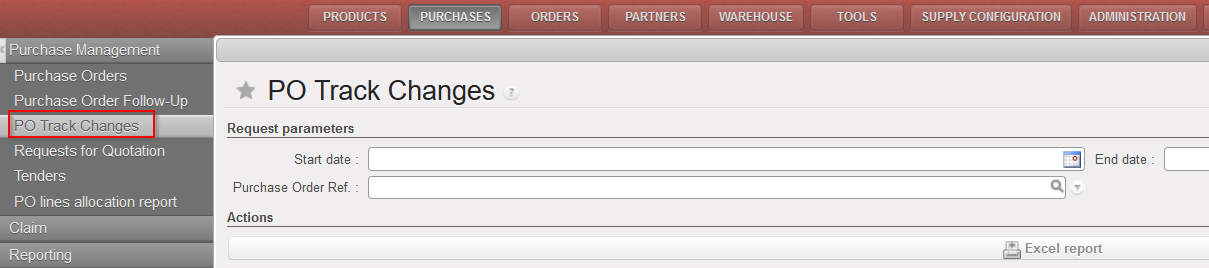
It is also possible to track the changes of Pos by using the report under “Purchases> Purchase Management > PO Track Changes

PO Track changes
PO Track changes -Excel export
  • Cancel a whole order line if needed by clicking on the red cross on the right side of the appropriate order line.
  • Adding a new line (only for “Draft” or “Validated” PO): addition of a new line to a sourced PO will require to fill the “Source document” field at line level with a non-Confirmed, non-Closed nor Cancelled IR/FO (of regular Order Type). If the Source document reference is different from the one existing at PO header, then the new reference will be added as well a the “Source document” header level.

3. Click the “Save” button on the top of the screen.
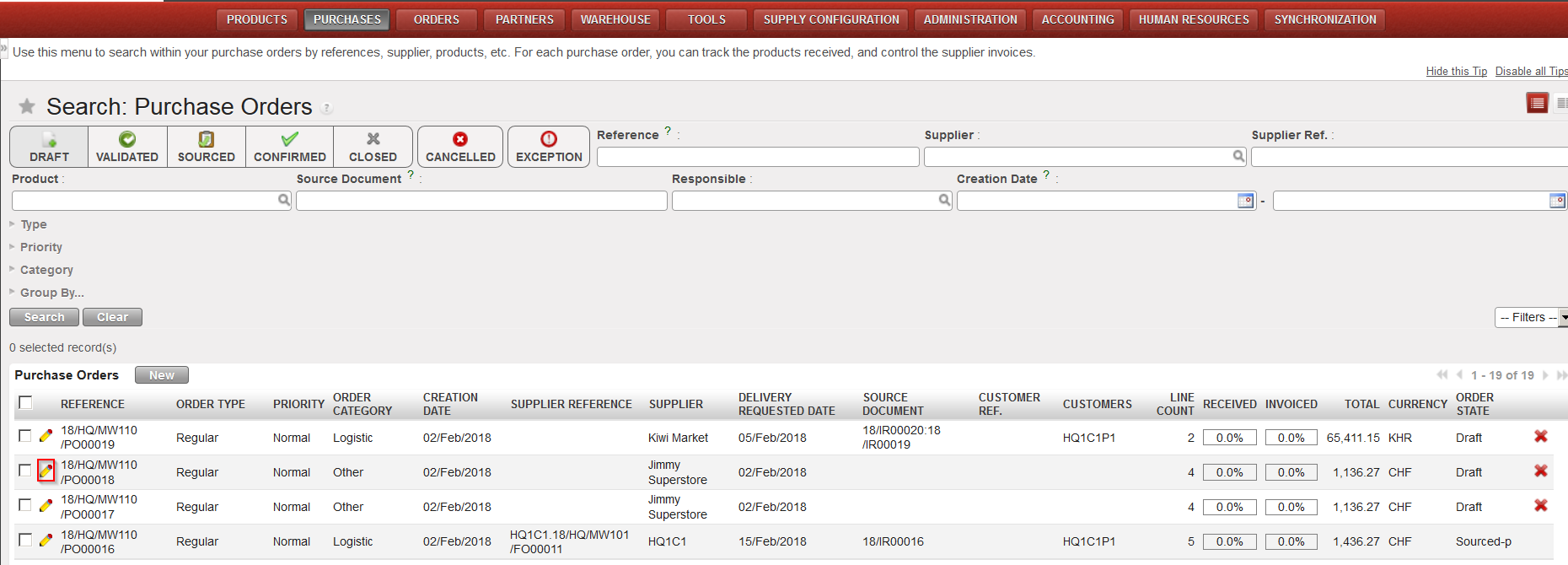
Updating a Purchase Order


Please note:


  1. It is important that the most recent (updated) version of your PO is printed and signed before it is validated in the system – please refer to your OC guidelines.
  2. It is not possible to add lines in requesting instance once a synchronized PO is validated, any change must be in the supplier instance.

F. How to Merge Purchase Orders.

Supply User Manual ENG -> 4. Procurement -> 4.6 LU-SU3201: Purchase Orders (POs) - Generals -> F. How to Merge Purchase Orders.

F. How to Merge Purchase Orders.

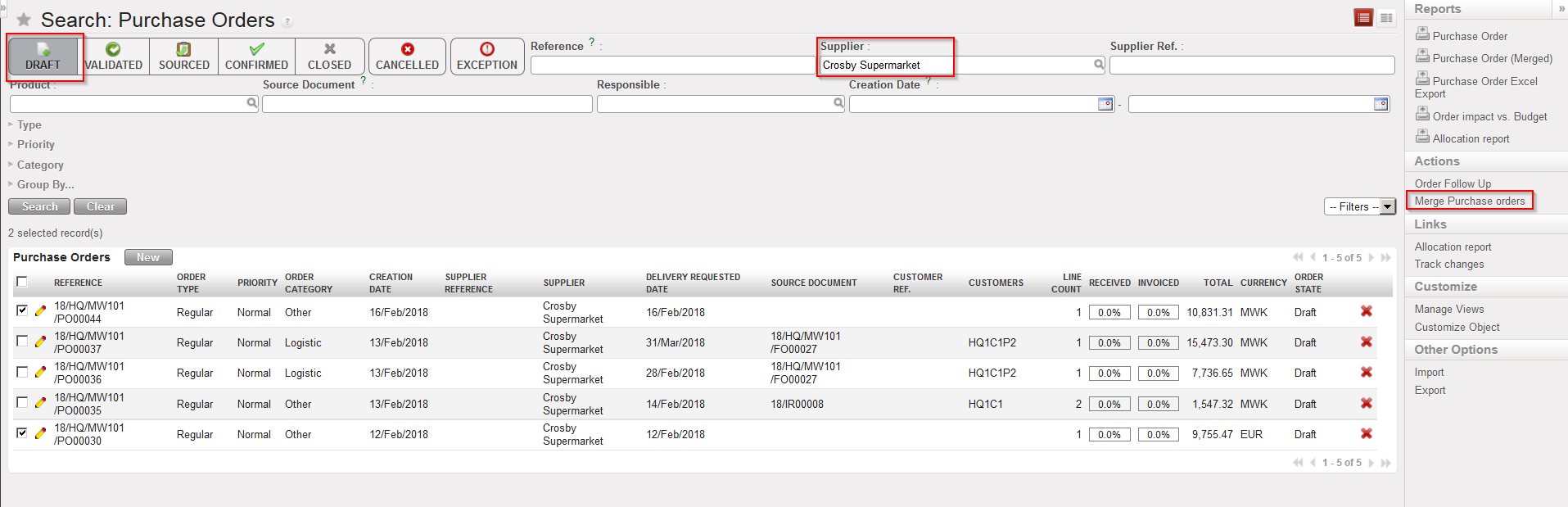
UniField allows the merging of several POs if they are in the state “Draft” and are addressed to the same supplier.

Go to: Purchases / Purchase Management / Purchase Orders

  1. Use the check boxes to select the Purchase Orders you want to merge (make sure they are in the state “Draft” and are addressed to the same supplier).
  2. Click the option “Merge Purchase orders” in the action menu.
Selecting POs for merging

3. A message appears to inform the user about the merge that he/she is about to do.

Information such as Sourcing Group and Destination Partner (for DPO) if different in both Pos will be taken from the template PO.

Message before POs merging

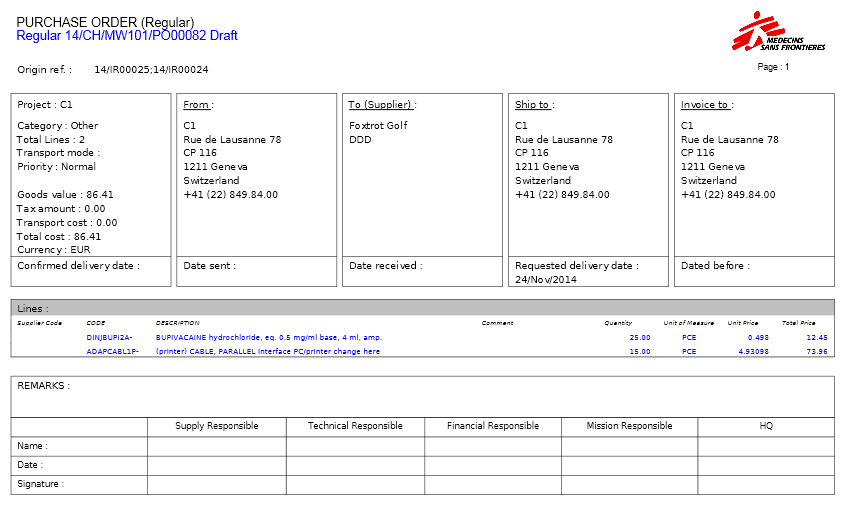
A report related to POs merging is also available. It displays multiple Internal Requests which were sourced to the same supplier. The output reporting format is a PDF document ready for validation.

Go to: Purchases / Purchase Management / Purchase Orders

  1. Click on the check box on the left part of the screen of the line of the Purchase Order to print.
  2. The Action Menu is displayed on the right end of the screen.
  3. Click on the “Purchase Order (Merged)” option.
  4. The PO will be exported in PDF format.
PDF version of a merged PO