C. HOW TO CREATE A DELIVERY ORDER FROM SCRATCH

Supply User Manual ENG -> 5. Warehouse -> 5.6 LU-SU4105: Delivery Orders -> C. HOW TO CREATE A DELIVERY ORDER FROM SCRATCH

C. HOW TO CREATE A DELIVERY ORDER FROM SCRATCH

Most of the Delivery Orders are generated automatically after confirmation of an IR-line with an External Consumption Unit as “Location Requestor” or after conversion of Picking Ticket to Simple Out.

However, UniField offers the opportunity to create Delivery Orders from scratch in specific cases. Note that this is not the standard process. Refer to your OC processes to know if and when creation of OUT from scratch should be done.

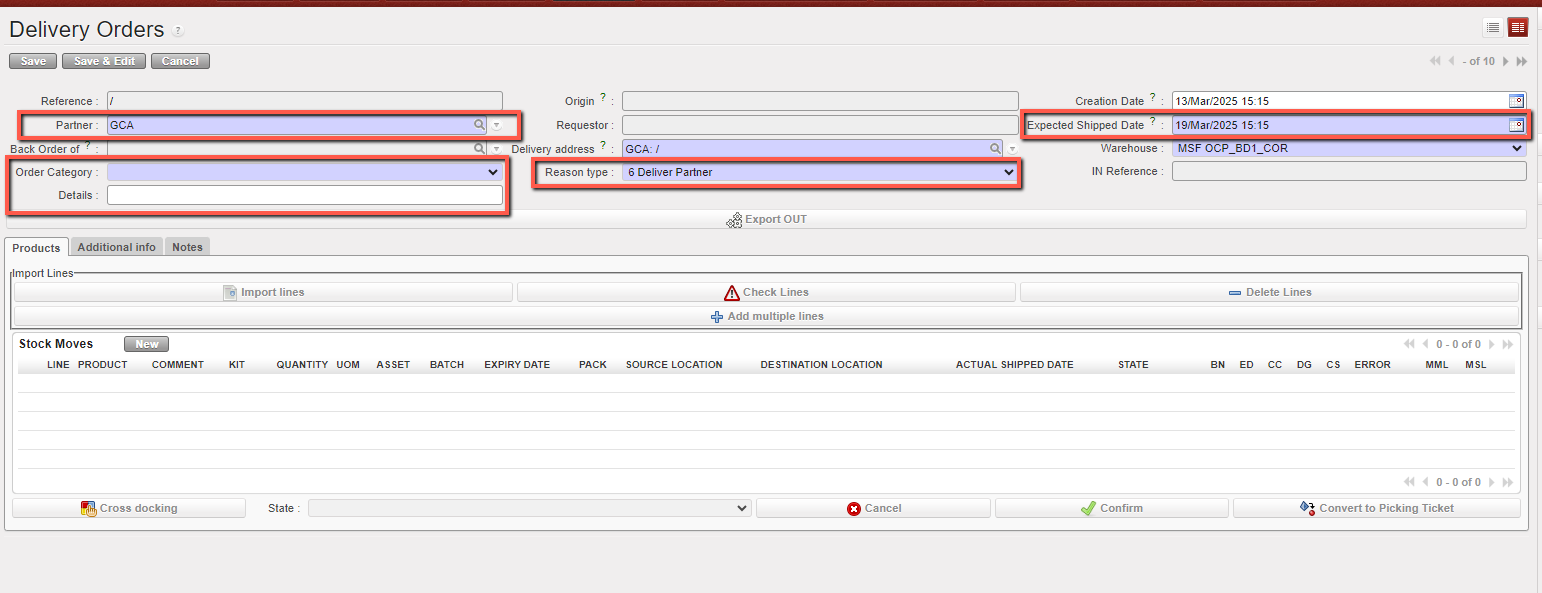
Go to: Warehouse / Warehouse Management / Deliveries / Delivery Orders

  1. Click on the “New” button.
  2. Enter a “Partner“.
  3. Enter an “Expected Shipped Date
  4. Check the “Reason type” is correct, the default is “6 Deliver Partner” but at line level will be sending good to an External partner “Reason type” should be “6 Deliver Partner”.
  5. Select Order Category. The default value is empty, and the user can select one of the following options: Logistic, Medical, Service, Transport, or Other.
  6. You can enter the OUT’s name, or any details related in the “Details” field.

Creating a Delivery Order from scratch

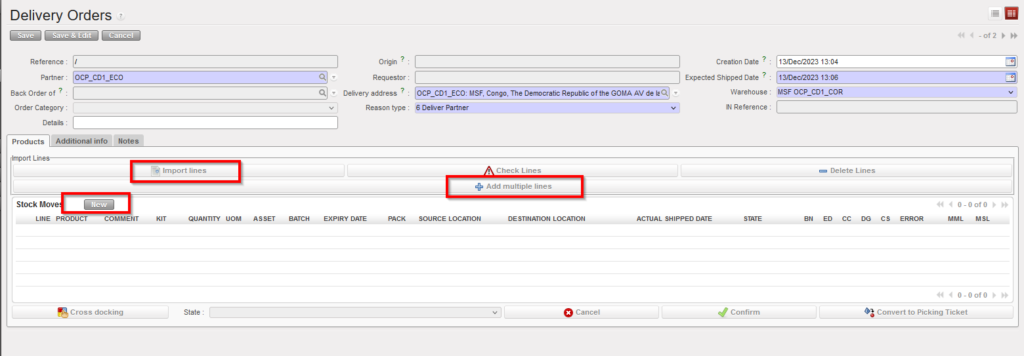
7. Create product lines by clicking on the “New” button, on top of the “Stock Moves” table. Alternatively, you may also use the buttons “Add multiple lines” to add several lines to the OUT in one step or “Import lines” to import an Excel file.

This image has an empty alt attribute; its file name is out-1.png

Creating a Delivery Order from scratch

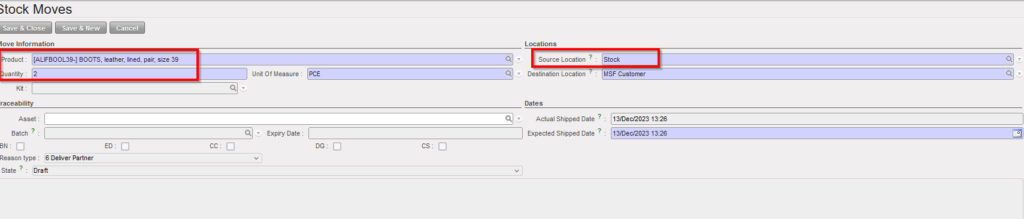
8. On the “Stock Moves” window, enter a product, a quantity and a destination location. Note that the default source location is “Stock“.

If a product does not correspond to the selected category, the user will receive a non-blocking warning message.
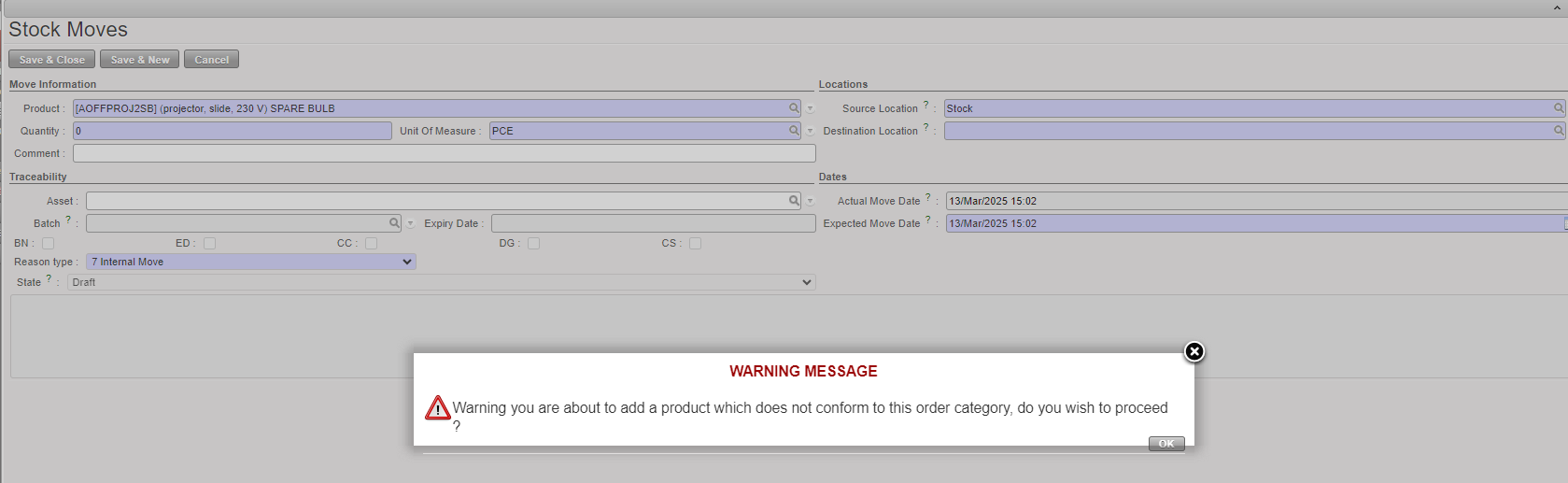
9. Click on the “Save & Close” button to save the line and return to the main OUT screen or on the “Save & New button” to save the line and add a new one.

This image has an empty alt attribute; its file name is out2.png

Inserting a line on a Delivery Order

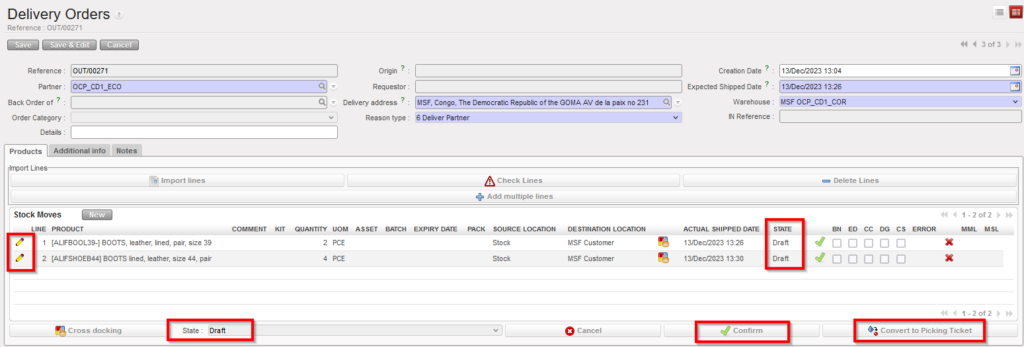
10. Once back on the main OUT screen, you have several options.

This image has an empty alt attribute; its file name is out3.png

Main OUT screen

You may edit the lines via the pencil icons and change source and destination location if needed.

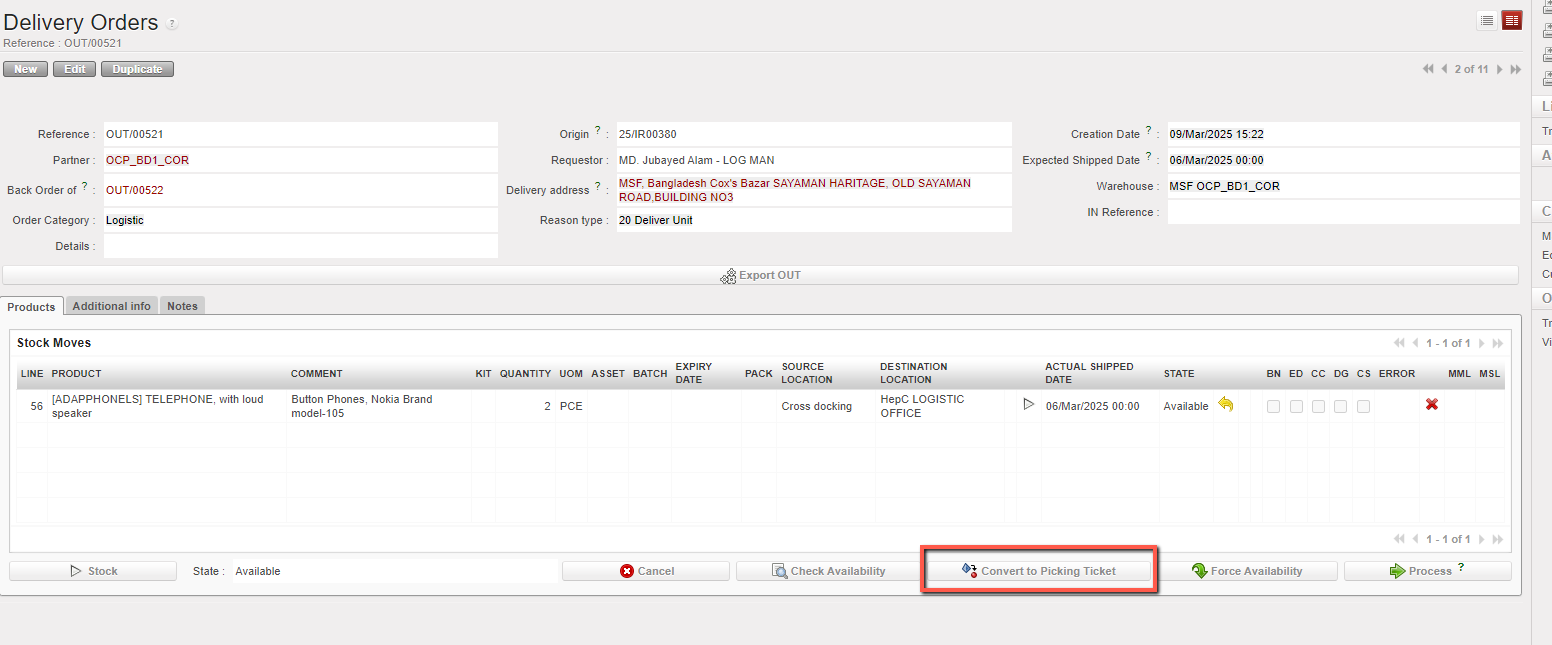
You may also convert the OUT into a PICK if you click on the “Convert to Picking Ticket” button. This is the opposite functionality to the one described in the previous section.

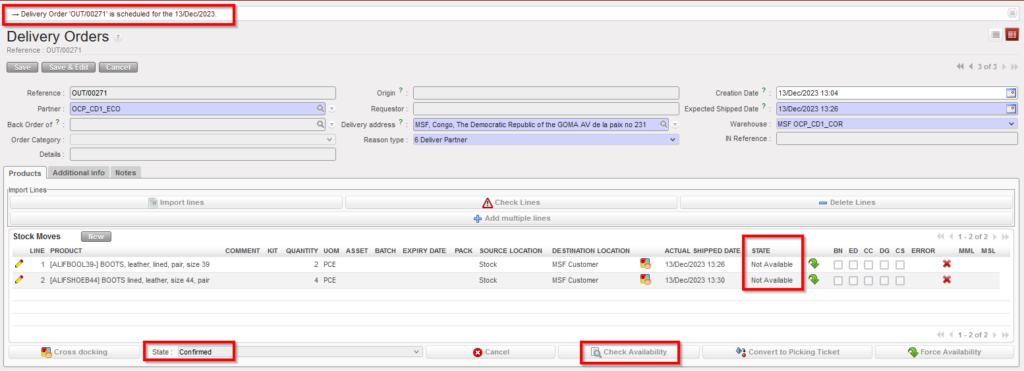
The Delivery Order is created in the state “Draft” as well as all its lines. It is not possible to check the availability of the products if the OUT is in this state.

11. Click on the “Confirm” button.

This image has an empty alt attribute; its file name is out4.png

Confirmed Delivery Order

The state of the Delivery Order switches to “Confirmed“. Note that the state of the lines is “Not Available“. It is now possible to check the availability of the products.

12. Click on the “Check Availability” button located at the bottom of the screen.

This image has an empty alt attribute; its file name is out5.png

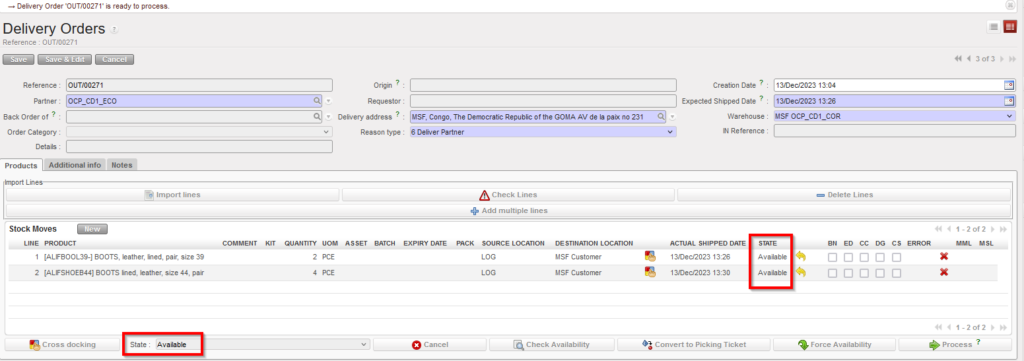
Available Delivery Order

If at least one product line from the OUT is “Available“, the state of the OUT switches to “Available” and you will then be able to process this OUT (see next section).

Remember that creating Delivery Orders from scratch should only be done in exceptional circumstances.


B. HOW TO CONVERT A PICKING TICKET INTO A DELIVERY ORDER (Simple Out Delivery / OUT); B.1. HOW TO CONVERT A DELIVERY ORDER (Simple Out Delivery / OUT) INTO A PICKING TICKET

Supply User Manual ENG -> 5. Warehouse -> 5.6 LU-SU4105: Delivery Orders -> B. HOW TO CONVERT A PICKING TICKET INTO A DELIVERY ORDER (Simple Out Delivery / OUT); B.1. HOW TO CONVERT A  DELIVERY ORDER (Simple Out Delivery / OUT) INTO A PICKING TICKET

B. HOW TO CONVERT A PICKING TICKET INTO A DELIVERY ORDER (Simple Out Delivery / OUT)

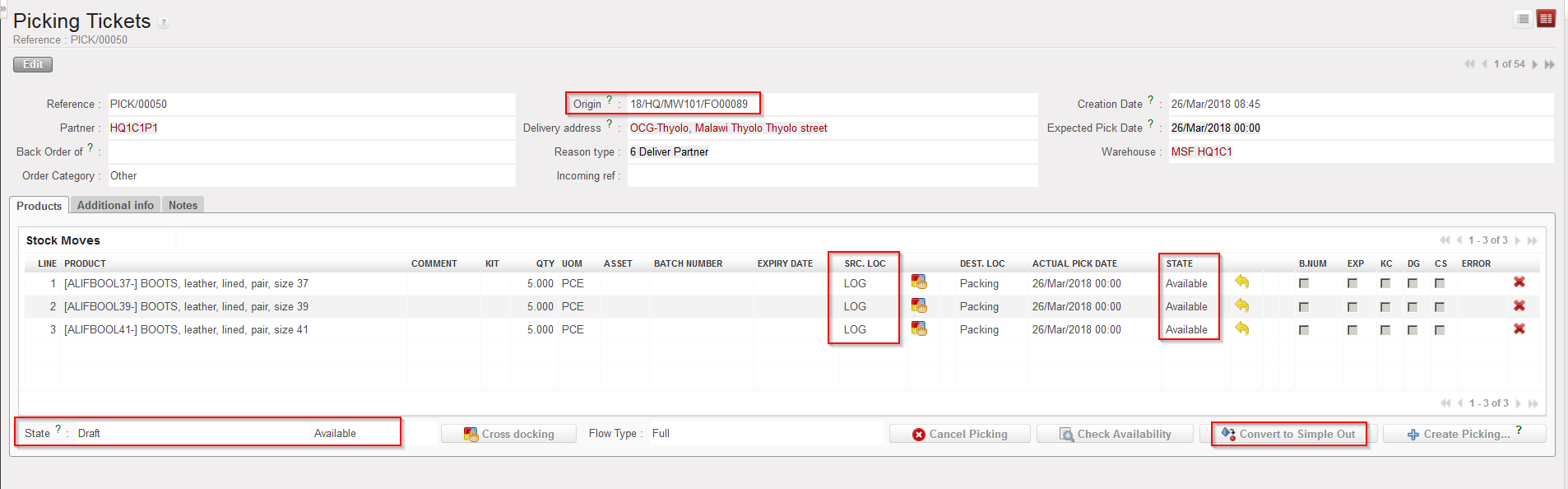
In the below example, an FO has been sourced from stock. As a consequence, a PICK has been created. This section explains how to convert this PICK into an OUT.

Go to: Warehouse / Warehouse Management / Deliveries / Picking

  1. Locate and open the Picking Ticket you wish to convert (it should be a main PICK).
  2. Check the content of the Picking Ticket, including source location and availability of the products.
  3. Click on the “Convert to Simple Out” button at the bottom of the page.

Picking Ticket

Note that in the above example, the Picking Ticket is “Available” and all its lines are “Available“.

Note that in the above example, the destination location of the products is “Packing“.

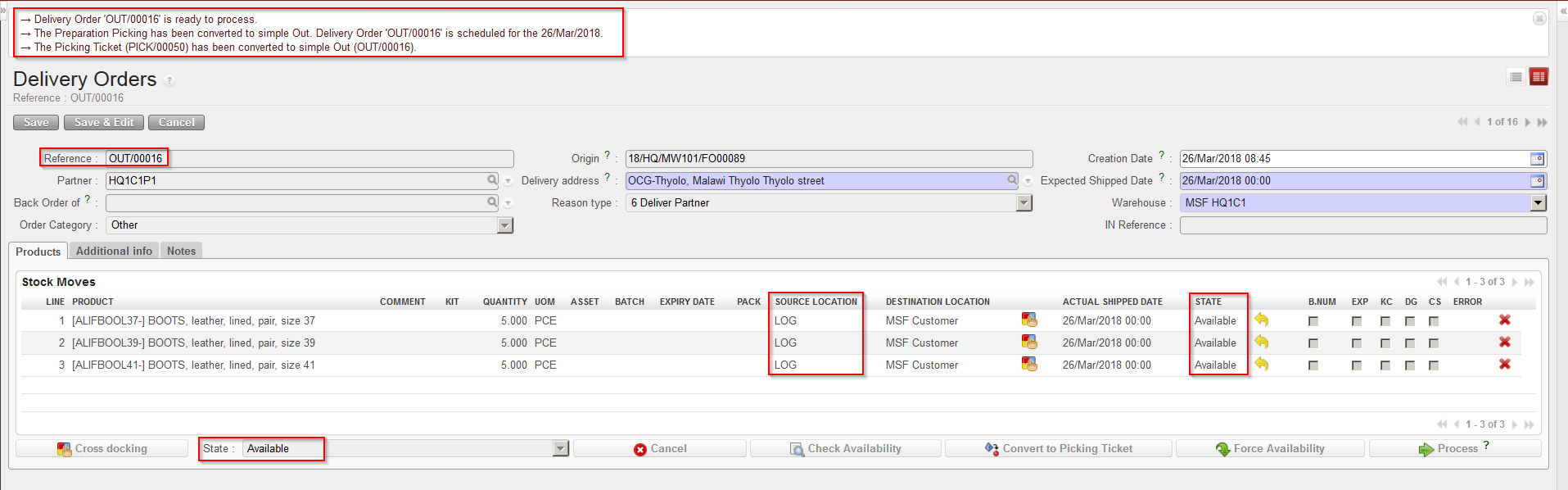
Delivery Order

The Picking Ticket has been converted into a Delivery Order. Note that the source location did not change while the destination location changed from “Packing” to “MSF Customer” (in the above example, because the customer is another UniField instance). The Delivery Order has the state “Available“. Product lines keep the state “Available“.

The “Reason type” will not be changed in this OUT.

If the PICK/OUT has been created from an “Regular” type FO, the “Reason type” will be “Deliver Partner”. “Donation before Expiry” if it has been created from “Donation before Expiry” FO.                          “Standard Donation” if it has been created from “Standard Donation” FO.                                           “Loan” if it has been created from “Loan” FO.

The example used above is quite simple as the objective was to illustrate the conversion principle. But you may have more complex situations with FOs partially validated, FOs partially sourced, FOs sourced partly from stock and partly on order, POs partially validated or partially confirmed, IN partially received, picking process already initiated, PICK partially picked, cancellation or cancel and resource used during the process,… These different situations will have various consequences on the conversion from PICK to OUT.

B.1. HOW TO CONVERT A DELIVERY ORDER (Simple Out Delivery / OUT) INTO A PICKING TICKET

In the below example, an IR has been sourced from stock. As a consequence, a OUT has been created. This section explains how to convert this OUT  into an PICK.

Go to: Warehouse / Warehouse Management / Deliveries / Delivery Orders

  1. Locate and open the Delivery Order (OUT) you wish to convert
  2. Click on the “Convert to Picking Ticket” button at the bottom of the page.

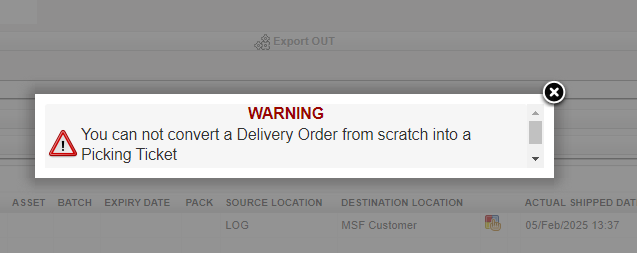
If the OUT is created from scratch “Convert to Picking ticket” option is blocked by the system with a warning message

5.6 DELIVERY ORDERS.

Supply User Manual ENG -> 5. Warehouse -> 5.6 LU-SU4105: Delivery Orders.

LU-SU4105: Delivery Orders.

A. LU INTRODUCTION

B. HOW TO CONVERT A PICKING TICKET INTO A DELIVERY ORDER (Simple Out Delivery / OUT)

C. HOW TO CREATE A DELIVERY ORDER FROM SCRATCH

D. HOW TO PROCESS A DELIVERY ORDER

E. HOW TO EXPORT AN EXCEL DELIVERY ORDER FILE

F. HOW TO IMPORT AN EXCEL DELIVERY ORDER FILE

G. HOW TO CONFIRM RECEPTION OF A DELIVERY ORDER

H. HOW TO CANCEL AN “OUT”

I. HOW TO CANCEL & RESOURCE AN “OUT”

J. DELIVERY ORDERS REFERENCES

G. CLOSED SHIPMENT LISTS

Supply User Manual ENG -> 5. Warehouse -> 5.5 LU-SU4104: Shipment -> G. CLOSED SHIPMENT LISTS

G. CLOSED SHIPMENT LISTS

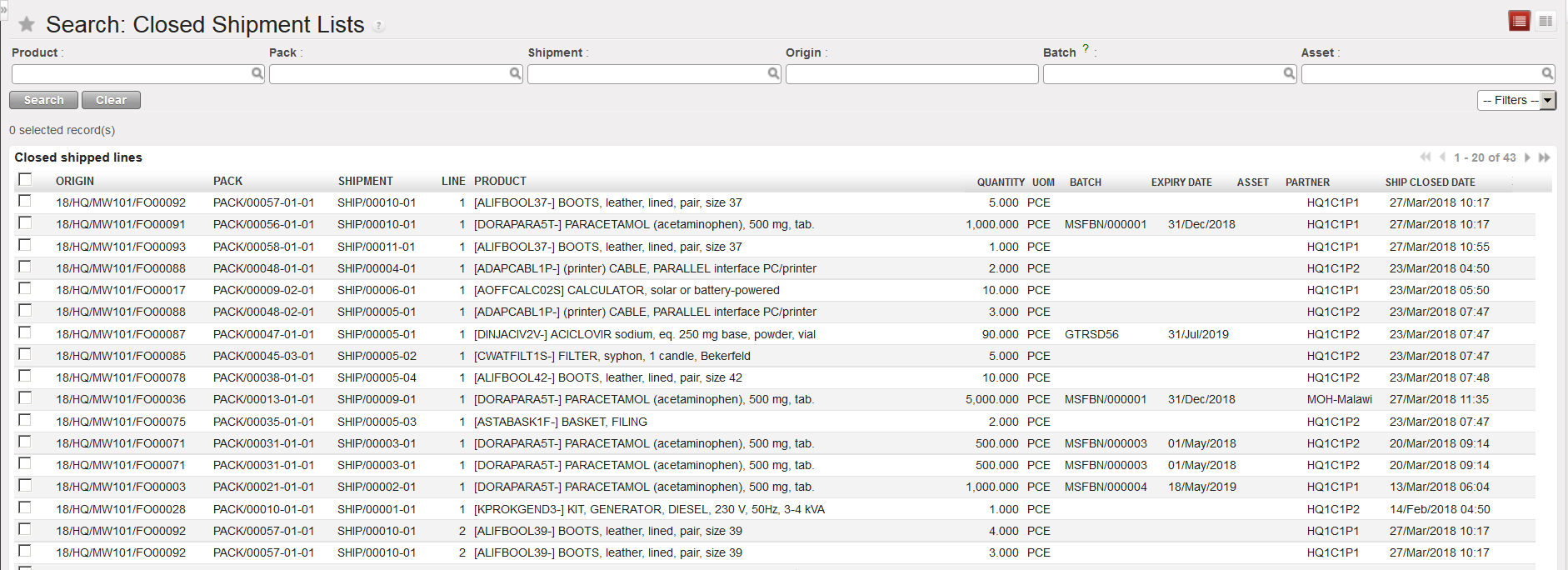
This functionality allows analyzing Shipments which are “Dispatched” or “Received“. It shows FO reference, PACK reference, SHIP reference, product, quantities, batches (BN/ED) and partners and allows filtering according to different criteria. It can be used to search shipped products within existing shipments.

Go to: Warehouse / Warehouse Management / Deliveries / Closed Shipment Lists

Closed Shipment Lists

Filters can be used to further define what should be showed.

F. HOW TO VALIDATE DELIVERY OF A SHIPMENT

Supply User Manual ENG -> 5. Warehouse -> 5.5 LU-SU4104: Shipment -> F. HOW TO VALIDATE DELIVERY OF A SHIPMENT

F. HOW TO VALIDATE DELIVERY OF A SHIPMENT

Once a delivery has been received by the consignee, this reception at the customer side should be reflected in UniField. On the Shipment, we can “Validate the delivery“.

If a shipment has been shipped to another UniField instance, the reception of the goods on the requesting instance will validate the delivery automatically via the synchronization. As explained in the previous section, once the shipment has been validated (i.e. is in “Dispatched” state), the synchronization will switch the state of the corresponding Incoming Shipment(s) on the requesting instance from “Available” to “Available Shipped”. It is only from this stage that the Incoming Shipment(s) should be processed on the requesting instance. Once done, the synchronization will validate the delivery on the supplier instance (i.e. state of the shipment will switch from “Dispatched” to “Received“).

If a shipment has been shipped to an external partner (i.e. to a partner who is not using UniField), no synchronization is involved, and the “validation of the delivery” should be done manually on the Shipment.

Go to: Warehouse / Warehouse Management / Deliveries / Shipment

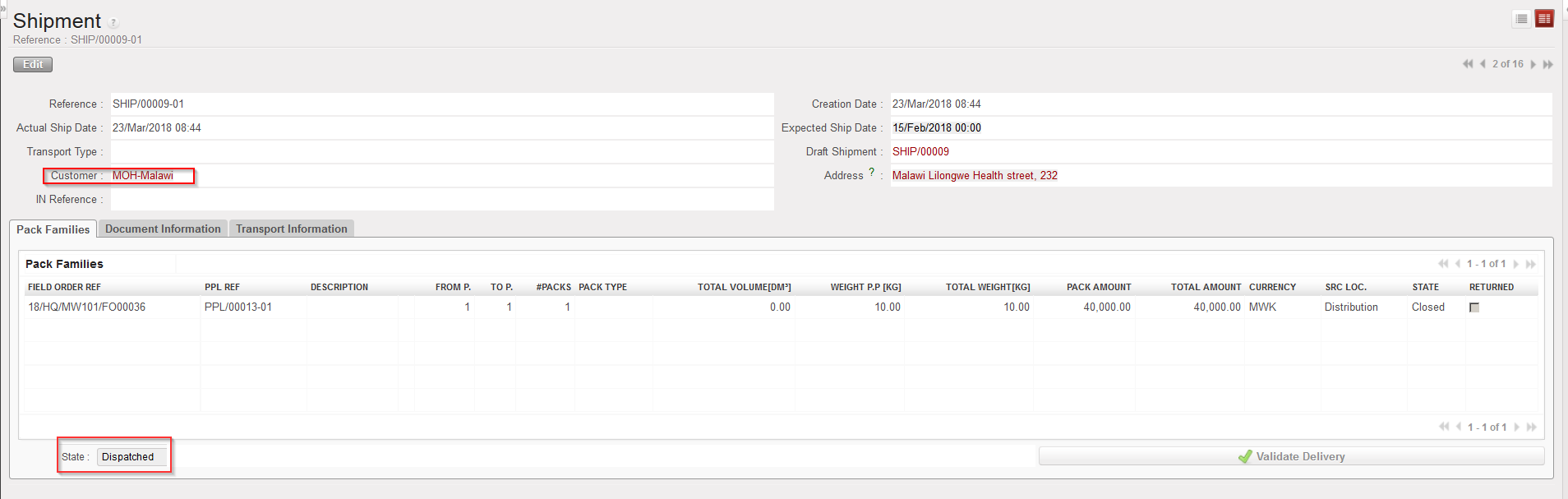
  1. Open the Shipment on which you want to validate the delivery. It should be a sub SHIP in the state “Dispatched” and the customer should be an external partner.
Shipment in “Dispatched” state

2. Click on the “Validate Delivery” button.

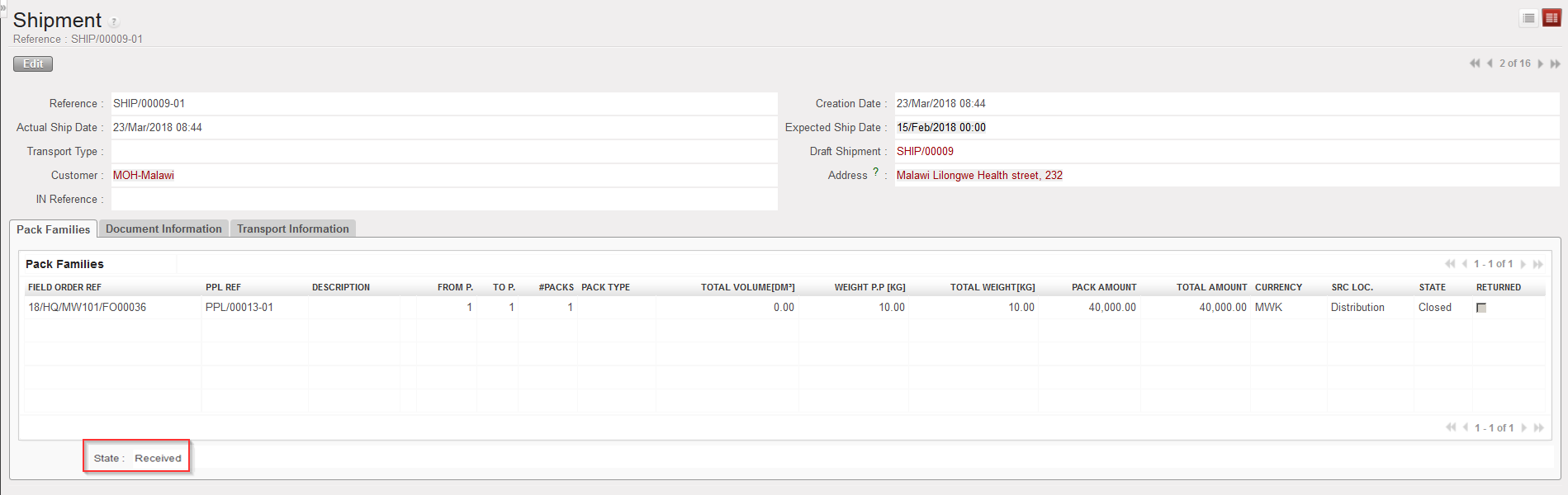
Shipment in “Delivered” state

The shipment switches to the state “Received“.

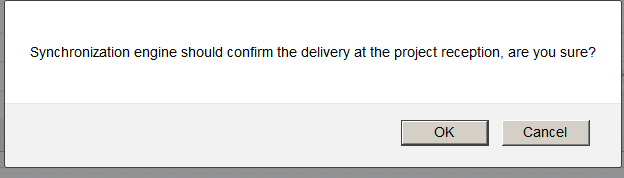
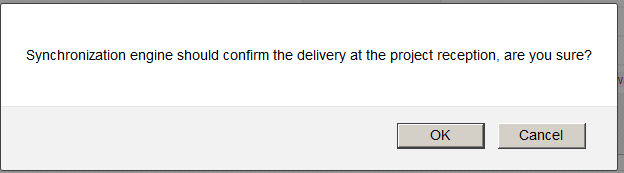
Note that if you try to validate the delivery on a shipment manually while it should be done by the synchronization (i.e. if the customer is another instance), you will get the below message.

Message when trying to validate a delivery on a Shipment while it should be done by the synchronization.

You may force the message and click on “OK” to change the state of the Shipment to “Received” but it is better to let the synchronization do this action.

E. HOW TO VALIDATE A SHIPMENT

Supply User Manual ENG -> 5. Warehouse -> 5.5 LU-SU4104: Shipment -> E. HOW TO VALIDATE A SHIPMENT

E. HOW TO VALIDATE A SHIPMENT

A (sub) Shipment has to be validated once it has been dispatched. The state of the (sub) Shipment will then switch to “Dispatched“. This means there will be no more option to return the parcels back to the (main) Shipment or to stock (as explained in the 2 previous sections).

Validating a shipment will also consume the products, transferring them from the “Distribution” location to the “MSF Customer” location if the customer is another instance or to the “Other Customer” location if the customer is an external partner. Note that these 2 destination locations are “Partners” locations.

Therefore, it is important to validate the Shipment only when you are sure that the goods were all sent.

Go to: Warehouse / Warehouse Management / Deliveries / Shipment

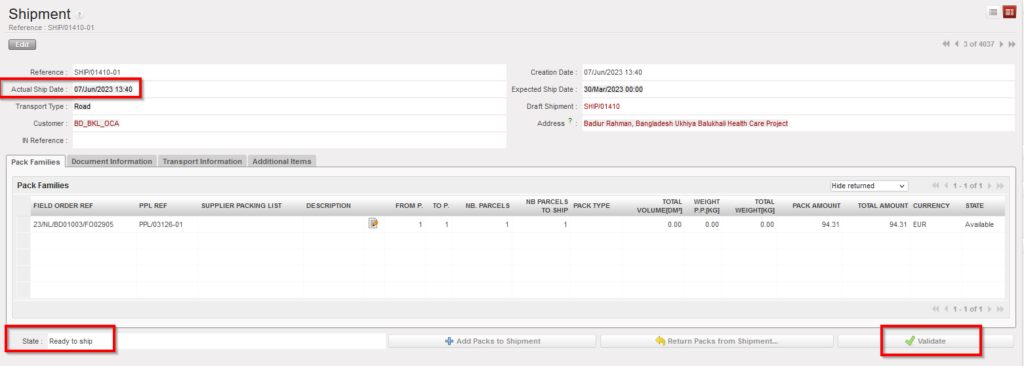
  1. Locate the Shipment you wish to validate (its state should be “Ready to ship“).
  2. Click on the green icon (which when you hover over it says “Validate”) on the right side of the screen on the appropriate line. Another option is to click on the “Validate” button from within the Shipment (nb: this process has been detailed above at the end of section B).
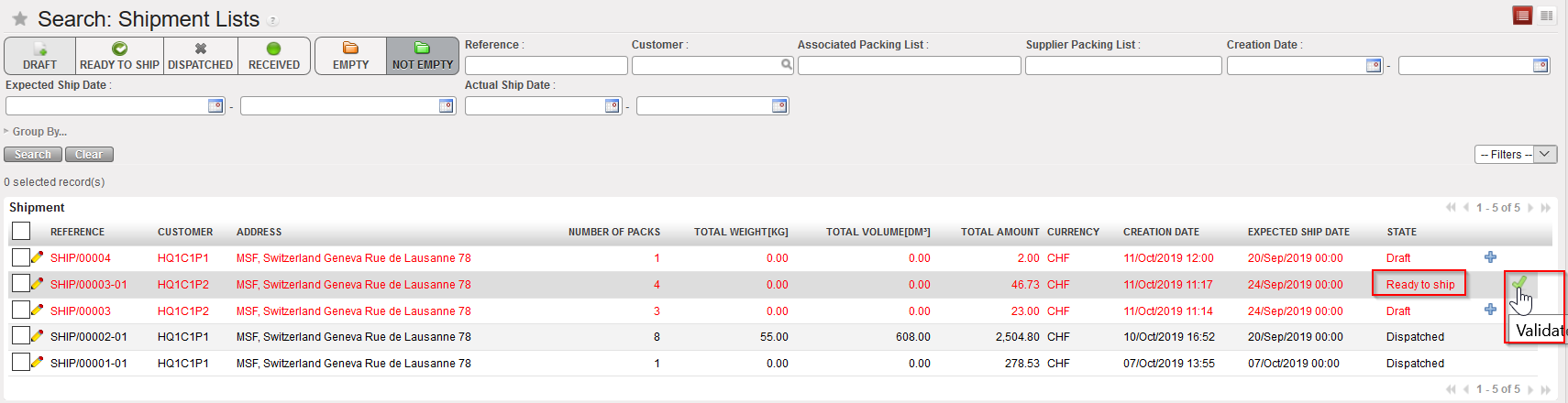
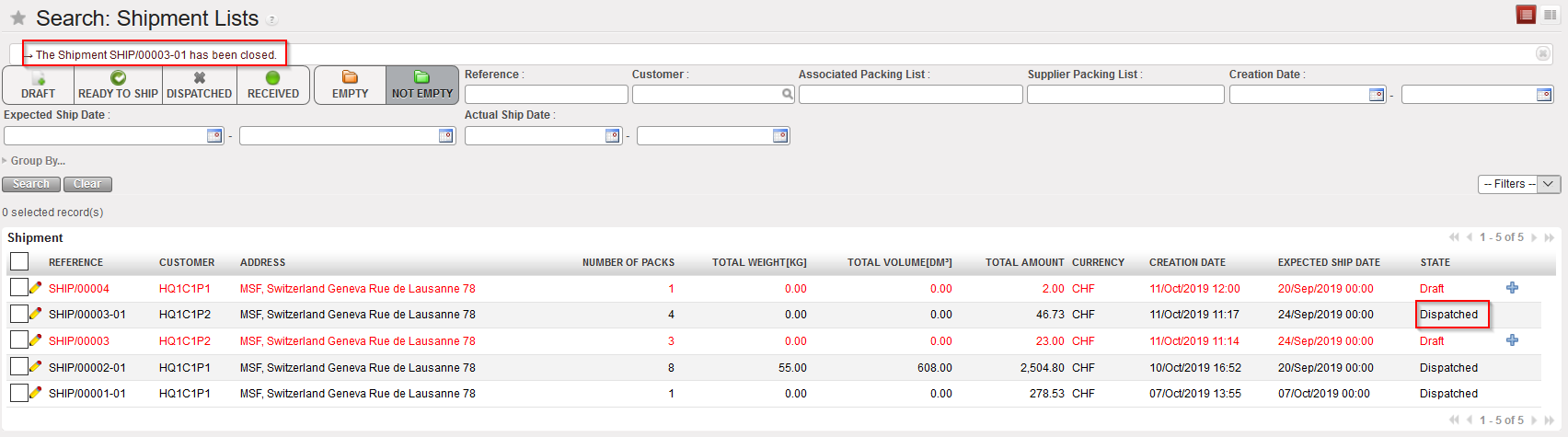
Validating a Shipment

Validated Shipment

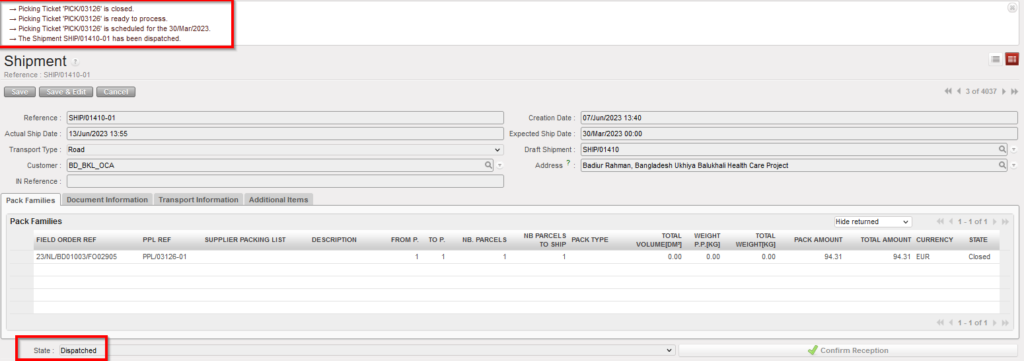
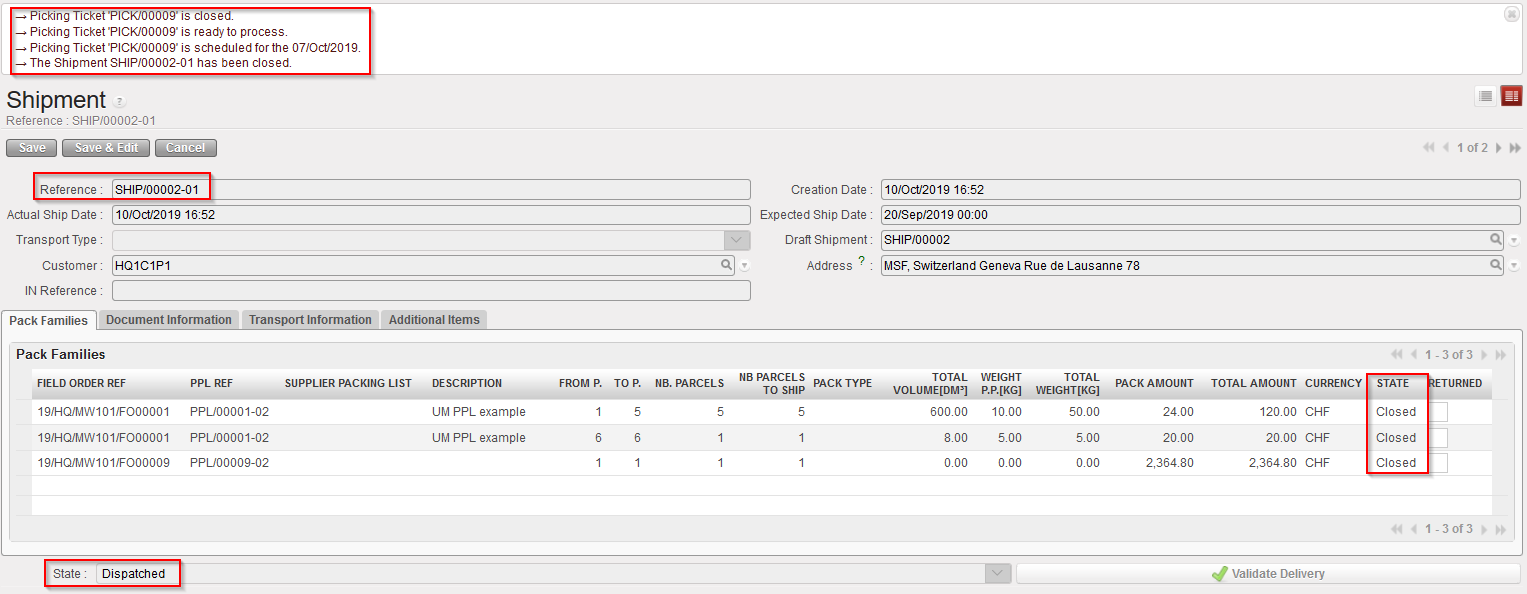
Shipment is validated (it switches to the state “Dispatched“) and the corresponding Picking Tickets are closed if relevant.

You can also validate the shipment while it is open:

Go to: Warehouse / Warehouse Management / Deliveries / Shipment

  1. Open the Shipment on which you want to validate, (its state should be “Ready to ship“).
  2. Click on the  “ Validate” button, pop-up screen will be displayed, asking to confirm the “Actual Ship Date”, you can change the date or leave it as it is and validate the shipment.

This image has an empty alt attribute; its file name is ship-validate-1024x366.png

This image has an empty alt attribute; its file name is pop-up-1024x113.png
Pop-up Screen
This image has an empty alt attribute; its file name is ship-final-1024x361.png
Shipment after validation

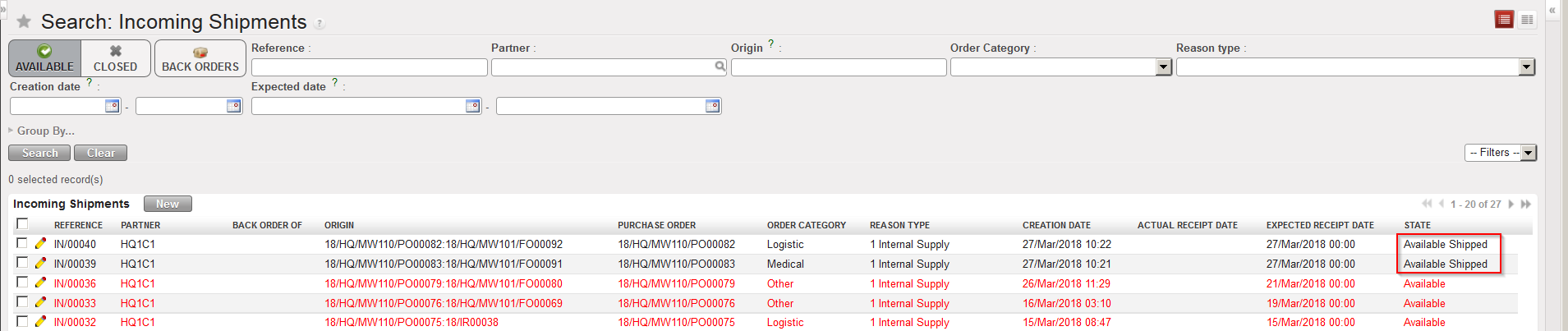
It is important to note that if a synchronization is done after validation of a Shipment, the related Incoming Shipment(s) at the requesting instance (often project) will switch from the state “Available” to the state “Available Shipped” and all the information will be carried on (products, quantities, expiry dates, batch numbers, packing information, volume, weight, form P , to P……).

Incoming Shipments in state “Available Shipped”

Incoming Shipments sent from other instances should not be processed if they are in the state “Available” but only if they are in the state “Available Shipped” (i.e. when the supplier instance has validated the shipment).

  • If, on the requesting instance, you try to process an Incoming Shipment sent from another instance which is still in the state “Available“, you will get the below message.

Message if IN sent from other instance is processed in the state “Available

The message can be bypassed and the Incoming Shipment processed anyway (i.e. you may force the reception). However this is absolutely not advised. If you do so you will create not run messages on the requesting instance as the synchronization will not be able to update the IN anymore (as it will be “Closed“) when the Shipment will be validated (meaning actually be shipped) by the supplier instance.

  • If, on the requesting instance, if user try to change the flow manually (e.g. cancelled), without waiting for the synch to update the IN, and then the Coordo has sent the line, another type of Not Run synch message will be created. It is called a “Partially Not Run” meaning the message itself was run for the document (so the IN has been updated with all lines where possible), but the flagging of Synch message as “Partially Not Run” indicates there were problematic lines in the document which could not be updated.  

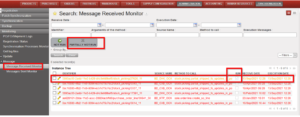
This type of Not Run is automatically displayed in the Message Received Monitor in the same way as standard Not run messages, but its line is displayed in Orange rather than Red, and there is a specific filter button for this type in the header. 

This type of Synch message has a button “Set as Totally Run” to allow user to set to fully Run in order to remove from this filter on the dashboard: 


D. HOW TO RETURN PARCELS TO STOCK FROM A “Draft” shipment

Supply User Manual ENG -> 5. Warehouse -> 5.5 LU-SU4104: Shipment -> D. HOW TO RETURN PARCELS TO STOCK FROM A "Draft" shipment

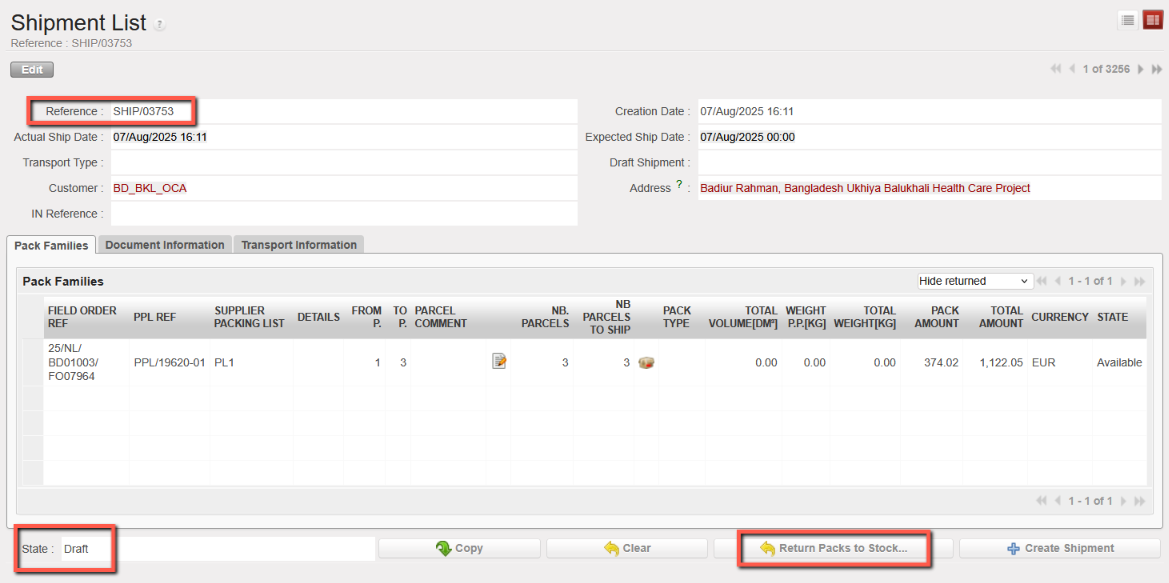
D. HOW TO RETURN PARCELS TO STOCK FROM A “Draft” shipment

Products can also be put back in stock from a “Draft” (main) Shipment. This may be needed if parcels have been left behind and no shipment for customer X is planned in the near future. Instead of keeping the products in parcels on a “Draft” (main) Shipment (with approaching expiry dates) it might be wise to put them back in stock and to ship them to another project or use them locally, while other items will be picked when a shipment will be organized for customer X.

Note that parcels can be returned from a “Ready to ship” (sub) Shipment to a “Draft” (main) Shipment (as described in previous section) and then directly returned from the “Draft” (main) Shipment to the stock. However, this should be done in 2 steps.

Go to: Warehouse / Warehouse Management / Deliveries / Shipment

  1. Open the “Draft” (main) Shipment from which you would like to return parcels. The state of the Shipment should be “Draft” and it will necessarily be a main SHIP.
  2. Click on the “Return Packs to stock…” button at the bottom of the screen.

Returning parcels to stock from a Shipment

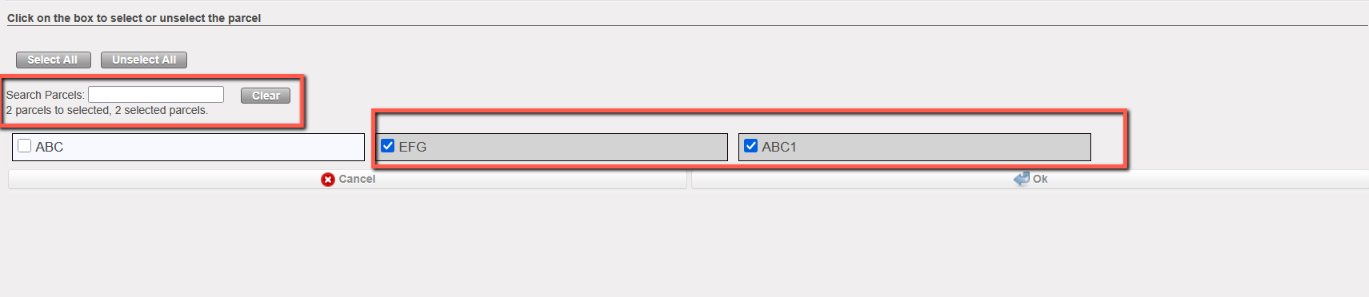
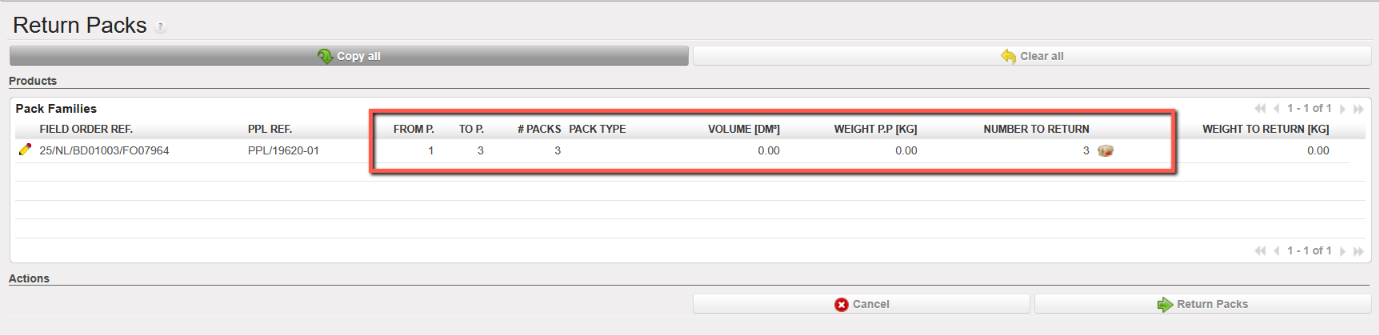
     3. Using the pencil icons, select the parcels you wish to return to stock. If Parcel ID is defined for parcels, the user need to select Parcels ID to return

     4. Click on the “Return Packs” button.

Returning parcels to stock from a Shipment

This image has an empty alt attribute; its file name is sraft-ship-3-1024x369.png

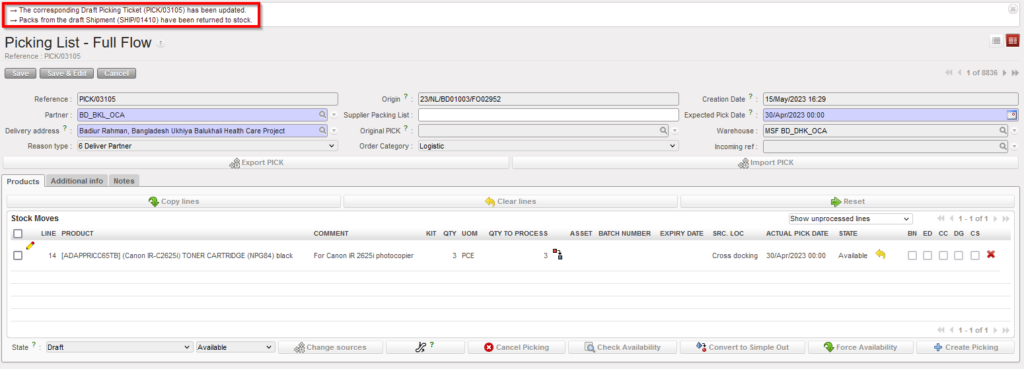
Corresponding main PICK after return

This image has an empty alt attribute; its file name is draft-444-1024x329.png

Shipment from which parcels were returned

The system updates an open the corresponding main PICK. Returned items have been moved from “Shipment” back to the stock. Returned items are “Available” on the initial Picking Ticket(s), ready to be picked when a shipment will be organized.

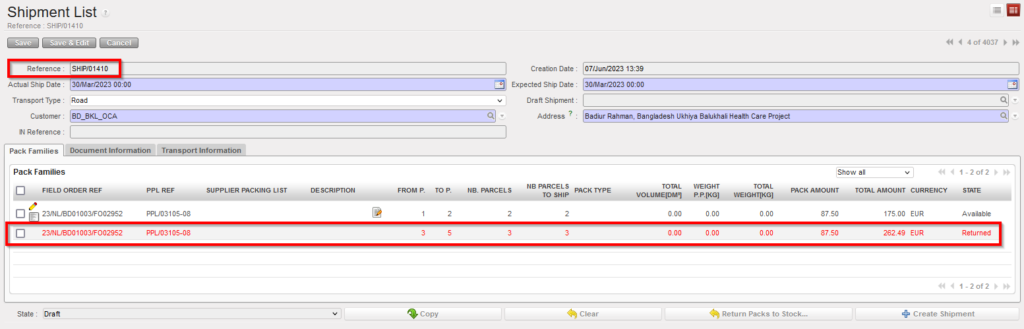
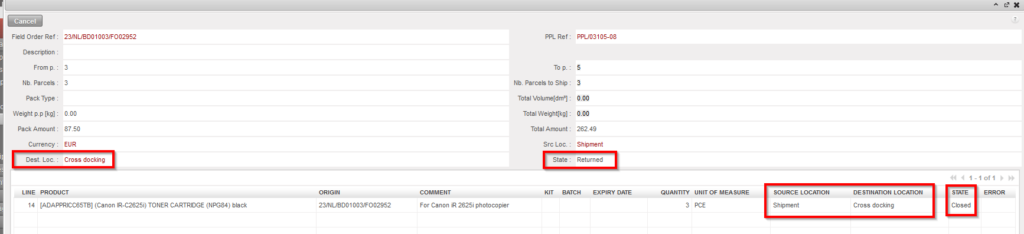
On the main SHIP, the returned parcels are still visible, but their destination location has changed (see below) and is now the stock (Cross docking in this case). The State of the returned parcel are now “Returned“, indicating that the parcels have been returned to stock.

This image has an empty alt attribute; its file name is draft-666-1024x234.png

Returned line on main SHIP

C. HOW TO RETURN PARCELS FROM A “Ready to ship” shipment

Supply User Manual ENG -> 5. Warehouse -> 5.5 LU-SU4104: Shipment -> C. HOW TO RETURN PARCELS FROM A "Ready to ship" shipment

C. HOW TO RETURN PARCELS FROM A “Ready to ship” shipment

It is still possible to remove parcels from a “Ready to ship” (sub) Shipment. This may happen if, for example, after preparing the (sub) Shipment, you realize that all parcels could not fit in the truck and some of them were left behind. You may then return these parcels from the “Ready to ship” (sub) Shipment to the “Draft” (main) Shipment. They will be shipped with the next (sub) Shipment.

Go to: Warehouse / Warehouse Management / Deliveries / Shipment

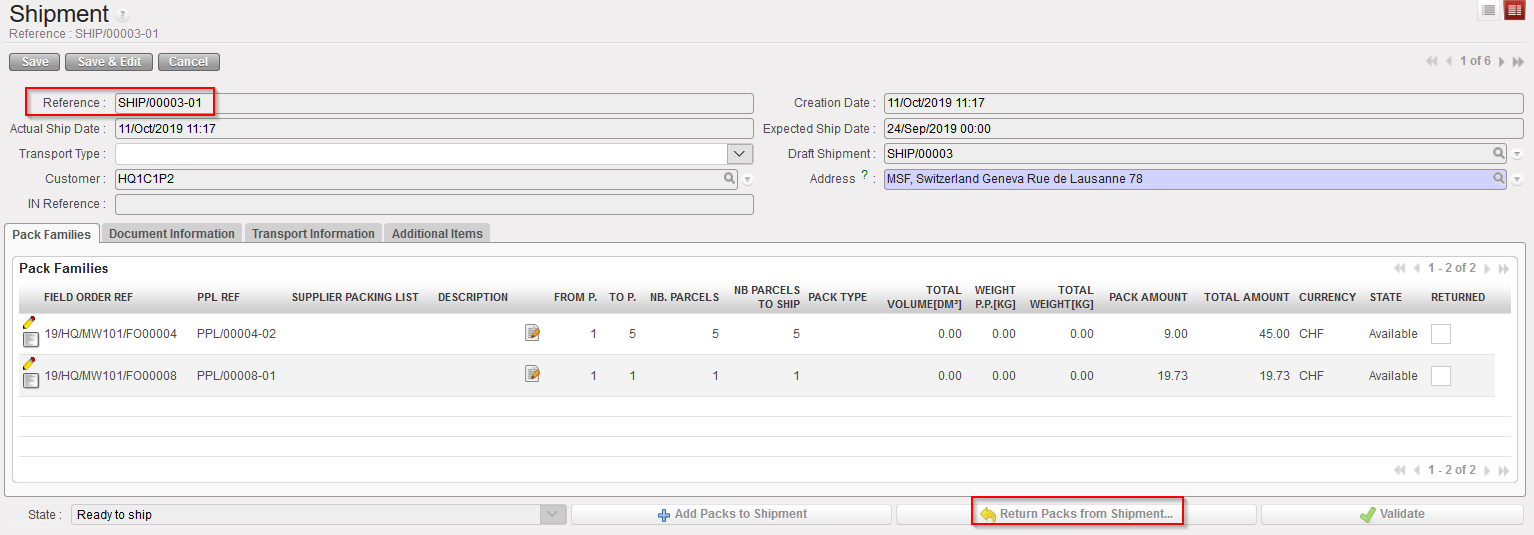
  1. Open the “Ready to ship” (sub) Shipment from which you would like to return parcels. The state of the Shipment should be “Ready to ship” and it will necessarily be a sub SHIP.
  2. Click on the “Return Packs from Shipment…” button at the bottom of the screen.

Returning parcels from a “Ready to ship” Shipment

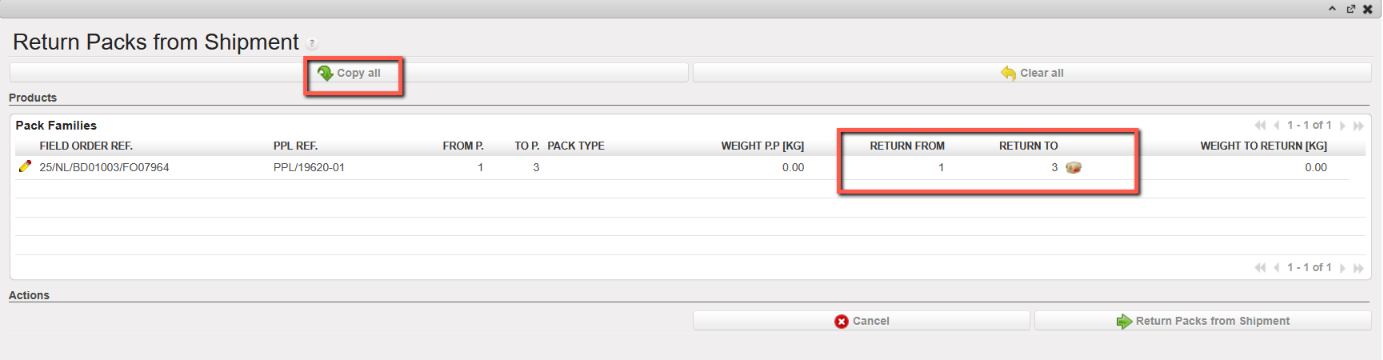
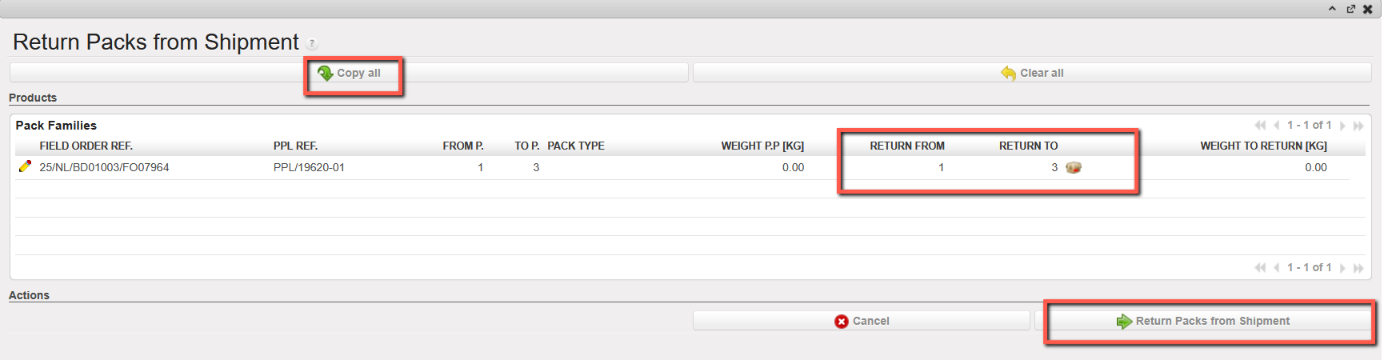
    3. Using the pencil icons, select the parcels that you wish to return. Alternatively, you may select all parcels using the “Copy all” button if needed.

Returning parcels from a “Ready to ship” Shipment

     4. Click on the “Return Packs from Shipment” button.

Returning parcels from a “Ready to ship” Shipment

If Parcel ID is defined for parcels, the user needs to select Parcels ID to return

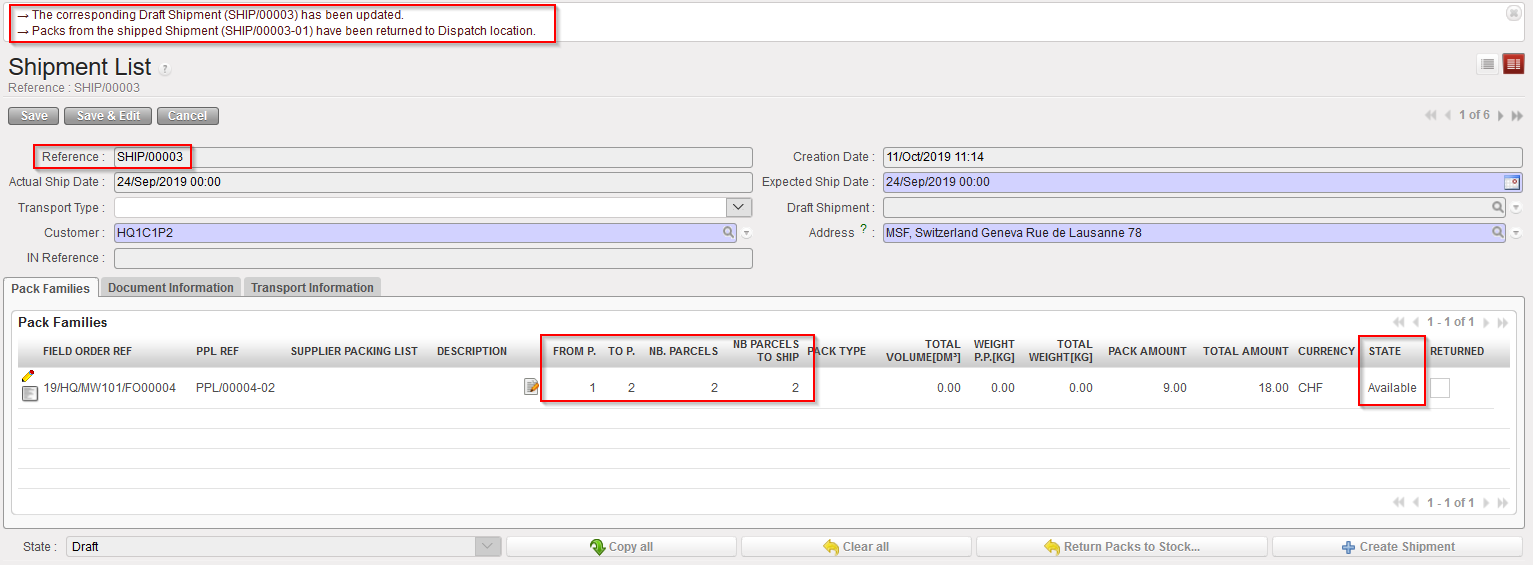
Sub SHIP after return

The system updates and opens the (main) Shipment.

The selected parcels have been sent back to the main SHIP. They are available in the “Shipment” location, ready to be shipped with the next (sub) Shipment.

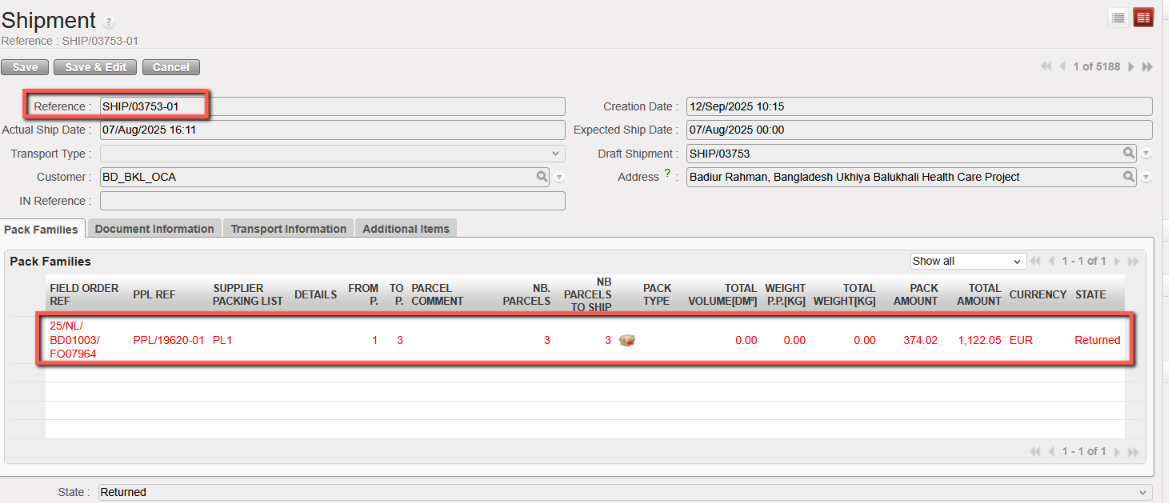
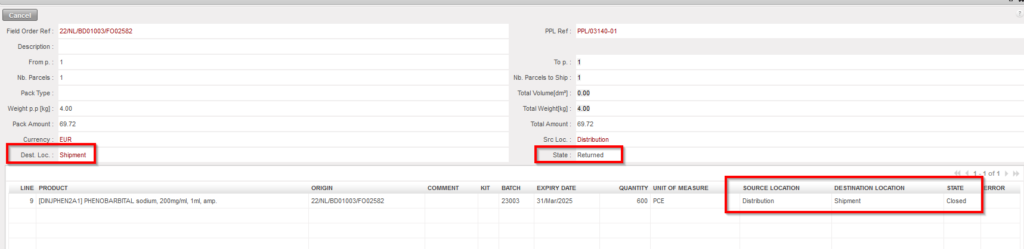
On the sub SHIP, it is still possible to see the returned lines by adjusting the filter to “Show All” or show “Returned Only”. Their destination location is “Shipment” (see below) and the State is “Returned“, indicating that the parcels have been returned.

This image has an empty alt attribute; its file name is sub-ship-line-2222-1024x249.png

Returned line on sub SHIP

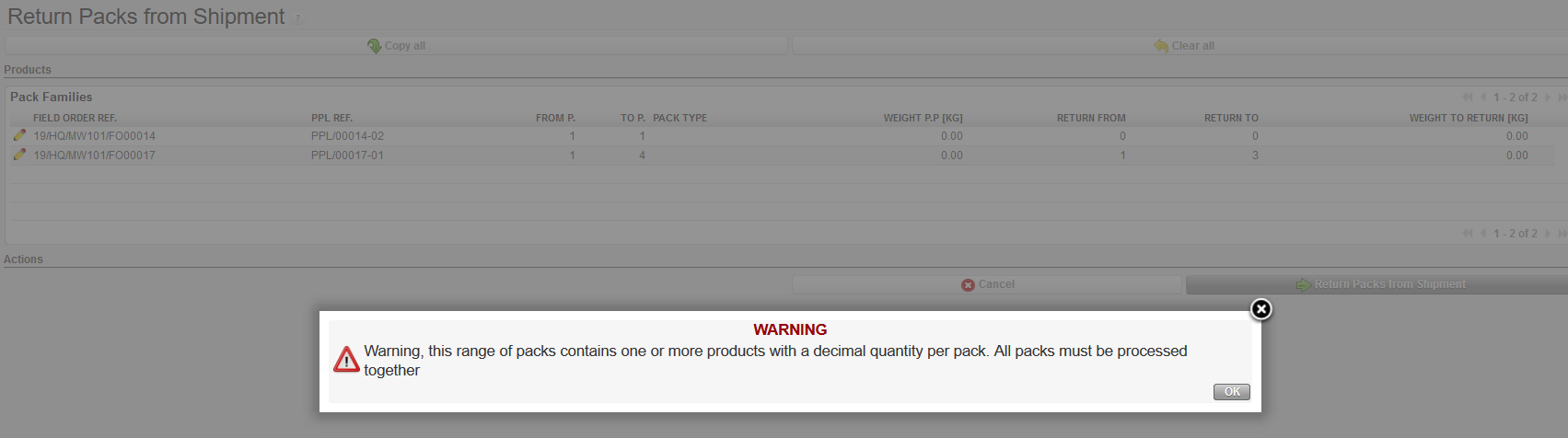
Please note that in case the user tries to return integer products partially with decimal quantities per boxes, the system will display the following blocking message:

The user tries to return 1 to 3 packs out of an initial range of 1 to 4 with decimals

The user will have to return either all packs or none.

B. HOW TO CREATE AN OUTGOING DELIVERY

Supply User Manual ENG -> 5. Warehouse -> 5.5 LU-SU4104: Shipment -> B. HOW TO CREATE AN OUTGOING DELIVERY

B. HOW TO CREATE AN OUTGOING DELIVERY

All parcels from processed Pre-Packing Lists are automatically added on a draft (main) Shipment. It is possible to either validate the full shipment (i.e. select all the parcels), or to proceed with a partial shipment (i.e. select only some parcels). In the case of a partial shipment, parcels left behind will remain on the (main) Shipment, ready to be shipped with a future shipment. Products can also be returned to stock, should they not need to be shipped anymore.

Go to: Warehouse / Warehouse Management / Deliveries / Shipment

  1. Locate the (main) Shipment you wish to ship to a project/customer. It should be in “Draft” state.
  2. Click on the icon located at the right side of the appropriate line. Another option is to open the Shipment and click on the “Create Shipment” button at the bottom of the screen.
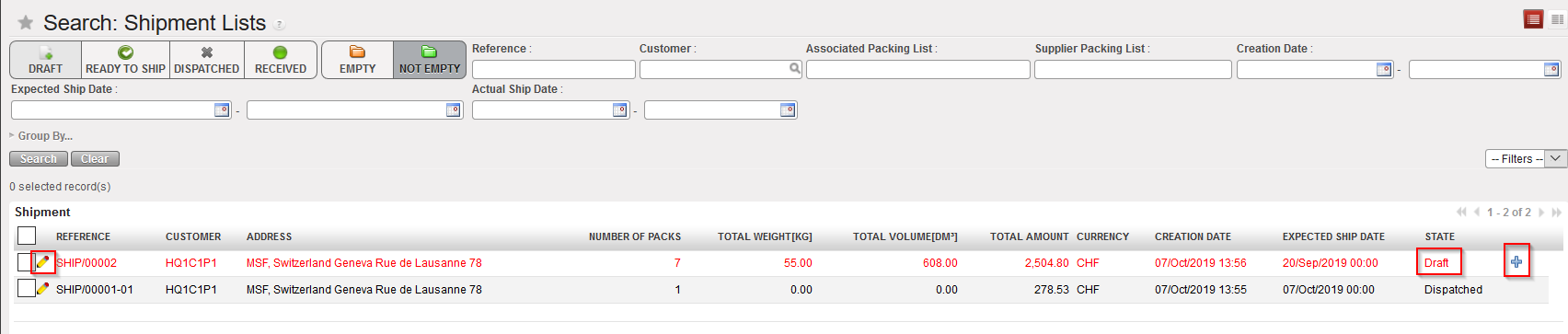
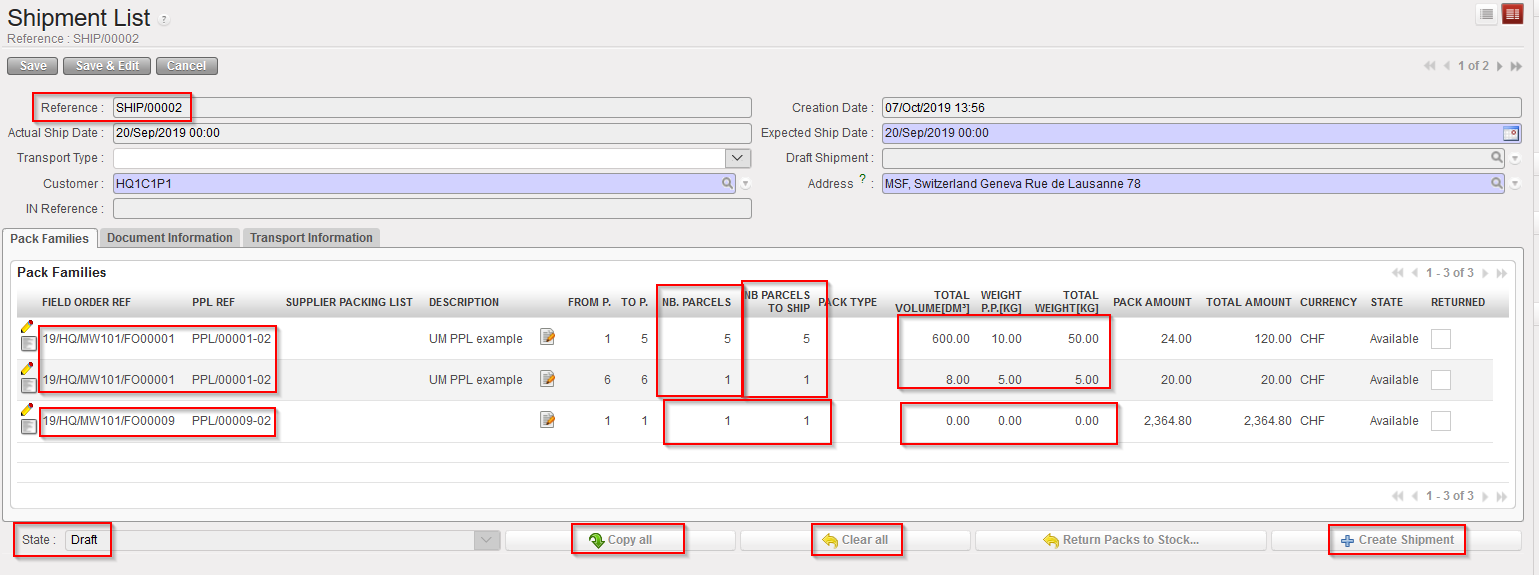
Processing a Shipment

Processing a Shipment

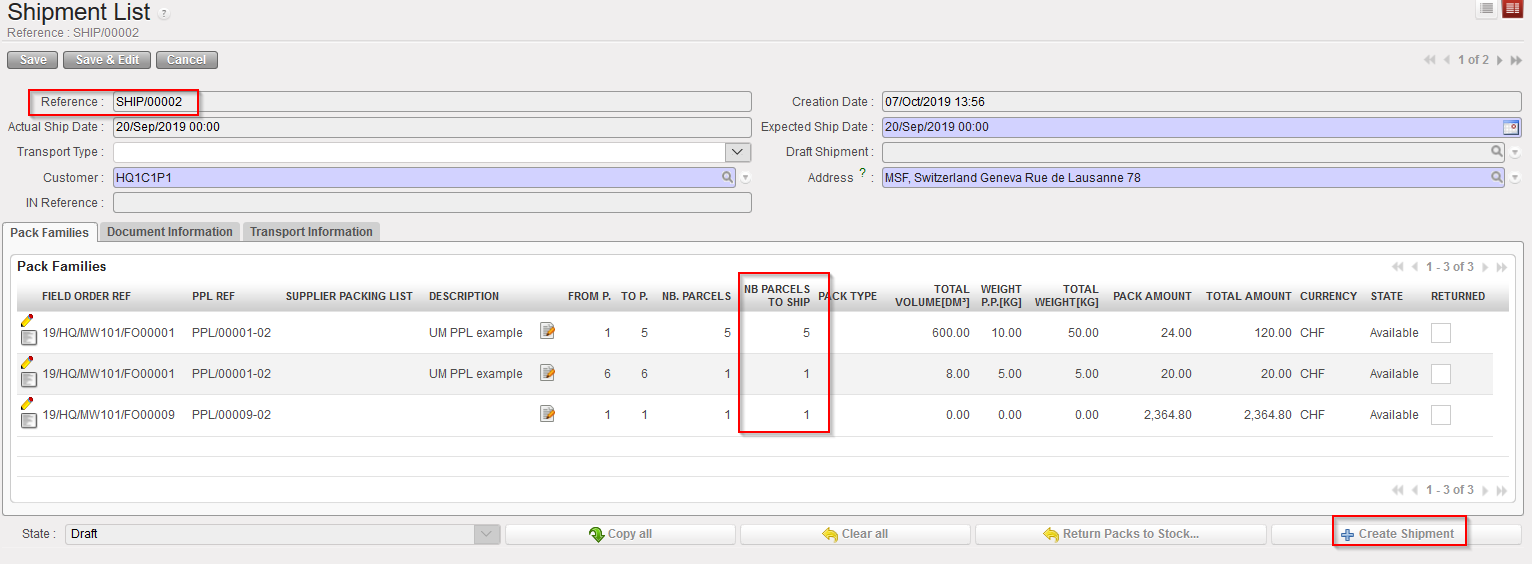
3. The “NB Parcels to Ship” is by default set to the same as “Nb Parcels” however, this can be edited/updated in case you need to ship only some parcels (using the pencil icon ).

Note that buttons “Copy all “ and “Clear all” are related to this field “Nb Parcels to Ship”.

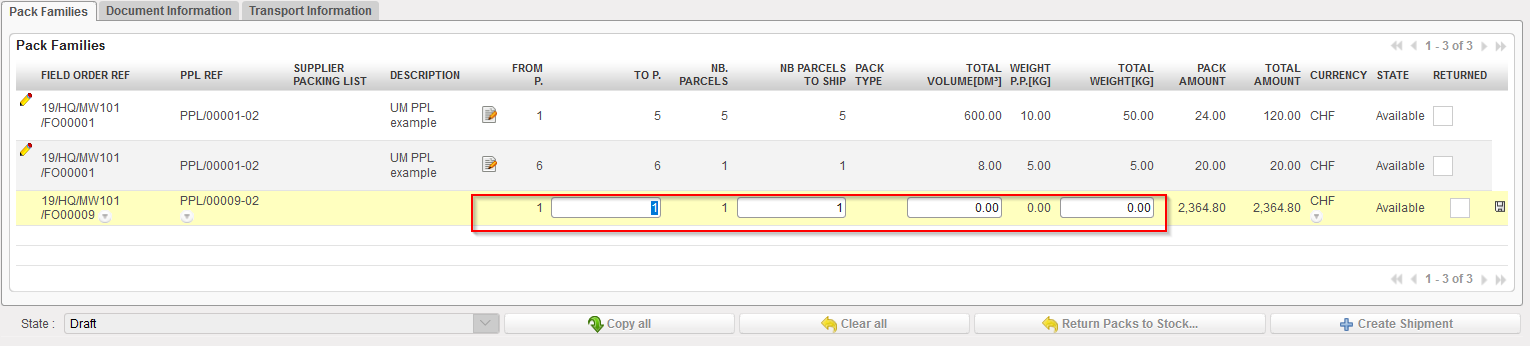
4. The “Total volume” and “Total weight [KG]” are retrieved from the PPL processed before. These fields can only be edited here in case the information has not been updated in the PPL (remember that these are not mandatory fields in the PPL) – in the example above only line from “PPL/00009-02” can be updated for Weight and Volume since their value is at “0”. Edition can be done using the pencil icon

5.  The “To P.” is also retrieved from the PPL processed before.

However, when the “Quick flow(2 steps – PICK to SHIP with no PPL) is used, the default value is “From P. =1” and “To P. =1”. In this specific case user still has the possibility to edit/update the “To P.” to set the number of parcels needed. User needs to click on the pencil icon (in case the PPL comes from the Full flow, the field “To P.” will not be editable anyway).
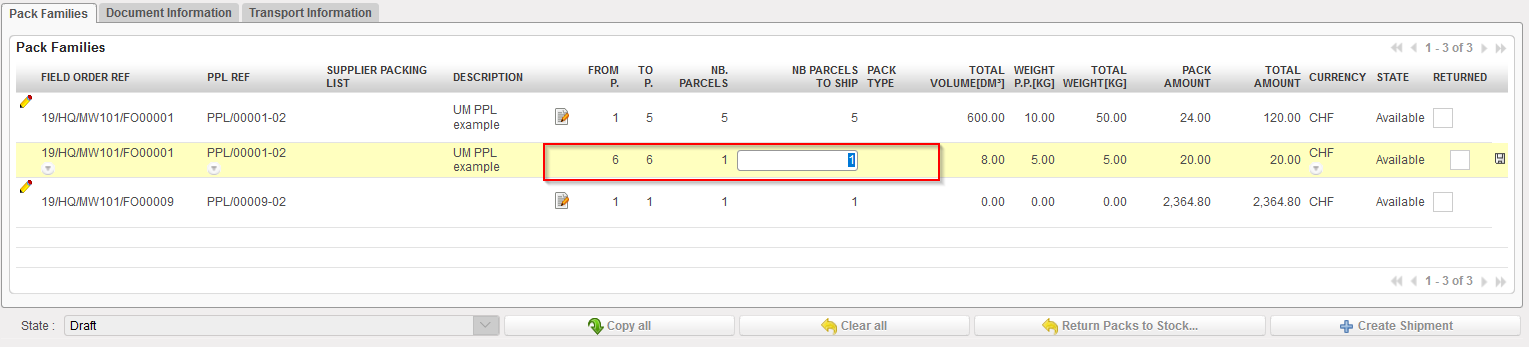
Editing line from Full flow (3 steps) – with all PPL info registered (including Volume and weight) – only “Nb parcels to ship” editable

Editing line from Quick flow (2 steps) – “To P.”, “Nb Parcels to ship”, “Total Volume” and “Total weight” editable

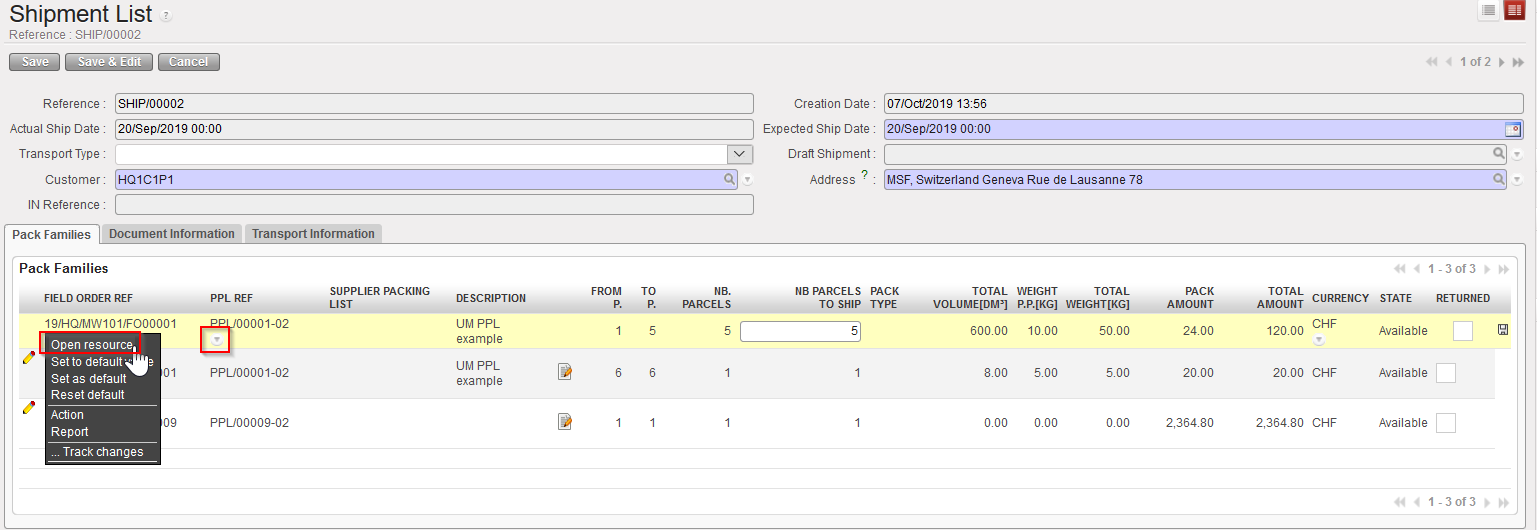
Note that you may choose the number of parcels to ship for each line. One line represents a certain number of identical parcels (same content, same dimensions, and same weight). The detail of a FO or PPL can be viewed by clicking on the “Open a resource” icon (down arrow) located at the right of the FO/PPL and by clicking on the “Open resource” option in the drop-down list.

Looking at the details of a FO or PPL

6.  Once the parcels have been selected, click on the “Create shipment” button to create a sub SHIP. In the below example, all parcels available on the main SHIP are selected.

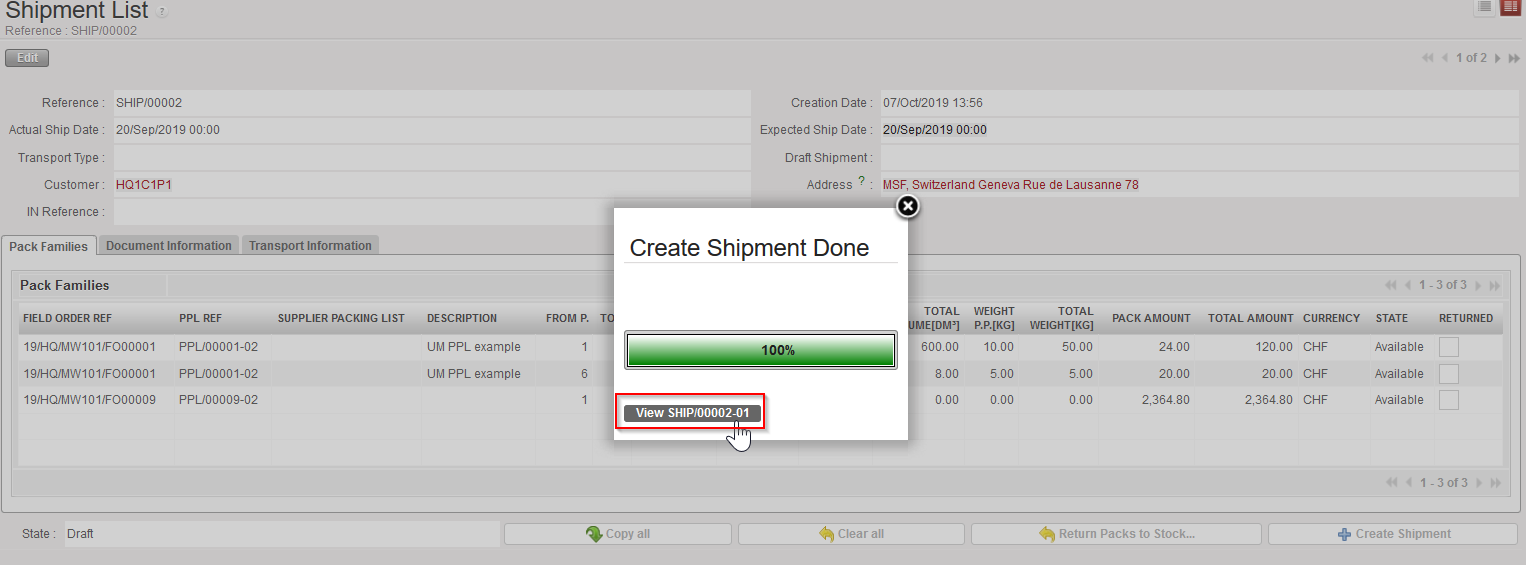
7.  Then click on the button“View SHIP/000XY-AB” from the pop up “Create Shipment Done

Creation of sub SHIP

Intermediate pop up to reach the newly created Sub-SHIP

Sub SHIP created by the system

Main SHIP after creation of the sub SHIP

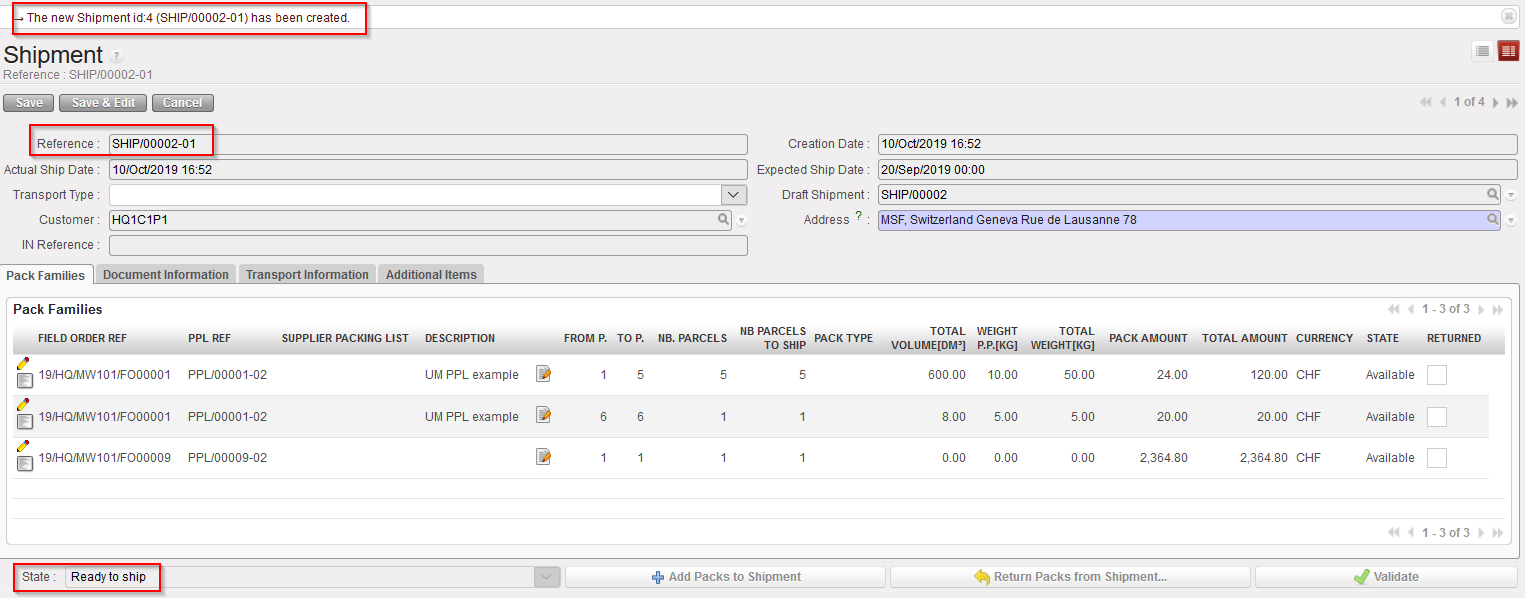
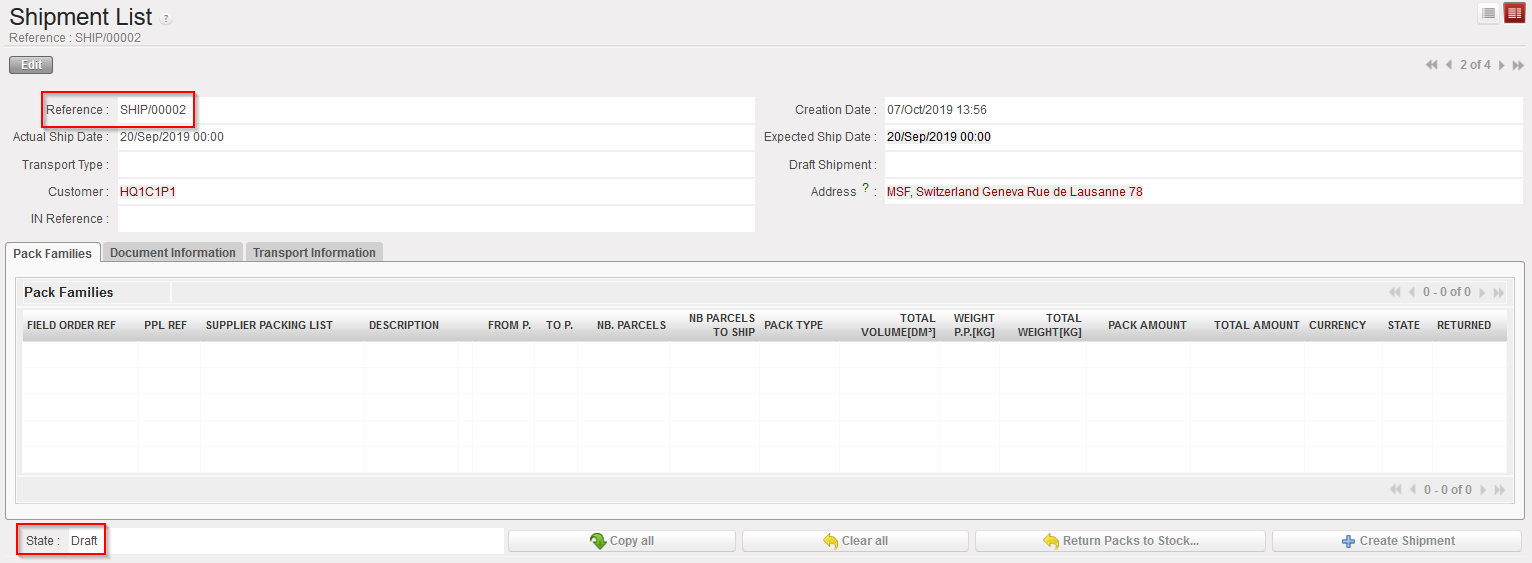
A sub SHIP (reference SHIP/000XY-AB) is created by the system and includes all parcels selected from the main SHIP (reference SHIP/000XY). The state of the sub SHIP is “Ready to ship“.

As all parcels have been selected from the main SHIP, this one is now empty. Note that the main SHIP stays in “Draft” to allow returns of products and welcome other parcels from PPLs for the same customer which could be processed.

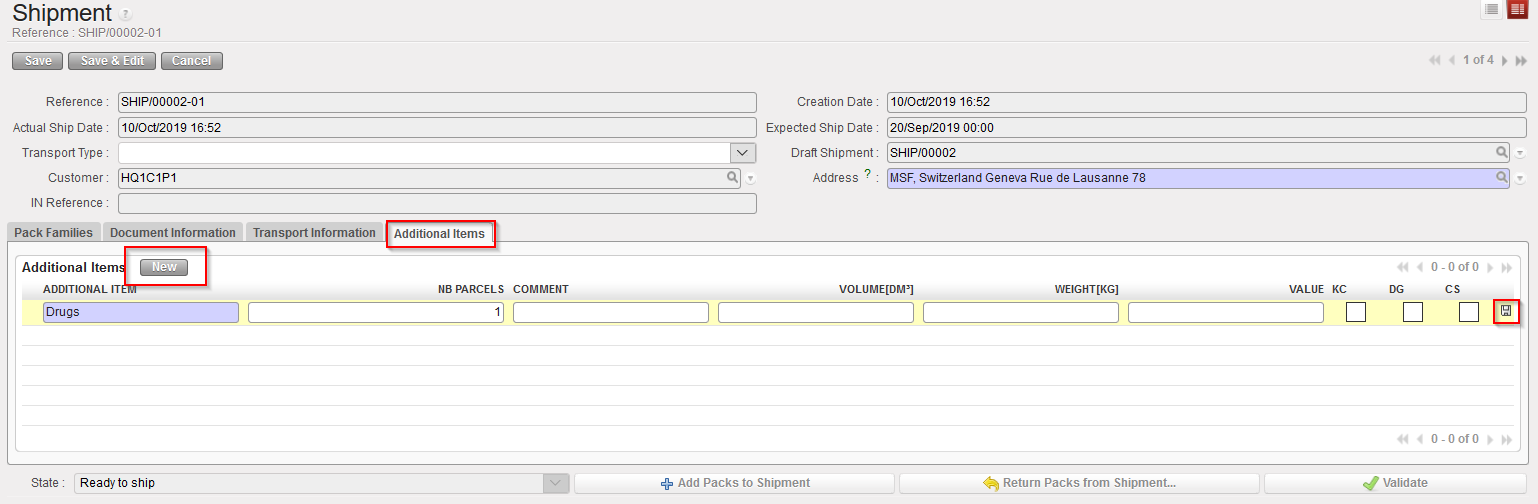
8.  Note that the “Additional Items” tab can be used to indicate items which should have been added to the Shipment but were not part of the previously processed documents (PPLs, PICKs, FOs). This tab is only editable in “Ready to ship” Status.

Adding new items to the shipment

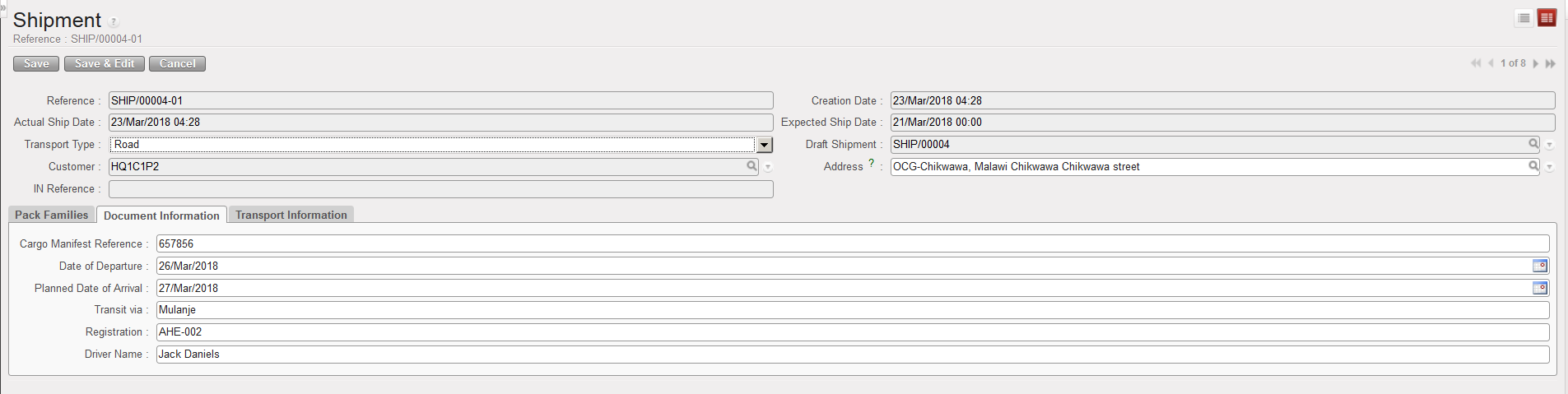
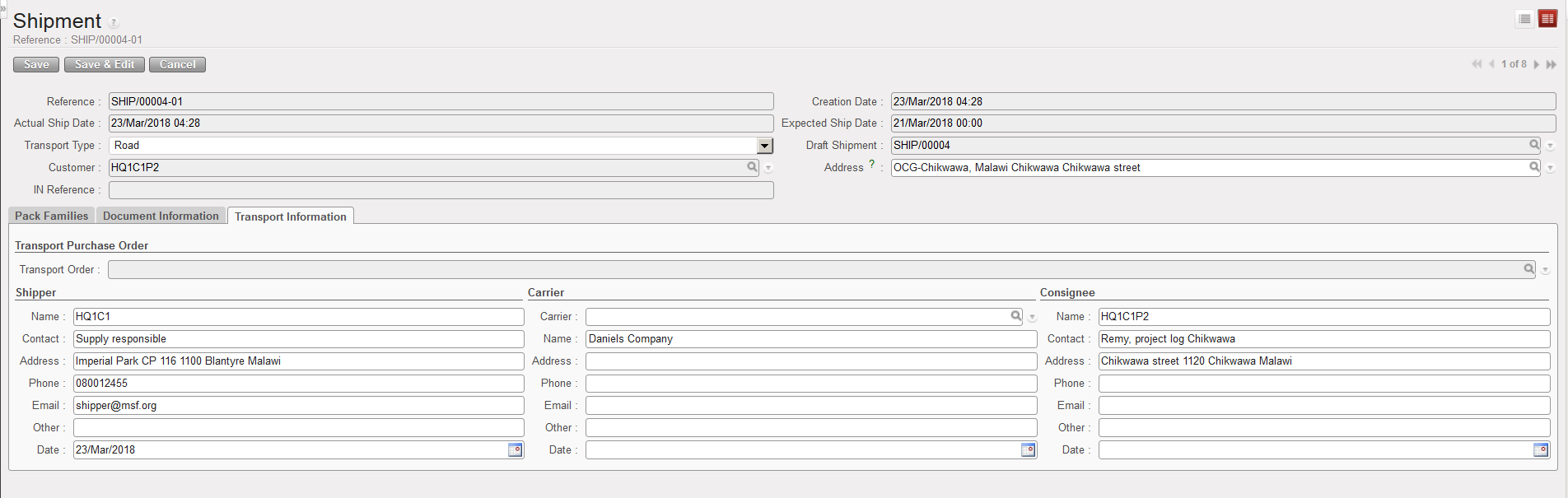
9. On the sub SHIP, you should complete the “Document Information” tab and the “Transport Information” tab with all necessary information needed such as reference of the cargo manifest, departure and arrival dates, driver and vehicle information, shipper information, carrier information and consignee information. Please note that Transport Order can be linked to the sub-Ship.

“Document Information” tab on a Shipment

“Transport Information” tab on a Shipment

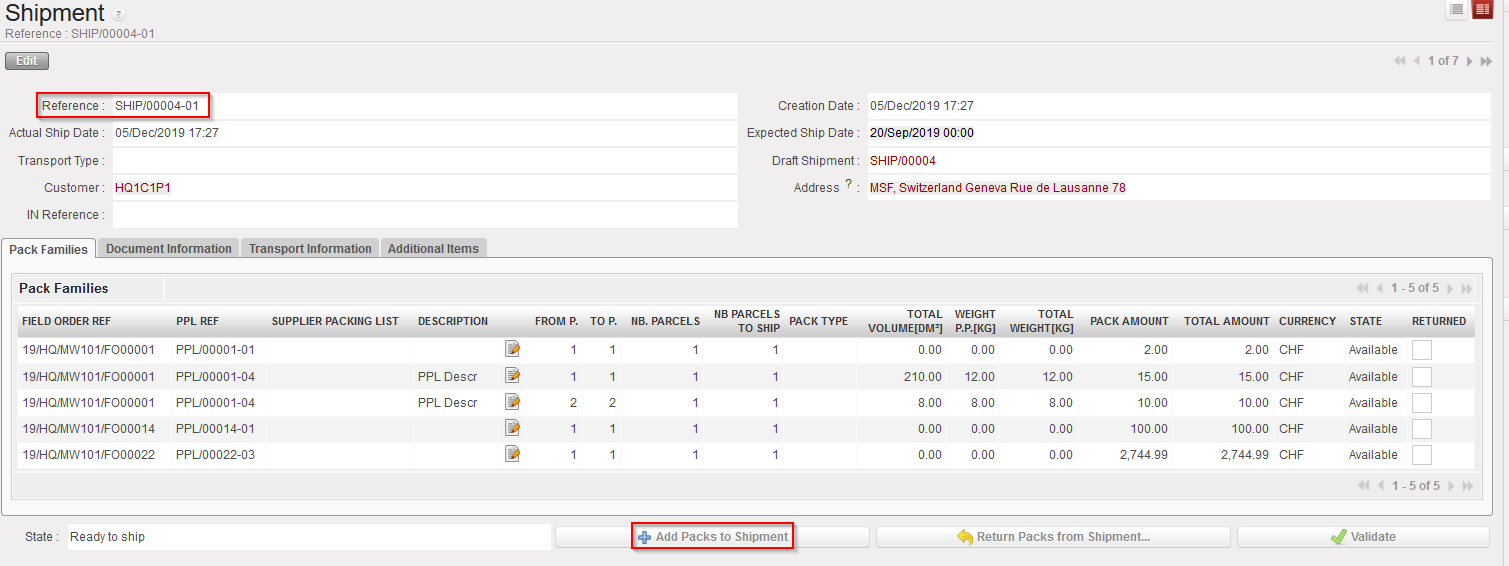
10. The “Add Packs to Shipment” button enables to add existing Packs to the Sub-Ship in “Ready to ship” status (button not displayed for other statuses).

All Packs for this customer from the Draft main Shipment are listed and can be selected.

By default the “Selected Number” field is set to “0” and can be updated line by line or by using the “Copy all” button (“Clear all “ button will be used to clear this field in case you need to correct the entered information).

Click on the “Add Packs to Shipment” button to add the selected PPLs.

Add Packs to the Shipment – Sub-SHIP

Add Packs to Shipment – List of PPL from the Main PICK

The sub-Ship main screen will be updated with these new additional Packs.

11. Click on the “Validate” button.

12. Click on the pop up “View SHIP/XXXX-AB

Closed sub SHIP – Dispatched

The sub SHIP switches to “Dispatched”.

Note that for shipments sent to other UniField instances, the validation of the sub SHIP will be automatically done by the synchronization, when the reception will be done on the receiving instance. This means that you should not click on the “Validate Delivery” button for those ones. If you click on it, you will get the below (non-blocking) message.

Please also note that the Validation of the sub-Pick (when status turns to Dispatched) closes the related picked lines.

Warning message when trying to “Validate Delivery” which is for a UniField instance

For shipments sent to External customer, you will have to validate the shipment manually once the customer confirms reception of the goods by clicking the “Validate Delivery” button.