A. LU Introduction (LU-SU4104)

Supply User Manual ENG -> 5. Warehouse -> 5.5 LU-SU4104: Shipment -> A. LU Introduction (LU-SU4104)

A. LU Introduction (LU-SU4104)

Remember that the previous section (packing) left parcels on a (main) Shipment after the processing of the PPL. Products were actually moved from the “Packing” location to the “Dispatch” location.

The shipment process consists of selecting parcels which are ready to be shipped to a customer and group them in a (sub) Shipment.

It is possible to select all parcels from all ready to be shipped PPLs and include them into a single (sub) Shipment.

It is also possible to select specific parcels from specific PPLs to include them in a (sub) Shipment while other parcels will be left behind and stay on the (main) Shipment. This may happen if, for example, there is no sufficient space available in a truck to ship the full consignment (i.e. all parcels ready to be shipped) or if some parcels need to be sent by plane while others will be sent by truck.

Parcels from Pre-Packing Lists which are for the same customer are automatically grouped on a same (main) Shipment once the PPL is processed, whatever the type of products involved or the transport mode specified in the previous documents.

The shipment process can also be seen as an internal stock move, transferring the products from the “Dispatch” location to the “Distribution” location when a sub SHIP is processed, then transferring them from the “Distribution” location to the “MSF Customer” or “Other Customer” (partner) location when validating/closing a sub SHIP.

The shipment process is similar to the picking process as main SHIPs and sub SHIPs will be used (similar to main PICKs and sub PICKs). The process will always start from the main SHIP from which sub SHIPs will be created. Shipments actually shipped to customer will always be sub SHIPs. The main SHIPs will stay open to welcome additional parcels from subsequent validated PPLs, to deal with partial shipments (back orders) and to be able to handle returns.

A. LU INTRODUCTION (LU-SU4105)

Supply User Manual ENG -> 5. Warehouse -> 5.6 LU-SU4105: Delivery Orders -> A. LU INTRODUCTION (LU-SU4105)

A. LU INTRODUCTION (LU-SU4105)

Delivery Orders are commonly used with IRs to deliver products to External Consumption Units such as offices; clinics, the car workshop, (IR with an External Consumption Unit as “Location Requestor”). In that case, the OUT will automatically be created upon sourcing of the IR when sourced from stock and upon confirmation of the PO (or PO-line) when sourced on order. It is actually the confirmation of the IR-line which triggers the creation of the corresponding OUT-line.

The whole picking/packing/shipment process which has been introduced in the previous Learning Units and which is, by default, initiated by the sourcing of an FO from stock or on order, can be simplified significantly by delivering the products via “Delivery Orders” (simple OUT process). The 3 steps (pick/pack/ship) delivery process will be reduced to a 1 step (OUT) delivery process.

Note that it is possible to configure an instance so that all goods are automatically dispatched in this way (i.e. the delivery process will be simple OUT in all cases). See Administration chapter, Reconfigure.

However, shipping goods to a customer with the simple OUT process will be done with 1 (OUT) document only. As a consequence, documentation you will be able to print with a simple OUT process will be limited compared to the usual cargo documentations you may print if you use a pick/pack/ship/process.

H. PRE-PACKING LISTS REFERENCES

Supply User Manual ENG -> 5. Warehouse -> 5.3 LU-SU4102: Picking -> H. PRE-PACKING LISTS REFERENCES

H. PRE-PACKING LISTS REFERENCES

All Pre-Packing Lists have a reference which looks like PPL/XXXXX-YY.

This reference matches with the reference of the Picking Ticket (sub PICK). Once processed, the Picking Ticket PICK/XXXXX-YY generates the Pre-Packing List PPL/XXXXX-YY.

In case of full picking, the main PICK has the reference PICK/XXXXX, the sub PICK has the reference PICK/XXXXX-01 and the corresponding Pre-Packing List has the reference PPL/XXXXX-01.

In case of partial picking, YY takes the value 01 for the first partial picking, 02 for the second partial picking, 03 for the third partial picking,… The Pre-Packing List PPL/XXXXX-01 matches with the partial picking PICK/XXXXX-01, the Pre-Packing List PPL/XXXXX-02 matches with the partial picking PICK/XXXXX-02, the Pre-Packing List PPL/XXXXX-03 matches with the partial picking PICK/XXXXX-03,…

On some reports (see, at the end of the chapter, sections on reporting), references PACK/XXXX-YY-ZZ may appear. The “PACK” reference is actually the reference of a Packing List. We refer to Packing List (and not to Pre-Packing List) when a PPL is on a Shipment (sub SHIP) which is in the state “Shipped“, “Closed” or “Delivered”. The Packing List PACK/XXXXX-YY-ZZ matches with the Pre-Packing List PPL/XXXXX-YY which matches with the Picking Ticket (sub PICK) PICK/ XXXXX-YY. ZZ always takes the value 01. Note that a PACK is not a new document but is just another way to name a PPL.

G. HOW TO UNPACK PRODUCTS AND RETURN THEM TO STOCK

Supply User Manual ENG -> 5. Warehouse -> 5.3 LU-SU4102: Picking -> G. HOW TO UNPACK PRODUCTS AND RETURN THEM TO STOCK

G. HOW TO UNPACK PRODUCTS AND RETURN THEM TO STOCK

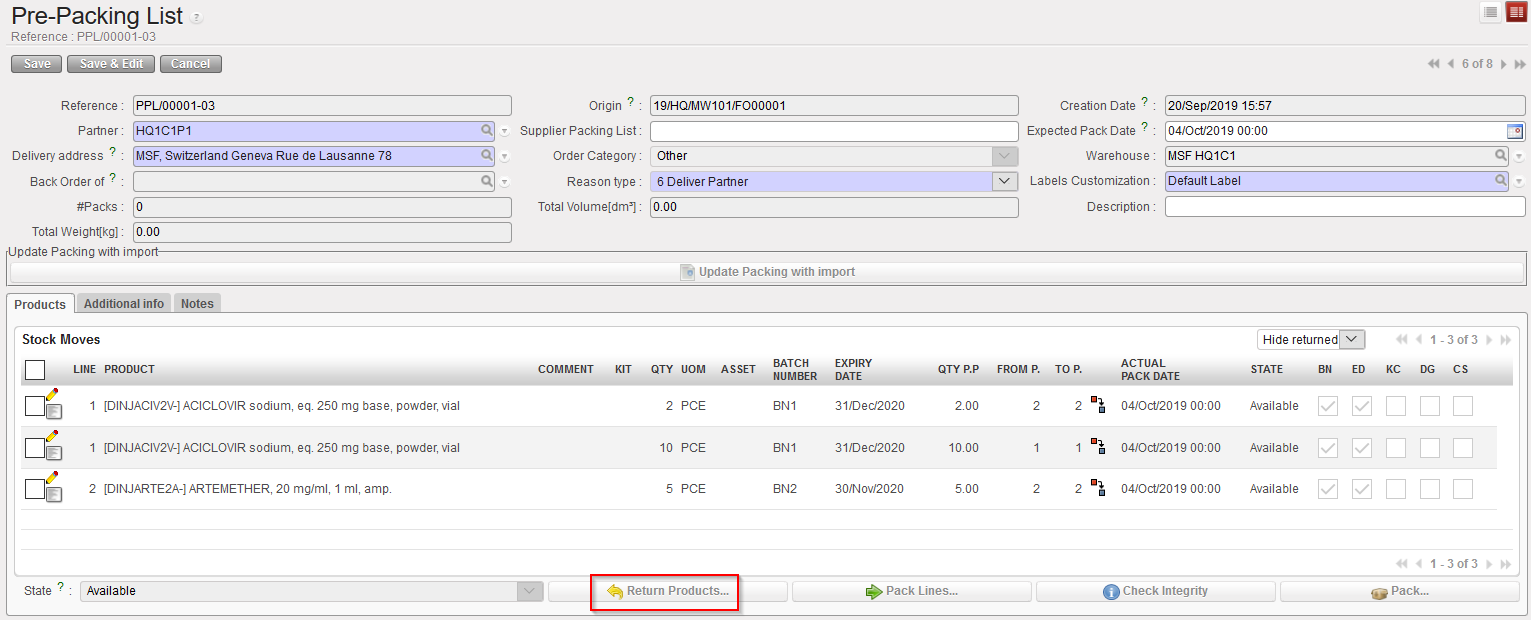
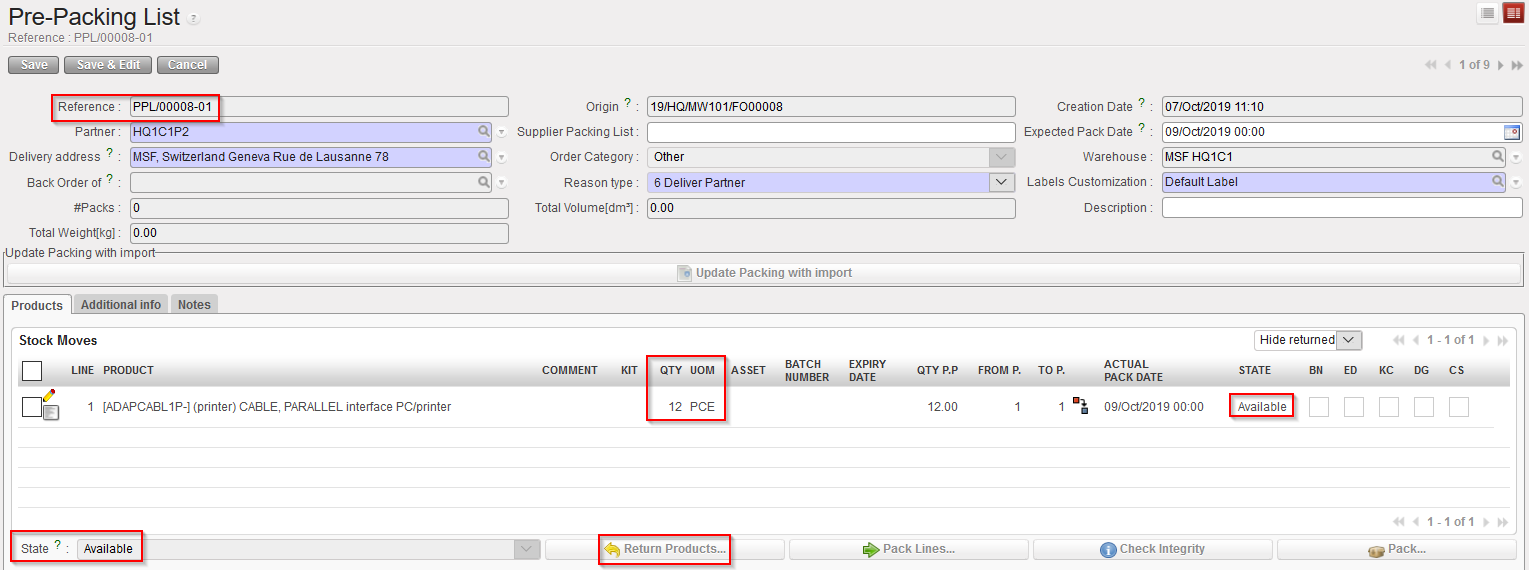
It is possible to return to stock products which have been picked and are ready to be packed. The PPL has to be in “Available” state (i.e. the products should not be declared as packed yet or the parcels should not be included on a shipment yet). The return can be total or partial.

Go to: Warehouse / Warehouse Management / Deliveries / Packing

  1. Open the PPL from which you wish to return products to stock.
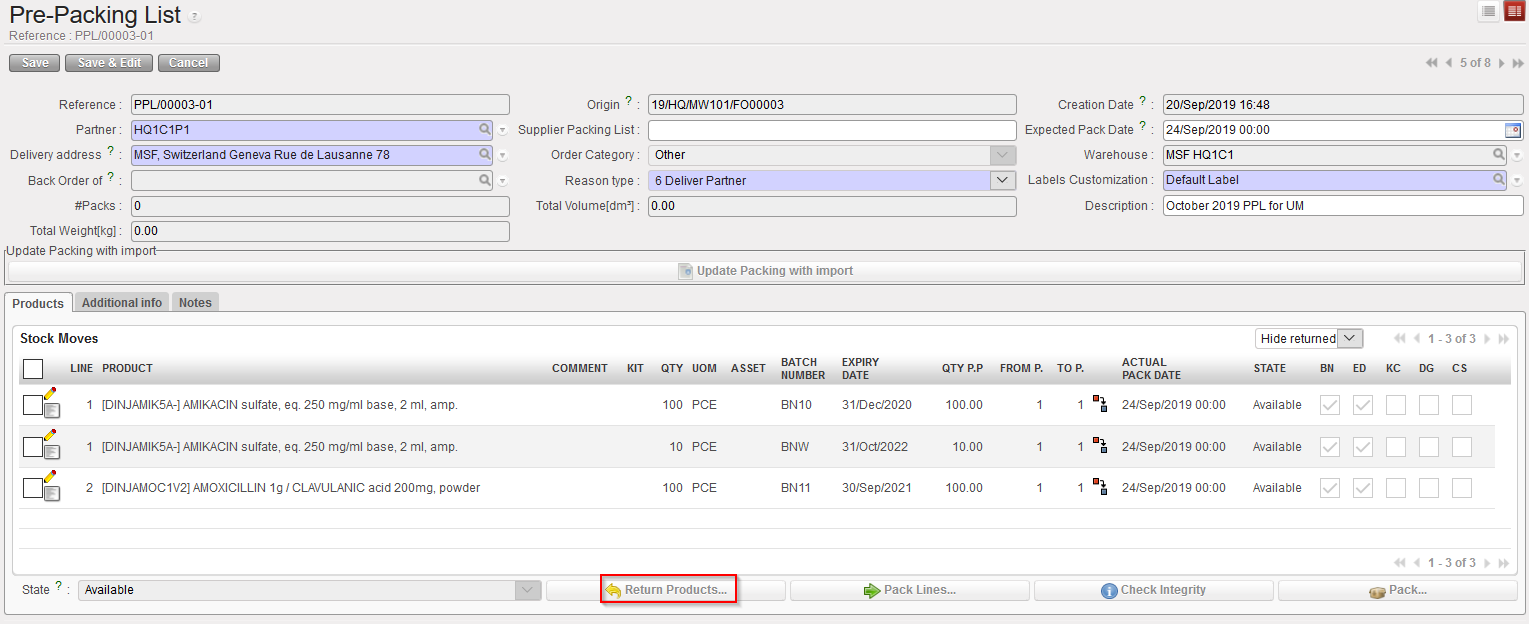
  2. Click on the “Return Products…” button.
Returning products to stock from a PPL

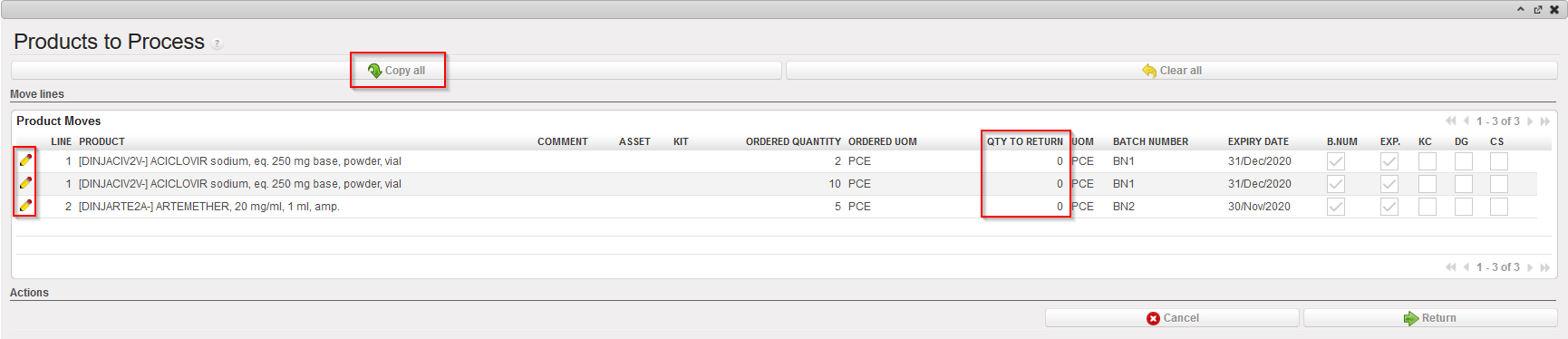
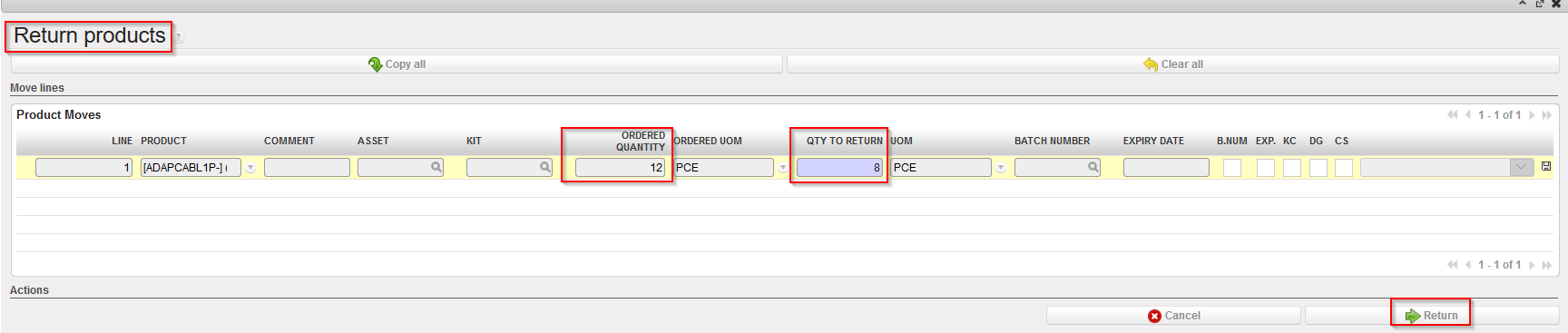
3. Click on the “Copy all buttons” to return all the products from the PPL to the stock. Alternatively, you may use the pencil icons if you want to specify which products/batches/quantities you wish to return to stock (i.e. return the goods partially to stock).

Returning products to stock from a PPL

4. Click on the “Return” button located at the bottom of the screen.

Returning products to stock from a PPL
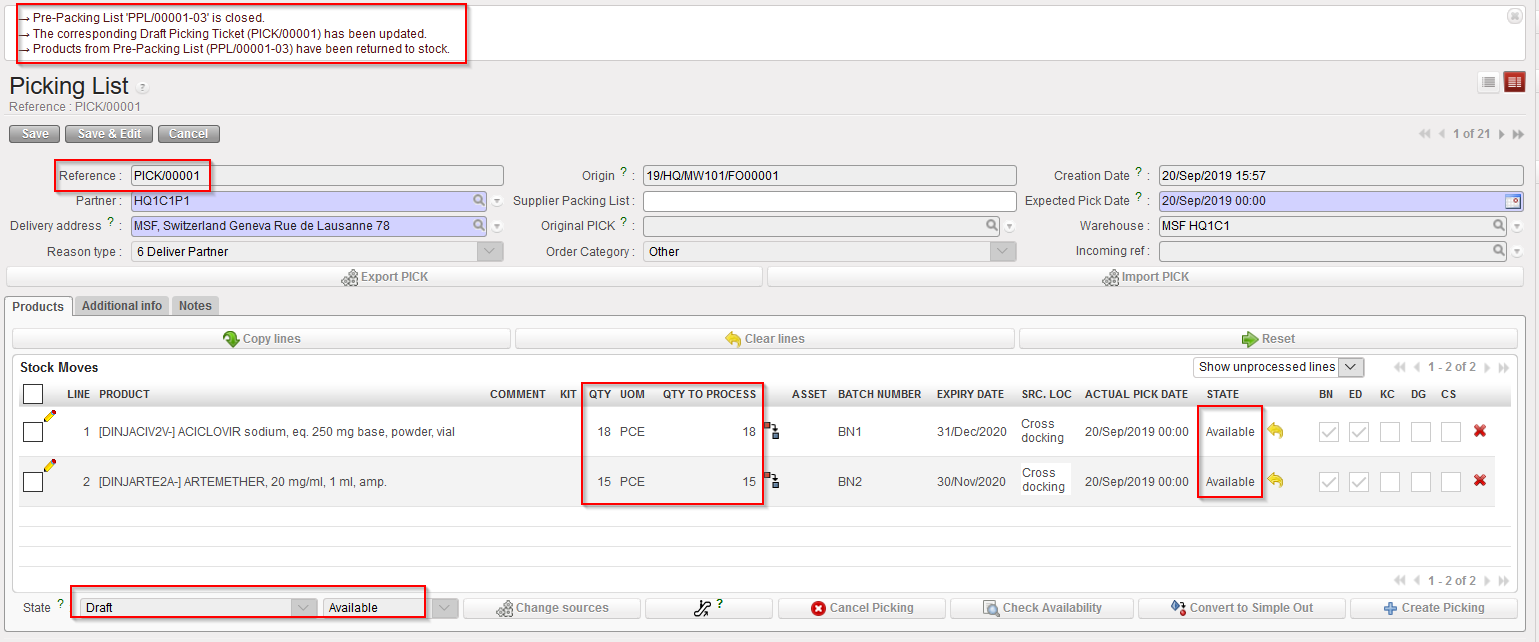
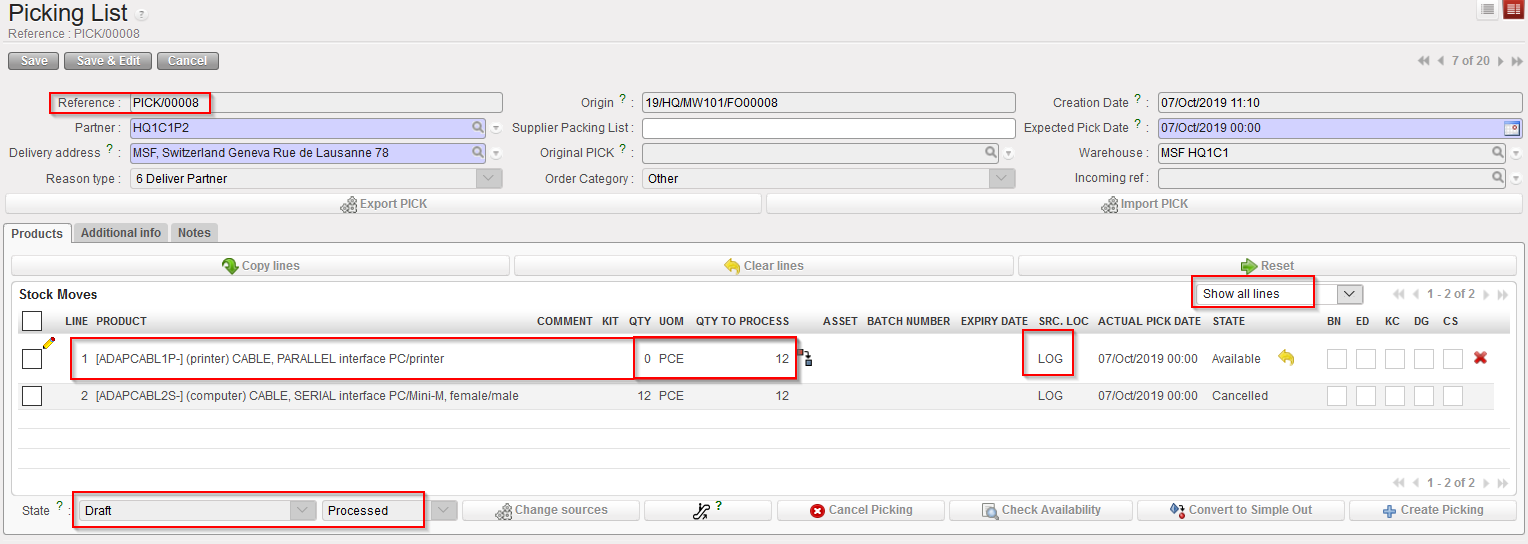
Main PICK corresponding to the PPL from which products were returned

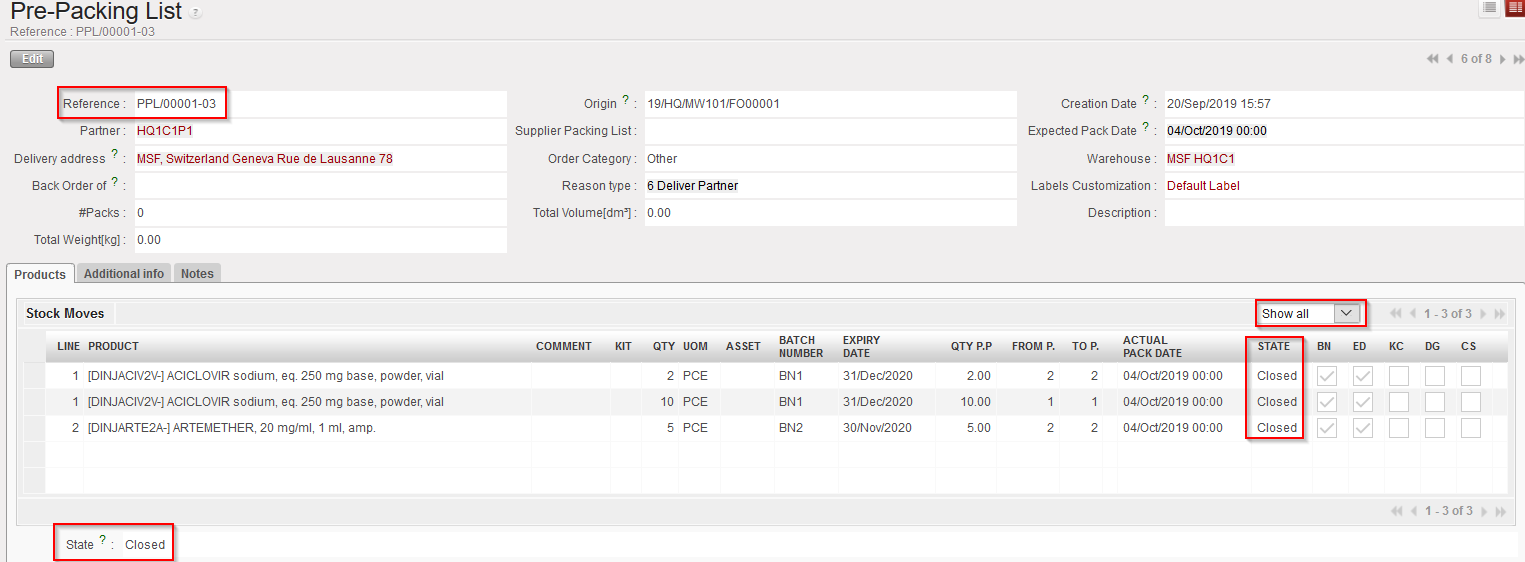
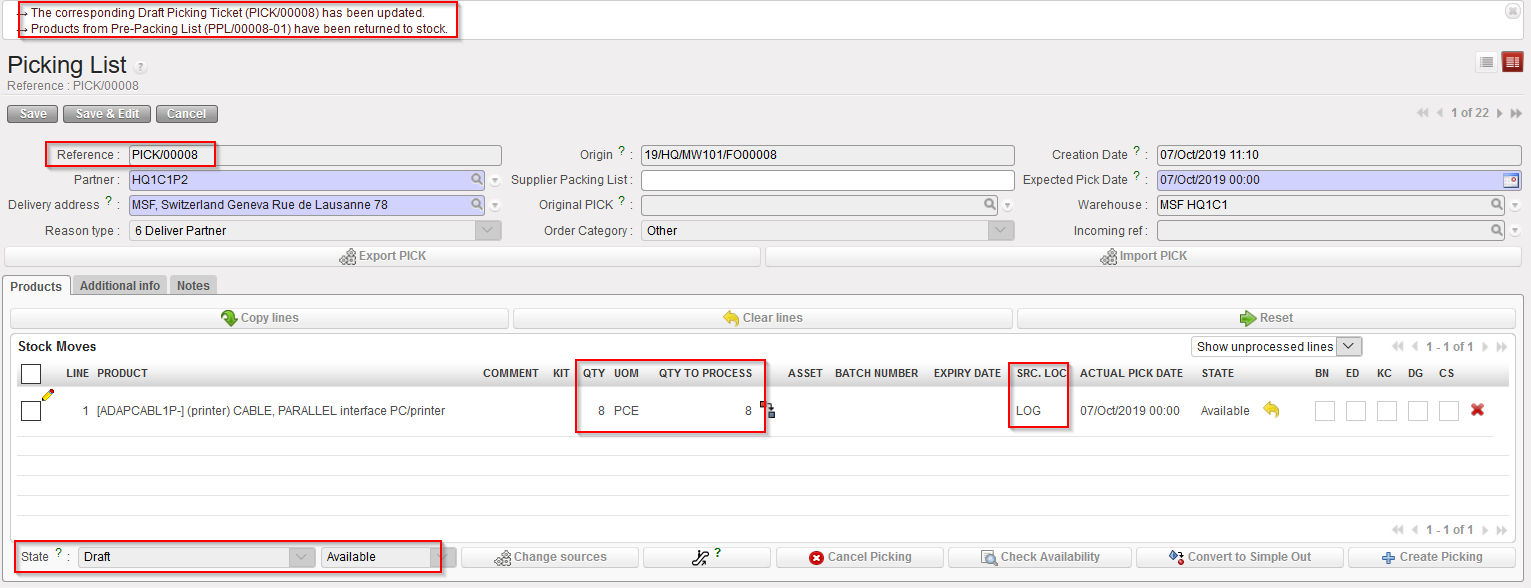
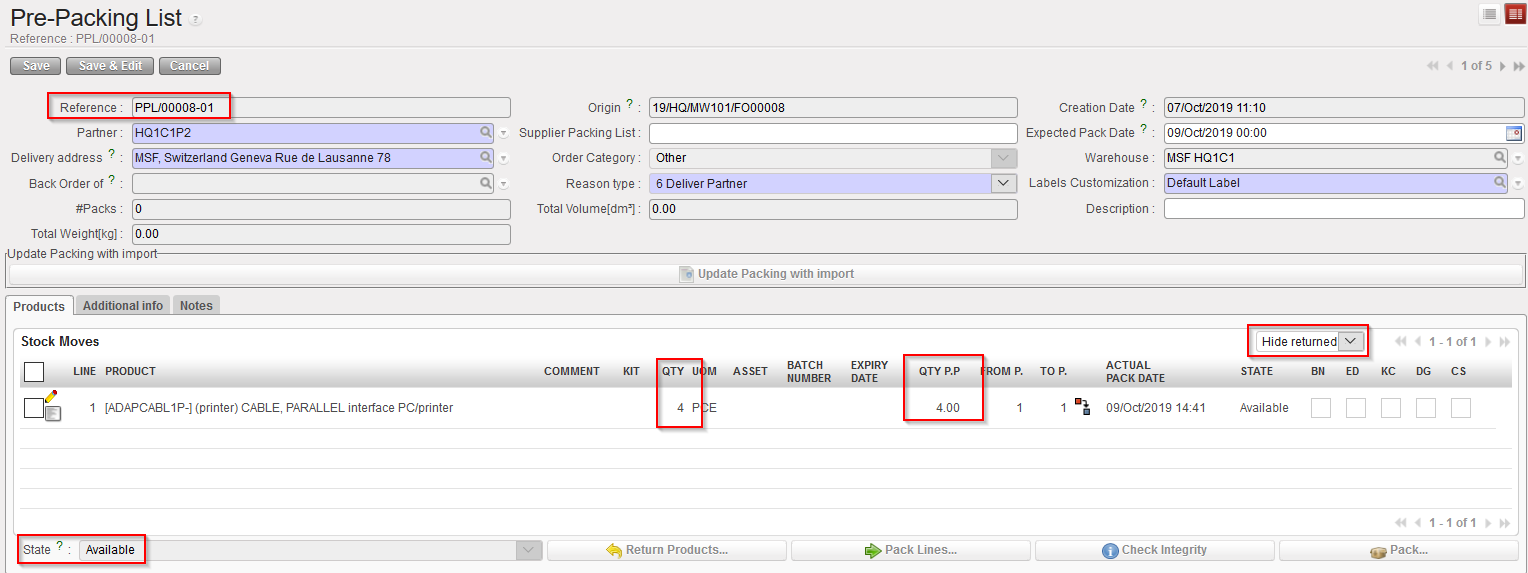
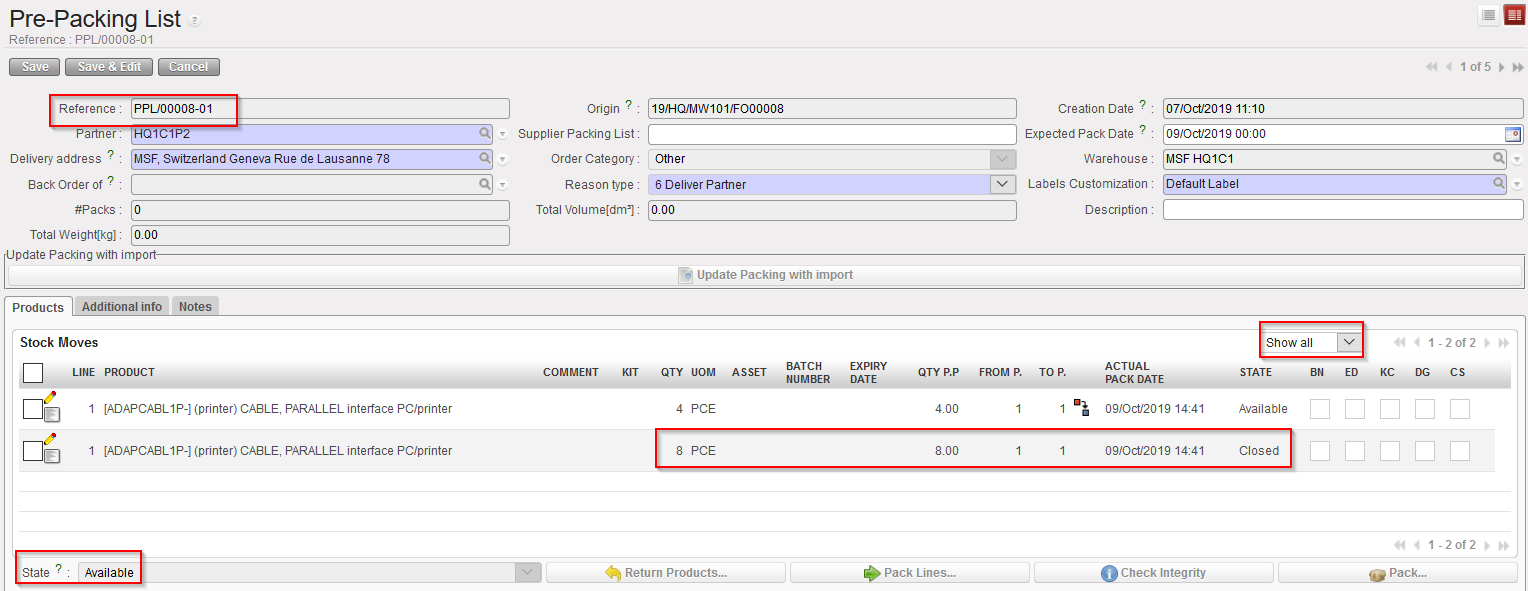
PPL after goods have been returned to stock – Note that you will have to change the filter from “hide returned” line to “Show all” in order to see the returned lines
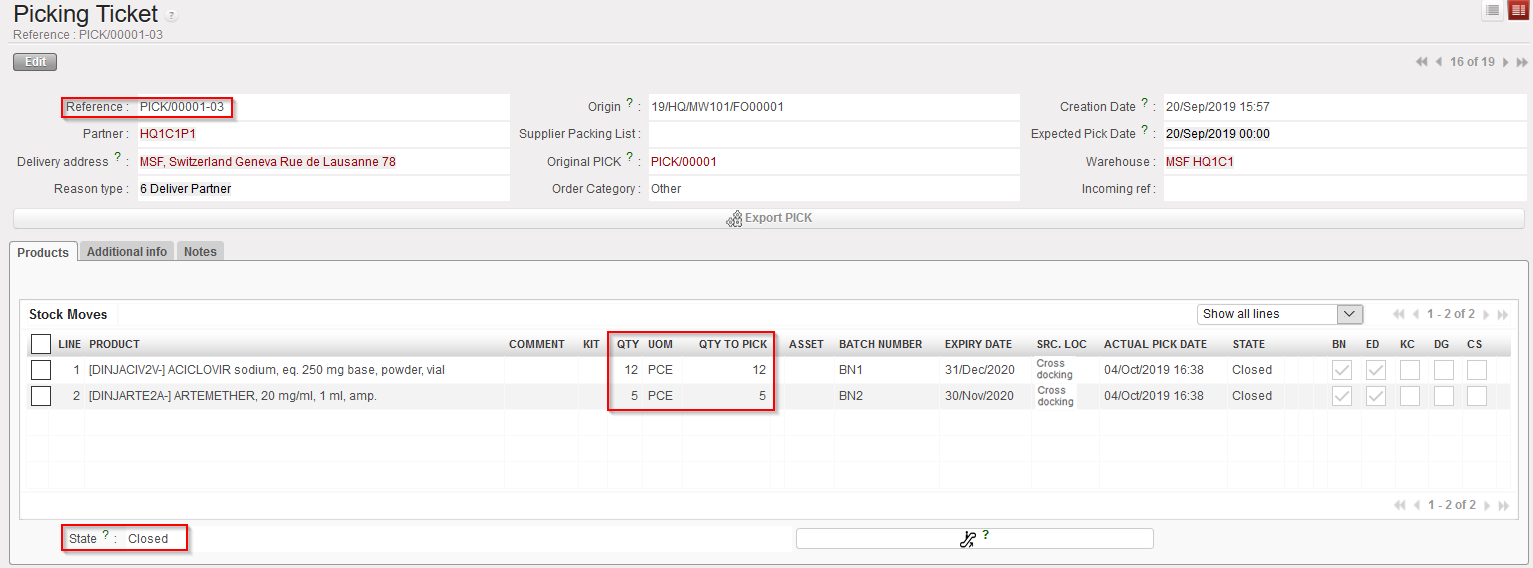
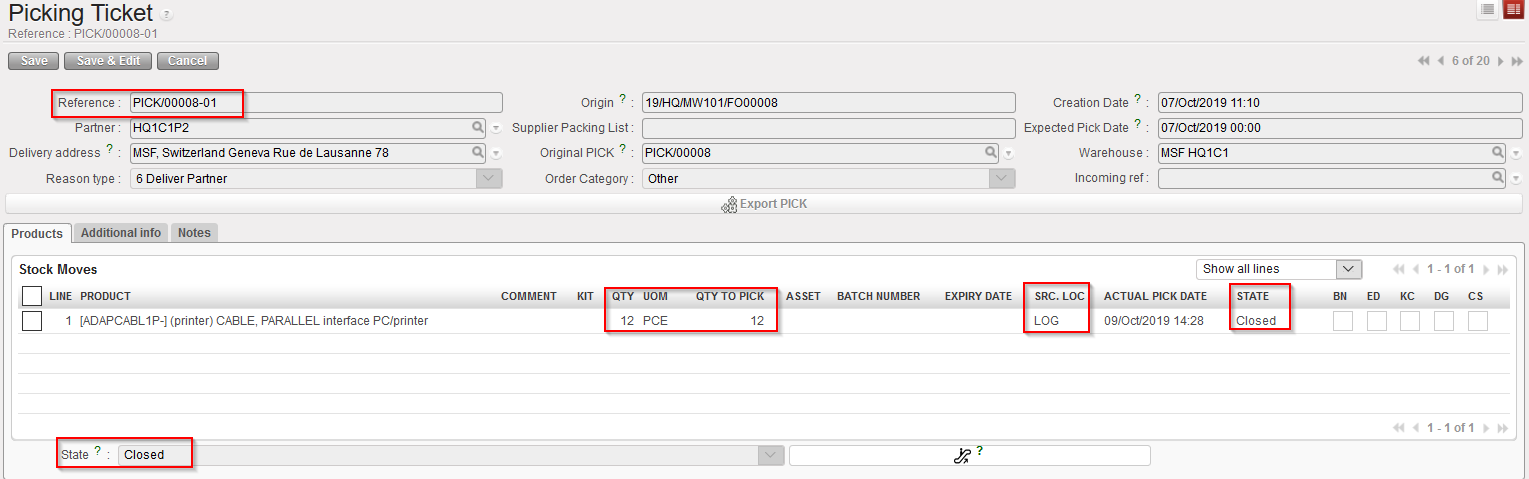
Sub PICK which was used to move the goods to the “Packing” location

The system switches back to the main PICK corresponding to the PPL from which a return was done. In the above example, products are sent back to this main PICK which is in state “Draft” with all its lines “Available“. Products have actually been returned from the “Packing” location to the “Cross Docking” location (as the picking was done following the sourcing of an FO on order).

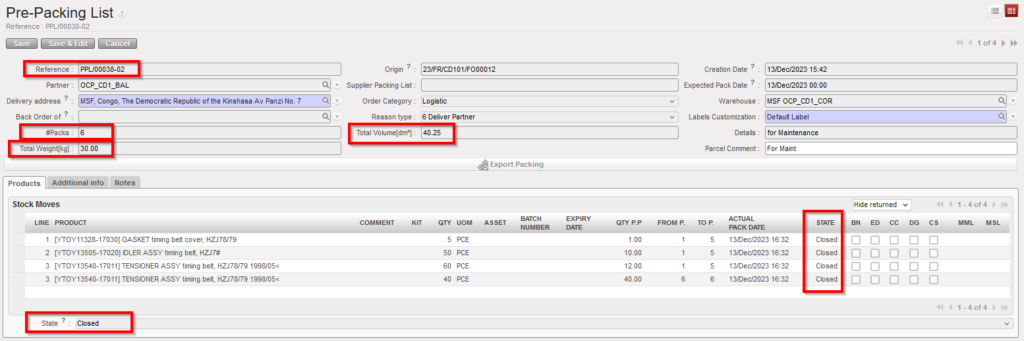
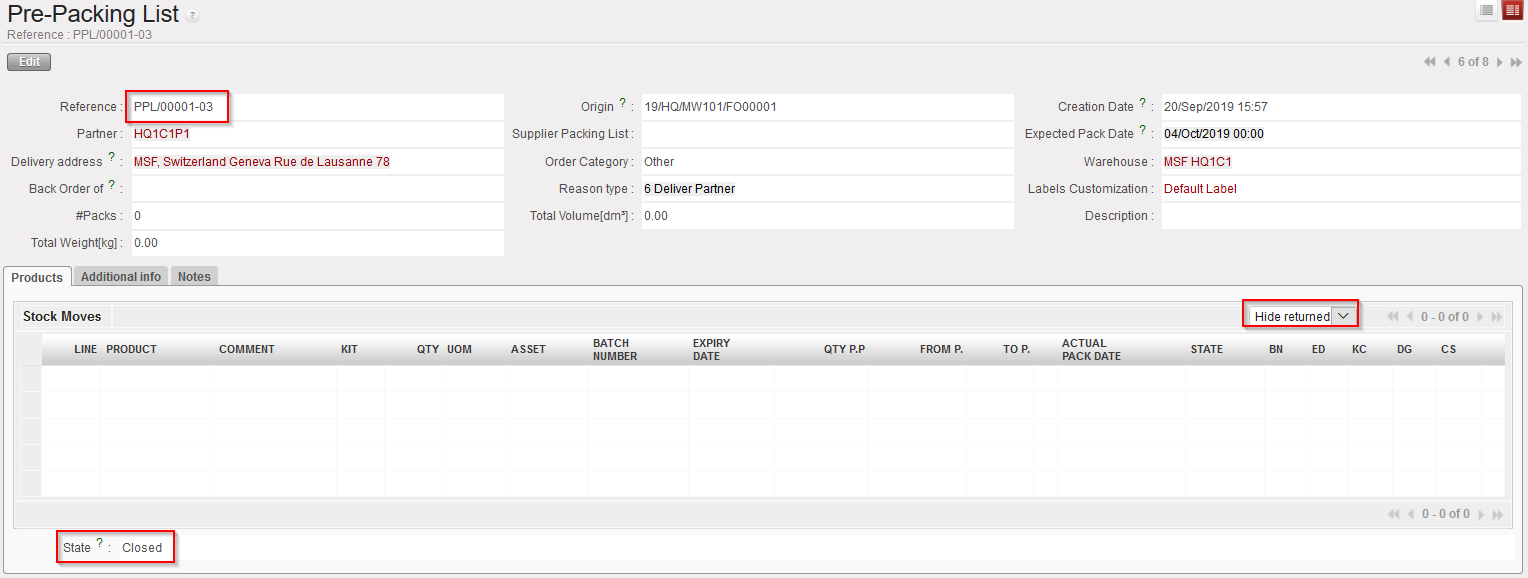
The PPL is now closed with all its lines closed. After updating the “Hide returned” line filter, we can see the returned lines.

Note that the sub PICK which was used to move the goods from “Cross docking” to “Packing(before they were returned) did not change. Its state is “Closed” with all its lines “Closed” as this movement has been done.

Picking should be repeated. For this you need to start from the main PICK and create a new sub PICK.

Below, you find an example of a picking done from stock (FO sourced from stock) with goods partially returned to stock from the PPL to the stock.

  1. Situation before partial return.
PPL before return
Corresponding main PICK before return – note that “Show all lines” filter is on
Sub PICK which was processed to pick the goods

2. Goods are partially returned to stock.

Returning partially the products from PPL to stock

3. Situation after partial return.

Corresponding main PICK after partial return

PPL after partial return – please note the change after using filter “Show all

Again, many alternative scenarios may exist involving partial validation of FOs, partial sourcing of FOs, partial validation of POs, partial confirmation of POs, partial reception of INs, partial picking, cancellation, cancel & resource, … All scenarios could not be described here but the most common were outlined.

F. HOW TO CANCEL A PRE-PACKING LIST (it is actually impossible to do)

Supply User Manual ENG -> 5. Warehouse -> 5.3 LU-SU4102: Picking -> F. HOW TO CANCEL A PRE-PACKING LIST (it is actually impossible to do)

F. HOW TO CANCEL A PRE-PACKING LIST (it is actually impossible to do)

You cannot cancel a Pre-Packing List. However, you can return the products to stock; this will close the PPL and update the Picking Ticket. See next LU to return items to stock.

Returning products to stock from a PPL

E. HOW TO PRINT THE PRE-PACKING LIST

Supply User Manual ENG -> 5. Warehouse -> 5.3 LU-SU4102: Picking -> E. HOW TO PRINT THE PRE-PACKING LIST

E. HOW TO PRINT THE PRE-PACKING LIST

Printing a document from an available PPL can be useful as it allows the storekeeper to write on it how picked items have been packed. Once done, this will be encoded in the system through the steps 1 & 2 described in the previous section.

Go to: Warehouse / Warehouse Management / Deliveries / Packing

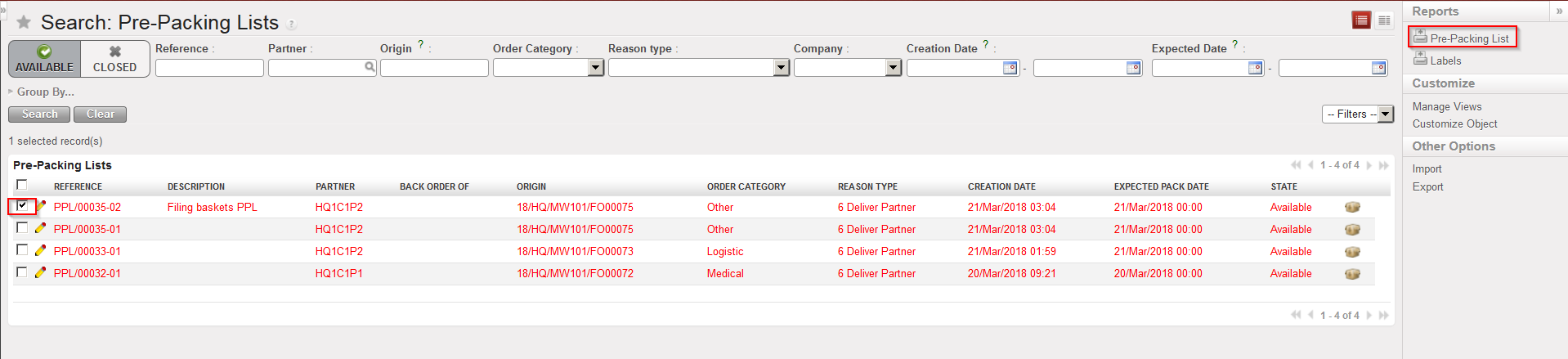
  1. Using the check boxes, tick the PPL you wish to print
  2. Select the “Pre-Packing List” option in the action menu to export the PPL to PDF

Selecting a PPL an exporting it to PDF

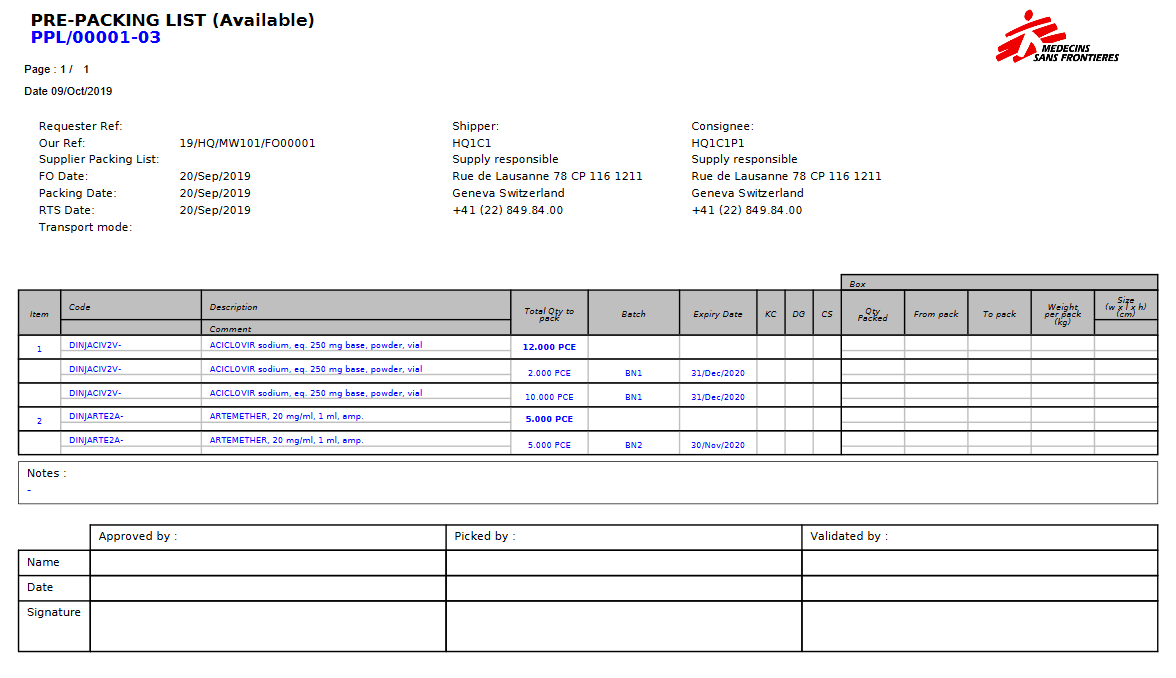
PPL in PDF

The “Pre-Packing List” option is also available in the action menu from within the PPL.

PPL can be exported to PDF in the state “Available” or “Closed“. However, if a “ClosedPPL is exported to PDF, the parcel information will not appear on the PDF document.

Note that labels may also be printed from a “Closed” PPL. Use the option “Labels” in the action menu to print them. You will get a PDF file with one page per parcel. Labels can be put on parcels in order to allow the shipper and the customer to properly identify them.

D. HOW TO IMPORT A PPL TO AN EXCEL FILE

Supply User Manual ENG -> 5. Warehouse -> 5.3 LU-SU4102: Picking -> D. HOW TO IMPORT A PPL TO AN EXCEL FILE

D. HOW TO IMPORT A PPL TO AN EXCEL FILE

Available PPL can be imported to Excel file with the information on screen:

Go to: Warehouse / Warehouse Management / Deliveries / Packing

  1. Click “Edit(pencil icon) on the PPL you want to import
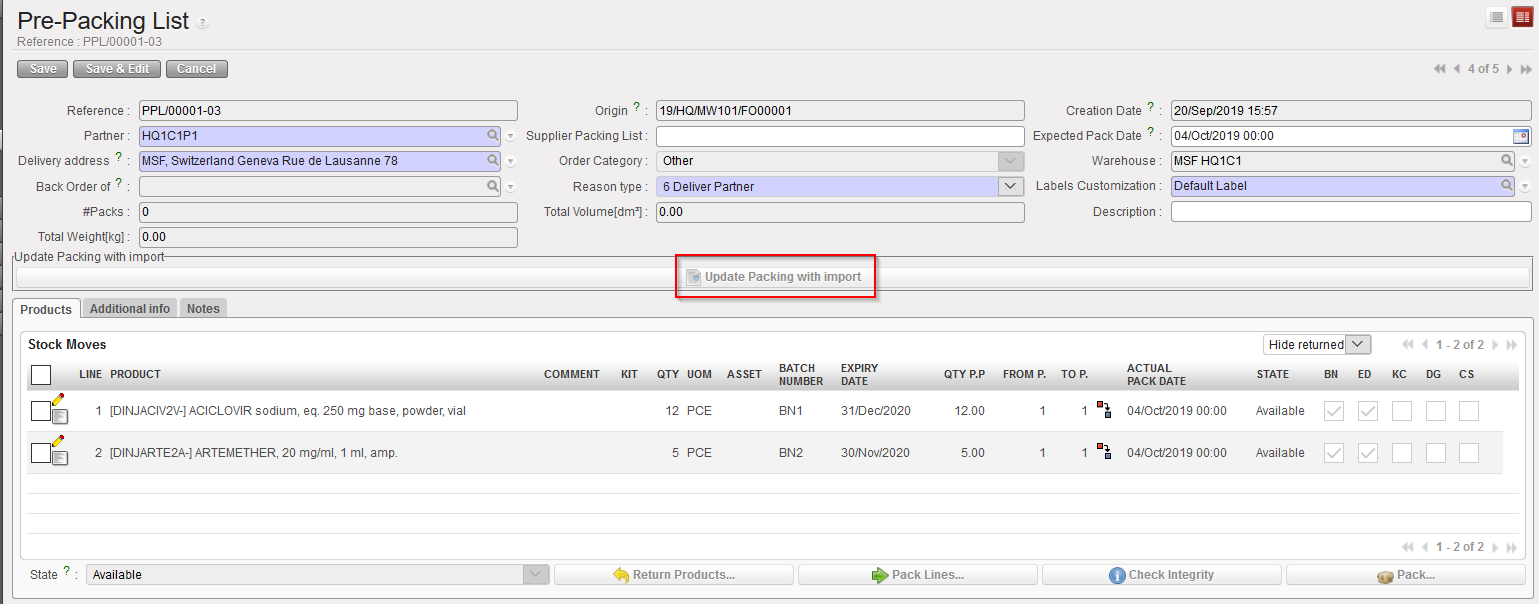
  2. From the PPL form view, click on button “Update Packing with import” and update your file
  3. Click on “add attachment
  4. Click on “Browse” to retrieve the import file
  5. Click on “Import file

Click on “Update Packing with import

PPL in Excel – one line has been split in this example

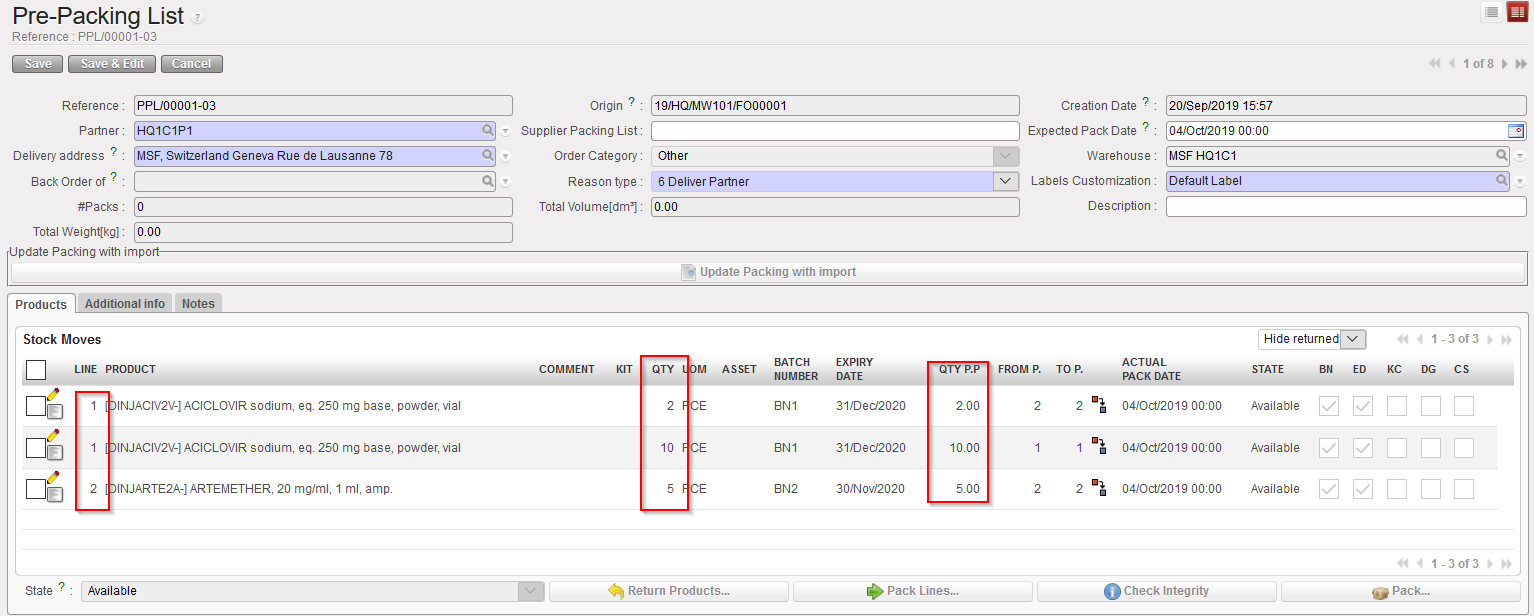
Result after import of above Excel file

Note that after import the split lines cannot be aggregated back ( but they can be put in the same range pack eventually). Import checks will ensure that total of split quantities will equal original line quantity. Other checks will control line # and code matching; line Availability; BN/ED existence…

C. HOW TO EXPORT A PPL TO AN EXCEL FILE

Supply User Manual ENG -> 5. Warehouse -> 5.3 LU-SU4102: Picking -> C. HOW TO EXPORT A PPL TO AN EXCEL FILE

C. HOW TO EXPORT A PPL TO AN EXCEL FILE

Available PPL can be exported to Excel file with the information on screen:

Go to: Warehouse / Warehouse Management / Deliveries / Packing

  1. Using the check boxes, tick the PPL you wish to Export
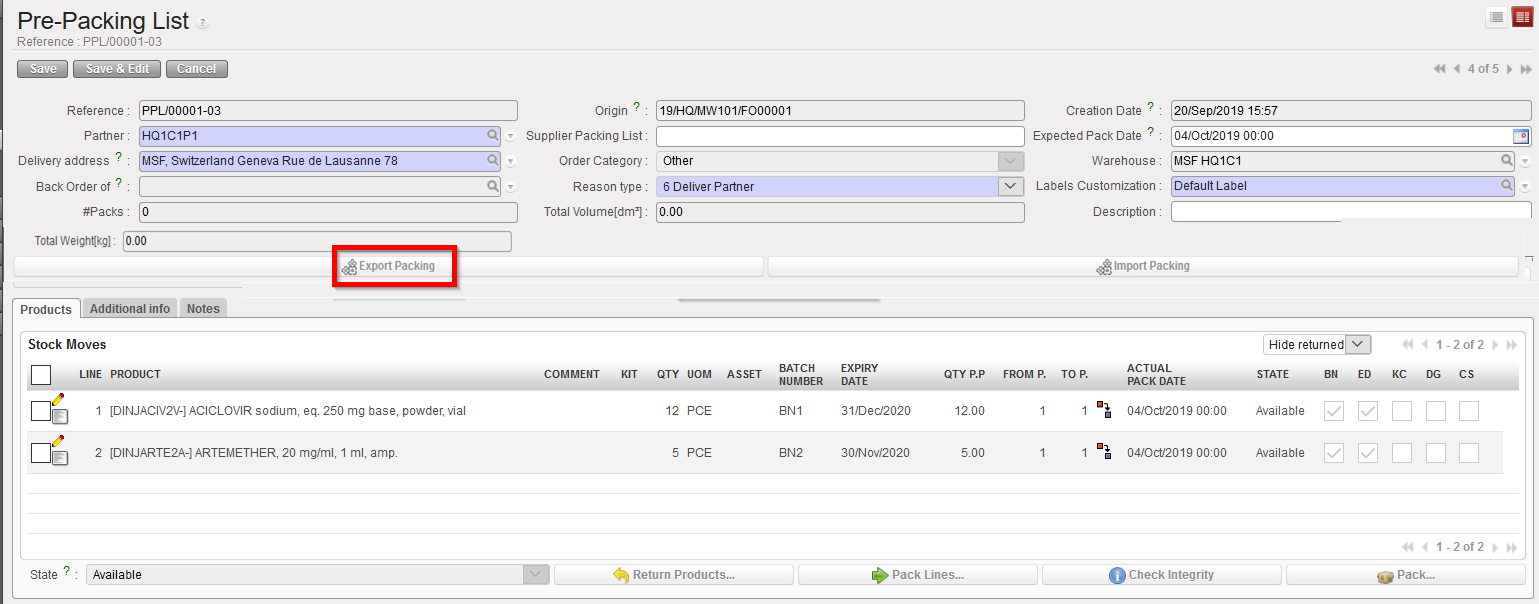
  2. Click on the “Export Packing” button

Selecting a PPL and exporting it to Excel

PPL in Excel

B. HOW TO PACK PRODUCTS

Supply User Manual ENG -> 5. Warehouse -> 5.3 LU-SU4102: Picking -> B. HOW TO PACK PRODUCTS

B. HOW TO PACK PRODUCTS

The pre-packing lists are prepared in the state “Available” after validation of (sub) Picking Tickets. They have to be processed manually to transfer the picked goods to a Packing List. Processing them will transfer the products from the “Packing” location to the “Dispatch” location.

One Pre-Packing List is created per sub Picking Ticket (1:1 relationship). This is illustrated with the reference of the PPL. The PPL with the reference PPL/000XY-AB is linked to the Picking Ticket with the reference PICK/000XY-AB

Note that Pre-Packing lists can be split or merged during the Shipment process.

Go to: Warehouse / Warehouse Management / Deliveries / Packing

  1.  Locate the Pre-Packing List you wish to process. Filters can be used to facilitate the research.

This image has an empty alt attribute; its file name is pack.png

“Search: Pre-Packing Lists” screen

    2. Edit the Pre-Packing List you wish to process using the pencil icon.

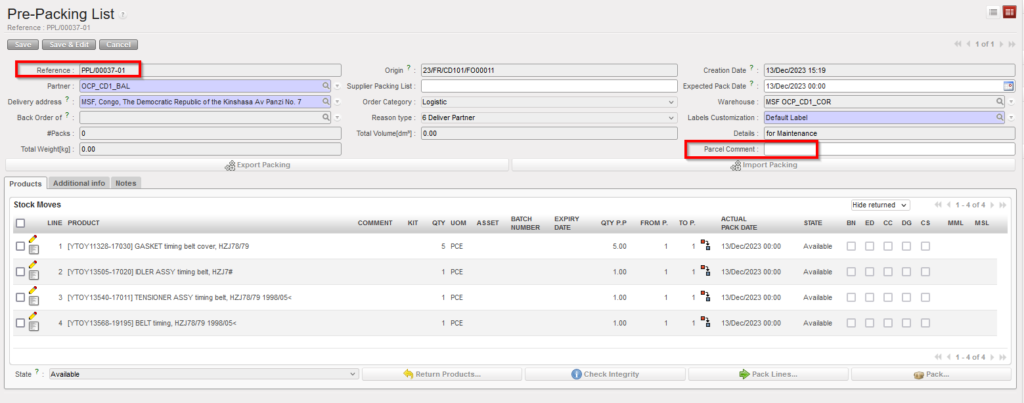
    3. If needed add a “Parcel Comment” for this PPL. This “Parcel Comment” will be transferred through to the Shipment and its related documents (Freight Manifest, Packing list,…)

This image has an empty alt attribute; its file name is pack-1.png

Entering a Parcel Comment on a PPL

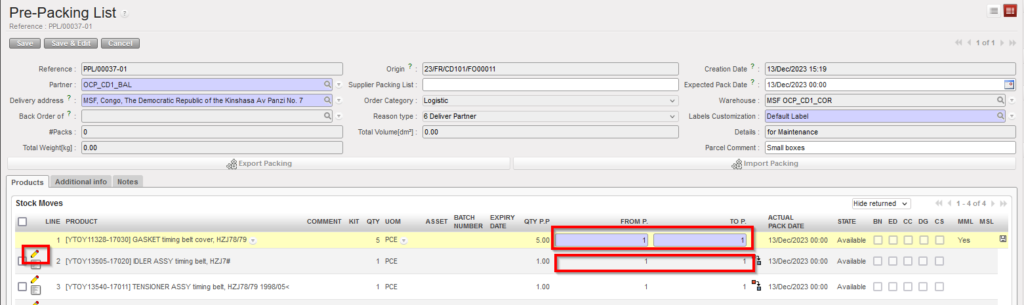
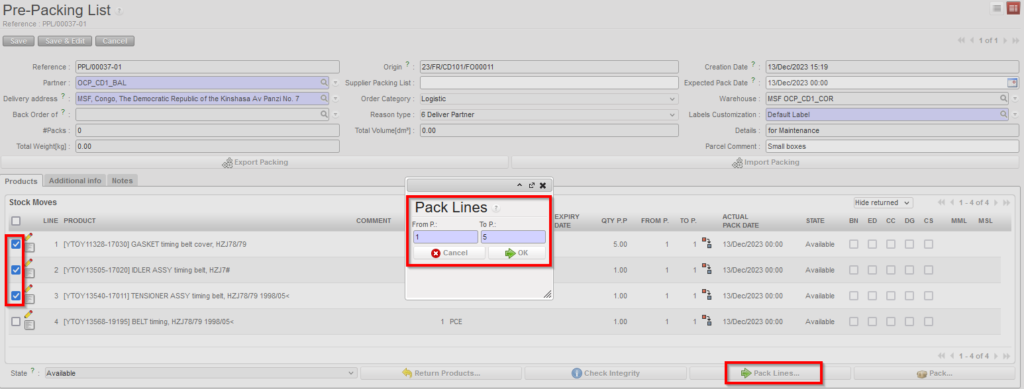
4. By default all items are put in a single box. All boxes/parcels are in the same line (“From P.=1” “To P.=1” where “From P.” represents the number of the first box in which you will find the product and “To P.” the number of the last box) and identical with the same size and weight.

You have 2 options to Edit the line:

a)  Using the Pencil icon : enables to update the packing product line by product line

b)  Using the “Pack lines” button , after having selected the requested product lines (using the check         boxes): enables to update the packing for several product lines at a time

This image has an empty alt attribute; its file name is pack-6.png

Updating line by line – using pencil icon

This image has an empty alt attribute; its file name is pack-7.png

Updating several product lines at a time – using “Pack lines”

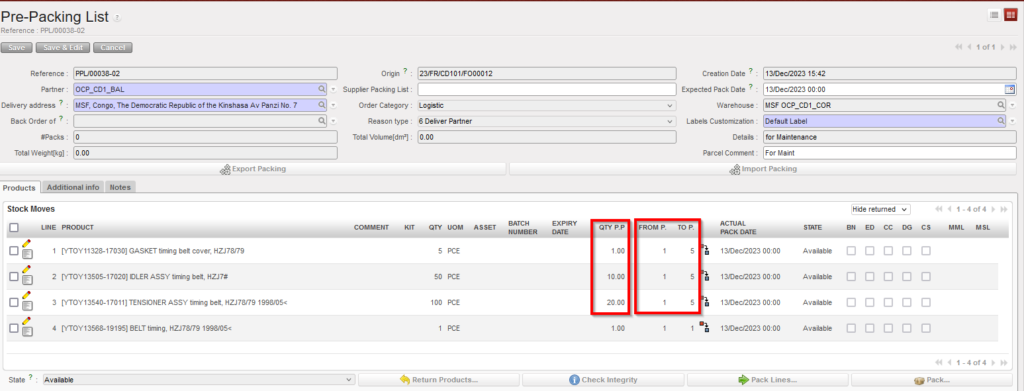
Note that if you change the number of parcels, the system automatically computes the quantity per parcel (see “QTY P.P” column: 12 and 16 in screenshot below) and splits the quantity equally across the number of parcels on that line range .

This image has an empty alt attribute; its file name is pack-8.png

“QTY P.P.” updated automatically – quantity split by 5 (nb of parcels)

This split might impact integer products that might result on decimal quantities per parcel (nb: this is coherent with the current use of kit product). Therefore, decimal quantities per parcel are allowed for integer (PCE) products and PPL can be processed further but a non-blocking message will be displayed for user.

“QTY” of 20 has been split in 3 boxes (form 2 to 4) resulting in non integer QtyP.P. = 6.67

This resulting message will be displayed when trying to Pack – non blocking

This message is a warning for later stage in case user try to “Return” partial range of boxes with decimal quantities from a PPL or from a Ship. In case of return, a blocking message will be displayed.

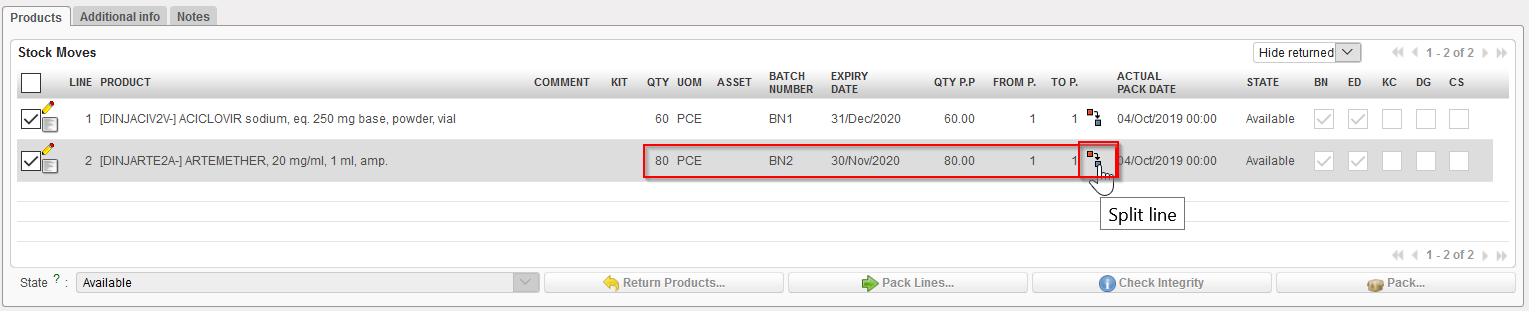
5.  If one line needs to be split in several parcels, you may use the split icon to split the line as much as needed.

Split product line

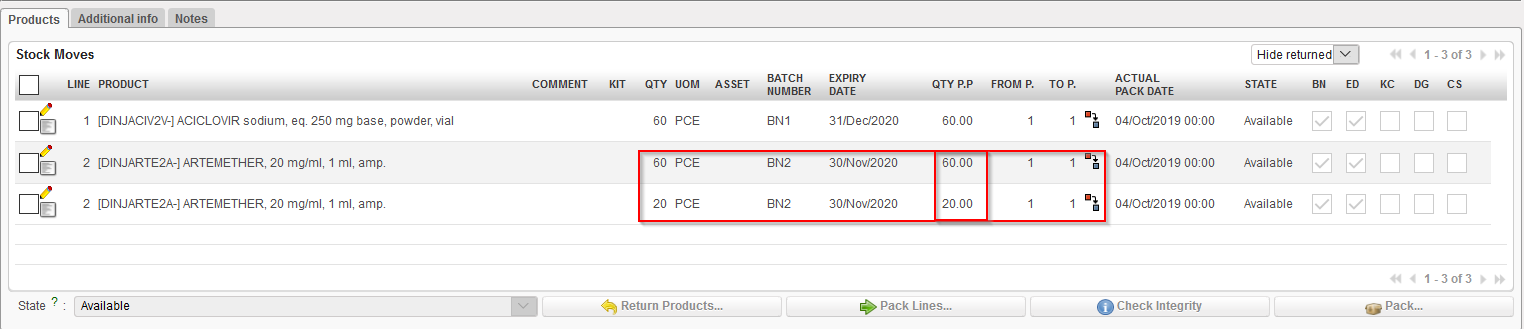
Initial quantity of 80 has been split to 60 and 20

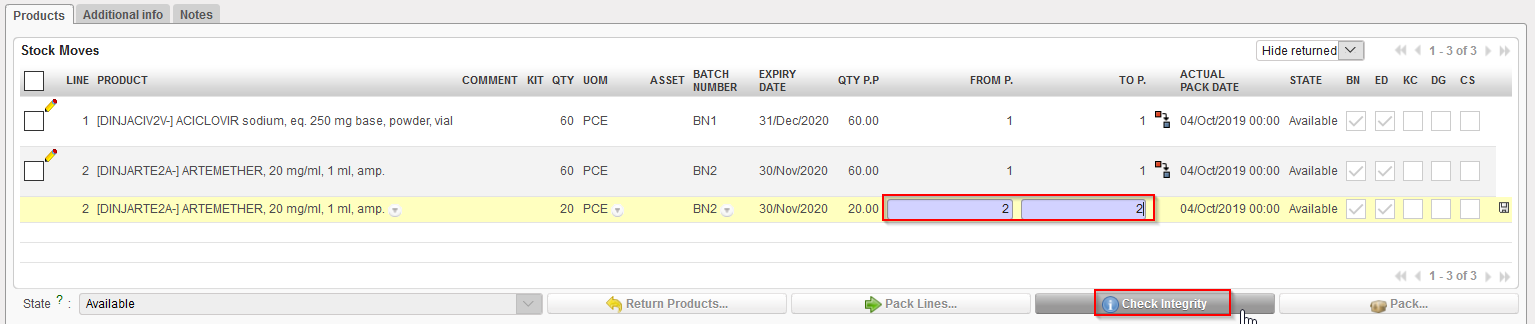
Quantity 20 has been packed on a 2d Box 2 and the other products remain in Box 1

6. The “Check integrity” button may help you to see if you did a mistake (overlapping boxes…)

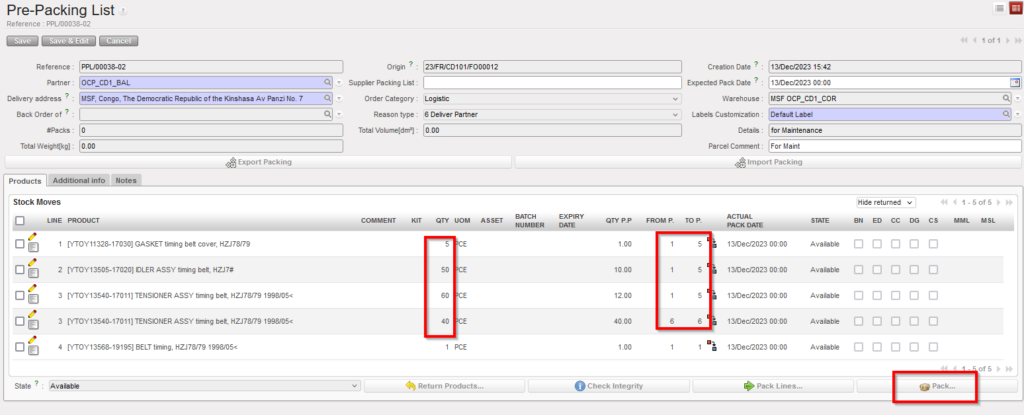
7. Click on the “Pack…” button located at the bottom of the screen to initiate the packing process.
This image has an empty alt attribute; its file name is pack-9.png

Updated Pre-packing List with items in 6 boxes “From P” =1 to “To “P=6

8.  You reach the “Packing details: Volumes and Weights” where sizes and weight of the different parcels must be specified. Use the pencil icon to edit each line and specify length/width/height/weight for each parcel. Save each line after update using the floppy icon.

Packing details: Volumes and Weights”

If pack types have been defined in configuration, you may use them to facilitate the process. Note that if your user has the requested rights, you may also define them at this stage. Behind a pack type, you find sizes (length/width/height). None of this field is mandatory but it is recommended to fill them whenever possible.

Note that if in the previous step, items have been distributed evenly in several boxes (e.g. from P1 to P5 in the example above) all these boxes will have the same sizes and weight.

Please also note that the “Save as draft” button will enable you to save this information in case you need to complete it later before processing.

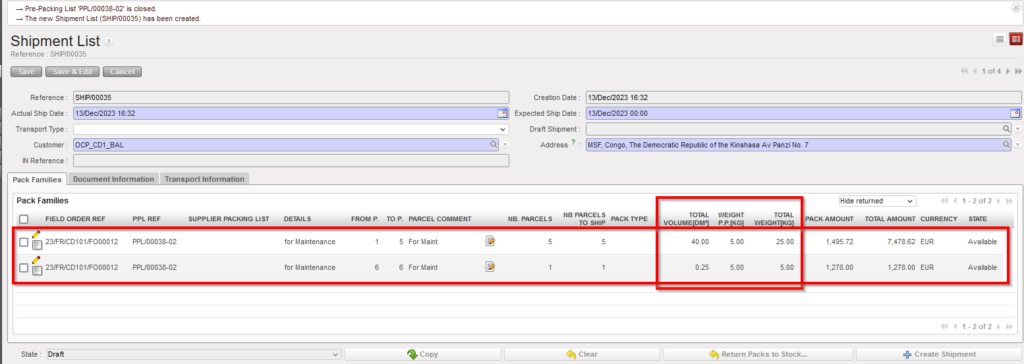
9. Once all lines have been updated, click on the “Process” button. This will open the next document from the flow – Draft Shipment

This image has an empty alt attribute; its file name is shipment-1024x364.png

Shipment

This image has an empty alt attribute; its file name is ppl-closed.png

Updated PPL

The PPL is now updated and turns to the state “Closed“. Splits done at step 1 of the PPL process, parcel distribution, total volume and total weight appear on the PPL but parcels detailed information (sizes and weights) indicated at step 2 are not visible here.

UniField jumps to the “Shipment” screen in order to allow you to process the next step, the shipment of the packed items to the customer.

If a “Draft” Shipment for the involved customer is available, the PPL is added on it (as it is the case in the above example). Otherwise, a new Shipment is created by the system.

Note that if you need to put a same product/batch in boxes with different sizes and/or weight, the split option should be used at step 1 when processing the PPL ( as detailed previously).

It is also possible to merge different products/batches in a same box (even if they are on lines in the PPL) by encoding them in the same box (“From P.” “To P.”). However, it can be tricky and you need to be very careful not to make the number of the boxes to overlap. Hence, the parcels numbers should be in sequential order from top product line to bottom product line. As already said, the “Check Integrity” button can help you with this.