
Supply User Manual ENG-> Supply Configurations-> 2.1 LU-SU1101: Instance set-up-> E. LU-SU1101: How to set-up configurable locations
E. LU-SU1101: How to set-up configurable locations.
Intermediate Stock locations and Internal/External Consumption Units can be created on an instance in order to reflect the physical stocks organization of a project/coordination office and support the physical flows which occur on the ground.
6 possible set-ups (from basic to complex) are illustrated below. These 6 set-ups focus on a consumption done from stock (i.e. not on order). Note that hybrid set-ups are also possible.
- Minimal set-up (no additional configurable locations)
Goods are received and kept in the main stock (Stock/MED/LOG).
If goods are consumed locally (on the instance) by an MSF requester, the consumption is recorded via a Real Consumption Report with the main stock (Stock/MED/LOG) as Source Location and the generic partner location “MSF Customer” as Destination Location. If goods are consumed by a non-MSF requester, the generic partner location “Other Customer” can be used as Destination Location. Internal Requests are not used to register local consumption with this set-up.
If goods are dispatched to a partner (a customer, via the sourcing of an FO), the consumption is recorded via a Delivery Order (OUT) or via PICK/PACK/SHIP. The Source Location of the OUT or the PICK is the main stock (Stock/MED/LOG). The Destination Location of the OUT or the SHIP is the partner location “MSF Customer” (or “Other Customer” if the customer is an external partner).
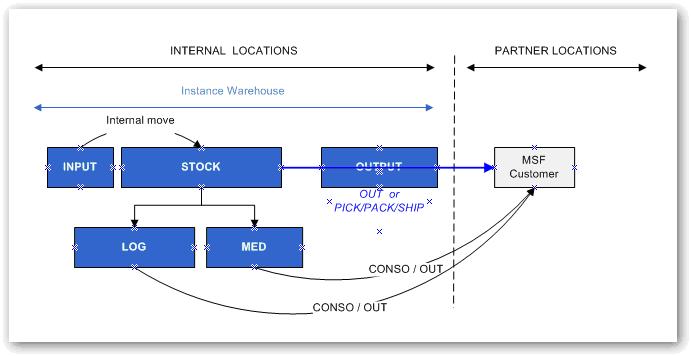
Minimal set-up
| Advantages | Disadvantages | Constraint/Effort |
| Quick and easy to manage and understand.
Minimal resources required. Stock visibility on warehouse (quantity, value, expiry dates). | Goods delivered from the W.H are considered consumed.
General follow up: no online details on intermediate stocks or consumption/activities. | Minimum |
2. Intermediate Stocks (IS)
When purchased, goods are:
- Either received in the main stock (Stock/MED/LOG) but transferred to an Intermediate Stock (with an Internal Move created from scratch or with an Internal Move created from IR sourcing) from where they’ll be consumed.
- Either received directly in an Intermediate Stock. This is possible if the replenishment of this IS starts with an IR which has the IS as Location Requester.
If goods are consumed locally (on the instance) by an MSF requester, the consumption is recorded via a Real Consumption Report with an IS as Source Location and the generic partner location “MSF Customer” as Destination Location. If goods are consumed by a non-MSF requester, the generic partner location “Other Customer” can be used as Destination Location. Internal Requests are not used to register local consumption with this set-up.
If goods are dispatched to a partner (a customer, via the sourcing of an FO), the consumption is recorded via a Delivery Order (OUT) or via PICK/PACK/SHIP. The Source Location of the OUT or the PICK is an IS. The Destination Location of the OUT or the SHIP is the partner location “MSF Customer” (or “Other Customer” if the customer is an external partner).
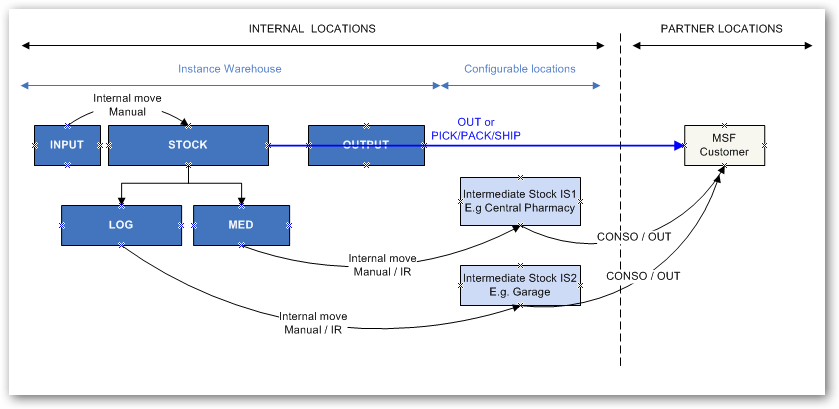
Intermediate Stocks
| Advantages | Disadvantages | Constraint/Effort |
| Fairly simple to manage.
Good visibility of stock after it has left Warehouse until it reaches intermediate stocks (quantity, value, expiry dates). | Goods delivered from Intermediate stocks are considered consumed.
More demanding in terms of input (transactions & updates) required for system. | Average |
3. External Consumption Units (ECU)
This configuration is similar to the minimal set-up but with further details on the destination of the goods.
Goods are received and kept in the main stock (Stock/MED/LOG).
If goods are consumed locally (on the instance) by an MSF requester, the consumption is recorded via a Real Consumption Report with the main stock (Stock/MED/LOG) as Source Location and a specific ECU as Destination Location. Note that the partner locations “MSF Customer” and “Other customer” can also be used as Destination Location if needed.
As an alternative to the RCR, local consumption can also be recorded through Internal Requests with an ECU as Location Requester. Their sourcing generates a Delivery Order with the ECU as Destination Location.
If goods are dispatched to a partner (a customer, via the sourcing of an FO), the consumption is recorded via a Delivery Order (OUT) or via PICK/PACK/SHIP. The Source Location of the OUT or the PICK is the main stock (Stock/MED/LOG). The Destination Location of the OUT or the SHIP is the partner location “MSF Customer” (or “Other Customer” if the customer is an external partner).
An alternative is to link a partner (customer) to an ECU (thanks to the field “Customer Location” available on the “Field orders & Purchases” tab of the partner sheet). In this case, all goods shipped to this partner have this ECU as Destination Location of the OUT or the SHIP.
Note that the stocks of the ECUs are not integrated (no visibility) as these locations are considered as “end customers”.
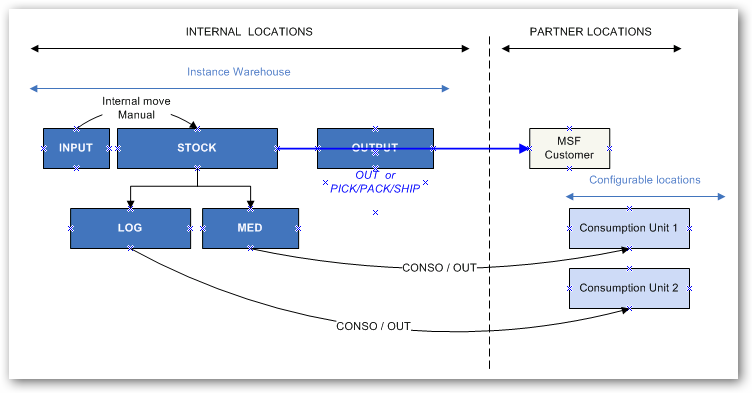
External Consumption Units
| Advantages | Disadvantages | Constraint/Effort |
| Quick and easy to manage.
Quite low volume of transactions. Minimal resources required. Stock visibility on warehouse (quantity, value, expiry dates) | Goods delivered from the WH are considered as consumed*.
General follow up and consumption information only on destinations (consumption units = end consumers) | Average low |
4. Intermediate Stocks (IS) and External Consumption Units (ECU)
This configuration is a mixture of set-ups 2 and 3.
When purchased, goods are:
- Either received in the main stock (Stock/MED/LOG) but transferred to an Intermediate Stock (with an Internal Move created from scratch or with an Internal Move created from IR sourcing) from where they’ll be consumed.
- Either received directly in an Intermediate Stock. This is possible if the replenishment of this IS starts with an IR which has the IS as Location Requester.
If goods are consumed locally (on the instance) by an MSF requester, the consumption is recorded via a Real Consumption Report with an IS as Source Location and a specific ECU as Destination Location. Note that the partner locations “MSF Customer” and “Other customer” can also be used as Destination Location if needed.
As an alternative to the RCR, local consumption can also be recorded through Internal Requests with an ECU as Location Requester. Their sourcing generates a Delivery Order with the ECU as Destination Location.
If goods are dispatched to a partner (a customer, via the sourcing of an FO), the consumption is recorded via a Delivery Order (OUT) or via PICK/PACK/SHIP. The Source Location of the OUT or the PICK is an IS. The Destination Location of the OUT or the SHIP is the partner location “MSF Customer” (or “Other Customer” if the customer is an external partner).
An alternative is to link a partner (customer) to an ECU (thanks to the field “Customer Location” available on the “Field orders & Purchases” tab of the partner sheet). In this case, all goods shipped to this partner have this ECU as Destination Location of the OUT or the SHIP.
Note that the stocks of the ECUs are not integrated (no visibility) as these locations are considered as “end customers”.
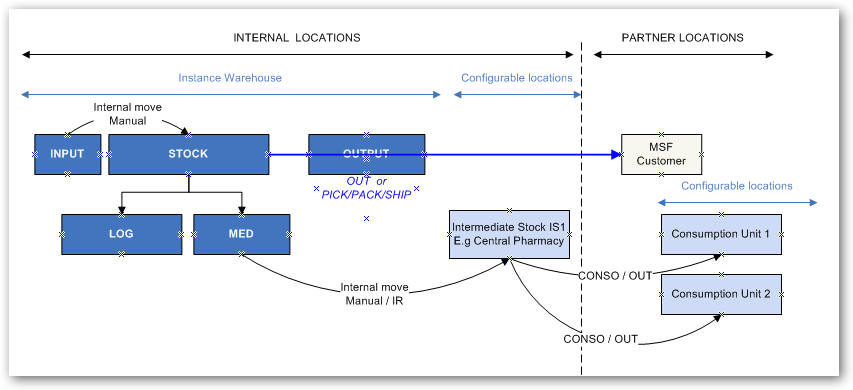
Intermediate Stocks and External Consumption Units
| Advantages | Disadvantages | Constraint/Effort |
| Good overview of stock management and general follow up for Intermediate Stocks (quantity, value, expiry dates).
Consumption information by destination/consumer. | More complex.
Needs more input to manage: Moves from stock to intermediate stocks plus one consumption report by destination (consumer). Stock of consumption units is not integrated (no visibility). | Average |
5. Internal Consumption Units (ICU)
This configuration is very close to set-up 2.
When purchased, goods are:
- Either received in the main stock (Stock/MED/LOG) but transferred to an Internal Consumption Unit (with an Internal Move created from scratch or with an Internal Move created from IR sourcing) from where they’ll be consumed.
- Either received directly in an Internal Consumption Unit. This is possible if the replenishment of this ICU starts with an IR which has the ICU as Location Requester.
If goods are consumed locally (on the instance) by an MSF requester, the consumption is recorded via a Real Consumption Report with an ICU as Source Location and the generic partner location “MSF Customer” as Destination Location. If goods are consumed by a non-MSF requester, the generic partner location “Other Customer” can be used as Destination Location. Internal Requests are not used to register local consumption with this set-up.
If goods are dispatched to a partner (a customer, via the sourcing of an FO), the consumption is recorded via a Delivery Order (OUT) or via PICK/PACK/SHIP. The Source Location of the OUT or the PICK is an ICU. The Destination Location of the OUT or the SHIP is the partner location “MSF Customer” (or “Other Customer” if the customer is an external partner).
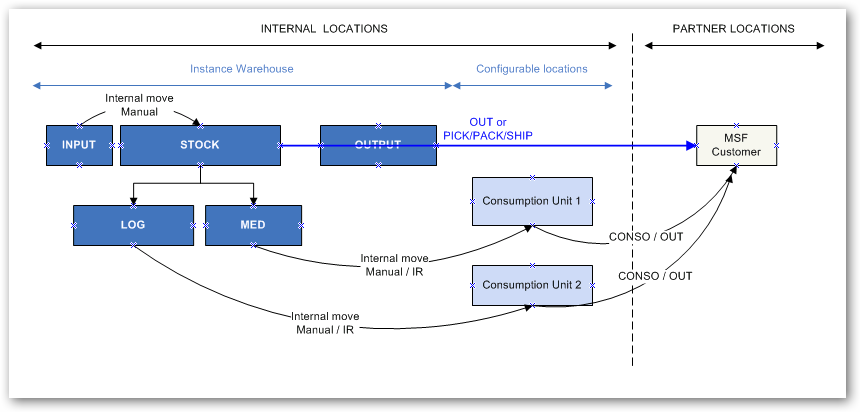
Internal Consumption Units
| Advantages | Disadvantages | Constraint/Effort |
| Fairly good overview of consumption of stocks.
Visibility of consumption units’ stock (quantity, value, expiry dates) | Some resources needed to ensure system is up to date (frequent consumption of consumption unit). | Average |
6. Full set-up
In this configuration, Intermediate Stocks, Internal Consumption Units and External Consumption Units are used. This set-up is more complex and requires much more transactions, meaning resources, to maintain the system.
When purchased, goods are:
- Either received in the main stock Stock/MED/LOG (via the Input location and the manual/automatic processing of an INT)
- Either received in an Intermediate Stock (via the Input location and the manual/automatic processing of an INT)
- Either received in an Internal Consumption Units (via the Input location and the manual/automatic processing of an INT)
Goods can be moved between these 3 types of locations using Internal Move created from scratch or Internal Moves created from IR sourcing.
Local consumption is registered via RCR. The 3 types of locations can be used as Source Location. The Destination Location can be an ECU, “MSF Customer” or “Other Customer”.
As an alternative to the RCR, local consumption can also be recorded through Internal Requests with an ECU as Location Requester. Their sourcing (from one of the 3 types of locations) generates a Delivery Order with the ECU as Destination Location.
If goods are dispatched to a partner (a customer, via the sourcing of an FO), the consumption is recorded via a Delivery Order (OUT) or via PICK/PACK/SHIP. The 3 types of locations can be used as Source Location on the OUT or the PICK. The Destination Location of the OUT or the SHIP is the partner location “MSF Customer” (or “Other Customer” if the customer is an external partner).
An alternative is to link a partner (customer) to an ECU (thanks to the field “Customer Location” available on the “Field orders & Purchases” tab of the partner sheet). In this case, all goods shipped to this partner have this ECU as Destination Location of the OUT or the SHIP.
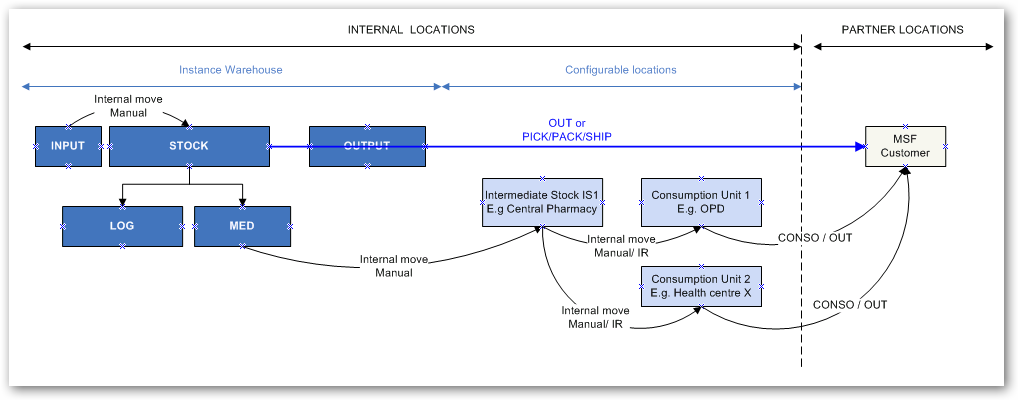
Full set-up
| Advantages | Disadvantages | Constraint/Effort |
| Very precise follow up of goods at the different stages (quantity, value, expiry dates,) of the supply chain until they’re consumed by the end consumer.
Closer to real consumption. | Complex to understand.
Increased number of transactions (meaning also of resources needed to maintain the system). Delay in the time frame when goods are considered “consumed”. | Maximal |
In general, goods are considered consumed once they have left internal locations for external (partner) locations. Consumption in the system reflects either consumption reports or outgoing delivery of shipments (we exclude loans, donations, loss and discrepancies as consumption and we also deduct returns). The Warehouse Chapter details how consumption (real by location or monthly average for the instance) are calculated.
Configurable Stock Locations can be created at Coordination and Project instance levels but the decision should be taken on case by case basis according to Mission/OC decision.
