
Supply User Manual ENG -> 4. Procurement -> 4.7 PURCHASE ORDERS (POs) - SPECIFICS -> G. How to create a Purchase Order with a Purchase list
G. How to create a Purchase Order with a Purchase list
This type of PO is used when a cash advance (float) will be used to purchase goods at the local market. This is why the default supplier is “Local Market” although if you have created the actual supplier in the system, you can edit and enter this instead. Usually the amounts are not significant in relation to the total budget.
Creating a Purchase List is similar to creating a Purchase Order, but the type will be “Purchase List“. Check with your OC for specific validation procedures, as the PO should be validated before the goods are bought, and if appropriate, the goods can be bought, then the PO modified to enter the actual price paid if it is different to the original estimated price, and only after this should the PO be confirmed. Once the PO type PL is confirmed, Finance will be able to link the payment / float justification to the PO (see Finance Module Supply Finance Integration for more details).
Go to: Purchases / Purchase Management / Purchase Orders
- Create a new PO via the “New” button.
- As “Order Type“, select “Purchase List“.
- Fill in the rest of the header information (priority,category, details).
- The Supplier field will have been populated with Local Market, but this can be changed if you have created the specific supplier record.
- Add product lines manually or via file import.
- Enter the Analytical Distribution.
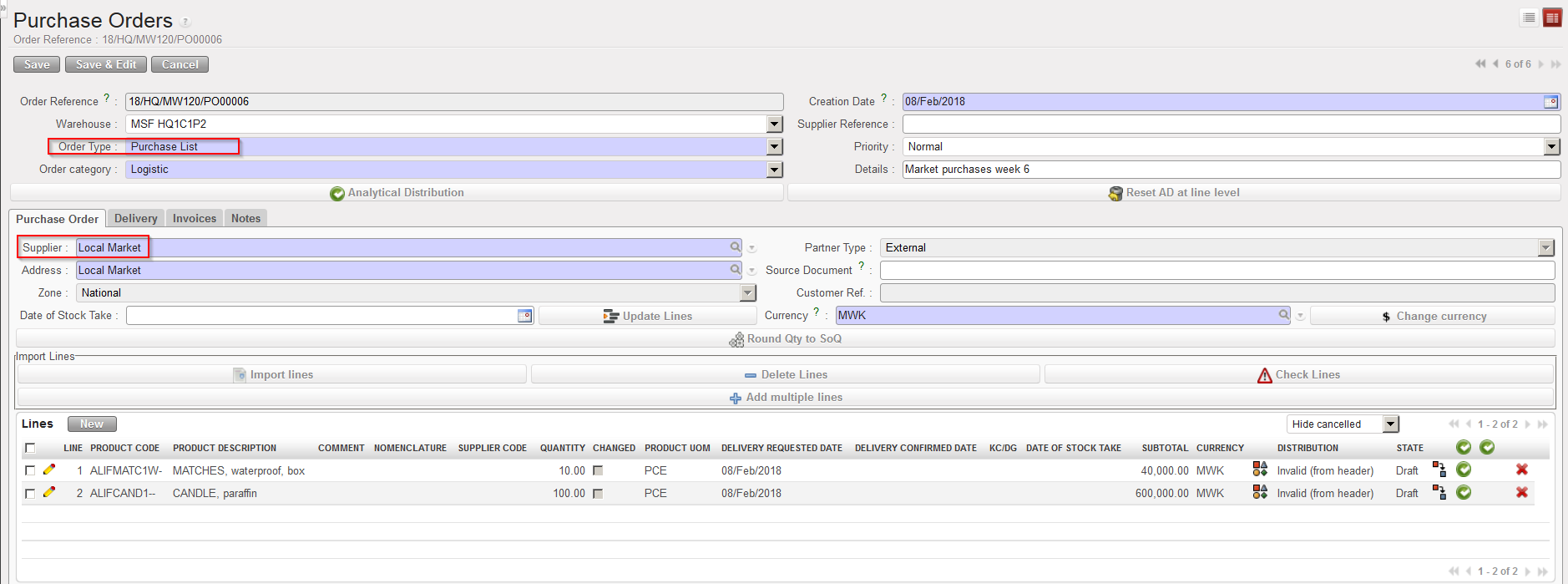 |
| Purchase List PO |
Depending on the processes in place on your mission, this PO could be printed in PDF and used as part of the request for operational advance /cash float.
Note that a PO PL (line) should only be confirmed after the final prices have been updated in the system, this may mean (check your OC procedures) that the PO PL (line) should only be confirmed after goods have been bought. This will mean that there is no incoming shipment (IN) created until after the goods arrive; therefore it would be good to notify the warehouse officer beforehand so that s/he is prepared to receive the goods.
