
2.11 Project Instances
All steps described in this section are to be performed with the admin user. It is also important that the coordination’s validation synchronizations described in step 2.10.9 are finished before starting setting up Projects. Log in your Project instance.
2.11.1 Connect and Register to Synchronization Server
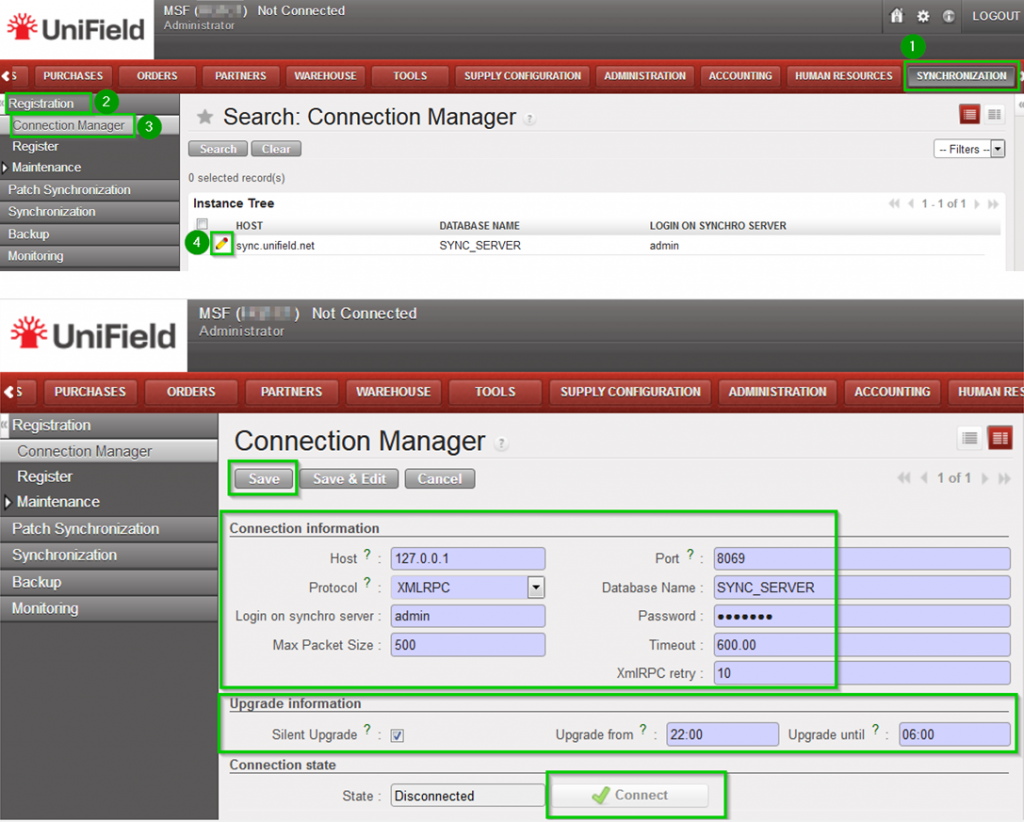
Connect Click on Menu Synchronization 1, Registration 2, Connection Manager 3
Click on the edit icon (4) and to edit the Current Connection
Host:
* Production instance: sync.unifield.net
*Sandbox: Address of the machine where your Sync Server is installed (localhost if installed on the same machine)
Port:
*Production: 443
*Default or Sandbox: 8069
Protocol:
*XMLRPC
*secured compressed XMLRPC
Database Name:
*Production: SYNC_SERVER
*Sandbox: Your_sync_server_name
Login on synchro server:
*Production: provided by the Support Team
*Sandbox: Your_sync_server_login
Password:
*Production: provided by the Support Team
*Sandbox: Your_sync_server_password
Max Packet Size: 500
Timeout:600 – The number of seconds the instance will wait during a sync before raising a timeout error
XmlRPC retry: 10 – The number of retry during a sync when the instance don’t receive the acknowledge from the sync server with the XmlRPC protocol.
Silent upgrade: The instance will patch automatically during the time slot defined if an automatic synchronisation is performed. It is strongly
recommended to activate it
Click on Connect 5 the State switches to connected
Click on Save
| Register: Click on Menu Synchronization 1, Registration 2, Register 3 A new wizard will open Check that the instance name matches the Project database name as defined in the installation checklist Enter contact email 4 wwwClick on Next 5 | 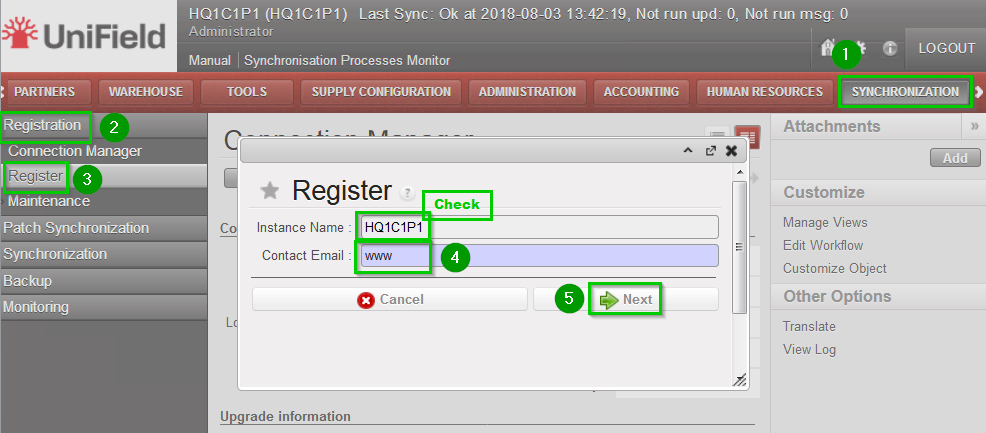 |
| Select your Coordination Parent Instance 1 Select your Operational Center 2 Click on Next 3 | 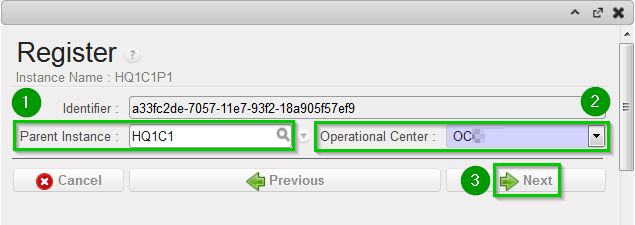 |
| Click on Add 1 Choose groups 2:
Click on Select 3 | 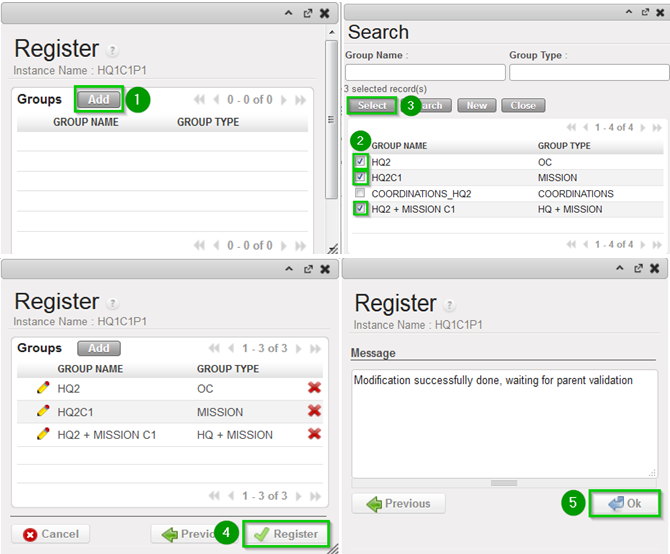 |
2.11.2 Validate Instance (only at sync_server side)
For Production instance this step is done by the Support Team.
For Sandbox instance login in your_Sync_Server instance with the admin user.
| Click on Menu Administration 1, Synchronization 2, Configuration 3, Instance 4 Click on the edit icon 5 of the Project instance created in previous steps | 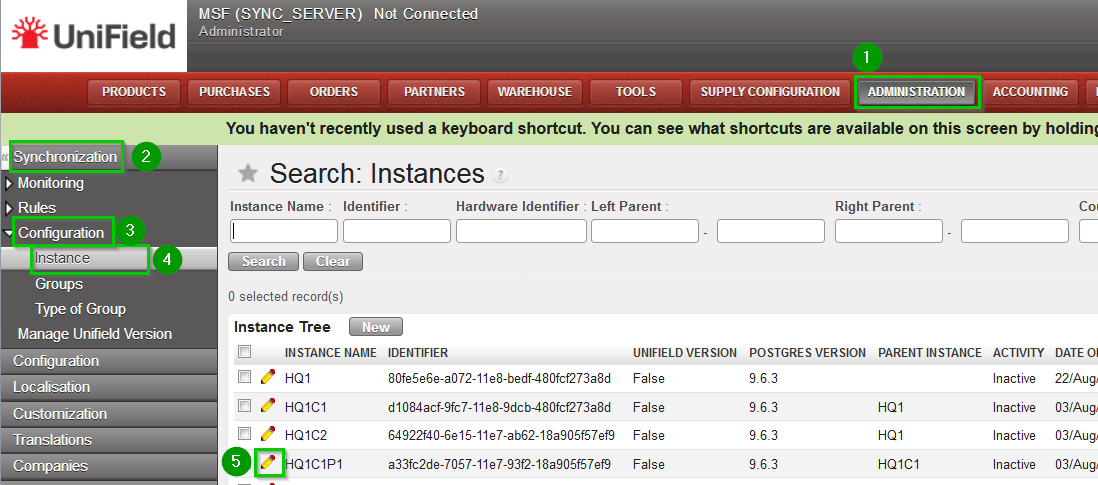 |
Check the following is correct:
Note that at this stage, it is normal that no children appear in the list, they will appear later on when Coordinations are created and defined as children of the HQ. | 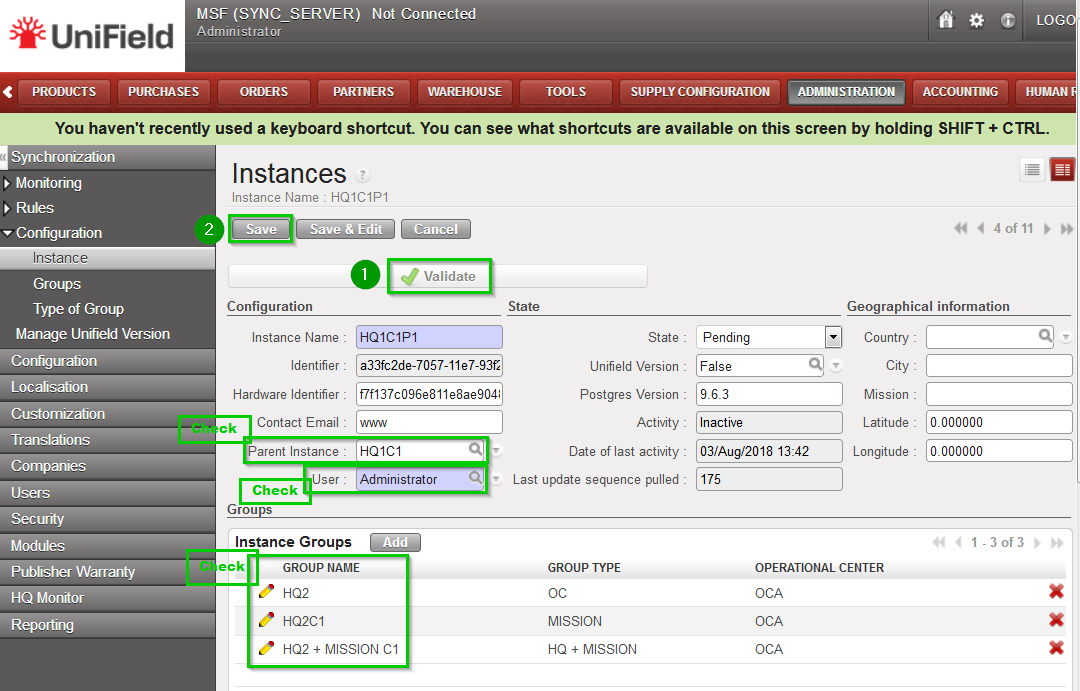 |
2.11.3 Configure Automatic Backups
It is strongly recommended to schedule automatic backups and to save it in another location than the server instance.
| On your HQ instance, click on Menu Synchronization 1, Backup 2, Backup config 3 You must enter an existing path 4 to save backups. The following options 5 are available to run automatic backups, please ensure the backup path exists as the sync. may fail:
Click on Save 7 |  |
| To schedule an automatic backup click on Menu Synchronization1, Backup2, Automatic3 Edit the following fields 4:
Tick the Active box 5 |  |
It is possible to send your latest backup to OneDrive. This is STRONGLY RECOMMENDED, refer to section 12.2 Automatic instance backup to the Cloud to configure it. the configuration is done from the HQ for the HQ and its children instances.
Please note that this IS NOT to be considered as a offsite backup solution (this is for Support Team debbuging, support and BI purpooses)
2.11.4 Perform Initial Synchronization
| Click on Menu Synchronization 1, Synchronization 2, Manual 3 A new wizard opens. Click on Start All Synchronization In Background 4 You should wait until the synchronization is finished before starting to configure the Projects. |  |
| In order to perform this check: Click on Menu Synchronization 1, Monitoring 2, Synchronization Processes Monitor 3 Check 4 that the last synchronization is Done |  |
2.11.5 Perform Reconfigure
| Click Menu Administration 1, Configuration 2, Reconfigure 3 A new wizard will open and you would then navigate to various screens. | 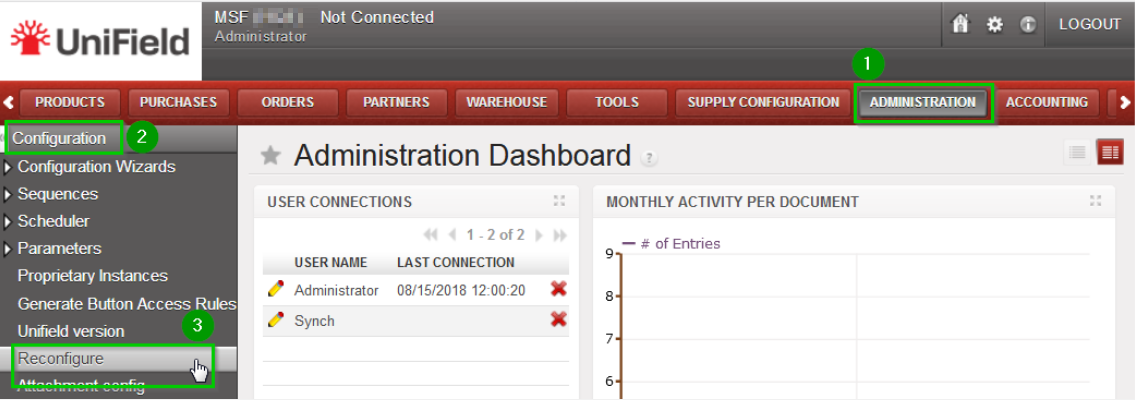 |
| Instance Configuration: Choose the proprietary instance corresponding to the project1 (as created in step 2.9.2). This step cannot be re-done; if the wrong proprietary instance is chosen, the database needs to be dropped and re-created. Choosing a proprietary instance already in use in your OC could lead to corruption of other instances. Most of the time the proprietary instance’s name and the instance’s name will be the same. Click on Next 2 | 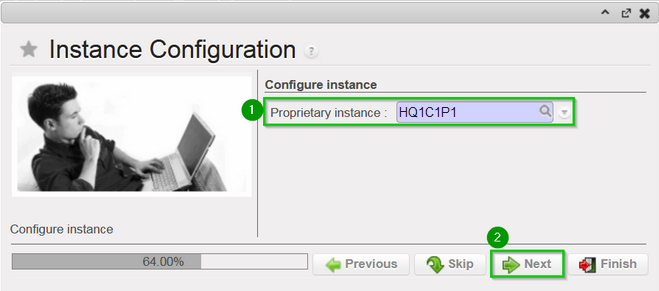 |
| A confirmation message window opens asking you to confirm the choice of the proprietary instance. If its correct click on Next 1, if not click on Previous | 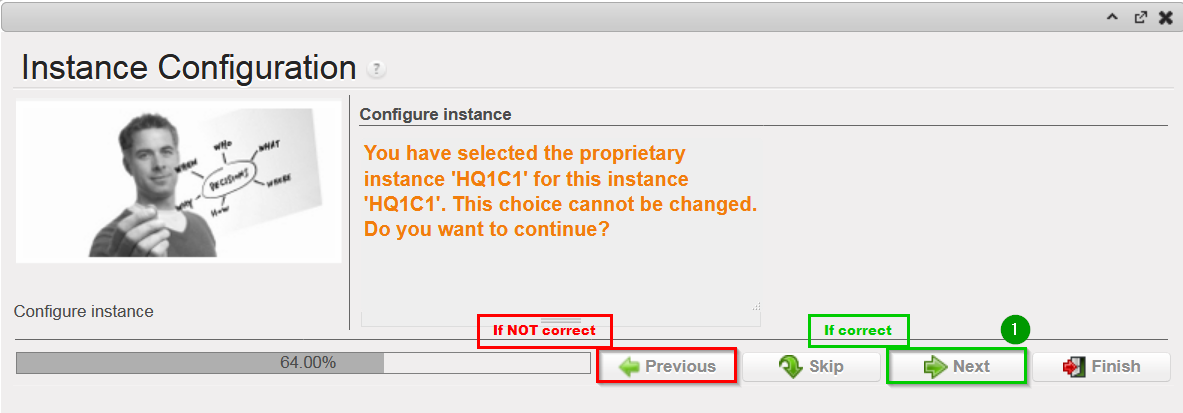 |
| Most of the time the property instance’s name matches the instance’s name. If it’s not the case a warning message is displayed. The only exception applies to instances at HQ level. Please be extremely cautious before proceeding after this warning message. |  |
Activate the International Commitments Import
Click Next 2 | 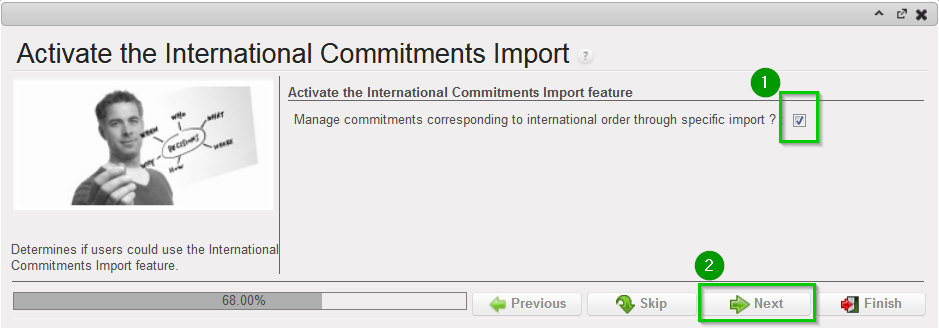 |
| Activate the Fixed asset configuration Leave default options. Click Next 1 | 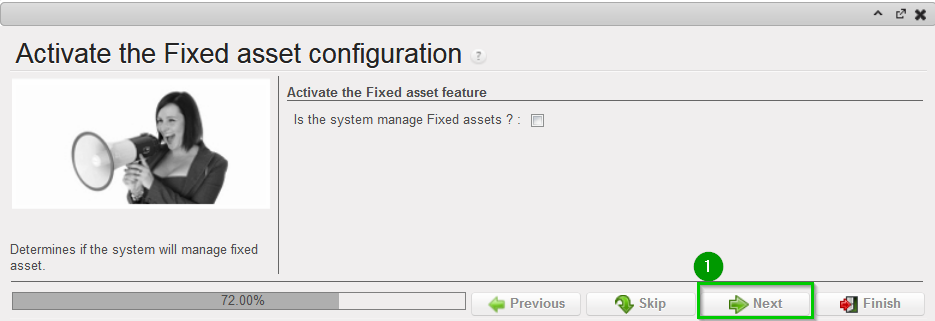 |
| Activate the Payroll configuration Check the box if you use Homere “Does the system manage Payrolls import from Homere?” Click Next | 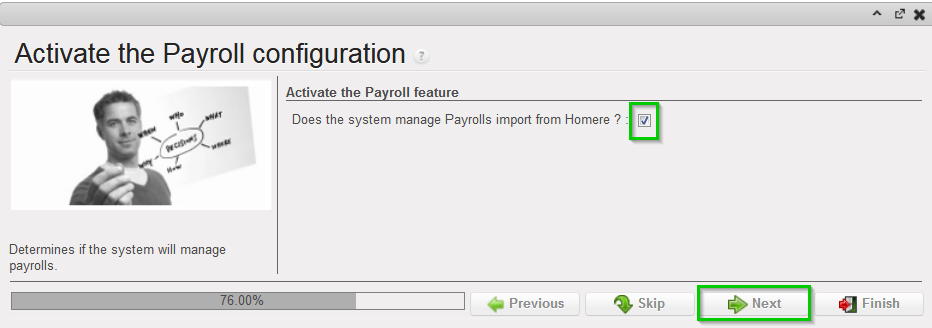 |
Currencies Configuration
Click Next 2 | 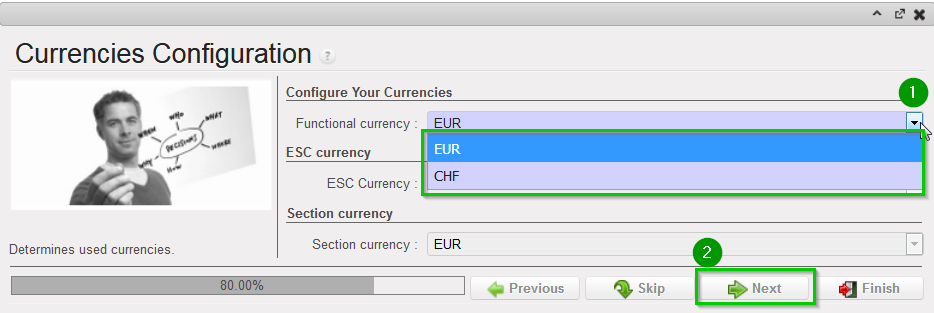 |
| Company Configuration Fill in the different values 1 2 3 Click Next 4 | 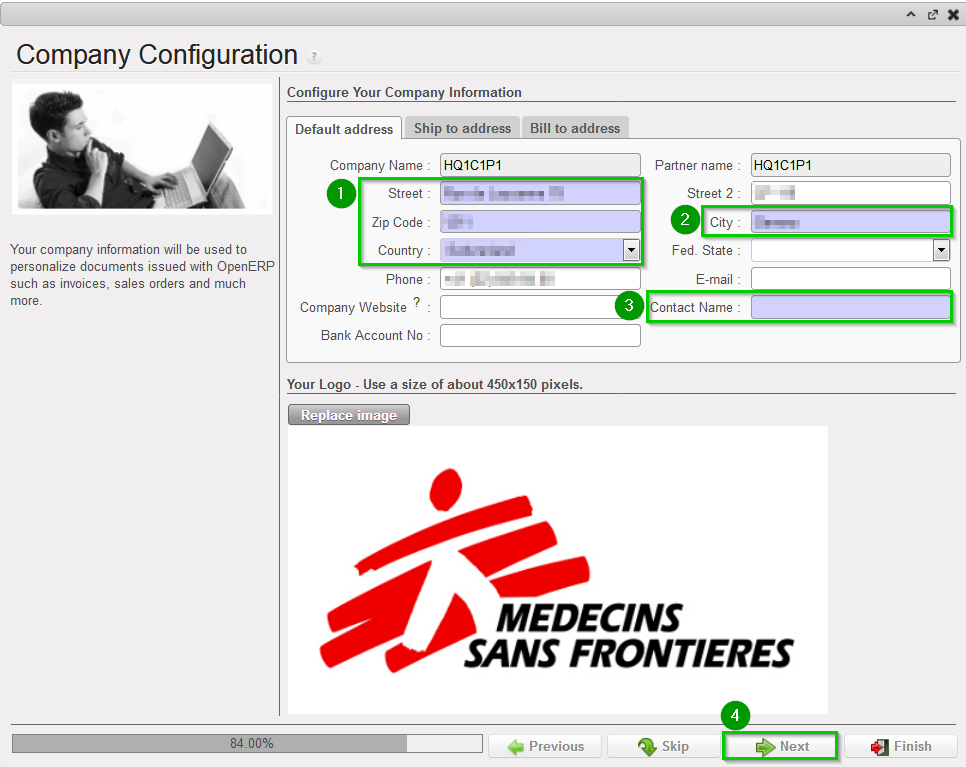 |
| Delivery Process Configuration: Choose the appropriate shipping method 1 (you may leave the default value). Click Next 2 | 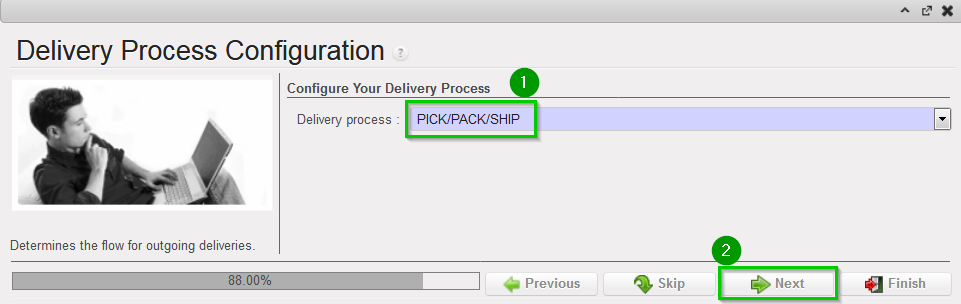 |
| Allocation Stock Configuration Leave default values. Click Next 1 | 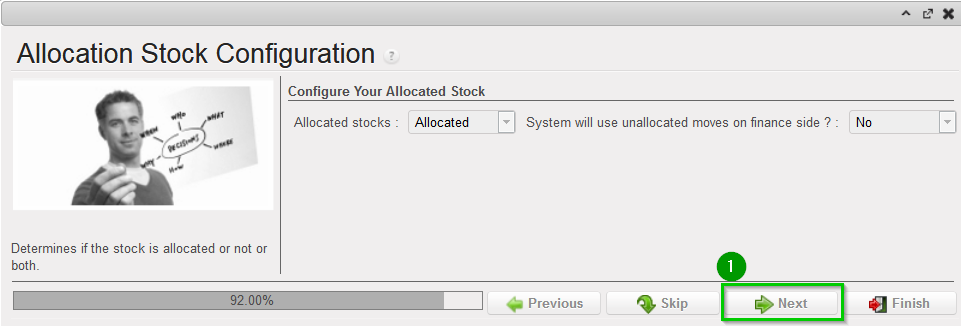 |
| Country restrictions Configuration Leave default values Click Next 1 | 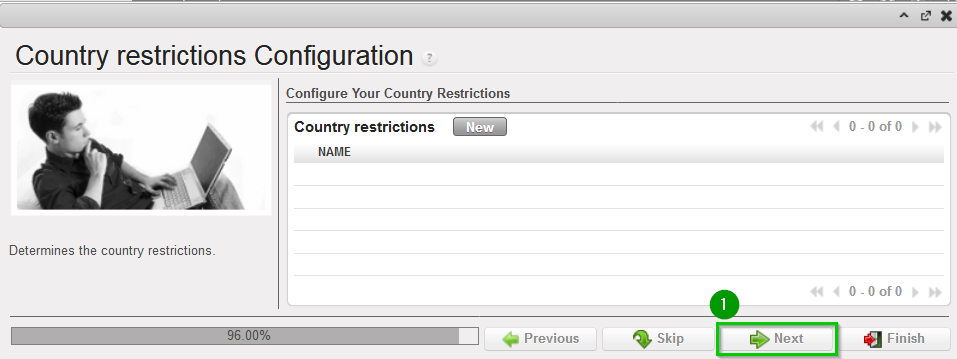 |
| Allow previous Fiscal Year dates Does the system allow document dates on previous Fiscal Year?: 1
Click Next 2 | 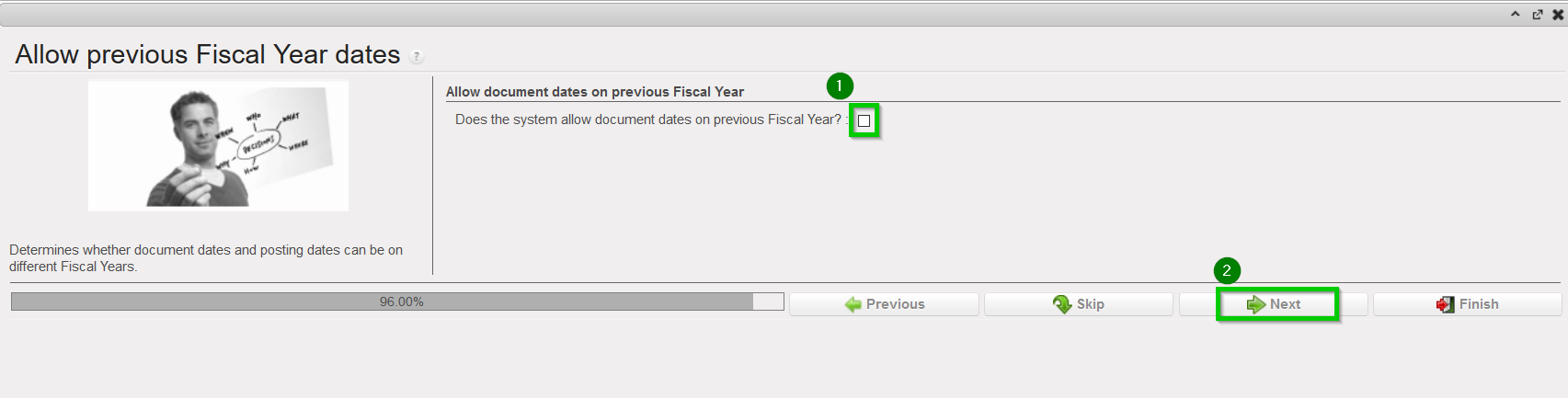 |
2.11.6 Import Analytic Journals
| Click Menu Accounting 1, Configuration 2, Analytic Accounting 3, Analytic Journals4 Click on the double arrow icon 5 and import file account.analytic.journal.csv  Note: this is the same file as the one used at HQ level. |  |
2.11.7 Import GL Journals
| Click Menu Accounting 1, Configuration 2, Financial Accounting 3, Journals 4, Journals 5 Click on the double arrow icon 6 and import file account.journal.csv Note: this is the same file as the one used at HQ level. |  |
2.11.8 Perform Internal Partner Configuration
| Click on Menu Partners 1, Suppliers (2), Suppliers 3 You should see one partner named “Local Market”. Edit this supplier 4 | 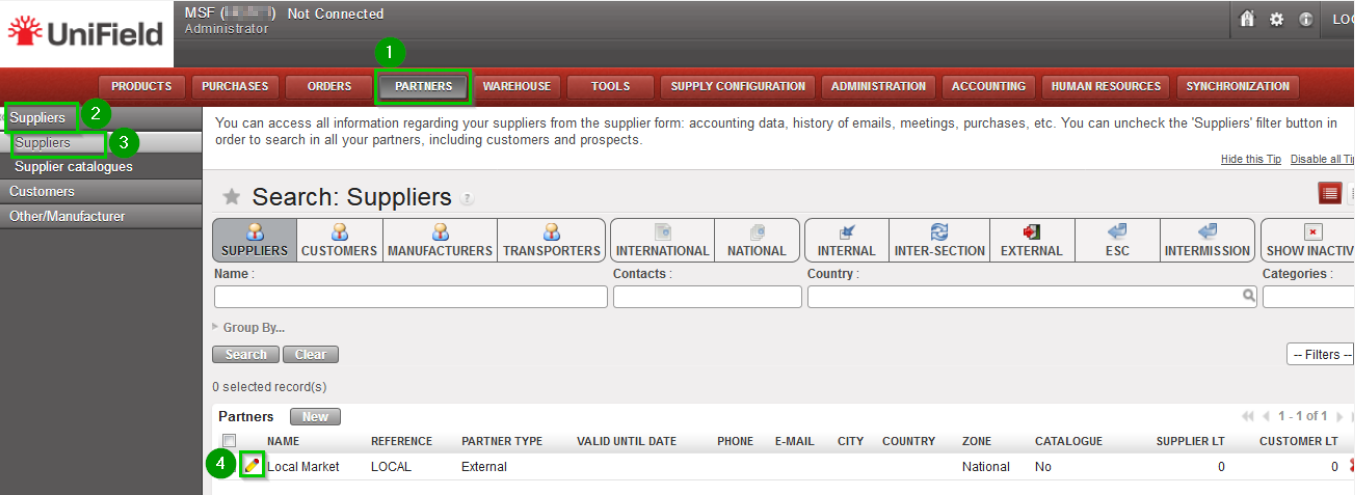 |
Click on tab Accounting 1 and enter the following codes:
Click on Save 4 | 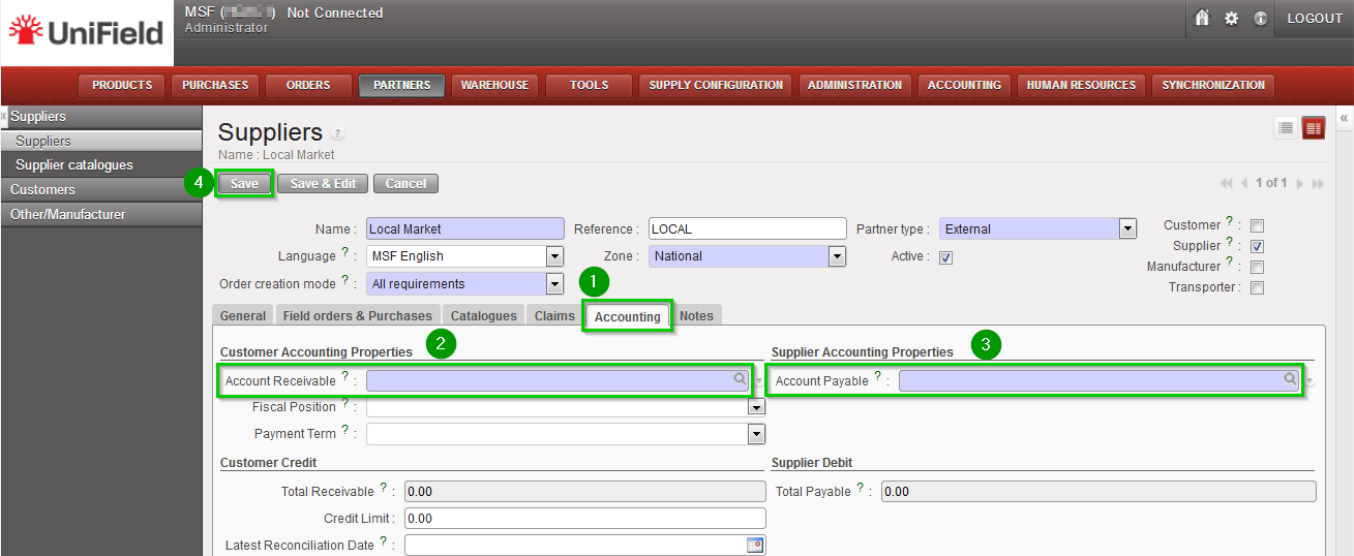 |
| Click Menu Partners 1, Suppliers 2, Suppliers 3 Uncheck filter Supplier 4, check filter Internal 5 You should see 1 partner with the same name as the instance. Edit this supplier 6 | 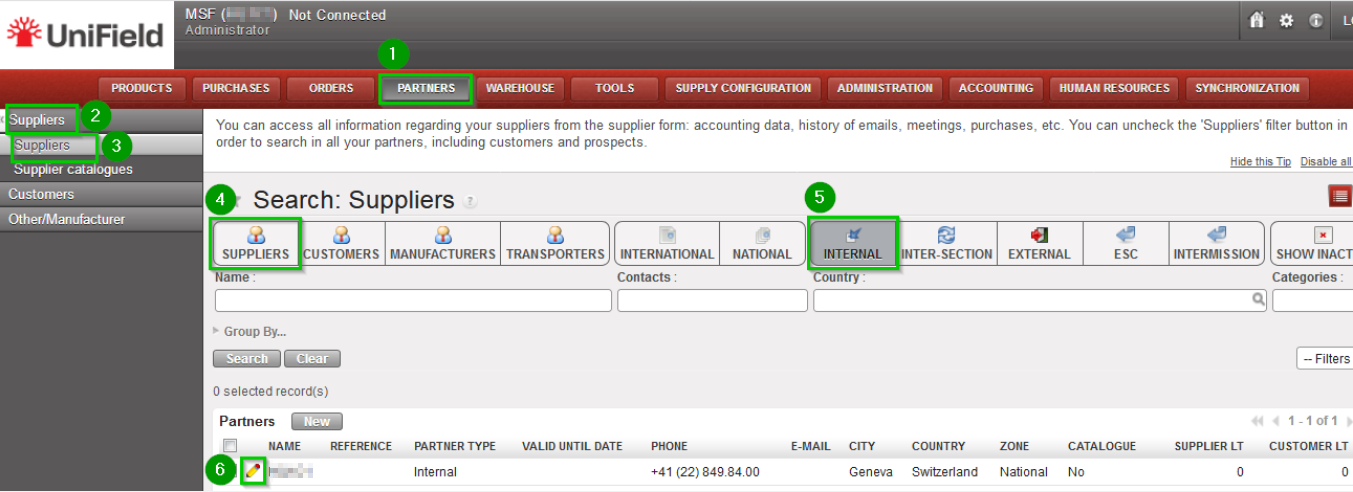 |
Click on tab Accounting 1 and enter the following codes:
Click on Save 4 | 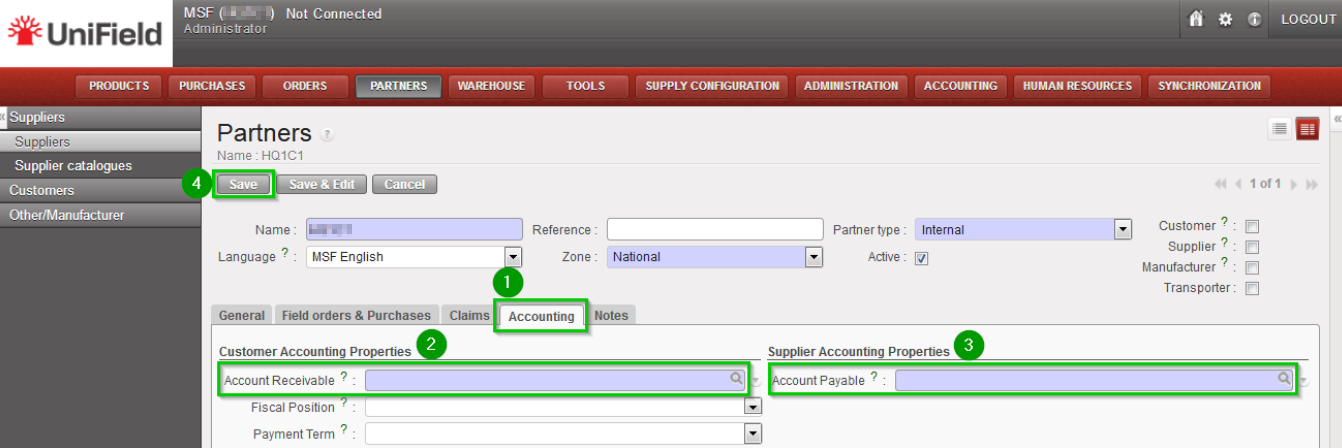 |
2.11.9 Perform validation synchronization
Synchronise your instance (as done in step 2.11.4) to send imported data to the SYNC_SERVER. If UniField tells you that you are not connected, follow steps 2.11.1 (only the “Connection” part) and try to synchronize again.
Important note: at this stage, the configuration of the Project instance is finished but the Cost Centers have not yet been received from the HQ due to the mechanism used for validating the Proprietary Instances. In order to finish 100% the installation, it is necessary to:
- Perform synchronization at HQ level (as described in 9.23)
- Once finished, perform a final synchronization at Project level
2.11.10 Project Companies Configuration
| Click on Menu Administration 1, Companies 2, Companies 3 Click on the edit icon 4 of the company | 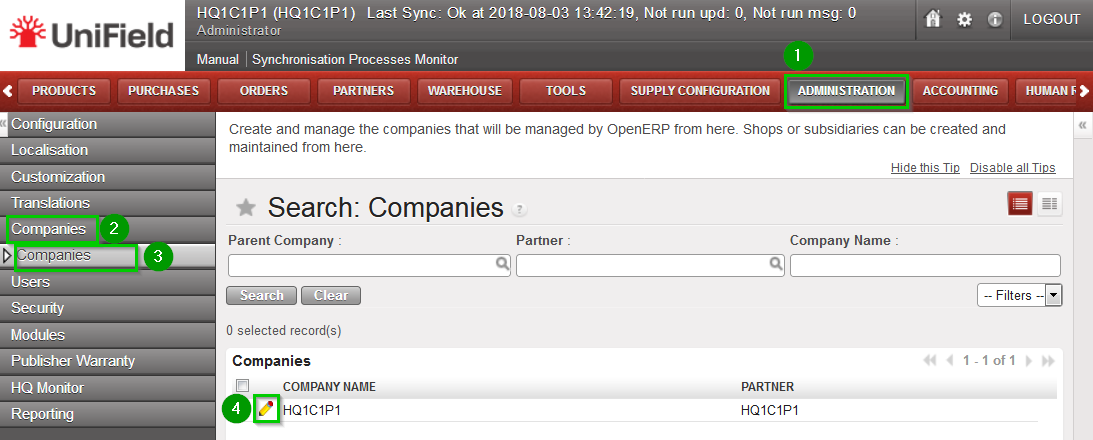 |
| Check first with your finance department the accuracy of those accounts. Click on the tab Configuration 1 Depending of your OC procedure, fill in:
Click on Save 4 after you made all the modification needed. | 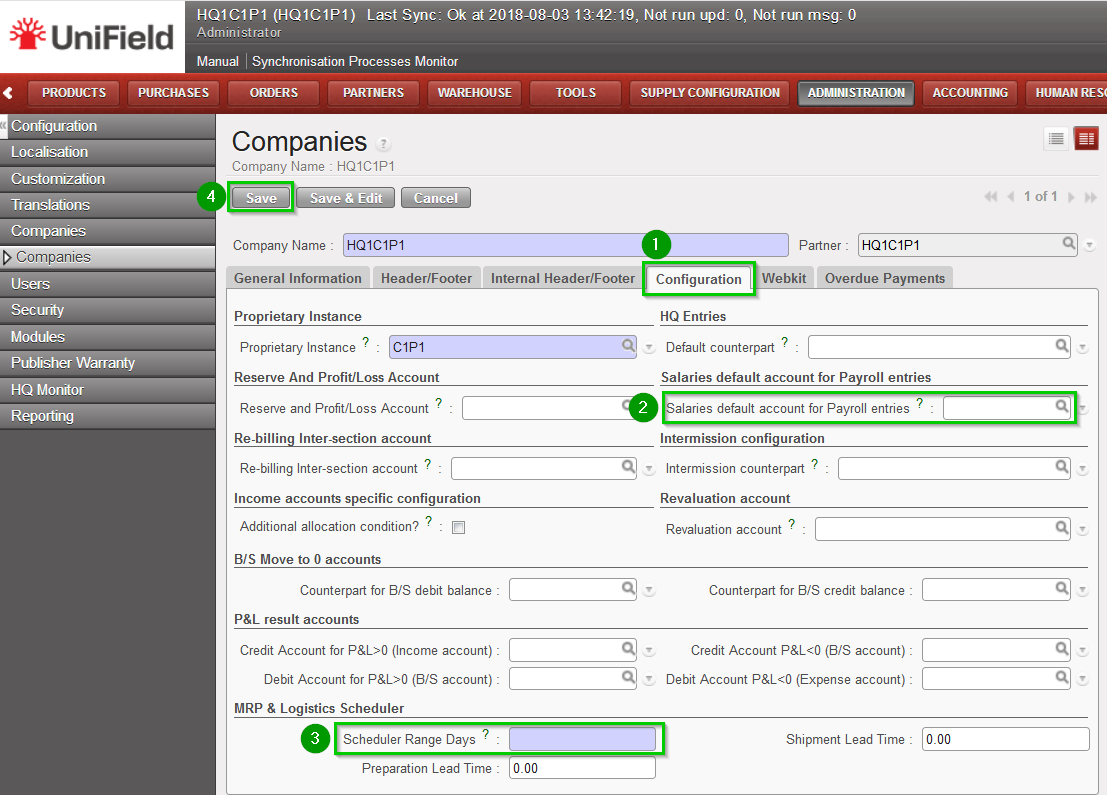 |
2.11.11 Cost Center For FX Gain/Loss
| Allocate the cost center for the FX exchange rate. Click on Menu Accounting 1, Configuration 2, Analytic Accounting 3, Analytic Accounts 4 Edit the Cost Center 5 defined by your Finance OC procedure | 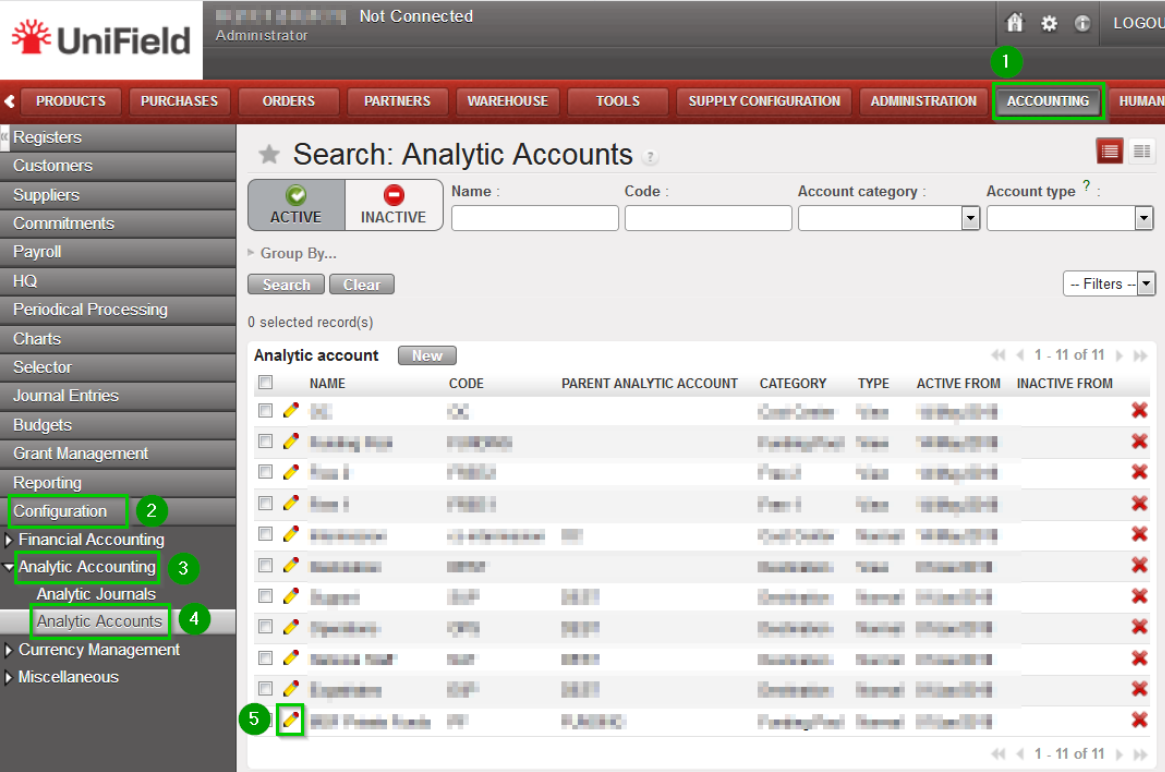 |
| Click the tick box “For FX gain/loss?” 1. Click on Save 2 NB: it has to be the coordination cost center. i.e for OCG= the coordination SUPZZZ cost center | 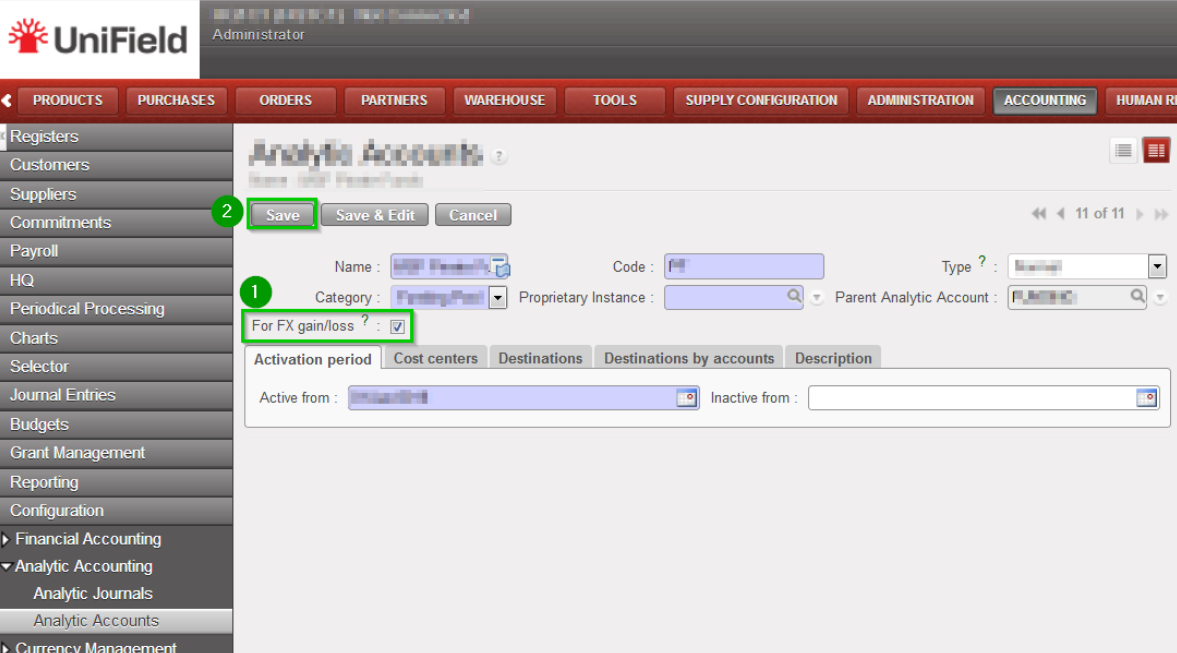 |
2.11.12 Creation of the Intermission Partner
The ProjectIntermission partners need to be created at the HQ level. Please refer to Section 2.9.25 Configuration of the Intermission partners.
