Fixed assets, also known as long-lived assets, or property, plant, and equipment, are items in physical form that:
– are held for use in service of organizational activities, or for administrative purposes; and
– are expected to be used more than once (not consumable); and
– are expected to be used during more than one year period; and
– can uniquely be tracked and monitored; and
– are with value greater than a defined materiality amount.
HQ Configuration:
Fixed assets must be activated from HQ. To activate the function, the following must be done:
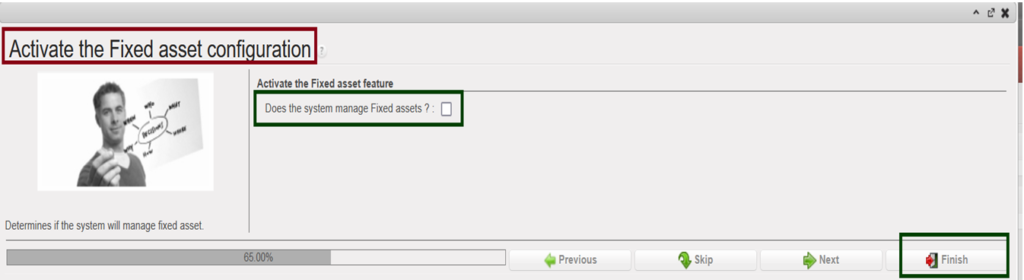
Go to ADMINISTRATION > Configuration > Parameters > Reconfigure.
Follow the ‘Next’ button until you find “Activate the Fixed asset configuration.”
Tick the box with “Does the system manage Fixed assets ? ” then click on “Finish”
How to reconfigure fixed assets
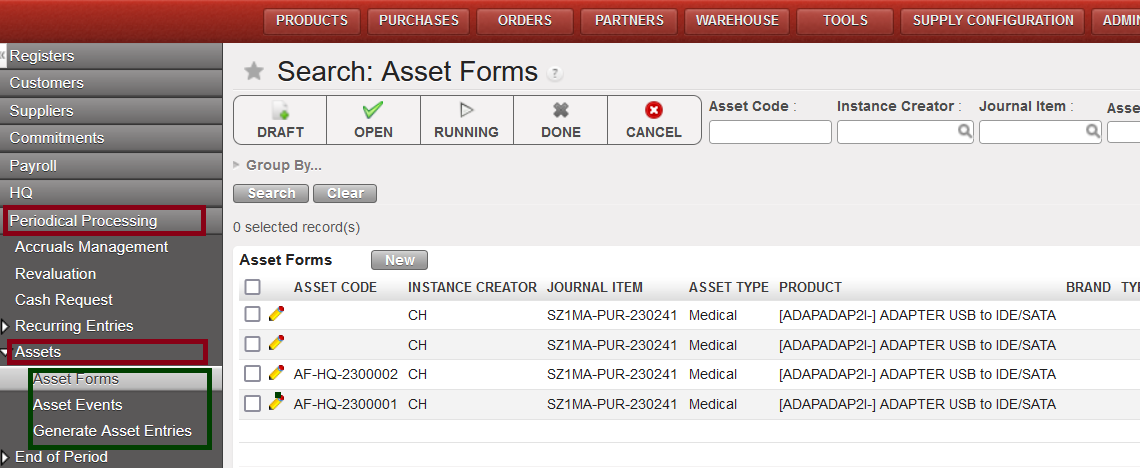
Then go to Accounting > Periodic processing, you will find “Assets” is active with 3 sub-menus:
How to access assets in search view
>> Asset Forms: Assets data shall be recorded in an asset form to enable fixed asset events monitoring.
>> Asset Events: Assets form will have a specific tab that follows Asset Events
>> Generate Asset Entries: Automatically generate entries based on what has been entered in the system until a specific period.
Asset accounts:
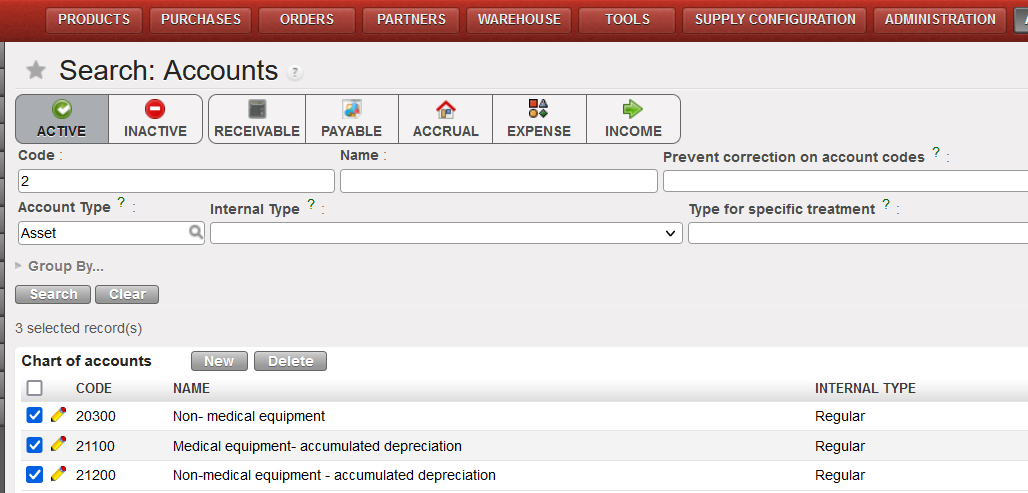
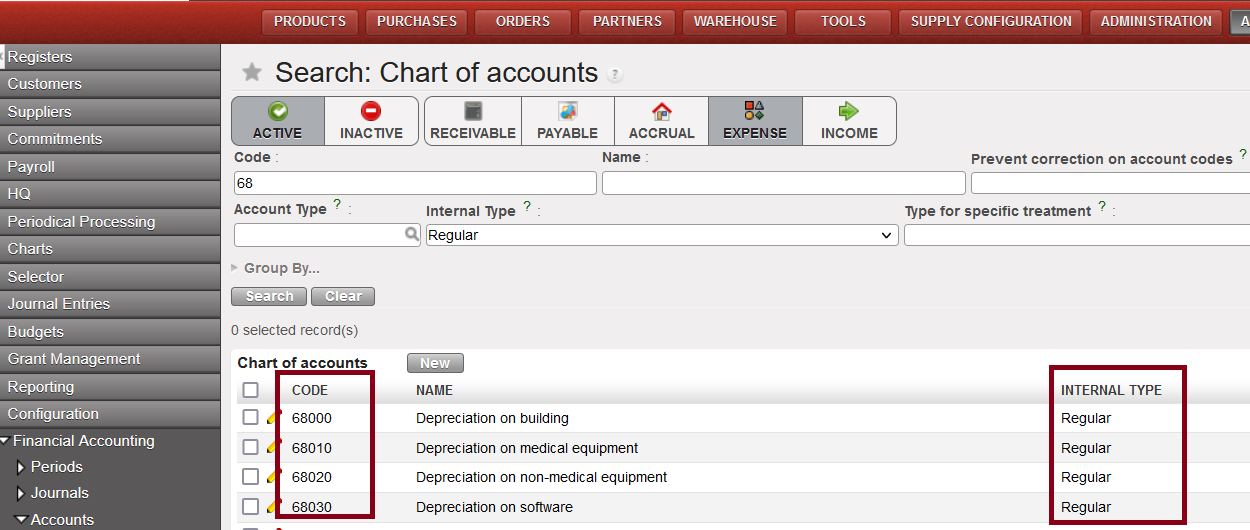
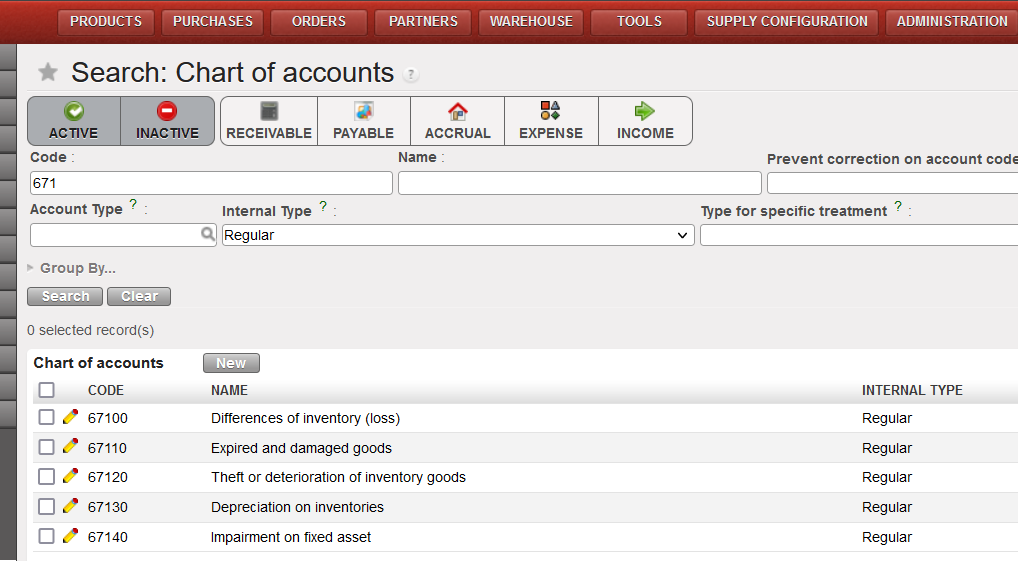
Asset accounts configured as below:
>> Internal type as Regular
>> Account type as an Asset for B/S , Expense for P&L
View of accounts to be used in events
Product categories configuration:
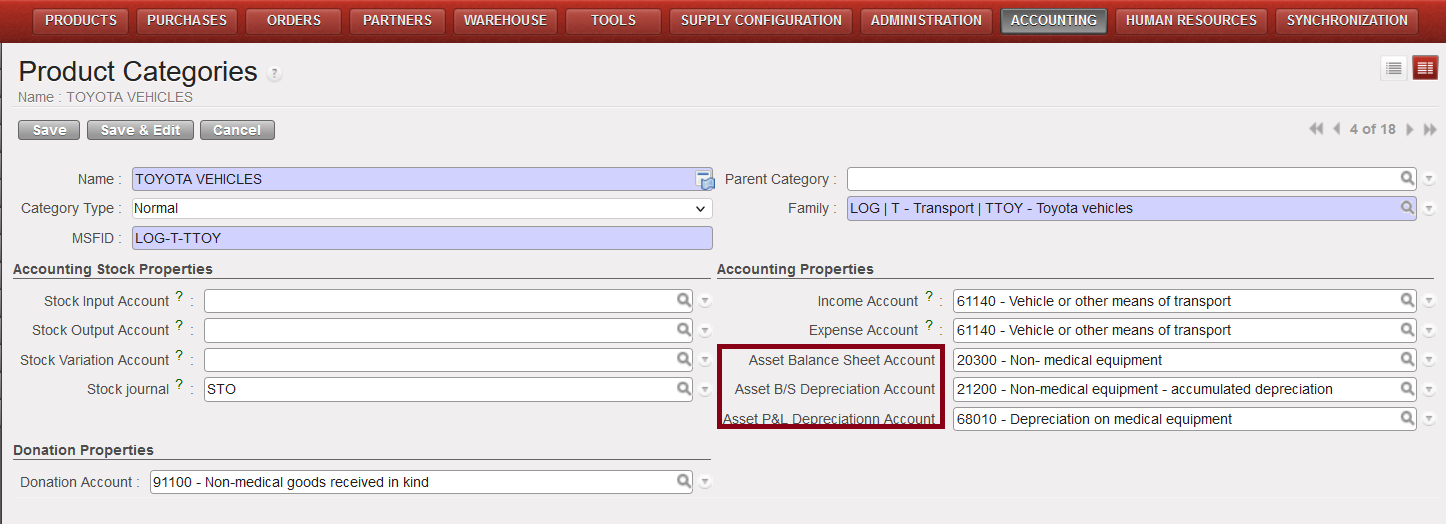
At HQ level, product categories linked to assets must be defined with asset accounts as follows:
>> Asset Balance Sheet Account
>> Asset B/S Depreciation Account
>> Asset P&L Depreciation Account
Here an example configuration product “TOYOTA VEHICLES”:
Go to Accounting > Configuration > Miscellaneous > Product Categories > Product categories.
Search in “Name” by “TOYOTA VEHICLES”
View of product categories with accounting properties
Assets Configuration:
To configure assets, proceed as follows:
Go to Accounting > Configuration, there are two sub-menus, ‘Asset Type’ and ‘Asset Event Types’ .
>> To create a new asset type:
In “Search: Asset Types” click on “New”
Update fields “Name” and “Description”
To update “Useful Life (years)” click on “New” to update with numbers.
Click on “Save”
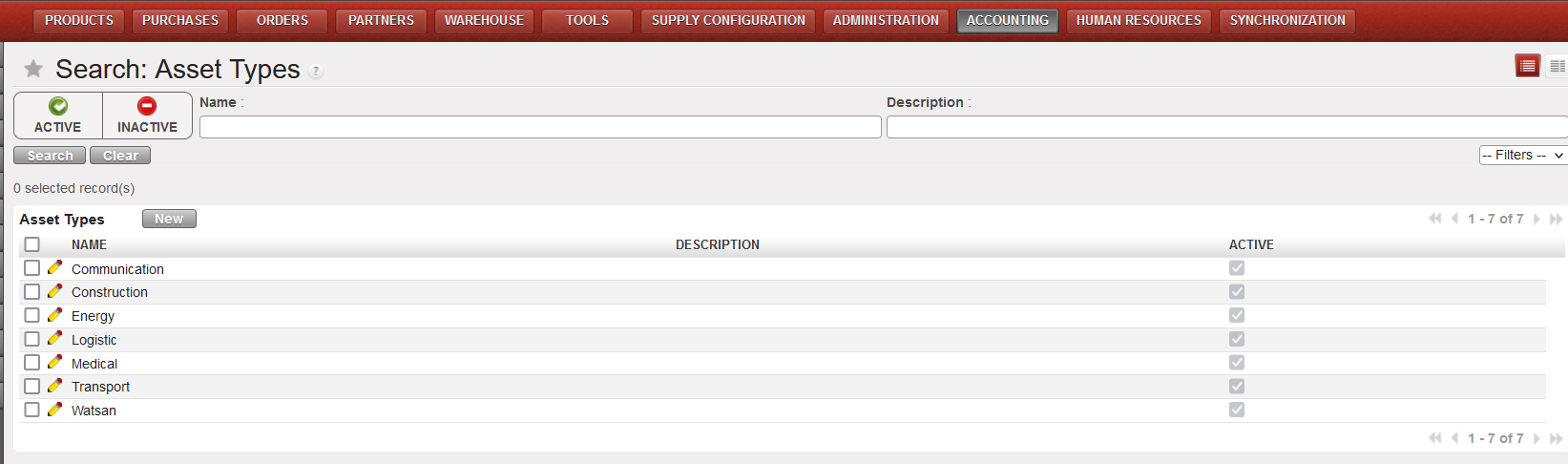
Below samples of asset types:
View of asset types
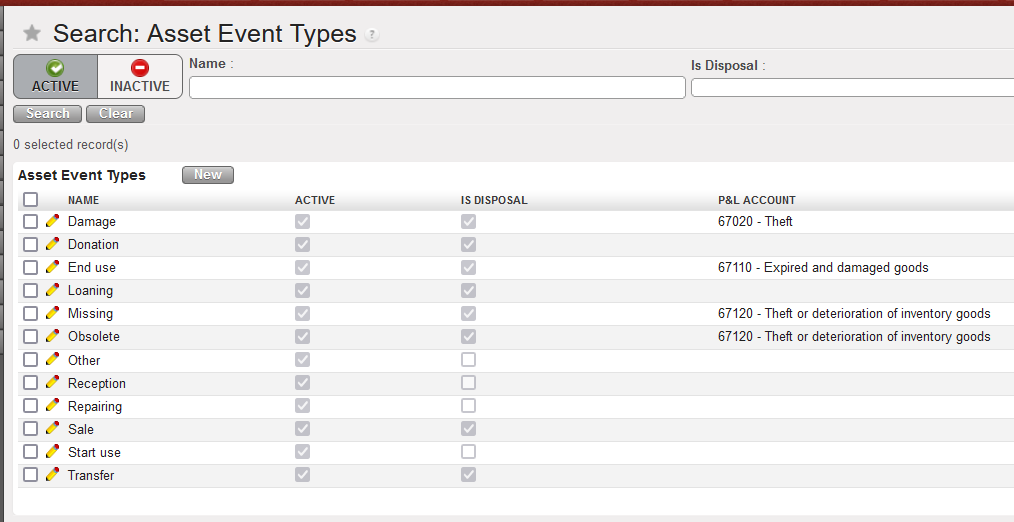
>> To create a new Asset Event Types to use for example for disposal:
In “Search: Asset Event Types” click on “ New ”
Update fields “Name” & “P&L account”
Asset Event Types view
Fixed assets management in the mission:
Each mission’s coordination office is responsible for asset management.
How to create asset form:
Go to Accounting > Suppliers > Supplier invoices.
Click on “New” to create new SI
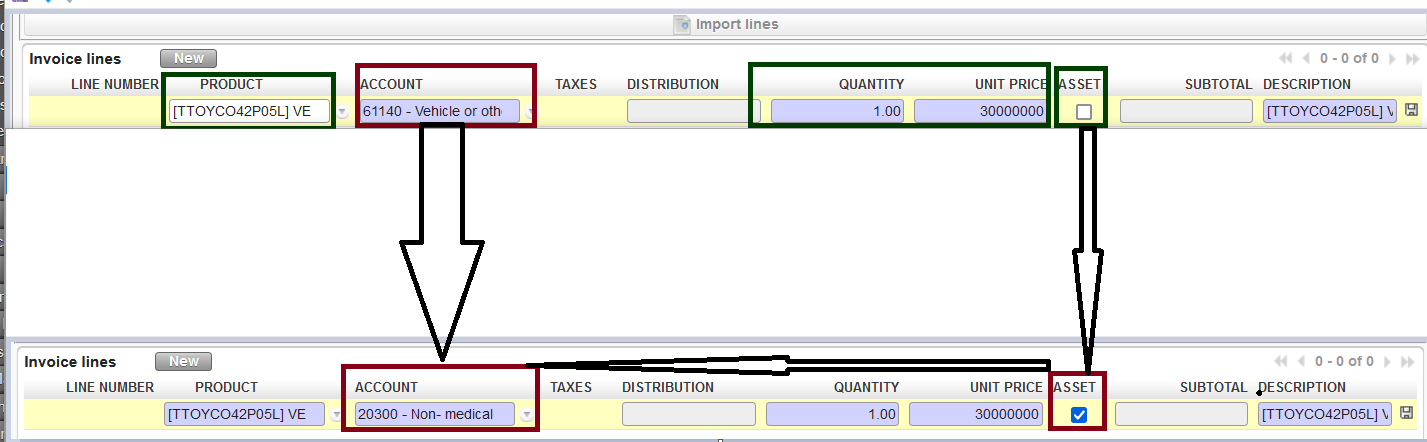
In “invoice lines” create new line
Update “PRODUCT” and “UNIT PRICE”
Tick the box in the “ASSET” column (Once ticked “ACCOUNT” will change from 6xxxx to 2xxxx)
Click on “save record”
Creation asset form through supplier invoice
When you click in “Validate” you will receive “The following lines will generate asset forms”
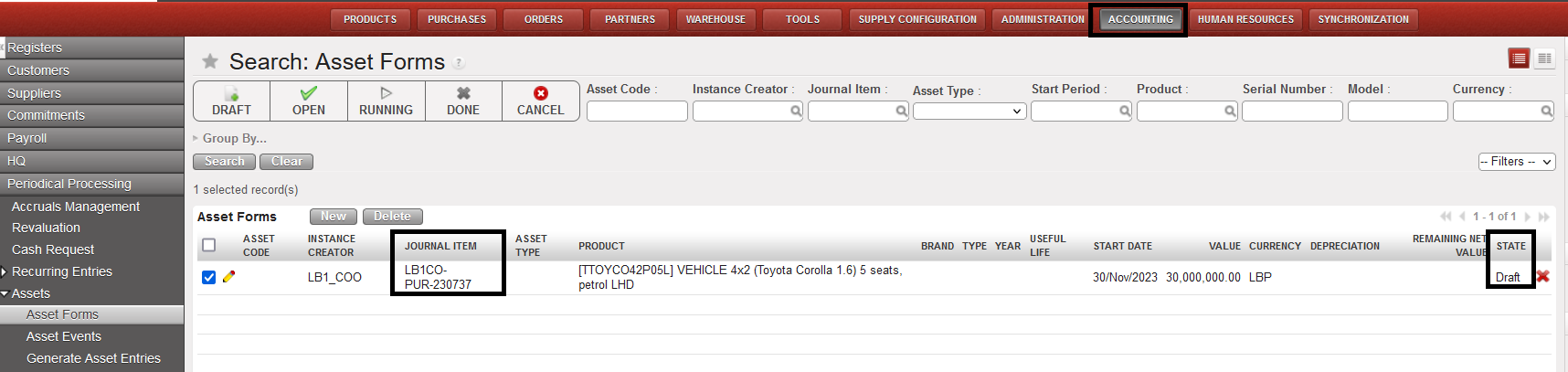
After approval of SI will create asset form as draft
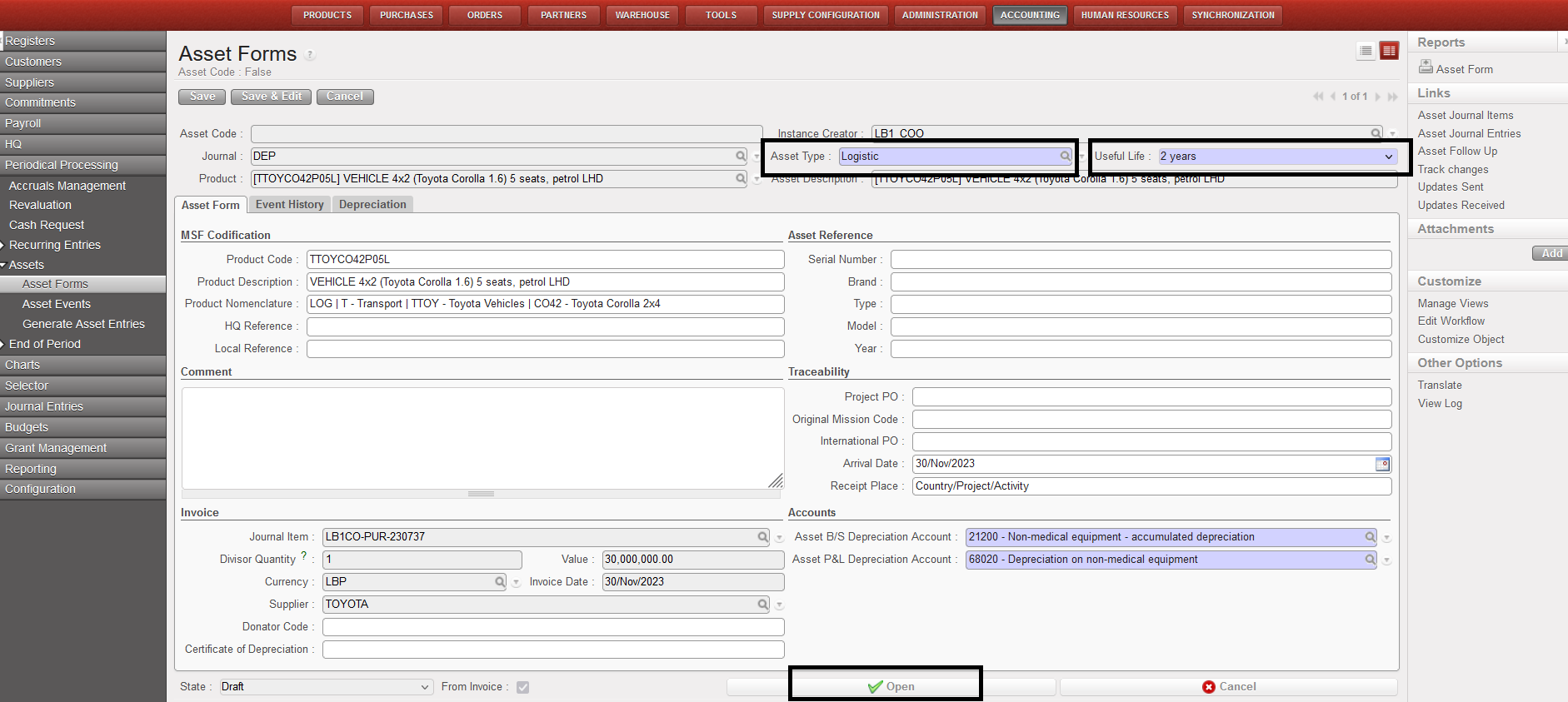
Asset Forms view
Update “Asset type” and “useful life” manually
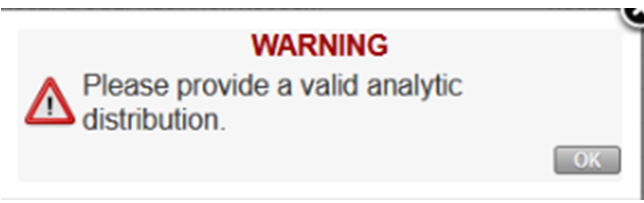
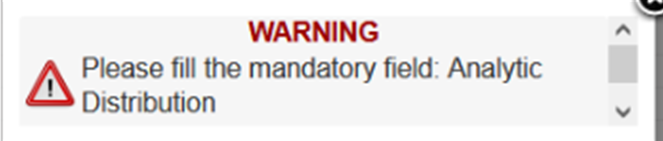
It is mandatory for an asset form to have a valid analytical distribution (AD) before it can be set to “OPEN” status. If the analytical distribution is not valid, the asset cannot be moved to “OPEN” status.
If the analytical distribution is incorrect, you will receive an error message, and the asset cannot be moved to “OPEN” status.
Click on “Open”
It will create “Asset Code” and change the state to “Open”
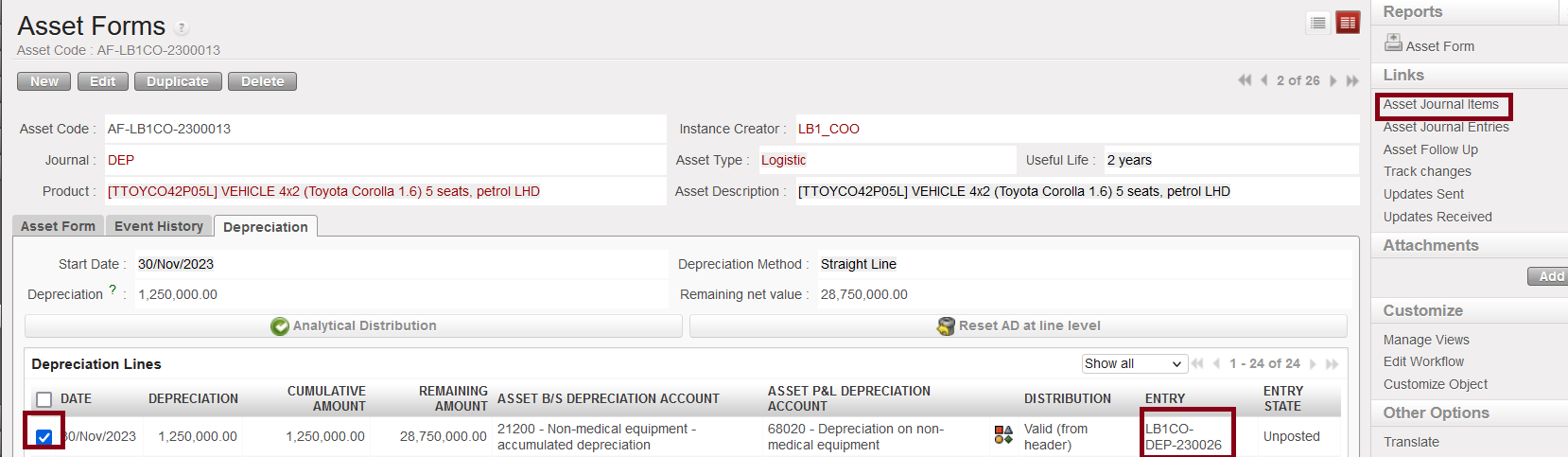
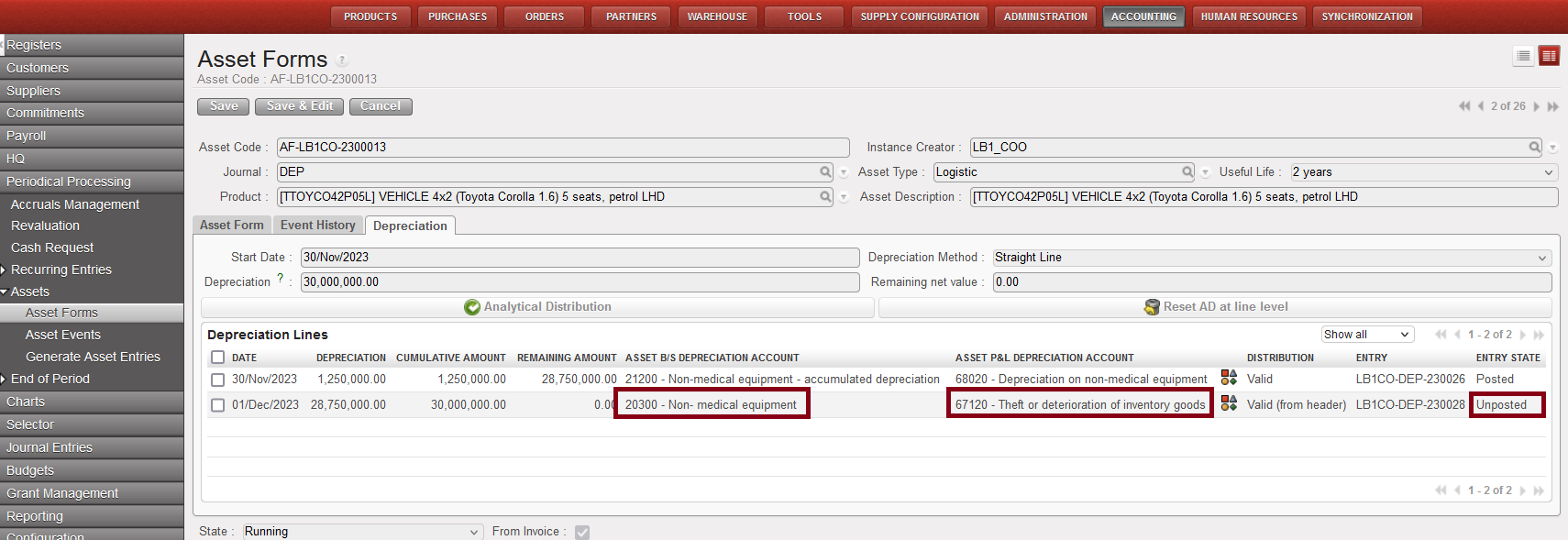
To create monthly depreciation entries, click on “Generate asset entries “select the oldest month then click on “Generate entries” ,the entry generated is “unposted”
– To post the generated entry, click on the “Checkbox” of the line, then click on “Asset Journal Items” on the right-side menu.
How to view asset journal items
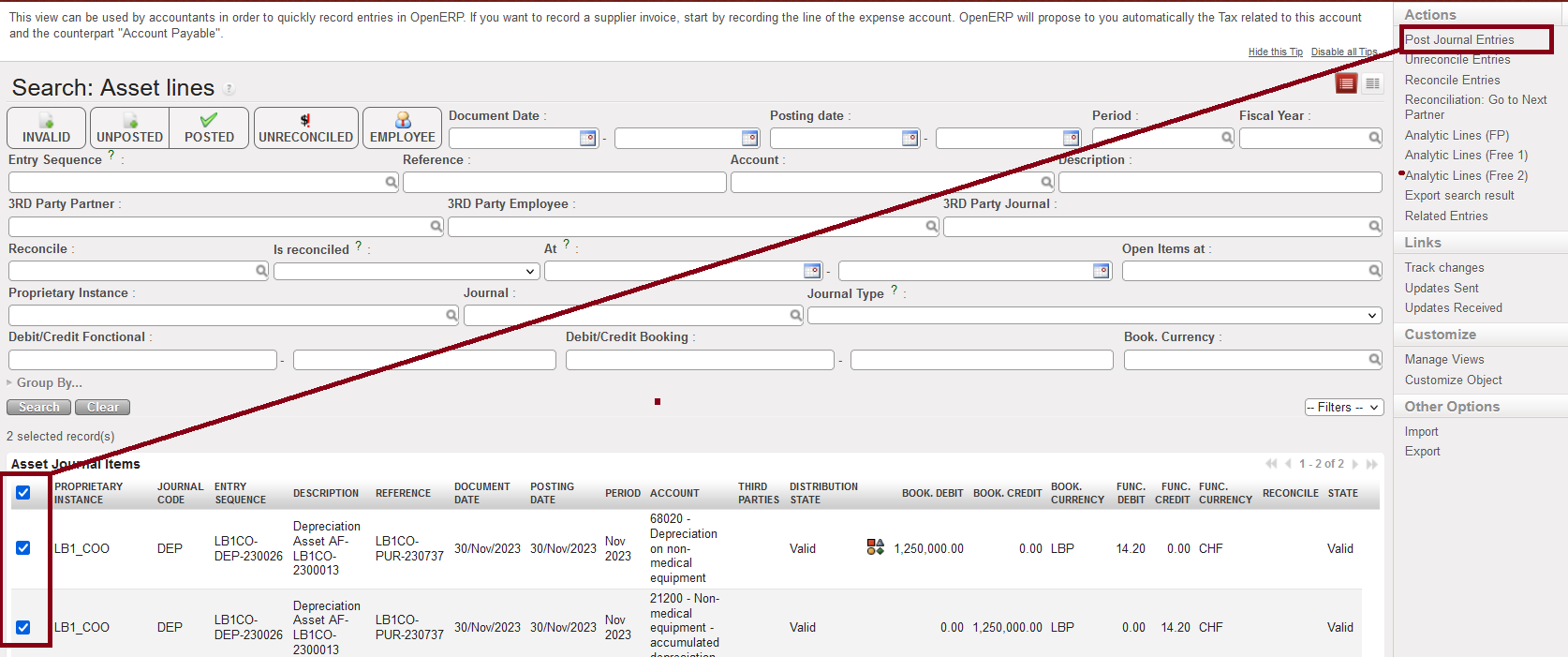
– It will open a new window, tab “Search Asset Rows”, select both rows and click on “Post Journal Entries”.
How to post asset journal items
Disposal:
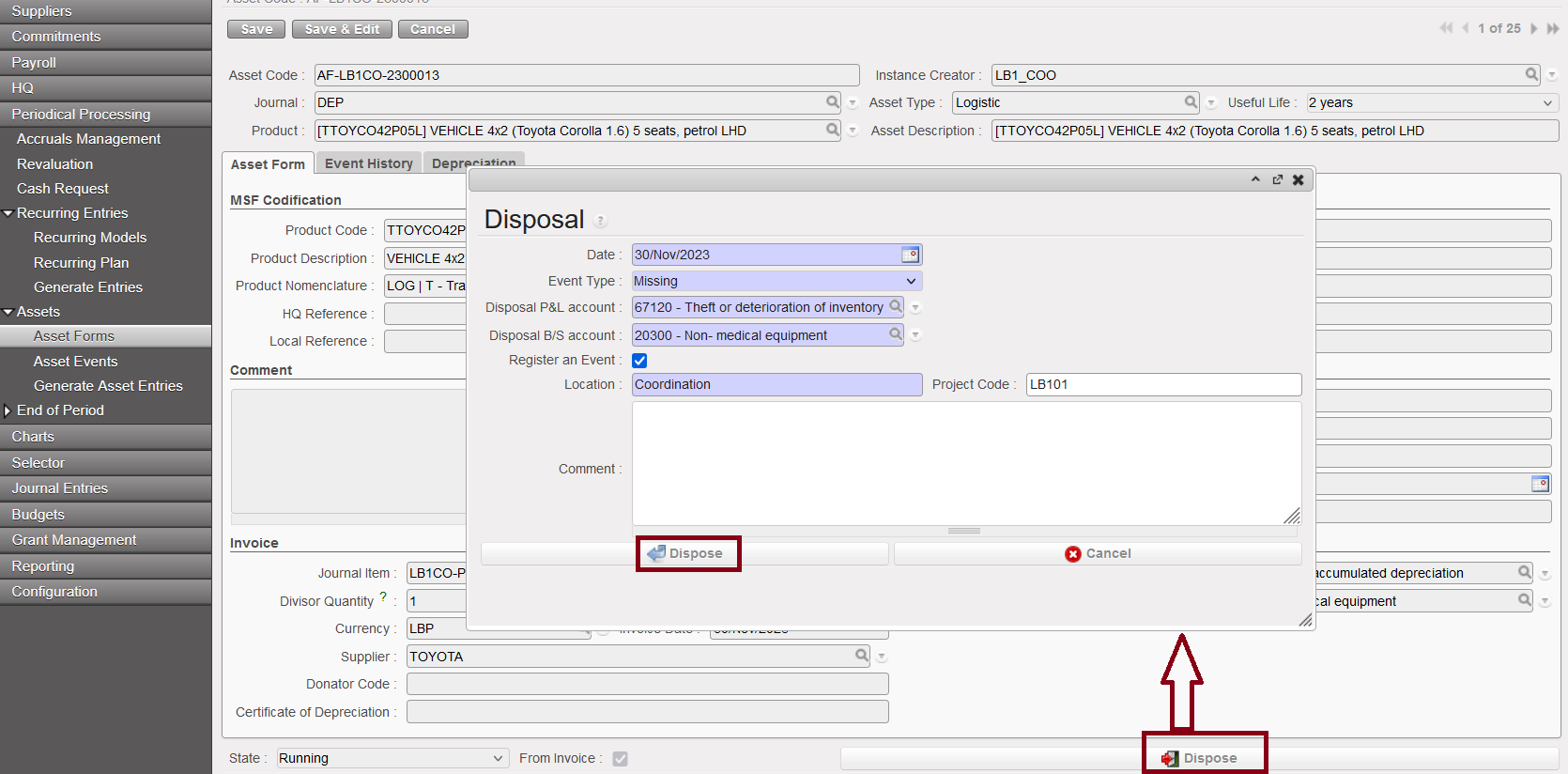
It is possible to lose the assets in different ways (damage, theft, donation etc.), so in this case it is possible to use “Dispose” to end the use of the life.
To do “Dispose” as blow:
In “Asset form” form view clicks on “Asset form”
Click on “Dispose” it will open popup “Disposal”
Update mandatory blue fields as below, to create an even you must tick on “Register an Even” :
Click on button “Dispose” :
How to dispose of assets
Disposal will reverse all amount into Acc 67xxxx
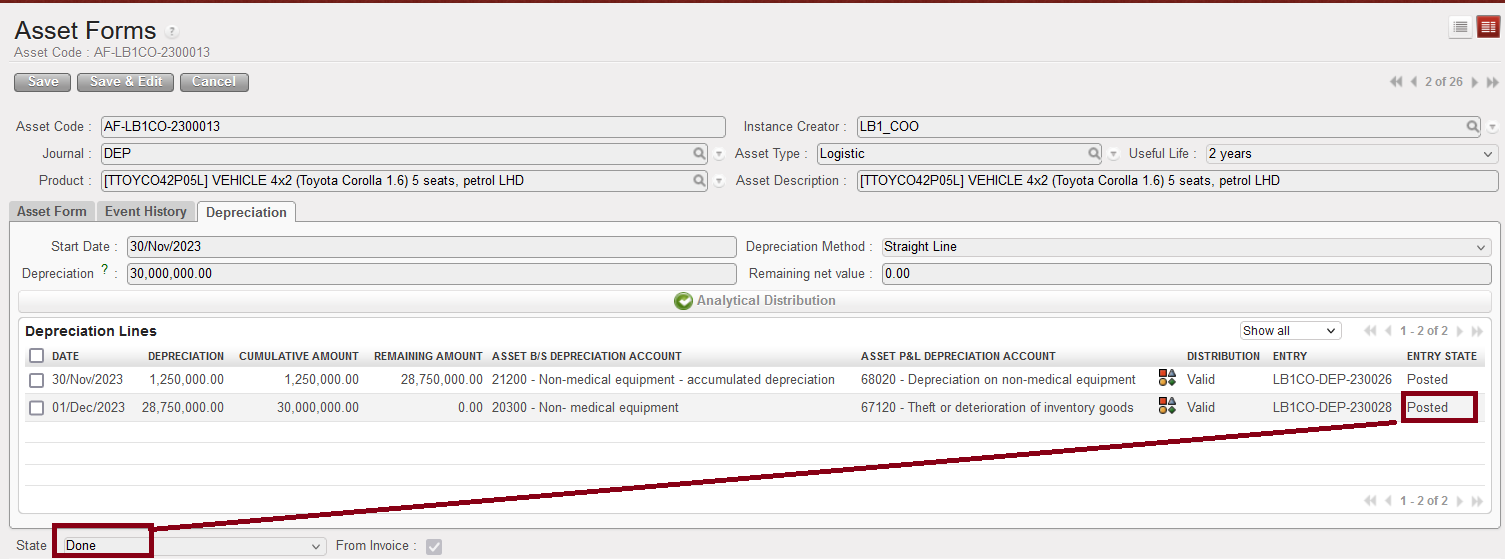
Posting the disposed line changes the status of the asset form from Running to Done.
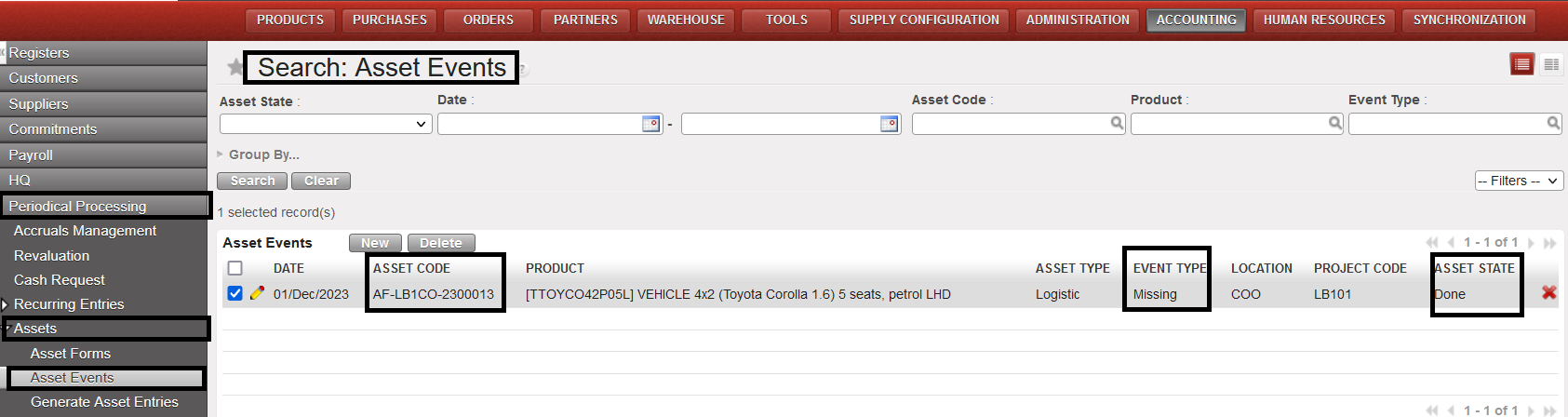
To see the event created, go to accounting > Periodic processing > Assets > Asset events:
At the end of each month all registers will have to be checked, validated and closed before closing the entire period and sending documents to Coordination/HQ. Cash, cheque and bank registers all require confirmation that the information on the paper copies matches what is in UniField and the physical amount of money matches the information in UniField.
Before closing any register you must:
Enter all remaining receipts/expenses paid in this period
Enter all open advances and close all justified advances
Confirm all information in UniField matches the information on the hard copy receipt/invoice
Confirm all register entries have been hard-posted
Confirm salary payments and all salary advances have been booked in UniField
Confirm your physical cash balance matches your register closing balance
Please note, procedures vary from one OC to another, so please refer to your own Section’s procedures. For example, you may not need to record open advances.
Cash Register Closing
After all transactions have been completed for the month and hard-posted, an authorized user needs to confirm the month-end cash count and close the cash register. Only if the balance in UniField matches with the actual physical cash count can the cash register be fully closed.
If the cash register balance does not match the actual physical balance then the cash register can only be partially closed. Partially closed registers can be re-opened in order to book additional entries.
If the user cannot identify and resolve the issue which caused the cash difference, the user must create an entry for the amount of the cash difference (the account to use depend of each OC procedures, e.g. 67000 – Cash difference). The balance in UniField will be updated to eliminate the gap. After that, the register can be fully closed.
Once the register is fully closed, only a user with an Administrator profile can re-open the register and the related cash count.
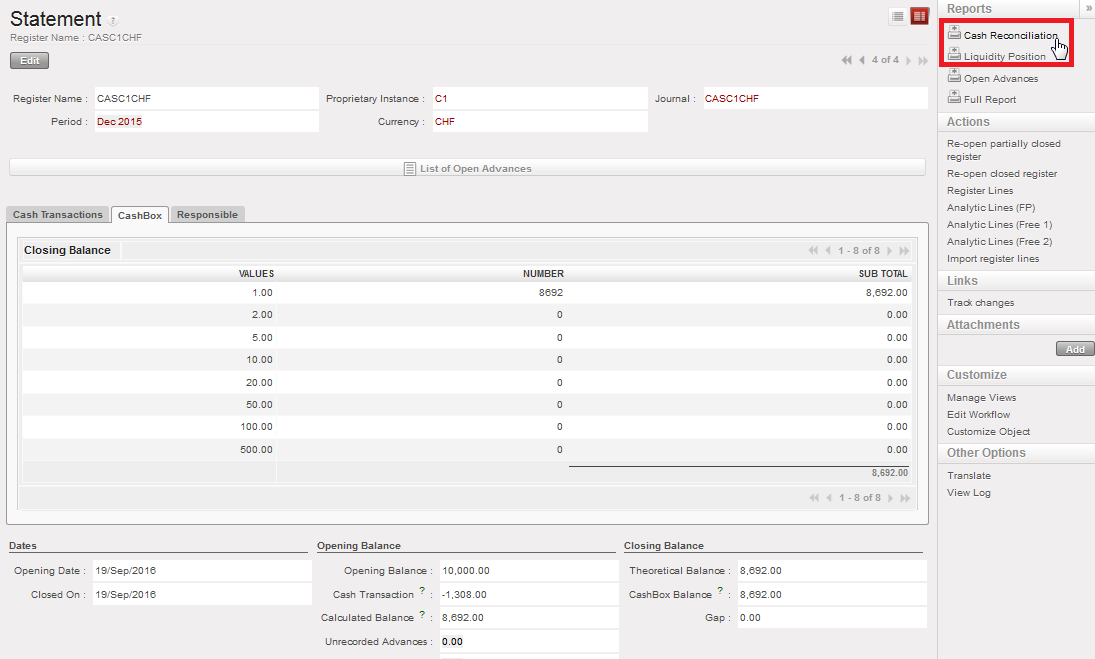
From the cash register you can print the Cash Reconciliation report. This report is the paper evidence to sign-off and acknowledge the cash reconciliation was properly recorded.
Cashbox view where the physical cash balance is reported and the location of Cash Reconciliation button
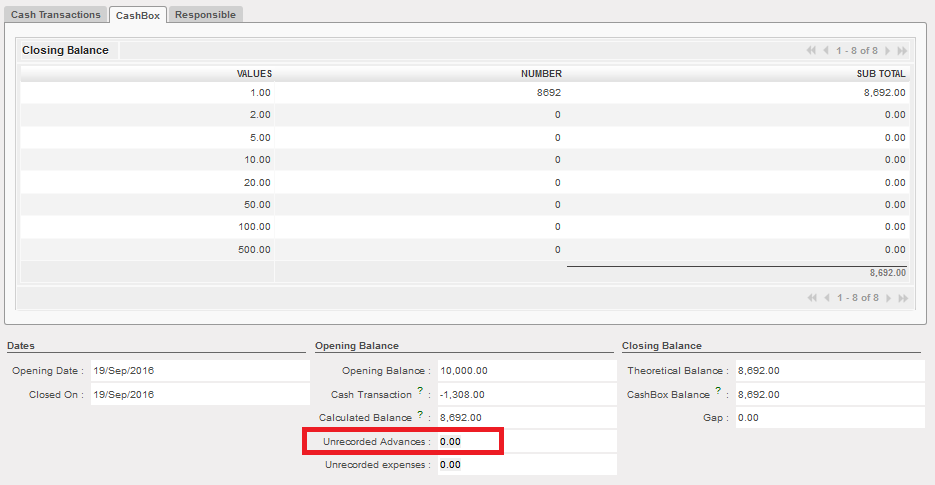
N.B. Remember if your section does not record operational advances in UniField, you can report the total amount of open advances in the cash box inventory before confirming the cash box closing balance and closing the cash register.
Field used to report {Unrecorded Advances} in the cashbox
How to Conduct a Cash Count
At the end of each month, your cash count can be entered into UniField in order to confirm the balance in UniField is the same as the physical amount in the cash box. Frequency of cash counts depends on the policy of each section.
Go to: Accounting/ Registers/Cash Register
Open the cash register that you want to check in {Edit} mode
The cash register Form view appears
Open the {Cashbox} tab
The {Cashbox} tab appears
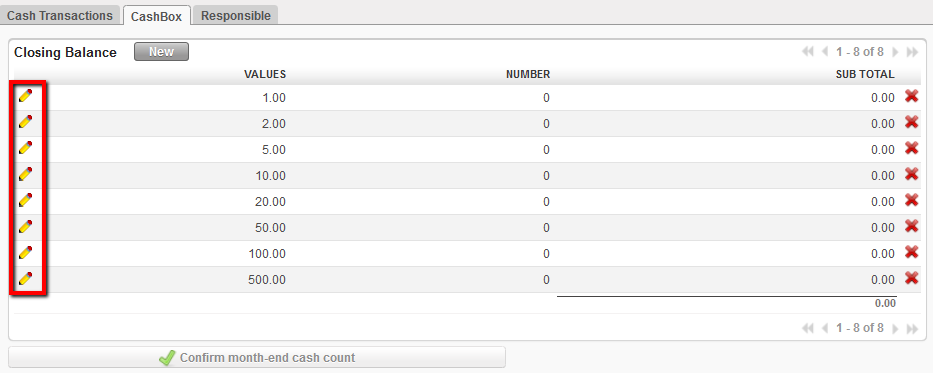
Click on the pencil to edit the corresponding {Number} of the cash denomination lines {Values}
Use pencil icon to edit denomination lines
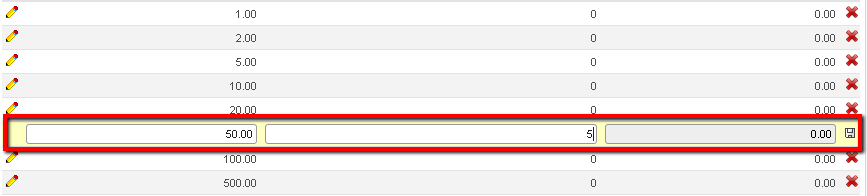
Enter the quantity of each denomination in {Number}
Enter cash count quantities
Save () each denomination line. Click {Save} at the top of the register form
The CashBox values in UniField are updated. The CashBox balances as well as the Gap field are updated.
2. Depending on your OC’s policies, enter open advances in {Unrecorded Advances} and any outstanding receipt in {Unrecorded Expenses}. For a detail definition and use of Unrecorded Advances and Expenses, see LU30201 of Chapter 3 – Payments. Click {Save} at the top of the register form to update the Theoretical Balance.
How to Close a Cash Register without a Cash Discrepancy:
Go to: Accounting/ Registers/Cash Registers
Open the cash register you want to close
Open the {CashBox} tab and enter the value of your physical CashBox in the {CashBox} tab
Click {Confirm month-end cash count}
{Confirm Month-end cash count} button
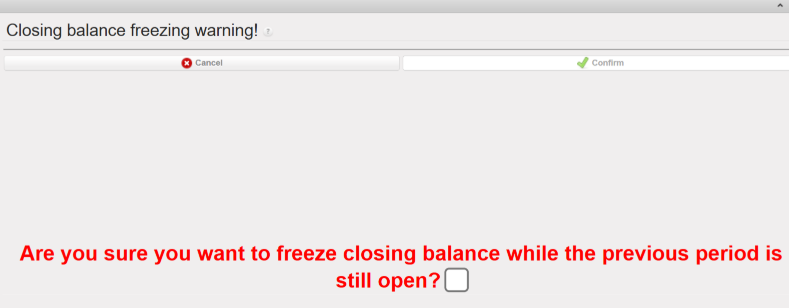
Confirm the action if you want to freeze the month-end balance
A pop-up window “Closing balance freezing warning!” will appear with the message “Are you sure you want to freeze the closing balance?” or “are you sure you want to freeze closing balance while the previous period is still open? , Check the box and click the “Confirm” button.
Confirmation month-end cash count wizard
2. At the bottom of the screen, select {Close Register}
A wizard asks you if you want to close the CashBox
{Closing CashBox} wizard
Check the box of the field {Are you sure?} and {Confirm}
The register state has changed from {Open} to {Closed} if there is no gap between the UniField cash balance and your physical cash balance.
Once the register is fully closed, only a user with an Administrator profile can re-open the register and the related cash count.
How to Unfreeze a confirmed cash-box balance:
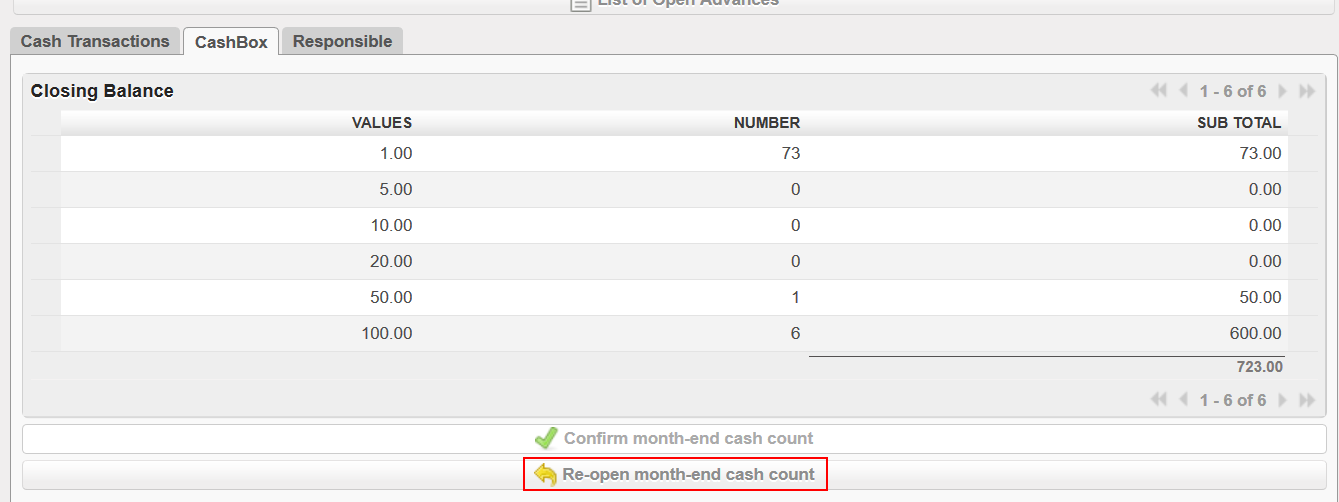
In case the balance was confirmed wrongly, the confirmed end of month balance can be un-freeze by the option of {Re-open month-end cash count}. This option is only available for an Admin user at HQ level only.
How to Produce a Cash Reconciliation Report:
Go to Accounting/Registers/Cash Registers
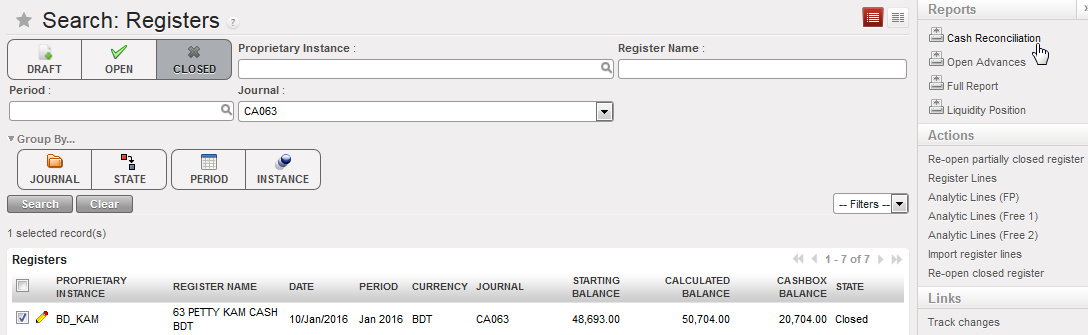
In the Search Cash Registers view, select the filter and tick the checkbox of the register you want to run the {Cash Reconciliation}
Go to Reports on the right side of the screen, and select {Cash Reconciliation}
Cash Reconciliation Report Action
A cash reconciliation report is generated in PDF as below:
Cash Reconciliation Report
N.B.: In some cases, you may run the report right after you have closed the register so you would not go back again to the Cash Registers Search view. From the Cash Register Form view, you would simply click on the report link.
Cash Reconciliation
PDF output by register with closing balance, opening balance and a placeholder for signatures. This report is the paper evidence to sign-off and acknowledge the cash reconciliation was properly performed.
How to Produce an Open Advances Report
If your section manages operational advances in the system, you will be able to generate an Open Advances report.
Go to Accounting/Registers/Cash Registers
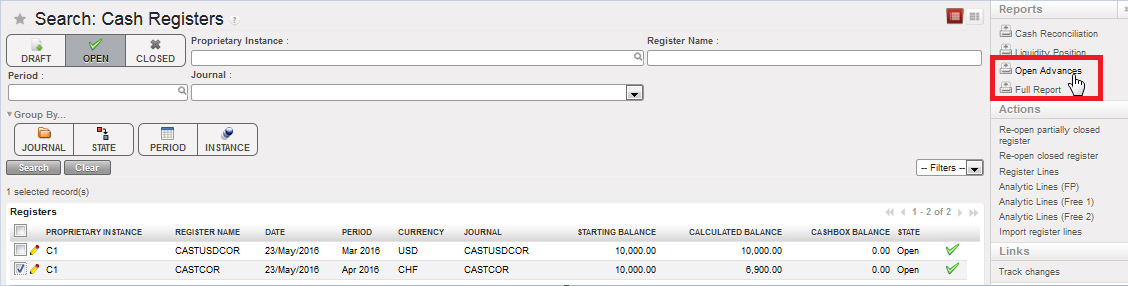
In the Search Cash Registers view, tick the checkbox of the register for which you want to run the {Open Advances report}
Go to Reports on the right-hand side of the screen, and select {Open Advances}
Open Advances report action
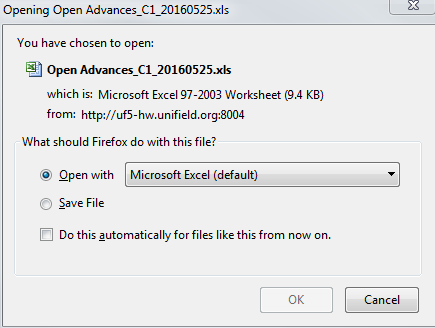
A window {Open Advances} displays
3. Select {OK}
An Open Advances report is generated in Excel.
Open Advances report
Open Advances
Excel output showing all open advances booked to date and that have not been cleared.
Open Advances
Excel output showing all open advances booked to date and that have not been cleared.
Cheque Register Closing
Before closing a cheque register, all entries must be hard-posted and all cheques which have been cashed into the bank register must have been imported to the related bank register (for the cheque import process, refer to LUFI-30206 of Chapter 3 – Payments). Cheques imported into the bank register are then reconciled.
Cheque payments are usually processed by the bank during the same month of the booking. However, if the bank cashes the cheque during the next month, the user should NOT import the cheque in the current month’s bank register. At the end of the month cheques not reconciled may remain open – even after the register is closed. This means they are available to be imported into the next month’s bank register. In the Cheque Register, the Cheque Inventory report displays the open cheques in booking and functional currencies.
How to Close a Cheque Register
Go to Accounting/Registers/Cheque Registers
Select the cheque register you want to close
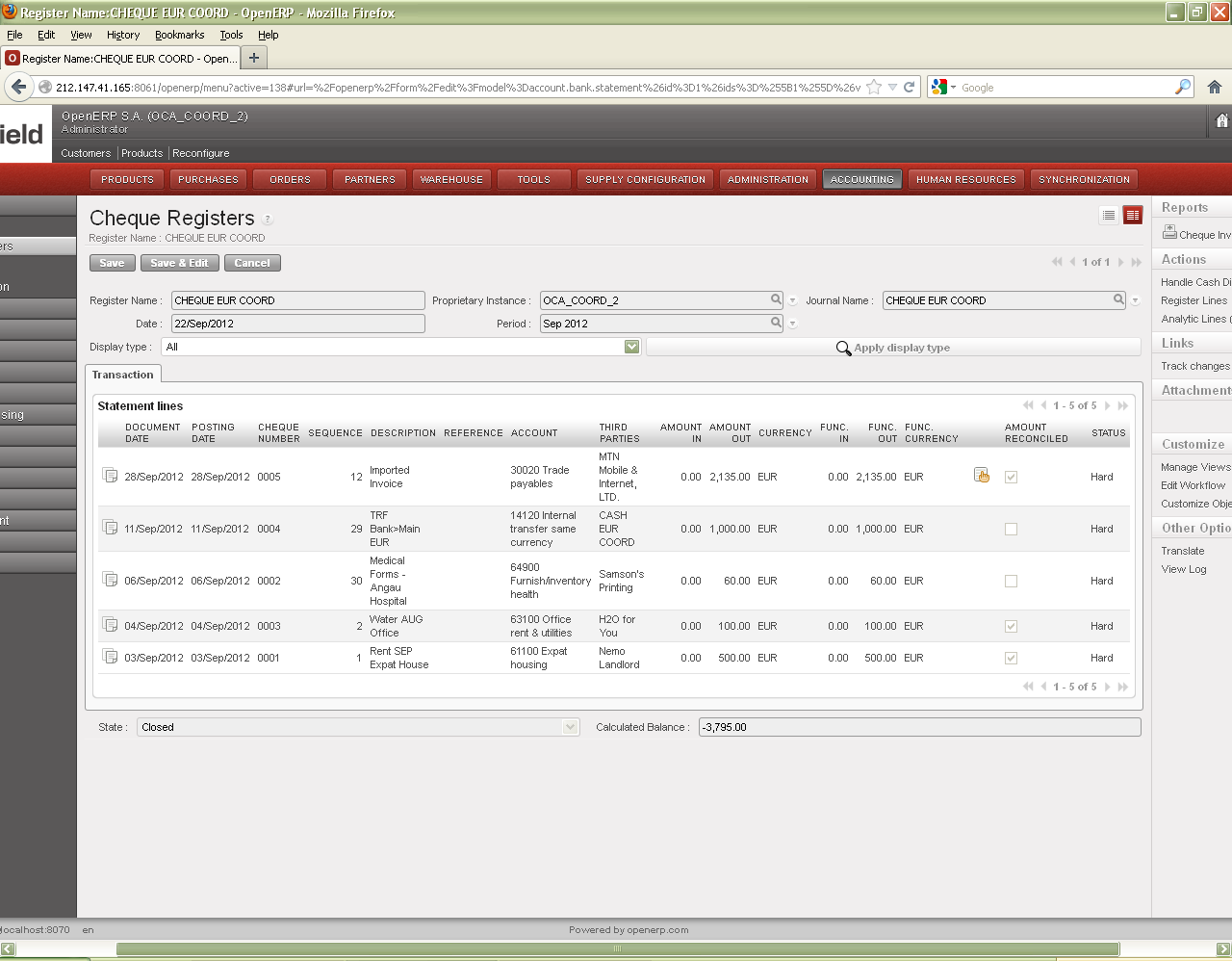
Select at the bottom of the form. The cheque confirmation wizard window opens. Click {Yes}.
Confirming reconciliation process was done
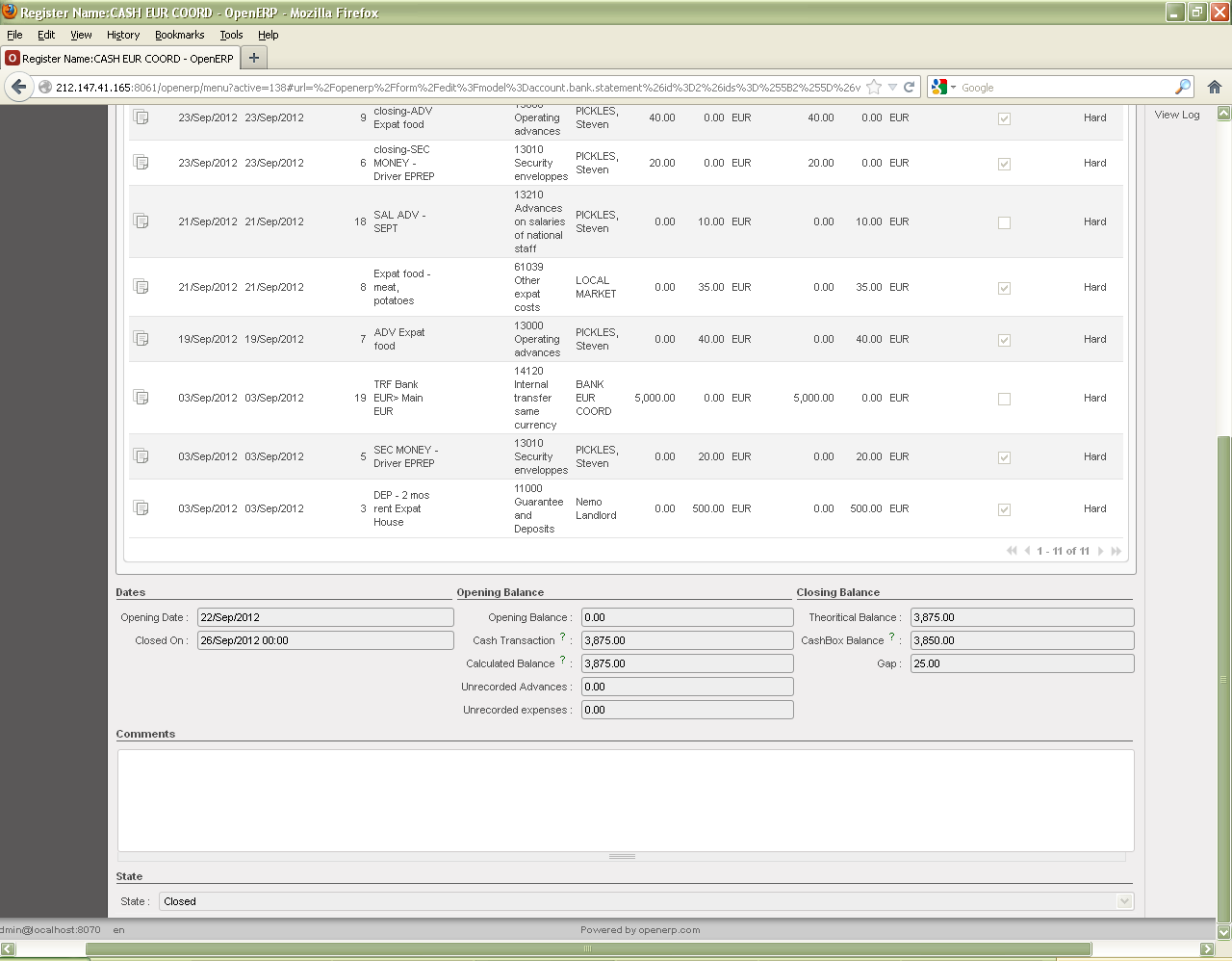
The {Closed on} date field is automatically populated. The status changes from {Open} to {Closed}.
The Calculated balance is the total sum amount of Open cheques.
The field State gets updated when Register is closed
How to Produce a Cheque Inventory Report:
Go to Accounting/Registers/Cheque Registers
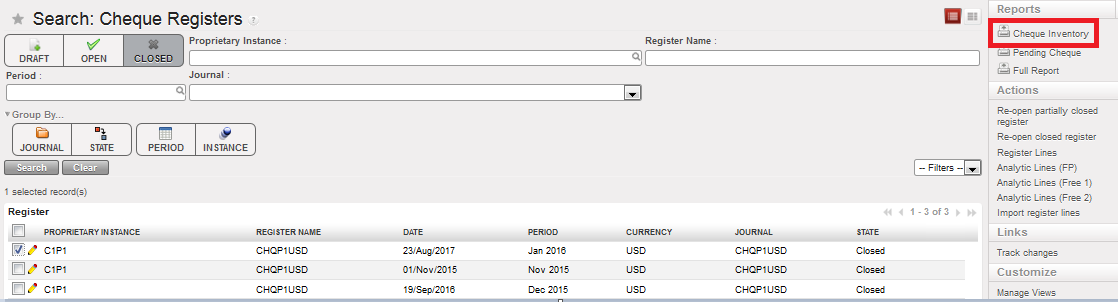
In the Search Cheque Registers view, select the filter and tick the checkbox of the register for which you want to run the {Cheque Inventory}
Go to {Reports} on the right side of the screen, and select {Cheque Inventory}
Cheque inventory report action
A window {Cheque Inventory} displays
Select {OK}
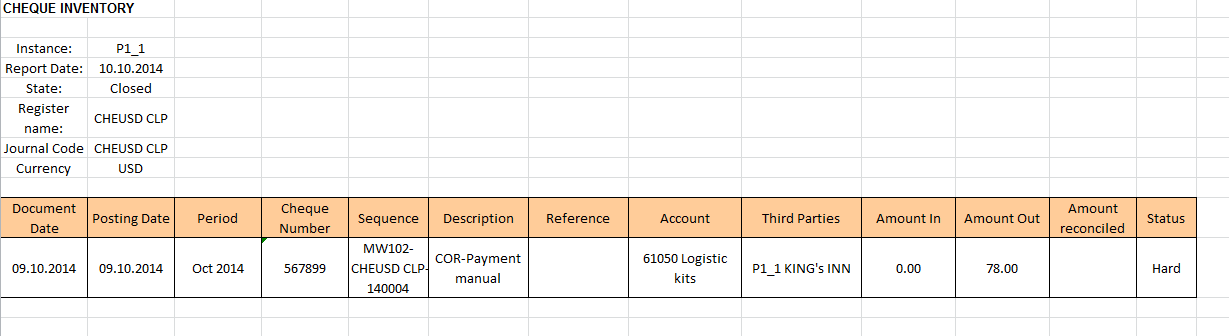
A cheque inventory report is generated
Cheque inventory report shows the cheque 567899 has not been reconciled yet
Cheque Inventory
Excel output displaying all outstanding cheques of the current and previous period:
– Open cheques not imported
– Open cheques imported in Temp state
– Draft cheques
N.B.: In some cases, you may run the report right after you have closed the register so you would not go back again to the Cheque Registers Search view. From the Cheque Register Form view, you would simply click on the report link.
How to Produce a Pending Cheque Report:
In the Search Cheque Registers view, select the filter and tick the checkbox of the register for which you want to run the {Pending Cheque}
Go to Reports on the right-hand side of the screen, and select {Pending Cheque}
Pending Cheque report action
A window {Pending Cheque} displays
Select {OK}
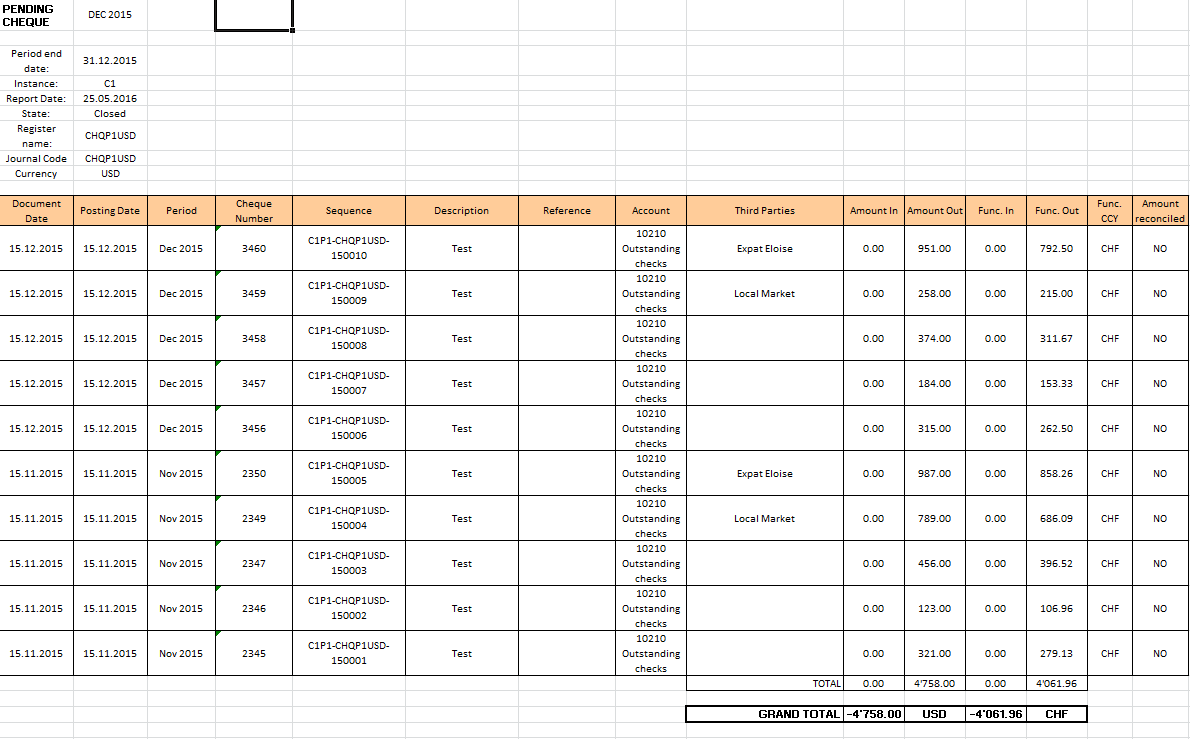
A pending cheque report is generated
Pending cheque report showing outstanding cheques for Nov and Dec periods
The Full report production is explained further down.
Pending Cheque Report
Excel output showing outstanding cheques without any period limitation:
– Open cheques not imported
– Open cheques imported in Temp state
Bank Register Closing
Bank reconciliation is the process of matching your actual bank statement entries with the bank register entries in UniField.
In UniField, the user imports all cashed cheques in the bank register to adjust the bank account balance. If bank transfers are performed, they should be entered in the bank register. Bank fees should also be booked directly in the bank registers.
Cheque payments are usually processed by the bank during the same month of the booking. However if the bank cashes the cheque during the next month then the user should NOT import the cheque in the current month’s bank register.
When you have imported only the cashed cheques into the bank register (for the cheque import process, refer to LU30304 of Chapter 3 – Payments) and hard-posted all entries, you can close the bank register. The bank register balance should always reflect the bank statement balance and the difference between them should be zero.
You can then generate a bank reconciliation report showing starting, calculated and bank register balances. This report is the paper evidence to sign-off and acknowledge the bank reconciliation was properly performed.
How to Close a Bank Register
Go to Accounting/Registers/Bank Registers
Open the bank register you want to close
Enter the bank statement balance in the field {Bank Statement Balance}
Bank statement balance reported
3. Save and the calculated balance as well as the Gap field is updated
Calculated Balance and Gap updated
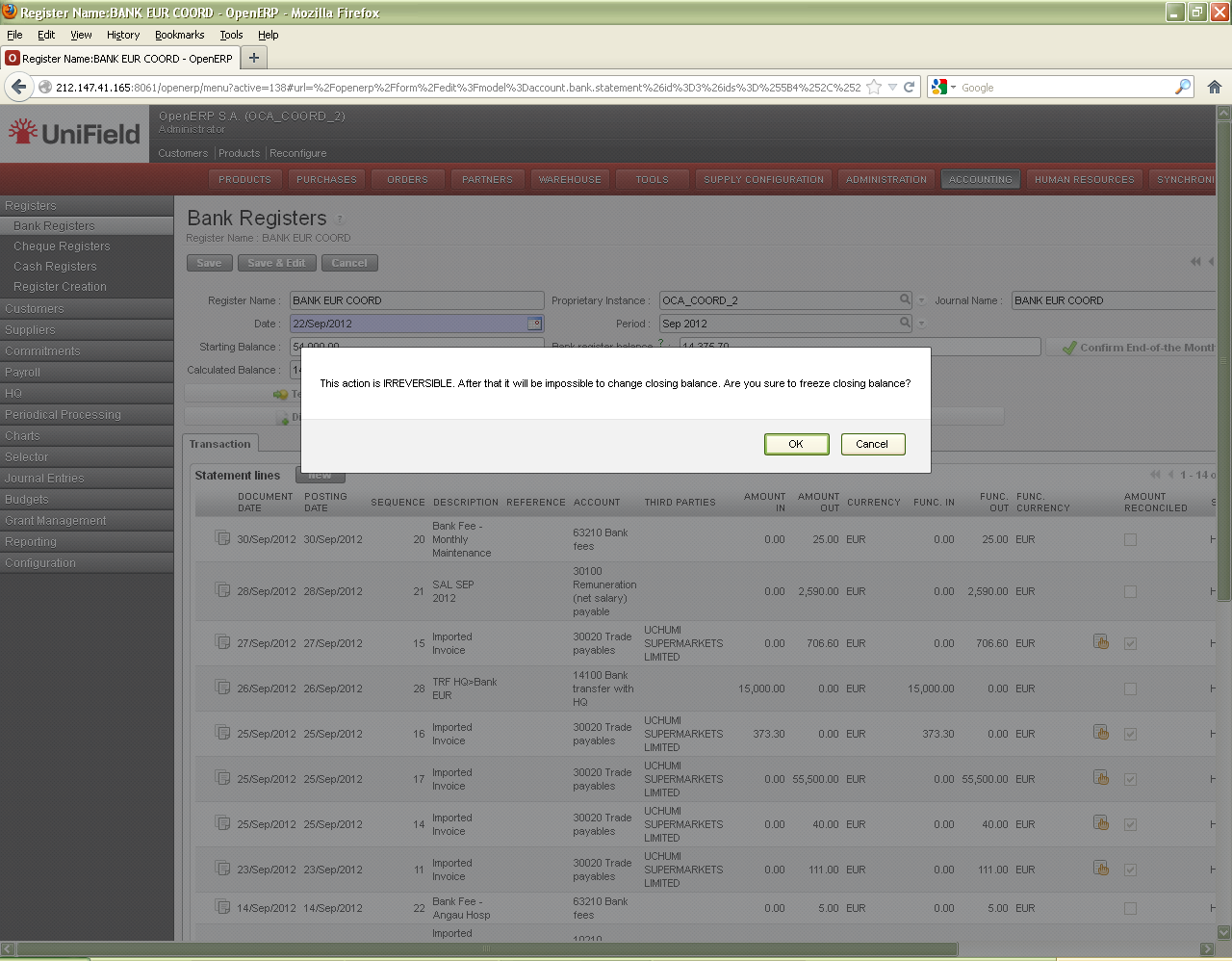
Click on {Confirm End-of-the Month Balance}. A warning message displays. Select {OK} to freeze the bank register balance, which cannot be edited anymore.
Warning message when closing balance
5. Select at the bottom of the form. The bank confirmation wizard window opens. Click {Yes}.
The closing date is automatically generated and the register status changes from {Open} to {Closed}.
Status changes to Closed
How to Produce a Bank Reconciliation Report
Go to Accounting/Registers/Bank Registers
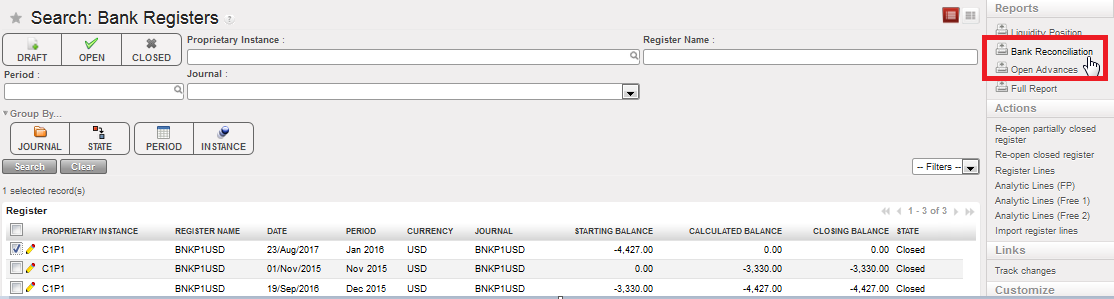
In the Search Bank Registers view, select and tick the checkbox of the register for which you want to run the {Bank Reconciliation}
Go to {Reports} on the right-hand side of the screen, and select {Bank Reconciliation}
Bank reconciliation action
A window {Bank reconciliation} displays
Select {OK}
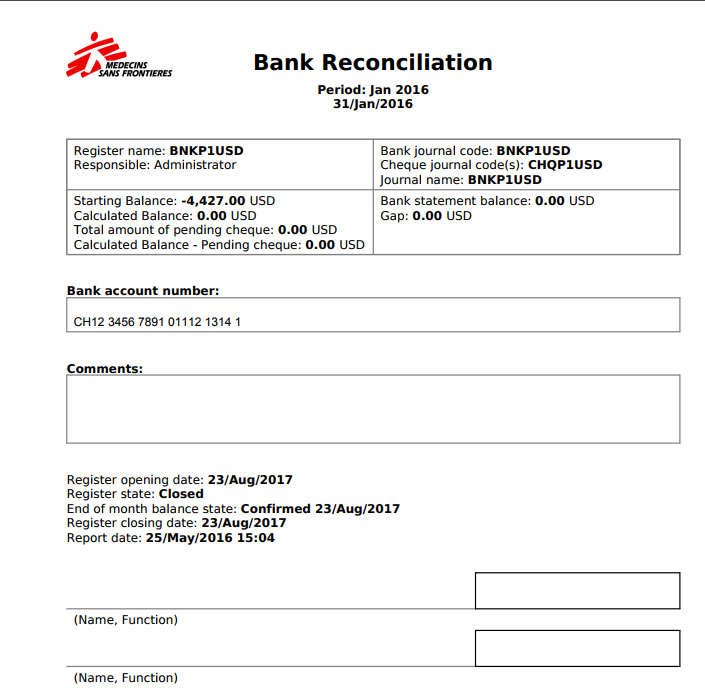
A bank reconciliation report is generated in PDF as below:
Bank Reconciliation Report
Bank Reconciliation
PDF report showing starting, calculated and bank register balances. This report is the paper evidence to sign-off and acknowledge the bank reconciliation was properly performed.
N.B.: In some cases, you may run the report right after you have closed the register so you would not go back again to the Bank Registers Search view. From the Bank Register Form view, you would simply click on the report link.
How to Produce a Liquidity Position Report:
Go to Accounting/Registers/Bank Registers
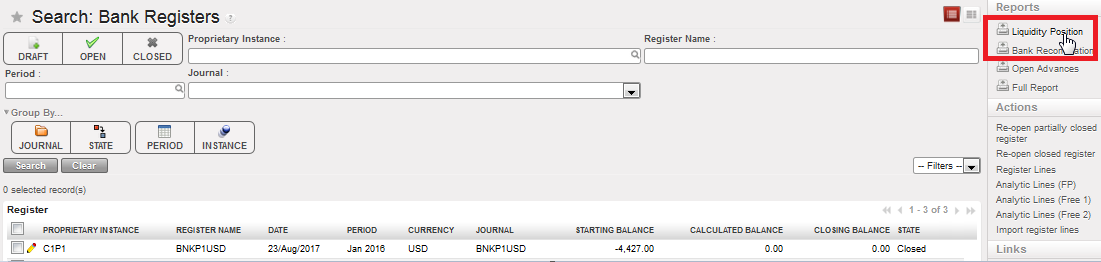
In the Search Bank Registers view, on the right side of the screen, expand the {Reports} menu and select {Liquidity position} report.
Selecting Liquidity position report when the report menu is expanded
A window {Liquidity Position} displays
Select the period for which the report should be generated and select the export format
Select {Export}
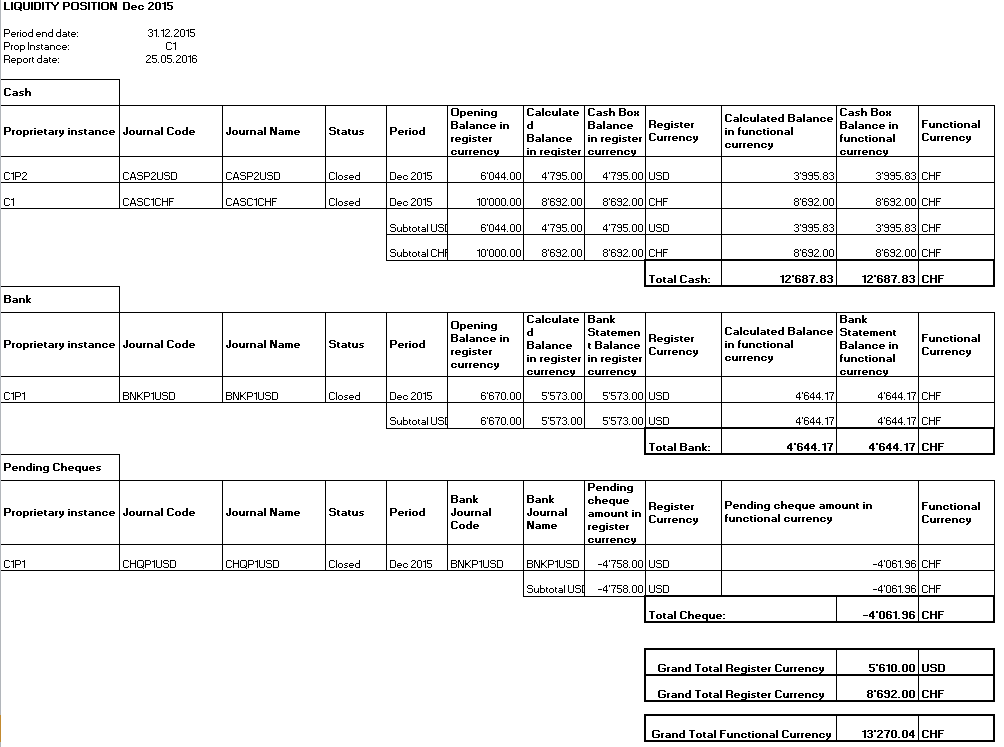
A {Liquidity Position} report is generated
Liquidity Position report displaying a calculated balance and a register balance. The calculated balance is the difference between the opening balance and the sum of transactions. The register balance is the physical liquidity balance in the cash box or at the bank.
Liquidity Position
Output of each bank, cash and cheque register of the instance (at project level) or the mission (at coordination level) with opening, calculated and closing balances (cashbox balance / bank statement balance / pending cheque amounts).
How to Produce a Full Report:
Go toAccounting/Registers/Cash Registers
In the Search Cash Registers view, on the right-hand side of the screen, expand the {Reports} menu and select {Full Report}.
A window {Full Report} displays
Selecting Full Report
Select {OK}
A {Full report} report is generated
Full Report
In the full report we have the corrections of the advance expense’s entries.
This is already the case for the direct entries that are corrected via the correction wizard.
The color codes are corrected (original entry) and reversal and correction = new entry
Display of corrected and reversal lines
Full Report
Excel output showing all entries in a register, including breakdown of invoice lines for imported invoices, direct invoices and justified advances. Subsequent corrections on these elements are also reflected in this report.
In additon, entry sequences with no liquidity account lines (deleted entries, automatic down payment reversal entries and trade payable entries originating from direct entries) are shown in this report for reference.
How to produce the Pending Invoices Report
The pending Invoices report will help you identifying which invoices are in draft or in open status.
Go to Accounting > Suppliers: Under Suppliers there are seven sub-menus creating different documents as below:
Supplier Invoices
Supplier Direct Invoices
Supplier Refunds
Intersection Supplier Invoices
Intersection Supplier Refunds
Donation
Intermission Voucher IN
When you open one of the above sub-menus, go to the right-side menu called “Reports”:
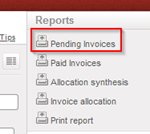
Under “Reports” there are five reports to produce, the first one is the report named “Pending Invoices “:
Click in “Pending invoices”:
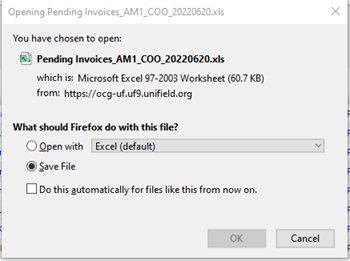
You will have this window:
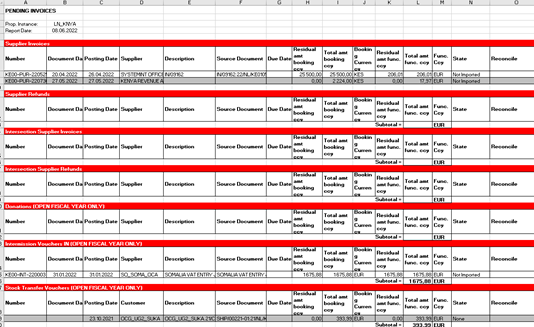
then you will get the downloaded file “Pending Invoices_Instance code_YYYYMMDD” which includes the following columns:
1. Number
2. Document Date
3. Posting Date
4. Supplier
5. Description
6. Source Document
7. Due Date
8. Residual amt booking ccy
9. Total amt booking ccy
10. Booking Currency
11. Residual amt func. ccy
12. Total amt func. ccy
13. Func. Ccy
14. State
15. Reconcile
16. Payment Sequence Number
17. Down Payment Sequence Number
How to extract “Pending Invoices” reportDisplay of the “Pending Invoices” report
For the Supplier invoices: we will have the open invoices before and the draft invoices after (drafts in light grey in order to distinguish Draft from Open).
For the Donations: we will have the open and draft donations of the Open fiscal year + the donations in draft.
For the Intermission Vouchers IN: we will have the Intermission Vouchers IN of the Open fiscal year + the IVI in draft.
For the Stock Transfer Vouchers: we will have the Stock Transfer Vouchers of the Open fiscal year + the STV in draft.
When HQ entries have been reviewed, an authorised user can validate (Hard-post) and synchronize them.
Once the HQ entries are validated at Coordination level, they become validated at the HQ instance in the HQ entries sub module so that HQ can follow which HQ entries have been validated by each mission. HQ entries mass or individual validation at coordination will trigger one Journal Item per HQ entry. There will be no more entry sequences containing several HQ entries in the same sequence. (one entry sequence per HQ journal entry)
Go to Accounting/HQ/HQ Entries
–>A list of HQ entries to validate displays
List of draft HQ entries displayed in the {HQ Entries List} Search view
Tick the check-boxes of the entries you want to validate. Note that selecting one split entry will lead to validation of lines involved in the split (original entry and all related split entries).
Go to the {Actions} menu and select {Validation}.
{Validation} action
–>A {Validation} wizard displays
{HQ Entries Validation} wizard
3. Select {Validate}
–>HQ entries are validated. From this moment they become accounting entries and are reflected in the {HQ} journal. After this step changing entries is only possible through accounting corrections.
HQ entries mass or individual validation at coordination will trigger one Journal Item per HQ entry. Same for Analytic Journal Items (one entry sequence per HQ journal entry)
Validated HQ entries displayed in {Journal Items} Search view
Validated HQ entries displayed in {Analytic Journal Items} Search view
When an HQ entry is corrected before validation for account or analytical distribution or when the entry is split, automatic correction entries in OD journal are created. This means that the original HQ entry is reversed and corrected with a separate entry. The original entries have the correction history wizard available.
Corrections History viewed from the Analytic Journal Items
How to track changes on HQ entries:
1. The fields used as headers in the list view of the HQ entries.
2. The transition to “Validated” (the tag on which the filters To Validate and Validated depend), so that we can spot when the HQ entries have been posted.
3. The split and unsplit of entries. Note: lines coming from a split will be identifiable because the “Original HQ Entry” will have a value for these lines (contrary to the “original” lines).
Headquarter (HQ) entries consist of accounting entries recorded at HQ level on behalf of the mission offices. They encompass for example international orders and expatriate salary expenses. The mission sends international orders for medical and logistic supplies to supply centers which will then source, pay for and ship these items to the mission. The supply centers periodically charge OCs (at HQ level) for the goods shipped to the field.
International orders are initiated in the field but settled at HQ level. To remain consistent with the current expense recognition scheme, goods are expensed:
At time of shipment for the OCA
When the European Supply Center (ESC) invoice is validated in the HQ accounting system for all other OCs.
As invoices are already settled at HQ level, the reception of an international order by a field office instance does not trigger the creation of an invoice at field level e.g. a PO addressed to a partner with type ESC does not trigger the creation of a supplier invoice and therefore the entries must be imported into the system.
From a system perspective the process of HQ entries is as follows:
Expenses settled at HQ (HQ entries) on behalf of the field missions are entered into the HQ ERP system.
Expenses are exported to a csv file.
The file is then imported into the UniField HQ instance.
The imported entries are synchronized to the UniField coordination instance in {Draft}.
At coordination level, the entries are reviewed in the {HQ Entries} sub-module. By default the funding pool picked is {Private Funds}. Field users must update the funding pool as well as verify the amounts, account codes, and analytical information.
Once the entries were reviewed, the authorized user validates them. At this point, they become accounting entries in the coordination’s {HQ} journal.
The corresponding analytic entries allocated to projects are then synchronized down to the project(s). Both coordination and project(s) take the HQ entries into account in the follow-up of their budget.
Goods from an international order are often received in partial deliveries. The associated commitment voucher generated when the PO to the supplier ESC was validated, must be updated:
Either manually by the coordination instance when entries are received from HQ and validated by the coordination. If not, costs reflected in your budget will be incorrect if you choose to include pending commitments. Once expenses have been fully recognized and entries received from HQ and validated at coordination, you must manually close the commitment voucher. The commitment voucher state will change from {Validated} to {Done}. If not, cost will be reflected in your budget as committed (or simulated) expenses AND as actual expenses.
Or automatically by importing an external file (OCA, OCB) representing outstanding international commitments. Once imported this data is recorded in the “international engagements” analytic journal and is not synced. Next time a file is imported, previous entries on this journal will be deleted. See next chapter for more explanation.
LUFI-40101 National Staff Database Management for Missions Using Homere
LU Introduction
HR transactions performed in the field cover national staff salaries, salary advances, social security charges, taxes, etc. Within MSF, HR management is generally performed through the Homere software.
UniField integrates with Homere:
The Homere Sending File (Per_mois) with all employees’ basic information can be imported into UniField.
The Homere Payee_SAGA Payroll file can be imported to create payroll entries per employee each month.
With UniField, national staff payroll and salary advances continue to be booked in Homere. Every month the Homere Saga payroll file and the Homere sending file (per_mois) with all employees are imported into UniField to create payroll entries and update the national staff database. The import of these files is performed in the {Payroll} module in the {Accounting} business application.
Before creating payroll entries, all employees existing in Homere must also exist in UniField. When the user imports the file with all employees, the first movement will be a check based on the employee identification number:
If this number already exists in UniField, no action.
If this number does not exist in UniField, a new record is created in the employee list by combining the first and last name as well as the identification number. The employee {Active} flag is also checked.
If this number exists in UniField with the employee set to {Inactive} and it is included in the data to import then the employee is automatically set back to {Active}.
Once in UniField, you cannot delete or edit employee data that comes from Homere. The only exceptions are the analytical information and active/inactive status. If an error is spotted, it must be changed directly in Homere and re-imported in UniField.
If any information regarding the employee has been changed in Homere since the last import (name, function etc.), this information is updated in UniField when importing the Per_mois file.
If an employee is moved to another project, the procedure regarding changing the employee ID depends on each OC. By default, all imported employees synchronize within the mission + HQ as inactive, meaning that if the same employee ID is used across projects, an existing record in UniField is used also in the new project. Importing the per_mois file will set the employee as active in the new project. If the employee ID is changed and a new employee record in Homere is created every time an employee is moved from one project to another, a new record is created for each new employee ID in UniField, too.
The analytical allocation for employees is set either automatically or manually depending on the analytical account type and each OCs procedures:
Destination: The default destination for each employee is NAT. This destination is automatically applied to all employees loaded into UniField. However, if NAT is not used by an OC, the destination is automatically updated when importing the Payee_SAGA file for payroll. This means that if the destination information is filled in Homere and included in the Payee_SAGA file, the employee master data for destination will be automatically updated.
Cost Center: The cost center field is by default empty. Cost center will be automatically updated when importing the Payee_SAGA file for payroll. This means that if the cost center information is correctly filled in Homere and included in the Payee_SAGA file, the employee master data for cost center will be automatically updated. If cost center information is not included in Payee_SAGA file or is of incorrect format, the cost center has to be manually updated for each employee.
Funding Pool: The funding pool can only be updated manually. If no default funding pool exists, the payroll entries will be created with a default funding pool “PF”.
Special note for OCG*:
Automatic updates of the analytical allocation do not concern OCG instances who continue to manually update all employee analytical allocation.
Mass re-allocation of employee analytic distribution:
If a group of employees has the same analytical information, UniField provides the option to change their analytical distribution in mass.
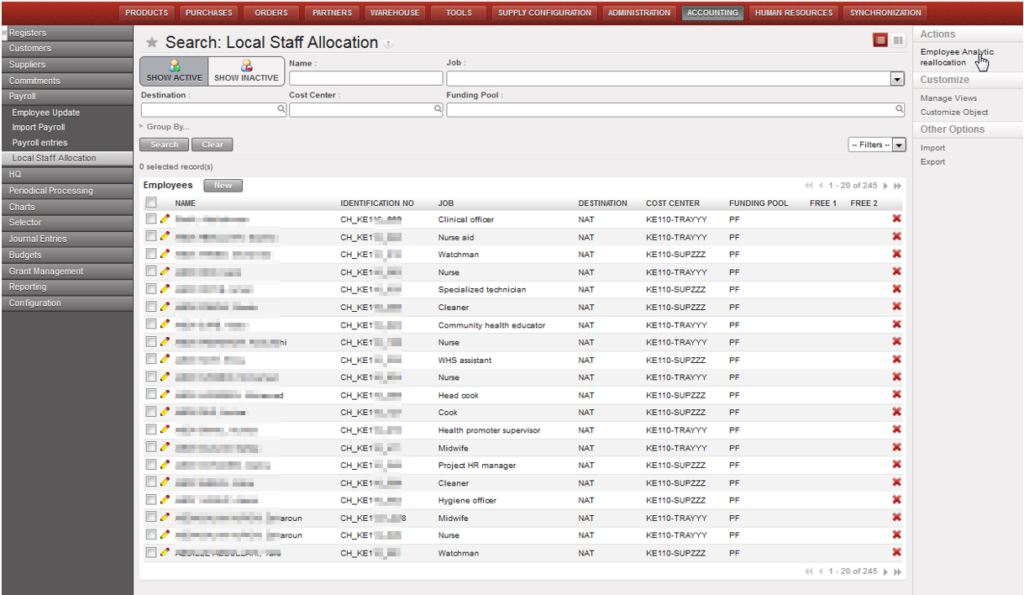
You assign (individually or by group) an allocation by choosing the action {Employee Analytic reallocation}. This action opens a new window called {Employee Analytic reallocation}.
List of Active national staff not reallocated yet
{Employee Analytic reallocation} wizard
At each payroll import, UniField retrieves the employees’ default analytical distribution and applies it to the appropriate payroll entry. This allows you to avoid allocating all payroll lines every time the payroll is imported (each month). The allocation may become obsolete at some point e.g. when the funding pool eligibility date is over. In this case the employee’s allocation and payroll entry will become red. The user will need to modify it and set a new valid analytical distribution.
Local Staff employees synchronize across the mission to all projects, coordination and HQ. The employees synchronize by default as inactive.
The employees are activated once a per_mois file containing the employee is imported into a new instance. All accounting entries can be assigned also to inactive employees (e.g. coordination instance can create entries for an inactive project employee).
How are National Staff employees used in UniField Registers?
There are various financial transactions which involve National Staff employees.
Per diem for training/travel
Security money for training/travel
Operational advances
Salary advances
In UniField, there is a field called {THIRD PARTIES} which allows the user to select the type {Employee} and then select the employee name. This allows tracing and reconciling advances better.
Assigning a register entry to a Third Party type {Employee} and selecting the Employee
In a situation where there is a need to select a former employee as third party, you can click on the magnifying class and uncheck the filter {Show Active} in the {Search Employees} window to display both, active and inactive staff.
How to check “Employees” balances?
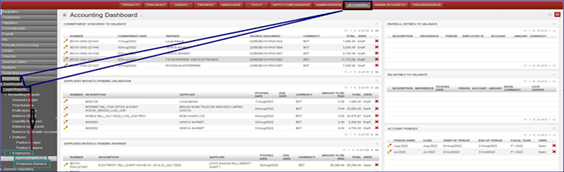
We can see the reports here: go to accounting > Reporting > Legal Reports > Accounting Reports. We have a new menu called “Employees” with two sub-menus “Employee Ledger” & “Employee Balance”:
How to access “Employees”
Employee Ledger:
This report is an analysis done by employee. It is a report containing one line per employee representing the cumulative credit balance.
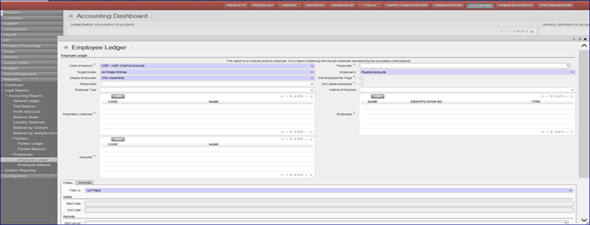
Go to Accounting > Reporting > Legal Reports > Accounting Reports > Employees > Employee Ledger:
We will have several possibilities to do our selections using the filters.
View of “Employee Ledger”
Employee Balance:
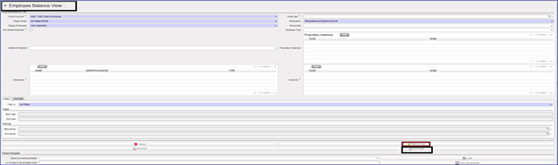
To see this new report, we go to Accounting > Reporting > Legal Reports > Accounting Reports > Employees > Employee Balance:
We will have several possibilities to do our selections using the filters. It’s optional to tick on “Only active employees”.
LUFI-30501 Auto Rebilling (inter-mission / inter-sectional)
A. LU Introduction
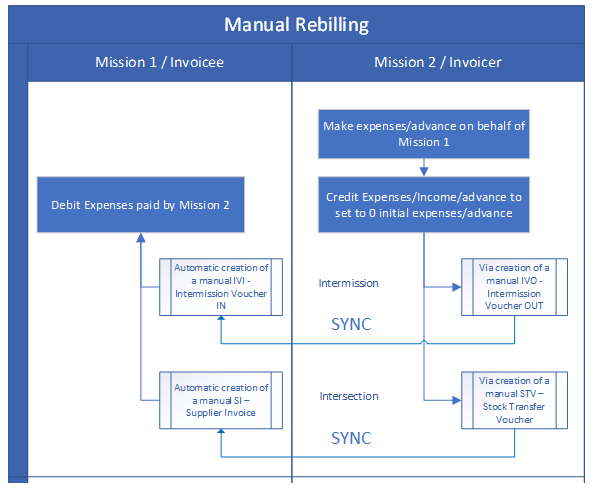
Intermission and intersection invoices are now synchronized between 2 instances for manual or supply flows so that automatic counterpart invoices are created and match at both sides.
Invoices are created via supply flow or manually by finance at Provider/Invoicer. Once the Provider/Invoicer validates those rebilling invoices, they synchronize from the Provider/Invoicer to the Requester/Invoicee.
Requester/Invoicee can’t change currency, nor prices, nor quantities… This is to ensure amounts and currency matches in both sides.
There are 2 possible cases:
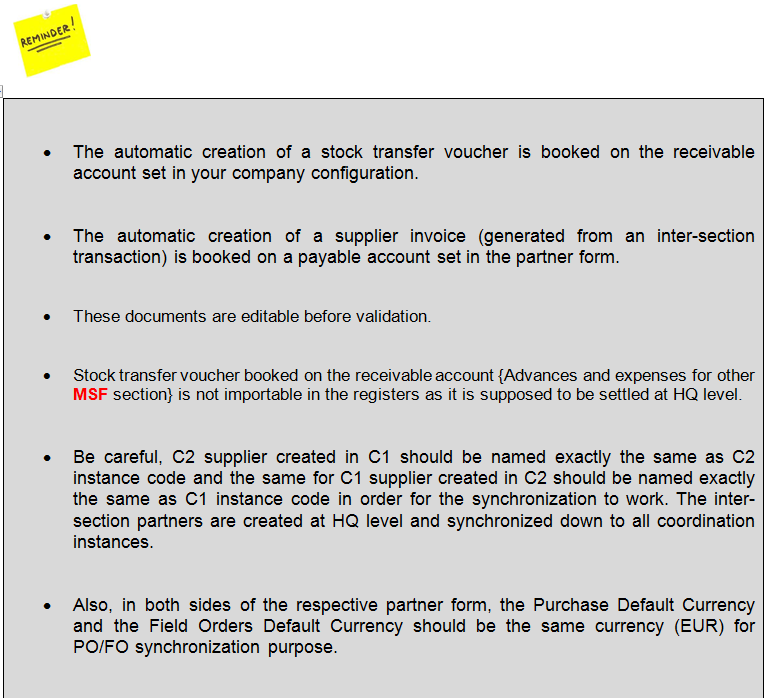
Either the missions decide not to reimburse each other and the settlement will be done at HQ level. In that case, the receivable accounting code to be used for the Stock transfer voucher is {Advances and expenses for other MSF section}. You will have to set it in the company configuration and will be retrieved at the time of creating automatically the stock transfer voucher. For the supplier invoice, the payables account code will be the one linked to your partner and should be too. There will be no matching on these accounts in the UniField HQ instance.
Both missions decide to reimburse each other at mission level. In that case, the counterpart accounting code to be used is {Receivable from other sections} for the Stock transfer voucher and {Payable to other sections} for the Supplier invoice. The receivable account will be set as such in company configuration. For the supplier invoice, the payable account will be the one linked to your partner.
Rebilling is created and pushed only from the Provider/Invoicer to the Requester/Invoicee.
When linked to supply flows, no rebilling invoices is created at reception of the goods by the requester. The reception of the rebilling invoice is not generated at the same time than the reception of the goods.
Invoices are created only by the mission that provides/invoice the goods (automatically created via supply flow or manually created by finance when linked to services).
Invoices created are then synced from the invoicer to the invoicee (not the other way around no pushed invoicee invoices).
Invoice edition / validation / approval
Only the reinvoicer can create and edit the rebilling invoices and validate them.
The reinvoicee will only approve the invoice once received via sync. Only the posting date will be editable by the reinvoicee before approval.
In case reinvoicee don’t agree with the invoice, it can validate and then cancel it using the automated function.
Invoices created via supply flow will have some restriction on some fields: not possible to change the product nor quantities.
B. Rebilling Inter-mission via Supply Flow
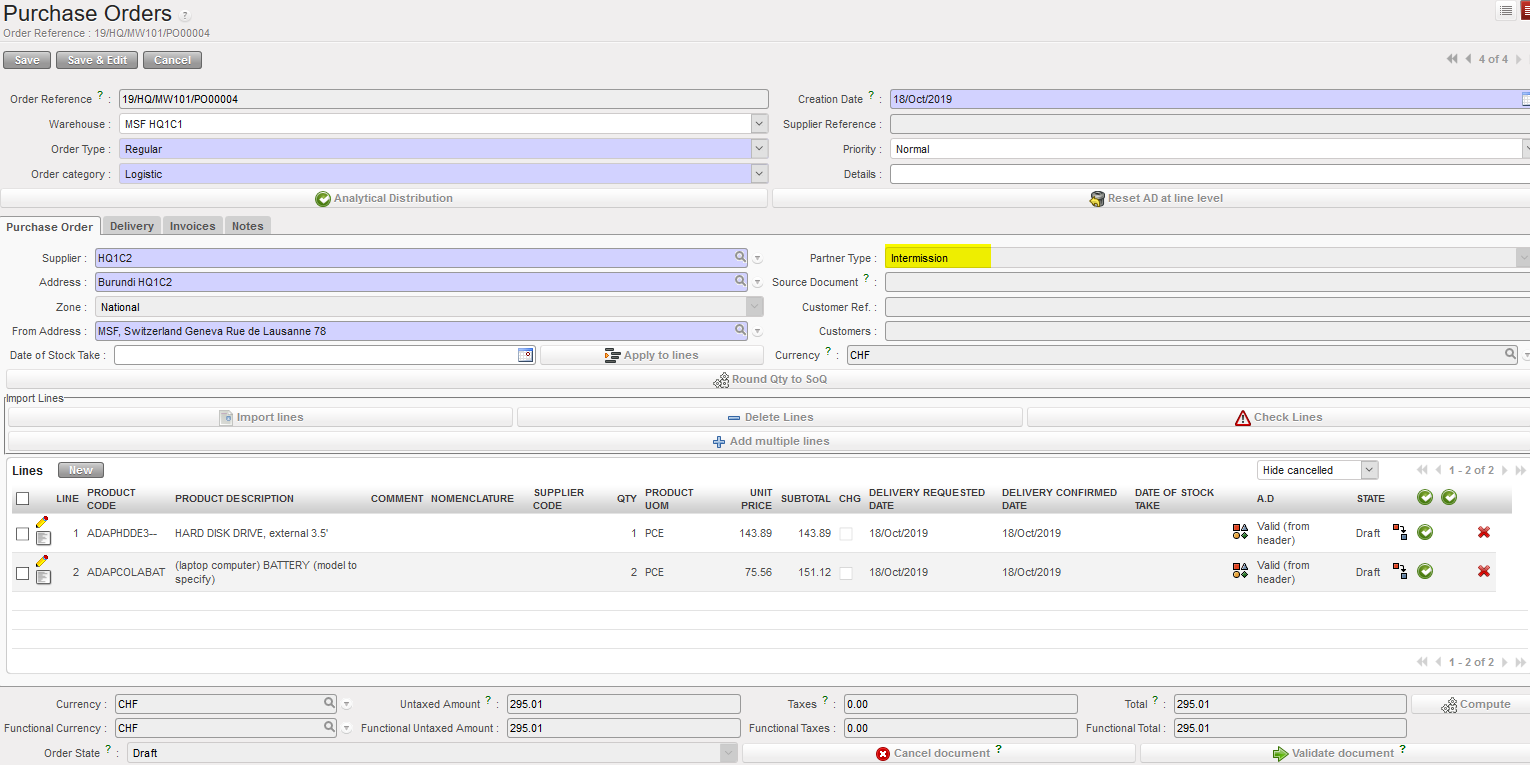
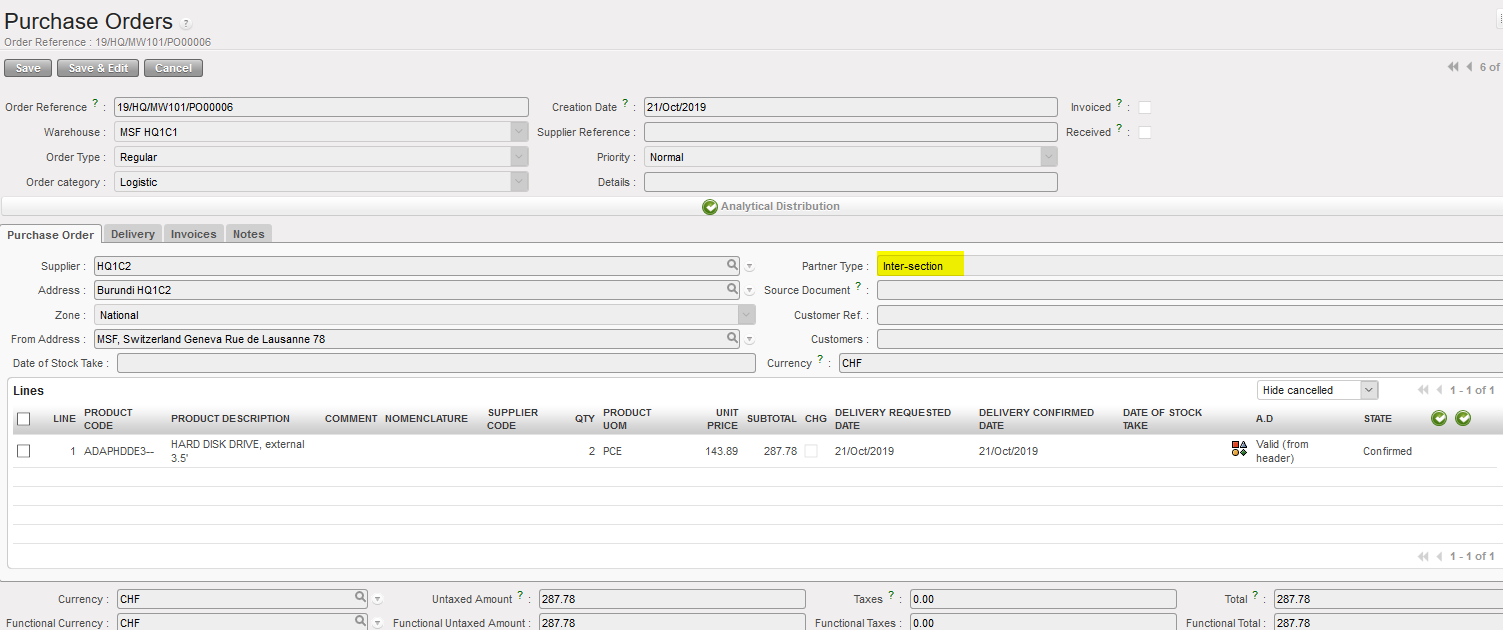
For example, we have the instance HQ1C1 that want to request some items from another mission HQ1C2 within the same OC section.
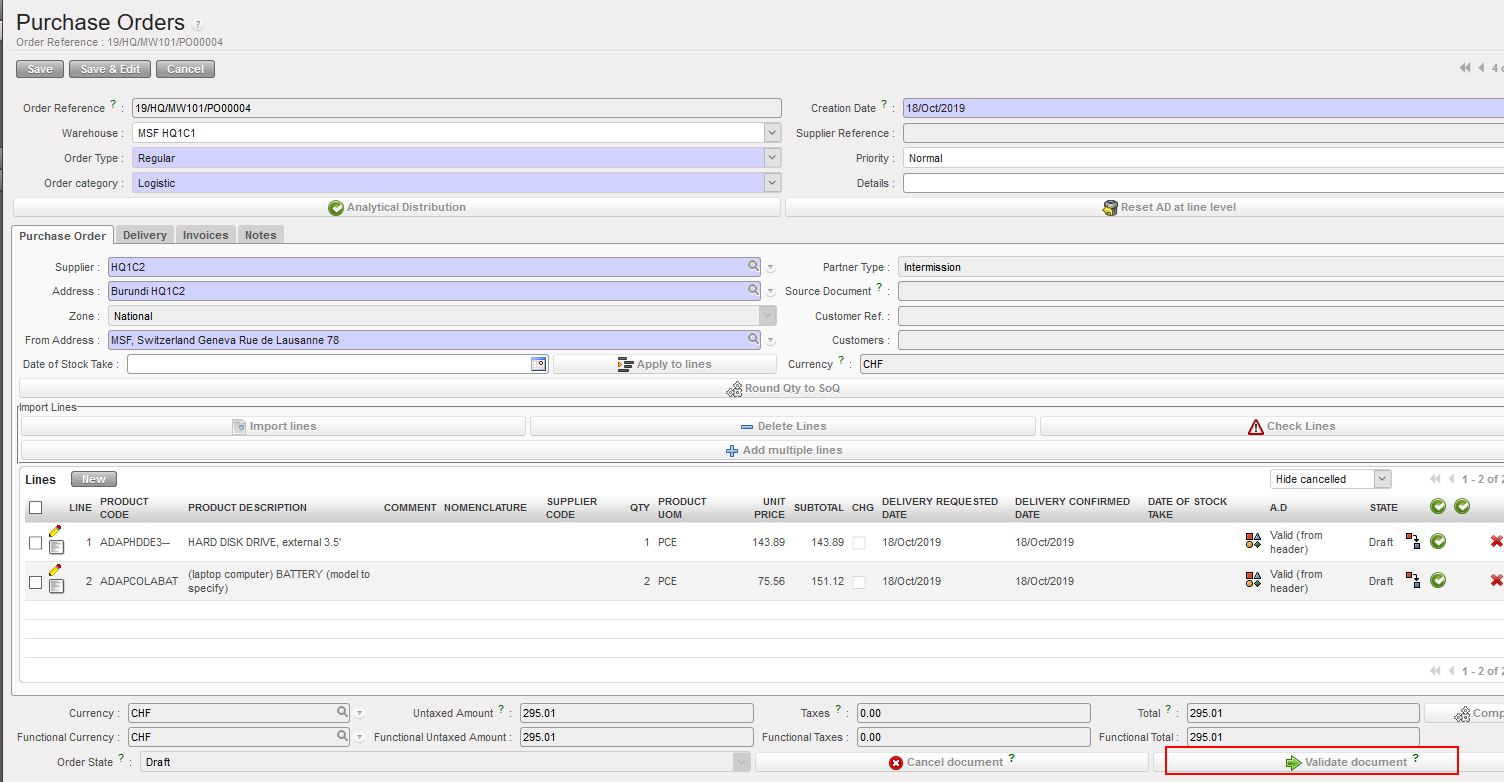
A PO is created by the requester mission HQ1C1, with the provider mission HQ1C2 as a supplier. (Done by a supply user not a finance user)
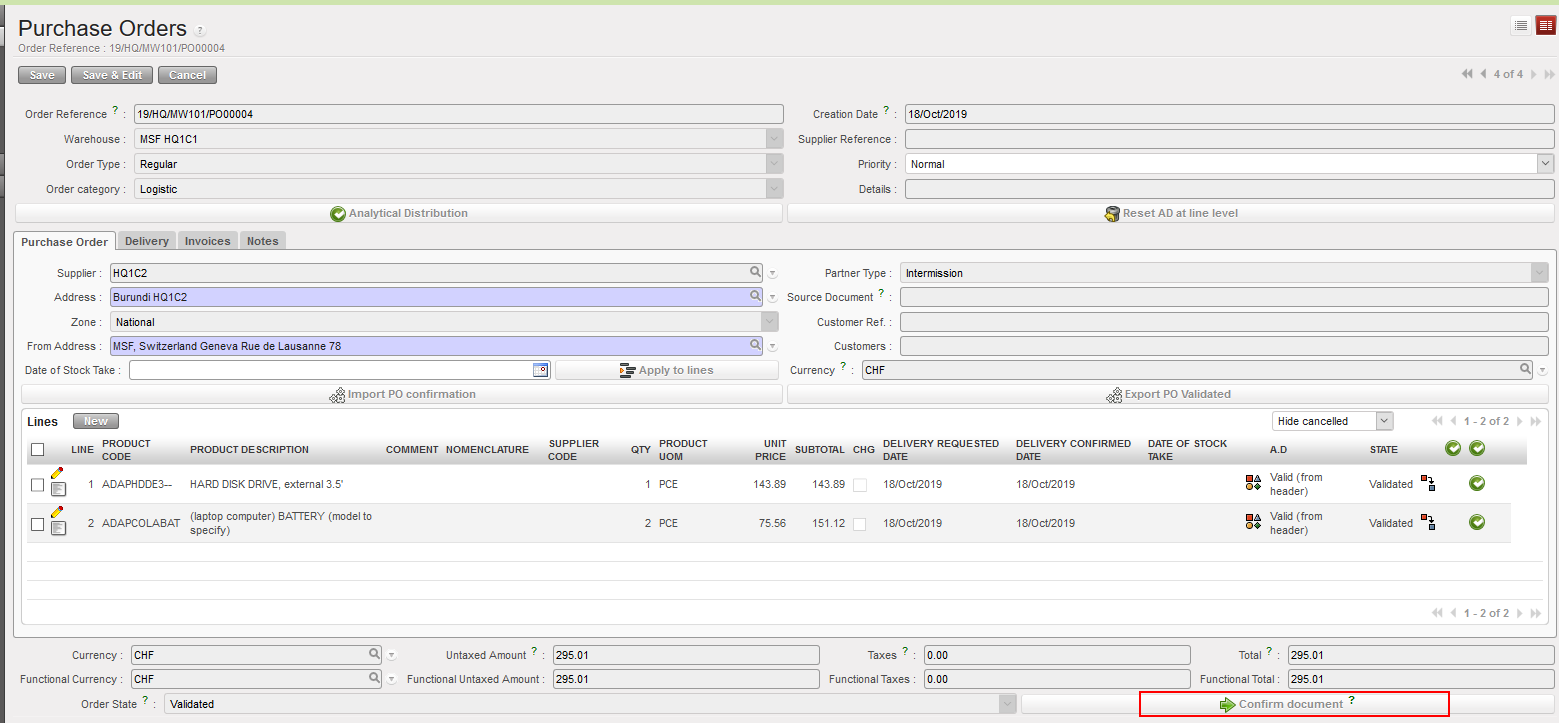
2. After inserting all the required information, the PO should be validated then confirmed. (Done by a supply user not a finance user)
3. After synchronization in the two instances, an FO in Draft state will be created in the provider mission HQ1C2 as a result of the PO created in requester mission HQ1C1. (Done by a supply user not a finance user)
Before validating the FO, you will need to update again the Analytic Distribution and then you validate but don’t confirm the document. (Done by a supply user not a finance user)
4. Go to Orders Sourcing tool to source the document (Sourcing: is choosing from where you want to order the requested items, either from the warehouse or from an external supplier) in our case here, we will choose to order the items from external supplier. Either you select the supplier on each line separately and then you click on the green arrow to source or select all and click on Source lines in the right side menu in case you want to order the items from the same supplier then save and source. (Done by a supply user not finance user)
5. After that, the FO will be automatically confirmed, the state of the FO will be sourced. (Done by a supply user not a finance user)
6. A PO will be automatically created in Draft sate after the sourcing in the provider mission HQ1C2, with supplier chosen during the sourcing.
7. After checking all the information and apply the delivery confirm dates to all lines, you can validate then confirm this PO. (Done by a supply user not a finance user)
8. Once the PO is confirmed, the incoming shipment will be created. (Done by a supply user not a finance user)
9. Process the incoming shipment when the goods are received in the warehouse. (Done by a supply user not finance user)
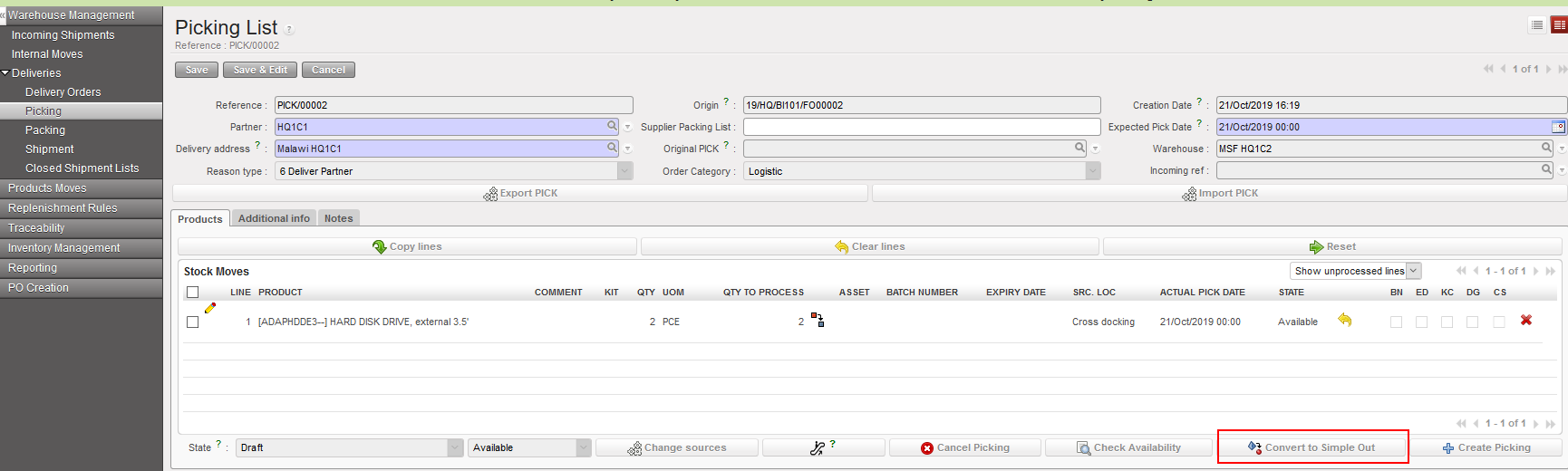
10. To do the picking of the items, go to Warehouse Management/ Deliveries/ Picking/ Convert to Simple Out/ Copy all/Process (Done by a supply user not a finance user)
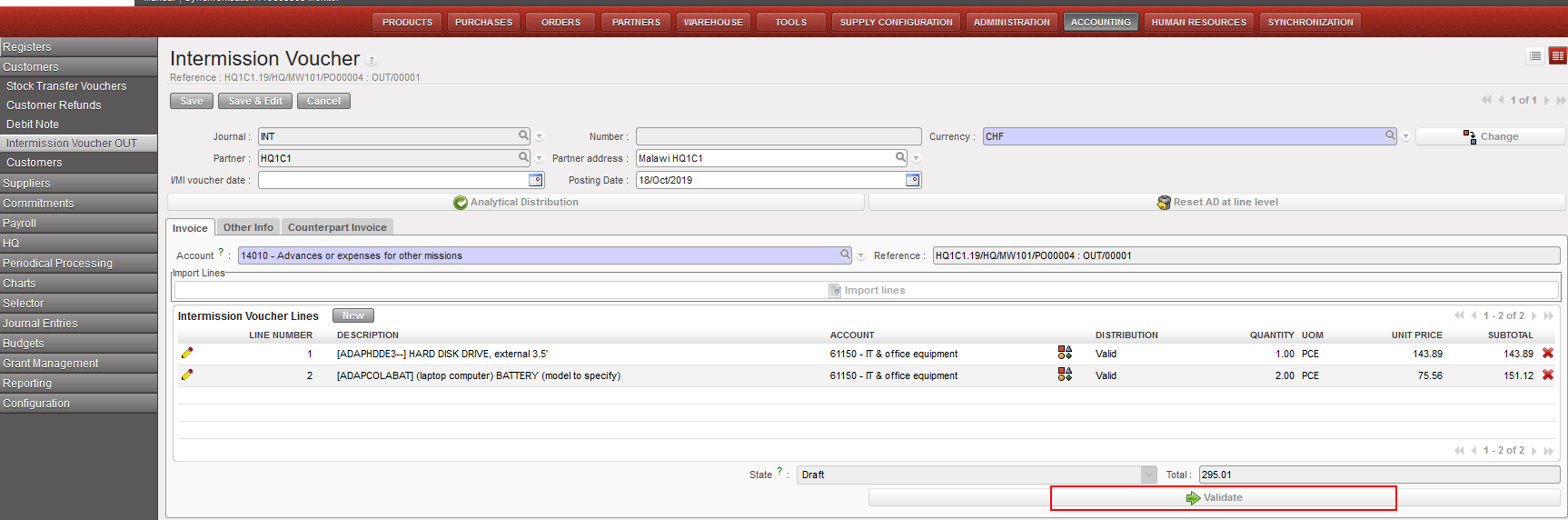
11. The IVO will be created automatically, and it will be accessible for the finance user.
Go to Accounting/ Customers/Intermission Voucher Out
12. In the counterpart Invoice, the Synchronized check box will be already ticked and will be non-editable as the IVO was created throw the supply flow.
13. If all the information were correct, the finance user will validate the IVO. (Done by Finance User)
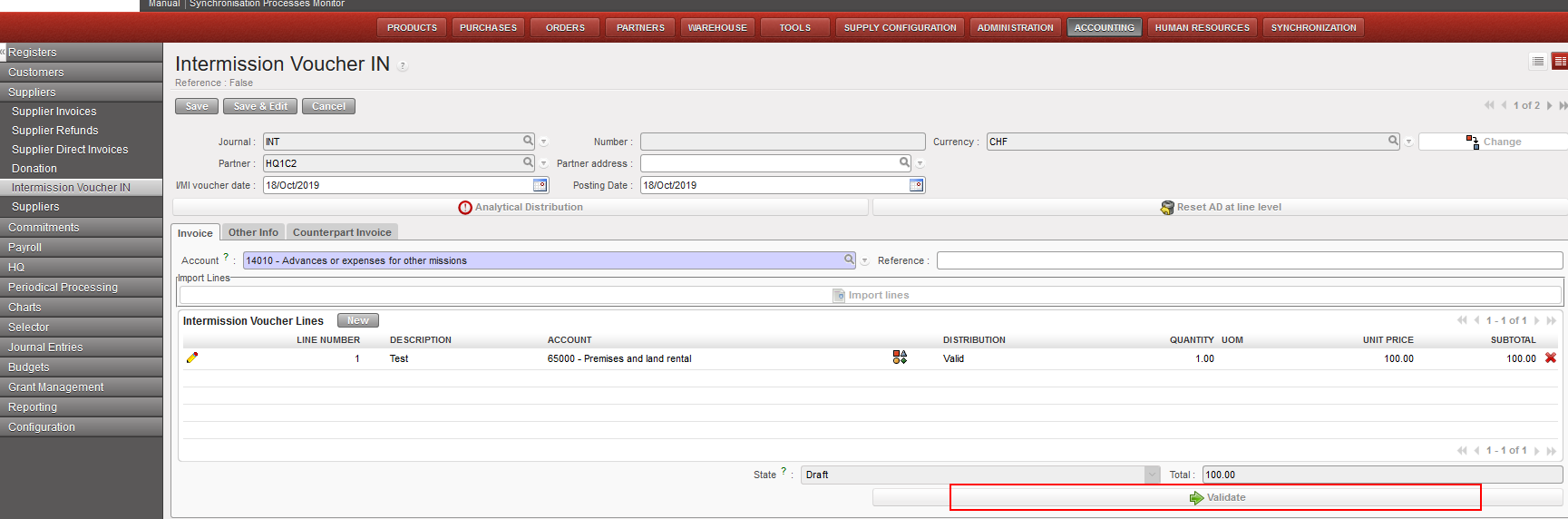
14. After the synchronization in the two mission, an IVI will be created in a Draft state in the requester mission HQ1C1.
In the requester mission, Go to Accounting/ Suppliers/Intermission Voucher In
15. The finance user should check all the information if all were correct (including accounting code and analytic distribution), then the IVI should be validated. (Done by a Finance user)
How to Create an Intermission Voucher IN and OUT Manually
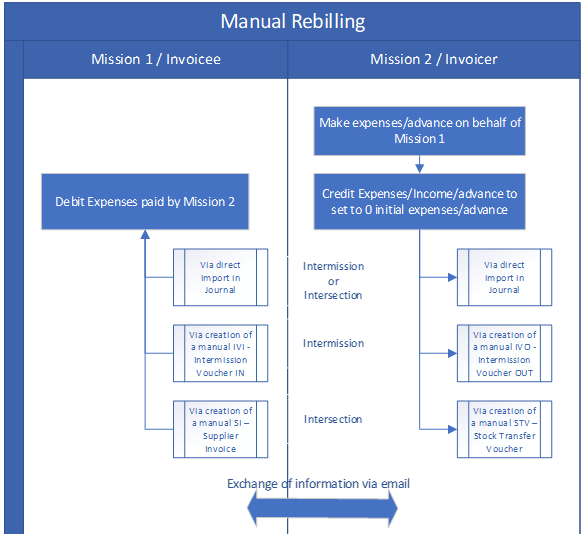
Rebilling for non-supply flows is manual in both sides. It relies on processes. What is being done manually in the Invoicer (Provider) instance need to be done also in the Invoicee (Requester) instance.
Here below the process:
•Invoicer create the rebilling invoices manually or use the import in journal function.
•Invoicer send the elements out of Unifield for the Invoicee to create the counterpart rebilling invoice.
Risks: Both sides can change/edit documents and the risks are that they don’t match in term of prices, products, currencies…
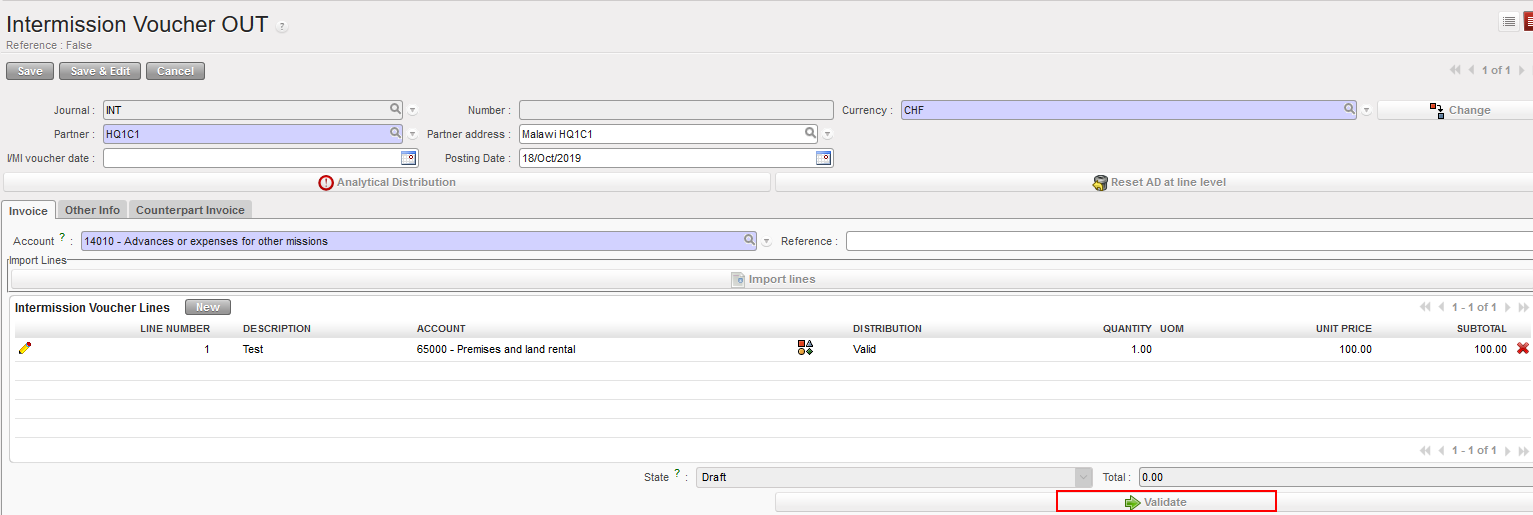
In the invoicer/provider mission (customer) mission, for example HQ1C2:
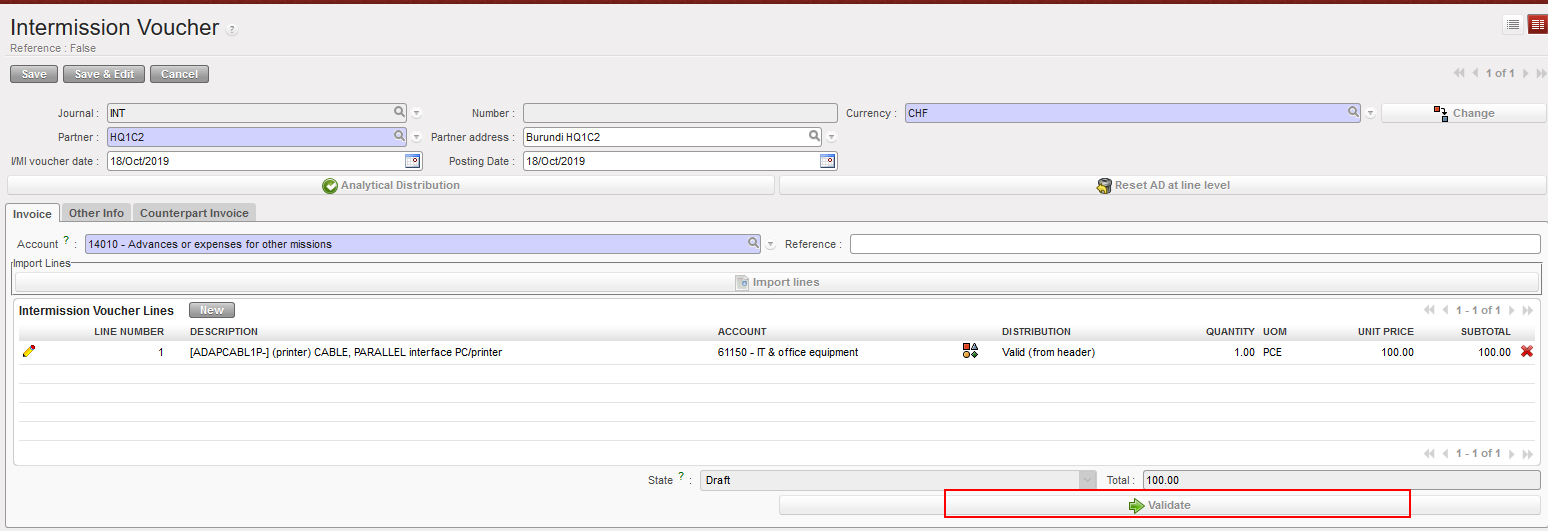
Go to Accounting/ Customers/Intermission Voucher Out
Click on {New} to open a new form and chose the mission of rebilling ( for example: HQ1C1)
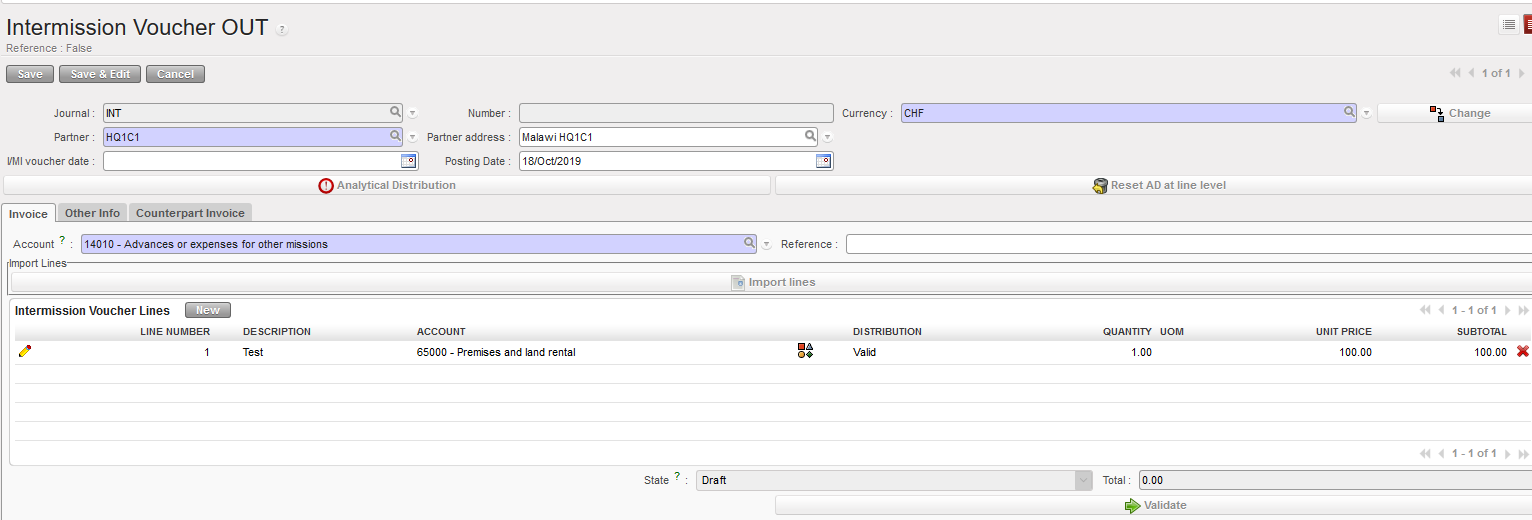
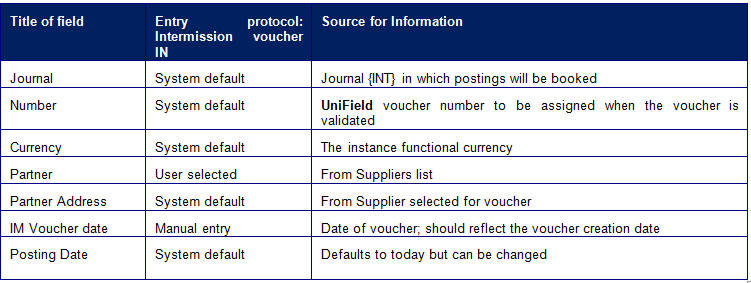
⮡ A form displays to create a new voucher. Fields in blue are required; white fields are optional; grey fields are view only.
Intermission Voucher OUT creation from the Customers module
is used to apply a global analytic distribution across all lines in the invoice.
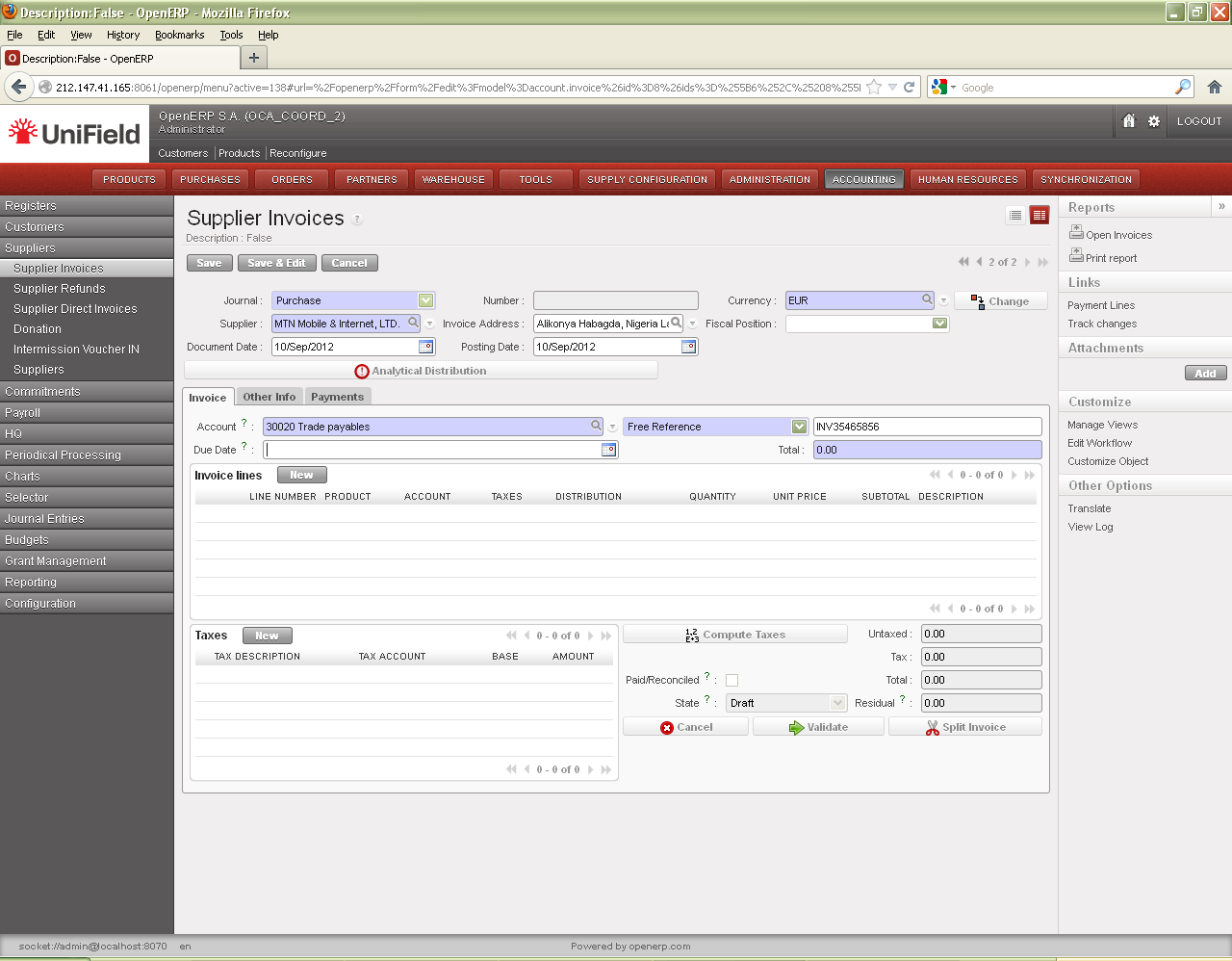
On the {Invoice} tab, Selectand complete the {Description}, {Account}, {Quantity} and {Unit Price} to represent the various goods or services on the voucher to be created.
Click button for additional invoice lines, or click button to return back to the supplier invoice window.
Assign the analytical distribution per line or globally across all invoice lines. Allocate the Cost Center to the correct Cost Center or to the purchasing instance.
Cost Center allocation
3. From Counterpart invoice, tick the Synchronized check box and then validate the IVO
4. After the synchronization in the two instances, In the supplier mission HQ1C1 (invoicee/requester):
Go to Accounting/ Suppliers/Intermission Voucher IN
You will need to update the analytic distribution again and then validate the IVI if all information were correct.
How to Create an Intersection Voucher IN and OUT Manually
The same process can be done for inter-sectional re-billing. The only difference will be having stock transfer voucher to validate instead on IVO.
For instance, a PO was created at HQ1C1 (inter-section). We choose another inter-section partner as a supplier, and then validate and confirm the PO.
2. After the synchronization in the two instances, an FO will be created in the provider instance ( HQ1C2)
3. The Cost Center should be updated again and after checking all the information => validate the FO but don’t confirm.
4. Source the document from Orders Sourcing Tool, either select available items from the warehouse or order from external supplier. In our case here, we will choose external supplier.
5. After that, the FO will be confirmed automatically, and a new PO will be created to order the requested items from the external supplier.
6. Same process as in inter-mission, validate and confirm the PO after checking all the information => confirm the incoming shipment in the warehouse when the items are received. After doing the picking with convert simple out and process, a stock transfer voucher will need to be validated.
7. Go to Customer/Stock Transfer Voucher/ Check all the information and then validate (Note: the synchronization check box will be already ticked and cannot be edited)
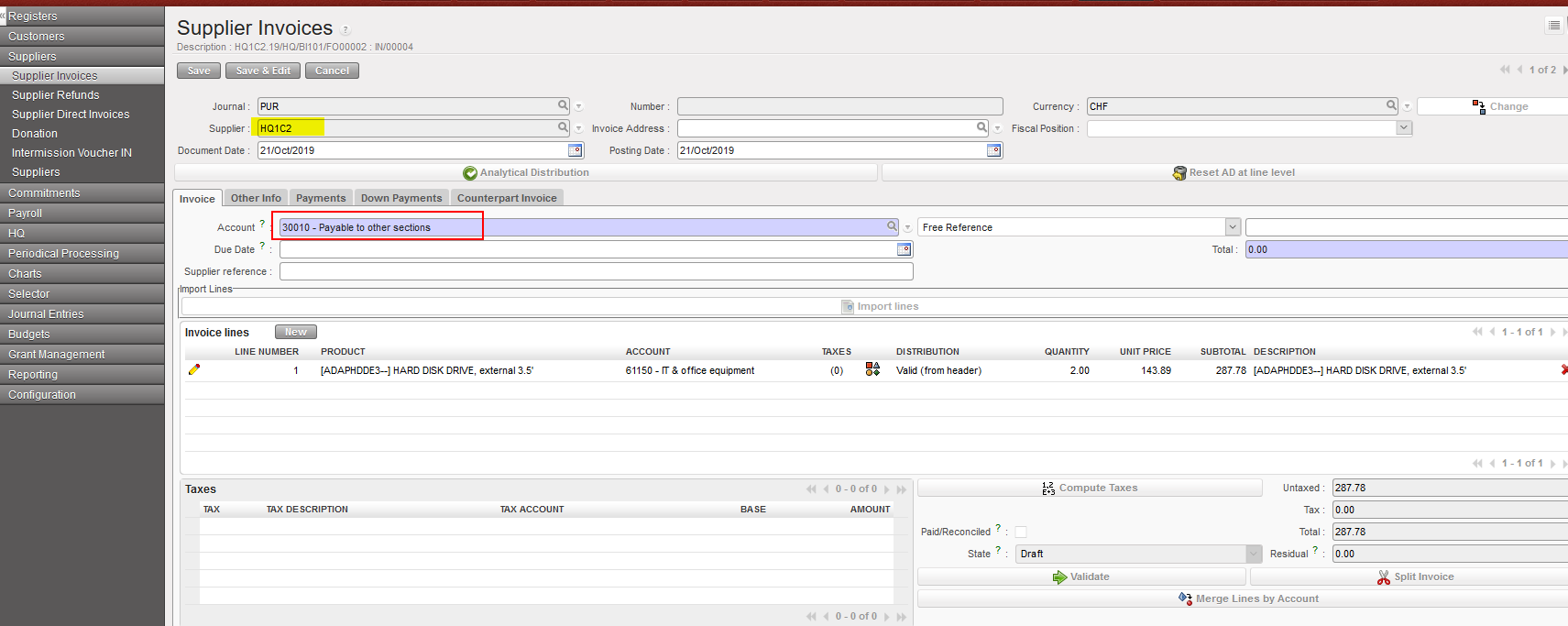
8. After the synchronization is done in the two instances, a supplier invoice will be created automatically in the requester mission HQ1C1 with the provider mission as a supplier. The payable account will be Payable to other sections. The process then as usual, check all the information then validate the invoice.
Manual STV/IVO synchronization check box and Synchronization check box of manual STV/IVO when created from duplicate:
if the partner chosen is intermission/intersection, the check box is ticked.
if the partner chosen is not intermission/intersection, the check box is Unticked:
when the user creates a partner, the user clicks on [validate] button, we will always make a check to ensure the consistency between type of partner at [partner] field and [synch] check box.
if the partner is not intermission/intersection and the synch check box is active, we will not allow to validate. Error message: ” You are not allowed to synch an invoice to this partner. Please remove the tick from the check box “synchronization” from the tab Counterpart invoice”.
When an ISI or IVI is created at synch time, the account on each line is taken from (by order of priority) the related CV line if any, else on the product or product category, else directly from the account used on the line in the other instance. In case the account is not found or is inactive, the related line is created without account and is displayed in red (until the account is set). The lines concerned are listed in the related “Synch Message Received” which appears as “Partially Not Run”.
It is not possible to validate the invoice as long as accounts are still missing.
This should be the only UC where invoices can be created with “empty” accounts. Therefore it is not possible to create an invoice by duplicating another invoice with missing accounts: all the accounts must be filled in first.
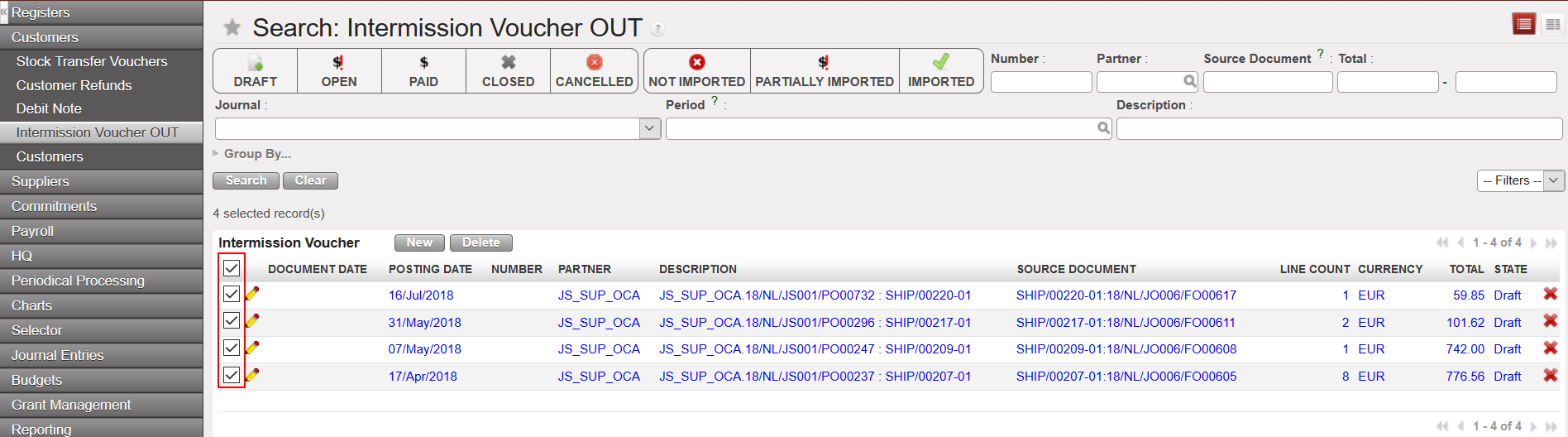
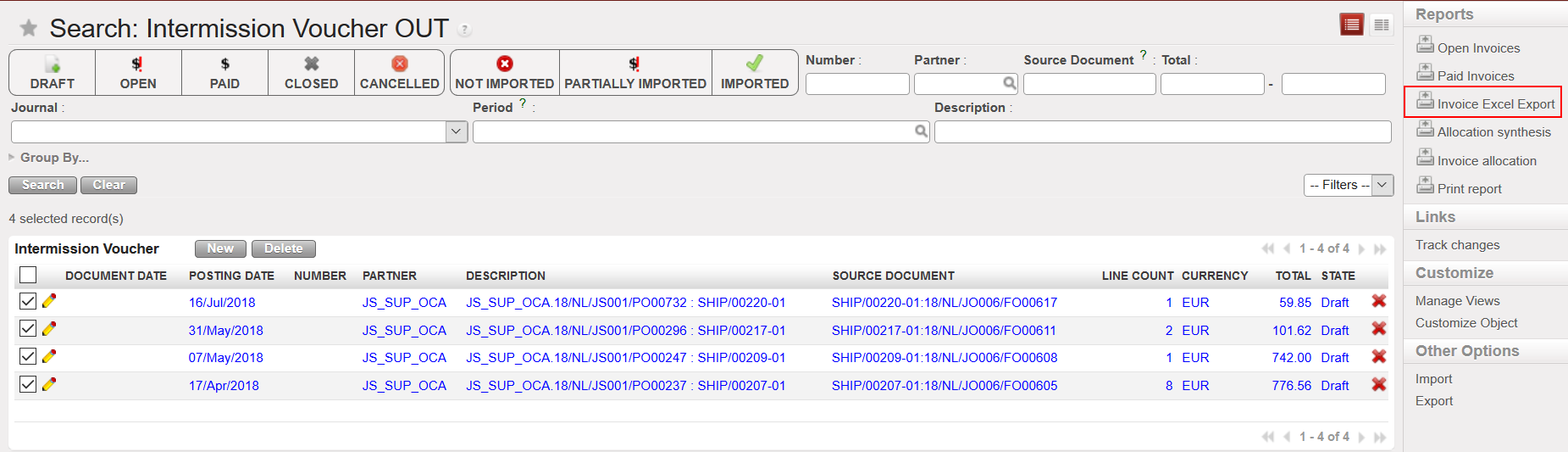
IVO/IVI “Invoice Excel Export” report for invoice lines
To export the list of IVO/IVI invoice lines (with specific details for each document):
Go to Accounting/ Customers (for IVO lines)-Suppliers (for IVI lines)
Select the lines you want from the IVO/IVI search view.
2. From the right-side menu click on {Invoice Excel Report}.
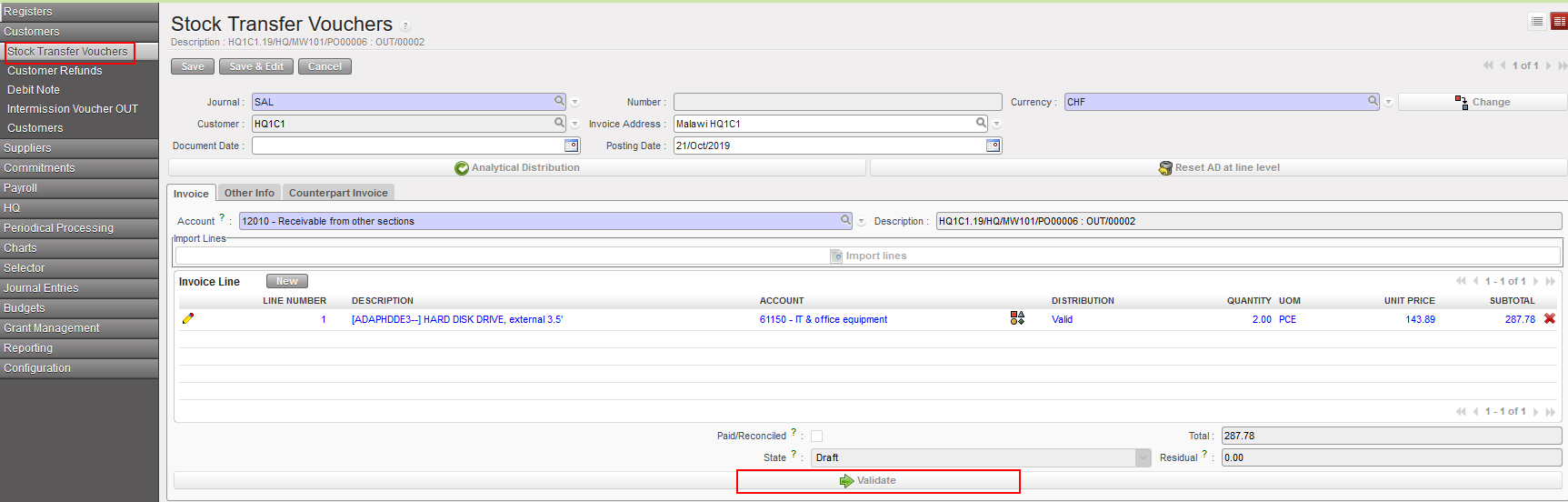
How to Create a Stock Transfer Voucher Manually
We will show below the case in which the mission reimburses the expense directly in the field.
Go to Accounting/ Customers/Stock Transfer Vouchers
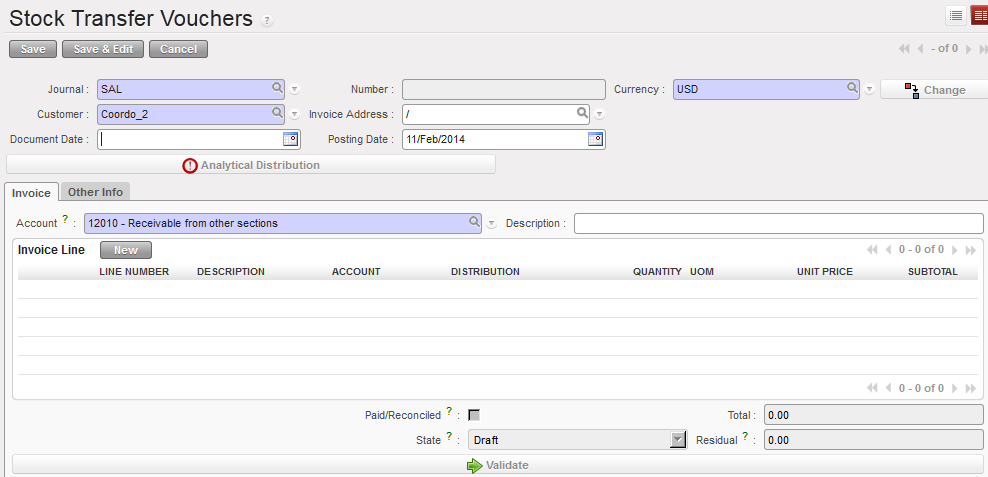
Click on {New} to open a new form.
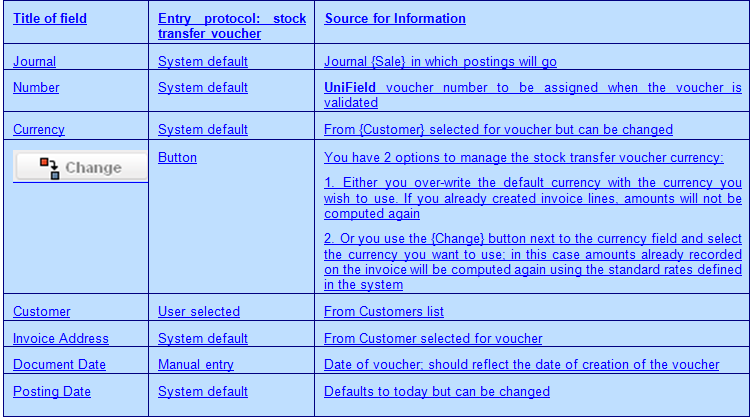
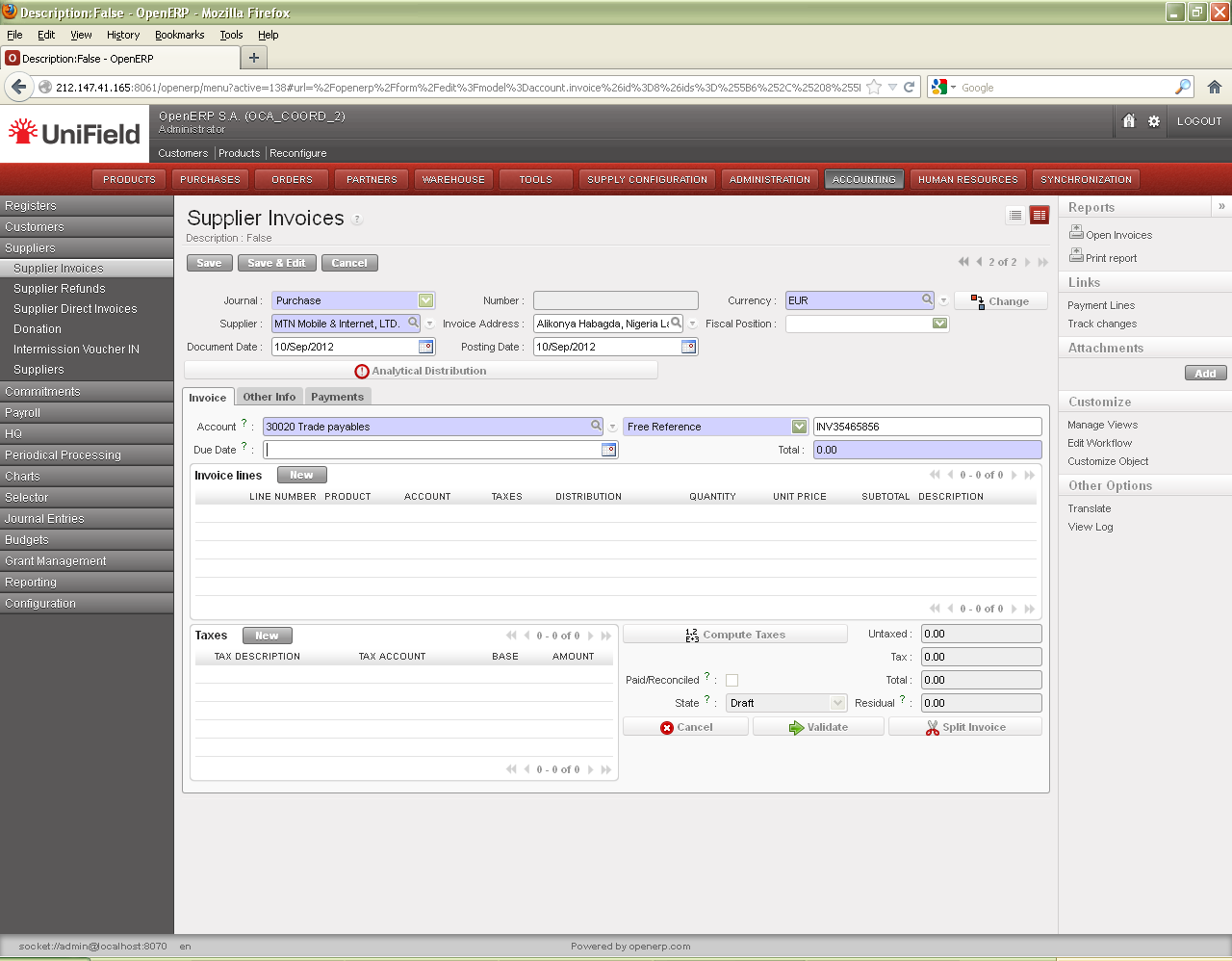
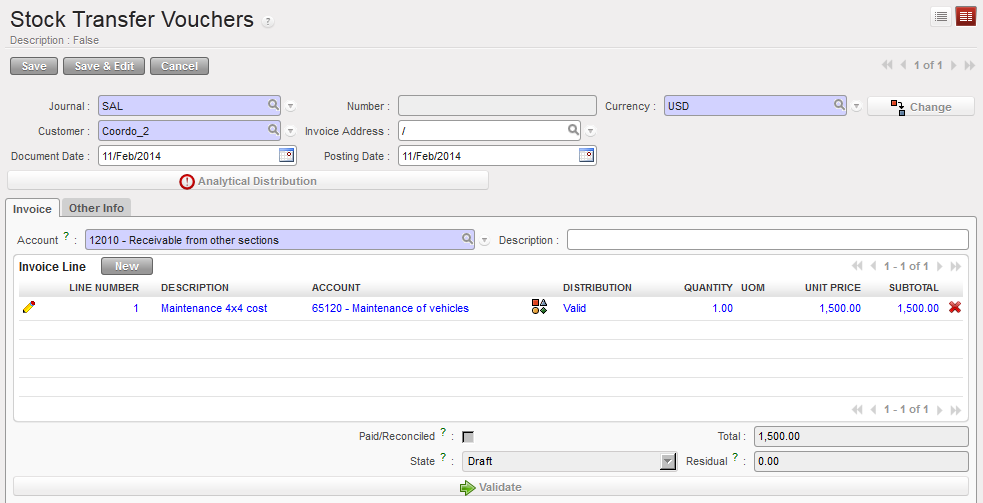
⮡ A form displays to create a new voucher. Fields in blue are required; white fields are optional; grey fields are view only.
Manual stock transfer voucher creation
, is used to apply a global analytic distribution across all lines in the invoice.
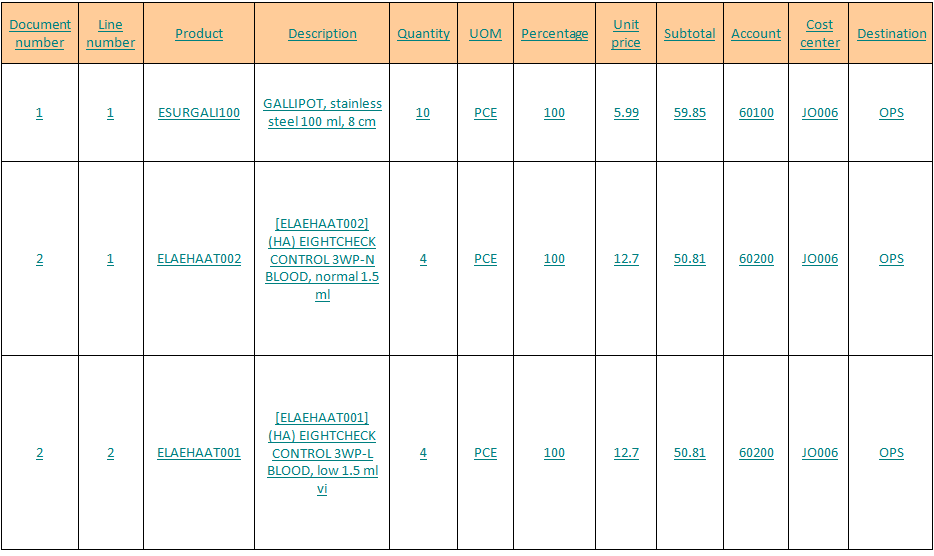
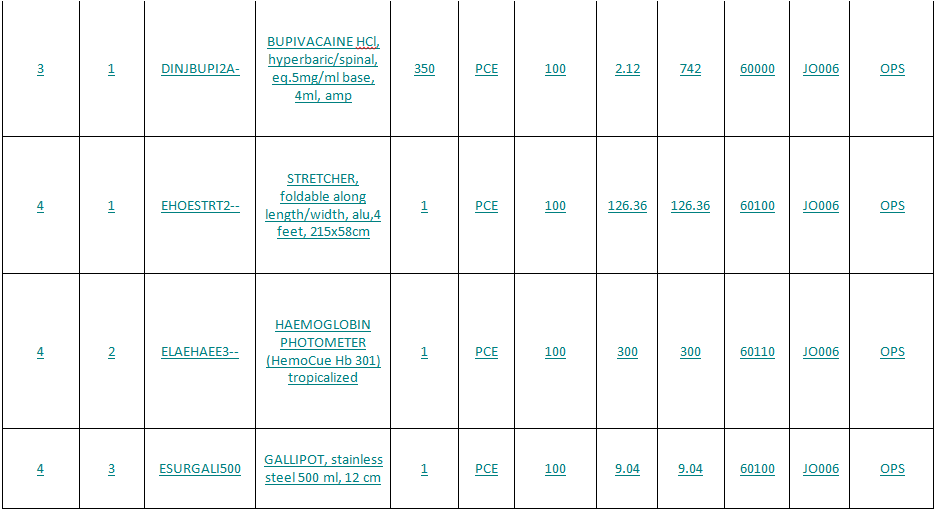
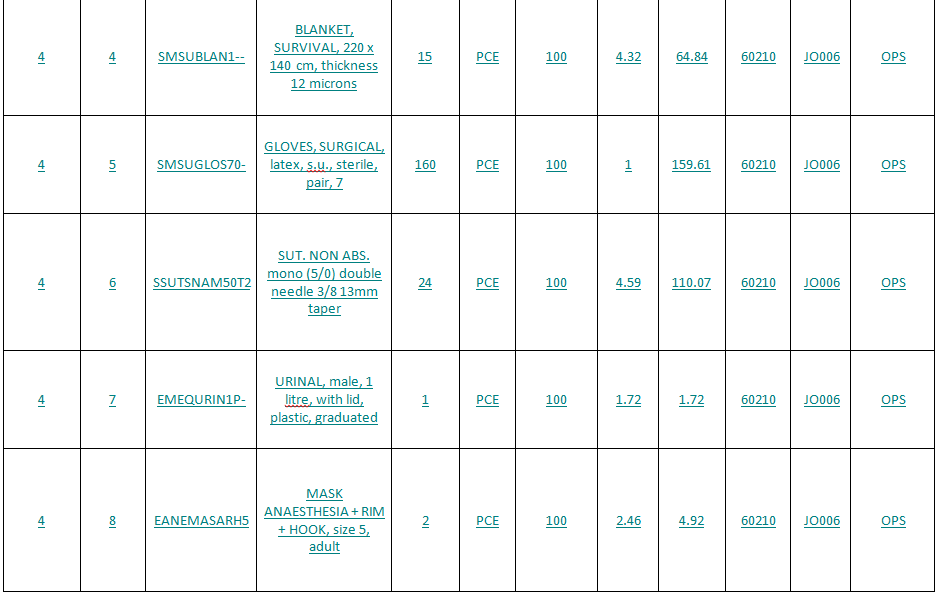
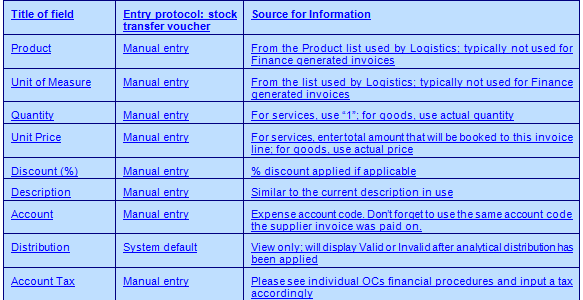
2. On the {Invoice} tab, you complete additional fields and add invoice lines to represent the various goods or services on the invoice to be paid.
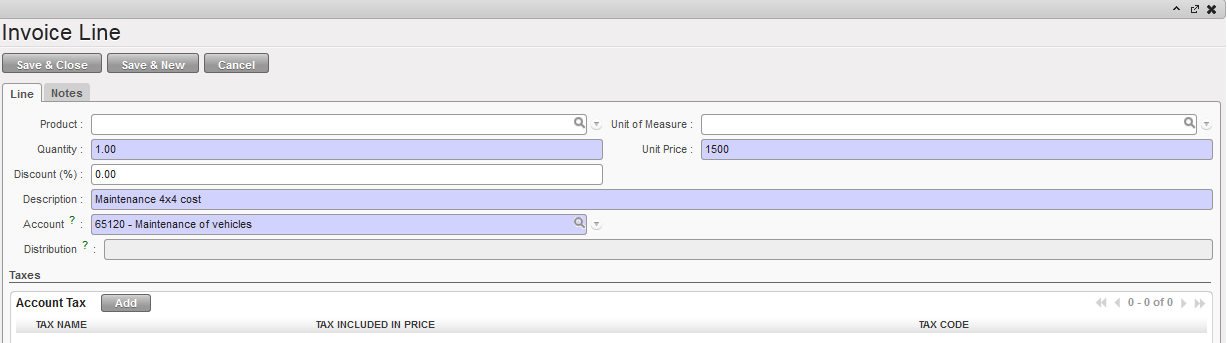
3. In the {Invoice Lines} section, click {New} to create a new invoice line.
{Invoice Line} window to add line items on a manually created Supplier Invoice.
4. Click {Save & New} button for additional invoice lines, or click {Save & Close} button to return back to the supplier invoice window.
5. Assign the analytical distribution per line or globally across all invoice lines. Don’t forget to use the same analytical distribution as when the supplier invoice was validated.
Valid analytical distribution on invoice line
6. In the tab {Other info}, complete the {Due Date}. The {Journal Entry} is linked to the accounting entry booked in the sales journal once the voucher is validated. {Responsible} identifies the user who validated the voucher. The other fields are automatically completed if they were recorded in the client’s form.
Validated stock transfer voucher and {Other info} tab completed
7. Save. The invoice is created in {Draft}, waiting for validation.
Payment of a stock transfer voucher changes state to {Paid} and automatically reconciles the journal items. At this stage you can use the {Refund} option from the stock transfer voucher.
Paid stock transfer voucher
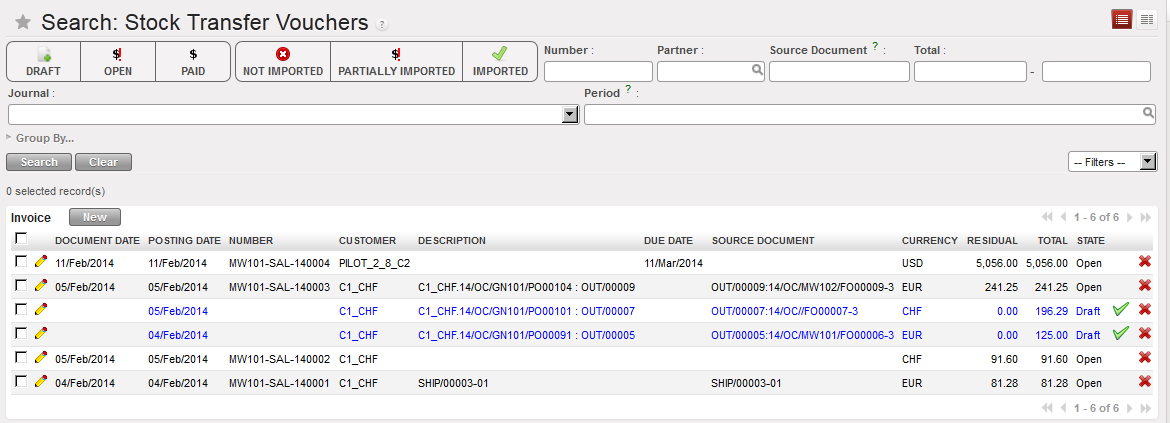
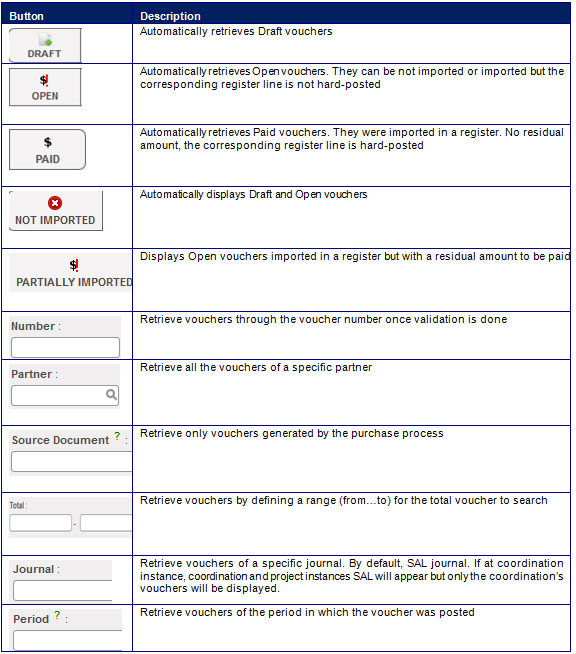
A series of filters is available in the {Stock Transfer Vouchers} Search view to help you retrieve a voucher.
Search Stock Transfer Vouchers view
How to Edit a Stock Transfer Voucher
Like supplier invoices, you can edit a stock transfer voucher if the state is {Draft}
Go to: Accounting/ Customers/Stock Transfer Vouchers
Search for the Draft voucher by selecting the {Draft} filter or any other filters located at the top of the Search view.
When you have located the voucher, click on the pencil to open the form.
In the {Stock transfer voucher} form view, change the relevant fields.
Click the {save} button.
⮡ The voucher is edited
How to Delete a Stock Transfer Voucher
Like supplier invoices, you can delete a stock transfer voucher if the state is {Draft}
Go to: Accounting/ Customers/Stock Transfer Vouchers
Search for the Draft voucher by selecting the {Draft} filter or any other filter located on top of the Search view.
When you have located the voucher, click on the red cross
⮡ The invoice is deleted
How to Validate a Stock Transfer Voucher
Like supplier invoices, validating a stock transfer voucher will create accounting moves in the journals.
Go to Accounting /Customers/Stock Transfer Vouchers
Search for the Draft voucher by selecting the {Draft} filter or any other filters located at the top of the Search view.
When you have located the voucher, click on the pencil to open the form.
Change the relevant fields if necessary. You should carefully review the accounts, destinations, cost centers and funding pools assigned to each product on the voucher invoice. Remember that accounts and analytical distribution must be identical to the supplier invoice you have paid.
Validate it.
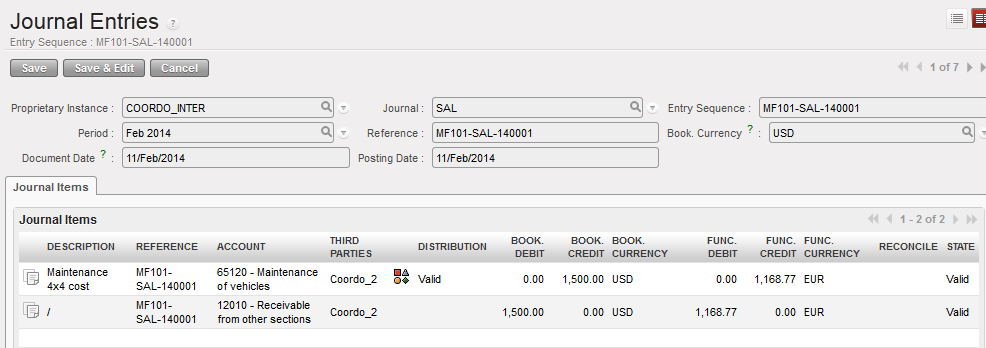
⮡ The voucher state becomes {Open}. Validation of the voucher also automatically creates a receivables entry in the {Sale Journal}
Open stock transfer voucher
Posted journal items when a stock transfer voucher is validated
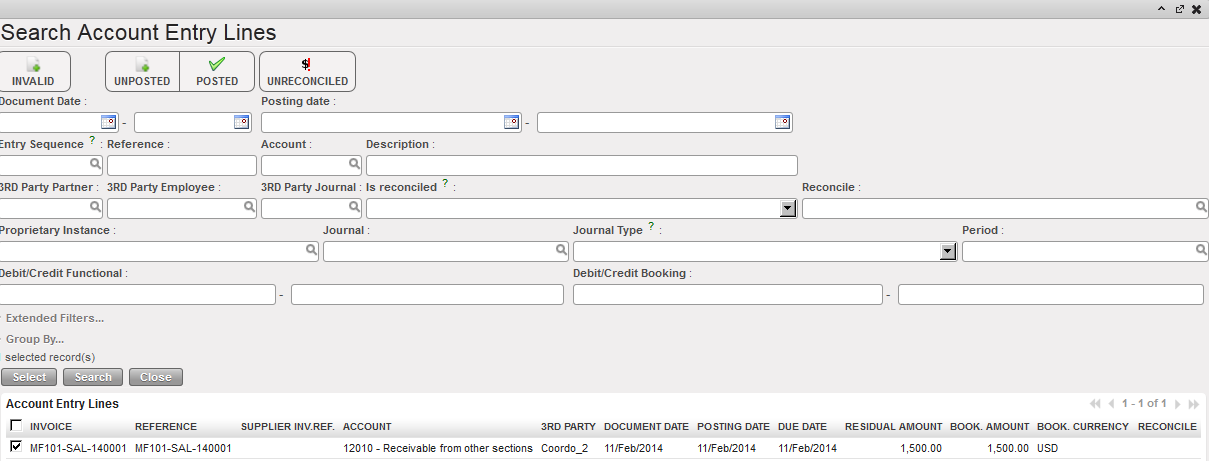
When you will receive the payment of this voucher, you will need to import the voucher in the registers.
{Search Account Entry Lines} window when importing a stock transfer voucher in a register
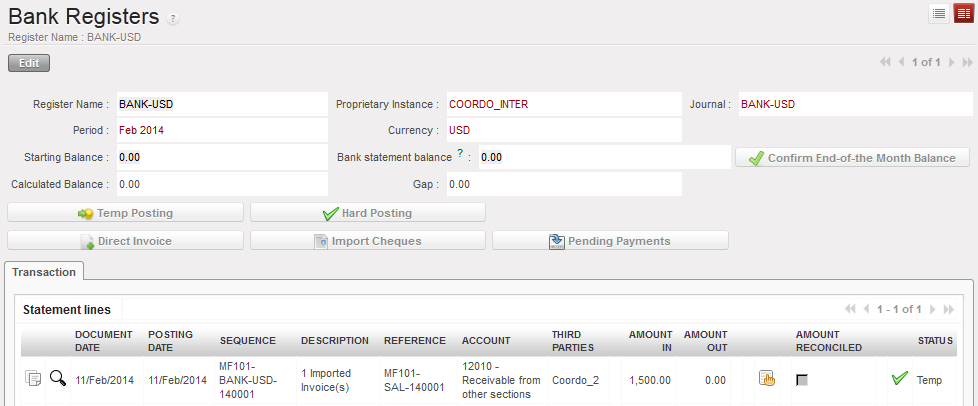
Tries will be reflected in the register in {Temp} state.
Temp-posted register line corresponding to the stock transfer voucher import in the register
You need to hard-post this entry to create accounting lines in the journals.
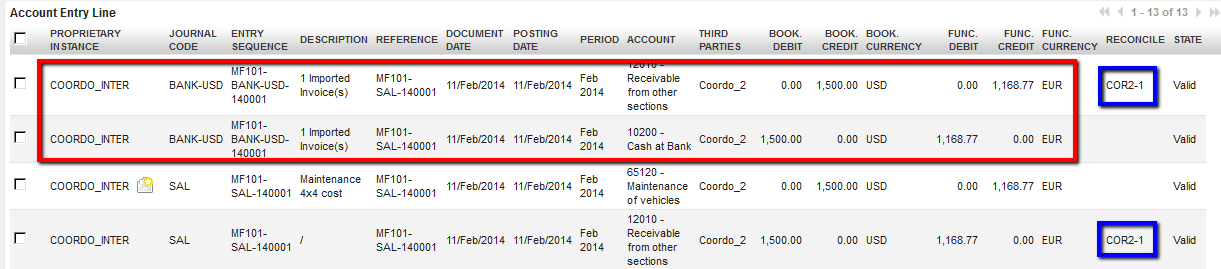
In the journals you will view the following accounting moves:
Payment of the voucher,
12010 – Receivable from other sections reconciled
Journal entries of a paid stock transfer voucher in cash
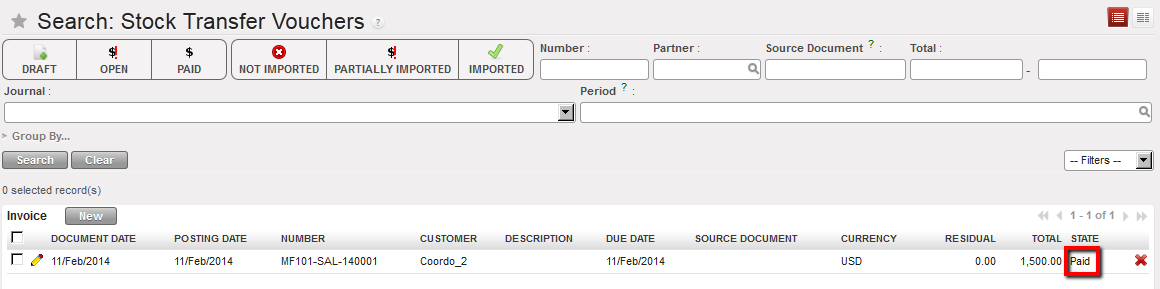
3. The stock transfer voucher becomes {Paid}
Stock Transfer Voucher Search view displaying a Paid voucher
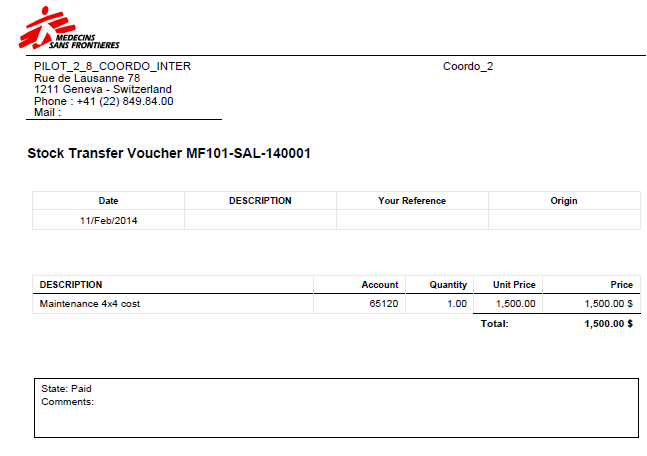
TIP: To print a stock transfer voucher, go the {Stock Transfer Vouchers} Search view and check the box of the voucher you want to print. Then on the right side of the screen, in the section {Reports}, select {Print report}. A PDF report will display the voucher details. The columns {Description} and {Origin} will be completed if the voucher was triggered by the validation of an incoming shipment OUT (thus generated by a FO).
Stock Transfer Voucher report display
On the other side, a supplier invoice will have to be created manually with the same information than the Stock transfer voucher. The counterpart accounting code will be {30010 – Payable to other sections}.
How to cancel Stock Transfer voucher and IVO
You can always cancel the draft STV or IVO if they are still in draft (remember that the Draft STV and IVO do not sync).
Go to Accounting /Customers/Stock Transfer Vouchers or IVO
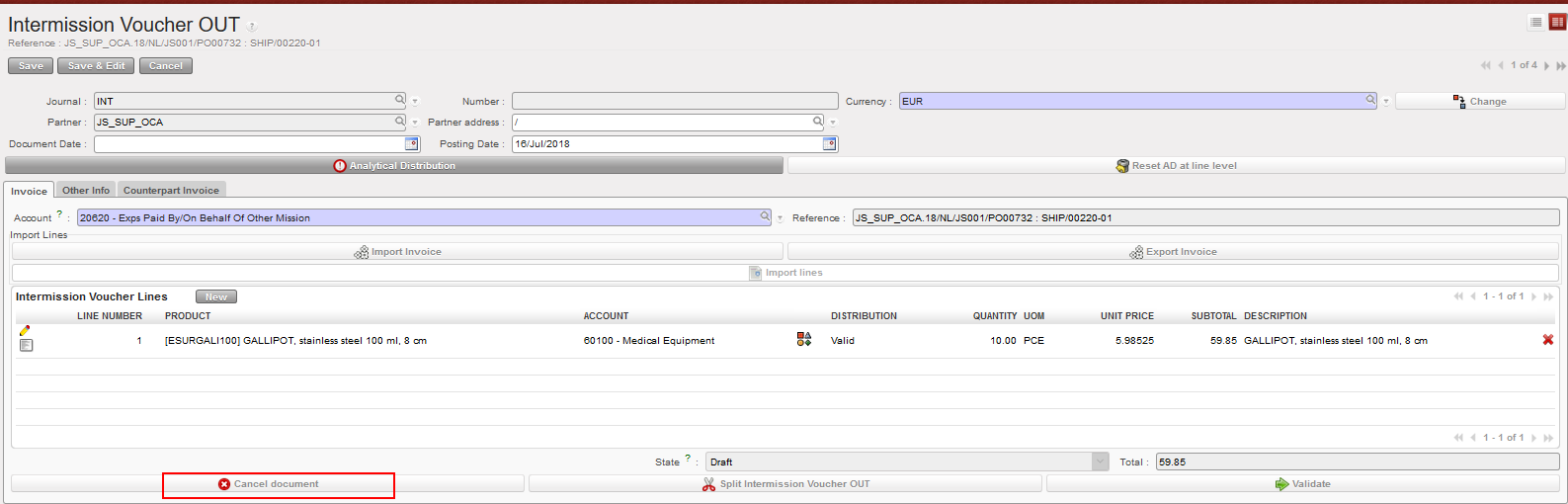
In the STV or IVO you want to cancel, click on the {Cancel) button.
Draft IVO to cancel (same thing is applicable for draft STV)
If the draft IVO or STV were cancelled, they won’t be synchronized to the other counterpart intermission / intersectional instance and no more further actions will be possible on that object (no duplicate, no validate, no refund).
How to extract STV’s invoice Excel Export :
You will be able to have a new excel file called “Invoice Excel Export” from the STV in order to follow the flow.
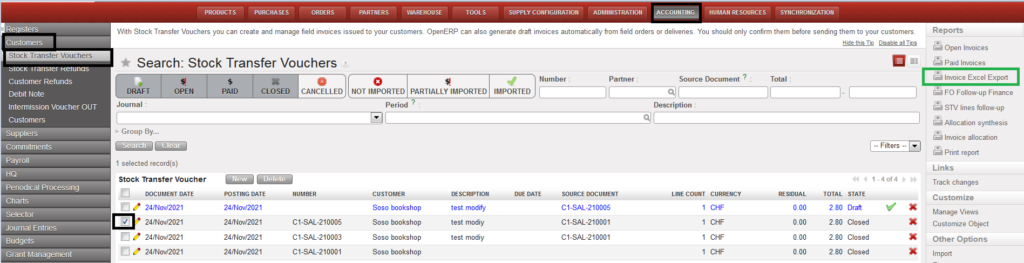
Go to: Accounting > Customers > Stock Transfer Vouchers > select STV line > go to the right menu “Reports” and you will find the “Invoice Excel Export” report.
How to extract STV’s invoice Excel Export
How to add a legal entity names in the STV PDF print out form:
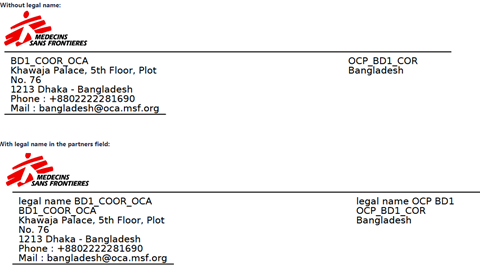
In Accounting> customers> STV and then in the first tab “invoice”, we are talking about the report pdf named “print invoice” only related to the STV (intersection flow)that we can find in the actions right menu. The field legal name is placed below the field “Name”.
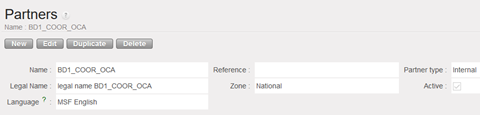
To have the legal name in this document, it is important to fill the Legal Name in the partners form under the Name.
(Note: when we create an instance, the instance must also be created as an internal partner).
It has been decided that the legal name will appear in the PDF document for all partner types (because there are still intersection instances that are not using UniField).
If the legal entity name is not available in the partner’s form, it will be empty, the second line is the Name and this remains the same.
Legal name in the print out of STV
New filter button named “OPEN FY” on STV/IVO/ISI/IVI:
We have added a filter button named “OPEN FY” on STV/IVO/IVI/ISI screens.
Display of new button “OPEN FY”
The Fiscal year to consider is the FY of the posting date.
The following statuses are considered as NOT open: draft, mission closed and HQ closed.
This filter button “OPEN FY” is toggled on by default.
When the filter button “OPEN FY” is toggled off ==> all objects are displayed.
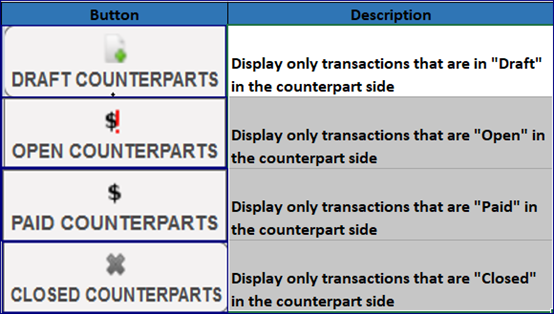
There are four buttons to show the states of the counterparts for the following transactions:
In UniField, it is possible to synchronize data manually or automatically. An automatic daily synchronization can be configured by the IT staff. If your section chooses a manual synchronization, someone in each instance should be responsible to launch it on a regular basis. Only this user will have access to the synchronization business application.
How to Synchronize Manually
Go to Synchronization/Synchronization/Manual
Select {Start all synchronization in the background}
Partners are third parties which MSF is doing business with. UniField transactions with third parties must be recorded as Payables or Receivables which recognizes a debt or a receivable.
UniField introduces different partnership types. They are:
Internal: entities belonging to the same mission. They could be suppliers, customers or both (e.g. a coordination purchasing for a project, they both belong to the same mission).
Inter-mission: entities belonging to the same section but different missions. They could be suppliers, customers or both (e.g. a coordination in Bunia purchasing for a coordination in Nairobi They both belong to Operational Center Geneva OCG).
Inter-section: entities belonging to different sections. They could be suppliers, customers or both, (e.g. OCA coordination in Chad providing tents to OCG coordination in Chad).
External: entities not related to MSF. They could be suppliers, customers or both (e.g. a landlord providing office space to MSF, or an office supply company providing pens to a project, or OCA receiving mosquito nets from UNICEF).
ESC: European Supply Centers such as MSF Logistic and MSF Supply which are used by various sections to purchase goods internationally.
Which users (supply, finance or both) create suppliers will vary per section. Please seek guidance from your mission’s financial procedures.
Suppliers and Customers can be set-up in the {Partners} supply business application or in the {Accounting} business application. This depends on the level of access rights the user has. As supply and finance share the same database, a supplier created through the {Accounting} business application will be visible in the {Partners} business application and vice versa.
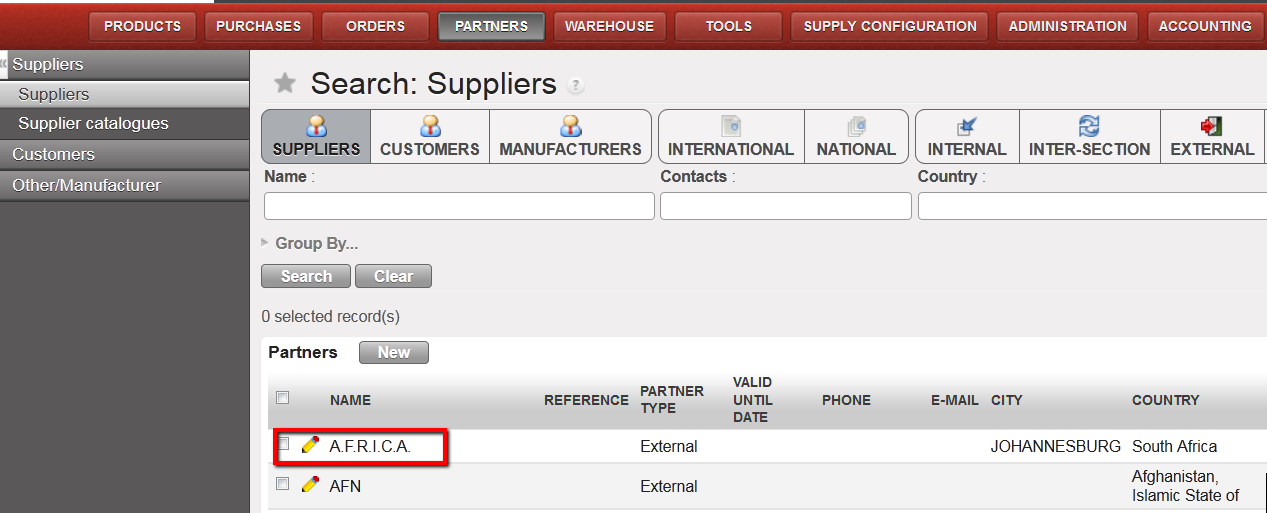
Supplier A.F.R.I.C.A. visible in the PARTNERS business application
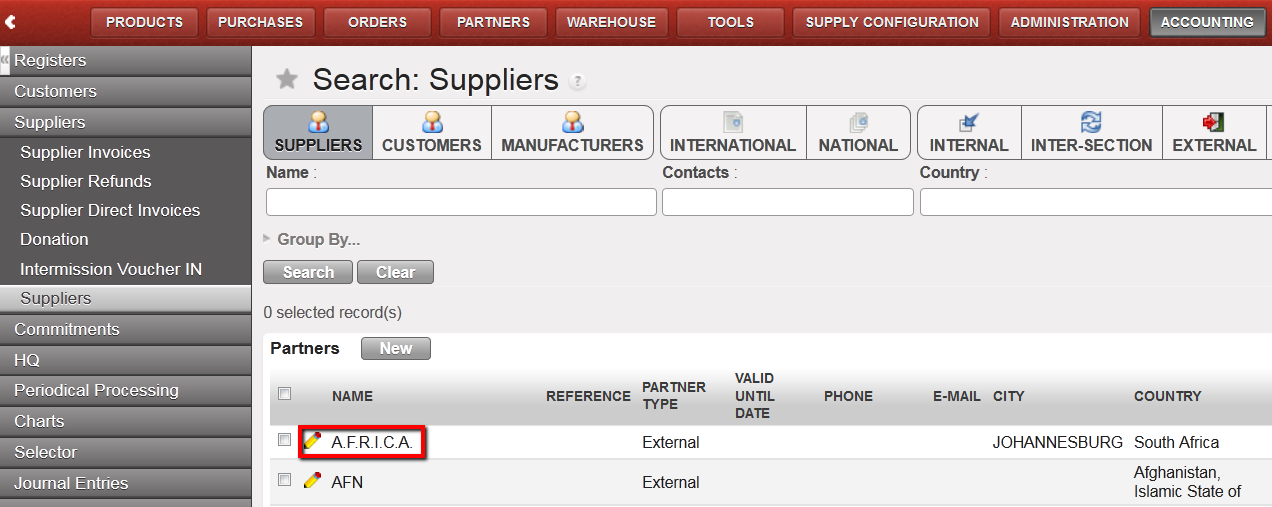
Supplier A.F.R.I.C.A. visible in the ACCOUNTING business application
If you create a supplier (or customer) which already exists in the database with the same name and city, you will get a warning message and be blocked in the process. This is to avoid duplicated (external) partner.
If you are creating a partner for the same company but for a different location with separate billing, then add the location to the partner name (e.g., Local market Addis Abeba vs. Local market Abdurafi).
Please note that all external partners created in one instance will synch bi-directionally as inactive within the mission. If one partner is used by several instances within a mission, it will have to be created only once in one instance and then synchronized as active to the other instances so the partner will be the same in all the instances.
Please keep in mind that the type of partners (and orders) impacts the generation of specific financial documents. Therefore the right partner type must be chosen when a partner form is created.
Accounting on suppliers (Accounts Payables or A/P) reflects what an instance owes to suppliers for products and services purchased, while accounting for customers (Accounts Receivables or A/R) is the money to be received for products and services provided by an instance.
In UniField, each partner need to be linked to financial accounts in the {Accounting} tab of the Supplier/Customer form, one for the account receivable and one for the account payable. Therefore, the documents generated linked with the supplier will use one of these accounting codes, depending if this is an amount to pay (accounts payable, i.e. supplier invoice) or an amount to collect (accounts receivable, i.e. supplier refund).
OCs should define procedures to decide whether finance will need to provide this information to the supply team or if it is up to the finance to enter the accounts into supplier forms.
Some examples:
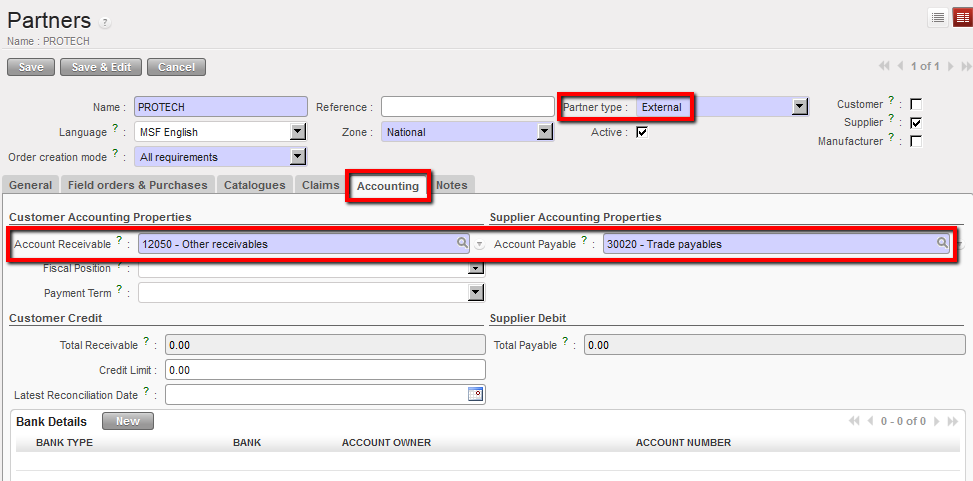
An {External} supplier of goods or service should be linked to account 30020 {Trade payables} and 12050 {Other receivables}.
A supplier {External} of goods and services and associated accounting codes
The social security is an {External} partner and should be linked to the account 30200 {Social security} and 12040 {Social security receivable}.
Social security partner (external supplier) and associated accounting codes
The tax office (to record income taxes liabilities) should be linked to the account 30310 {Payroll taxes} and 12030 {Tax receivables}.
Tax office partner (external supplier) and associated accounting codes
An {internal} supplier (coordination) should be linked to the account 30020 {Trade payables} and 12050 {Other receivables}.
Coordo_2 is both a supplier and customer type of internal partner
A/P and A/R accounts need to be assigned to partners of type {inter-section} and {inter-mission}:
Inter-section partners are associated to the accounts 12010 {Receivables from other sections} and 30010 {Payable to other sections}.
Coordination-002 is a supplier type of inter-section partner
You can also decide to associate a partner of type {inter-section} to the A/R account 12011 {Expense re-invoiced to other sections} and periodically create debit notes.
Inter-mission partners are associated by default to the accounts 14010 {Advances or expenses for other missions} and 30000 {Payable to other missions}.
Coordination-3 is a supplier type of intermission partner
When activating a partner type intermission, the system will check if the same name exists in the internal partners; if yes, the system will not allow to activate the partner (regardless of the status of the internal partner and whatever the letter case) and we will have an error message as follows:
“There is already an Internal Partner with the name ‘XE_ZZZZ_XYZ’. The Intermission Partner could not be created and activated”
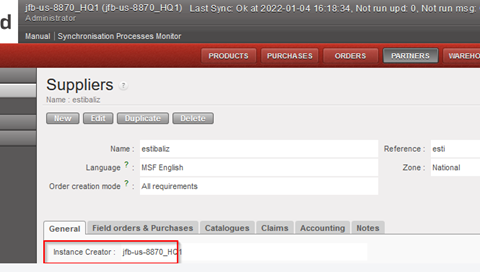
In the Suppliers/Customers form we have created a new field “Instance Creator” in the tab “General”.
We have added this field in all partners type synchronization rules.
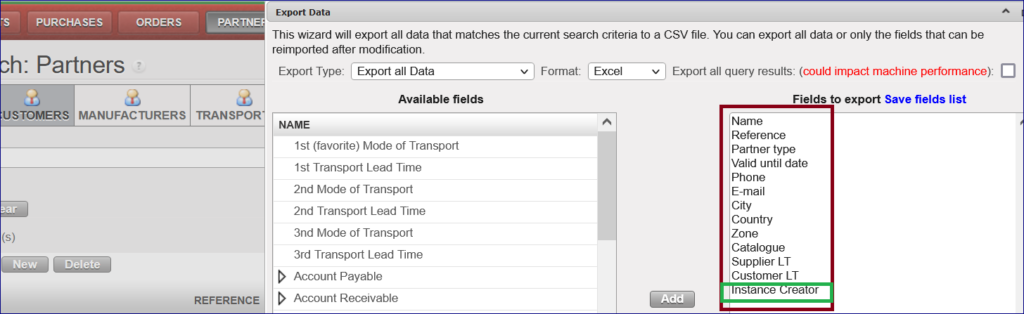
We have also added this field in the export action menu as a default field
Filter parameters through “Group By…”:
You can filter suppliers by different parameters.
Go to Partners > Click on “Group By…” > It will display below by toggling in each one of them:
Filter parameters through “Group By…”
There are four roles for a partner: Supplier, Customer , Manufacturer and Transporter .
When creating/editing a partner, it is mandatory to tick one of the roles, otherwise a warning message will pop up below:
It is possible to have two external partners with the same name but different cities within the same instance, but it is not possible to edit the external partner to have the same city for both external partners with the same name, otherwise you will get a warning popup as below:
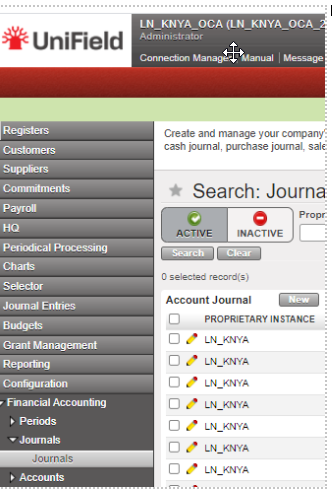
In the [Accounting/configuration/financial accounting/journals/journals] screen, we have created a filter with [active] or [inactive] status on the header of the journal list for activation and inactivation of the GL journal.
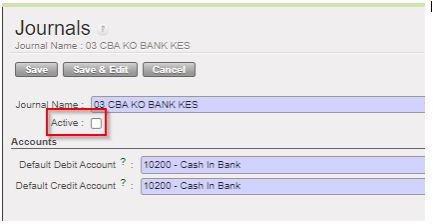
The standard display is [active]: Only active journals are displayed in the standard display screen. Registers related to inactive journals are not listed anymore on the register creation screen on [accounting/registers/register creation]. In the Journals we have the field Active:
The [inactive] journals cannot be used anymore in the interface:
as third party of an entry
to book a manual journal entry
We cannot import a file to the journal from manual journal entry, or into a register for register lines should check the active status of the journal code seen in the import.
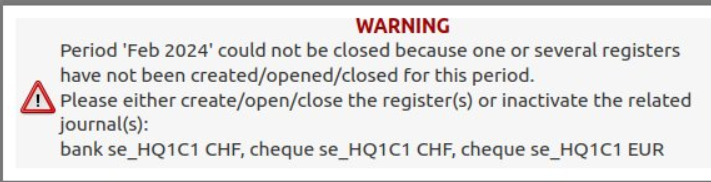
Deactivation of the liquidity journal is a must if the journal is not to be used in the future, otherwise the closing period of the following month on which the journal of the register was not created will be blocked, so you will receive warning message as below:
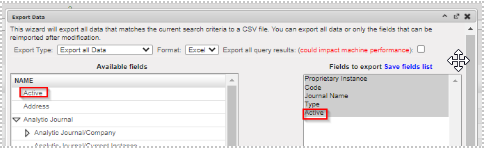
The creation of a journal with the same code as an inactive journal it is not allowed. We have added in the exportable fields the [Active] status in the export of the list of journals.
The conditions to allow the inactivation will be:
For liquidity journals, before allowing the inactivation check:
all registers have been closed
all manual journal entries have been posted
the balance of the last register is zero
We will receive error messages as the following one:
A Cheque journal correspond to the bank register must be deactivated before bank journal ,otherwise warning message with “The bank journal BXXX cannot be inactivated because the related cheque journal CHQXXX is still active “
For non-liquidity journals: all entries have been posted on the journals.
The activation-deactivation will synchronize to the other instances. We will prevent the deactivation if there are draft, or temp posted entries / documents. For the GL journals that have been deactivated, we will show the correction wizard in AJI and JI. We have added the field “Active” in the Journal Track Changes. We will not allow:
The selection of inactive journals in the invoices
The duplication of JE and invoices on inactive journals
The re-opening of a register on an inactive journal
The selection of inactive journals in the Recurring Models
The inactivation of a journal if a Recurring Plan which isn’t “Done” uses it
The selection of a Recurring Model on an inactive journal, in the Recurring Plans
The duplication of a Recurring Model on an inactive journal / of a Recurring Plan using a Recurring Model on an inactive journal
The selection of an inactive Bank Journal in the Cheque Journal form
The selection of inactive journals as Refund Journal in the Refund Wizard
The Refund Type “Modify” for the invoices booked on an inactive journal
Reporting
We will not show the registers related to inactive liquidity journal in the [liquidity position report]
We will show the inactive journals in the [liquidity balances] report as far as there have been movements within the period considered in the report. So, the related line won’t be displayed on the condition that the journal is inactive, and the “Starting Balance”, the “Movements”, and the “Closing Balance” are all 0.00.
We have added a new column in the [liquidity balances] report: [Journal Status].
In the reports “Trial Balance”, “Partner Balance”, “General Ledger”, and “Partner Ledger” the inactive journals will be displayed in red.
In the Search views of the invoices, we have done a standard search view, with a filter hiding the inactive journals by default.
Inactivating analytic accounts is performed at HQ. This action prevents users from booking future entries on an account that is not in use anymore.
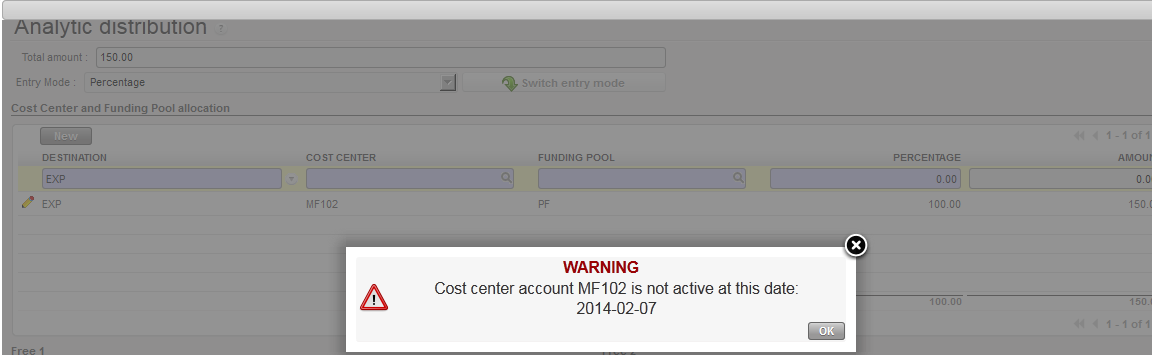
Deactivation is synchronized down to all missions and new entries for the inactivated analytic accounts are blocked. The check on Destination and Cost Center are based on Posting Date, e.g. the Posting Date of a new entry can’t be on or later than the inactivation date of the account. For Funding Pools, the check is on Document Date. If the entry’s Posting Date (Destination or CC) or Document Date (funding Pool) is outside the analytic account activation period, you will get the following error message:
System control on an inactive analytic account
Because the inactivation date can be set for a past date, it may result in not run synchronization updates if entries that have been created earlier for the now inactive accounts are modified.
B. How to Inactivate an Analytic Account
Go to: Accounting/Configuration/Analytic Accounting/Analytic Accounts
A list of active analytical accounts appears.
In the {Name} field, enter the account name you want to inactivate.
Once the account is retrieved, click on the pencil to edit the form.
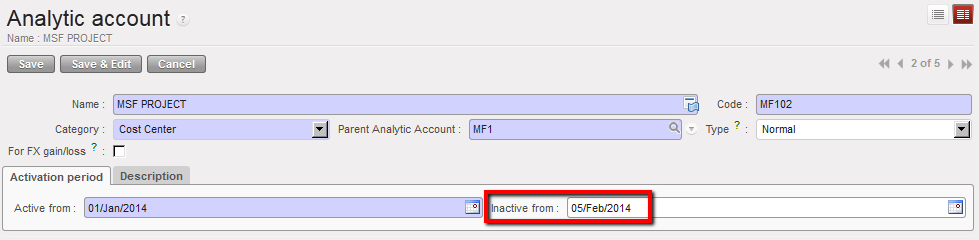
In the {Activation period} tab, go to the {Inactive from} field, enter a date to inactivate the account.
Click {Save} button.
The analytical account is inactivate
Analytic account inactivation
The validity of sub cost center must match with the parent cost center validity; in case of not matching, a warning popup will appear based on the posting date of the entry:
If the parent Cost Center is not active, you cannot create a child to this parent:
If the sub-cost center validity date is greater than the parent cost center validity date, you will be blocked.
If the sub-cost center validity date is greater than the parent cost center validity date and also if the sub-cost center activation date is lower than the parent cost center activation date, we will see a warning popup as below:
We use cookies to ensure that we give you the best experience on our website. If you continue to use this site we will assume that you are happy with it.


 Cashbox view where the physical cash balance is reported and the location of Cash Reconciliation button
 Field used to report {Unrecorded Advances} in the cashbox
 Use pencil icon to edit denomination lines
  Enter cash count quantities
  ) each denomination line. Click {Save} at the top of the register form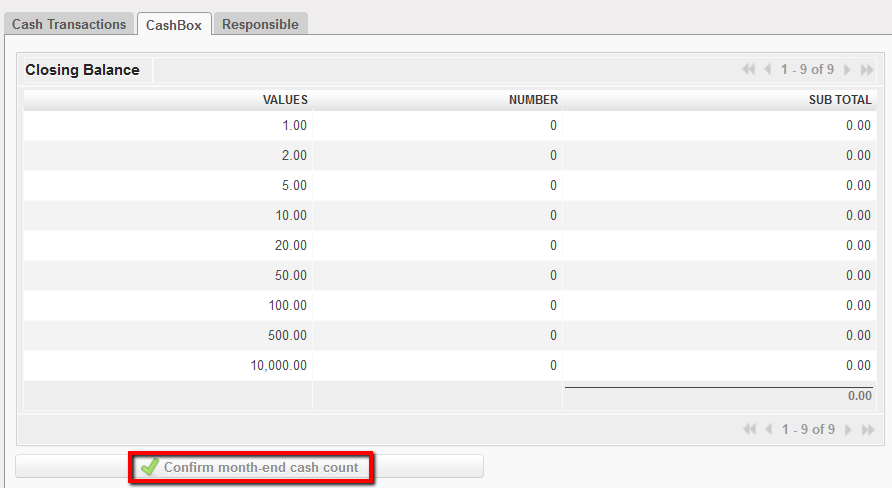





 Cash Reconciliation Report Action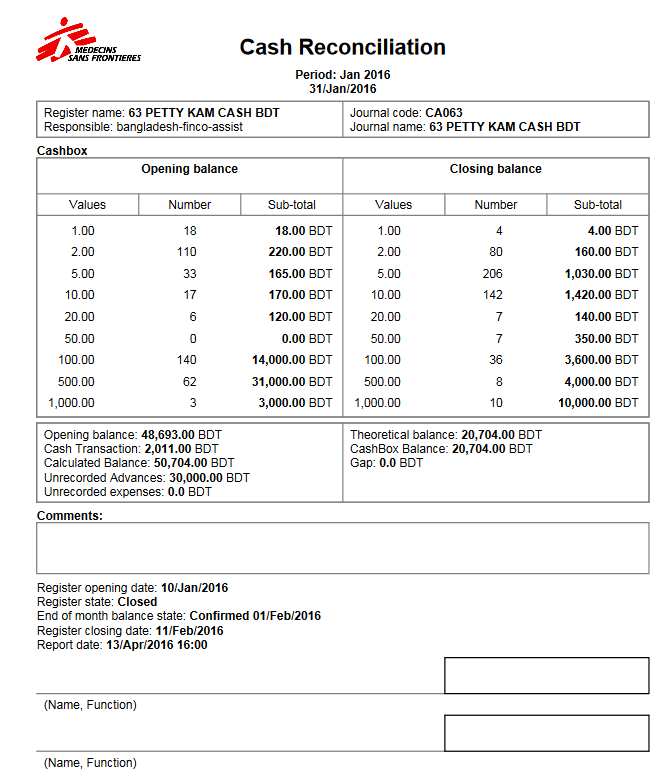




 Cheque inventory report action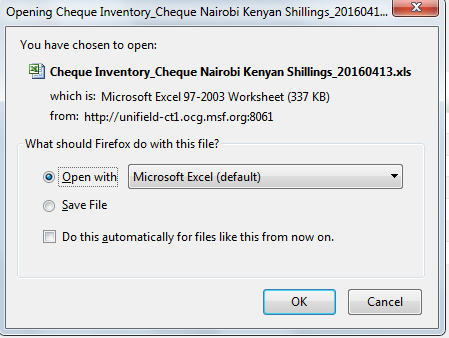

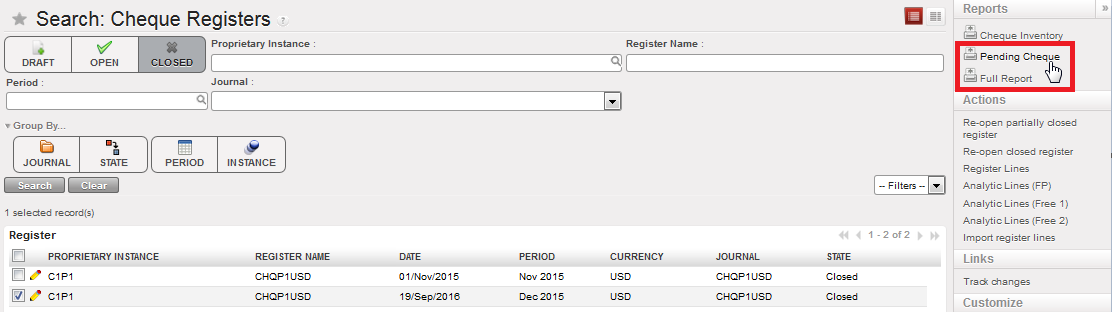 Pending Cheque report action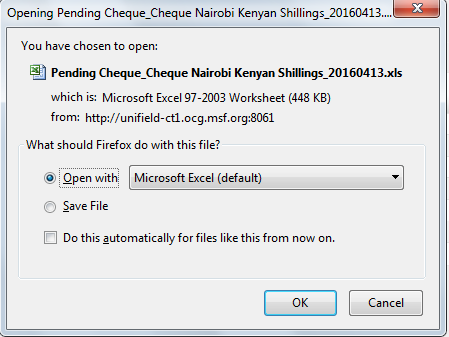

 and the calculated balance as well as the Gap field is updated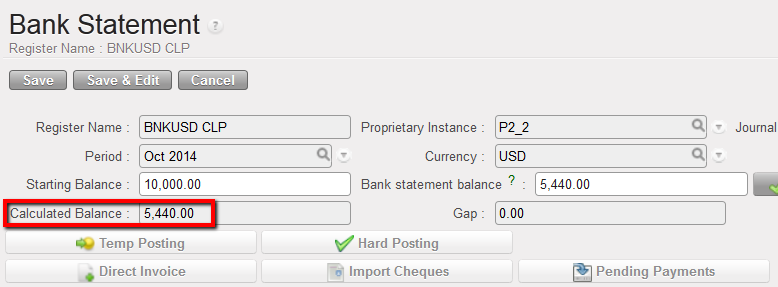

 Bank reconciliation action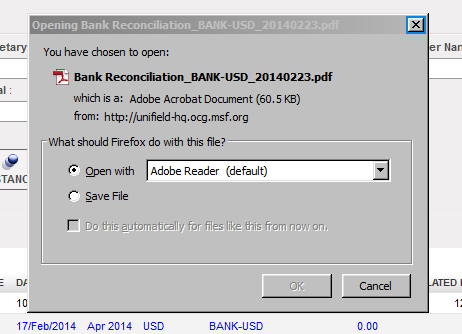
 Selecting Liquidity position report when the report menu is expanded
 Selecting Full Report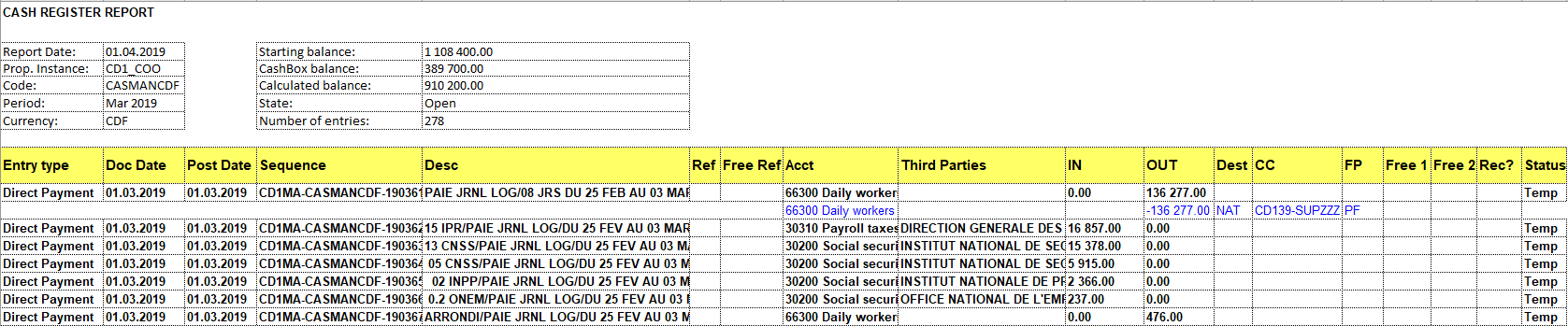



 List of draft HQ entries displayed in the {HQ Entries List} Search view
 {Validation} action
 {HQ Entries Validation} wizard
 Validated HQ entries displayed in {Journal Items} Search view
 Validated HQ entries displayed in {Analytic Journal Items} Search view
 Corrections History viewed from the Analytic Journal Items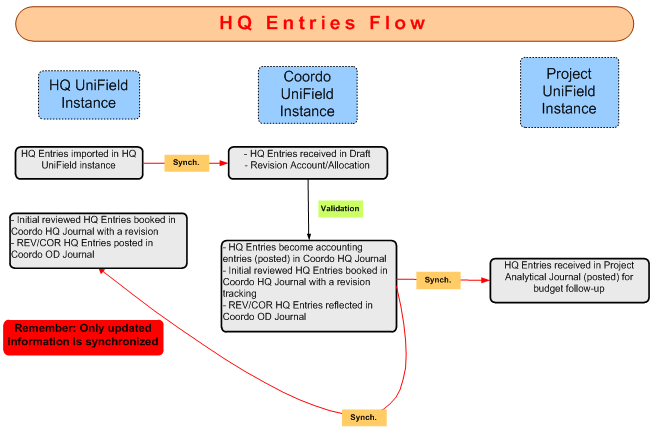




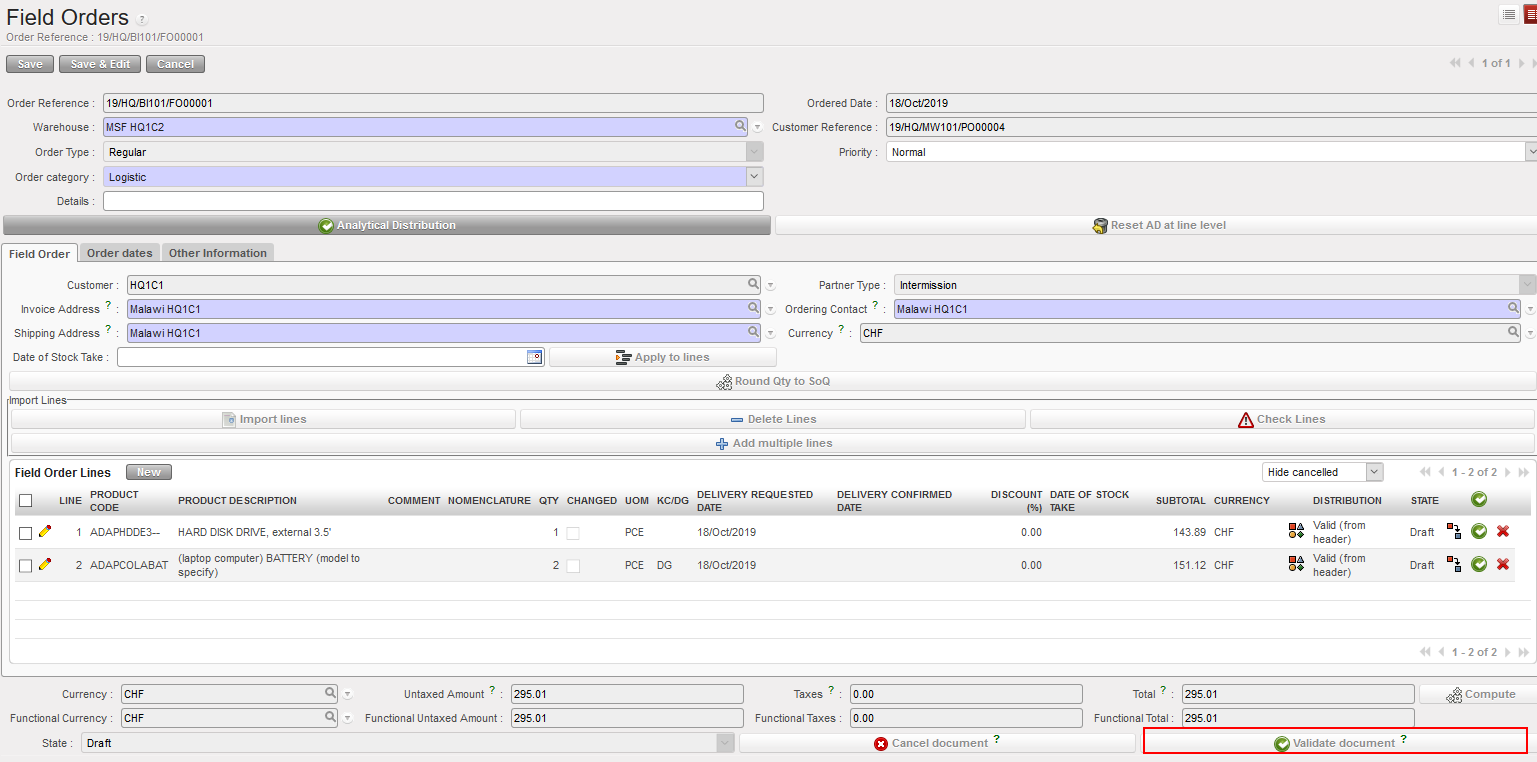 4. Go to Orders Sourcing tool to source the document (Sourcing: is choosing from where you want to order the requested items, either from the warehouse or from an external supplier) in our case here, we will choose to order the items from external supplier. Either you select the supplier on each line separately and then you click on the green arrow to source or select all and click on Source lines in the right side menu in case you want to order the items from the same supplier then save and source. (Done by a supply user not finance user)
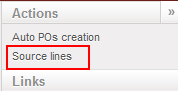



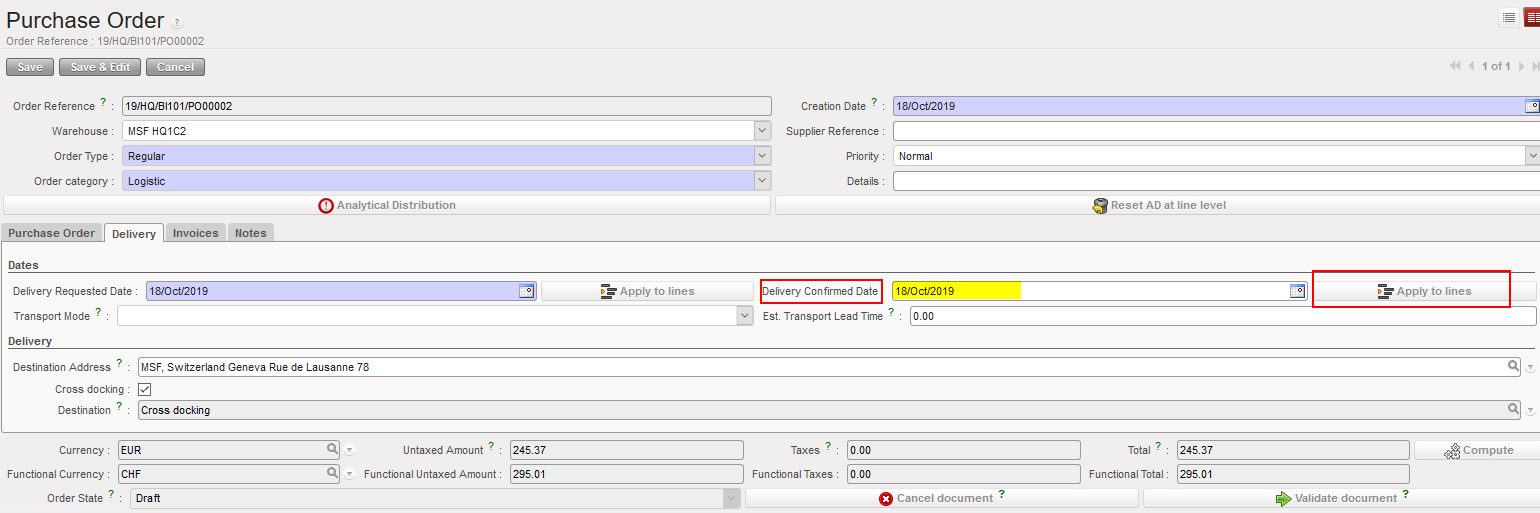
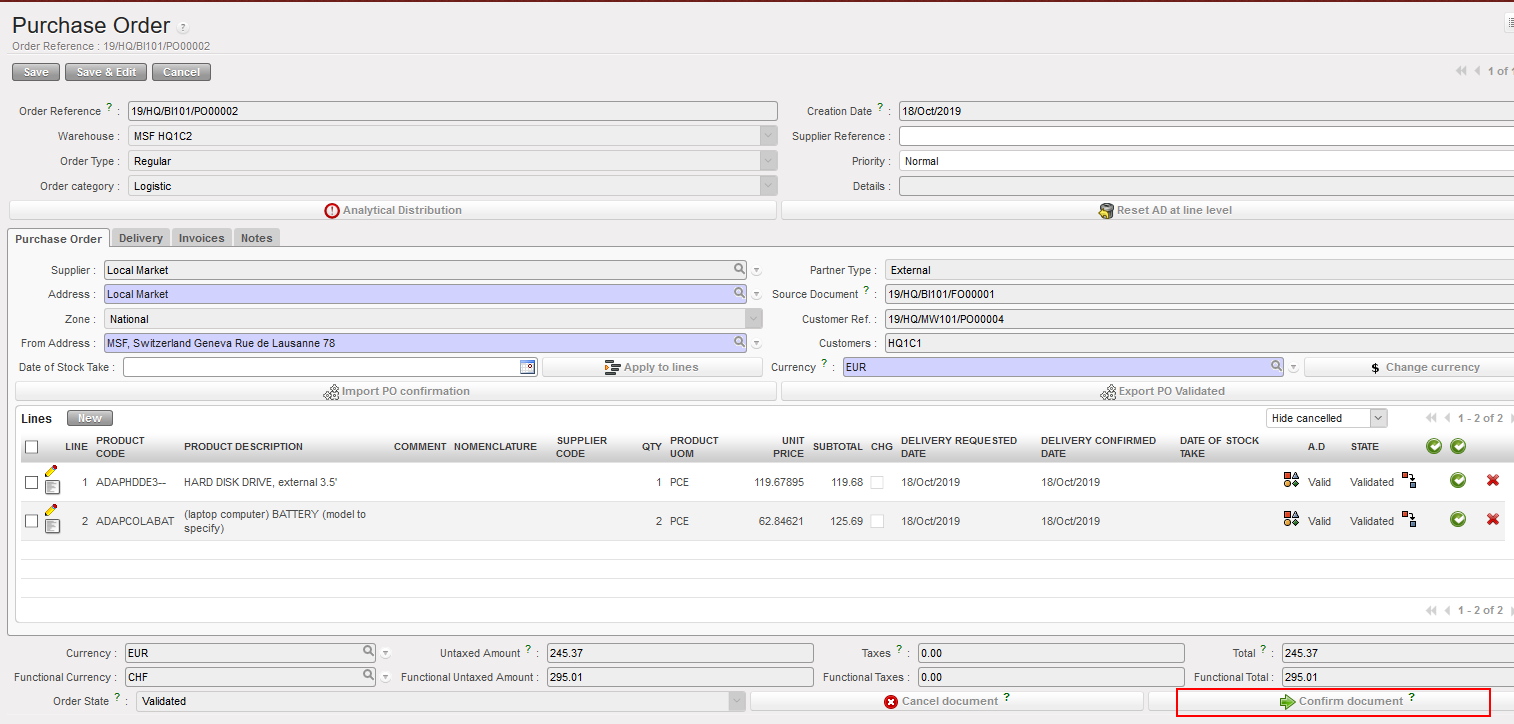
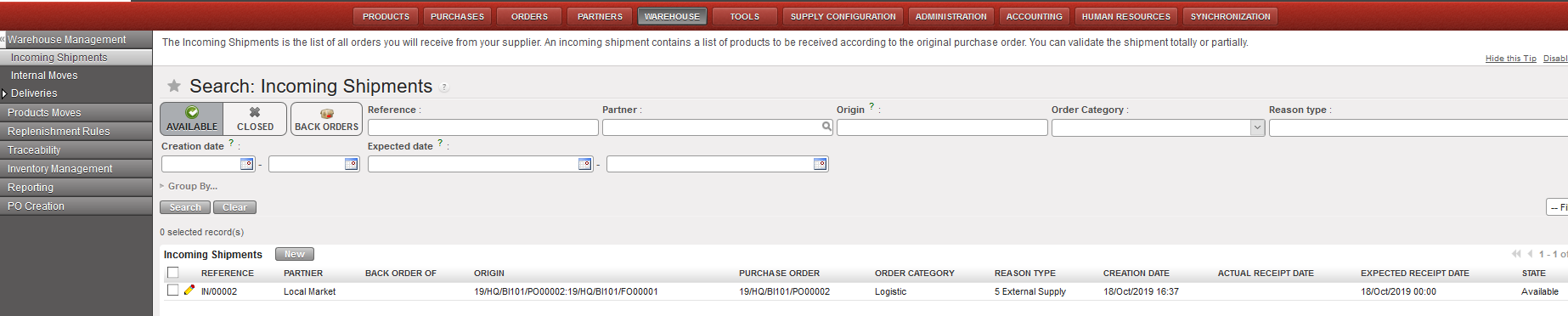
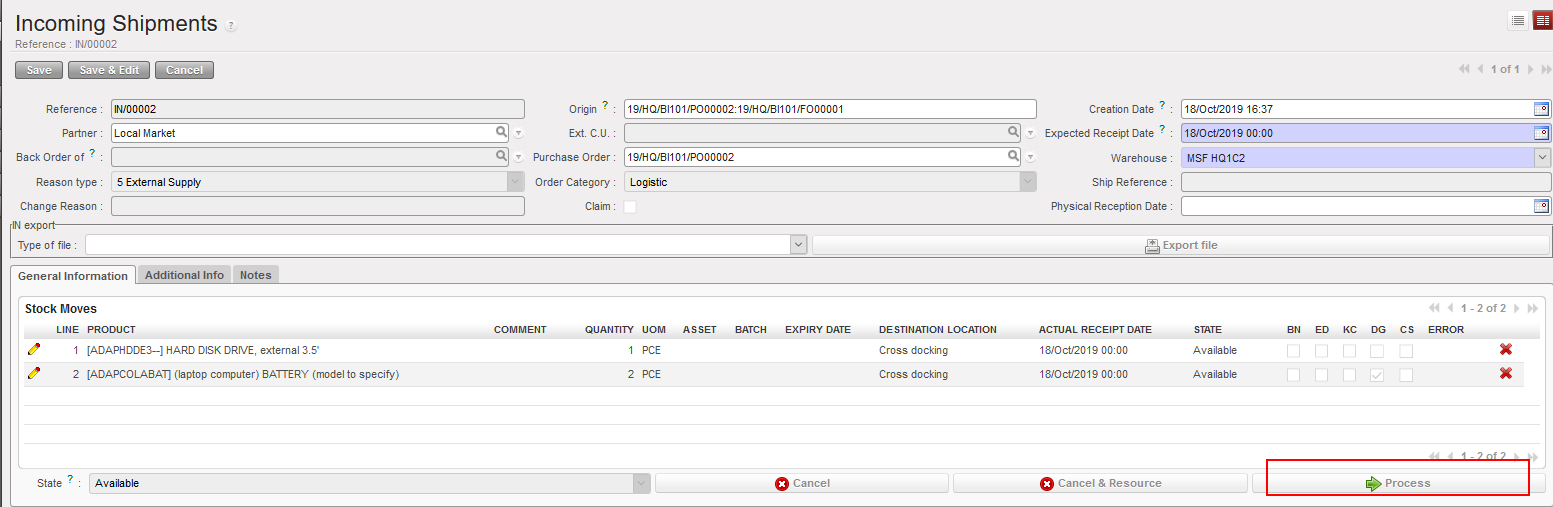
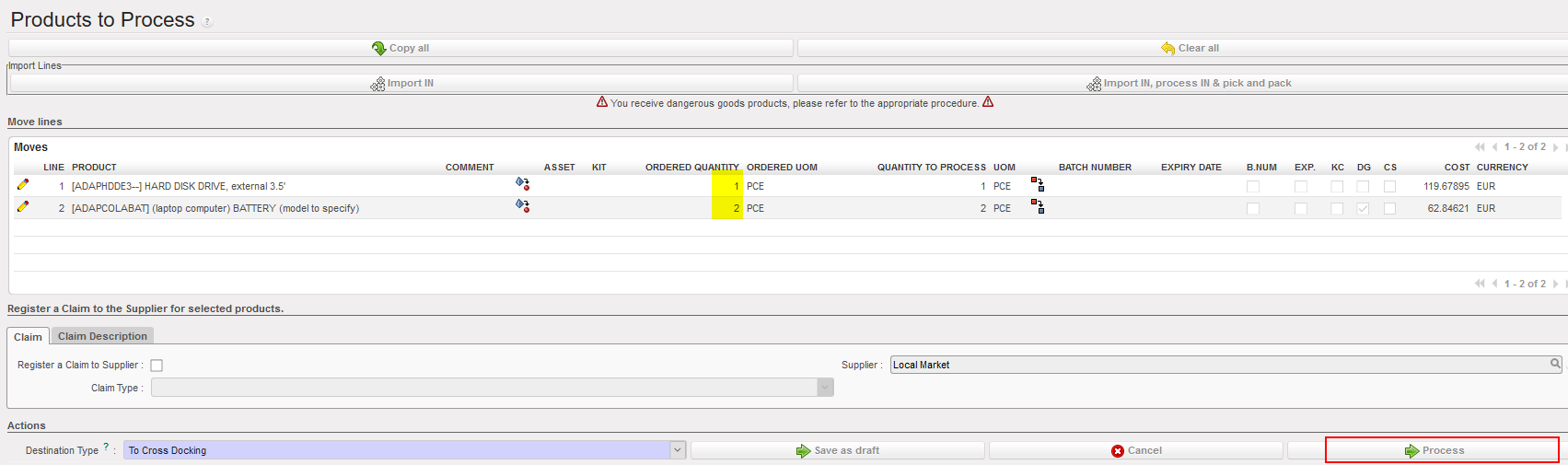 10. To do the picking of the items, go to Warehouse Management/ Deliveries/ Picking/ Convert to Simple Out/ Copy all/Process (Done by a supply user not a finance user)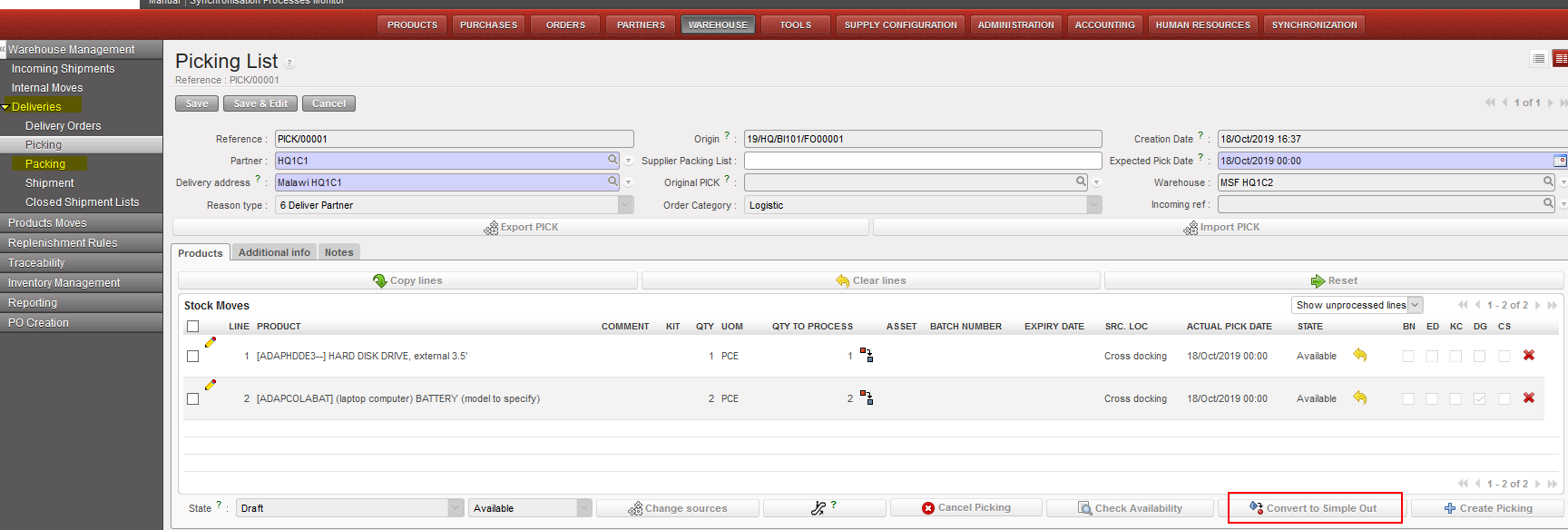



 and complete the {Description}, {Account}, {Quantity} and {Unit Price} to represent the various goods or services on the voucher to be created.
 button
 per line or globally across all invoice lines. Allocate the Cost Center to the correct Cost Center or to the purchasing instance.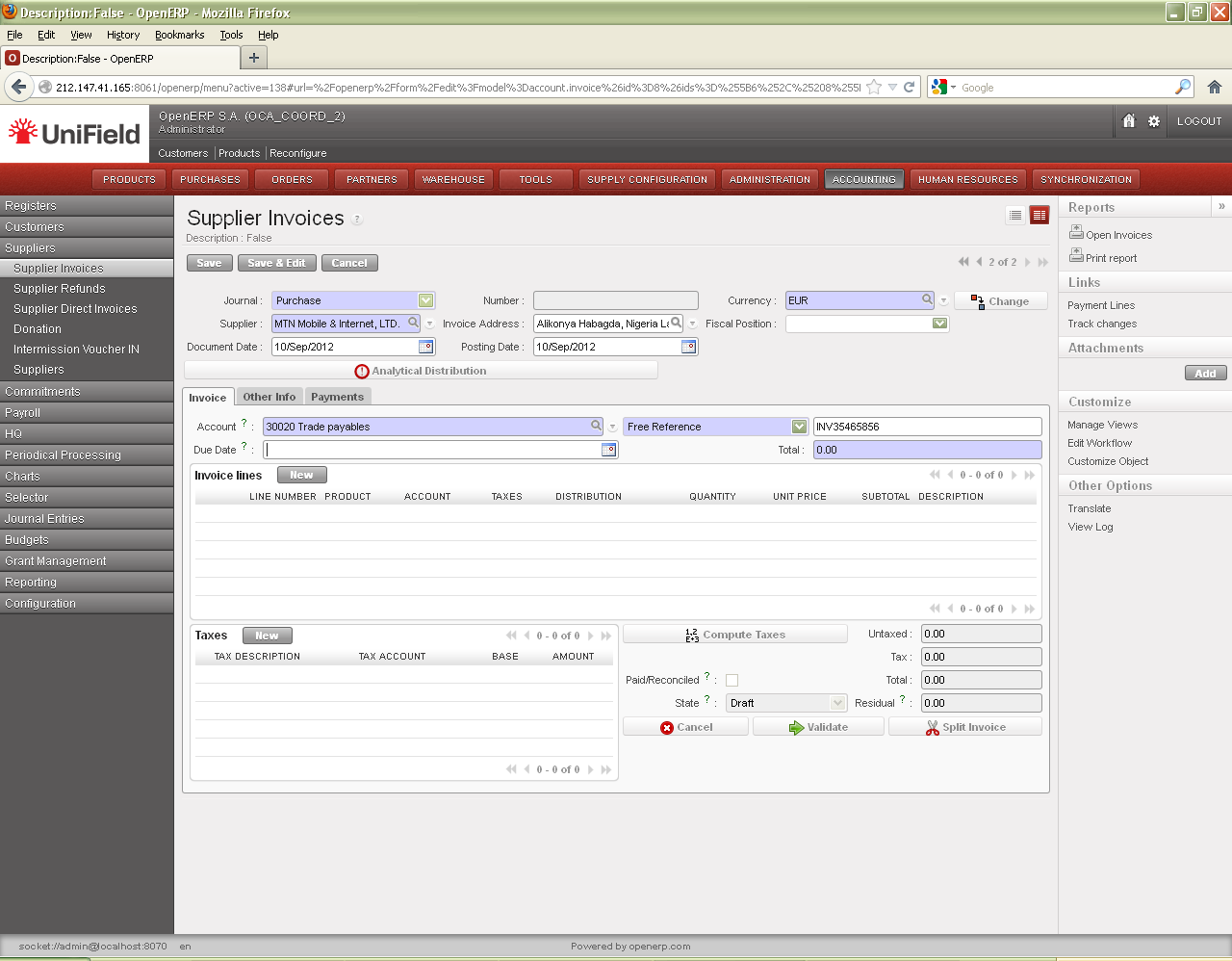









 to open the form.
 to open the form.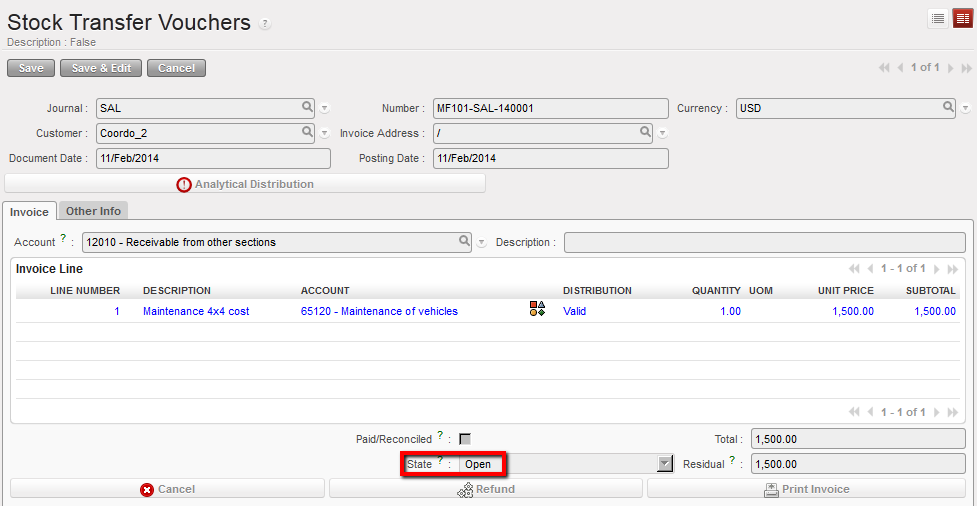



 Supplier A.F.R.I.C.A. visible in the PARTNERS business application
 Supplier A.F.R.I.C.A. visible in the ACCOUNTING business application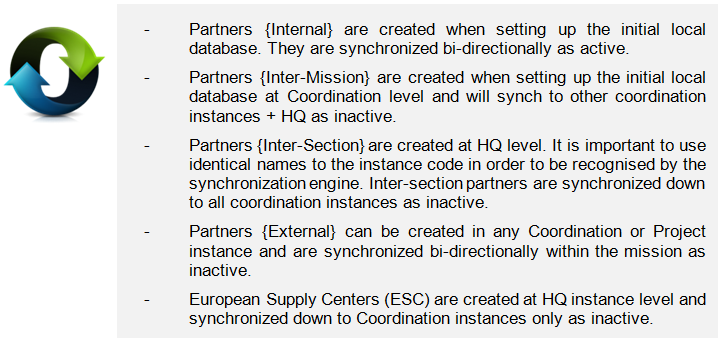
 A supplier {External} of goods and services and associated accounting codes
 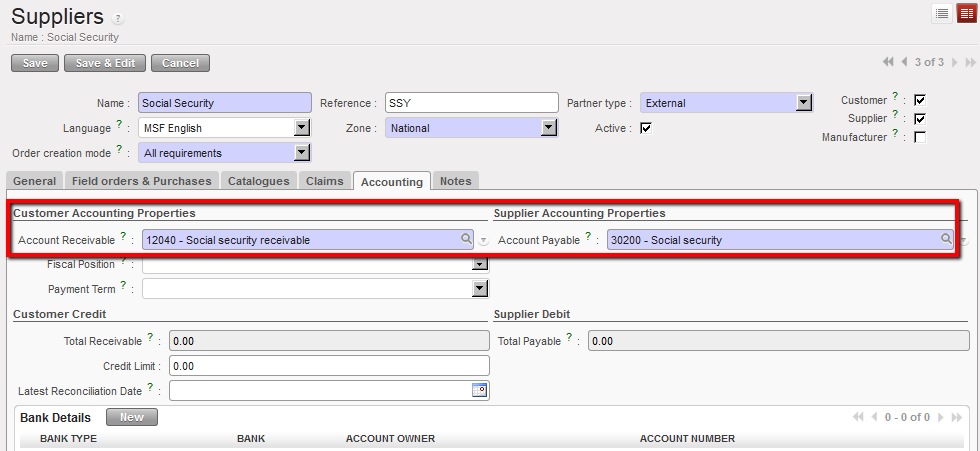 Social security partner (external supplier) and associated accounting codes
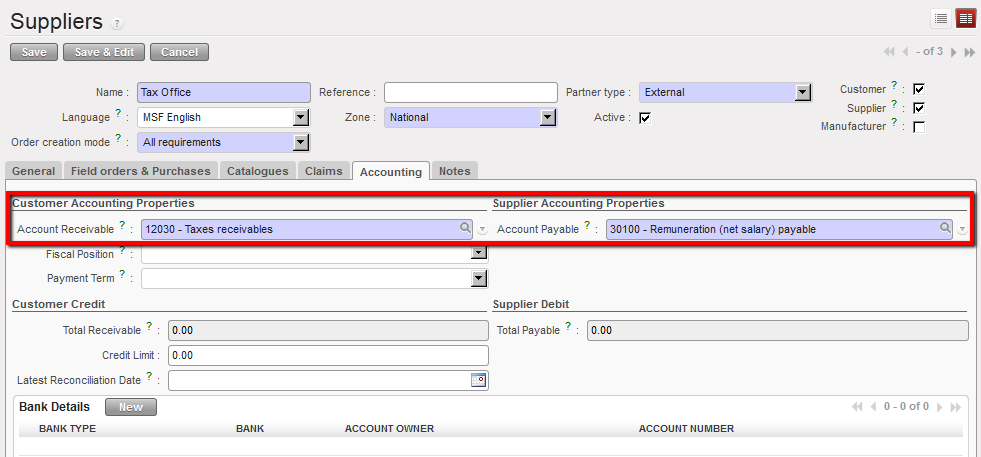 Tax office partner (external supplier) and associated accounting codes
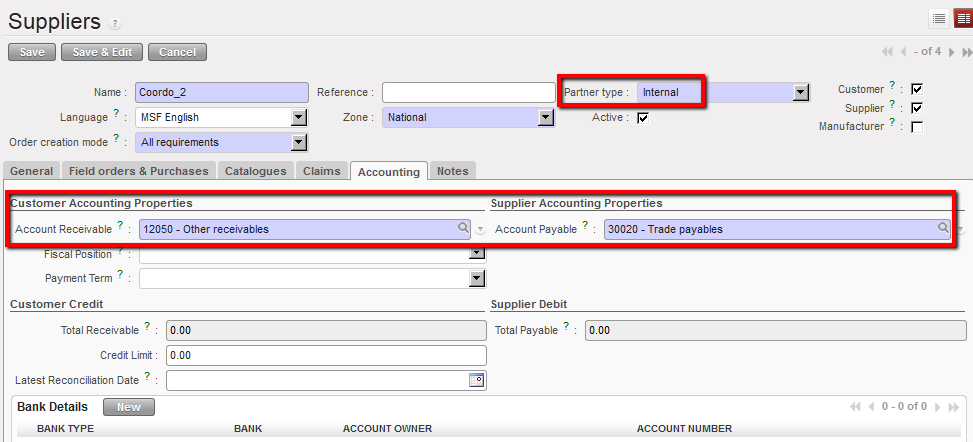 Coordo_2 is both a supplier and customer type of internal partner
 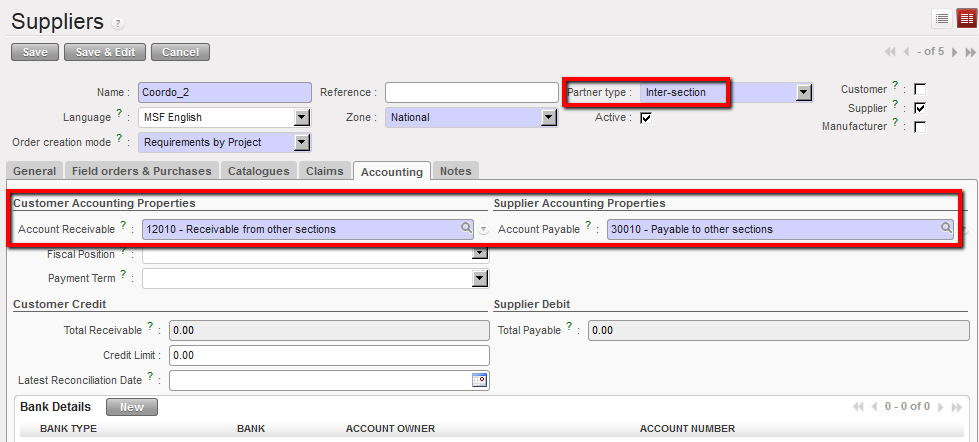 Coordination-002 is a supplier type of inter-section partner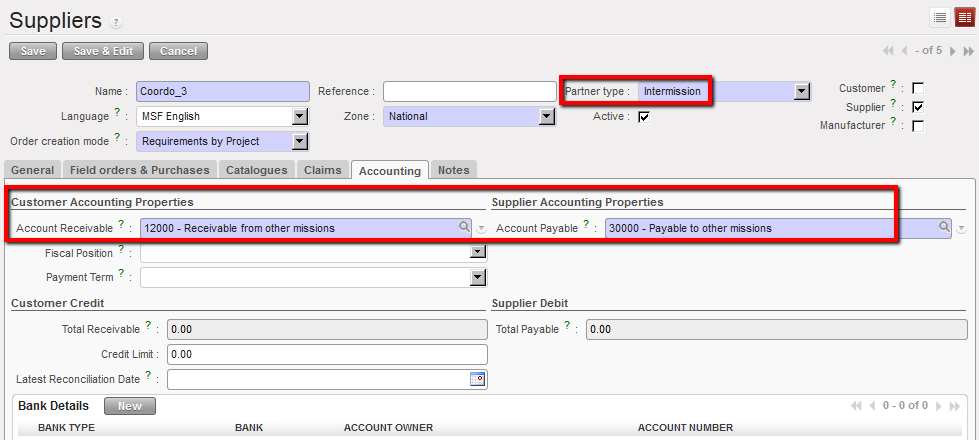





 System control on an inactive analytic account
 to edit the form.