
B. How to create a “Donation before expiry” FO
J. How to cancel a whole Field Order
Supply User Manual ENG -> 4. Procurement -> 4.4 LU-SU3103: Field Orders (FOs) – General -> J. How to cancel a whole Field Order
J. How to cancel a whole Field Order
In case the Coordination does not agree on the whole order, or if they are unable to meet the demand, the complete order will have to be cancelled. The PO at project level will be cancelled too after synchronization.
Go to: Orders / Orders / Field Orders
- Select the Field Order to be cancelled by clicking on the appropriate Field Order line to open the FO. The FO should be in Draft or Validated. Click on the “Cancel Document” button at the bottom of the screen. The system will warn you that you are about to cancel, confirm if you want to proceed.
|
|
|
Draft Field Order cancellation |

2. The FO will switch to the state “Cancelled”. You will see that the FO lines do not appear anymore. That’s because they are also in the state “Cancelled”. You may see them if you use the drop-down filter at the top of the “Field Order Lines” table which allow you to show the cancelled order lines.
|
|
|
The Draft Field Order state becomes Cancelled |
|
|
|
Cancelled FO-lines can be shown if you use the appropriate filter |


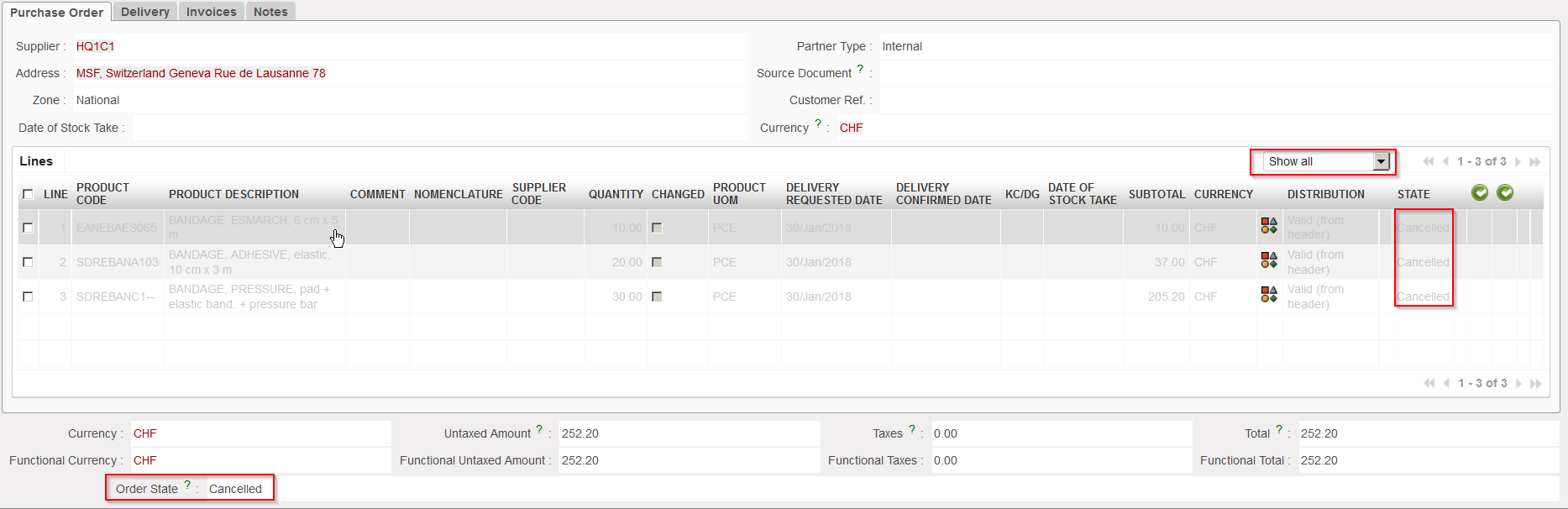
3. If the FO has an internal partner as customer, after synchronization of both instances, the corresponding PO on the customer instance will also switch to the state “Cancelled” with the corresponding PO-lines in state “Cancelled“.
|
|
|
Cancelled PO on the customer instance |
Note that “Draft” and “Validated” FOs can be cancelled but an FO which has already been sourced cannot. At this stage you will have to do the cancellation on the next document (e.g. PO or PICK). Please note that when Cancellation is done at OUT/PICK level, the FO will be “Closed” if FO has been sourced to a PO whereas it will be “Cancelled” should the FO be sourced from Stock.
I. How to confirm a Field Order (line) through the Orders Sourcing Tool.
Supply User Manual ENG -> 4. Procurement -> 4.4 LU-SU3103: Field Orders (FOs) – General -> I. How to confirm a Field Order (line) through the Orders Sourcing Tool.
I. How to confirm a Field Order (line) through the Orders Sourcing Tool.
In most of the cases, FO lines will have to pass through the Orders Sourcing Tool in order to be confirmed. The OST offers the possibility to source FO partially (i.e. source some lines of an FO and leave the other ones pending).
If the FO-line is sourced from stock, a picking ticket will be created, and the FO-line will switch to status “confirmed“.
If the FO-line is sourced on order, a procurement document (Tender, PO,) will be created and the FO-line will switch to status “sourced“.
The FO itself will switch status according to the status of its lines.
H. How to validate a Field Order.
Supply User Manual ENG -> 4. Procurement -> 4.4 LU-SU3103: Field Orders (FOs) – General -> H. How to validate a Field Order.
H. How to validate a Field Order.
Go to: Orders / Orders / Field Orders
- Select the Field Order to validate by clicking on the appropriate order line.
- Click on the button “Analytical Distribution”

to add the analytical distribution if not yet done (the AD process is described in LU-SU3201 PO Generals).
a) if all products have the same analytical distribution, add this in the header.
b) if all products have not the same analytical distribution, add the analytical distribution per order line by clicking on the icon  and entering destination, cost center and percentage if needed. Click on the floppy disk icon to save the AD-line, then click on the “Save” button to save the AD.
3. If your user has the appropriate user rights, you may either validate the FO at header level, either validate it at line level.
a) To validate an FO at header level, click on the “Validate Document” button at the bottom of the screen.
b) To validate a specific line of an FO, click on the green button at the left of the line you wish to validate.
c) To validate several (but not all) lines of an FO, select the lines you wish to validate using the check box on the left of the lines and click on the green button on the top of the “Field Order Lines” table (next to “STATE“).
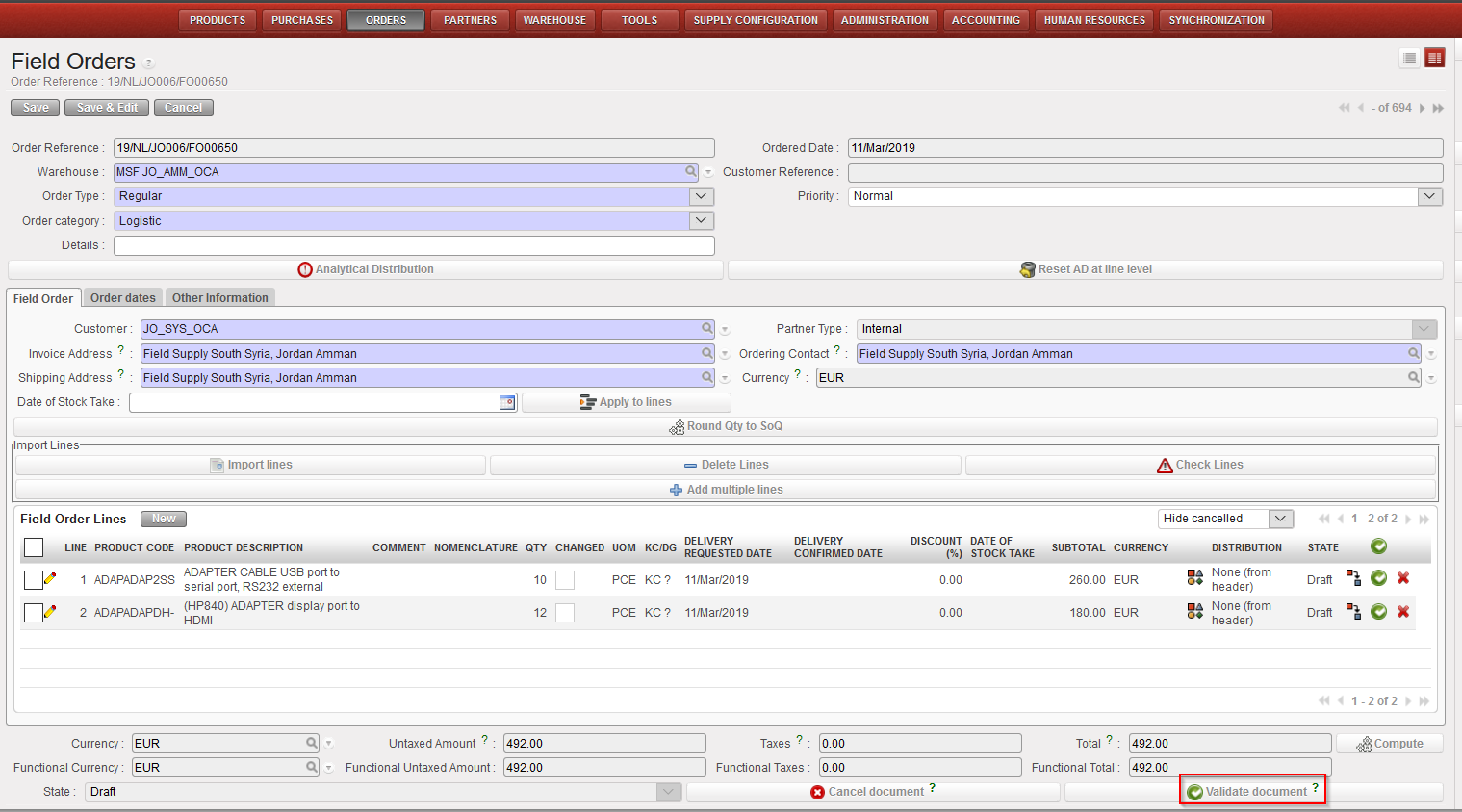 |
| FO validation at header level |
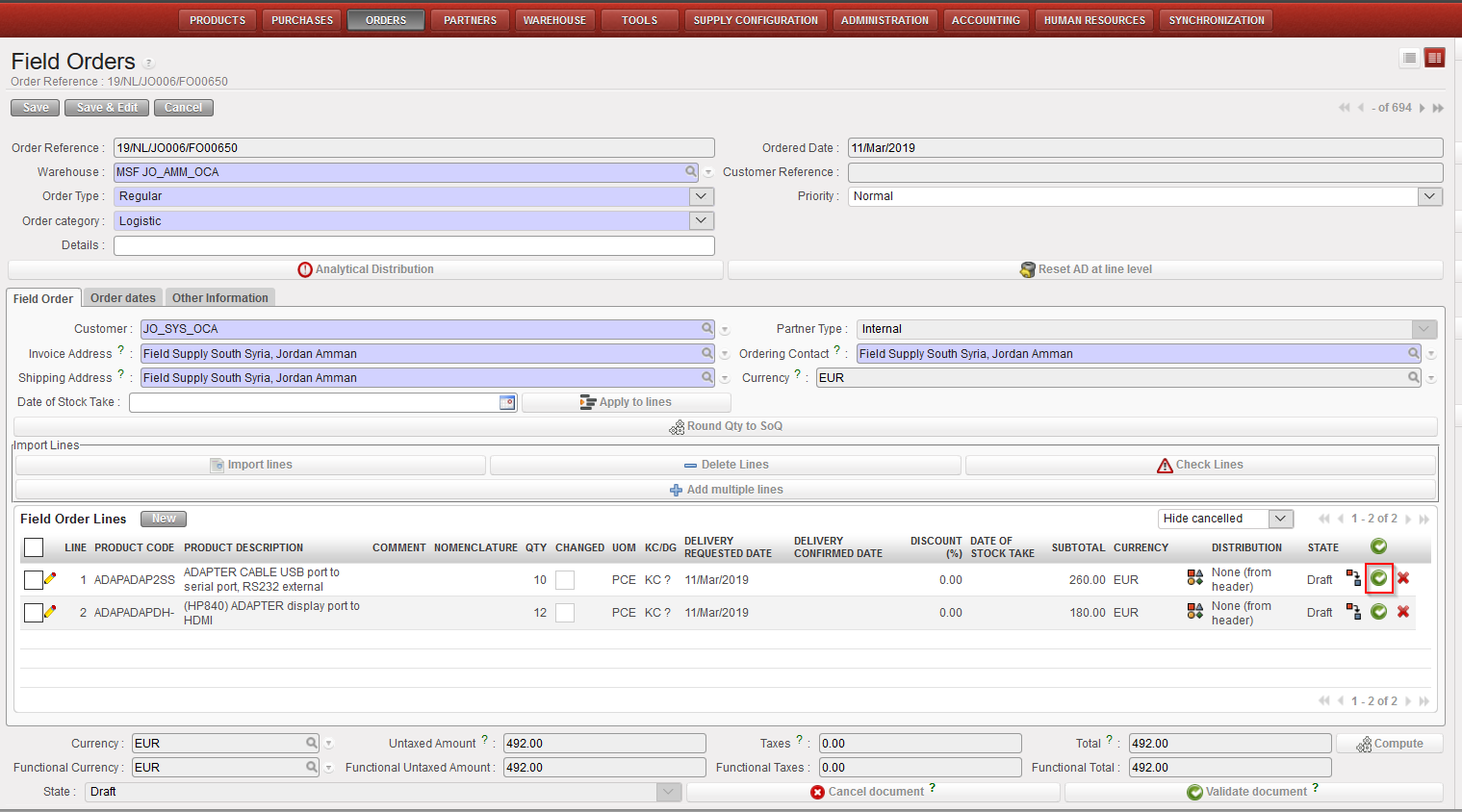 |
| FO validation at single line level |
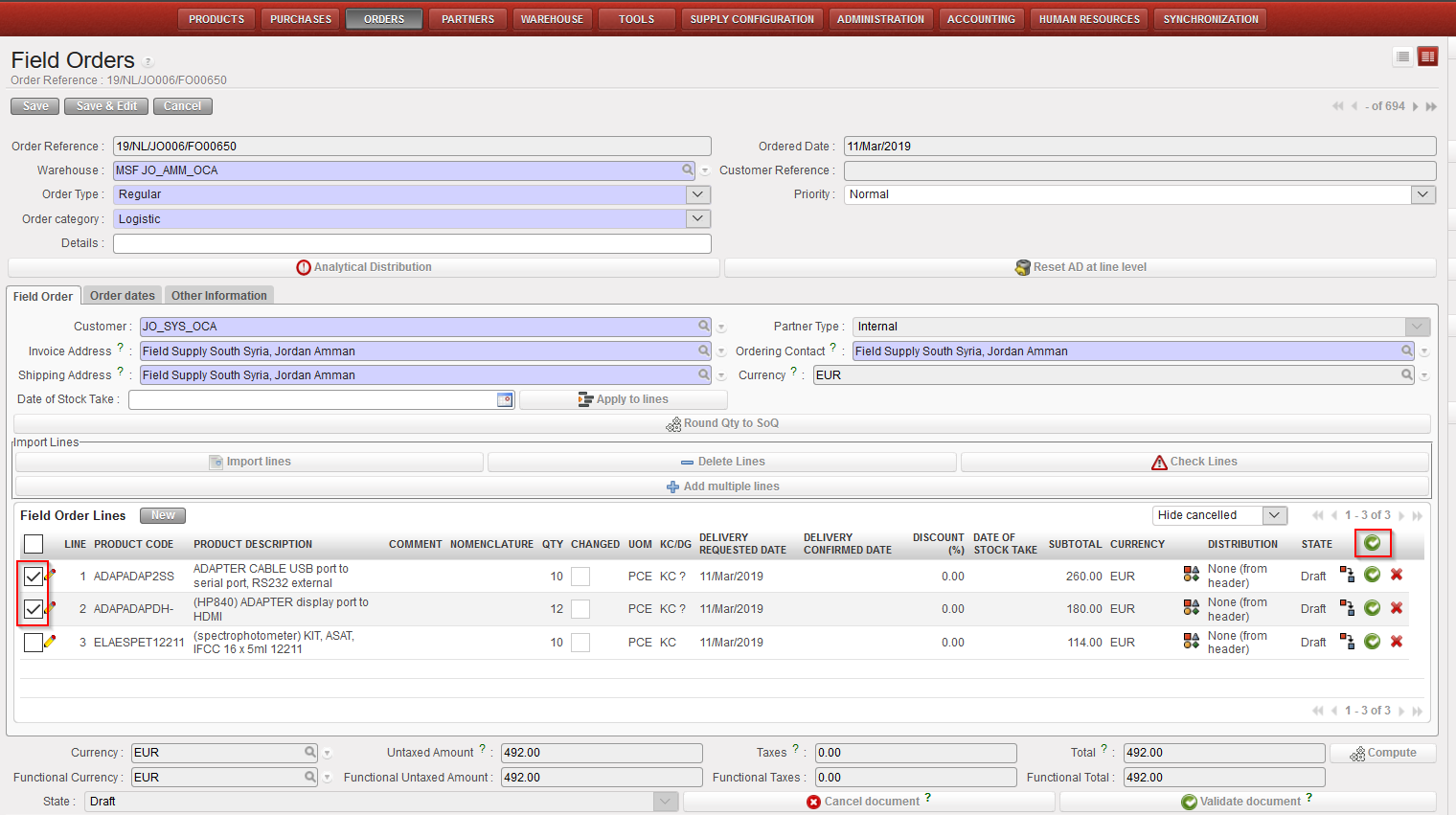 |
| FO validation at multiple lines level |
Note: An FO-line cannot be validated if its unit price is at 0 (except for donations and loans).
G. How to export a Field Order.
Supply User Manual ENG -> 4. Procurement -> 4.4 LU-SU3103: Field Orders (FOs) – General -> G. How to export a Field Order.
G. How to export a Field Order.
Go to: Orders / Orders / Field Orders
- Click on the check box on the left part of the screen of the line of the Field Order to export.
- The action menu is displayed on the right of the screen.
- Click on the “Field Order Excel Export” option.
- The FO will be exported with the following format (XML Spreadheet 2003):
 |
| Export from FO to Excel |
You can also print an FO in PDF for validation purpose by selecting the “Field Order” option in the action menu.
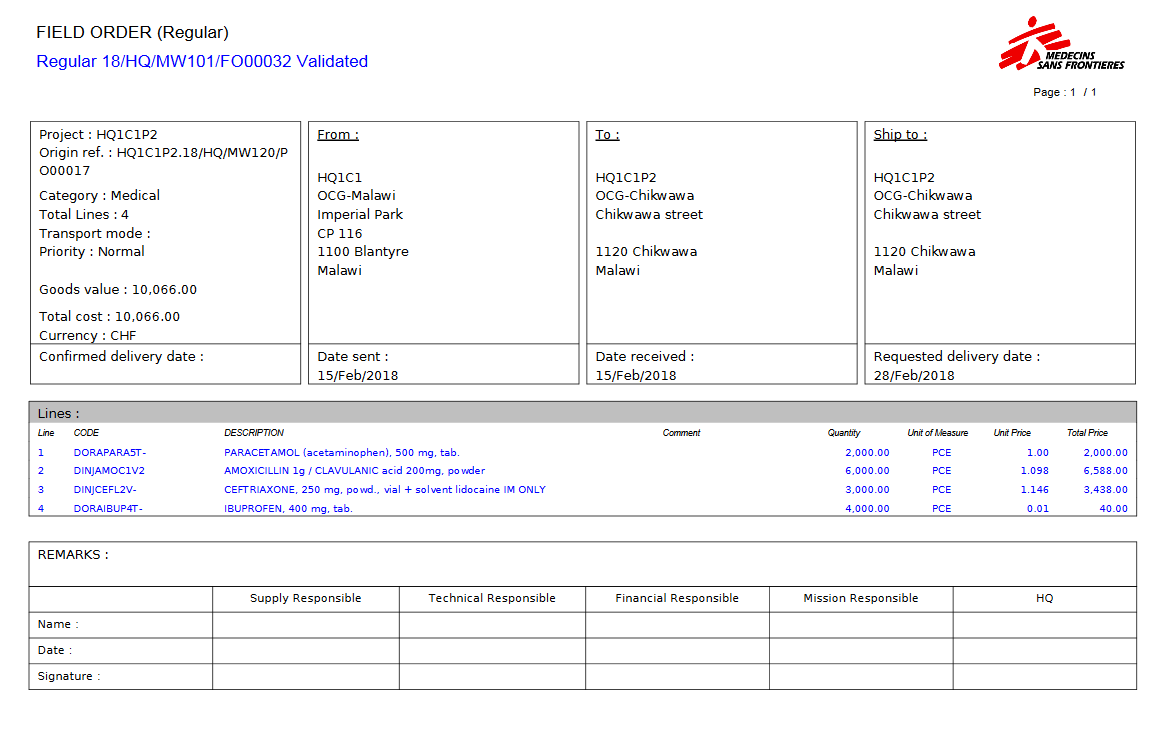 |
| Export from FO to PDF |
Note 1: It is possible to select several FOs at the same time on the “Search: Field Orders” screen (using several check boxes) and export them in one click to Excel. In Excel, you will get one FO per sheet. Note that this option is not possible for export to PDF (which is possible with IRs).
Note 2: The export to excel and PDF can also be done from within the FO as the “Field Order Excel Export” and the “Field Order” options are also available in the action menu (under “Reports”).
Note 3: If you export to Excel, the comment included in the “Comment” column of the FO will appear in the column “Comment” of the Excel. Note that the notes included in the “Notes” tab of the FO-line are not exported to excel.
Note 4: If you export to PDF, at header level, the notes inserted on the “Notes” tab of the FO will appear (at the bottom of the PDF, behind “REMARKS”). At line level, the comment included on the “Nomenclature Selection” tab of the FO-lines will appear (in the column “Comment” of the PDF) but the notes included on the “Notes” tab of the FO-lines won’t appear.
Note 5: Cancelled lines are not displayed in the PDF export.
F. How to import lines on a Field Order.
Supply User Manual ENG -> 4. Procurement -> 4.4 LU-SU3103: Field Orders (FOs) – General -> F. How to import lines on a Field Order.
F. How to import lines on a Field Order.
It is possible to import all order lines at once instead of having to encode each order line manually. The Field Order information (products, quantities, unit price) should be available in an Excel (XML Spreadsheet 2003 format) file to be imported on a Field Order.
The file should be in the exact following format:
 |
| Field Order, Import lines |
Go to: Orders / Orders / Field Orders
- Open an existing FO or create a new one.
- Click on the “Import lines” button.
- Click on the “add attachment” button then “Browse” and search on the computer for the file to import.
- Select the file you want to upload and click on “Open” in the browse window.
- Click on the “Import file” button to import the file, and then click “Update“. A message will indicate if lines have been imported successfully.
- Click on the “Close Window” button.
- Save the FO.
Note that comments can also be imported in the FO if you populate the “Comment” column of the Excel. These comments will then appear in the “Comment” column of the FO and be editable on the “Nomenclature Selection” tab of the FO-line.
Note that “product by nomenclature” lines can also be imported from Excel into an FO. Leave the “Product Code” (and “Product Description“) columns empty and populate the “Comment” column. After importing you will have to complete the lines with “product by nomenclature” and add the mandatory nomenclatures level. This should be done on the “Nomenclature Selection” tab of the FO-line where you will also be able to update the uploaded comment if needed.
To get a template of the correct Excel format needed, you may export an existing FO to Excel as explained below (see: F.How to export lines from a Field Order). Note that you will have to delete the last 4 columns of the Excel generated if you want use it as a template ( “Justification Code“, “Justification Coordination“, “HQ Remarks” and “Justification Y/N“).
Note that the “Status” column values are not imported.
E. How to update / amend a Field Order
Supply User Manual ENG -> 4. Procurement -> 4.4 LU-SU3103: Field Orders (FOs) – General -> E. How to update / amend a Field Order
E. How to update / amend a Field Order
Once a synchronized Field Order has been received from a project, coordination members can amend the order prior to its validation to change the products, the quantities, the unit prices or any other information included in the Field Order. All changes will be reflected in the Project’s Purchase Order as soon as both sides have synchronized their instances.
Go to: Orders / Orders / Field Orders
- Select the Field Order to be updated by clicking on the pencil
 at the left of the appropriate row.
 - Change any information in the header of the order.
- Update any line (product, quantity, unit price,) if needed. Note that the field “Modification Comment” can be used to explain a change and will be synchronized on the corresponding PO of the requesting instance.
- Cancel a whole order line if needed by clicking on the red cross of the appropriate order line (on the right side of the screen).
- Click the “Save” button on the top of the screen.
Note that an FO created by the synchronization will have “Synch” as responsible while and FO created manually will have as responsible the user who created the FO.
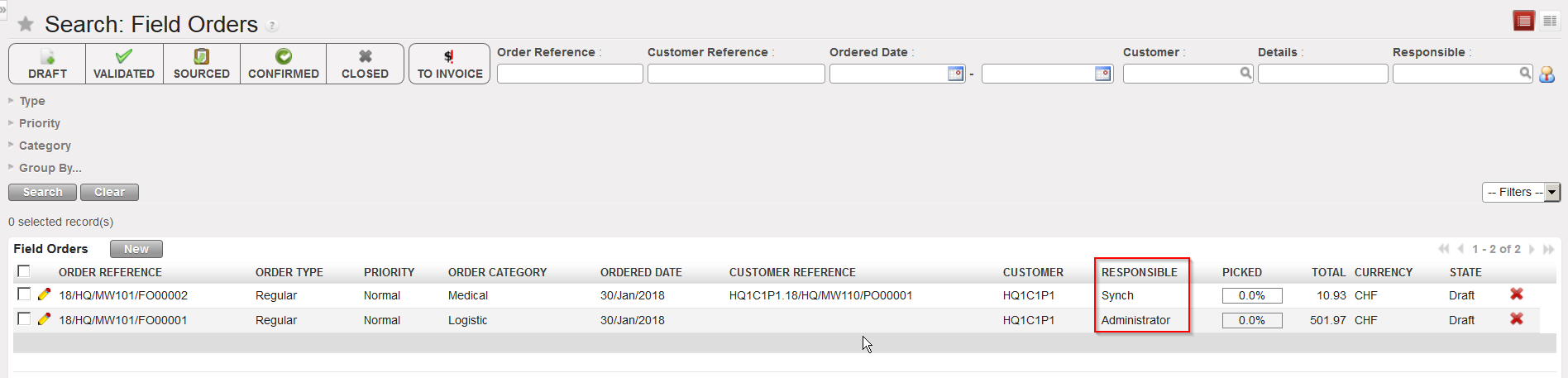 |
| FO created by the synchronization versus FO created manually |
Please note that any change on “Product”, “Quantity”, “Price” and “UoM” to a “Validated” line will trigger the ticking of the “Changed” checkbox. These changes will also trigger the checkbox if the FO is still in Draft but only for FOs created by sync (i.e.: pulled FO).
Changes can be seen by clicking on the updated line; this will open a pop up with the details of the line (the same one as when clicking on “new”). You will see the “Original value” compared to the actual one:
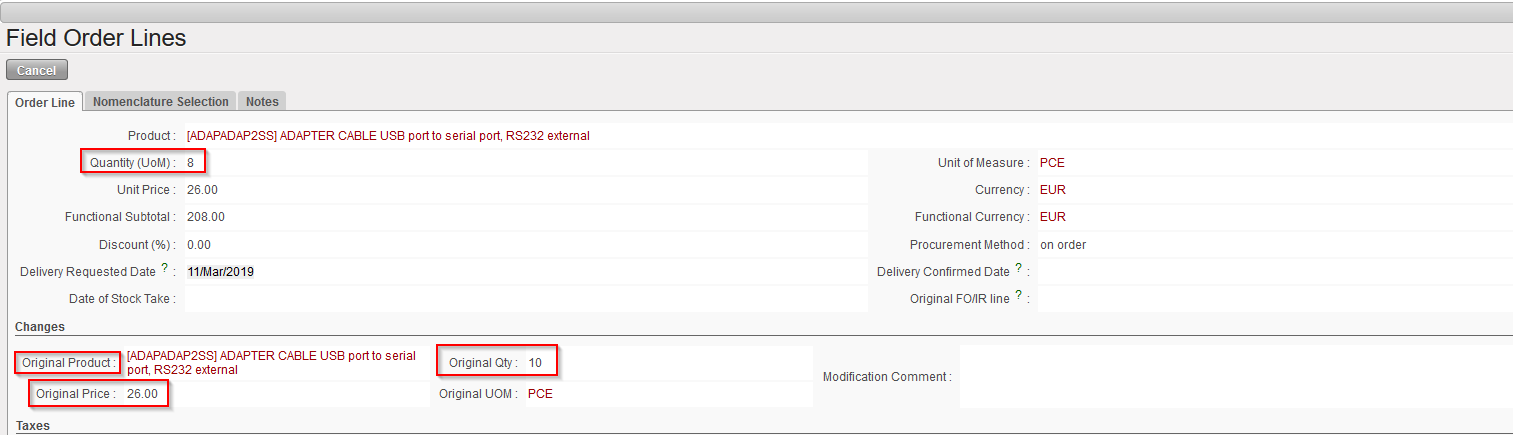 |
| FO line updated: in this example “Quantity (UoM)” has been updated to 8 vs “Original Qty” of 10 |
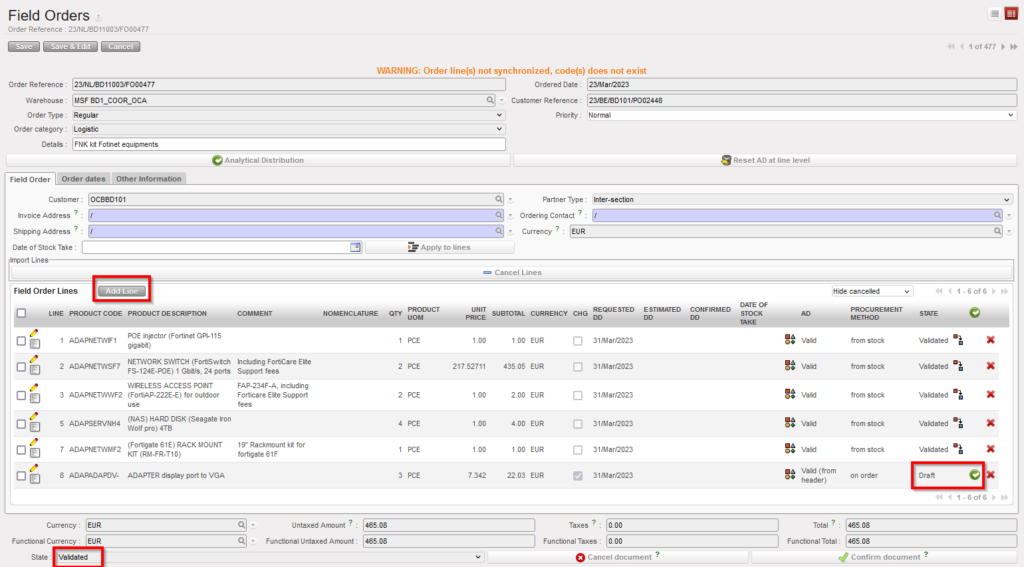
As long as the FO is in “Validated” status, it is still possible to add new line to the order however this will trigger the “Changed” checkbox.
The addition of new lines to a “Validated” FO is conditioned by User rights. A new button named “Add line” will replace the “New” button which is only used for Draft FO. New lines added at “Validated” state will still be created as “Draft” and will need validation from authorized user.
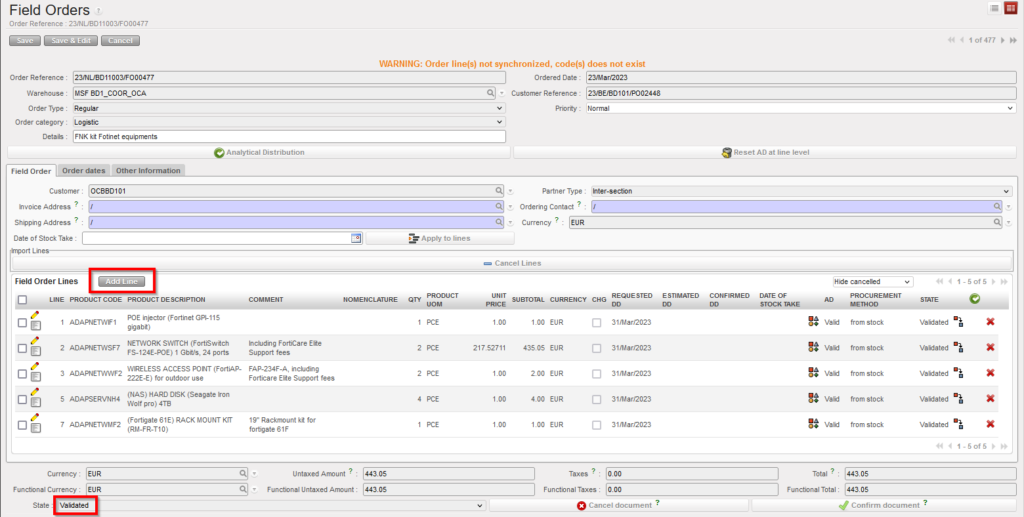
Please note that after adding a new line to a “Validated” FO, the FO remains “Validated” (document status does not “go backward – not to “draft-p”) despite the new Draft line.
B. How to manage a Field Order through the synch engine.
Supply User Manual ENG -> 4. Procurement -> 4.4 LU-SU3103: Field Orders (FOs) – General -> B. How to manage a Field Order through the synch engine.
B. How to manage a Field Order through the synch engine.
In the case of a Field Order generated through a synchronization, you will have a “requesting instance” (usually project) and a “supplier instance” (usually coordination). The “requesting instance” will send a request, through a validated Purchase Order (PO), to the “supplier instance”.
The validated PO from the “requesting instance” will basically be transferred to the “supplier instance” thanks to a synchronization at the “requesting instance” level.
In order to receive this request the “supplier instance” will also need to perform a synchronization of its instance. The PO of the “requesting instance” will be transformed to an FO at the “supplier instance” level.
The FO will usually be automatically generated after an automatic synchronization and you will need to check the Orders / Orders / Field Orders screen to open and follow the draft FO.
All the main fields of the FO should already be populated with the information coming from the “requesting instance” PO. You should have the products, the analytical distribution, dates, quantities,…
However, depending on the synchronization setting of your instance (it could be done every night, every X hours,…) and the urge of the situation, you may need to launch manually the synchronization in order to receive your FO straightforward after communicating with the requesting instance. In that case, you will need to do the synchronization manually (see Procurement Advanced Feature/ How to do a manual synchronization paragraph below).
These FOs generated through synchronization are also referred as “Pulled FO“.
Even though everything is generated automatically, communication between internal instances remains key to ensure a smooth and timely processing of the requests.
Please keep in mind that after synchronization of a validated PO at the “requesting instance”, no changes should be made to this PO (they will not be taken into account).
Remember, it is worth after synchronization to check the PO/FO/Shipment Logs (Synchronization / Monitoring / PO/FO/Shipment Logs) to see which documents have been created and modified due to the synchronization. Please see the Configuration chapter for more details on this, LU-SU1103 Synchronization: How to view documents created by synchronization.
A. LU Introduction (LU-SU3103).
Supply User Manual ENG -> 4. Procurement -> 4.4 LU-SU3103: Field Orders (FOs) – General -> A. LU Introduction (LU-SU3103)
A. LU Introduction (LU-SU3103)
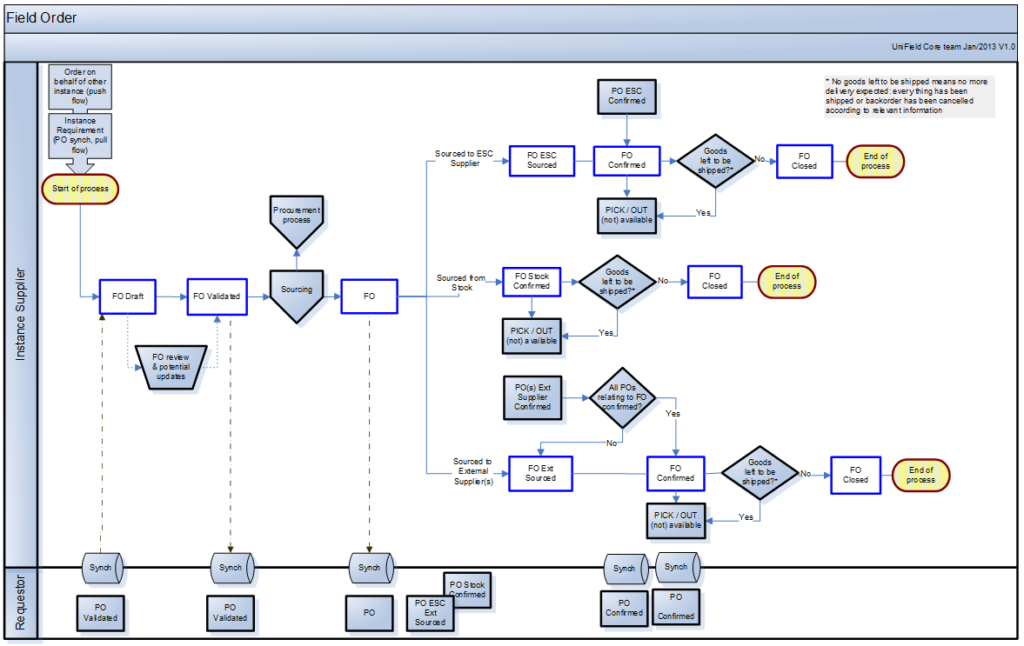
A Field Order is a document which represents the requirements of a customer (often a project, but can be other internal or external partners). If the customer is a project, the FO corresponds to the project’s PO. The FO can be either created via the synchronization engine (comes from a PO created on the project’s instance – pulled FO) or can be created manually “on behalf” of the project (this action will automatically trigger the creation of the equivalent PO on the project’s instance – pushed FO), or on behalf of an external partner (of type customer) if for example donating goods to them.
See flow chart next page.
4.4 Field Orders (FOs) – General.
Supply User Manual ENG -> 4. Procurement -> 4.4 LU-SU3103: Field Orders (FOs) – General
LU-SU3103: Field Orders (FOs) – General
B. How to manage a Field Order through the synch engine
C. How to create a Field Order manually
D. How to add one or multiple Analytical Distribution (AD) to Field Orders Line/Lines
E. How to update / amend a Field Order
F. How to import lines on a Field Order
G. How to export a Field Order
H. How to validate a Field Order
I. How to confirm a Field Order (line) through the Orders Sourcing Tool
J. How to cancel a whole Field Order
K. How to cancel one specific Field Order line or multiple lines