In UniField, you can create a debit note to cumulate several customer invoices (Stock transfer vouchers and Intermission Vouchers OUT) and proceed to the payment in one go.
How to Create a Debit Note:
Confirm first that the re-billing inter-section account is set to {Expense re-invoice to other sections}. This action prevents the system from importing the STVs booked on this account code in the partner form into the registers.
Choose account code 12011 in the Re-billing Inter-section account field when you Plan to pay multiple STV through a debit note.
Next, proceed to the creation of the debit note.
Suppose we want to consolidate the payment of the below STVs:
Stock Transfers Vouchers Search view
Go to: Accounting/Customers/Debit Note
In the Debit Note Search view, select {New}
New button to create a Debit Note
Complete the {Customer} field and in the {Currency} field populate the currency set into the Customer form. Choose a {Document Date} and {Posting Date}. Then in the invoice section, select account {12010 – Receivable from other sections}.
Select to import the relevant STVs, then click {Add}
Creating a Debit note
Import invoice window
Select the STVs to import, then {OK}
Selecting STVs to import
“OK” Button
The STV lines display in the {Invoice Line} section. The debit note is {Draft}. After checking all the fields are correct, you can validate it.
Debit note waiting for validation
Debit note becomes Open
Next, proceed to payment of the debit note in the register by using the {Pending Payments} function
Pending Payments used to import the debit note into a cash register
In order to recognise the same expense every month during several months, a periodical processing function called Recurring Entries can be used in UniField. These are entries entered in to a recurring entries Model which enables to equally spread the expenses over each period. For example, we pay the rent for the 1st quarter of the year on January, all the money is paid on January but the expenses are actually for January, February and March.
Recurring entries follow this standard:
Create the supplier invoice
First, the user records the booking using a pre-paid expense account (in the supplier invoice line) – so the transaction debits Prepaid account and credits A/P Accounts Payable.
Pay the supplier invoice
The user records the supplier invoice payment importing the invoice into a register – so the movement is debit A/P (accounts payable) and credit on the liquidity account.
Create the accounting Model (= Recurring Model)
The user sets up a recurring Model, defining the journal entries to be repeated. The movement is debit expenses and credit prepaid expenses.
The user needs to perform an analytic distribution for the expense account leg of the Model.
Create the periodic Model (= Recurring Plan)
The user defines the periodicity at which the postings should occur (e.g. weekly, monthly) and the number of periods during which this entry will be repeated.
Generate the entries in the journal (= Generate Entries)
The user generates accounting entries based on the recurring Model and the recurring Plan – Prepaid to Expense. The creation of these entries is not automatic. The user must use the recurring Model to generate these entries at the end of each period. These entries are created and become {un-posted}; the user must review them and post them in the journal. If these entries are not generated and posted, UniField will not allow you to close the period.
Reconcile the prepayment entries (pre-paid account) in the journal
Manually reconcile the Supplier Invoice with the recurring entry. The prepayment account will be partially reconciled until all entries in the Model are generated.
Accounts move for a 3 months rental paid (EUR 3,000) starting from August (EUR 1,000)
Description
Account
De
Cr
Entries matching
Supplier Invoice Booking
Trade Payables
30020
3,000
A1
Pre-paid expenses rental
13300/13620 (OCA)
3,000
A2
(2,000)
Supplier Invoice payment (August)
Cash account
10100
3,000
Trade Payables
30020/15600 (OCA)
3,000
A1
Recurring entry generated (August)
Pre-paid expenses rental
13300/ 13620 (OCA)
1,000
A2
Expat housing: rent & running costs
61110
1,000
(2,000)
How to Book a Recurring Entry Expense:
Assume we are in a situation where we paid 800 USD for upfront office rent. We would like to record it as 4 expenses which take place every month.
Create the supplier invoice
Go to: Supplier/Supplier Invoice
Create manually a supplier invoice using a pre-paid expense account {15600 – Prepaid expenses rentals} for some OCs or for OCA in the example 13620 for an amount of 800 USD.
Invoice line booking on a prepaid account
Validate the supplier invoice. The invoice becomes {Open}
Draft supplier invoice and {Validate} button
Pay the supplier invoice:
Go to a register to proceed with the supplier invoice payment.
When the register is open, import the supplier invoice and hard-post the register entry.
Imported invoice and entry hard posted
Create the accounting Model (= recurring Model)
Go to: Periodical Processing/Recurring Entries/Recurring Models
Click on {New} to create a Model.
Enter a {Model Name} and Journal {Purchase}.
Tip! If you include text “%(year)s”, “%(month)s” or “%(date)s” in to the Model name, the entries will pick the year, month or date in to the entry reference when they are posted!
Select the Model currency. For this example, it is {USD}.
Enter two (2) Journal Entry Model Lines (Prepaid on Credit and Expense on Debit).
For example, we want to pay 800 USD in 4 payments. Therefore, we debit 200 USD on the expense account and credit 200 USD on the 13310 account or 13620 account for OCA. Do not forget to select the appropriate third party in order to reconcile entries.
Record an analytical distribution on the expense account.
Click on {Save} button. The recurring Model is created as shown below.
If the Model lines are unbalanced, they will appear in blue! If they are balanced, they will appear in black.
Recurring Model created balanced (lines in black)
Recurring Model created unbalanced (lines in blue)
Recurring Model states:
The recurring Models has three different states:
Draft State = when no Recurring lines have been computed
When the Model is created and it has not been added in any Plan, it can be edited and deleted.
When the Model is created and added in a draft Plan without [computed] lines, it can be edited but can not be deleted. The warning message will be:
This allows to make easy clean for Models which have been created per mistake/forgotten one which has never been used.
The Draft Models are in blue color. Same color for the Draft recurring Plans.
Running state = when subscription lines have been computed in a recurring Plan (entries un-posted OR posted).
If the Model is used in one recurring Plan in running state (so dates computed), and the entries have been generated or not and there is no recurring Plan in state done related to the Model, the Model can still be edited but not deleted.
Donestate = once all subscription lines have been generated and posted.
A recurring Model in done state is not anymore selectable when creating a new or editing existing recurring Plan.
You cannot duplicate a Recurring Plan using a Done Model. You will have a warning message.
For a Model used for 2 different Plans where one Plan is in done state and the second one is in running state: The Model will be in state done. The second Plan, in running state, will have the field Model in read only.
The Done Models are in grey color as for the Done Recurring Plans.
Recurring Model states workflow
Create the Recurring Plan (= recurring entries via recurring Plan):
Go to: Periodical Processing/Recurring Entries / Recurring Plans
Click on {New} to create new recurring lines.
Enter a {Name} and select the {Recurring Model}.
Select the starting date of the Model (= date of the first expense booking).
As we want to spread the cost over four (4) months and book the expense every month, choose Repeat {1} Number of Periods {4} and Period Type {month}. The final expense booking will take place in 4 months from your start date.
Fill in a reference if desired.
Click on {Compute} to display automatically the subscription lines.
Click {Save} button.
Recurring entries Plan expenses will be booked according to the subscription lines schedule.
Recurring Plan states:
The recurring Plan has three different states : Draft, Running and Done.
Draftstate = when no Subscription lines have been computed. The button Compute is available
Runningstate = when Subscription lines have been computed (entries un-posted OR posted).
Buttons available are Delete Unposted Entries and Compute
In Running State, we can still change the fields: Name, Start Date, Number of periods, Repeat and Period type.
Example: we can decide to change the number of months at this stage: from 4 months to 6 months.
We tick Compute and two new subscription lines will be created and a recalculation will be done consequently.
Donestate = once all lines have been generated and posted. No buttons are available. All fields are set as not editable.
When a Recurring Plan is set to done using one Model, the related Model is set as done and is not editable anymore nor erasable.
States of the Recurring Plan:
Generate the entries in the journal
Go to: Periodical Processing/Recurring Entries/Generate Entries
Choose the date to select entries to be generated before a specific date.
For example, if you want to generate September entries, you can set the date in September.
Entries to be generated in December should be created in the standard December period and not in the special periods 13 to 16 (this possibility has been blocked).
Click on {Generate Entries}.
⮡ A new window {Generate Entries} will appear.
Post entries in the journal
The entries are generated as unposted. To post your entries, you must first select {Post Journal Entries} in the Action menu:
When clicking on {Generate Entries}, you have the list of all entries to post according to the period chosen. Not just for the Model that you are in. You can choose those entries you want to post. Select the line with X and go to the right Action menu and click to Post Journal Entries.
⮡ The Recurring Entries to Post window appears
Generated unposted journal entry
Remember that the entries are still unposted and as long as they are still unposted, you still can delete the unposted entries from the Recurring Plan. To know if it’s posted or not, you can click directly on the entry generated in the subscription lines in the recurring Plan window.
The unposted subscription Line in the Recurring Plan
Post Recurring Entries:
Go to: Periodical Processing/Recurring Entries/Recurring Plan
If the entries are not immediately posted after being created, the user can return to the {Recurring Plan} menu, open the {Actions} menu and select the {Recurring Entries to Post}.
Recurring Entries to Post button
Select the entries you want to post, then click on {Post Journal entries} on the action menu.
⮡ A new search window {Generate Entries} will appear where can select the entries you want to post and post them by clicking on {Recurring Entries to Post} from the action menu.
Click on {Approve}.
The recurring Entries are posted now.
You won’t be able to click and to use the {Delete unposted Entries button} in the concerned recurring Plan if the recurring entries were posted.
Reconcile the prepayment entries in the journal:
Go to: Journal Entries/ Journal Items:
Tick the original invoice line and the posted recurring entry line to reconcile.
Click on {Reconcile Entries} in the right-hand menu.
Posted and unreconciled journal items and Reconcile entries action
⮡ The {Reconcile Entries} window appears proposing a partial reconciliation as the journal items selected do not allow for a full reconciliation.
Reconcile Entries window
Click on {Partial Reconcile} button.
In the Search Journal Items view, the account 13300 is partially reconciled with an outstanding balance of 600 USD.
Account 13300 partially reconciled
Reset AD at line level button to input a valid AD
Editing the AD on a recurring Model when it became invalid.
How to Delete a Recurring Model and a Recurring Plan:
ENTRIES IN DRAFT (NOT GENERATED YET)
How to delete a Recurring Model:
Go to Periodical processing/Recurring entries /Recurring Models
Delete the recurring Model by clicking on the red cross.
You can not delete a Model which is used already in a Plan. You will have an error message:
How to delete a Recurring Plan:
Go to Periodical processing/recurring entries/Recurring Plan
Delete the recurring Plan by clicking on the red cross.
Recurring Entries module for management of Fixed Assets
A new Analytic journal DEP has been created in order to use the recurring entries module for the management of the fixed assets.
This is optional per OCs. OCA will not use that for the moment.
Go to Accounting > Configuration > Analytic Accounting > Analytic Journals
The Journal code is named DEP, the Journal Name is Depreciation, and the type is also named Depreciation:
This is optional per OCs. OCA will not use that for the moment.
Go to Accounting > Configuration > Analytic Accounting > Analytic Journals
The Journal code is named DEP, the Journal Name is Depreciation, and the type is also named Depreciation:
The process to create a depreciation entry follows these steps:
Go to Accounting >Configuration > Financial Accounting > Accounts> Accounts, activate the GL codes for the accumulated depreciation (example code 21200 for the Non-Medical Equipment).
Go to Accounting > Periodic processing > Recurring entries > Recurring models.
Click on the button “New” to create a “Recurring Model”
Go to Recurring Plan and create a “New” Recurring Plan by selecting the Recurring model previously created in the Recurring Model screen.
Go to “Generate entries” and click on “Generating entries”: it will create entries with the “Journal code” DEP.
A down payment is a cash advance to a supplier made at the time of ordering goods when the purchase is not yet invoiced.
In UniField, a down payment is recorded in a bank, cash or cheque register to ensure the money out impacts the register’s balance. It is recorded under the account {Advances done to third parties} with a mandatory third party. This icon helps user link the approved Purchase Order to the down payment recorded in the register. It appears once you saved the register line.
The down payment is displayed in the Purchase Order {Invoices} tab once the down payment accounting line is hard-posted in the register. At this point there is no supplier invoice because no goods have been received yet.
After the goods are received, a supplier invoice is automatically created in {Draft} in UniField for the total amount of the goods purchased. It is then possible to see the down payment on the {Down Payments} tab in the draft supplier invoice to be validated. The down payment is only displayed on the tab if the down payment entry is hard-posted.
{Supplier invoice} Form view
When an authorized user validates the invoice, the supplier invoice takes into account the part of the payment that has already been done. The user finds this information in the {Payments} tab in the supplier invoice form additionally to the {Down payments} tab. The validated invoice shows a residual amount to pay based on what was already disbursed as down payment.
{Payments} tab showing a down payment in a supplier invoice Form view
{Down Payments} tab showing a down payment in a supplier invoice Form view
Residual amount to pay displayed in a supplier invoice
Accounts move related to down payment and supplier invoice validation
When the down payment is delivered, the account {Advances done to third parties} is debited and the account {10100 – cash on hand} is credited in the liquidity journal.
When the invoice is validated, the expense account is debited and Trade Payables account credited for the total cost in the purchase journal.
Automatic account reconciliation: In the liquidity journal, the advances to third parties account are reconciled (M1-9) and the Trade Payables account is partially reconciled (M1-10) showing a residual amount to pay.
Note! These entries are not reflected in the register; therefore a gap of sequence can be expected when creating a new register line. However, these entries can be followed up on the Full Report.
Invoice to import showing a residual amount
The final payment is done by importing the supplier invoice into the register.
Once the payment is done and hard-posted in the register, UniField automatically creates a new reconciliation reference.
This is what you will see in journal items:
Journal items when the imported invoice register line was hard-posted. A new reconciliation reference was created.
How to Record a Down Payment:
(Same procedure applies to record a Down Payment in a cash, cheque or bank register)
Go to: Accounting/Registers:
Select the register used to pay the down payment.
Click on {New} to create a register line.
Complete the line. In the {Account} field, select the account {Advances done to third parties}. Select the supplier in the {partner} field
Save the line.
⮡ The line is saved in {Draft}. The icon appears.
Click on the icon to link the down payment to the purchase order.
⮡ A {Down payment} wizard appears
A {Down payment} wizard appears
In the {Purchase Order} field, select the relevant purchase order to link it with the advance and validate it. Remember, no supplier invoice will exist because goods have not been received yet. If you do not see your purchase order, confirm you are in the register corresponding to the correct currency and you have selected the correct supplier. Also, check the PO lines status; only POs lines in status {Confirmed} can be linked to a Down Payment and the total amount of any confirmed PO lines minus any validated Supplier Invoices for the same PO cannot be exceeded.
Back to the register line, save it.
⮡ The down payment is booked in your register. Only after the down payment is hard- posted will the down payment be recorded in the associated purchase order in the {Invoices} tab.
An operational advance is defined as money provided to an employee from cash or bank registers to be used to purchase goods or services from third parties on behalf of MSF. The employee returns with the goods or services and a receipt for payment. Any unused cash is returned to the petty cash box or bank account and the payment is booked for the expense.
UniField can manage operational advances from the moment the advance is disbursed until it is returned. To create operational advance entries select the suspense account {Operating Advance}. The cash handed to the employee is booked on his/her name as third party.
If the advance payment relates to a Purchase Order, the advance can be linked to the confirmed PO when creating the register line. This action allows you to select the automatic supplier invoice in the advance return wizard later in the process. Operational advances can be closed once the reception is processed and the related supplier invoice validated. The {Advance Return} wizard is triggered by selecting this icon located on the advance register line as soon as the line is hard posted.
Cash advance and return
How to Book an Operational Advance:
Go to: Accounting/ Registers/Cash Registers:
Open the cash or bank register of the currency in which the operational advance is given.
In the {Cash transactions} tab, create a new statement line and complete the statement fields. In the {account} field, choose the account {Operating Advance}.
As {Third Party}, enter/select the name of the employee receiving the advance (mandatory).
Enter an {Amount Out}.
In the {OPE ADV-LINK TO PO} box, you link the advance to the PO for which the advance was requested if the PO is Regular or DPO. This PO must have been confirmed, but not closed yet, to show up in the Search Purchase Orders view.
Booking an operational advance linked to a PO not of type Purchase List
Searching for the PO to link to the advance
Save the line. The advance is now in {Draft} status. You will need to hard post it to be able to close the advance. The field Reference is mandatory, where you should add the advance number.
Operating advance booked in draft state in the cash register
How to Generate a List of Open Advances:
Once the advance is booked, you need to close it in UniField. You can use the button {List of Open Advances} to help you retrieve the advance. Both hard posted and temp posted advances will be displayed. A list generated at Coordination level will display open advances of coordination and project instances. A list generated at project level will only display open advances of the project instance.
Go to: Accounting/Registers/Cash Registers:
Open the cash or bank register where the money will be returned.
Click on the button {List of Open Advances}.
List of Open Advances button on a cash register used to retrieve hard/temp-posted operating advance
Search Open Advances window displaying hard/temp-posted advances not returned yet
How to Settle an Operational Advance:
You need to click on the wizard.
When the advance return wizard is used, use this reference in the field “Advance Return Reference” => the field is read only and not editable.
The advance can be linked to a supplier invoice in case of purchasing or services from an external partner. If the type of the invoice should be a direct invoice, this is an exceptional case where you should create the invoice as supplier invoice instead of direct invoice (it’s in case you want to use the invoice to settle an operating advance).
You can use a direct entry type as well to settle the operating advance in case of direct expenses to staff or daily workers …etc. You can add that in the Advance line section.
Both direct entry type and supplier invoice can be used if required at the same time to settle the operating advance.
Indicate the amount of cash returned (if any) and enter the date of cash return. The date must be in the same month as the register.
Indicate an advance return amount if needed.
Select {Compute} button to calculate the Justified Amount = advance lines + advance return amount. This should equal the Initial Advance amount.
Click {OK} button.
Advance return wizard and invoice lines automatically added
Advance closed and reconciled in the register
Notes:
The reference at the level of the advance return lines which is in the column “Reference” (to the right of description) will be removed from the lines of the wizard.
Both Initial advance and advance return JIs will have the same reference based on the initial advance. Note that it won’t be possible to change the reference once the initial advance is posted.
How to Settle an Operational Advance combining a Supplier Invoice and a Manual Expense line:
Go to: Accounting/ Registers:
Open the register where you want the advance to be returned.
Ensure the advance line is hard posted.
Select the button {List of Open Advances}, and once you have located your advance in the {Open Advances} Search view, click on the below button {Advance return}located on the advance line.
Enter in the {Advance return amount} the amount of cash returned and the date of the cash return:
Leave it blank if no cash is returned.
If you linked the advance to a PO when the register line was booked, the invoice details are automatically retrieved and displayed in the invoice lines section when calling for the Advance Return wizard (see point D). If not, select the desired supplier invoice with the “Add button”
In the Search Invoice view, choose the invoice to import and press on “Select” to close the window.
Search Invoice view when calling for invoices to import in the Advance Return wizard
Then press “Add Invoice” to display the invoice in the invoice line section
To add a manual expense line, follow the steps described in point E from step 5
Manual expense line saved in the advance return wizard
All these actions have closed the advance in the register and created two new sequences in journals (only the liquidity journal sequences are visible in the register). Accounts 13000 and 30020 are reconciled. If the imported invoice’s details have to be checked, use the icon located on the payables line.
Advance closed in the register
In the journals, we have:
Operating advance booked in the liquidity journal:
10100 Cash on hand on credit (150 UGX)
13000 Operating advance on debit (150 UGX)- reconciled CD1AD-3
Trade payables reconciled (CD1AD-1) when the invoice is imported. We have account moves in the purchase and liquidity journals.
Trade payables reconciled (CD1AD-2) when the manual expense is input, impacting only the liquidity journal.
Advance return in cash, impacting the liquidity journal
How to Close an Advance when the Actual Cost Exceeded the Advance:
We will use the example of a manual advance closing.
Go to: Accounting/ Registers:
Open the register where you want the advance to be returned.
Ensure the advance line is hard posted.
Select the button {List of Open Advances}, and once you have located your advance in the {Open Advances} Search view, click on the button {Advance return} located on the advance line.
In {Additional amount}, enter the amount of additional cash used by the employee. Leave the {Advance return amount} to 0.00 and fill in the date for cash return even if no cash is returned. This is the date when the advance is justified and when the advance return is posted in the journals (expense and cash accounts).
In the {Advance line} field, select {New} and complete the fields in blue. You can select a generic partner called {Local Market} or record it on a specific partner. UniField will automatically reconcile it. Save the line.
Expense amount equals the initial advance amount plus the additional advance amount. This will represent the justified amount.
Proceed now to the allocation of this cost. Select the button located on the advance line if you need to assign different analytical accounts to several advance lines. If not, use the button at the header. The destination is set by default.
Save the line . The line becomes blue. The allocation is valid.
Valid analytical distribution in a cash return wizard:
Indicate an {Advance Return Reference} if needed
Click {Compute} button to calculate the Justified Amount = advance lines + additional advance amount. This should equal the Initial Advance amount.
Click {OK} button.
⮡ The window closes. The advance is closed in the register. Use the {Return to register} action to check the entries created.
Advance closed and operating advance account automatically reconciled
In the G/L journals, we have:
Operating advance booked in the liquidity journal:
10100 Cash on hand on credit (300 MWK)
13000 Operating advance on debit (300 MWK)
Return operating advance closed in the liquidity journal (1):
13000 Operating advance on credit (310 MWK)- reconciled GN101-19
13000 Operating advance on debit (10 MWK)
13000 Operating advance on debit (300 MWK)
Return operating advance closed in the liquidity journal (2)
10100 Cash on hand on credit (10 USD), entry sequence
61170 Furniture on debit (310 USD), entry sequence
Trade payables reconciled in the liquidity journal when the cash return is booked
30020 Trade Payables on credit (310 MWK)- reconciled GN101-18
30020 Trade Payables on dedit (310 MWK)- reconciled GN101-18
Warning message on the cash return wizard
Advance return wizard: show the third-party liquidity journal if account code type is “internal transfer”.
You are be able to select Journal 3rd party on Return advance entry if the account codes “14120 – Internal Transfer Same Currency” or “14130 – Internal Transfer With Currency Exchange” are selected:
Sometimes suppliers request a guarantee (e.g. to rent houses, for a phone line, etc.) which should normally be returned at the end of the agreement. When cash is given to the supplier, you will record a transaction in the register on an account {Guarantee and Deposits}.
Depending on your section’s policy, you can differentiate if the guarantee is more or less than one year and use a different account depending on the case.
When the cash will be returned at the end of the renting contract you will record it in the register. A manual reconciliation on the {Guarantee and Deposits} account needs to be done to settle the balance. The reconciliation can be done once both entries are hard-posted.
USD 3,000 Short-term deposits for Expat house rental
Description
Account
De
Cr
Entries matching
Deposit paid to supplier
Cash on hand
10100
3,000
Short-term deposit
11000
3,000
A1
Deposit return
Cash account
10100
3,000
Short-term deposit
11000
3,000
A1
How to Record a Guarantee or a Deposit to a Supplier
Go to: Accounting/ Registers:
Open the appropriate register to record the money out.
Click on {New} to create a register line.
Complete the line. In the {account} field, select the account {Guarantee and Deposits}. Select your supplier in the {partner} field.
Save this entry.
After the money is returned, repeat the process with money coming in. Save this entry. Ensure both entries are hard posted.
These two entries can now be reconciled in the journals.
In certain missions, security advances will need to be given to expatriate or national staff. It is assumed these advances will be returned when they are no longer needed.
How to Record a Security Advance:
Go to: Accounting/ Registers:
Open the appropriate register to record the money out.
Click on {New} to create a register line.
Complete the line. In the {account} field, select the account {Security envelopes}. Select the appropriate employee in the {partner} field.
Save this entry.
Hard Post this entry. The advance return wizard will now appear.
After the money is returned, find your entry by using the List of Open Advance Button
select the Advance return wizard
⮡ The advance return screen appears
Enter the amount of returned cash into {Advance Return Amount}. If the whole amount is not returned, fill in the partial return amount and record the expenses incurred in the {Advance Lines} below as detailed in step 10.
Complete the {Additional Advance Amount} field in case the employee had to disburse cash from his pocket.
If the advance was returned with an invoice, you can record a supplier invoice and import it using the magnifying glass. Then select the {Add Invoice} button. Another option to record the return is to input manually the advance return lines by clicking on {New} in the {Advance Lines} section.
Enter a partner if relevant. Below is explained which accounting moves you get if you complete or not this field.
Insert Analytical distribution
Advance return wizard with expense lines and amount returned:
Click Ok.
The Advance Return Wizard creates a second entry to reconcile the original advance and book the actual expense in the register
Entries will be automatically reconciled. Below is what you can see in the liquidity journals:
Description
Account
De
Cr
Entries matching
Advance delivered
Cash account
10100
100
Advance account
13010
100
M1-17
Advance returned
Expense account
61200
95
Cash account
10100
5
Advance account
13010
100
M1-17
Trade Payables
30020
95
M1-16
Trade Payables
30020
95
M1-16
Accounting moves when the {Partner} field is filled when booking the advance return
Description
Account
De
Cr
Entries matching
Advance delivered
Cash account
10100
356
Advance account
13010
356
M1-18
Advance returned
Expense account
61200
350
Cash account
10100
6
Advance account
356
M1-18
Accounting moves when the {Partner} field is left blank when booking the advance return. Of course no moves on the Trade Payables account.
Monetary transfers are performed from any kind of registers (bank, cash and occasionally cheque). They consist of two entries; one in the origin (sending) register and another in the destination (receiving) register, for example a transfer from the Coordination main safe to a Project’s main safe. These transfers can involve the same currency or two different currencies.
On the sending side the {Third Party} is the journal receiving cash. At the recipient side the {Third Party} is the journal sending cash.
A manual reconciliation needs to be done on the {internal transfer account}. For project-coordination transfers, the coordination performs the reconciliation in the coordination instance. At project level entries on the transfer account are not balanced as coordination B/S entries do not sync to project instances.
FX loss/gain are automatically calculated and recorded in the FXA {FX Adjustment} journal if the disbursing internal transfer is recorded in a different period than the recipient internal transfer or if the bank exchange rate is different from the system rate.
N.B. Suppose you need to withdraw cash at the bank using a cheque. Please check your OCs procedure to know whether you should record the amount OUT from the Bank or Cheque register and adjust the third party in the Cash register accordingly.
How to Book an Internal Transfer Same Currency:
Sending side
Go to: Accounting/ Registers :
Open a register to record an internal transfer sent out. Internal transfers are recorded the same in each register type.
Create and complete a statement line by selecting the account {Internal transfer same currency}.
The {Third Party} is set automatically to {Journal}. Choose the journal you transferred the funds to.
Save the entry.
⮡ The entry is saved in {Draft}. The entry must be changed to hard-posted so that it can be reconciled at a later stage.
Receiving side
Go to: Accounting/ Registers:
Open the recipient register to record an internal cash transfer received.
Create and complete a statement line by selecting the account {Internal transfer same currency}.
The {Third Party} is set automatically to {Journal}. Choose the cash journal you sent the cash from.
Select a {Third Party}: it will be the cash journal. Save the entry.
⮡ The entry is saved in {Draft}. The entry must be changed to hard-posted so that it can be reconciled at a later stage.
How to Book Internal Transfer with Currency Exchange
For transfers with a currency exchange it is not mandatory to know the amount the other side will receive at the time of booking.
Go to: Accounting/ Registers:
Open a register to record an internal transfer sent out
Create and complete a register line by selecting the account {Internal transfer with currency exchange}
The {Third Party} is set automatically to {Journal}. Choose the journal you transferred the funds to.
Save this entry.
⮡ This icon appears :
This allows you to enter the actual amount received in the other currency, which may be different from the exchange rate stored in UniField. Remember: entering this information is not mandatory. If you do not have this information simply leave this field blank.
Click on below icon to record manually the corresponding value of the currency changed locally.
⮡ A {transfer with change} wizard appears
{Transfer with change} wizard from disbursement side, optional
Record manually the local currency value received in the field {Transfer amount converted at real rate}.
Validate and Save your entry.
⮡ The entry is saved in {Draft}. The entry must be set to hard-posted so that it can be reconciled at a later stage.
Receiving side
Go to: Accounting/ Registers:
Open the receiving register to record an internal transfer received.
Create and complete a statement line by selecting the account {Internal transfer with currency change}.
The {Third Party} is set automatically to {Journal}. Choose the journal you sent the money from.
Select a {Third Party}: it will be the journal you sent the money from.
Save this entry.
⮡ This icon appears. This allows you to enter the amount of the money sent in the other currency, which may be different from the exchange rate stored in UniField.
Click on the icon to record manually the original value of the currency that was changed.
⮡ A {transfer with change} wizard appears.
{Transfer with change} wizard from recipient side, optional
Record manually the value that was sent in the field {Transfer amount converted at real rate}.
Validate and Save your entry.
⮡ The entry is saved in {Draft}. The entry must be set to hard-posted so that it can be reconciled at a later stage.
Account move for a 10,000 USD bank transfer to a USD cash box
Description
Account
De
Cr
Entries matching
Transfer sent from bank register
Internal transfer same currency
14120
10,000
A1
Cash at Bank
10200
10,000
Transfer received in cash register
Internal transfer same currency
14120
10,000
A1
Cash on hand
10100
10,000
Account move for a bank transfer of 10,000 USD to a KGS cash box (471,440 KGS)
Description
Account
De
Cr
Entries matching
Transfer sent from bank register
Internal transfer with currency exchange
14130
10,000
A1
Cash at Bank
10200
10,000
Transfer received in Cash Register
Internal transfer with currency exchange
14130
471,440
A1
Cash on hand
10100
471,440
How to Book a Transfer from HQ
Money sent to the field by HQ is recorded in the receiving register on a suspense account {Bank Transfer with HQ} or {Cash Transfer with HQ} usually at coordination level. The third party field should remain blank.
Go to: Accounting/ Registers:
Open the appropriate register to record the HQ transfer.
Create a new transaction using the account {Bank Transfer with HQ} or {Cash Transfer from HQ}.
Save this entry.
How to Book an Intermission Money Transfer:
A money transfer from one mission to another one is recorded in the registers on both sides as an “Out” move and “In” move.
There is no settlement done at mission level but at HQ instance level because there is no physical reimbursement between missions of a same section.
A manual reconciliation is needed on the {Transfer to/from another financial mission: Same section} account at the HQ instance level.
Accounts move at disbursement and receiving side for a USD 34,000 cash transfer without local reimbursement
Description
Account
De
Cr
Entries matching
Cash Out disbursement side
Cash account
10100
34,000
Transfer to/from another financial mission: same section
14140
34,000
HQ
Cash IN receiving side
Cash account
10100
34,000
Transfer to/from another financial mission: same section
14140
34,000
HQ
How to Book an Inter-sectional Money Transfer:
A money transfer from one section to another one is recorded in the registers on both sides as an “Out” move and “In” move.
The booking of this transaction depends on the way the reimbursement will be done. If done at the field level, the transaction will be booked on a receivable and payable account in the registers on both side and the settlement booked by recording the reverse movement in the registers on both sides too when the money is returned. The accounts used will be {Receivable from other sections} and {Payable to other sections} or another one depending of your section policy.
A manual reconciliation will be needed on the {Receivable from other sections} or on the {Payable to other sections} account code, depending on which side of the transfer you are acting.
If the reimbursement is done at HQ level, there is no settlement done at mission level but at HQ system level and the account used when booking the transaction in the field will be {Transfer to/from another financial mission: Other section}.
There is no reconciliation to be done and the entry on the account {Transfer to/from another financial mission: Other section}, which will remain unbalanced.
Accounts move for a USD 34,000 cash transfer and reimbursement settle at mission level
Description
Account
De
Cr
Entries matching
Cash Out disbursement side
Cash account
10100
34,000
Transfer to/from another financial mission: Other section
12010
34,000
A1
Cash IN receiving side
Cash account
10100
34,000
Transfer to/from another financial mission: Other section
30010
34,000
A2
Cash IN disbursement side
Cash account
10100
34,000
Transfer to/from another financial mission: Other section
12010
34,000
A1
Cash OUT receiving side
Cash account
10100
34,000
Transfer to/from another financial mission: Other section
Internal transfer is the process of transferring liquidity (money) from one liquidity journal/register to another, within a Country Program. There are two types of internal transfers:
Account code 14120 / 21600 – Internal Transfer Same Currency. Sending and receiving journal/register currency is the same.
Account code 14130 / 21610 – Internal Transfer Currency Exchange. Sending and receiving journal/register currencies are different.
Transfers could occur within one UniField instance (e.g. safe to cash box), or between two UniField instances (e.g. coordination bank to project bank).
Exclusion: Cash/bank transfers from/to HQ or from/to intermission/intersection are not considered as internal transfer and not part of this QRC. They have not been changed.
Internal Transfers (same currency or with currency exchange) are register entries booked manually. One transfer consists of two entries: one in the origin (sending) register and another in the destination (receiving) register. Reference to user manual: LUFI-30401 Internal Transfers
Entries: two entries are booked manually.
Description and reference should be the same. It is manually filled and maintained outside of UF
Third Party: At the sending side the “Third Party” is the journal receiving cash. At the recipient side the “Third Party” is the journal sending cash.
Amount: On the sending side, the amount is OUT. In the receiving side, the amount in IN.
Reconciliation is manual.
Above described behaviour is still applicable for internal transfers between two UniField instances: e.g. Coordination sending cash to project, or between two project instances.
Regarding internal transfers within one instance (proprietary instance of the journals/registers involved is the same), see below.
This change meant to ease the booking of internal transfers, one of most frequent register entries, via automatic booking of second transfer entry and auto reconcile. There are still two register entries per transfer.
When internal transfers occur within one instance (proprietary instance of the journals/registers involved is the same), e.g. Bank withdrawal to safe or transfer from Safe to Petty Cash, the following change is applicable.
Note that transfer between a project office and a sub-location of the project office which is using the same UniField instance is also considered as “within one UniField instance”.
After UF30 release, when an internal transfer entry is “temp” or directly “hard” posted in the register, UniField creates automatically the counterpart booking in the Third-Party register.
E.g. The cashier books the transfer IN #584 received from the Safe CA001 in the CA002 – Petty cash register.
When this entry is temp posted (or directly hard posted), UF creates automatically in CA001 the following counterpart entry in draft:
UF takes from initial booking all information to populate the fields of the counterpart booking:
Document and posting dates from initial entry.
Description and reference from the initial entry.
Third- party is the sending register of the initial entry.
Amount is in opposite field. If the initial entry is OUT, the counterpart is IN. It is possible that the transfer IN is booked as initial entry and temp posted. UniField will create the counterpart OUT.
The entry is in draft status. It could be edited (all fields), it could be deleted.
Internal transfer entries having a counterpart are marked with a link next to third-party field. Click on the link to see the counterpart booking. This link is visible on register screen and journal item screen and also synched to Coor.
When both entries are hard posted, UF reconcile automatically them (at the time of hard-posting the last one). This reconciliation could be undone. It is not possible to manually reconcile (at project or Coor) a transfer entry with a link (= having a counterpart booking).
In case one of the two entries is deleted, the link is broken and the remaining entry could be manually reconciled.
When the booking amounts do not match in internal transfer same currency, the hard-posting process of the second entry will display error message mentioning the “description- Reference” of the entry. UniField proposes two options
“NO”= The entry will not be not hard-posted. The user could then edit the amount and later hard post. This check is a final review of amount before posting. Use this when the change of amount from initial entry (e.g. due to typo) was not reflected in counterpart.
“YES”= The entry will be hard posted. There is no auto reconciliation (no partial). The link is broken. Both entries could be manually reconciled with other entries without counterpart. Use this if a transfer OUT is received in 2 or more smaller IN (e.g. The local transfer provider did not have enough cash).
This check applies only on internal transfer same currency. For currency exchange, the reconciliation always goes.
Always refresh the register before booking new internal transfer manually. Good coordination within the team helps also to know who is usually/always booking the initial entry. The following scenarios are for inspiration. Each Country Program /Office could define what is more suitable. E.g.:
Cashier/FinAssist is in charge of booking the transfer received in Petty Cash from Safe. FinCo/Admin will have draft counterparts ready to post.
Cheque entries are booked first, as the cheque needs to be issued for cash withdrawal using cheque. Counterpart in safe will be in draft.
Both initial and counterpart entries could be edited and deleted. UniField does not send update to the other entry. Any modification applied both sides after temp posting the initial entry should be communicated to the other register owner and applied on the other entry.
Major modifications: If the modification is on Third-Party or account code, it is better to delete both initial and counterpart and start from new. To do so, click on the link to access the counterpart entry and delete it with the red x before deleting the initial entry. Then book the correct entry.
Modification on Third-Party or account code meant that the counterpart register is not correct. As consequence, the counterpart entry created could not be used as it is not possible to move it to other register.
Tips: Review those fields before “temp” posting an initial transfer entry – especially the third party (frequent mistake).
Minor Modifications: If the modifications are on dates, description, reference, amount, both entries could just be edited. Those modifications need to be communicated to the owner of the counterpart register and applied on the counterpart entry. It is possible to click on the link and access the counterpart entry in order to check if the modifications have been applied.
If one of the entries is deleted, the link is broken, and the remaining entry could be reconciled with other entries without counterpart.
After hard posting of all register entries, all transfers with counterpart will be automatically reconciled. The list of transfers non-reconciled should be reviewed among other manually reconcilable entries as per procedures. Those transfers are:
To/from other instances
Within the same instance but the counterpart has been deleted.
If a correction transfer without counterpart is needed (e.g. To replace a counterpart which has been deleted), book a transfer entry in the appropriate register. Then using the link , delete the counterpart immediately after temp post. The link is broken. The entry is reconcilable with other entries without counterpart.
In addition to direct entries, direct invoices and supplier invoice payments, UniField is designed to handle all specific payments types required by MSF operations.
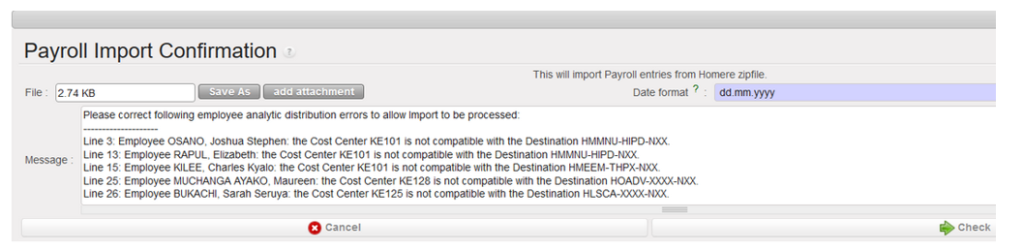
PAYE_UNIFIELD and PAYE_SAGA Import: request to have all the import error messages at once
When we import the payroll file in Unifield, the file import can be unsuccessful because of errors in Budget lines in the import file and Unifield was reporting the error messages one by one bringing confusion for the users
In this request we have requested to have all the wrong messages at once when the import fails:
This will help to spot the errors to correct in HOMERE.
When a register line is created, the state is draft. You can review and post it temporarily in the journals, pending for final approval. The register line becomes {Temp} in the register and the corresponding journal entries created unposted in the journals. Hard-posting the {Temp} register line will change the register line state to {Hard} and post the journal entries.
How to Temp-Post Register Entries
UniField allows you to temp post a register entry individually using the button located on the entry line, but you can also temp post entries by grouping several entries. The below task description explains how to temp post a group of draft entries.Go to: Accounting/Registers
Select the register where you want to temp post entries.
Click on the button to retrieve draft entries booked in your register. A list of {Draft} entries appears
Check the entry box to select it.
Temp-posting entries search wizard
Selecting the action of {Temp Posting} will only temp post the entries you can see directly from the list. For instance, if you have 29 lines to be temp posted, you will only see 20 lines of 29 and if you clicked on {Temp Posting} you will only temp post the 20 visible lines unless you extend the list if you wanted to temp post the 29 lines.
Extending the list in order to temp post all draft entries
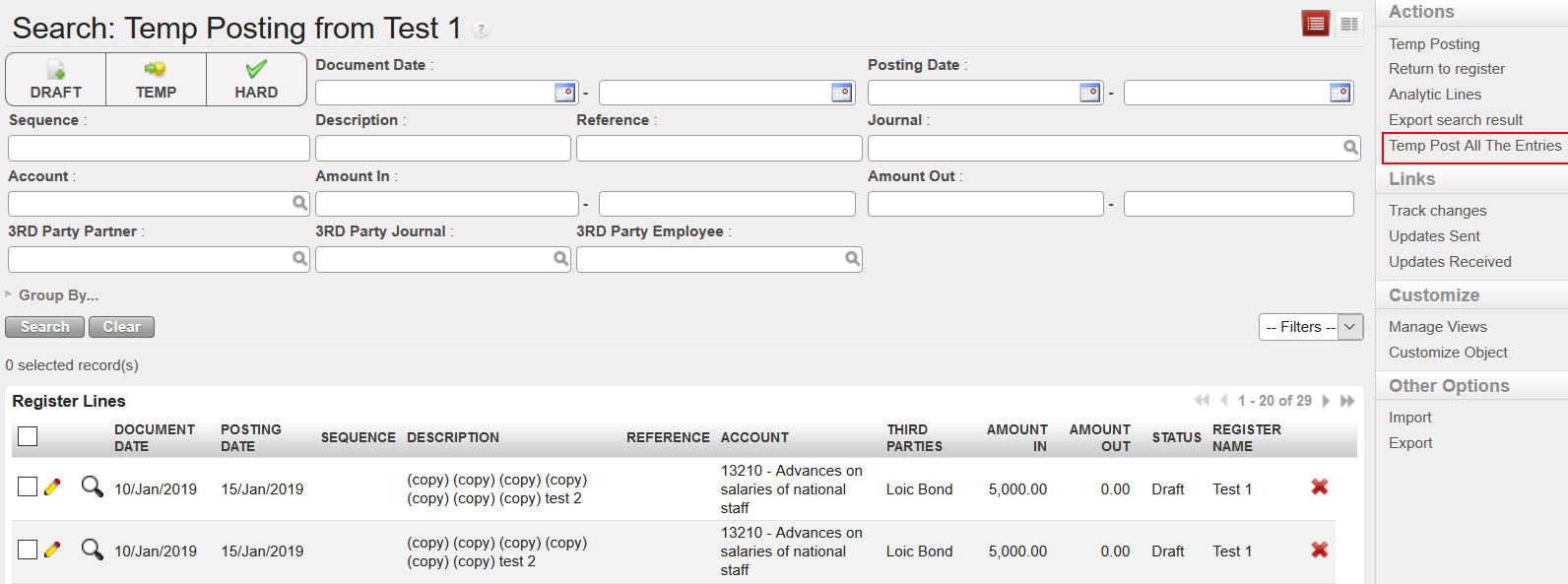
If you have many lines to be temp posted and you are sure you want to temp post all of them, you can select the option of {Temp Post All the Entries} from the right side menu and all the draft entries will be temp posted without the need to extend the list of lines.
Temp post all the entries with the need to extend the list
4. Go to the Action menu on the right side of the screen and select the action {Temp Posting}.
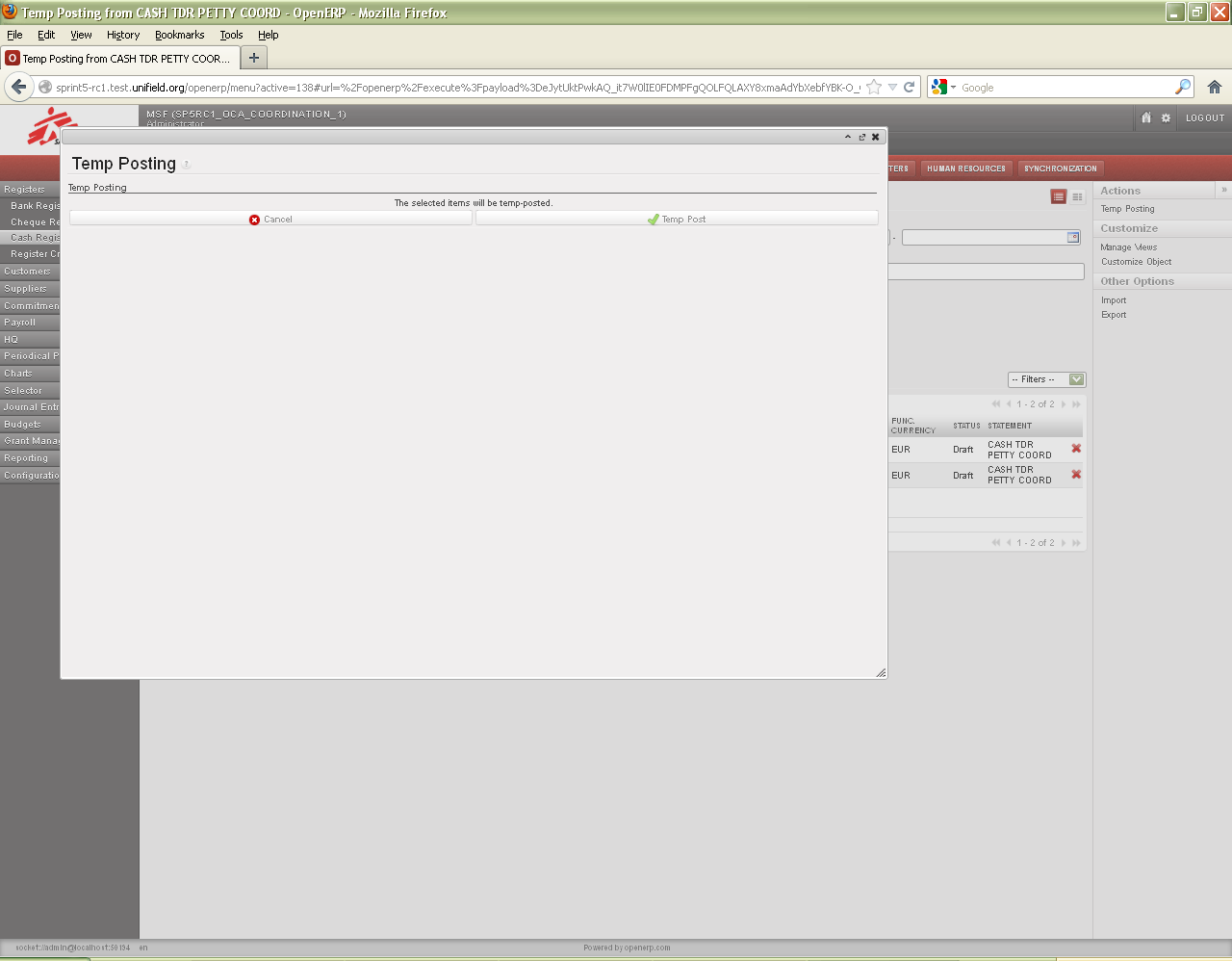
Temp-posting confirmation
5. Confirm the action selecting {Temp Post}.
The window closes. The entries are now in {Temp} state. An authorized user can still edit and delete them in the register. The entries became accounting entries and are reflected in the {Journal items} as valid but unposted.
Temp posted register entries
To look at the entries created in the {Journal Items}:
In the {Journal Entries} module, you select {Journal Items} and the {Journal Items} Search view appears. You will see unposted and valid double entry accounting per transaction in booking and functional currencies.
{Journal item} view displayed unposted journal items corresponding to the register line which was temp posted
How to Hard-Post Register Entries
UniField allows you to hard post a register individually using the button located on the entry line, but you can also hard post entries by grouping several entries. The below task description explains how to hard post a group of temp posted entries.
Go to: Accounting/Registers
Select the register where you want to hard post entries.
Click on the button to retrieve temp and draft entries booked in your register. A list of {Temp} and {Draft} entries appears
Check the entries boxes.
{Hard-posting entries search} wizard
4. Go to the Action menu on the right side of the screen and select the action {Hard posting}.
Hard-posting confirmation
5. Confirm the action selecting {Hard Post}.
The window closes. The entries are now in {Hard} state. The entries are reflected in the {Journal items} as valid AND posted.
Selecting the action of {Hard Posting} will only hard post the entries you can see directly from the list. For instance, if you have 42 lines to be hard posted, you will only see 20 lines of 42 and if you clicked on {Hard Posting} you will only hard post the 20 visible lines unless you extend the list if you wanted to hard post the 42 lines.
Extending the list in order to hard post all draft entries
If you have many lines to be hard posted and you are sure you want to hard post all of them, you can select the option of {Hard Post All the Entries} from the right side menu and all the Temp posted entries will be hard posted without the need to extend the list of lines.
Hard Post all the Entries
Hard posted register entries
In the {Journal Entries} module, you select {Journal Items} and the {Journal Items} Search view appears. You will see valid AND posted double entry accounting per transaction in booking and functional currency.
Posted journal items corresponding to the register line which was hard posted. A/P was reconciled
We use cookies to ensure that we give you the best experience on our website. If you continue to use this site we will assume that you are happy with it.



 button located on the entry line, but you can also temp post entries by grouping several entries. The below task description explains how to temp post a group of draft entries.Go to: Accounting/Registers
 button to retrieve draft entries booked in your register. A list of {Draft} entries appears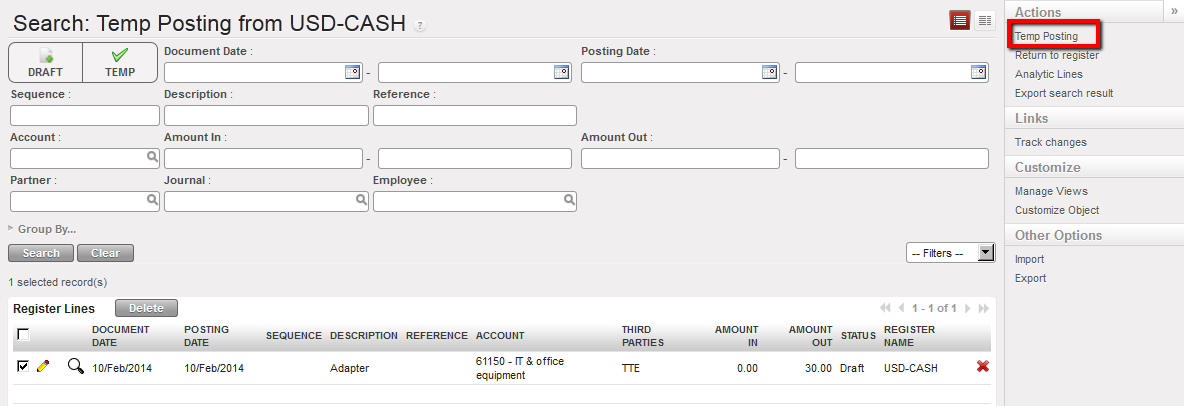

 Temp post all the entries with the need to extend the list
 Temp-posting confirmation
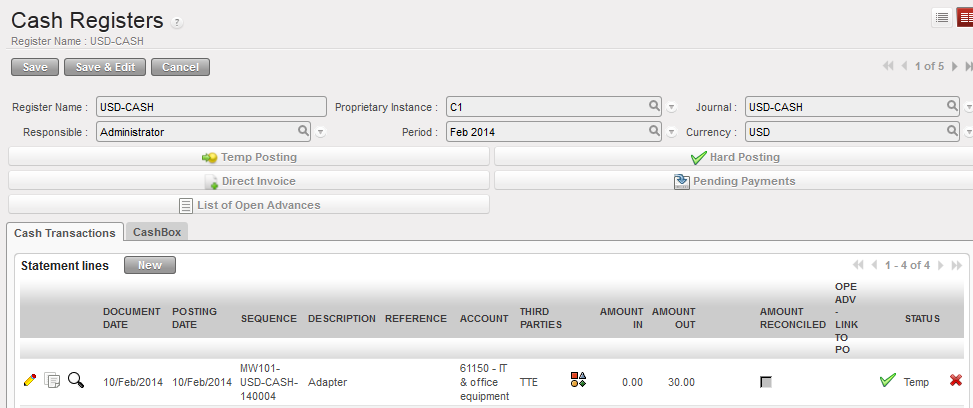 Temp posted register entries
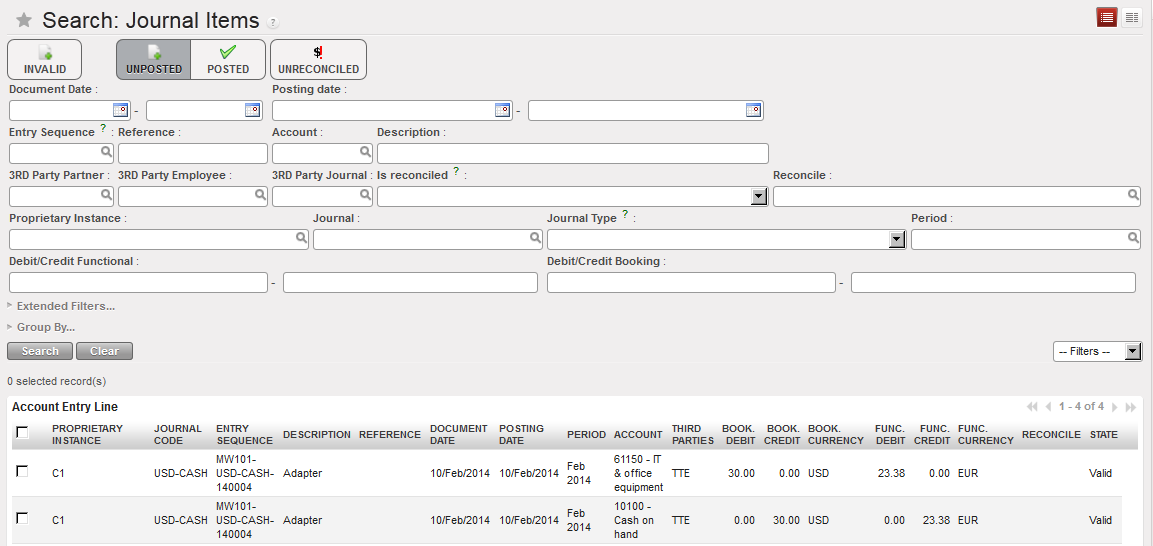 {Journal item} view displayed unposted journal items corresponding to the register line which was temp posted
 button located on the entry line, but you can also hard post entries by grouping several entries. The below task description explains how to hard post a group of temp posted entries.
 button to retrieve temp and draft entries booked in your register. A list of {Temp} and {Draft} entries appears
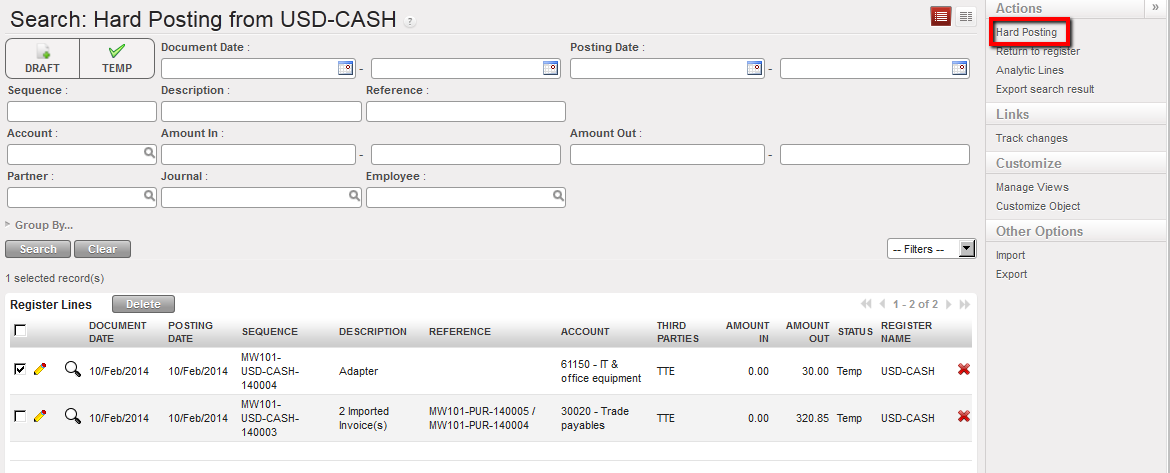 {Hard-posting entries search} wizard
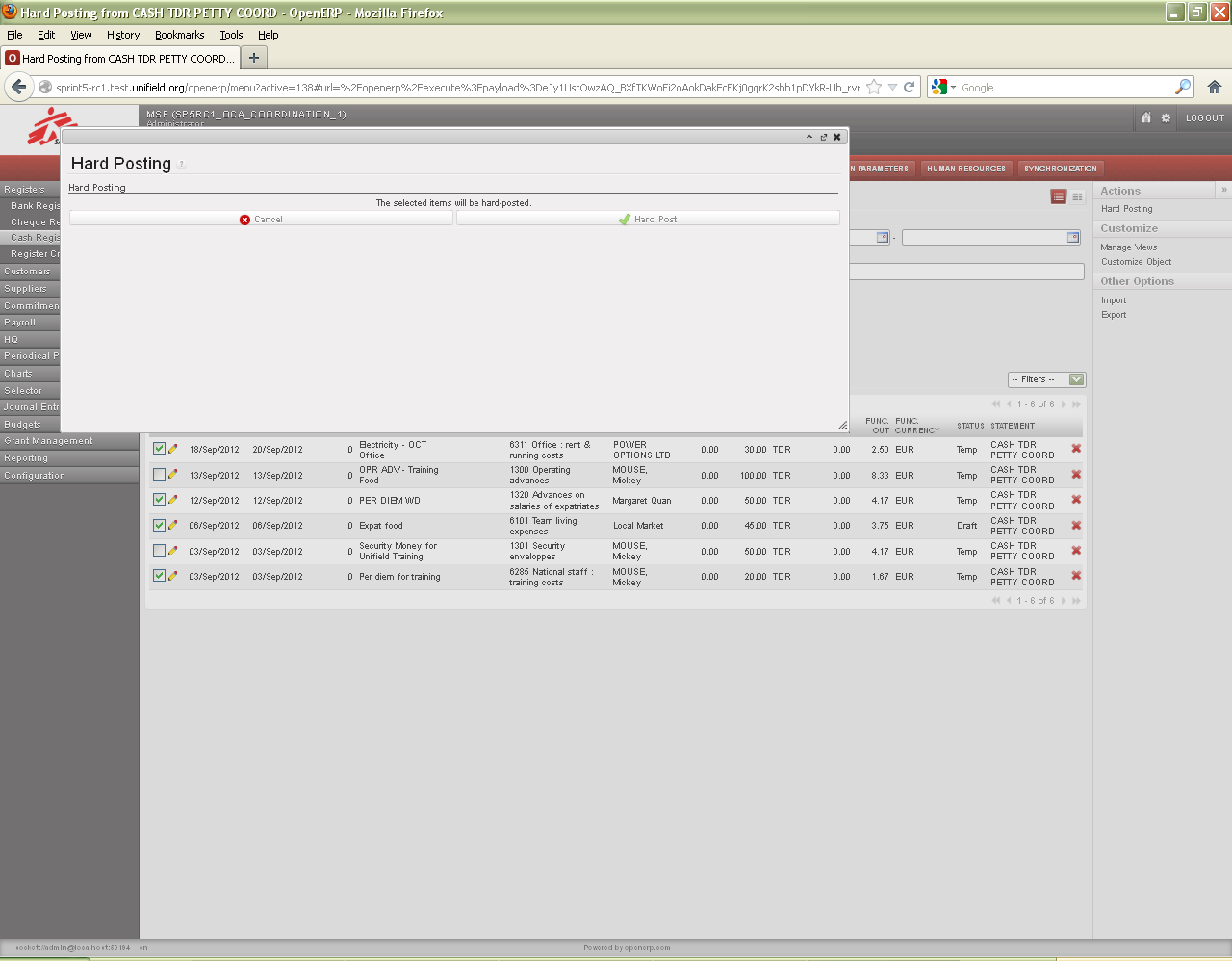 Hard-posting confirmation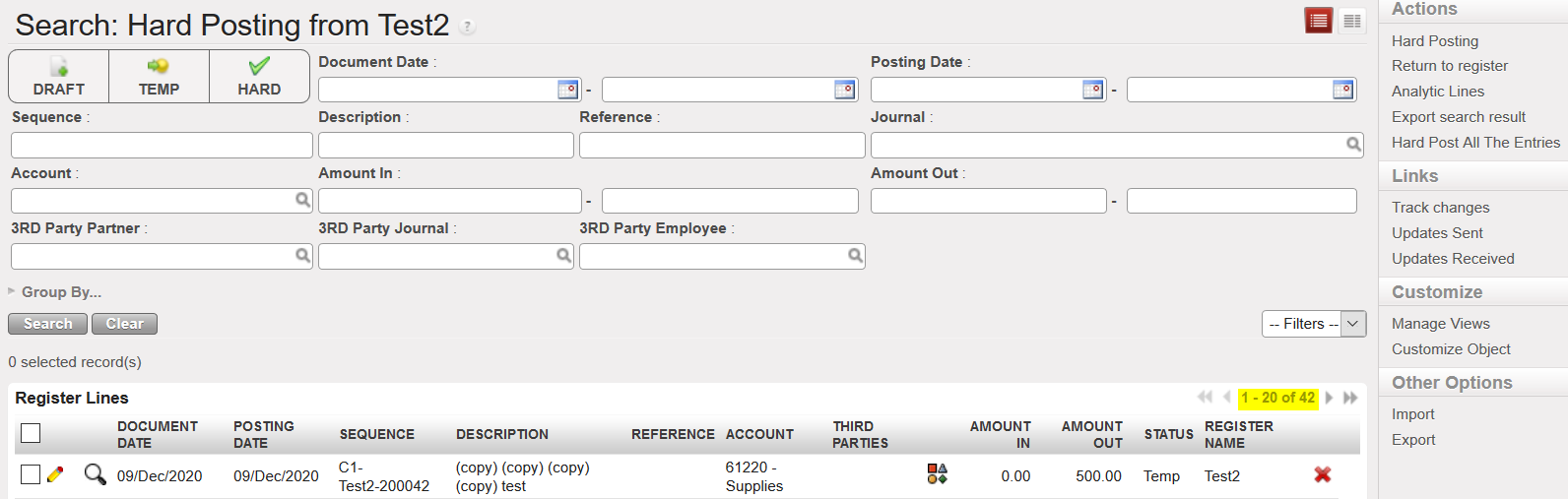
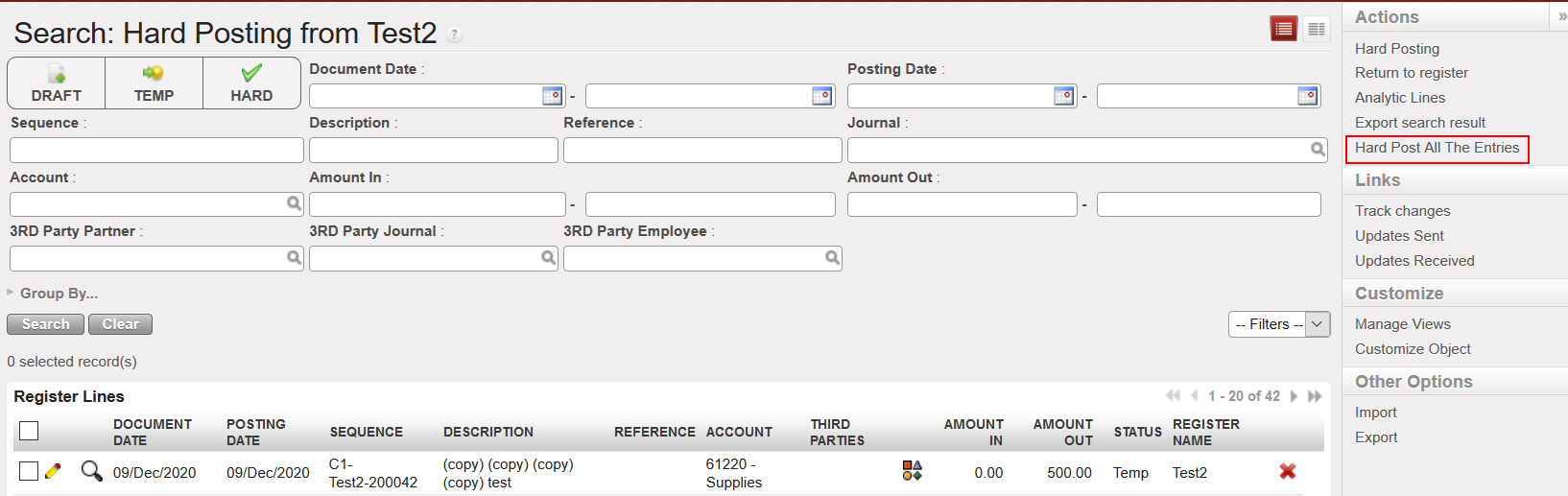 Hard Post all the Entries
 Hard posted register entries
 Posted journal items corresponding to the register line which was hard posted. A/P was reconciled