
Finance User Manual ENG -> 3. Payments.
LUFI-30210 INACTIVATION LIQUIDITY JOURNALS AND THEIR CORRESPONDING REGISTERS
How to inactivate liquidity journals and their corresponding registers ?
We can create a liquidity journal with its correspondent register and we can also deactivate the journal and its register. The purpose of the journal deactivation is to avoid opening a register by mistake in a new period and also to permit its reactivation in the future if needed.
The conditions to allow the inactivation of liquidity journals are the following:
For liquidity journals, before allowing inactivation check:
- all registers have been closed.
- all manual journal entries have been posted.
- the balance of the last register is zero.
For non-liquidity journals: all entries have been posted on the journals.
If all above requirements are not applied, you will receive the warning message “Please close the registers linked to the journal XXXXX before inactivating it”
To do deactivation you have to proceed as below:
Go to > Accounting > Configuration> Financial Accounting> Journals > Journals
There are 2 filters: “ACTIVE” and “INACTIVE”. You will have the “ACTIVE” filter by default, showing the active journals.
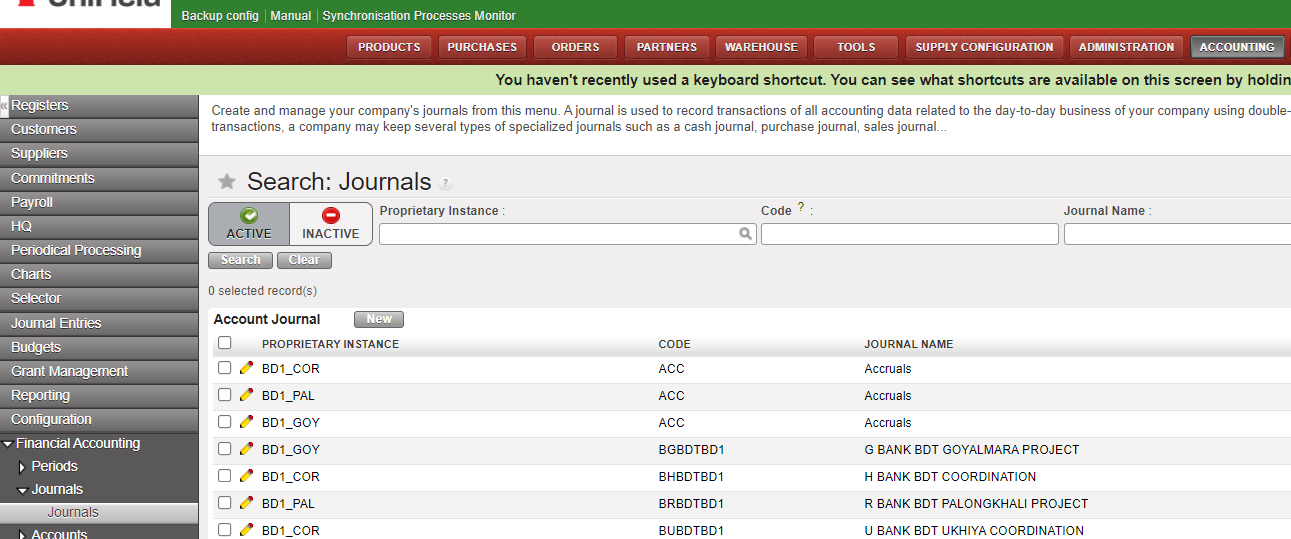
The process of deactivation:
- Select the register
- Click on Edit

- Tick off the box “Active”

- Click on “Save”
Once the journal changed to [inactive], it can not be used anymore in the interface:
- as third party of an entry.
- to book a manual journal entry.
- we can not import a file to the journal from a manual journal entry.
- the creation of a journal with the same code as an inactive journal it is not allowed.
It is not allowed :
- the selection of inactive journals in the invoices.
- the duplication of JE and invoices on inactive journals (note: we can’t create them with an empty journal as it is a mandatory field).
- the re-opening of a register on an inactive journal.
- the selection of inactive journals in the Recurring Models.
- the inactivation of a journal if a Recurring Plan which isn’t “Done” uses it.
- the selection of a Recurring Model on an inactive journal, in the Recurring Plans.
- the duplication of a Recurring Model on an inactive journal / of a Recurring Plan using a Recurring Model on an inactive journal.
- the selection of inactive journals as Refund Journal in the Refund Wizard.
- the Refund Type “Modify” for the invoices booked on an inactive journal.
LUFI-30209 Register Entries Actions
LUFI-30209 Register Entries Actions
LU Introduction
Register Entries, depending on their status, can be edited and deleted.
How to Edit and Delete Draft and Temp-Posted Direct Entries
Direct entries in {Draft} or {Temp} status can be edited or deleted. Click on the  pencil to edit the relevant fields. To delete a direct entry, click on the Red Cross
  . Deleting temp posted entries will also delete the associated journal entries and entries synchronized to other instances.
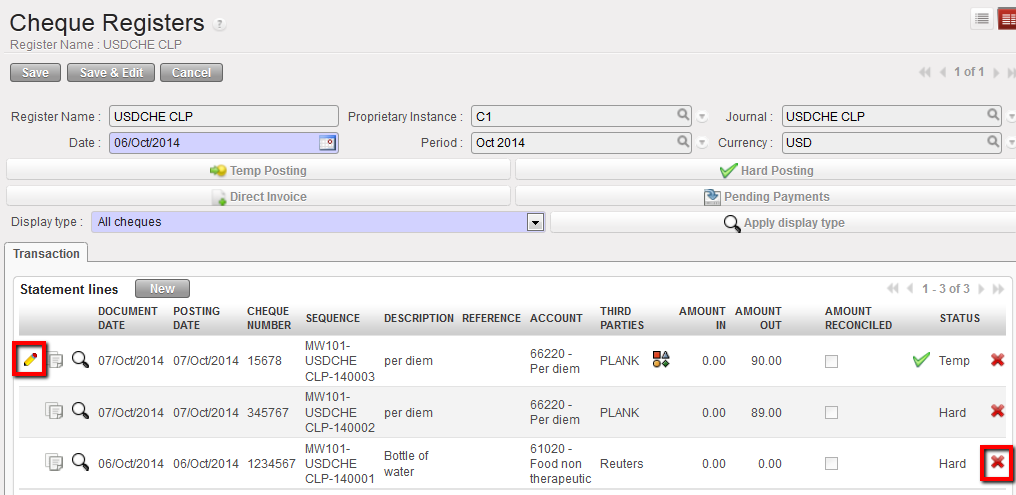
Direct entries in draft or temp status can be edited or deleted.
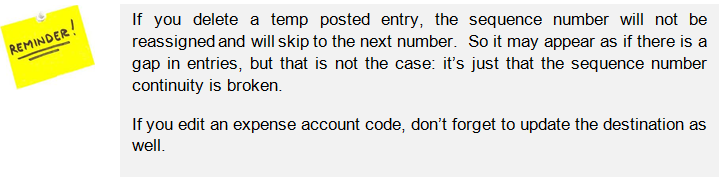
How to Edit and Delete Temp-Posted Direct Invoices
The validation of the direct invoice automatically creates a temp posted payment entry to a payable account in the register. Since the direct invoice is still in Draft status, edition can be made directly to invoice lines (description, product, price, quantity, account, AD).
Go to: Accounting/Registers
- Search for the register entry for the imported direct invoice which needs to be corrected. Click on the invoice icon.
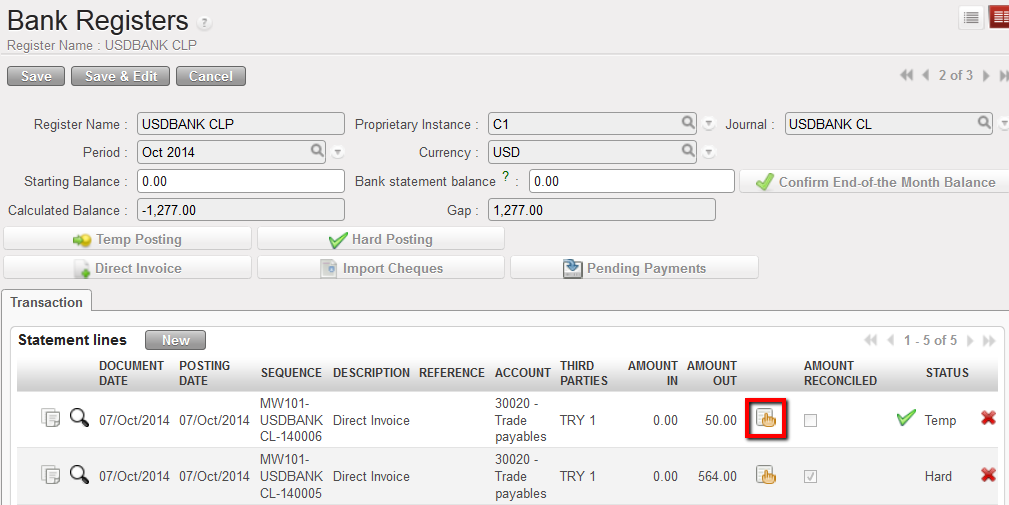
Open the Direct Invoice from Registers
2. A window opens displaying the Direct Invoice in Draft status. Invoice lines can be edited or deleted. Below we want to change the unit price to 6.00. After corrections are made, click on Compute Total and then Validate.
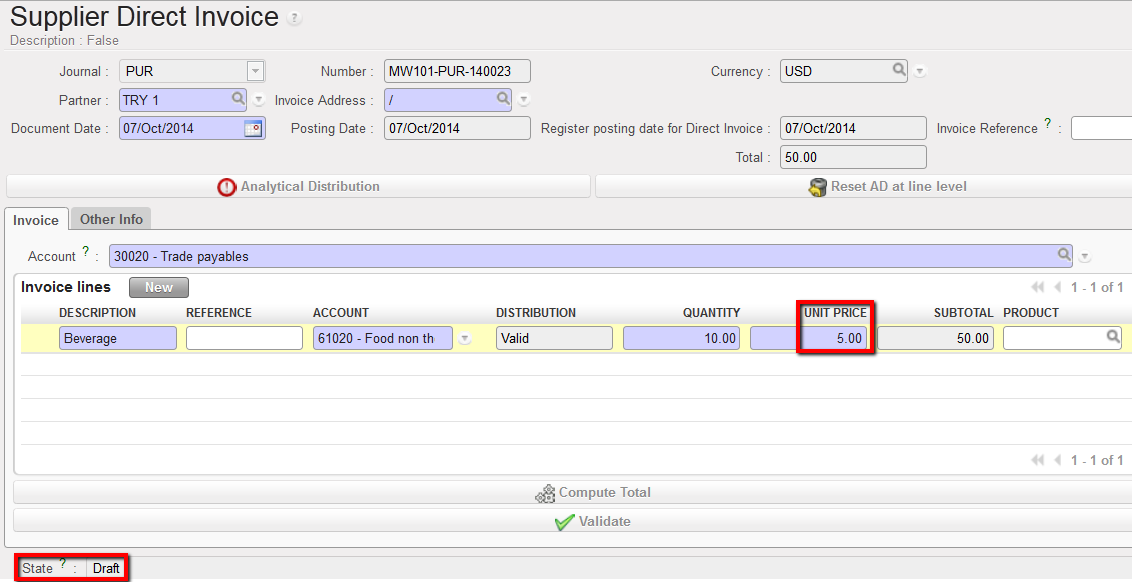
Edition of a draft Direct invoice and changing the unit price
3. The register line is updated.
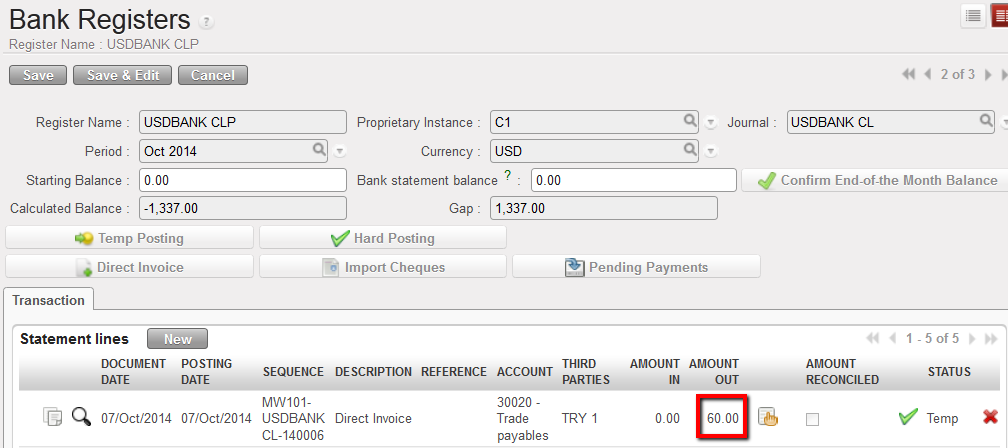
Register amount is updated
If you need to delete the Direct Invoice in {Temp} state, you must select the  on the register line.
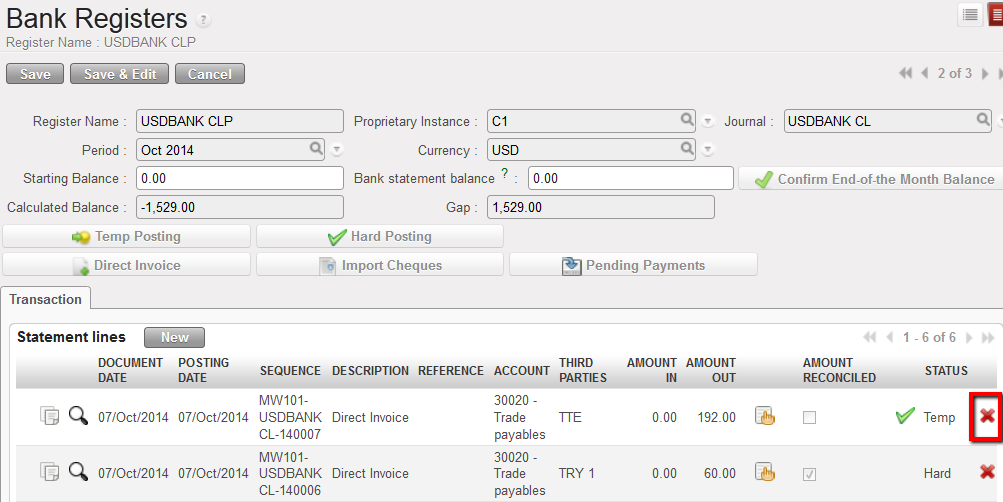 Deletion of a Direct Invoice in Temp state in a register
How to Edit Temp-Posted Imported Cheques into a Bank Register
If an incorrect cheque has been imported into the bank register and in Temp status, then the register entry simply needs to be deleted and the correct cheque imported.
Go to: Accounting/Registers/Bank Registers
- Open the bank register in edit mode. Search for the register entry that was imported incorrectly. Click on the red cross
 to delete.
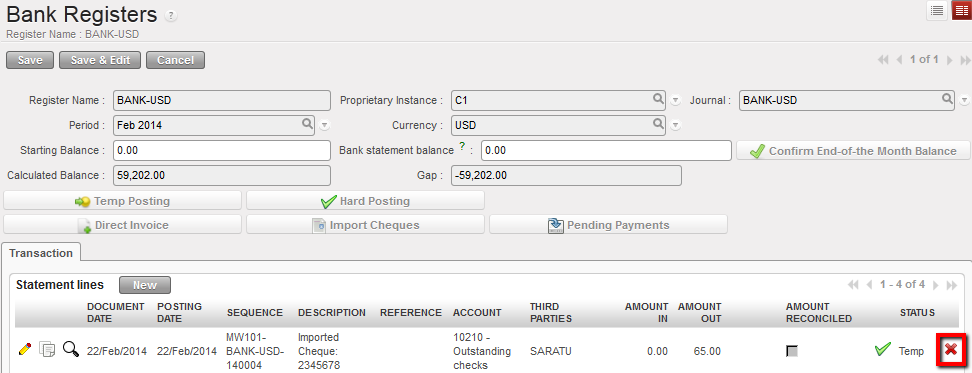
Delete the incorrectly imported cheque
2. The incorrect cheque is deleted from the bank register. Click on {Import Cheques}. Notice that the incorrect cheque is available again to import. Select the correct cheque to import.
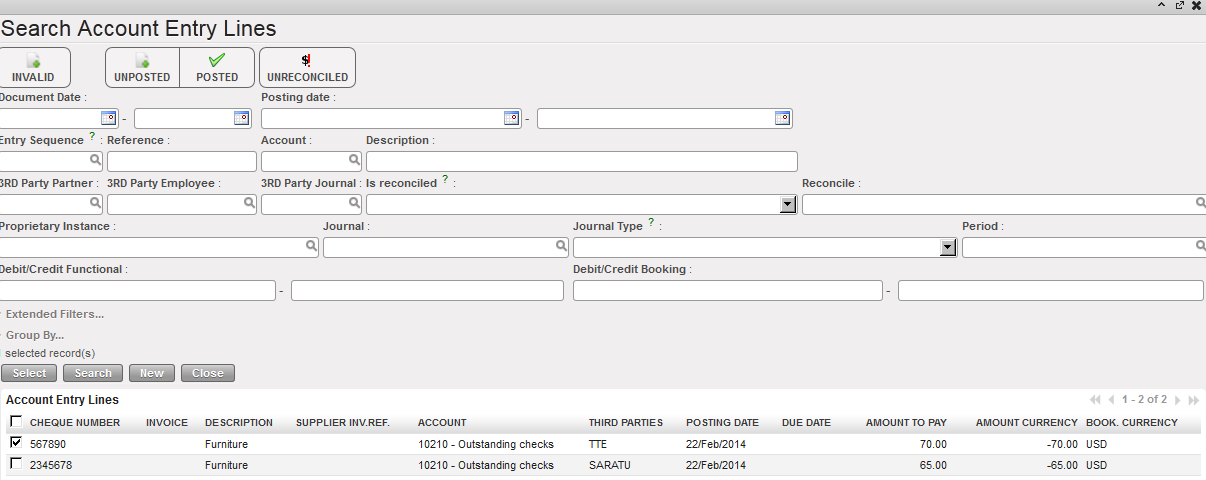
Select the correct cheque to import
How to Duplicate Register Entries
Go to: Accounting/Registers
- Select the register where the entry to be duplicated is booked
- Click on the
 icon located on the entry line you want to duplicate.
The register line is duplicated
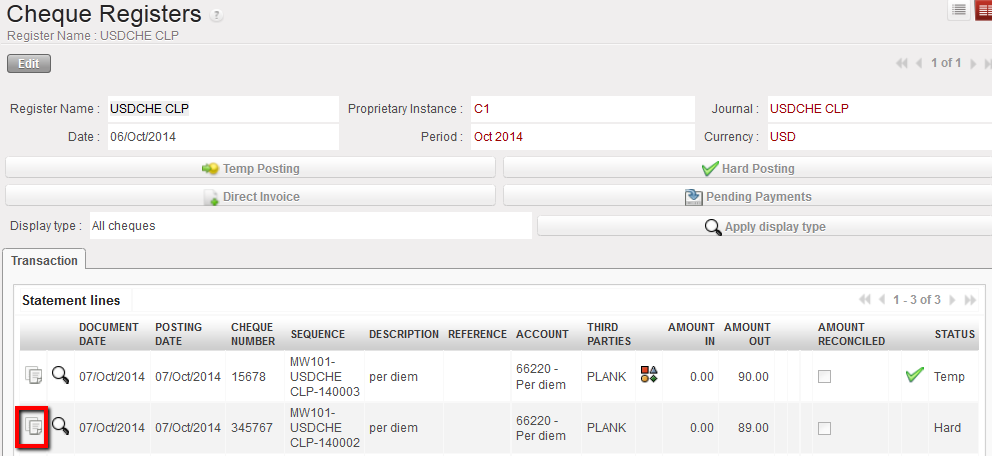
3. The analytical information is also duplicated. If required, edit the new entry.

How to View the Analytic Distribution of a Register Entry
Go to: Accounting/Registers
- Locate the register where you want to see the analytic distribution
- Click on the
 icon
icon
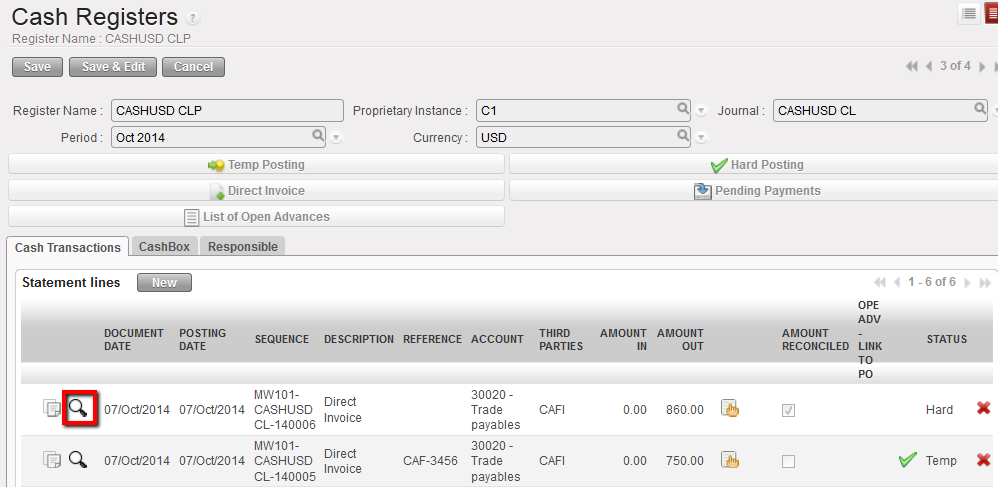 Magnifying glass to open the analytic journal items view
The analytic journal items window opens
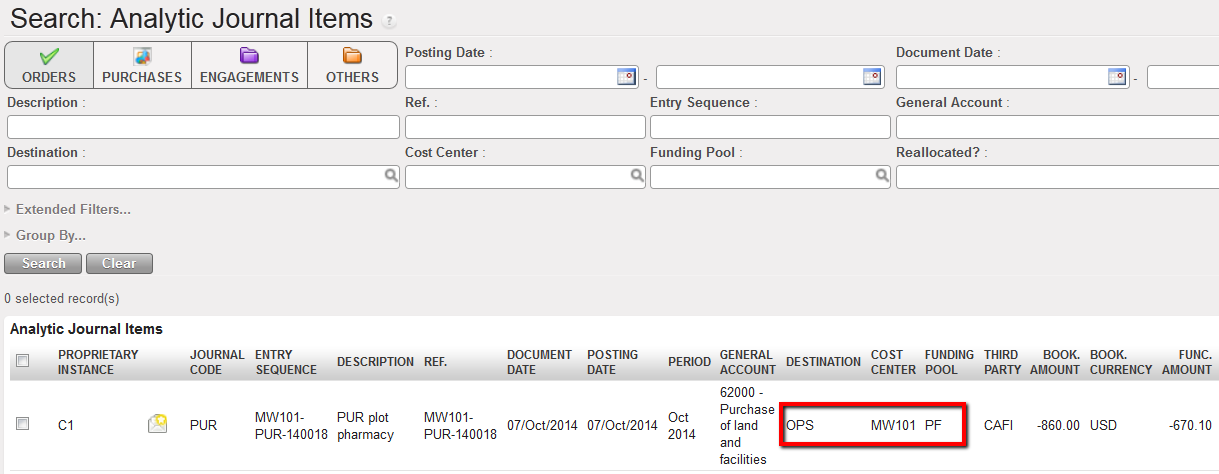 Analytic journal items search view