How to Do a Mass Re-Allocation in Analytical Journal Items
The mass reallocation functionality allows you to change the analytic distribution on analytic journal items en masse, e.g. correcting cost center, destination, funding pool and free axis for multiple entries.
Go to: Accounting/Journal Entries/Analytic Journal Items
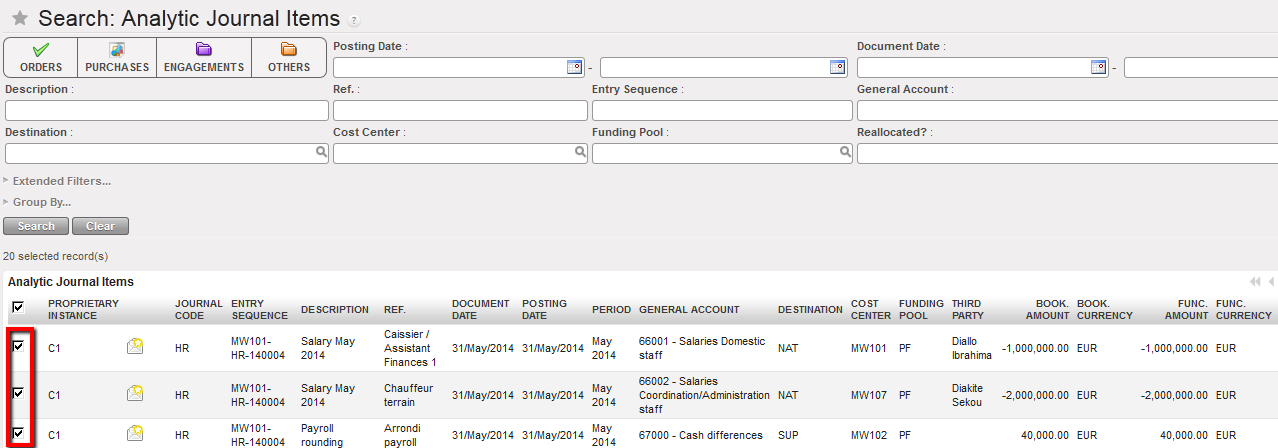
Search for the analytic journal items that you need to reallocate. You can also search in Analytic Selector. Select the entries by ticking the checkbox.
Selecting analytic journal items to reallocate
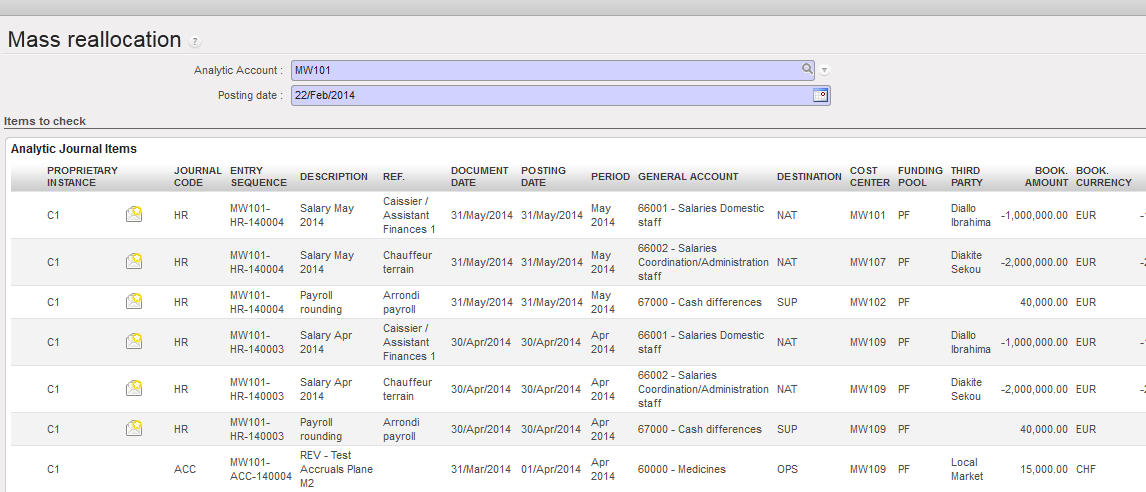
In the Actions menu on the right-hand side bar, click on {Mass reallocation} to allocate tick box selected items or {Mass re-allocation – All search results} to allocate all search results matching your search criteria. The selected entries display in the top pane of the window. Enter a posting date. Click on the magnifying glass on Analytic Account.
Select the desired analytic account.
Mass reallocation window
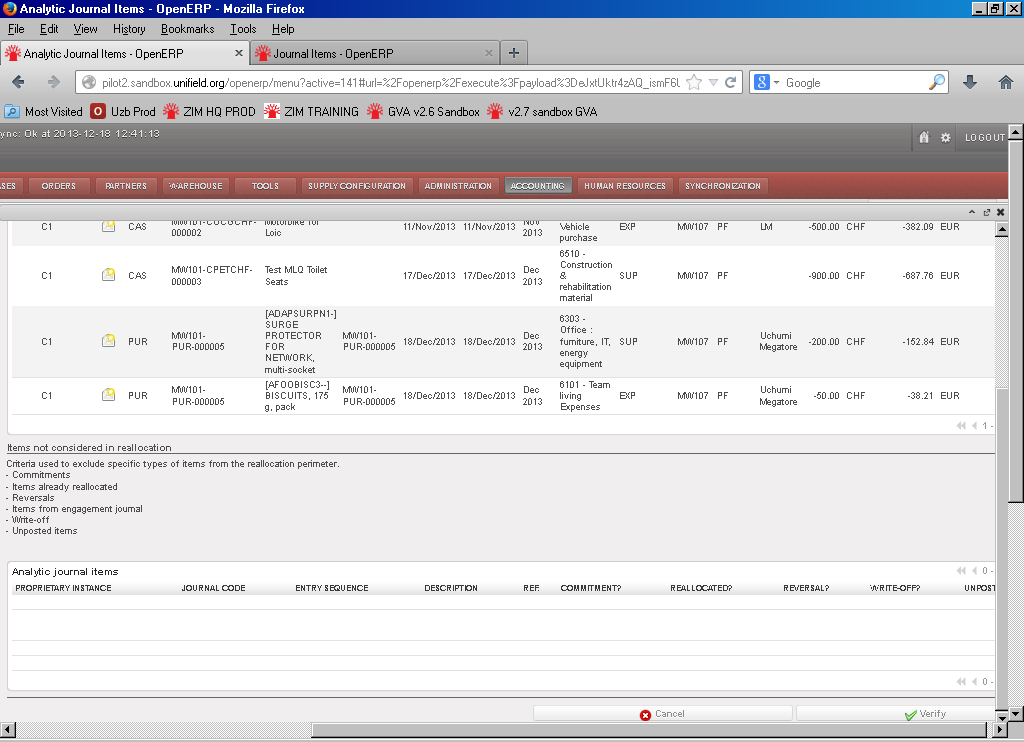
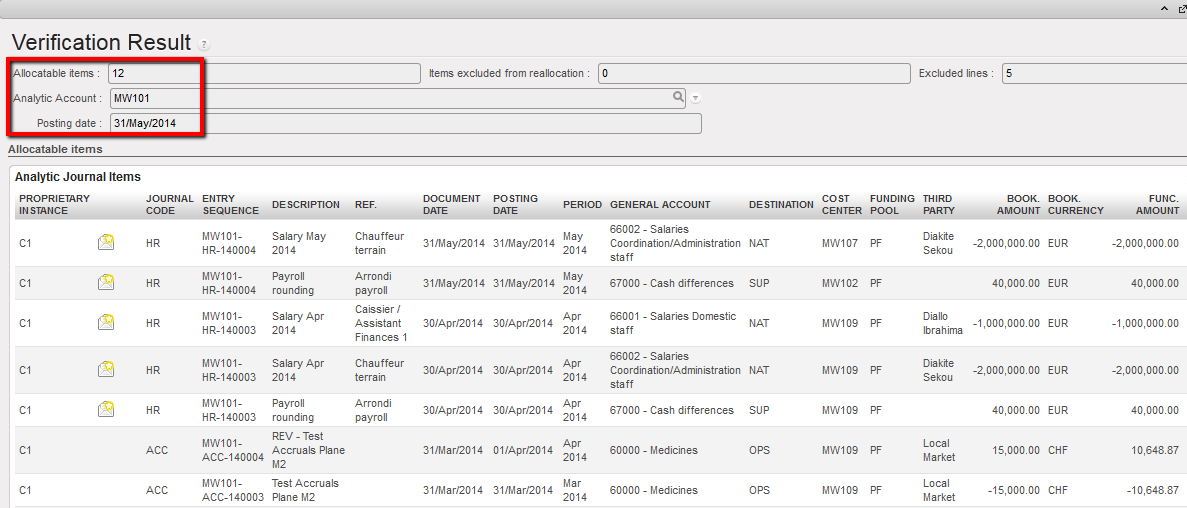
Click on . UniField will perform a check on all selected entries to confirm that the reallocation can be applied. A Verification Result window will open showing the items to allocate in the top pane and the items not part of the selection in the bottom pane. Items not considered in reallocation include:
Commitments
Items already reallocated
Reversals
Items from engagement journal
Write-off
Unposted items
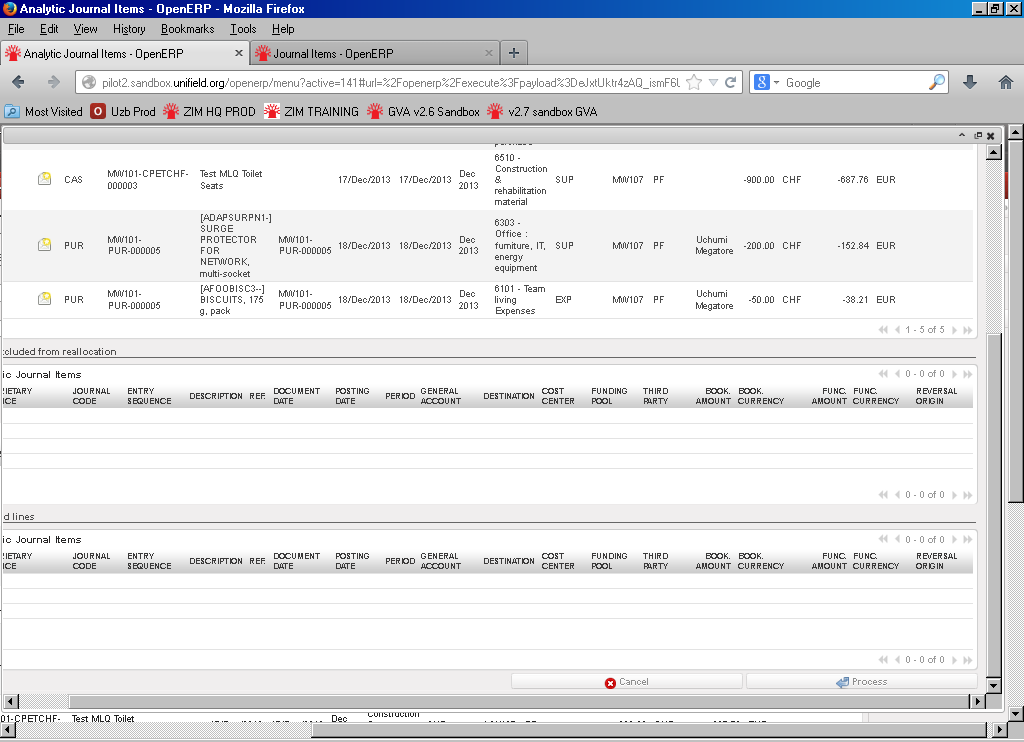
Verification result window
Click on to reallocate the entries. In Analytic Journal Items, you can search for the entries to confirm the change has been made.
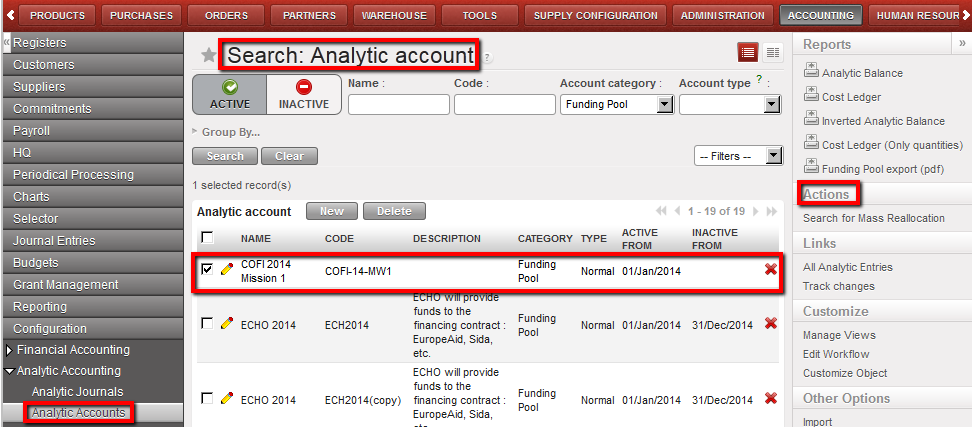
There is another way to perform mass reallocation on funding pools:
From the analytic accounts list view, select the analytic account (funding pool) to which entries should be reallocated
Selection of a funding pool in the Search Analytic Account view and Reports menu opening
On the right-hand side panel, in the Actions menu, click on .
The system will look for all entries that can be reallocated to this analytic account.
Follow the same mass reallocation steps: select the items to reallocate and process.
You can also perform a mass reallocation on free axis following these steps:
From the Free 1 (or 2) view, select the analytic journal items that you need to reallocate
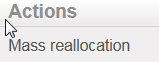
On the right-hand side panel, in the Actions menu, click on .
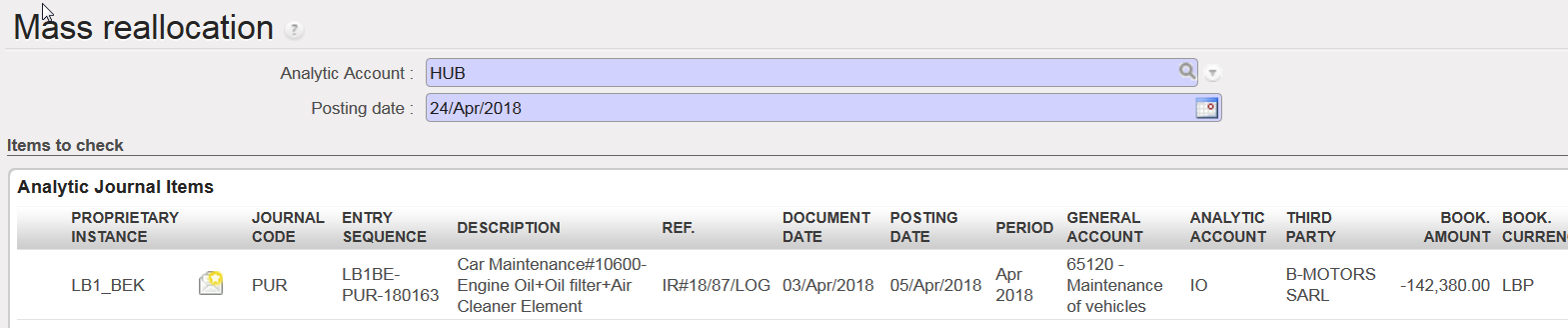
If you reallocate a Free 1 axis, the system will look for all analytic accounts set as Free 1 existing in the database. The same applies for Free 2 axis. Select an account and press “Verify” to check if the account is valid and “Process” to record the new allocation.
Analytic account selection for a Free 1 mass reallocation
This section addresses corrections when the cheque is imported into the bank register, i.e. the wrong cheque has been imported and the corresponding bank register line is hard-posted.
How to Correct Hard-Posted Cheque Imported in Bank Registers
If an incorrect cheque has been imported into the bank register and hard-posted, the correction is a two-steps process.
For the first step, a reversing entry needs to be created in the cheque register to cancel the payment, and then imported into the bank register to adjust the balance. The second step will be to import the correct cheque into the bank register.
Next, you will create again the cheque which was wrongly imported so that you can reconcile it when it is cashed at your bank.
Go to: Accounting/Registers/Bank Registers
First step:
In the bank register, identify the incorrectly imported cheque.
Incorrectly imported cheque in bank register
Go to: Accounting/Registers/Cheque Registers
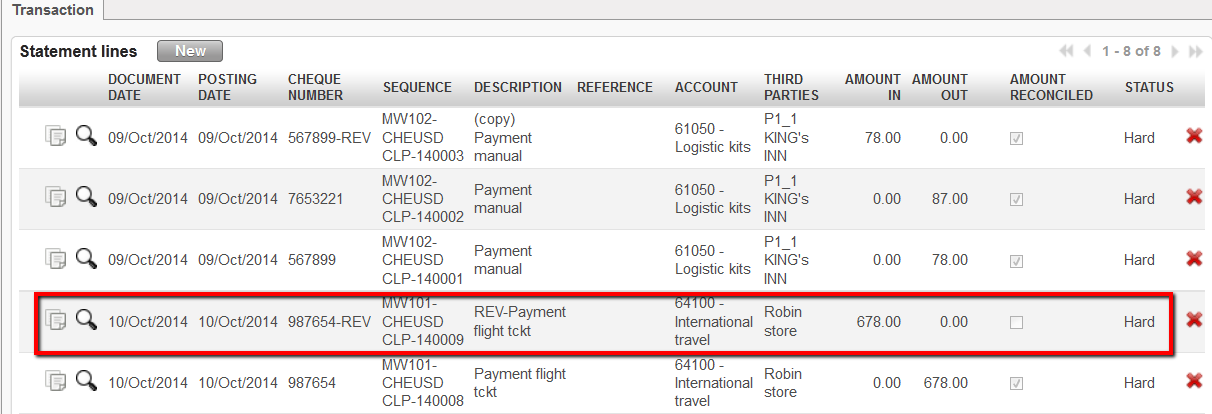
In the cheque register, click next to the incorrect cheque to duplicate the entry.
Duplicate the incorrect cheque in the Cheque Register
Edit the duplicate entry to show that it is a reversal. Delete the {Amount Out} and enter the same value in {Amount In}. Hard-post the entry.
Duplicate the incorrect cheque in Cheque Registers
Go to: Accounting/Registers/Bank Registers
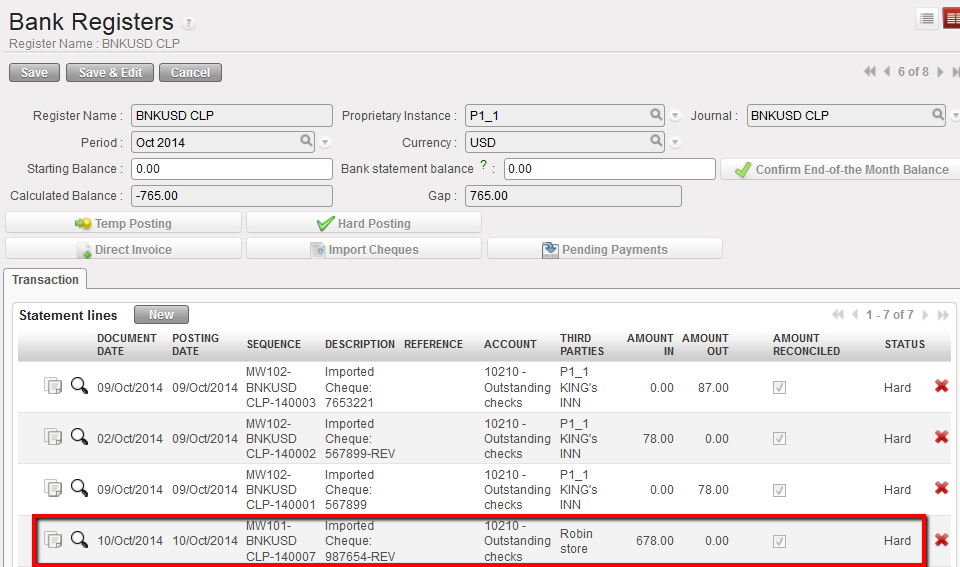
Import the reversal cheque into the bank register which should cancel the payment and restore the bank balance. Hard post-it.
Import the reversal cheque into the bank register to cancel the payment
The Journal Items are:
The original entry in the cheque register (cheque payment):
Debit to the expense account code
Credit to 10210 Outstanding cheques
When the cheque is imported into the bank register (bank reconciliation):
Credit to bank account to reduce the bank balance
Debit to 10210 Outstanding cheques to reconcile the cheque, 10210 reconciled
The reversing entry in the cheque register:
Credit to the expense account code to reverse the original entry
Debit to 10210 Outstanding cheques
When the reversing cheque is imported into the bank register:
Debit to bank account to restore the bank balance
Credit to 10210 Outstanding cheques to reconcile the reversing cheque
Journal Items from original and reversing cheque imported into bank registers
Second step:
For the second step, a corrected cheque will need to be created in the cheque register and hard-posted. If the entry in the cheque register was for a:
Direct Entry: duplicate the original cheque (incorrectly imported) with the same cheque number and with the correct information
Supplier Invoice: refund the invoice to reverse the invoice lines and trade payables, then create a new invoice with the correct information (Supplier Invoices paid in Registers, hard-posted)
Direct Invoice: refund the invoice to reverse the invoice lines and trade payables, then create a new invoice with the correct information (Direct Invoices imported in Registers, hard-posted)
How to Correct Direct Invoices Imported in Registers, Hard-Posted
When the register line corresponding to a Direct Invoice is Hard-posted, the status of the invoice changes from {Draft} to {Paid}. The entry cannot be edited or deleted any more.
If a correction needs to be made on the account code or analytic distribution of an invoice line, the user can click on the link to the analytic lines associated with the Direct Supplier invoice to use the Corrections Wizard (See Supplier Invoice paid in Registers, hard-posted).
Link to analytic journal items to make correction to account or AD
If a correction needs to be made on the following fields, use the Refund (non-editable) functionality (See Supplier Invoice paid in Registers, Temp and Hard-posted).
Product
Price
Quantity
Supplier
Document date
Currency
Refund functionality on a Direct Supplier Invoice
Go to: ACCOUNTING/Suppliers/Supplier Direct Invoices
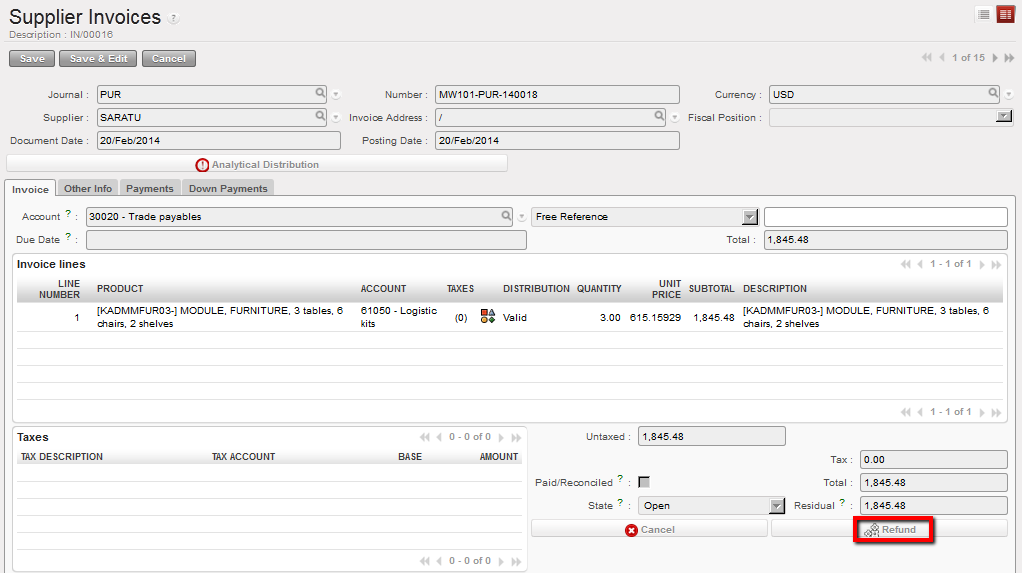
Open the paid Direct Supplier Invoice in Form view to refund it
Click {Refund}
Paid Supplier Invoice to be refunded
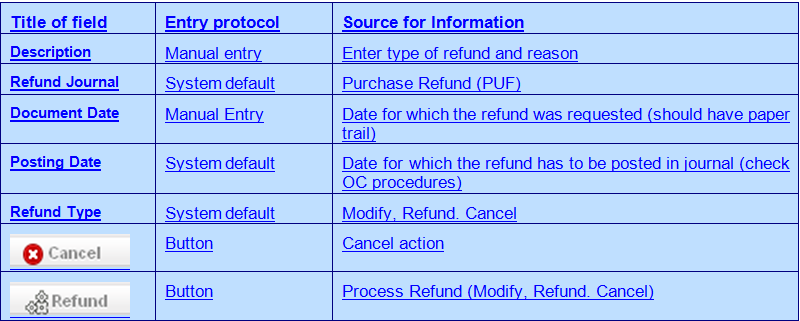
The Refund window opens for the user to complete the fields. In {Description}, explain what is being refunded and why. When you are done, press the {Refund} button.
Refund window
A new line appears in the Supplier Refund search window. The refund invoice is ready to be edited. The description of the invoice is copied from the entry made in the {Refund} window. Click on the pencil to open in Form view.
Supplier Refund automatically created
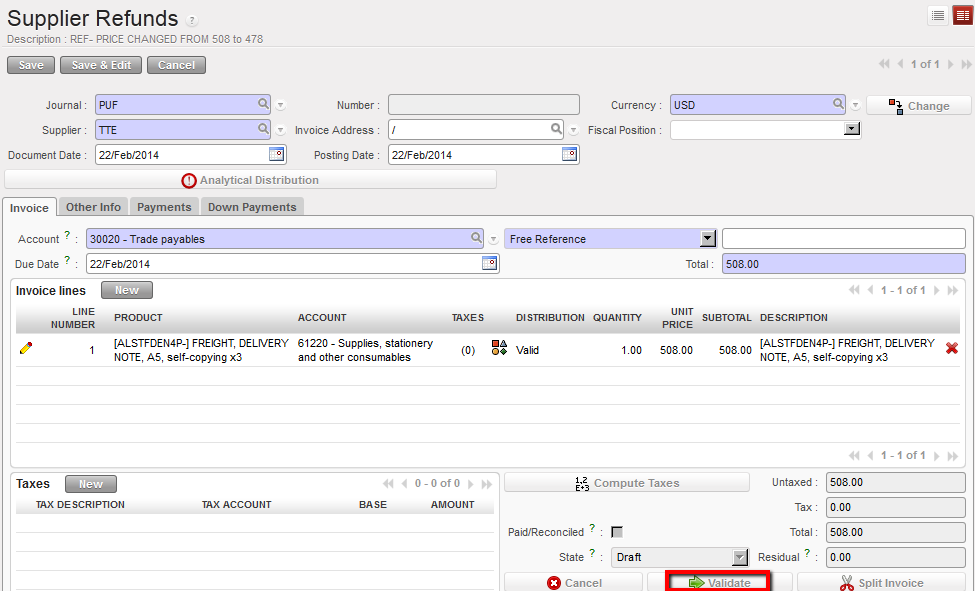
The Supplier Refund is a copy of the original direct invoice but the credit/debit amounts are reversed to cancel the original entries. Click {Validate} and the status changes from {Draft} to {Open}.
Supplier Refund is a copy of the original invoice with reversal credit/debit entries
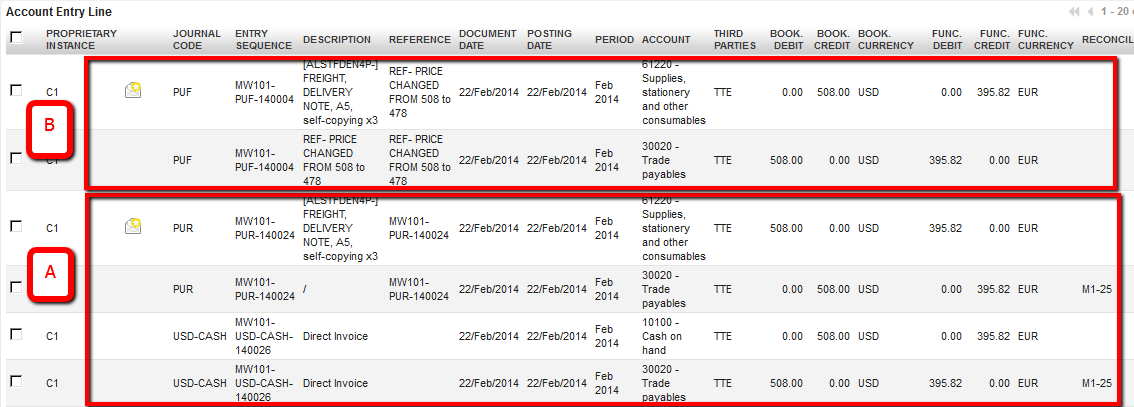
The Journal Items are as follows:
The original Supplier Direct Invoice when paid (register line hard posted):
Debit to the expense accounts for each invoice line
Credit to 30020 Trade Payables
Credit to the cash account to reduce the cash balance
Debit to 30020 Trade Payables to reconcile the outstanding payable
The Supplier Refund invoice validated:
Credit to the expense accounts for the amount refunded for each invoice line
Debit to 30020 Trade Payables
Journal Items from supplier direct invoice and supplier refund
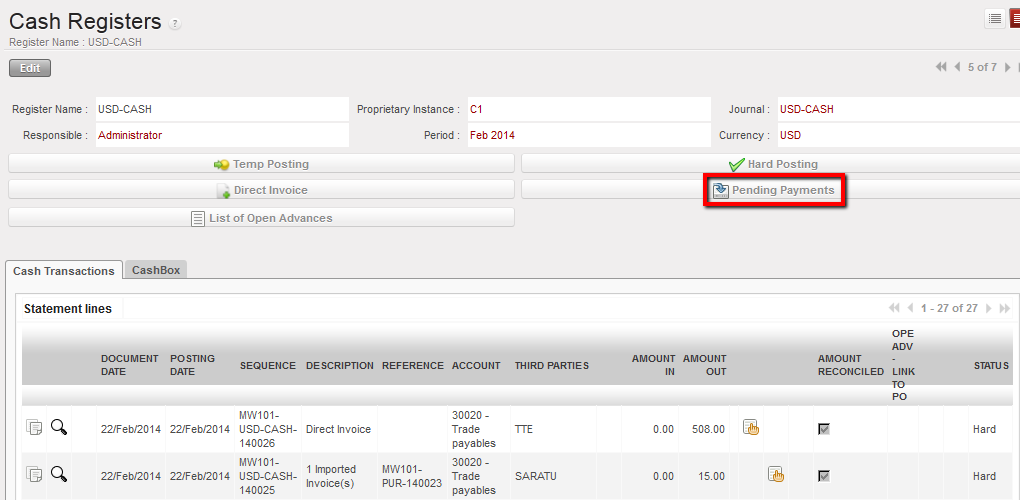
To completely reverse the paid invoice, you need to refund the cash balance in the register. Click on {Pending Payments} in Registers
Pending Payments in Registers
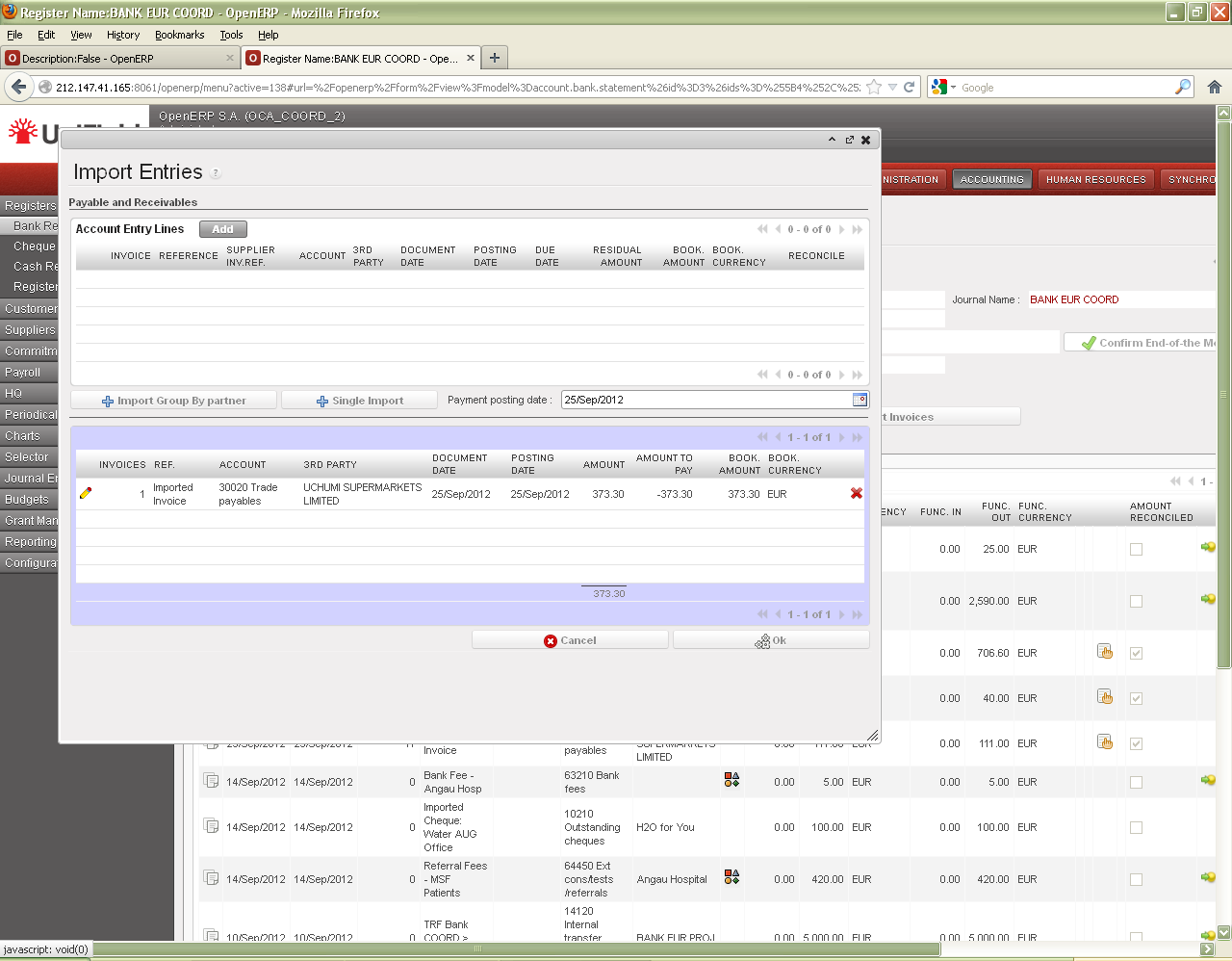
The {Import Entries} window opens. Click {Add}.
Import Entries
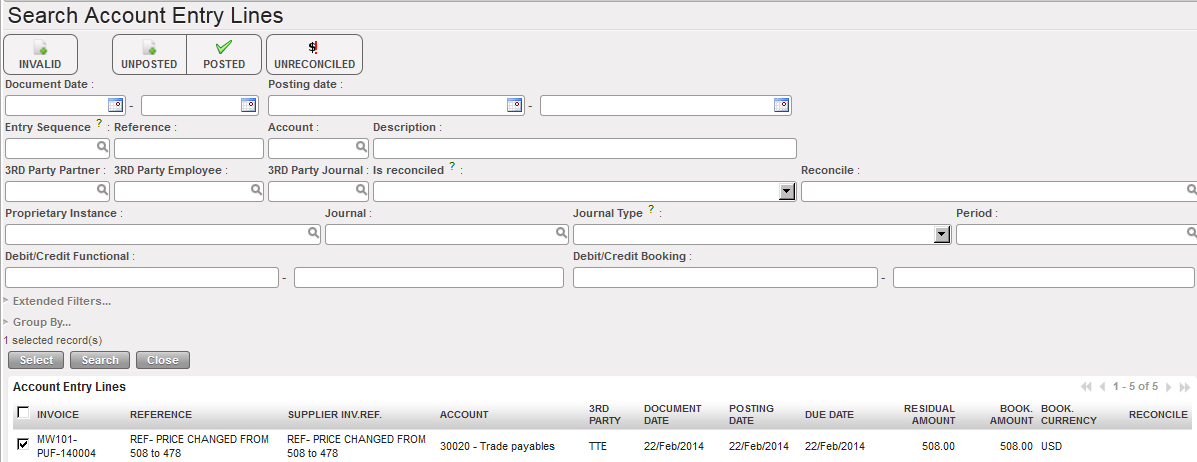
In the Search Account Entry Lines window, select the supplier refund invoice to import.
Selection of a refund invoice linked to a direct invoice
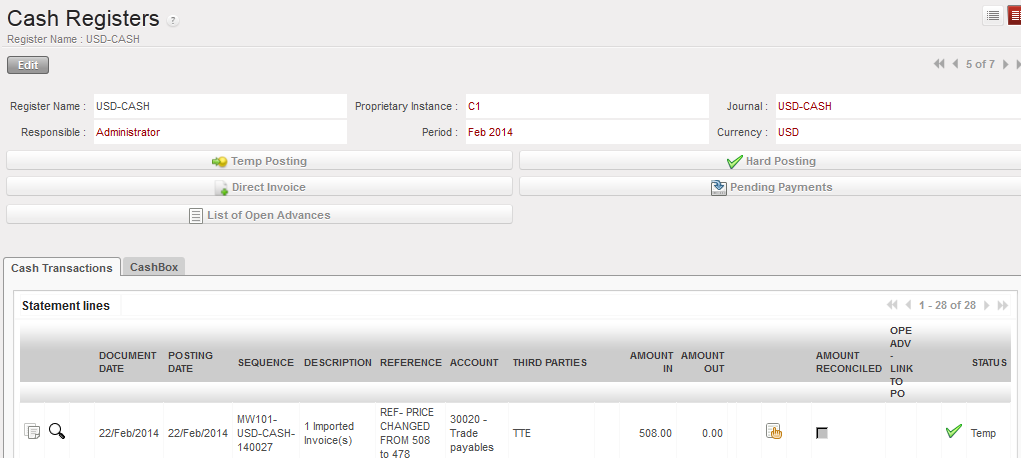
A register entry is created with the Amount In equal to the refund amount. This operation restores the cash balance to the amount before the invoice was paid.
Register entry created from refund
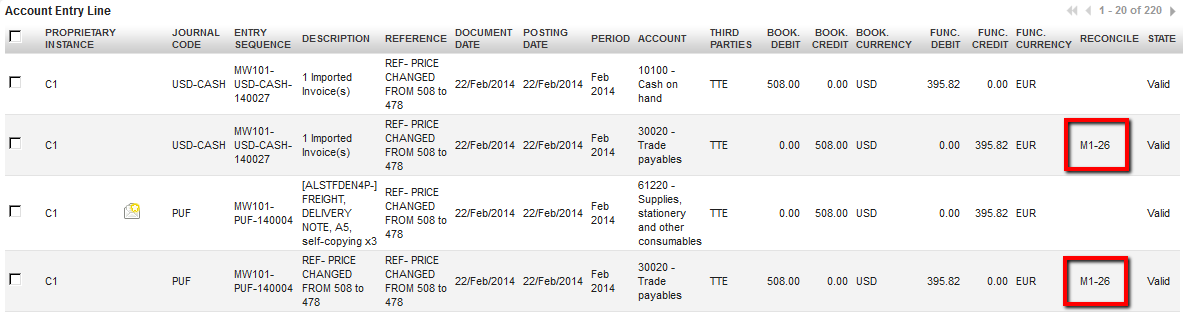
In Journal Items, double entries are created from the refund in the register:
Debit cash account to increase balance from Amount In
Credit 30020 Trade Payables
When the register entry is hard-posted, the Supplier Refund is marked {Paid} and UniField automatically reconciles the {30020 – Trade Payables} debit from the Supplier Refund with the credit from the register.
Journal Items created from refund payment in the register; payable entries reconciled
Now you need to create a new supplier direct invoice with the corrections, e.g. price. You will do it from the register. (see LUFI-30207 Chapter Payments)
Supplier invoices are created when an incoming shipment from a logistics purchase order is validated by Supply or when created manually by Finance. How corrections are made depends on the status and if the supplier invoice has been paid in Registers.
How to Correct Open Supplier Invoices Not Yet Paid
Once a supplier invoice has been validated, the status changes from {Draft} to {Open} and is pending of payment in Registers. The invoice cannot be edited and the related journal items are posted.
The user with appropriate access rights can correct the expense account and analytical distribution (Destination, Cost Center and Funding Pool) from the Journal Items or Analytic Journal Items view to make reversing and correcting entries using the Corrections Wizard:
Open supplier invoice displayed in the Supplier Invoices sub-module
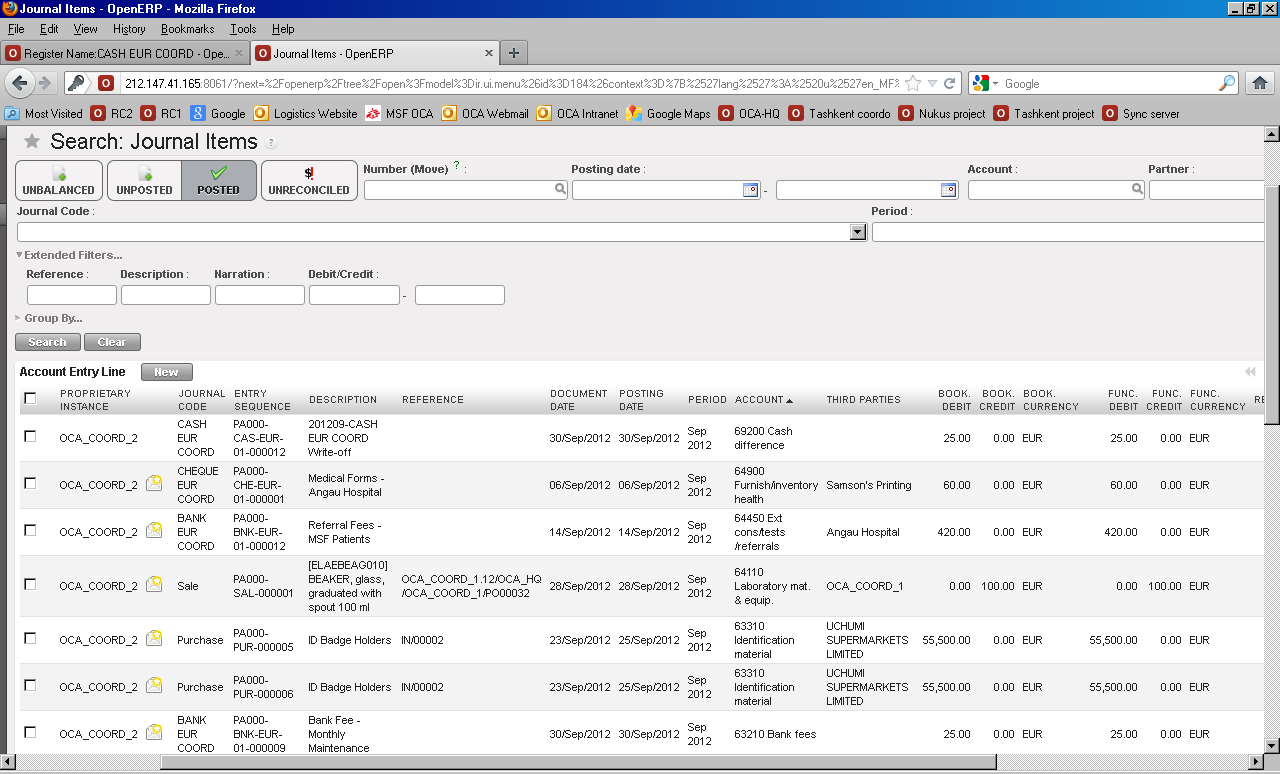
Go to: Accounting/Journal Entries/Journal Items
Search for the entries (expense and payables accounts) corresponding to the supplier invoice you want to correct
Corresponding Journal Items
2. Select the icon to open the Accounting Corrections Wizard
Accounting Corrections Wizard
Insert a correction date (=posting date of the correction entry) in the {Correction date} field
Select the icon to edit the account code or the icon to modify the analytical distribution. In this case we will change the cost center. The analytical distribution wizard opens.
In the wizard, select the icon to edit the analytical line
Edition button to change the analytical distribution
Change the distribution and save the line
Cost center changed
At the bottom of the screen, select to apply the correction. The window closes.
As we modified a cost center, Go to Accounting/Journal Entries/Analytic Journal Items and check if the correction was done.
Note! Depending on the period status of the entry that was corrected, either the original AJI is updated (=period is still open) or correction entries in OD journal are created (=period is closed)
The cost center was changed and the original AJI was updated.
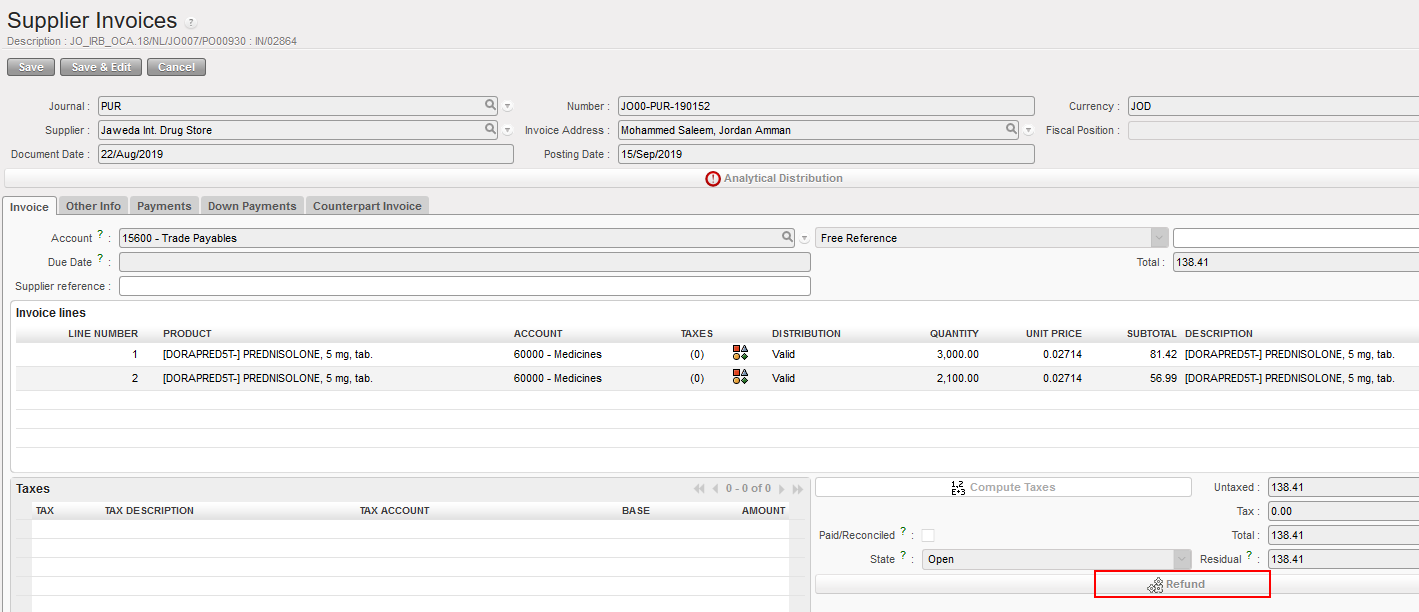
If you need to make a correction on product, price, quantity, supplier, document date or currency, you will use the function called {Refund} located on the supplier invoice.
In the Refund wizard, 3 options are possible: ModifyRefund and Cancel. They can all be used according to the situation you are facing.
Modify is used if for instance goods were received and checked but some of them are damaged at the time of consumption and they are sent back to the supplier. In case the initial invoice was validated but not yet paid (status is {Open}), you will modify the new invoice and pay the right amount accordingly i.e. deduct the damaged goods from your payment.
Note! Refund-Modify function is not available for partially paid invoices even if the status is “Open”.
You can also use this option if you realize an accounting correction must be done on this invoice.
Since the open invoice is not yet linked to any liquidity account (cash on hand, cash at bank), the Refund/Modify option will change that state of the initial invoice to Closed and not Paid
Modify executes three actions:
Original Supplier Invoice is marked {Closed}
Supplier Refund document is created and marked {Closed} to cancel the original Supplier Invoice, with which it is reconciled
A copy of the original Supplier Invoice is created in {Draft} to prepare a corrected version for validation and payment
Go to: ACCOUNTING/Suppliers/Supplier Invoices
Open the Supplier Invoice in Form view to modify it
Click {Refund}
Refund functionality in Supplier Invoice
A Refund window opens for the user to complete the fields.
Refund window
A new tab appears with the Supplier Refund search window. A copy of the original Supplier Invoice is created with status {Closed}. Click on the pencil to open in Form view.
Supplier Refunds search window
In the Supplier Refunds sub-module, the Supplier Refund is in {Closed} status. Its purpose is to create reversing entries in the Purchase Refund Journal to reconcile the Journal Items entries made from the original Supplier Invoice, thus cancelling it. The {Closed/Reconciled} checkbox is ticked.
Supplier Refund created is a copy of the original Supplier Invoice
The Journal Items are as follows:
The original Supplier Invoice:
Debit to the expense account
Credit to 30020 Trade Payables M1-17
The Supplier Refund reverses the entries created above:
Credit to the expense account
Debit to 30020 Trade Payables M1-17
Journal Items resulting from original Supplier Invoice and Supplier Refund
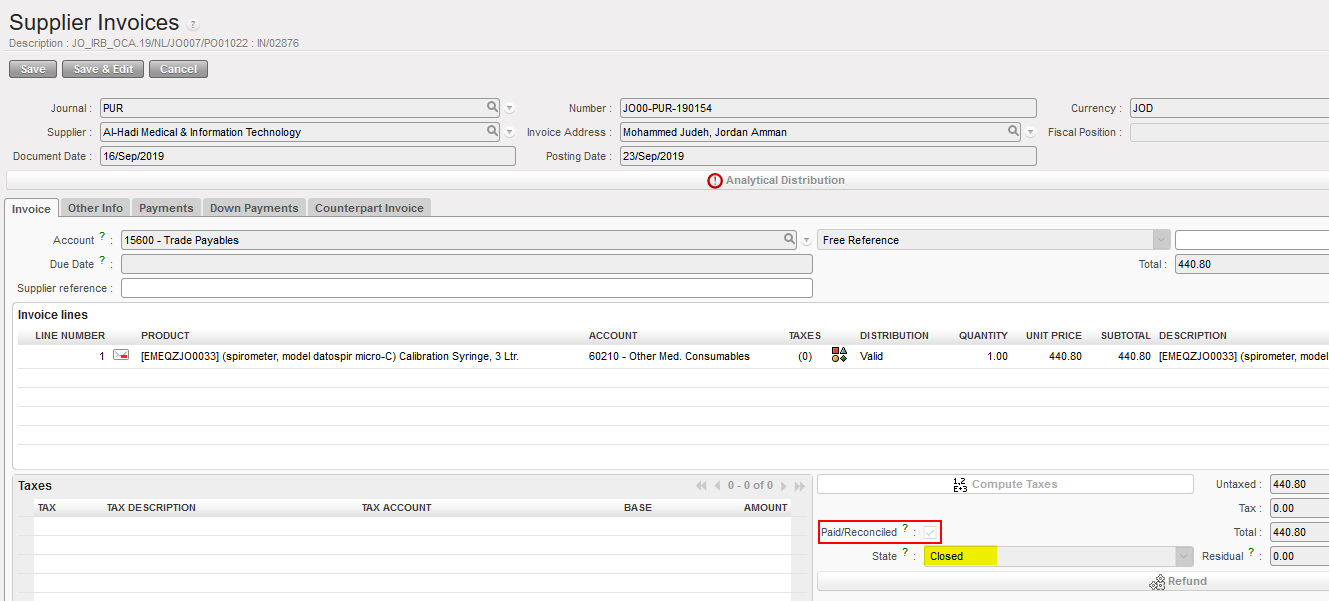
In the Supplier Invoices sub-module, the original Supplier Invoice is marked {Closed}. The {Paid/Reconciled} checkbox is ticked.
Original Supplier Invoice is marked Paid and reconciled after Modify applied
In the final step, in Supplier Invoices sub-module too, a copy of the original Supplier Invoice is created in {Draft} status for the user to modify and validate as usual. The Description refers back to the Purchase Refund, and the Free Reference field refers back to the original invoice, but there are no links in the system or accounting entries that tie back.
Modified Supplier Invoice is in draft status for corrections to be made
Cancel is used if for instance goods were received and checked but all of them are damaged at the time of consumption. They will be sent back to the supplier. We don’t expect any replacement. You will then cancel the invoice, thus cancel the debt towards this supplier.
Note! Refund-Cancel function is not available for partially paid invoices even if the status is “Open”.
Cancel executes two actions:
Original Supplier Invoice is marked {Closed}
Supplier Refund record is created and marked {Closed} to cancel the original Supplier Invoice
Go to: ACCOUNTING/Suppliers/Supplier Invoices
Open the Open Supplier Invoice in Form view to modify it
Refund functionality in Supplier Invoice
Click {Refund}. A Refund window opens for the user to complete the fields. In Description, explain what and why is being refunded. Select {Cancel} for Refund Type
Refund window
A new tab appears with the Supplier Refund search window. The Supplier Refund is in {Closed} status. Its purpose is to create reversing entries in the Purchase Refund Journal to reconcile the Journal Items entries made from the original Supplier Invoice, thus cancelling it.
Supplier Refund is in Closed status when created
The original Supplier Invoice changes from Open to Closed status
The Journal Items are as follows:
The original Supplier Invoice:
Debit to the expense account
Credit to 30020 Trade Payables M1-18
The Supplier Refund reverses the entries created above:
Credit to the expense account
Debit to 30020 Trade Payables M1-18
Journal Items resulting from original Supplier Invoice and Supplier Refund
How to Correct Supplier Invoices Paid in Registers, Temp-Posted
The payment of invoices is made in Registers (cash, bank or cheque depending on the method of payment). An entry is created in Temp status and booked to {Trade Payables} to pay the amount owed to an external Supplier.
Open Supplier Invoice imported into Registers
The correction of the invoice will depend on the situation:
If you need to proceed with a correction on an expense account or analytical distribution, you will use the accounting correction wizard (same as the correction for Direct entries and Open Supplier Invoice).
As the invoice was paid (the invoice is imported into the register to reflect the physical cash was given), the only possibility we can find in this situation is a refund. We can suppose for instance goods were paid and some of them will be sent back for which a refund was requested. In this case you will hard-post the register line and use the function Refund on the supplier invoice to correct the amount. You will select the option {Refund}.
Refund executes three actions:
Original Supplier Invoice is marked Paid. However as it makes sense to make a refund on a paid supplier invoice, the invoice will be already marked Paid.
Supplier Refund record is created to reflect what is being refunded and validated. It is a duplication of the original supplier invoice and will need to be adjusted.
The Supplier Refund is essentially a credit note, available in {Pending Payments} to adjust the cash balance and take the refund into consideration in the register.
Go to: Accounting/Registers/Cash Registers
In the below first example we see how to correct an account code or analytical distribution on a paid supplier invoice, temp-posted in a register:
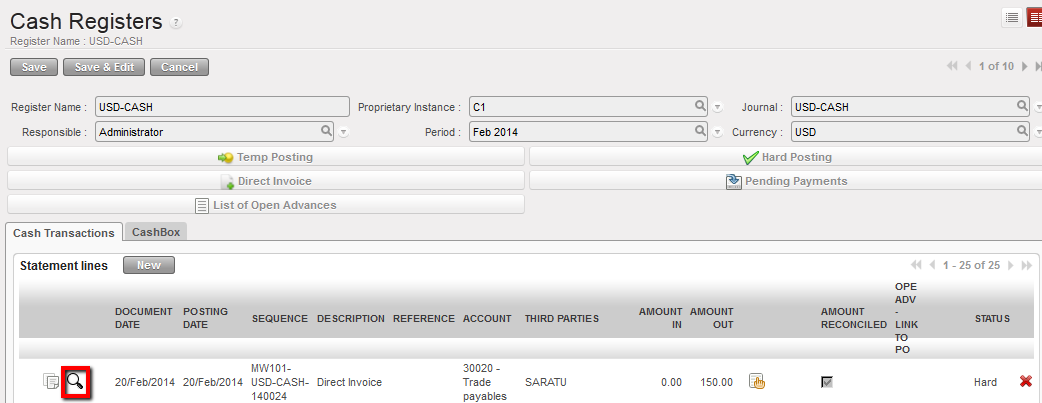
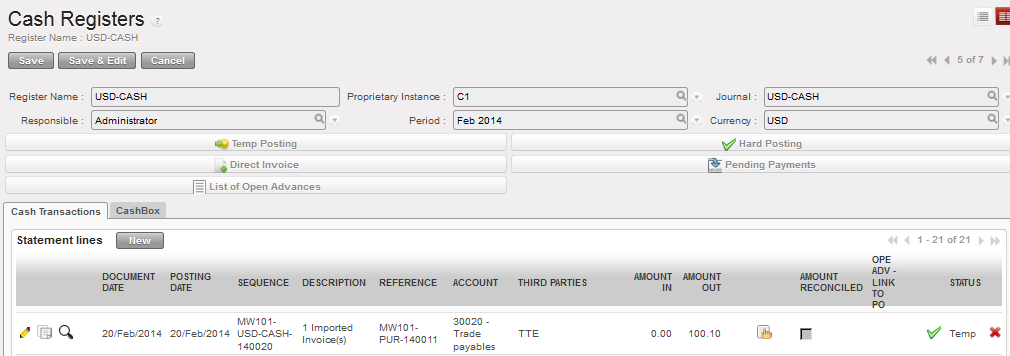
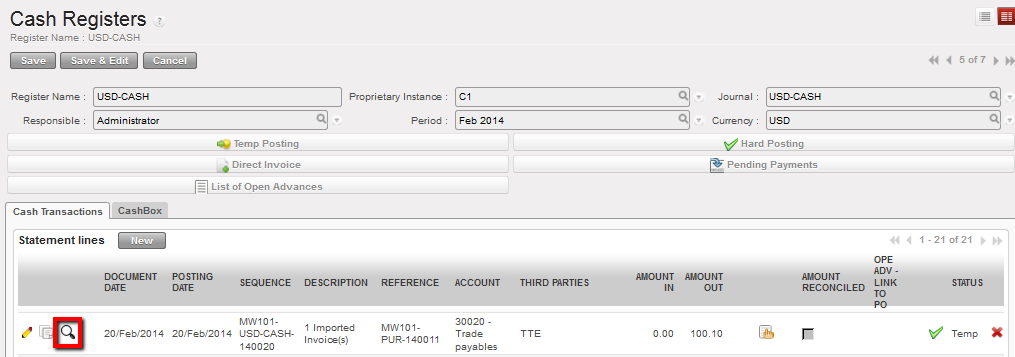
Find the temp posted register entry for the imported invoice. Click on the magnifying glass to link to the analytic lines associated with the invoice.
From Registers, link to the analytic journal items
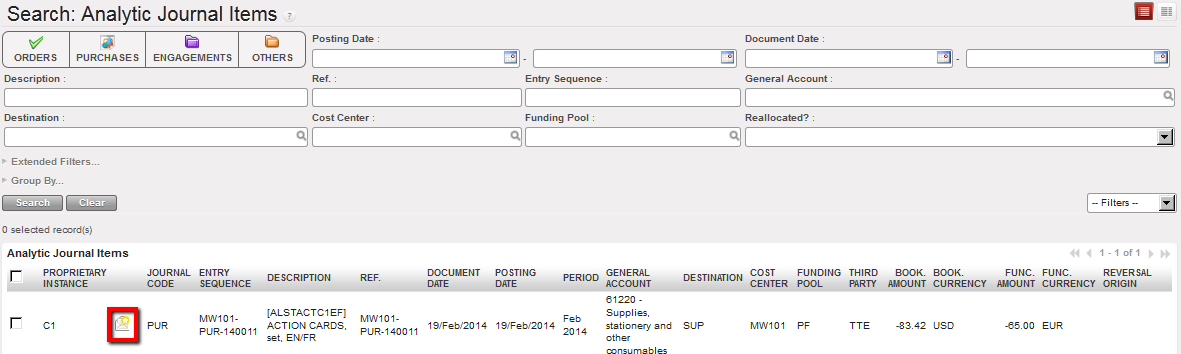
A new tab opens to display the analytic lines associated with the supplier invoice lines. Click on the envelope next to the entry that needs to be corrected.
Analytic Journal Items associated to the Open supplier invoice
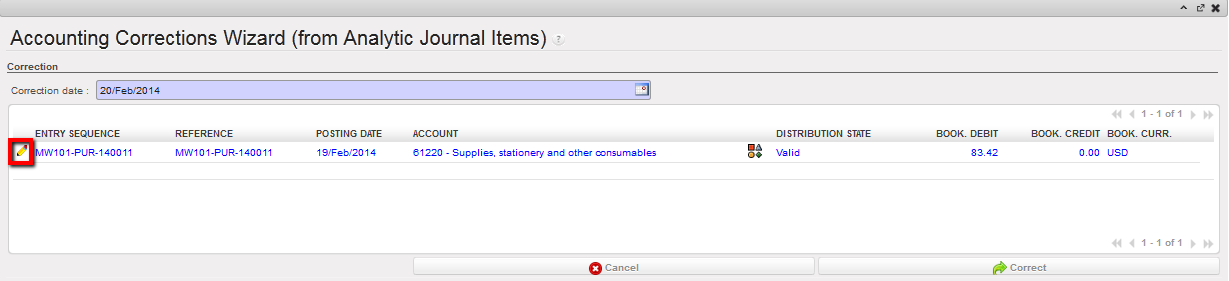
The {Accounting Corrections Wizard} opens. Enter the date on which the correction was made. To make a correction to account code, click on the pencil to edit the entry.
Click on the pencil to correct account code or the AD icon to correct analytic distribution
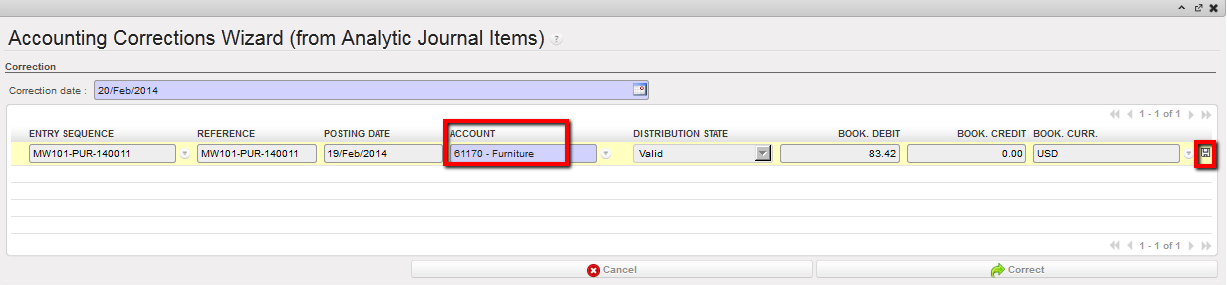
4. Change the account code and click to save.
Changed account in Accounting Corrections Wizard
If a correction is made on an expense account, you should review the analytical distribution to confirm that the new expense account is assigned to a proper destination or funding pool. If assigned properly, you can click {Correct}. If the new expense account is not assigned properly, the correction entry will display in red font and the user will not be able to validate the correction until the analytical distribution is changed. Click on the {AD} icon to assign the expense correctly.
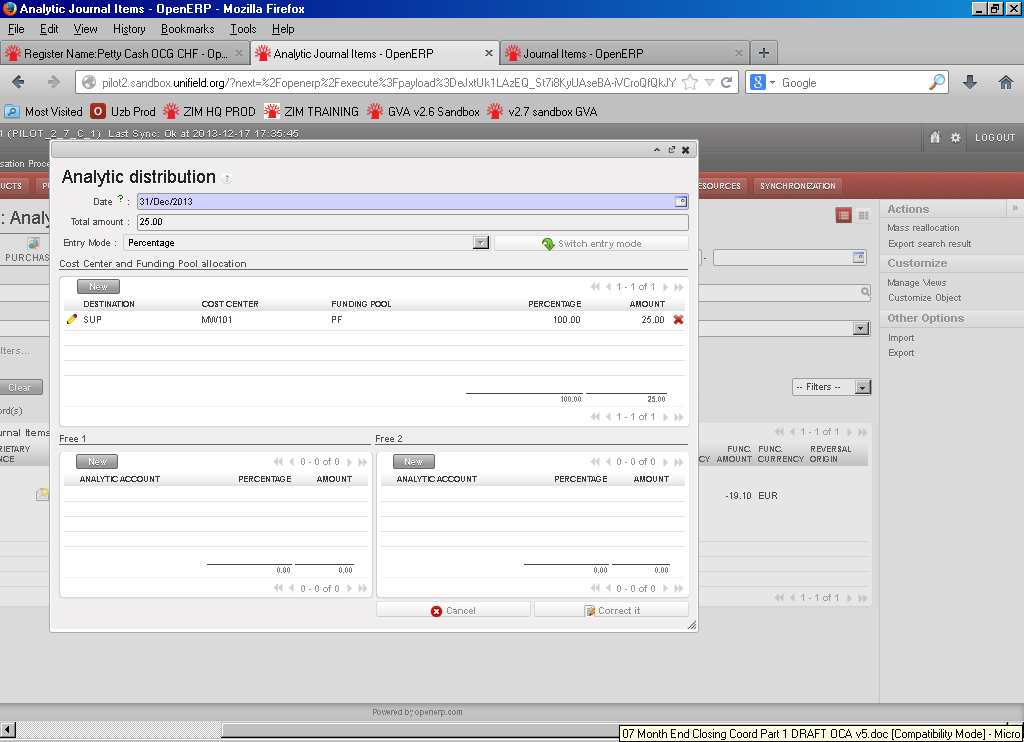
The Analytic distribution window opens. Click on the pencil to change the destination, cost center or funding pool as needed. Click to save and then click. The {Cancel} button will take you back to the Accounting Wizard.
Back to Analytic Journal Items, the original entry will now display a closed envelope icon to indicate that the entry has been reallocated. If you click on this envelop, a window will open to show the history of changes (original, reversing and correcting entries) in Analytic Journal Items.
History of changes on an analytic journal item reallocated using the Corrections Wizard
Back in the Supplier Invoice, the invoice line will display a closed envelope icon to indicate that the entry has been reallocated. If you click on this envelope, a window will open to show the history of changes (original, reversing and correcting entries) in Analytic Journal Items.
Corrections made in Analytic Journal Items are reflected in Supplier Invoice
If a correction is made only to the analytic distribution (destination and/or cost center and/or funding pool) in an open period, then the Correction Wizard will update the original analytic journal item. Reversing and Correcting entries are not created since the accounting journals are not affected, so you are not able to track if any corrections were made. Note: the supplier invoice line will still show the original AD and not the correction allocation.
If the period is closed, entries are created in the Corrections Journal to reverse the analytical distribution and then to correct it.
In the second example below we see how to create a refund invoice on a Temp posted register line.
Go to: Accounting/Registers/Cash Registers
Find the temp-posted register entry for the imported invoice.
Hard-post the line. The invoice becomes {Paid}.
In the Liquidity journal, we have:
Credit to the cash account (30.35 USD)
Debit to 30020 Trade Payables (30.35 USD)
On the register line, select the icon opening the supplier invoice and the search supplier invoices display.
Opening a supplier invoice hard-posted in a register
Search Supplier Invoices displays
Select the {Edit} button and the supplier invoice form view appears.
At the bottom of the view, select
In the Refund wizard, select the option {Refund} and describe the refund type and reason. The refund journal is automatically set to PUF:
Refund wizard
Select {Refund}.
Now proceed to the edition of the supplier refund invoice. In this case, we will request a refund for 3 damaged products. We will modify the refund accordingly.
Refund supplier invoice
Save the form and the invoice is saved in {Draft} state.
Select the {Validate} button to validate it.
In the PUF journal, we have the validated supplier refund displayed as such:
Credit to the expense account (7.71 USD)
Credit to VAT recoverable (1.54 USD); this is optional. The invoice was applied a VAT code in this case.
Debit to 30020 Trade Payables (9.25 USD)
The next step is to import the refund invoice into the register as soon as the payment from the supplier is received.
How to Correct Supplier Invoices Paid in Registers, Hard-Posted:
Once a payment for an invoice is made in the register and hard posted, the status of the supplier invoice changes from {Open} to {Paid}.
Status of Supplier Invoice changes to Paid
If a correction needs to be made on the account code or analytic distribution of an invoice line, you can click on the journal items or analytic lines associated with the supplier invoice to use the Corrections Wizard. (See example 1 of Supplier Invoice paid in Registers, temp posted).
Link to analytic journal items to make correction to account or AD
If you need to correct a paid supplier invoice (i.e. to mark the fact that a refund was agreed for paid products) you will use the {Refund} option of the Refund wizard. (See example 2 of Supplier Invoice paid in Registers, temp posted).
Direct entries are made directly in the register and not through other interfaces like Supplier Invoice or Direct Invoice. For further information on what is a direct entry and how to book it, see Chapter 3 -Payments LUFI-30205.
The edition and deletion of Draft and Temp direct entries is addressed in Chapter 3 – Payments LUFI-30209.
If you need to change a data of a direct entry in Hard-posted state, you will perform an accounting correction as shown below.
How to Correct Hard-Posted Direct Entries
Hard-posted direct entries cannot be edited or deleted in the register. How the correction is done depends on the field that needs to be corrected. If you need to correct the below fields:
Amount
Description
Third Party
Document date
You will make a reversal entry and a correction entry directly in the Register.
Go to: Accounting/Registers/Cash Registers
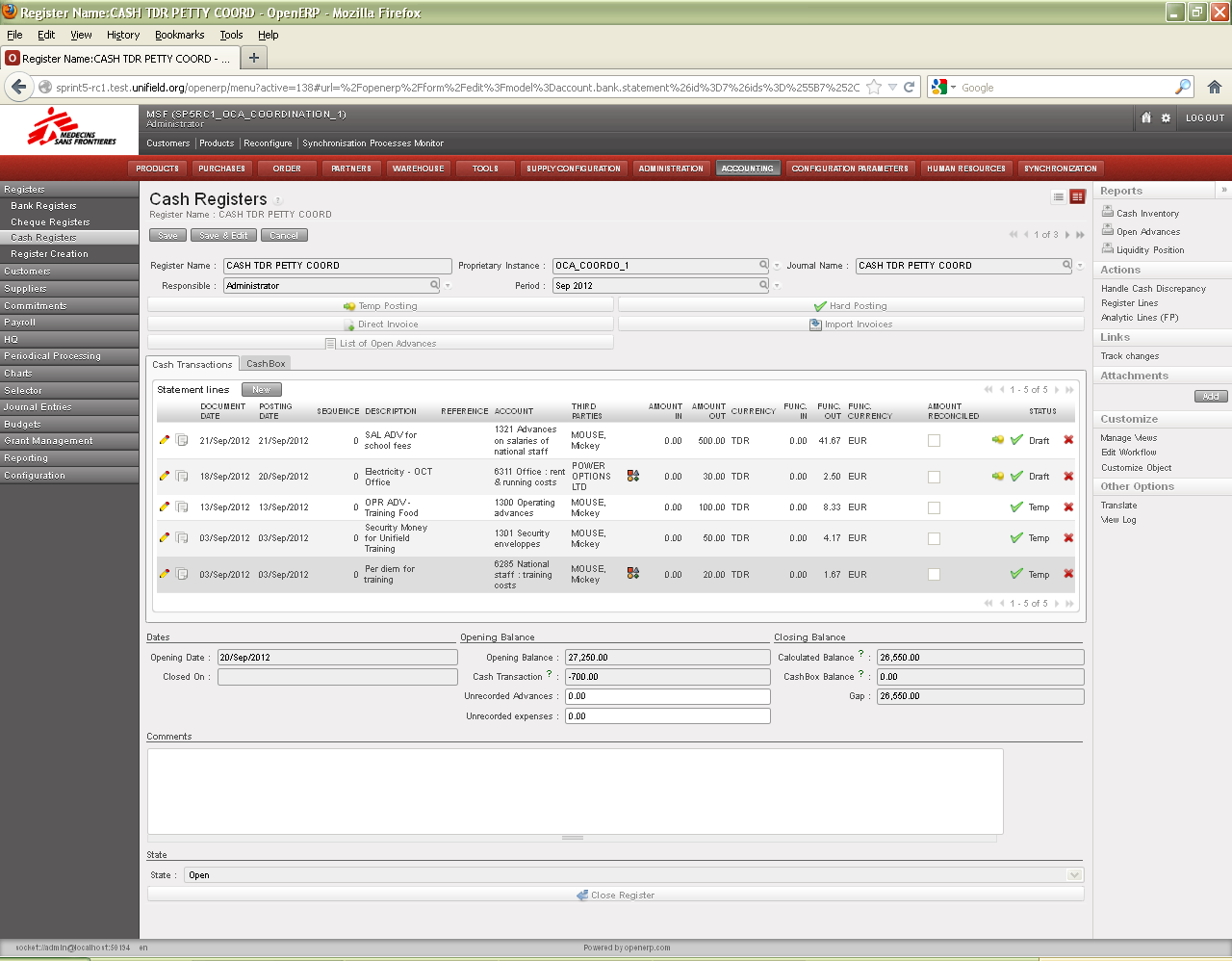
Find the hard-posted register entry for which the amount needs to be corrected, Click on the duplicate button
A copy of the original entry is created. Click to edit.
Reversed entry being created by using the Edit button
Edit the duplicate entry to reverse the original entry:
Revise the field {Description} to indicate this is a reversal entry and why, e.g. “REV – PER DIEM wrong amt, should be 95”. The original description is retained to make it easy to match it with the initial entry.
Delete the amount in the field {Amount Out} or {Amount In} and enter the same amount in the opposing field {Amount In} or {Amount Out}. This cancels the amount to zero and will update the register balance.
If you are correcting the {Third Party} or {Document Date}, then you should not change it in this copy. You will correct it in the correcting entry.
Click to save the entry
Revise the duplicate entry to reverse
Reversal entry is saved and Temp posted
Now, you need to create the correcting entry with the right amount, or document date, or description. Click on the duplicate button of the initial entry.
A copy displays. Click to edit.
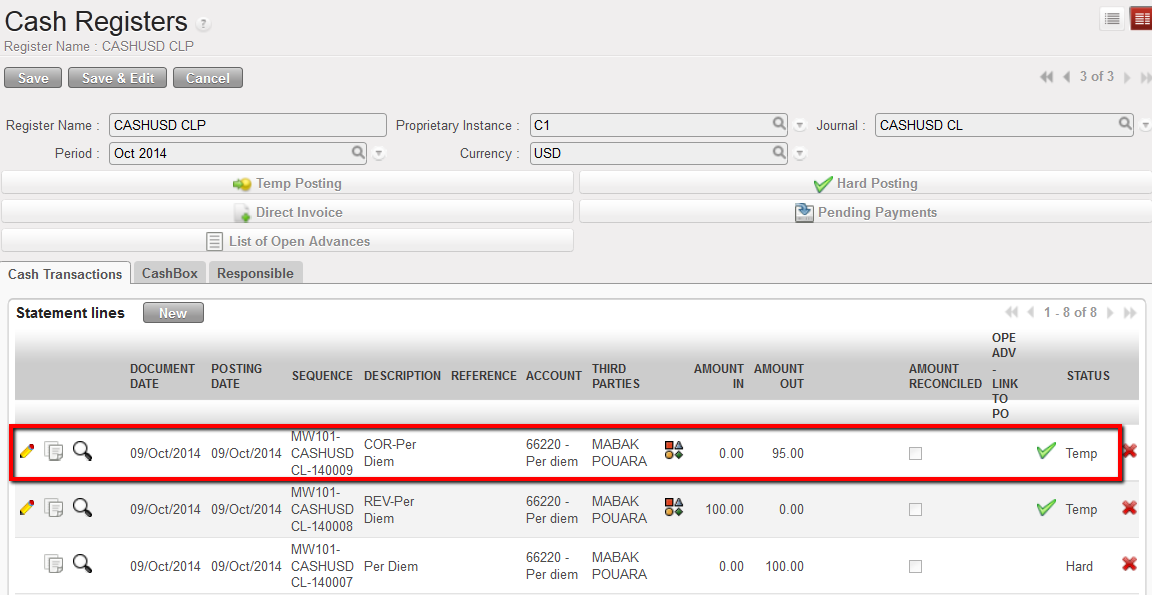
The second entry corrects the error:
Revise the field {Description} to indicate this is a correcting entry and why, e.g. “COR – PER DIEM wrong amt, should be 95”. The original description is retained to make it easy to match it with the initial entry.
If correcting amount, change it in the field {Amount Out} or {Amount In}
If you are correcting the {Third Party} or {Document Date}, enter the correct value
Click to save the entry
Revise the duplicate entry to correct
Correcting entry is created using the Duplicate button on the reversing entry
Now, you should be able to view:
The original register entry in which you made an error
The reversing register entry
The correcting register entry
In Journal Items, you can see the double accounting moves that correspond to the register entries which reverse and correct on the relevant journals and accounts:
Original entry:
Credit -10100 Cash on hand (100 USD)
Debit – 66220 Per Diem (100 USD)
Reversing entry:
Credit – 66220 Per Diem (100 USD)
Debit – 10100 Cash on hand (100 USD)
Correcting entry:
Credit – 10100 Cash on hand (95 USD)
Debit – 66220 Per Diem (95 USD)
Accounting entries are editable until they are Hard-posted. Only unreconciled entries can be corrected. Entries need to be manually unreconciled before correction (on manually reconciled entries). Once the correction is validated, the corrected entry can be manually reconciled with its counterpart entry (if relevant).
For the following fields, the user with appropriate access rights can open a link from the registers to the Analytic Journal Items to make reversing and correcting entries using the Corrections Wizard:
Expense accounts
Destination
Cost Center
Funding Pool
Corrections can be performed on entries belonging to open or closed periods. If correction takes place in a different period than the initial entry, the exchange rate in the reversal and correction entries is the rate of the original entry (based on the posting date). Also, keep in mind that corrections in Journals do not impact cash balances (no register line created).
Go to: Accounting/Registers/Cash Registers
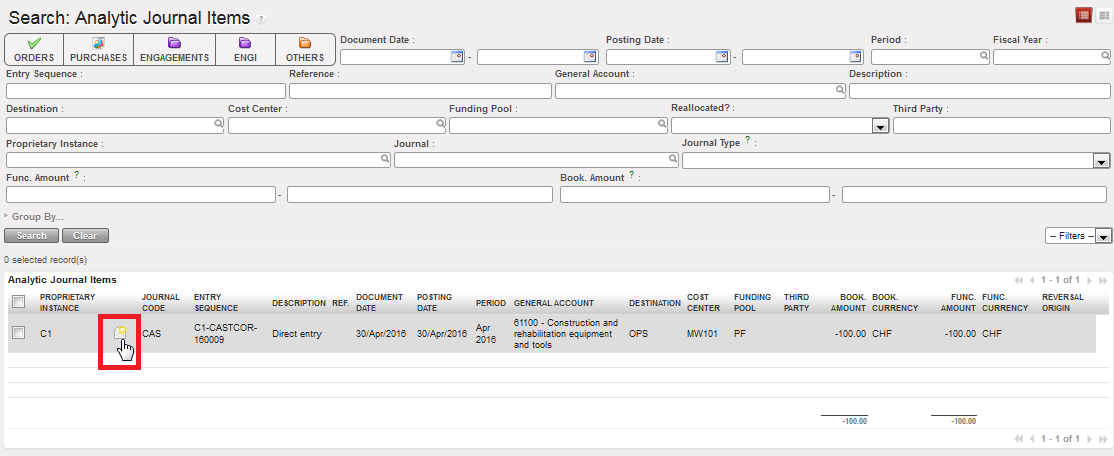
Find the hard-posted direct entry for which the expense account needs to be corrected. In this example, drinks ordered for the team were booked to {60030 – Therapeutic Food} but should be {61020 – Non Therapeutic Food}. Click on the magnifying glass to link to the analytic lines associated with the register entry.
From Registers, link to the analytic journal items
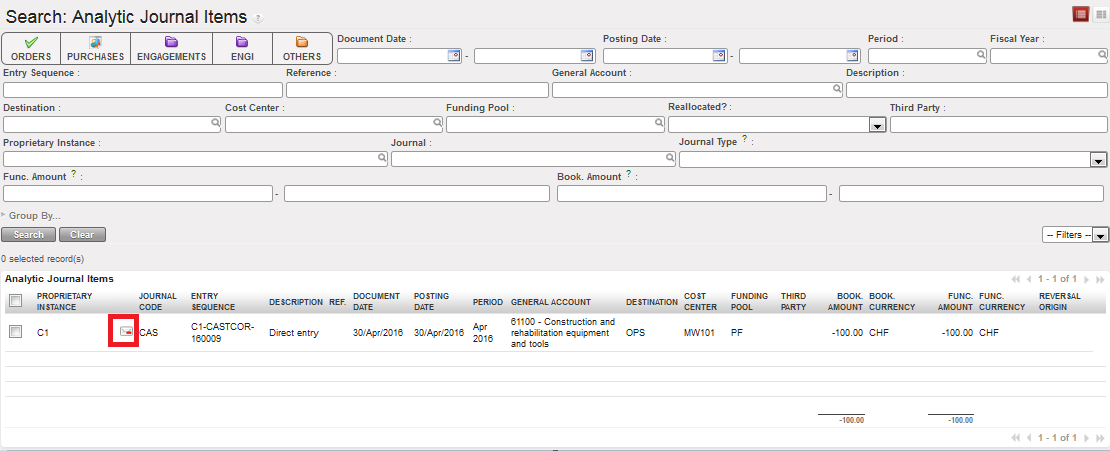
A new tab opens to display the analytic lines. Click on the envelope next to the entry.
Corrections using the link to Analytic Lines from Registers
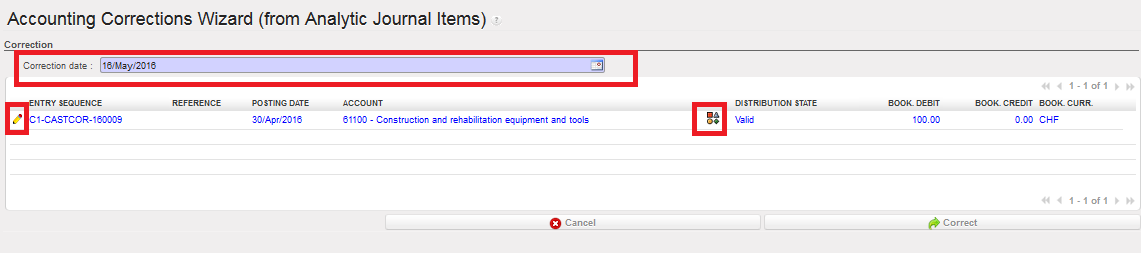
The {Accounting Corrections Wizard} opens. Enter the date on which the correction was made. To make a correction to account code, click on the pencil to edit the entry.
Click on the pencil to correct account code or the AD icon to correct analytic distribution
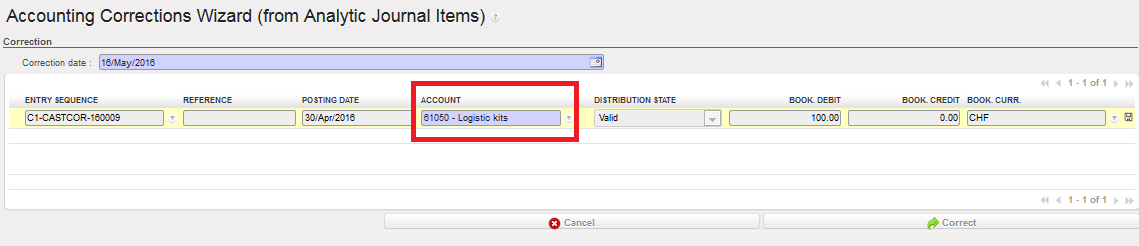
Change the account code and click to save. The new code is saved.
Correcting the account code:
If a correction is made on an expense account, you should review the analytical distribution to confirm that the new expense account is assigned to a proper destination and funding pool. If assigned properly, you can click {Correct}.
If the new expense account is not assigned properly, the correction entry will display in red font and the user will not be able to validate the correction until the analytical distribution is changed. Click on the {AD} icon to assign the expense correctly.
Analytic distribution is invalid after account code is corrected
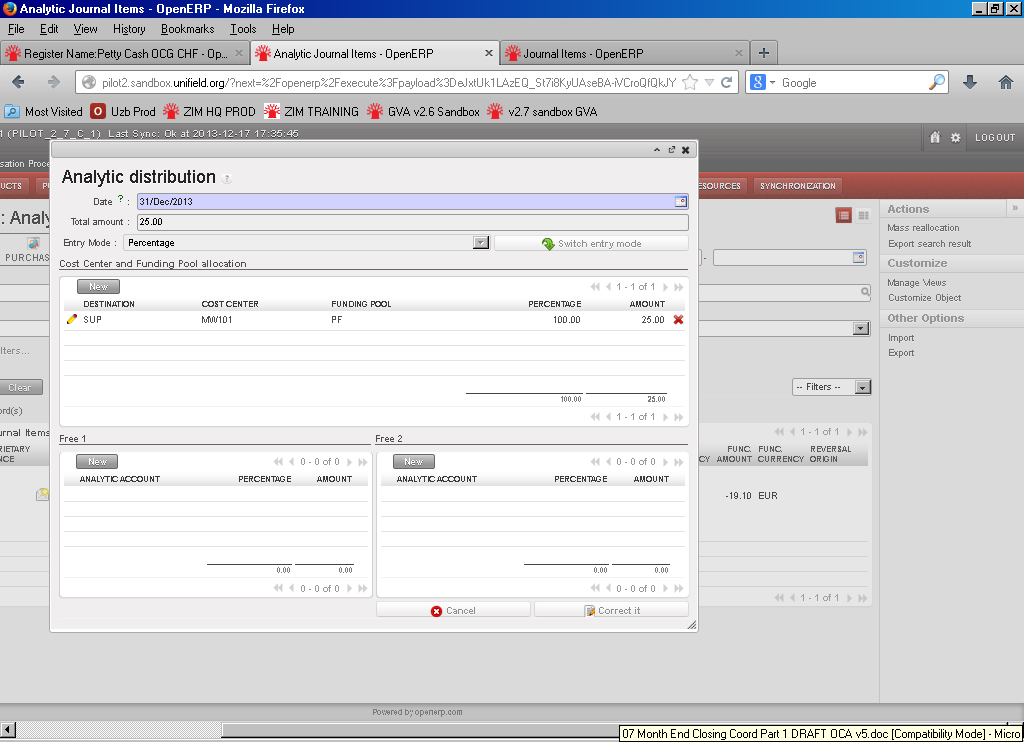
The Analytic distribution window opens. Click on the pencil to change the destination, cost center or funding pool as needed. When you are done, Click to save and then click. The {Cancel} button will return you back to the Accounting Wizard.
Edit button to change the analytic allocation
Correct button to save the correction
Back in Analytic Journal Items, the original entry will now display a closed envelope icon to indicate that the entry has been corrected. When this envelope is clicked, a window will open to show the history of changes (original, reversing and correcting entries) in Analytic Journal Items.
Closed envelope icon indicating the entry has been corrected
Correction history on an accounting code
The entries associated with this correction can also be searched directly in Analytic Journal Items. The original entry and the correction entry both display the icon to show the corrections history. The envelope icon is no longer displayed next to the original expense entry in Journal Items since a correction has been made. The envelope icon is now next to the corrected entry and is to be used if user needs to correct the corrected entry.
Note that for the reversing and correcting entries created from the Corrections Wizard:
The same description as the original entry is used but prefixed by REV and COR<#> where <#> tracks the corrections made to the original analytic journal item and will be incremental as subsequent corrections are made (“correction of the correction”).
They are automatically posted to the Corrections journal (OD)
The Reversal Origin of the reversal entry is the description of the original entry
The Reference of the reversal and correcting entries is the entry sequence number of the original analytic journal item allowing you to easily trace back to the initial entry.
Original, reversed and corrected journal item. Reversed and Corrected entries show the accounting corrections to debit and credit amounts:
Back to the Registers, the correction on the account will show on the register line
Correction on the account code displayed in the register line
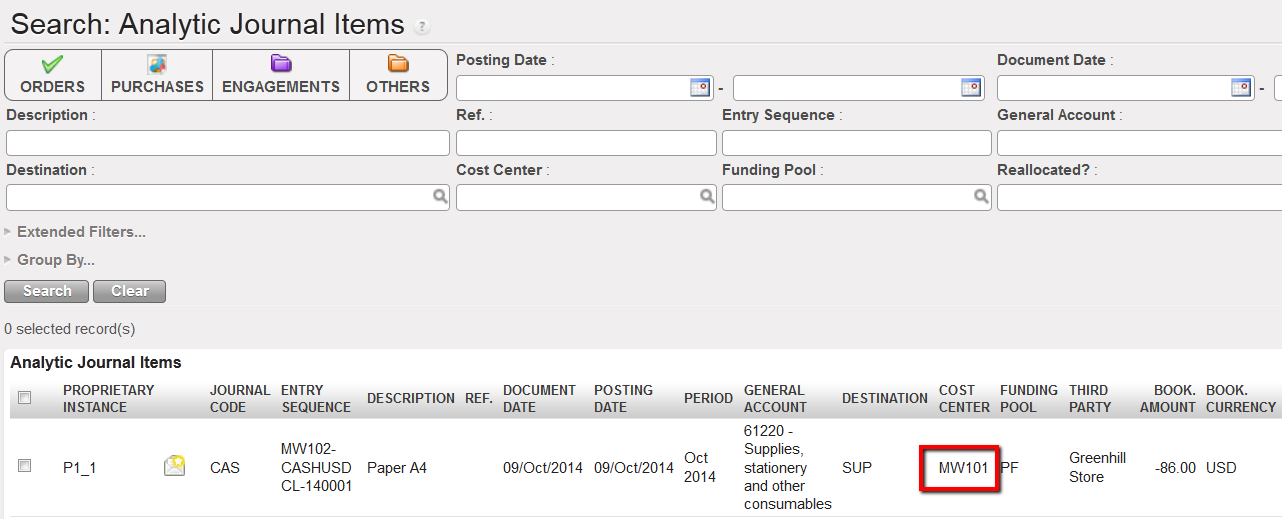
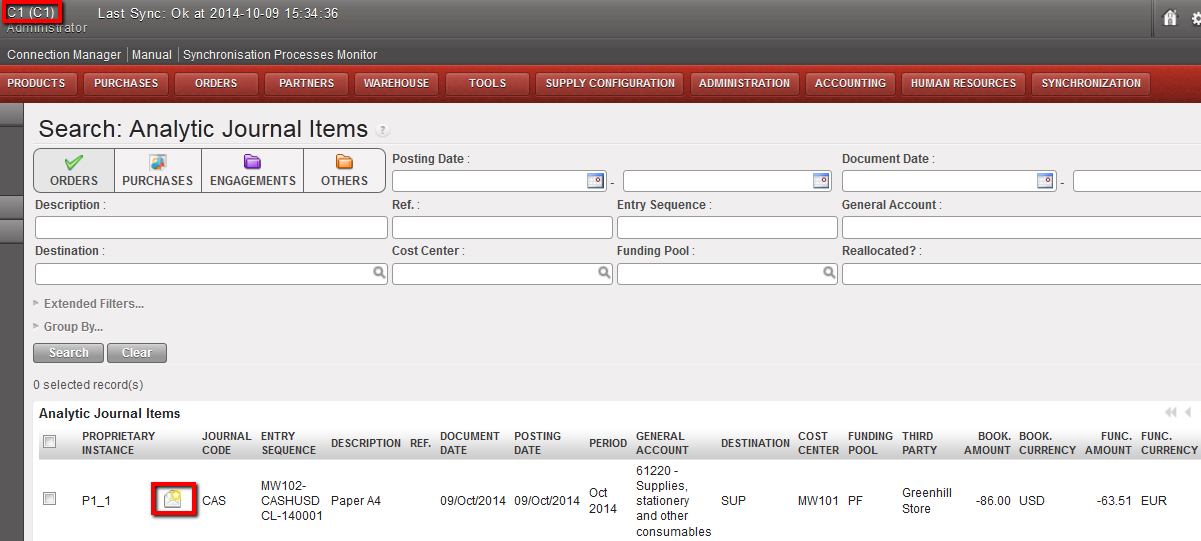
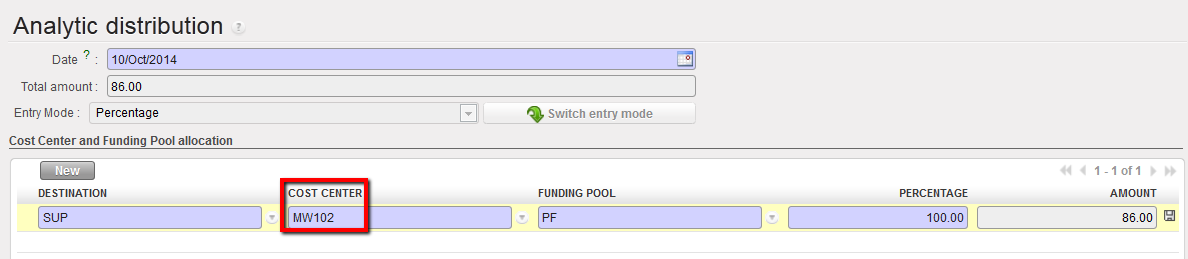
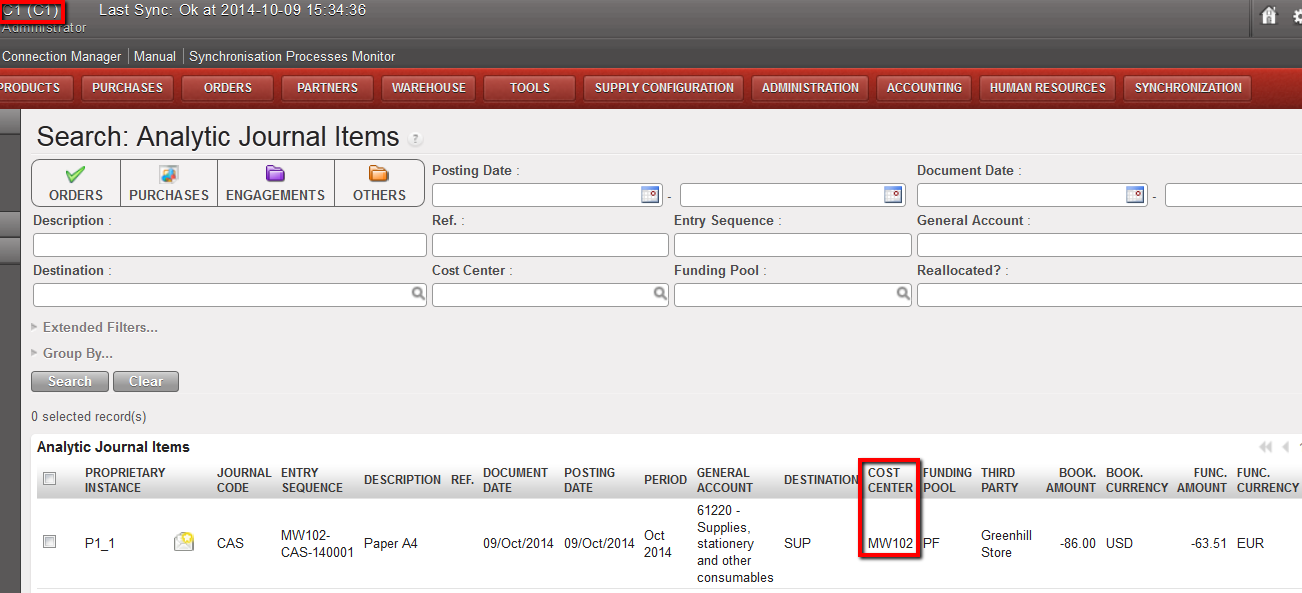
If Coordination has made the correction to a project entry, the change will be reflected upon synchronization at project level. Remember, Project will not be able to correct this entry again.
Entry recorded at project level and booked on the cost center MW101 instead of MW102.
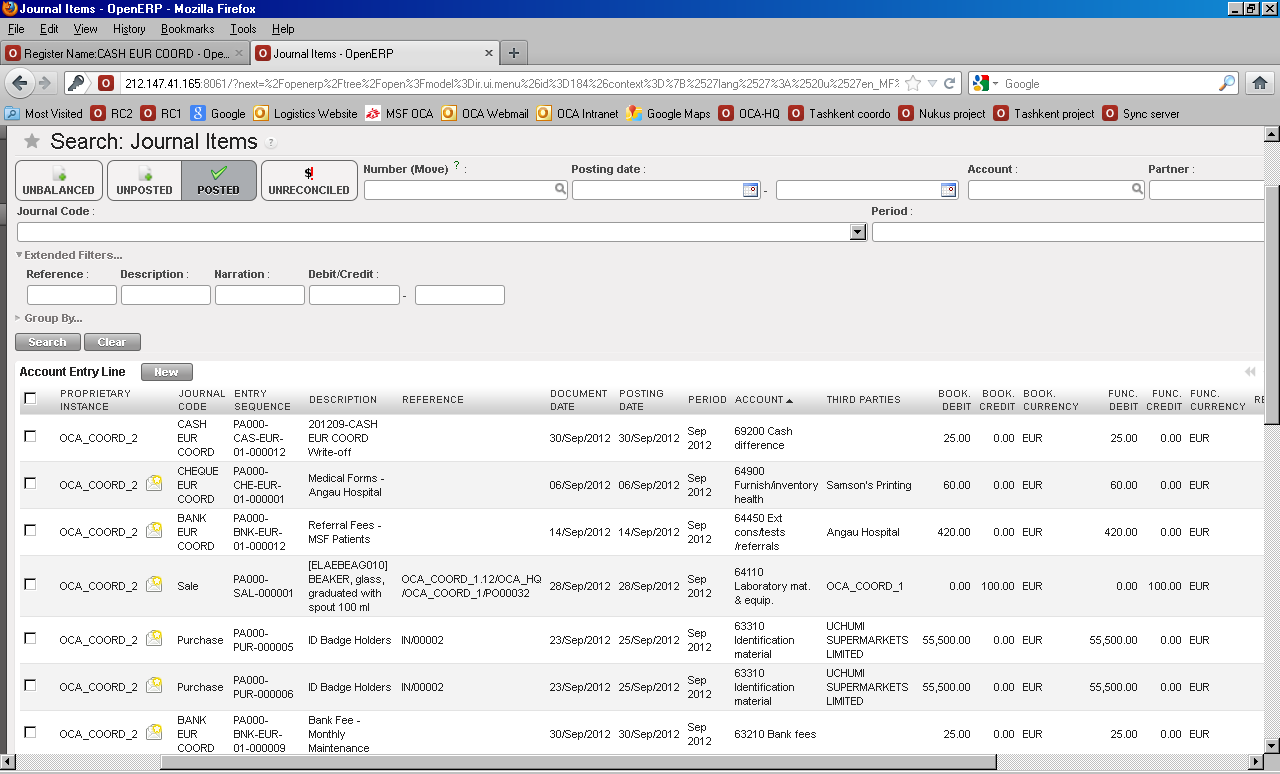
Synchronized entry to correct visible at Coordination instance
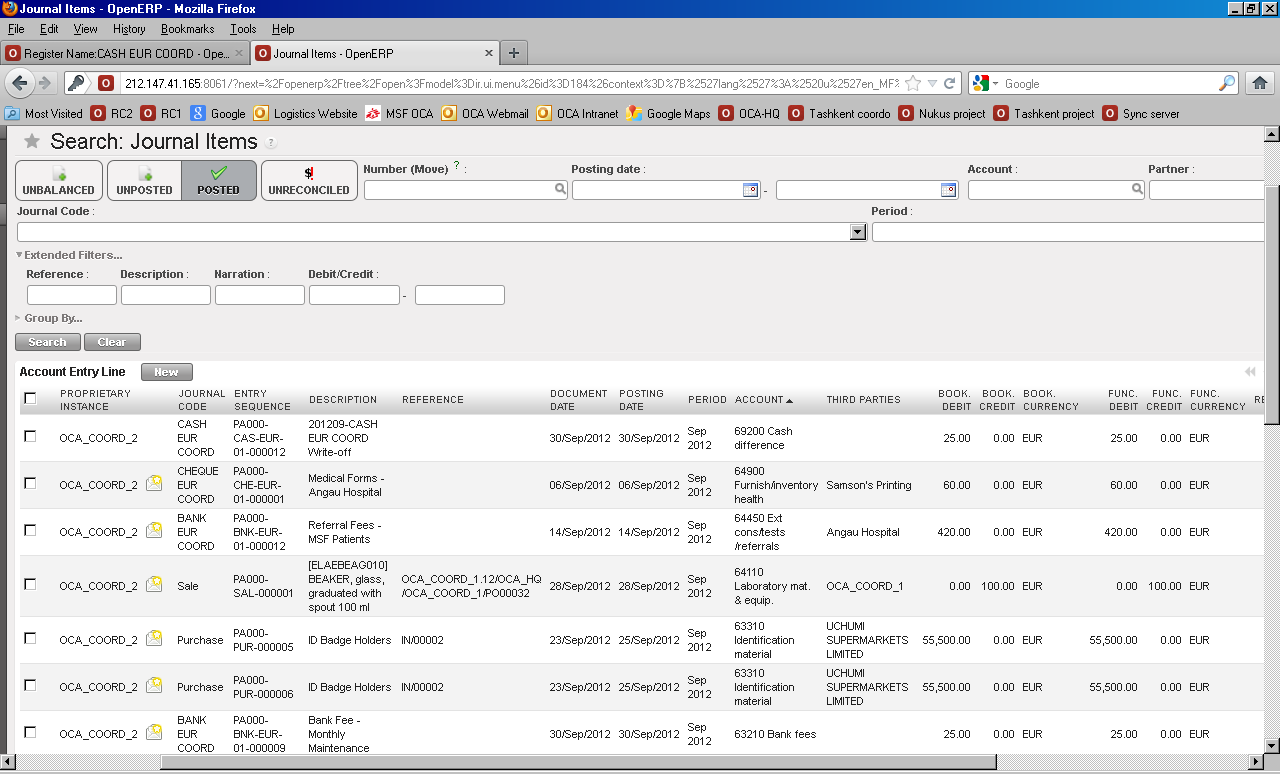
Cost Center being changed by Coordination to MW102
Cost center changed to MW102, visible at Coordination instance
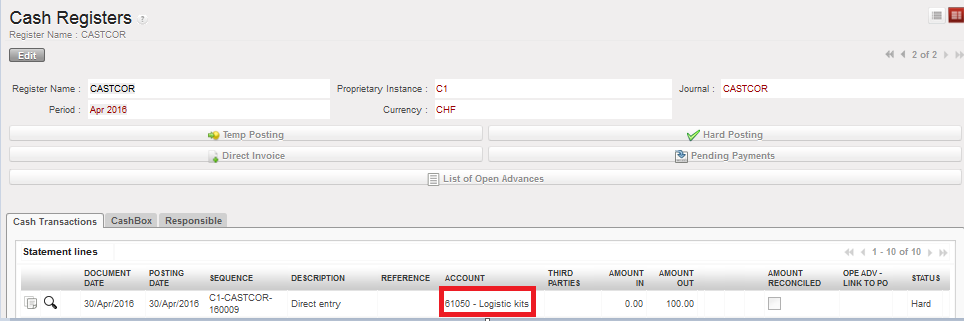
Cost center changed to MW102, visible at Project instance after being synched. This entry cannot be corrected anymore (no envelope icon = correction wizard disabled).
If a correction is made only to the analytic distribution (destination, cost center, funding pool) in an open period, the Correction Wizard will override the original analytic journal item. Reversing and Correcting entries are not created since the accounting journals are not affected, so you are not able to track if any change was made. The original entries in Registers and Journal Items remain unchanged.
Original cost center to correct
Corrections to the AD update the original analytic journal item
If the period is closed, entries are created in the Corrections Analytic Journal to reverse the analytical distribution and then to correct it. Back in Registers, you cannot view the correction to the analytic distribution because the entry has been hard-posted. There is no AD icon available.
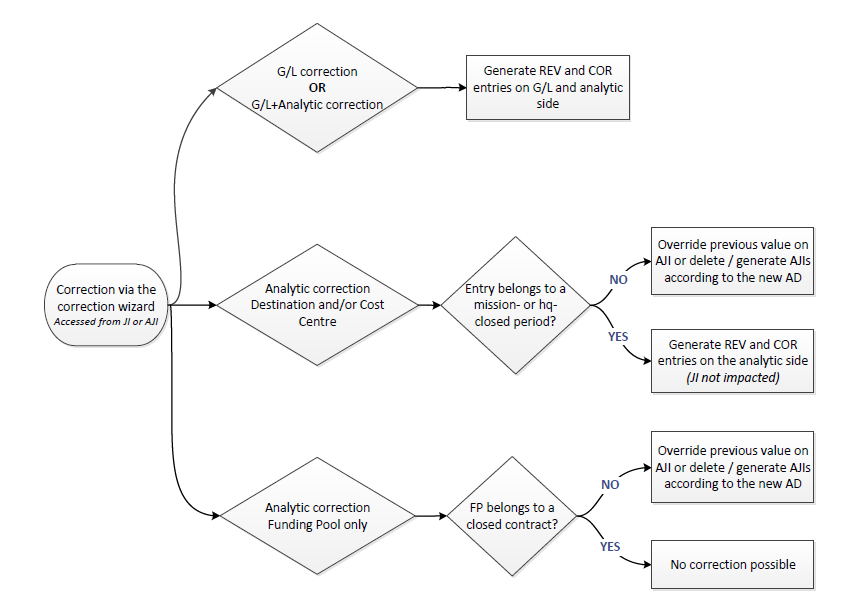
Below is a chart summarizing the system behavior when the correction wizard is used:
Depending on the nature of the entry and data to be corrected, the correction process will be different. This section will address the use of correction wizard as well as corrections of supplier invoices, direct invoices and imported cheques.
The basic rule is that if you need to correct an accounting code or the analytical allocation of a journal item (destination, cost center or funding pools), you will use a dedicated wizard called {Accounting Corrections wizard}. The wizard can be accessed directly on the journal item or the analytic journal item that you will need to correct. The use of the wizard is detailed in following LUFIs.
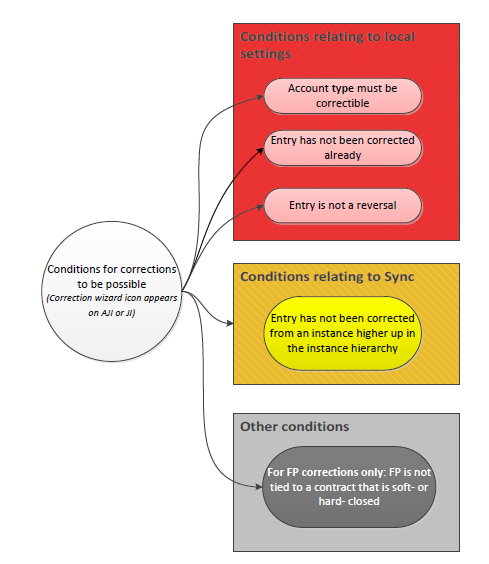
The corrections can be performed through the wizard provided the below requirements are fulfilled:
Basic requirements to perform a correction using the correction wizard
In the account configuration, the account must have not been set to uncorrectable (see LUFI-20301)
The entry was not corrected by an upper instance (i.e., Project cannot correct a project entry that has already been corrected in Coordination)
The entry is not a reversal nor an original entry already corrected
Only funding pools associated to draft or open financing contract can be corrected
Entry description, booking amount, third party and document date can be corrected in the register for direct entries that are not hard-posted yet; otherwise they can be corrected with a manual correction entry.
When using the correction wizard (either in JI or AJI) or the mass-reallocation, there is always a check on document date. The correction entry takes by default the same document date as the original entry, and therefore, if the document date belongs to an earlier fiscal year, a correction entry will not be created.
Below are examples of the accounting treatment for correcting an entry created with a Document Date and Posting Date of 15.12.2016 (Dec 2016 period):
If period Dec 2016 is open: You can correct Destination and Cost Center no matter which date is selected in the wizard, because the original AJI will just be updated no correction entry created
If period Dec 2016 is open: You can correct Funding Pool no matter which date is selected in the wizard, because the original AJI will just be updated no correction entry created
If period Dec 2016 is open: You can correct Account with a Posting Date of 31/Dec/2016 or earlier a correction entry is created with a Document Date of 15.12.2016 and selected Posting Date for Dec 2016
If period Dec 2016 is open: You cannot correct Account with a Posting Date of 01/Jan/2017 or later no correction entry created because Document Date 15.12.2016 is on an earlier Fiscal Year than Posting Date
If period Dec 2016 is mission-closed: You cannot correct Destination or Cost Center with a Posting Date of 31/Dec/2016 or earlier no correction entry created and no AJI updated because Dec 2016 is closed
If period Dec 2016 is mission-closed: You cannot correct Destination or Cost Center with a Posting Date of 01/Jan/2017 or later no correction entry created because Document Date 15.12.2016 is on an earlier Fiscal Year than Posting Date
If period Dec 2016 is mission-closed: You cannot correct Account with a Posting Date of 31/Dec/2016 or earlier no correction entry created because Dec 2016 is closed
If period Dec 2016 is mission-closed: You cannot correct Account with a Posting Date of 01/Jan/2017 or later no correction entry created because Document Date 15.12.2016 is on an earlier Fiscal Year than Posting Date
If period Dec 2016 is mission-closed: You can correct Funding Pool no matter which date is selected in the wizard, because the original AJI will just be updated no correction entry created, original AJI updated.
This means that entries belonging to FY2016 have to be corrected when Dec 2016 period is still open, they cannot be corrected in Jan 2017 or later except by passing a manual journal entry.
For entries belonging to extra-accounting periods 13, 14 and 15 no correction wizards are available. This means that if you create manual entries in these extra accounting periods, they can only be corrected with another manual entry. Also, these periods are not selectable in correction wizards for entries from earlier periods, e.g. you can’t use the correction wizard to create a correction entry for an entry from Dec 2016 for Period 13.
The correction wizard also provides an option to set any journal item as manually corrected. This option shall be used if a correction is made to an entry outside of the normal correction process (e.g. a manual correction entry was created) in which case there is no link to the original entry which could still be corrected. If the original entry is set as manually corrected, the correction wizard is no longer available to be used in that entry.
How to create a Sync Finance Queries from HQ or Coordination:-
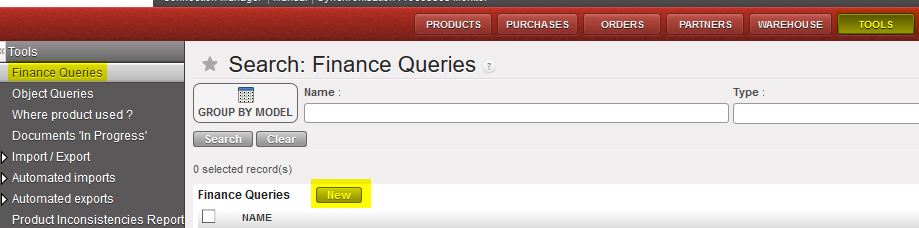
In TOOLS/Tools/Finance Queries/New
Select the query type:
GL Selector
Analytic Selector
Combined Journals report
General Ledger
Trial Balance
Balance Sheet
Balance by account
Balance by analytic account
Partner Ledger
Partner Balance
This creates a saved query as if it was directly accessed via the corresponding sub-menu. If you create the query from Tools, it then appears in the related sub-menu
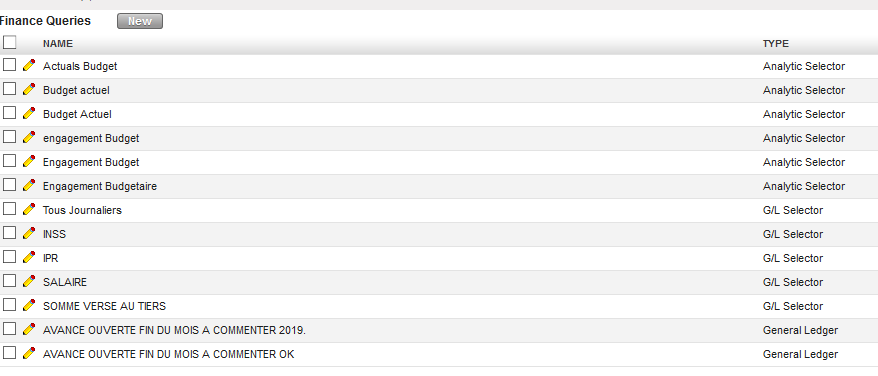
From Tools, it is then possible to see all saved queries of the related instance
Only from HQ and Coordination, it is possible to activate the sync so it sync down to all lower instances.
How to activate the sync on a saved query:-
Click on the plug or from inside the query and the sync will be activated
The query will sync down to all lower instances and will be visible directly in the corresponding sub-menu
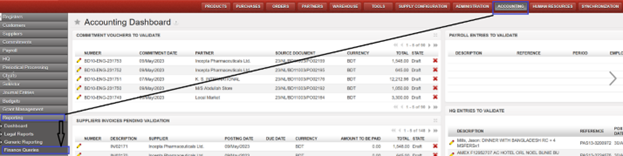
It is possible also to check finance queries through the “Reporting” menu.
Go to Accounting > Reporting >Finance Queries ,it includes the same columns of “Finance Queries” under Tools:
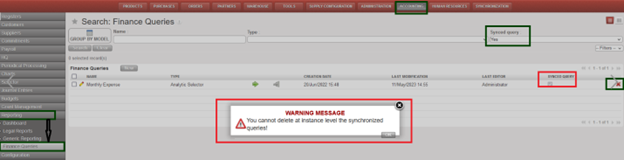
It is not possible to delete the synchronized finance queries:
Go to Tools > Finance queries OR Accounting > Reporting >Finance Queries
Try to delete one of “Synced query” you will receive a warning message “You cannot delete at instance level the synchronized queries!“
LUFI-50108 MULTIPLE SEQUENCES AND RELATED ENTRIES IN THE SELECTOR
LU Introduction
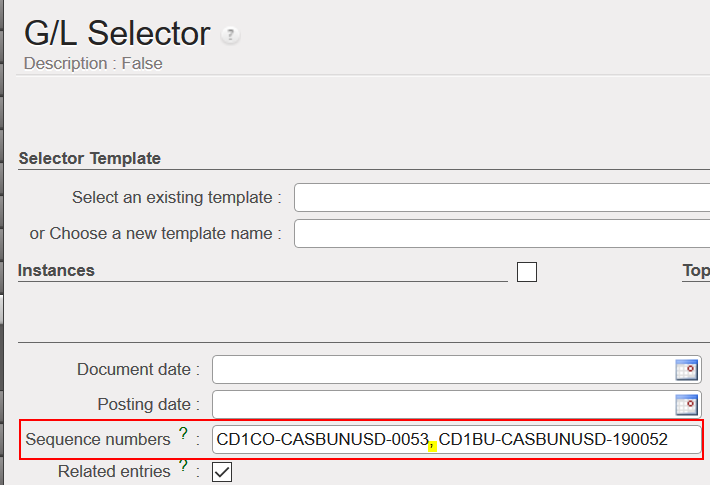
When making a query in the GL Selector and Analytic Selector, in “Sequence number” field, there will be a possibility to set several sequences if separated by “comma”.
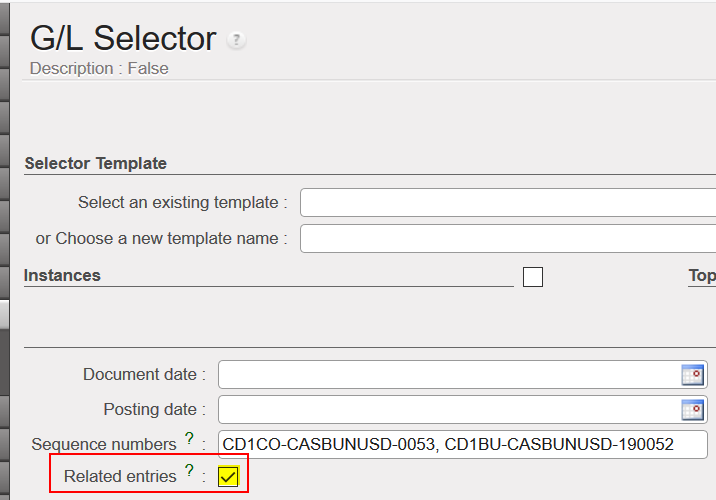
We have as well a new button called {Related Entries} that enable us to display all related entries from all the entry sequences filled in the “Sequence number” field. Related entry can work for multiple entries in the selectors only.
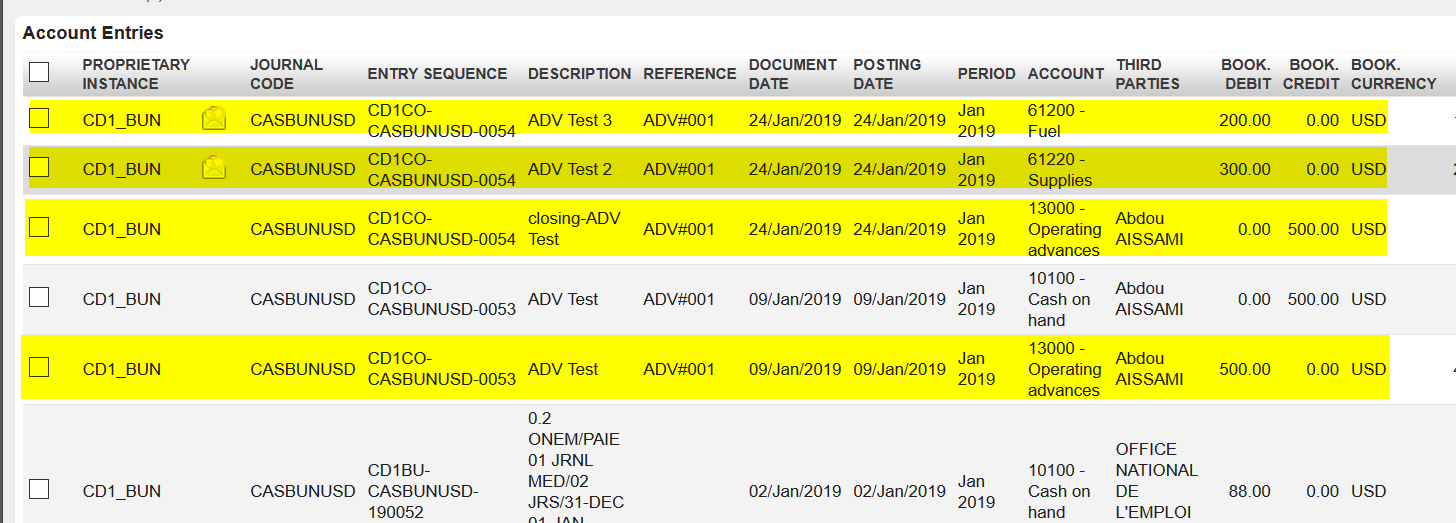
Related Entries are the entries that are linked together. For example, the operating advance entry and the automatic closing of this advance (when closed by the wizard) or automatically corrected entries in the Analytic journal Items (when using the open envelope to correct an account code/CC/Funding pool).
Related Entries in GL/ Analytic Selector
Go to: Accounting/Selector/GL Selector or Analytic Selector
In the sequence number, add the entry sequences that you want and separate them by a comma.
Tick the box of related entries.
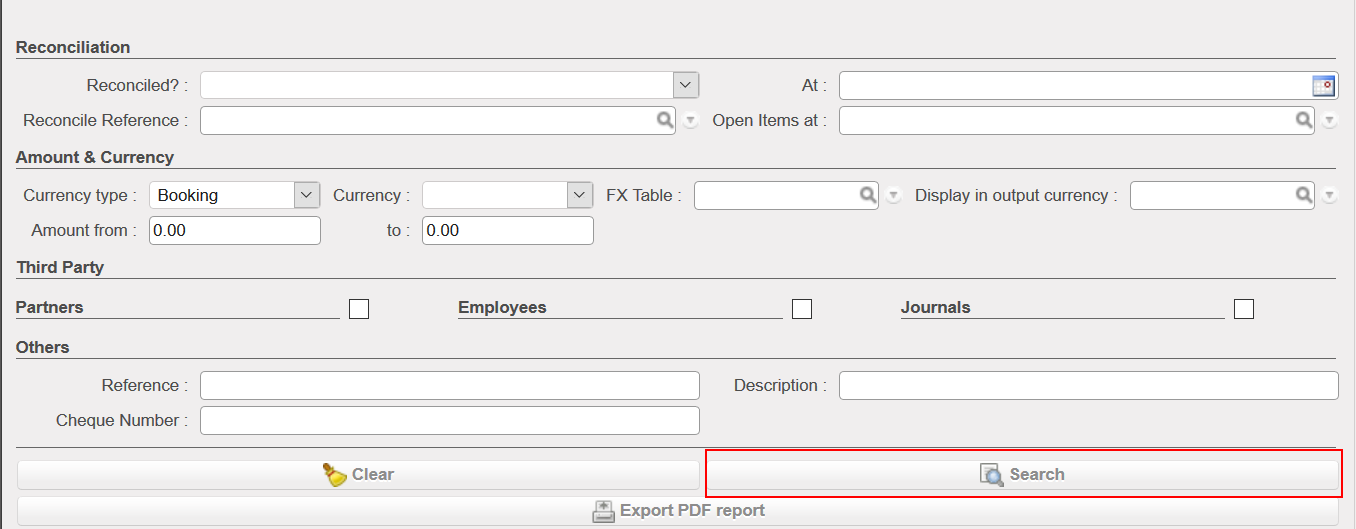
Click on {Search}
Only the selected entries will appear on your search in addition to the related entries if any. In the below example, we have the operating advance closing entries and the related expenses linked to the operating advance initial entry that we selected above CD1CO-CASBUNUSD-0053
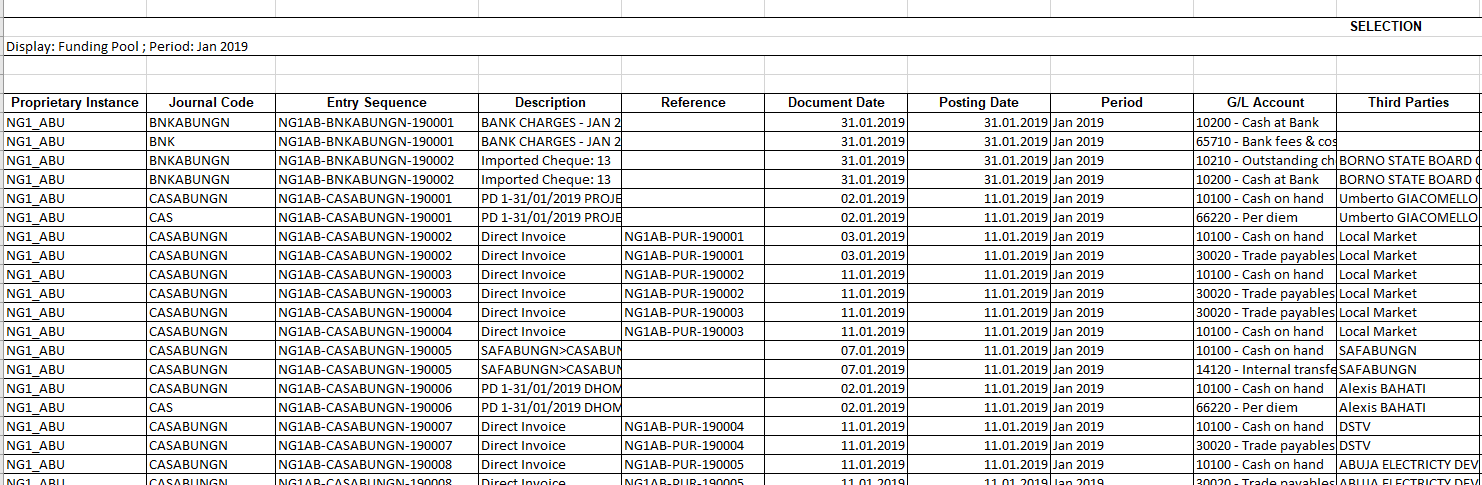
This report will combine all the JI and the AJI entries. The main purpose of this report is to display in one report all entries’ sequences in order, whether they were existing only in the JI, or only in the AJI or in both. In addition to that, it will help when doing the checking of the accounting documents when archiving per journal.
How to Produce Combined Journal Report
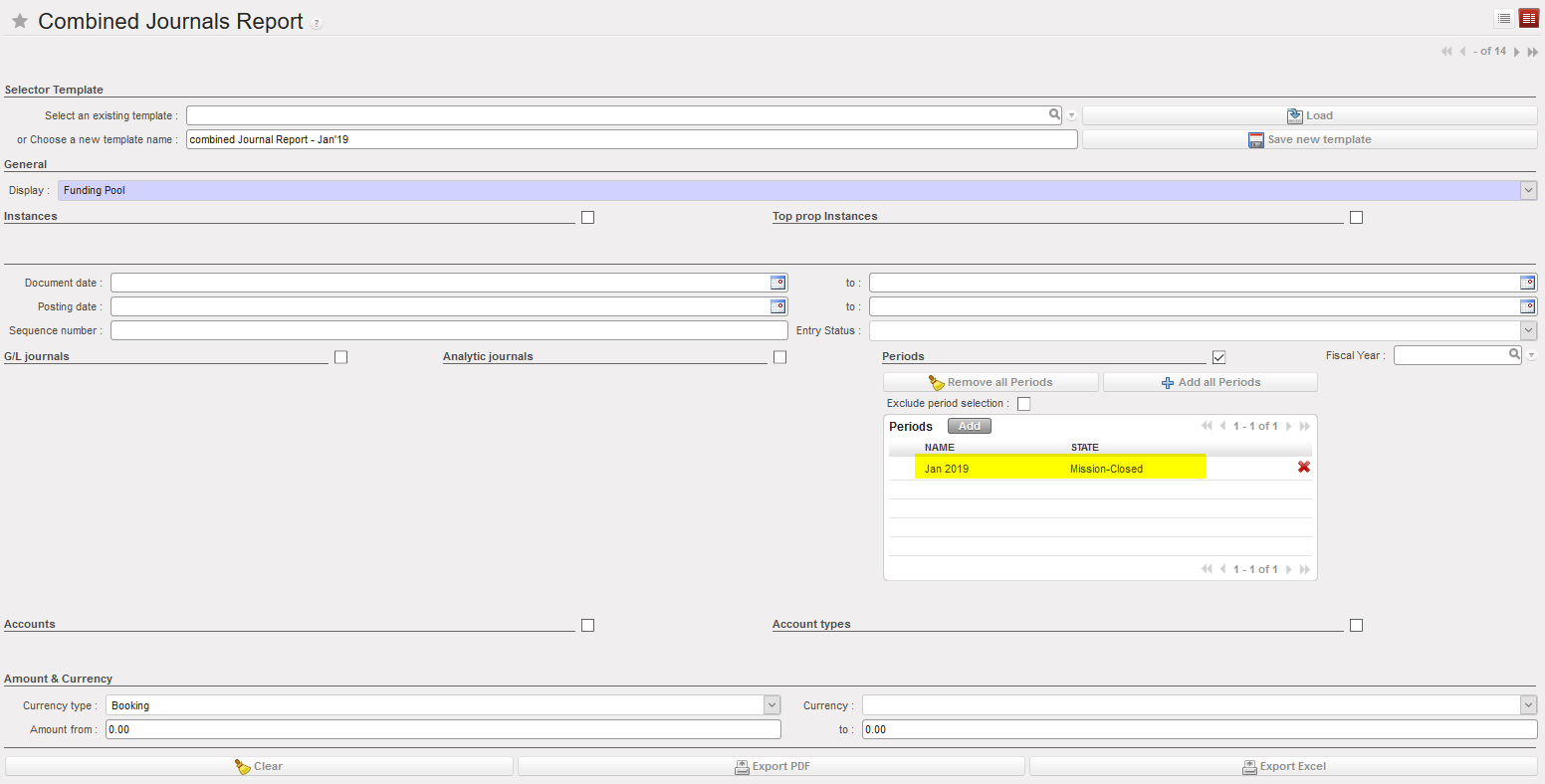
Go to: Accounting/Selector/Combined Journal reports
You have a wide range of possibilities to search for data. Ticking the checkbox for a certain heading will expand the screen for the user to select specific criteria. Similar to default search fields in other modules, you can enter data manually or use the magnifying glass to select from a drop-down list.
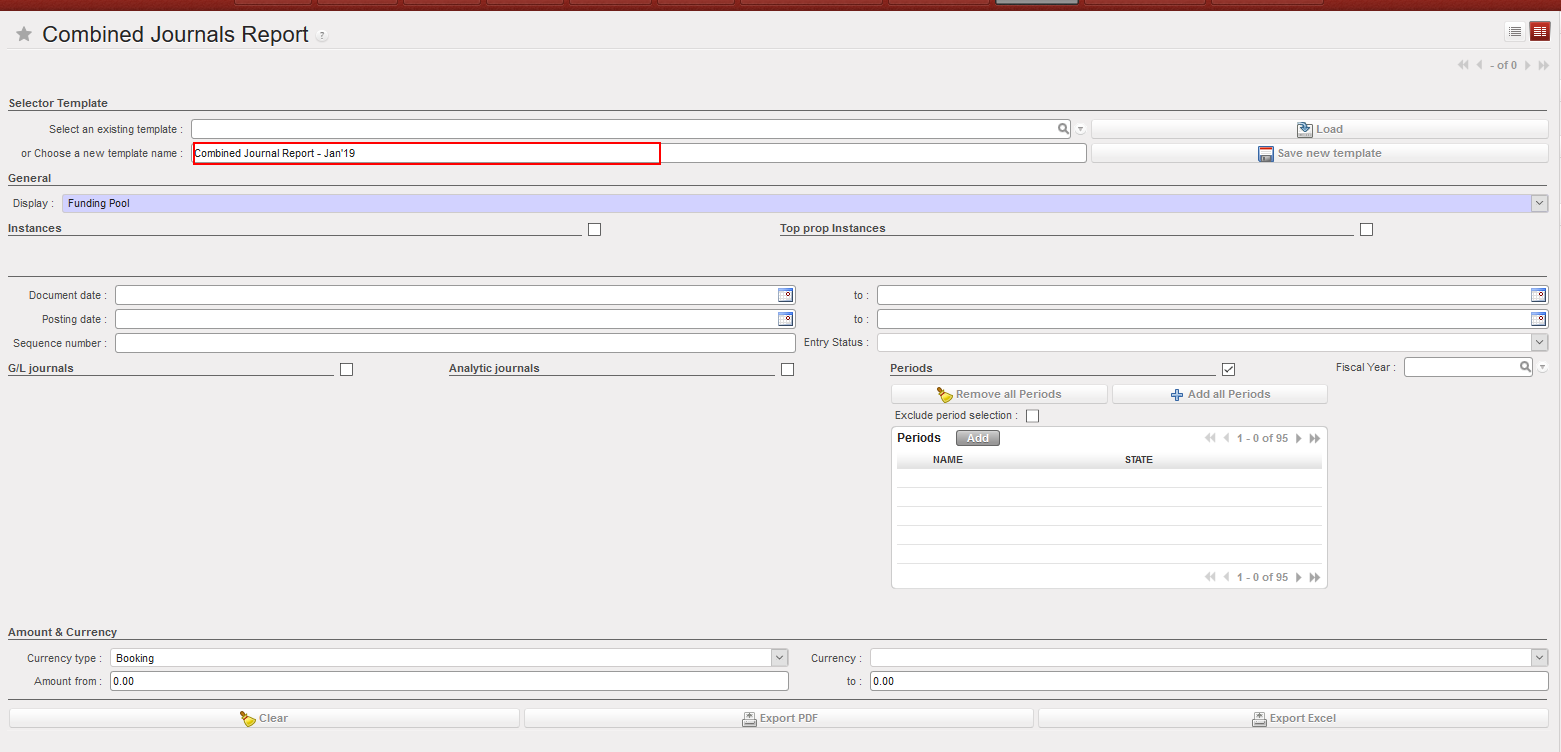
Create your template.
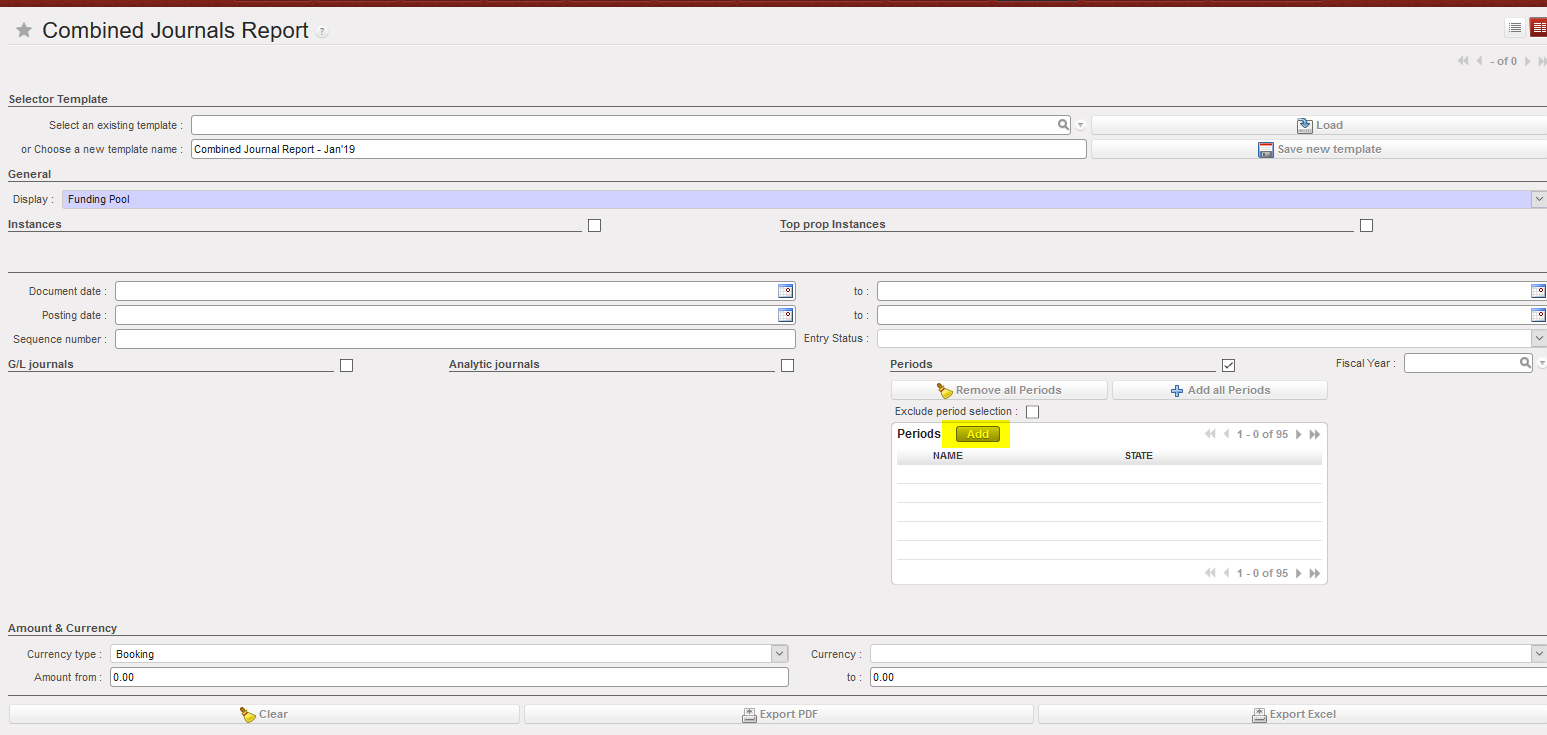
Select the period you want.
You will have a list of all periods, select all periods you want.
Also the field Sequence Numbers has a limit of 360 characters, and you can specify about 26 entries. Note that the total number of characters includes the character ( , )
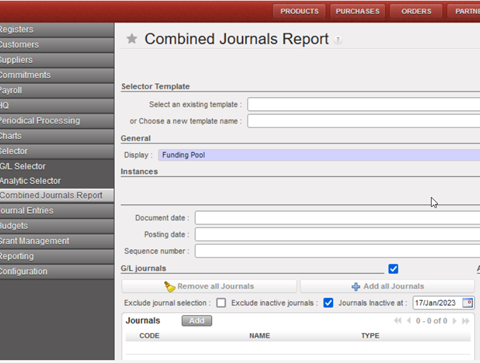
Also you can exclude inactive journals by dates by ticking on checkbox “Excluded inactive journals” and also a date on the Combined Selector:
Excluded inactive journals by date
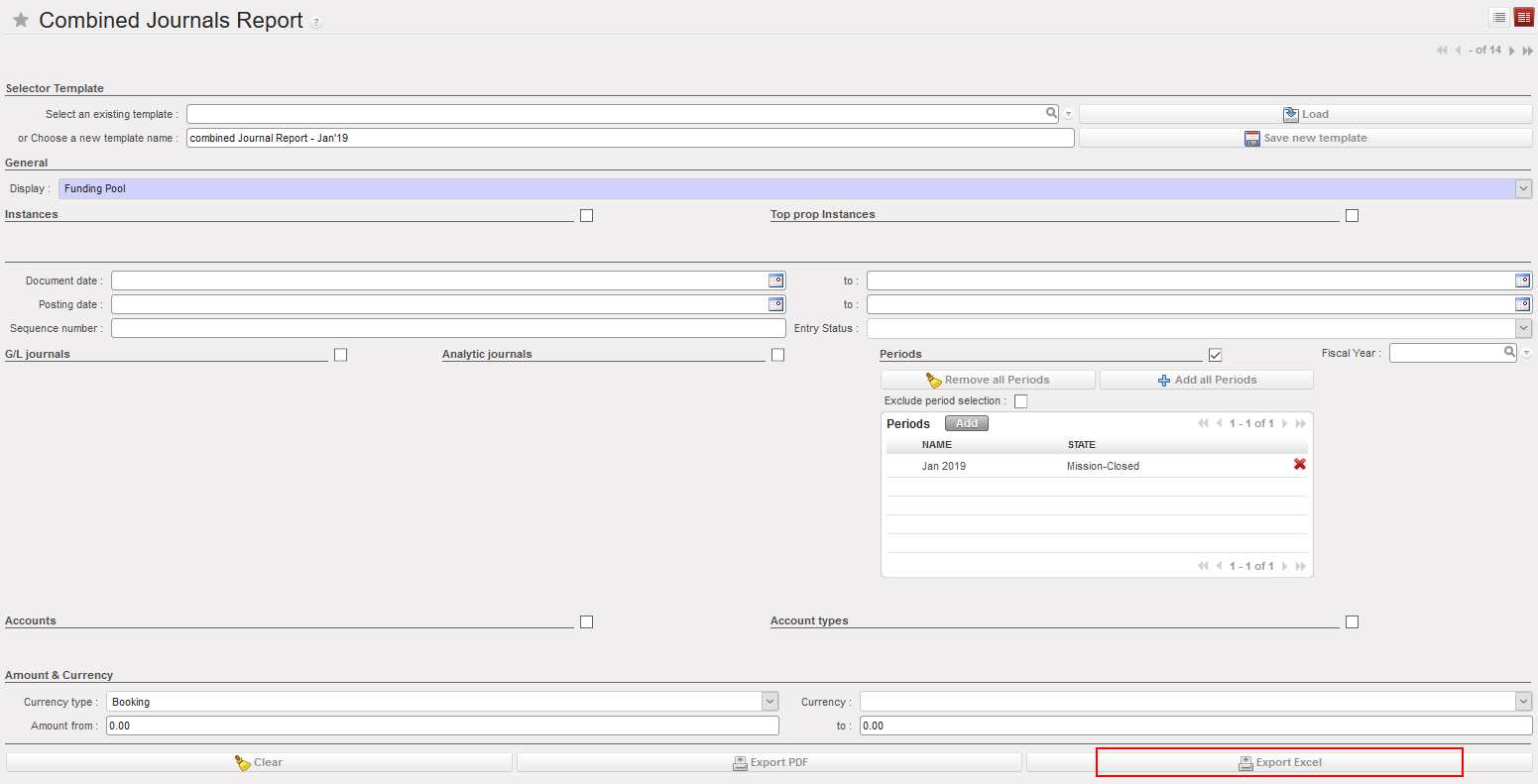
Click on {Export Excel} or {Export PDF}
Click on {Download Report}
In the report you will find all entries’ sequences (both JI and AJI) organized by order based on the sequence number.
UniField allows you to create and save queries that may need to be used repetitively. Users can access queries created by other users in the same instance.
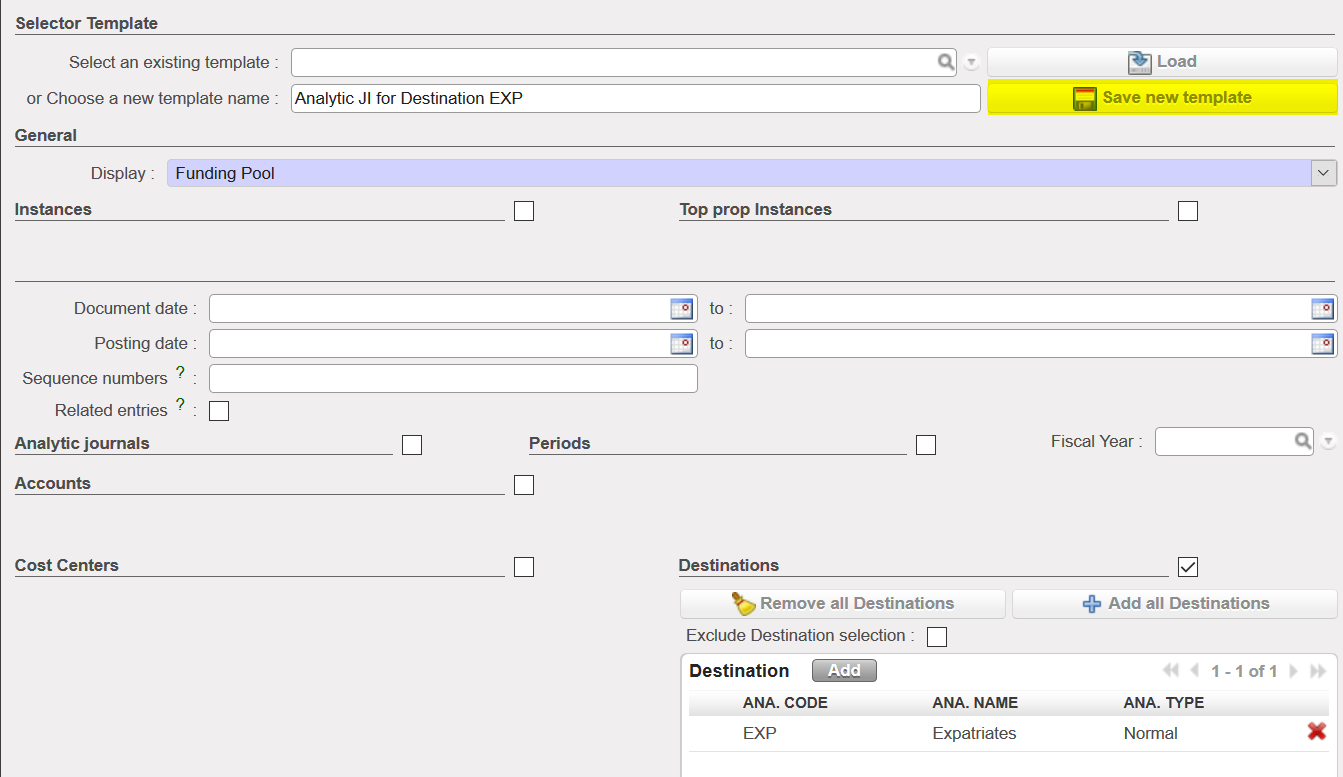
How to Save a Selector Query/Template Saving a query in the G/L or Analytic Selector is the same process. For the purpose of this exercise we will save a search in Analytic Selector for all entries allocated to destination “Expatriate”.
Go to: Accounting/Selector/Analytic Selector
Enter a name for your search in in {Choose new template name}
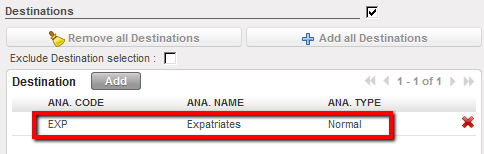
Expand the Search view of the Destinations criteria and Select the criteria {Expatriate}
Expatriate destination selected as saved Search criteria
Click on { Save new template }
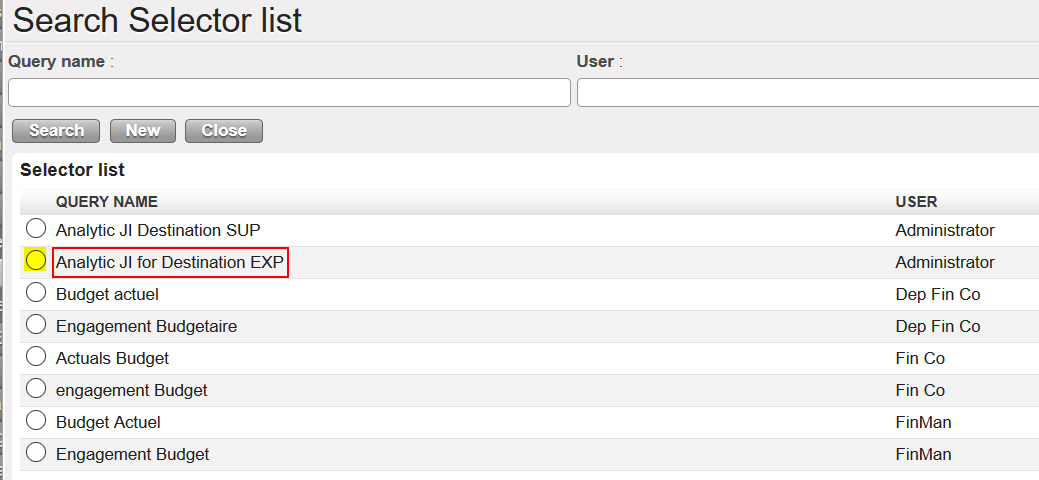
Next time when you go to Selector/Analytic Selector, search for the query you want by clicking on the magnifying glass in {Select an existing template}
Select the template (query) that you want.
Finally, click on {Search} to export your report.
We use cookies to ensure that we give you the best experience on our website. If you continue to use this site we will assume that you are happy with it.

 Selection of a funding pool in the Search Analytic Account view and Reports menu opening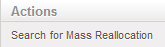
 Analytic account selection for a Free 1 mass reallocation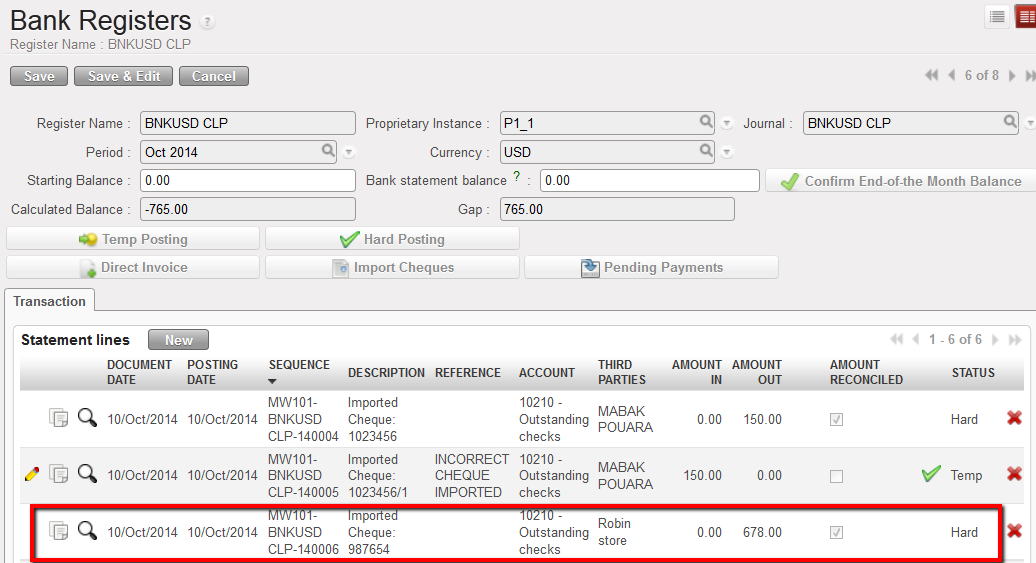
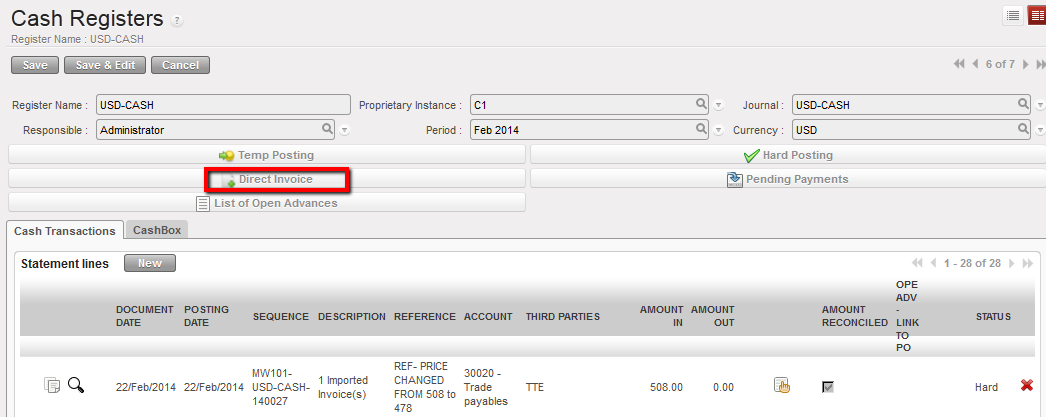 Direct Invoice functionality on a cash register
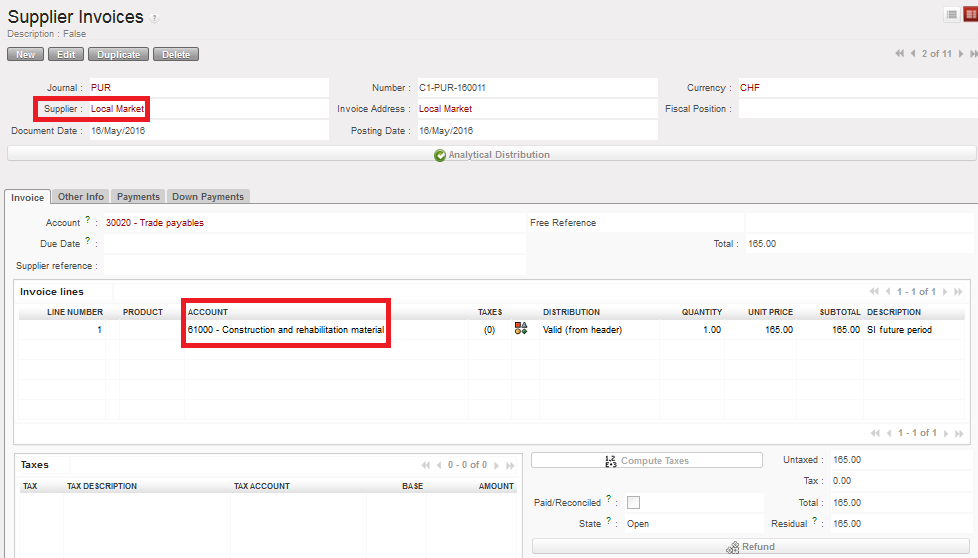 Open supplier invoice displayed in the Supplier Invoices sub-module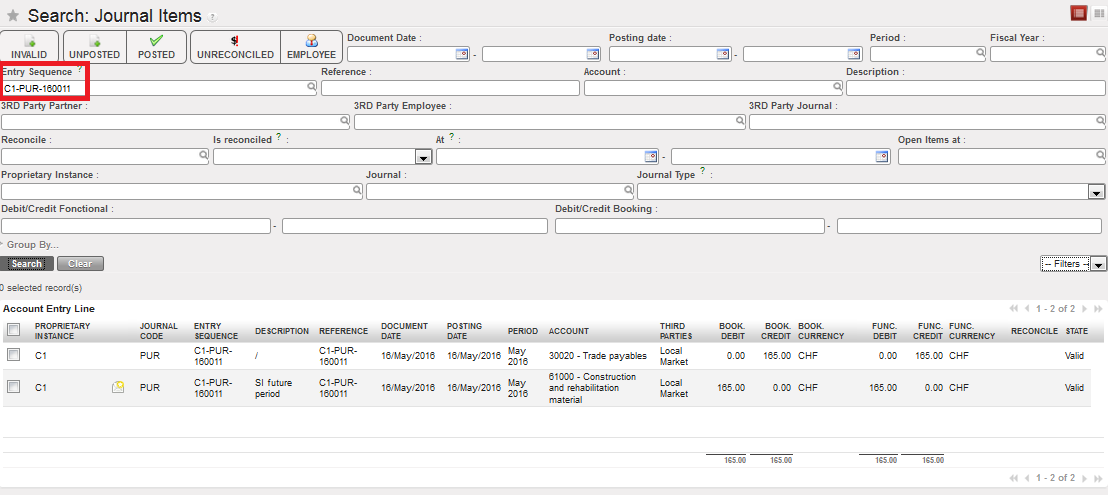
 Accounting Corrections Wizard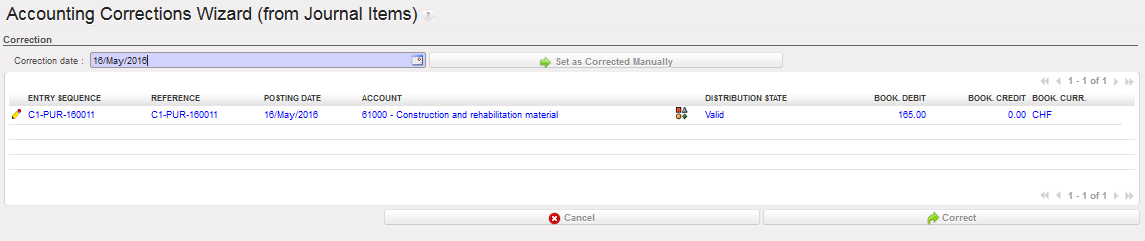


 Edition button to change the analytical distribution
 Cost center changed
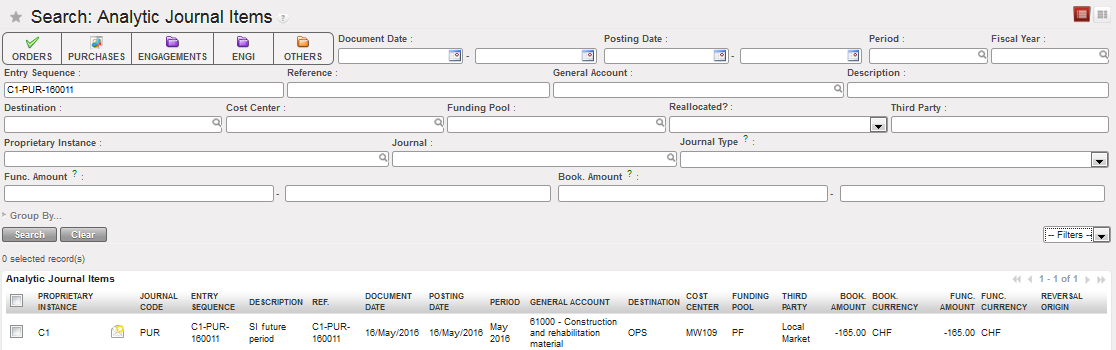 The cost center was changed and the original AJI was updated.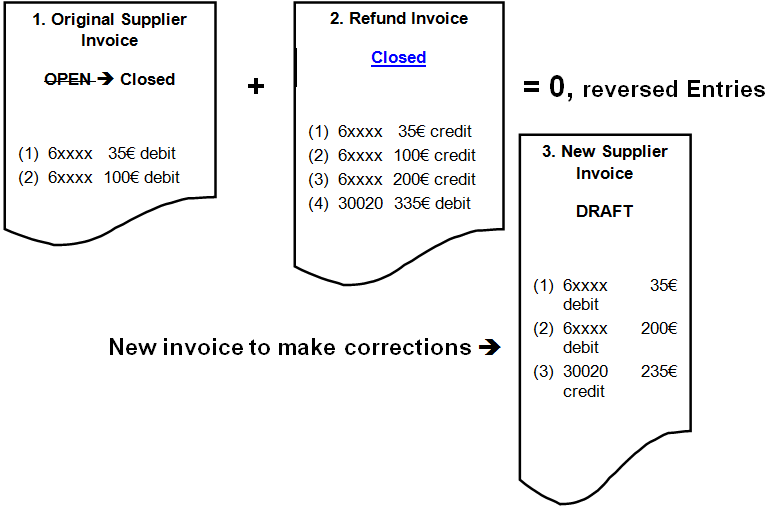








 Analytic Journal Items associated to the Open supplier invoice

 Changed account in Accounting Corrections Wizard
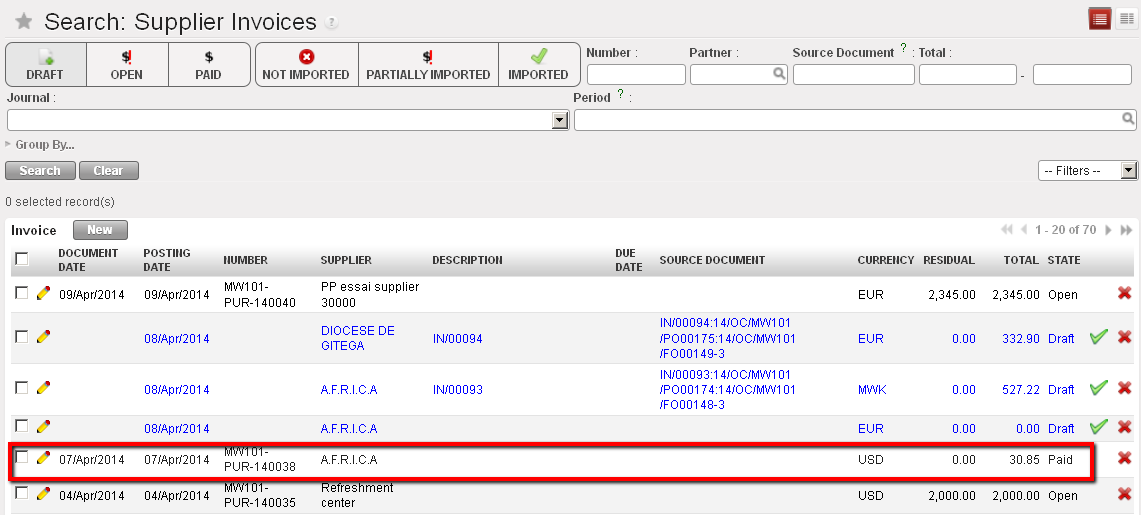

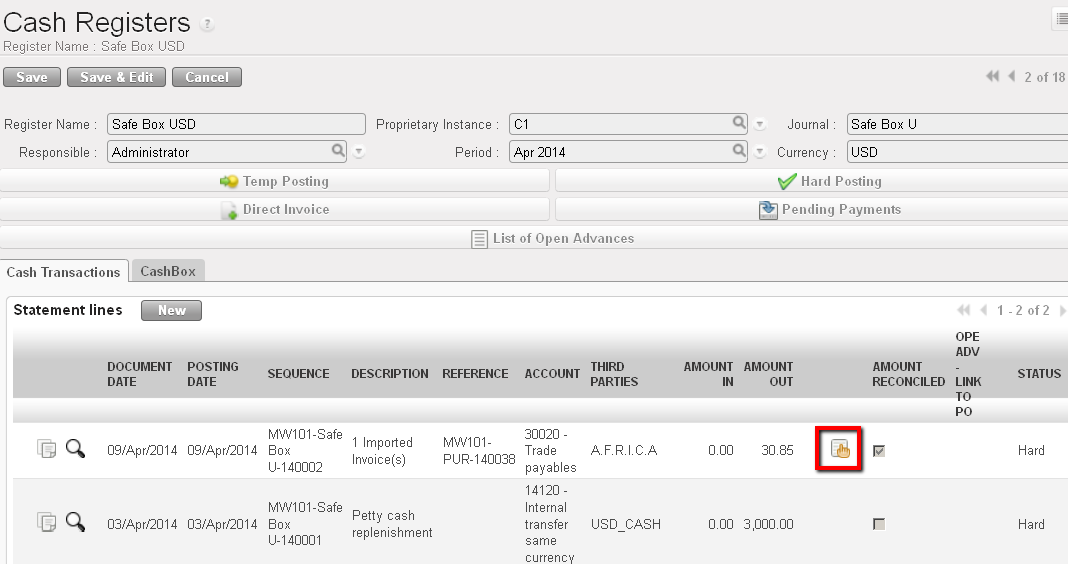 Opening a supplier invoice hard-posted in a register
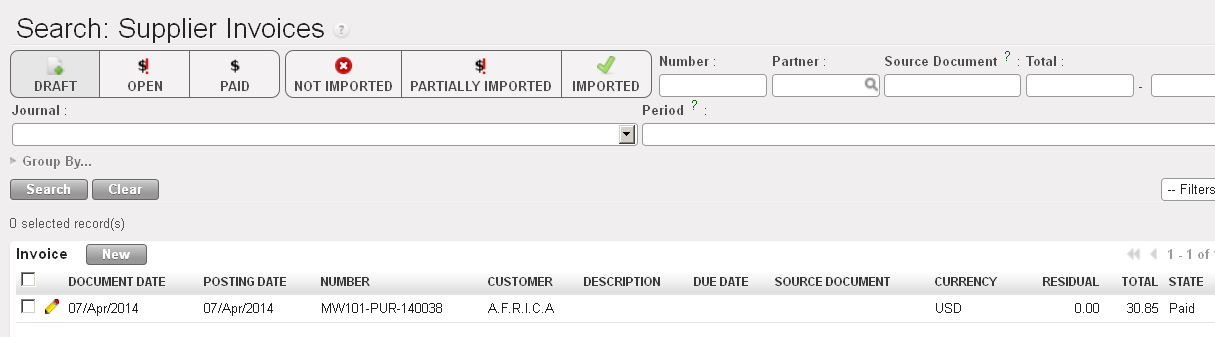 Search Supplier Invoices displays
 button and the supplier invoice form view appears.
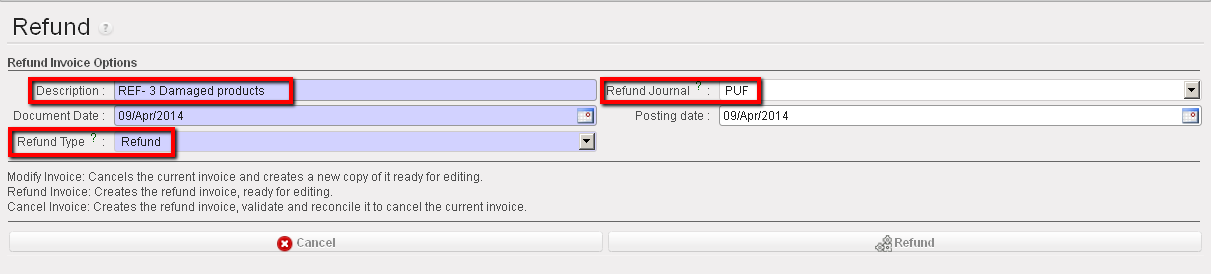 Refund wizard
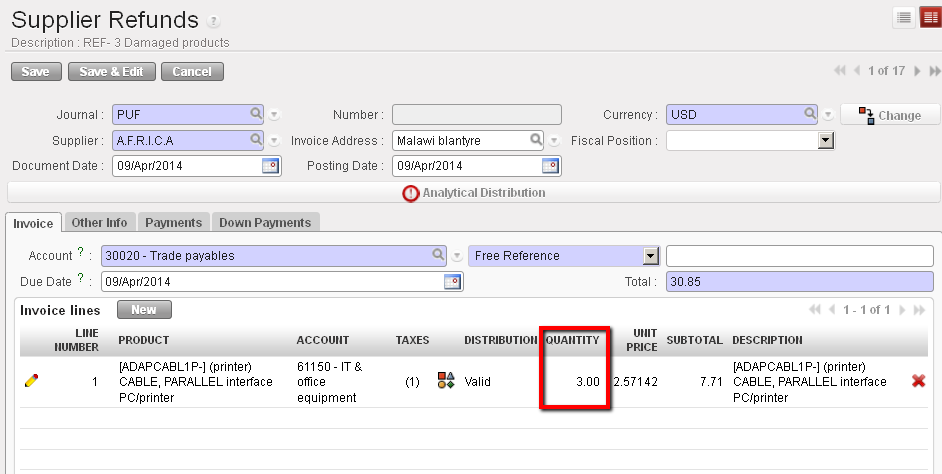 Refund supplier invoice
 to validate it.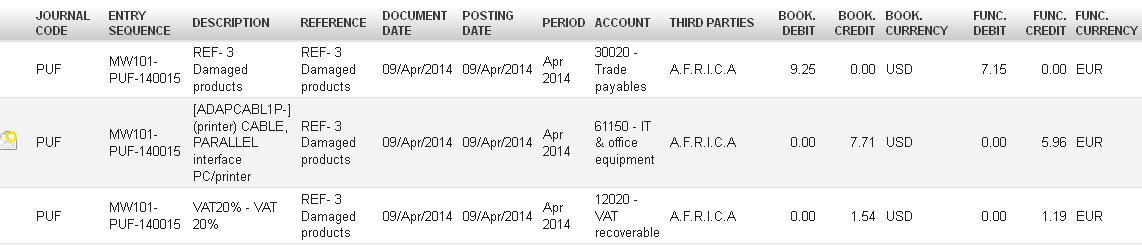
 to edit.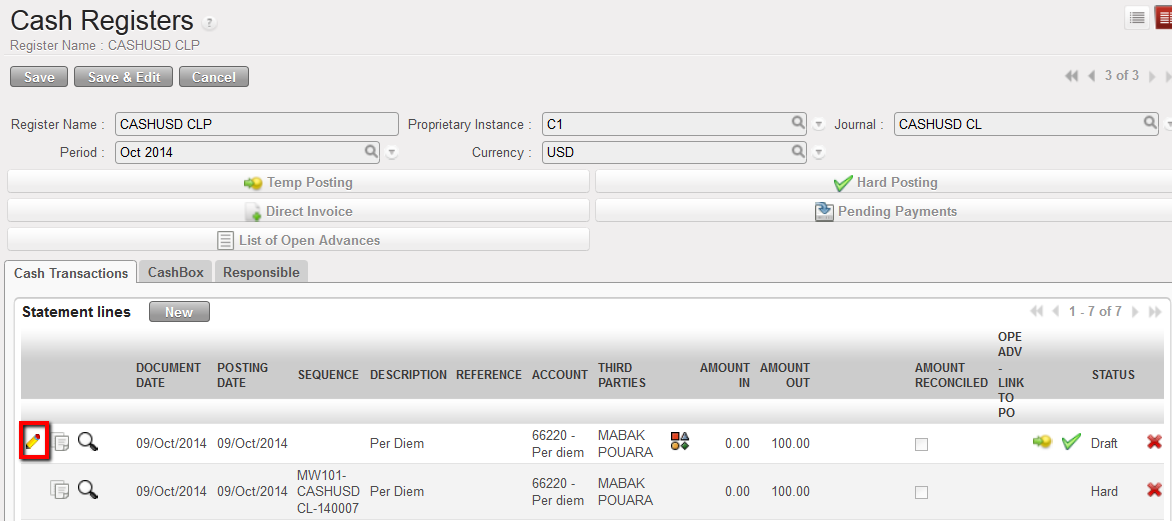
 to save the entry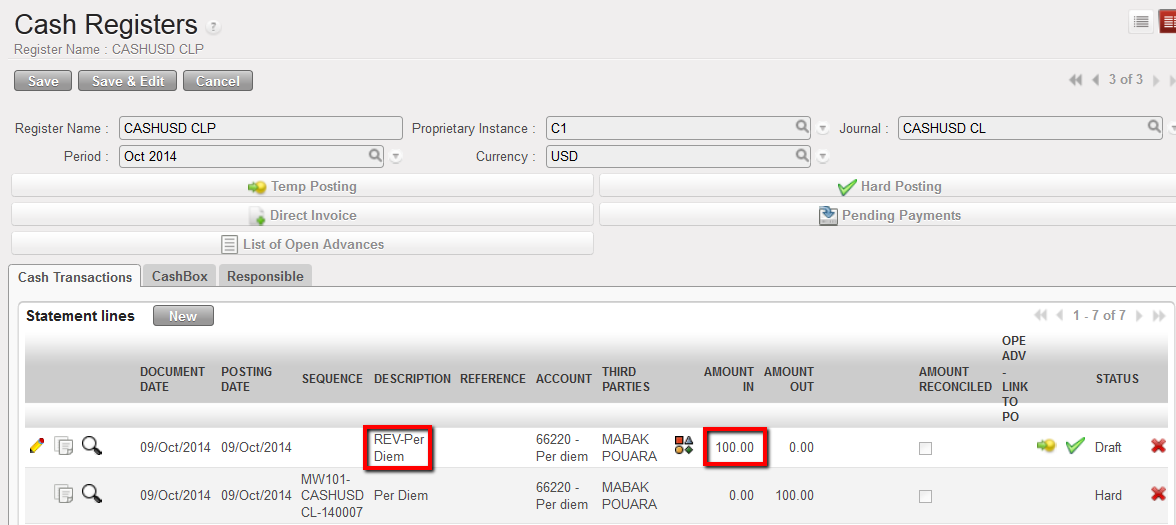

 to edit.
 to save the entry

 to edit the entry.
 Change the account code and click
  to save. The new code is saved.
 Correcting the account code: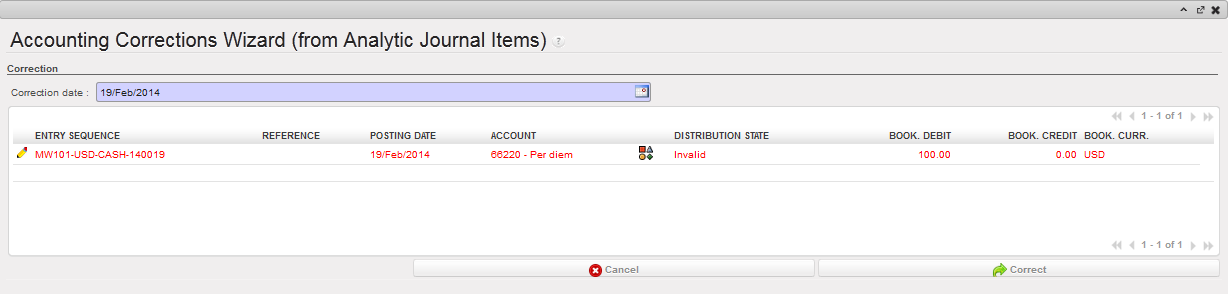


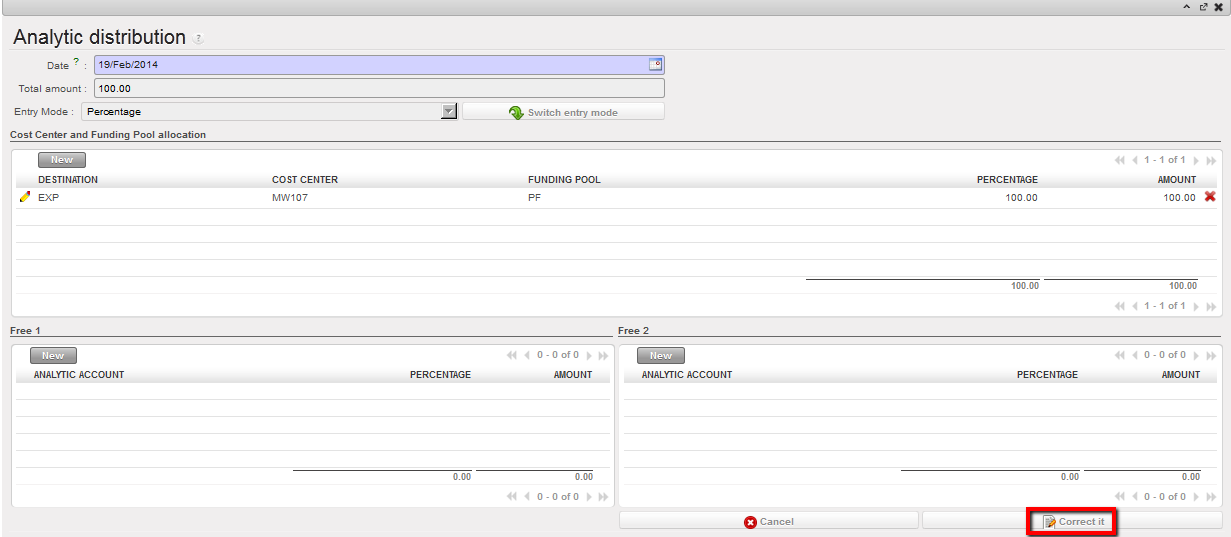 Correct button to save the correction
 Correction history on an accounting code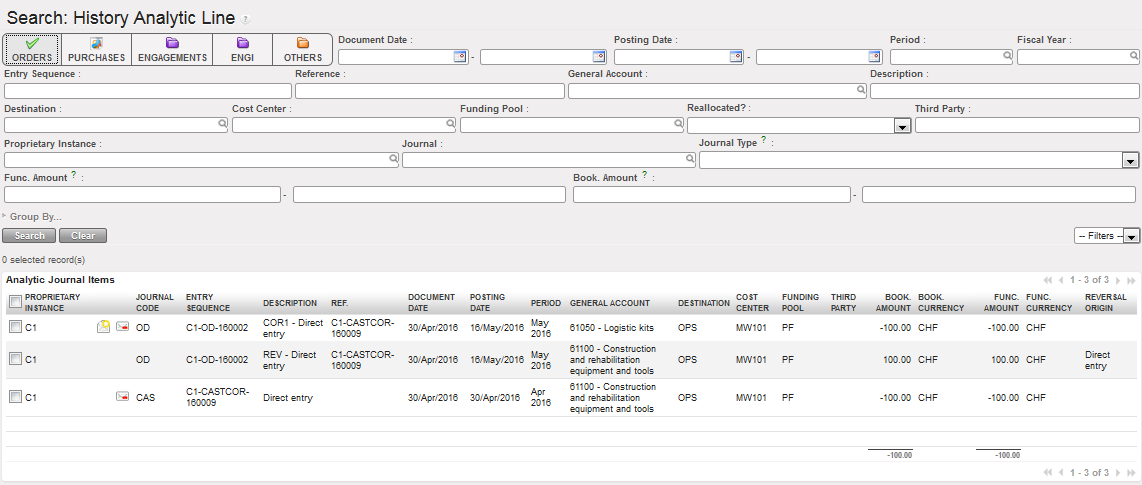
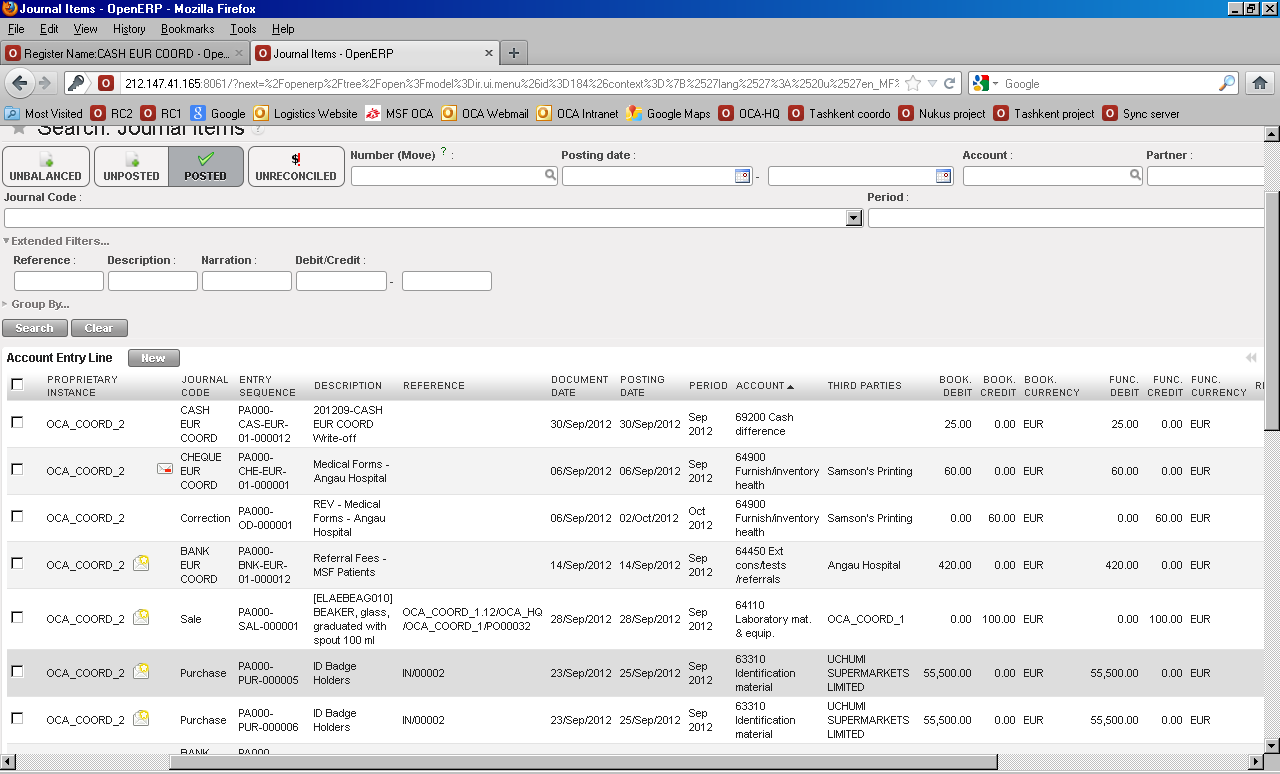

 Entry recorded at project level and booked on the cost center MW101 instead of MW102.
 Synchronized entry to correct visible at Coordination instance
 Cost Center being changed by Coordination to MW102
 Cost center changed to MW102, visible at Coordination instance
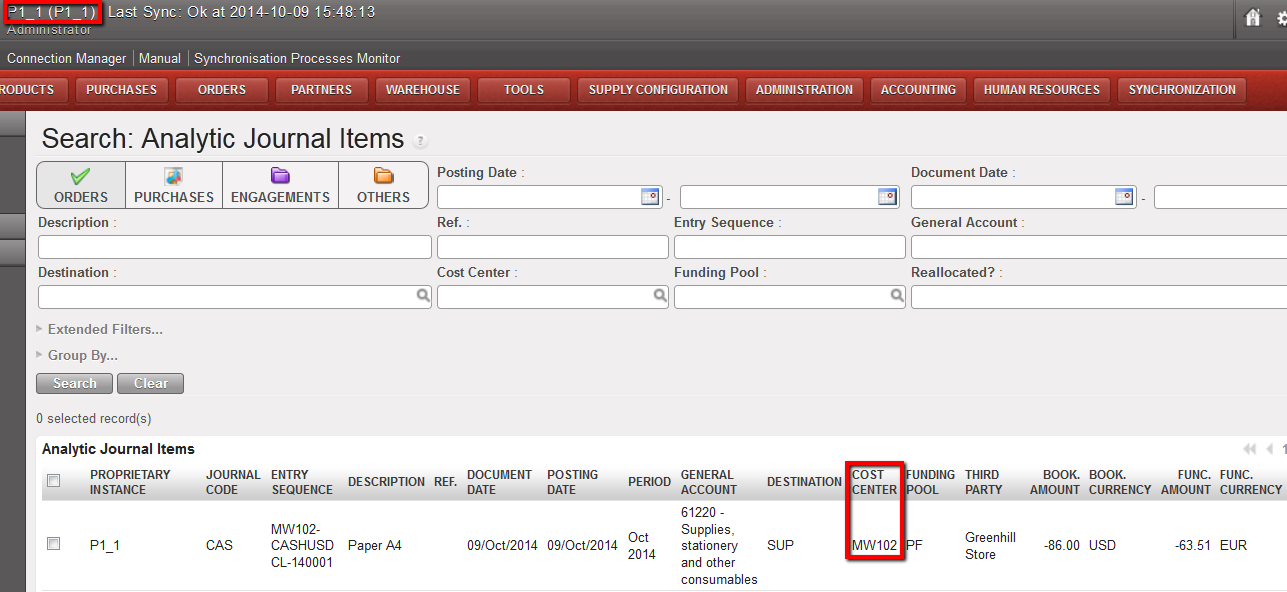 Cost center changed to MW102, visible at Project instance after being synched. This entry cannot be corrected anymore (no envelope icon = correction wizard disabled).
 is used: