The Analytic Selector is available in Accounting/Selector/Analytic Selector
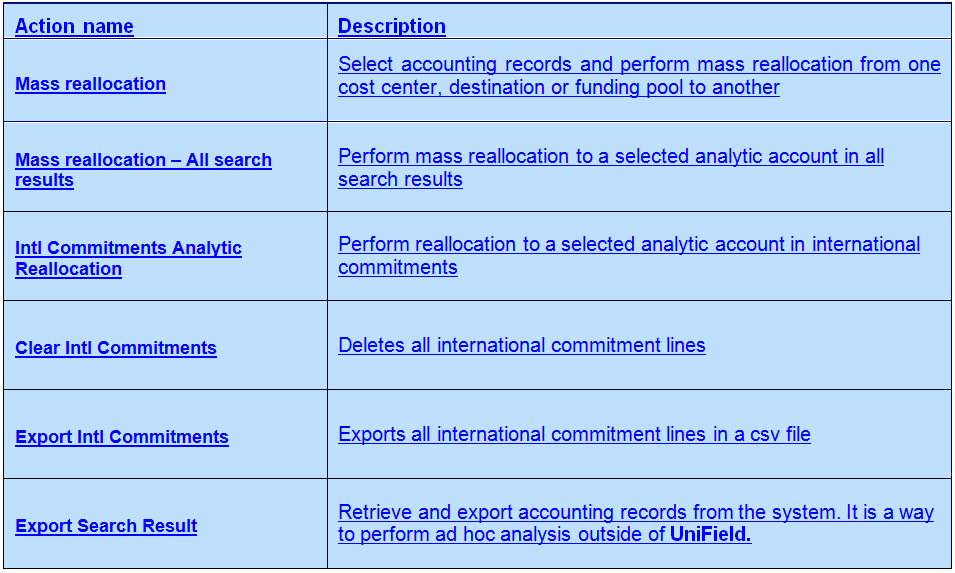
The Analytic Selector is a tool to search Journal items and their corresponding analytic allocation when you need to use multiple or complex criteria that cannot be easily done in Analytic Journal Items. You can use it for the following actions once the Search Analytic selector was performed:
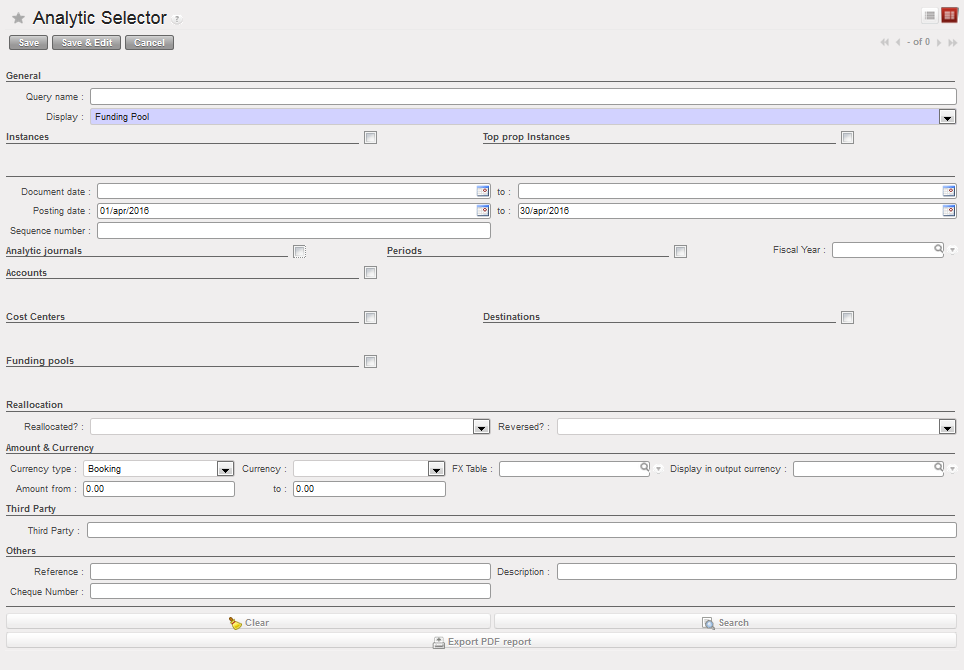
Analytic Selector used to look for entries based on the posting dates
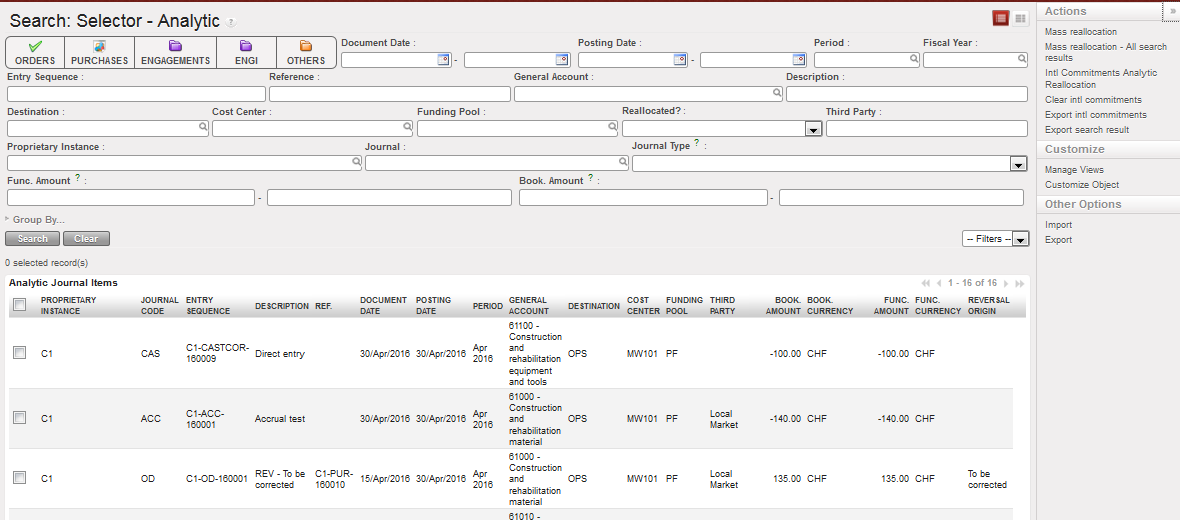
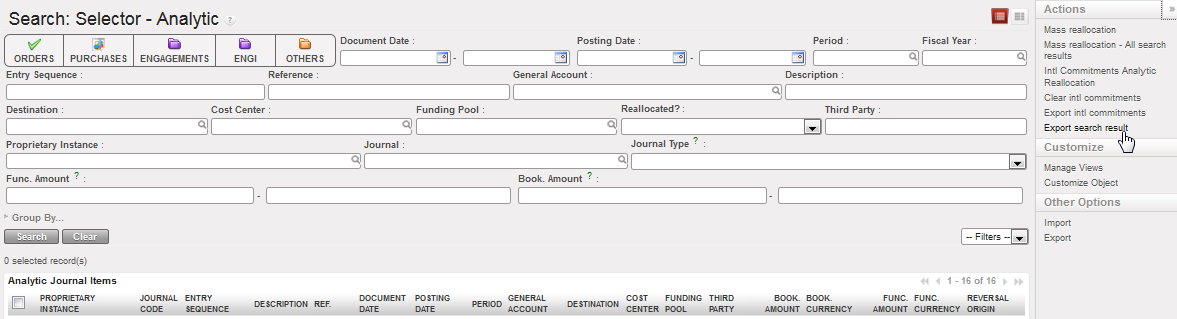
Analytic Selector search result view and related Actions menu
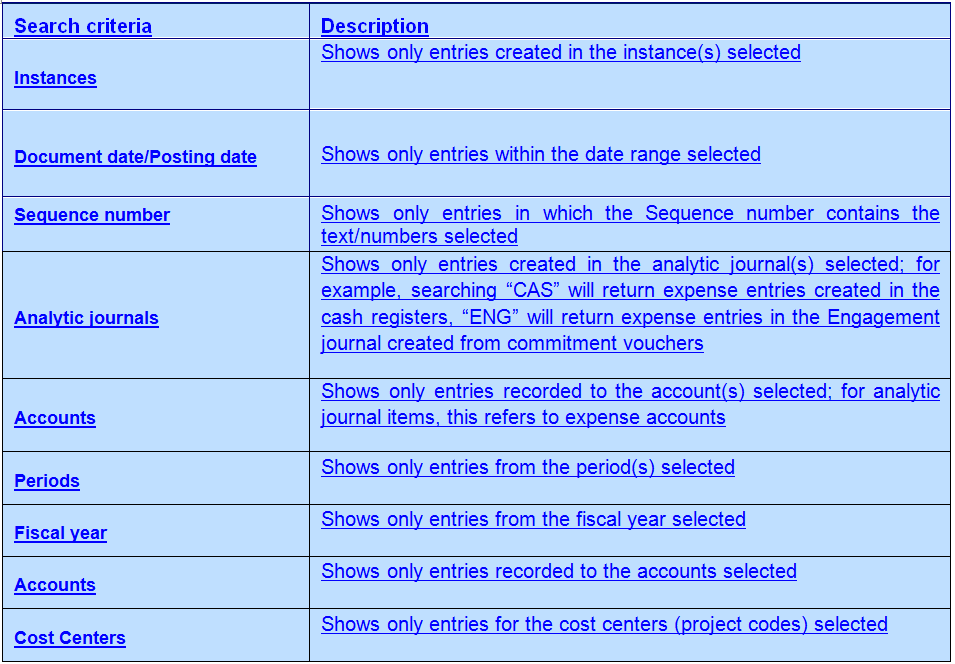
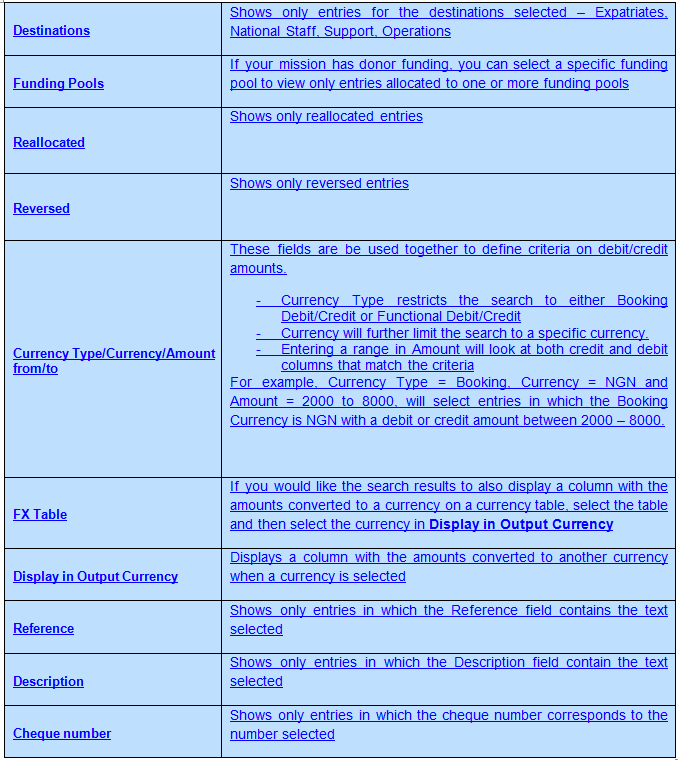
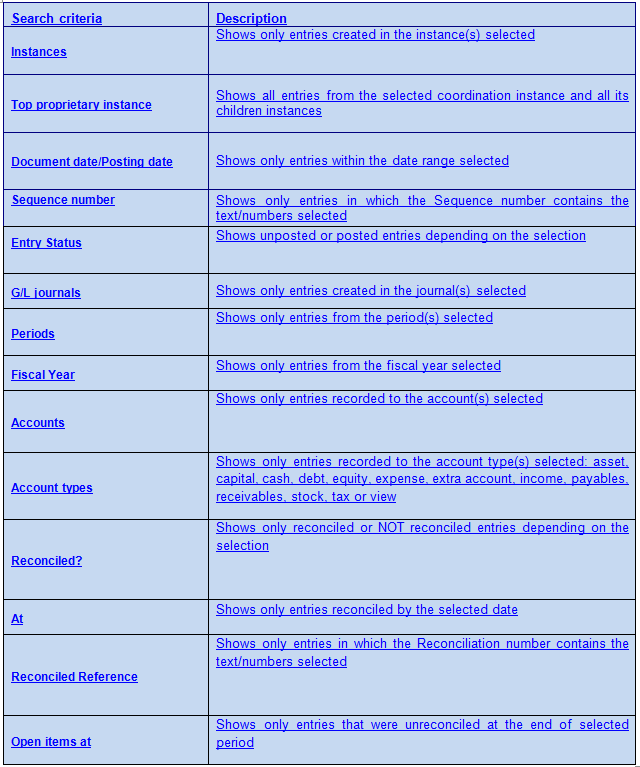
Description
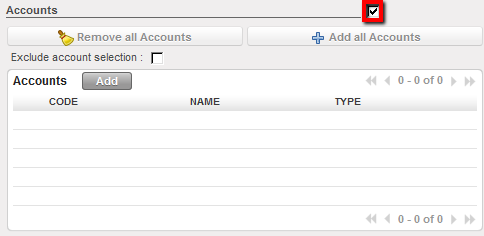
You have a wide range of possibilities to search for data. Ticking the checkbox for a certain heading will expand the screen for the user to select specific criteria. Similar to default search fields in other modules, you can enter data manually or use the magnifying glass to select from a drop-down list.
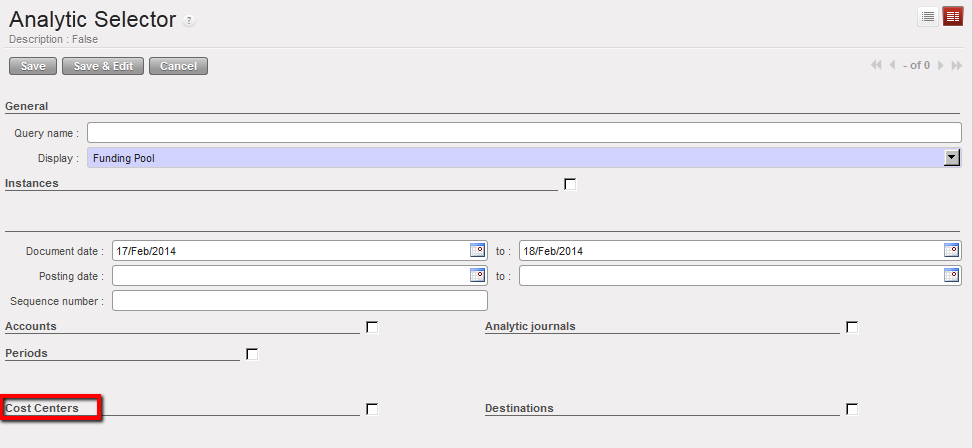
Ticking the Cost Centers checkbox in the Analytic Selector expands the view to select criteria for Cost Centers
Note that :The field Sequence Numbers has a limit of 360 characters, and you can specify about 26 entries. Note that the total number of characters includes the character ( , )
How to Perform an Analytic Search:
Go to: Accounting/Selector/Analytic Selector
In this example we will search expense entries allocated to a specific cost center for a specified period. Since analytic journal items only concern expenses / income, you do not need to select expense accounts as criteria.
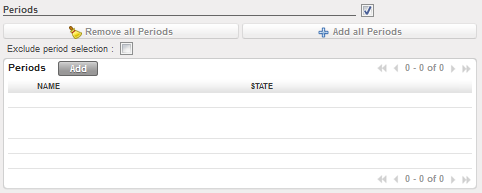
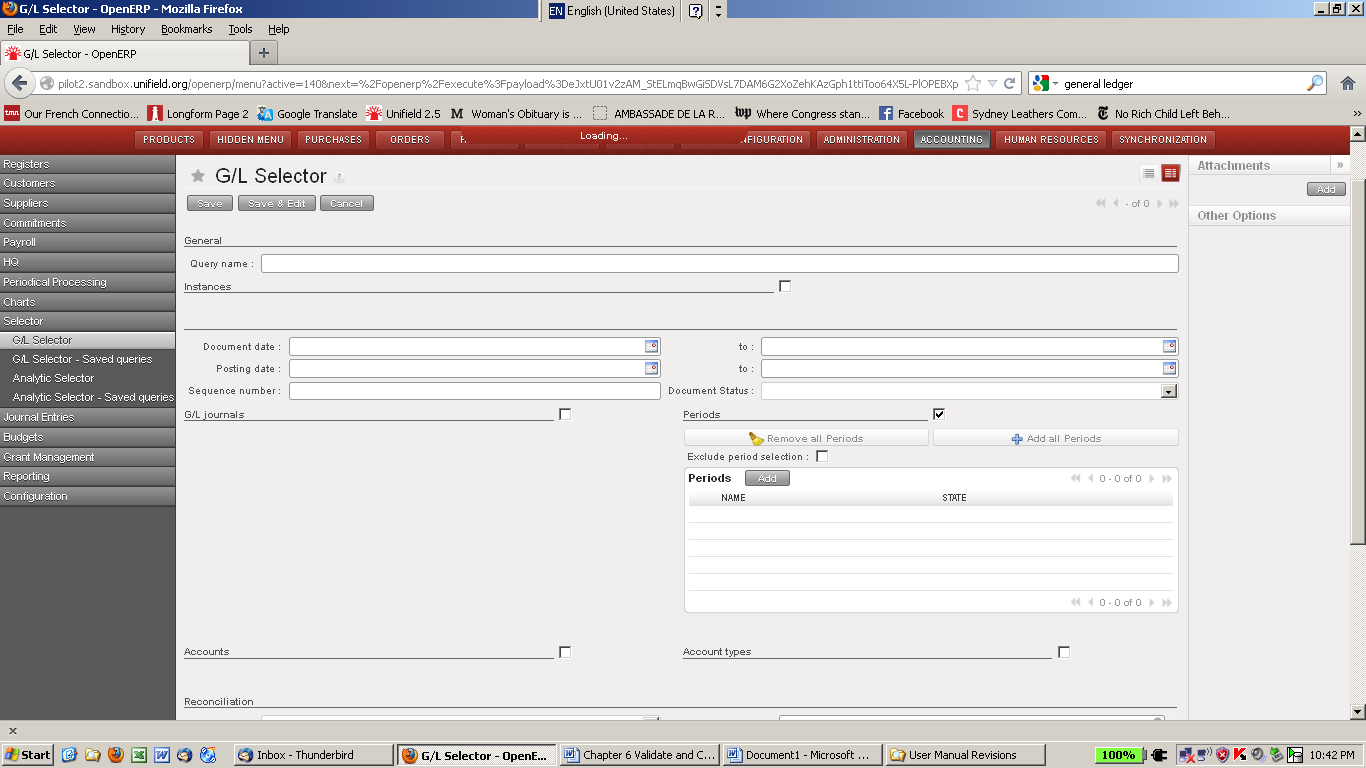
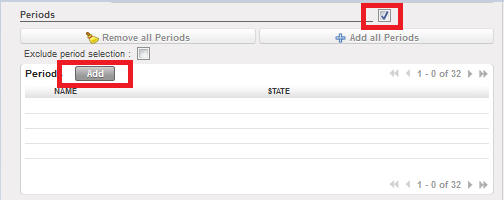
Tick the checkbox next to Periods to expand the search view.
Expand search view in the Analytic Selector to set period criteria
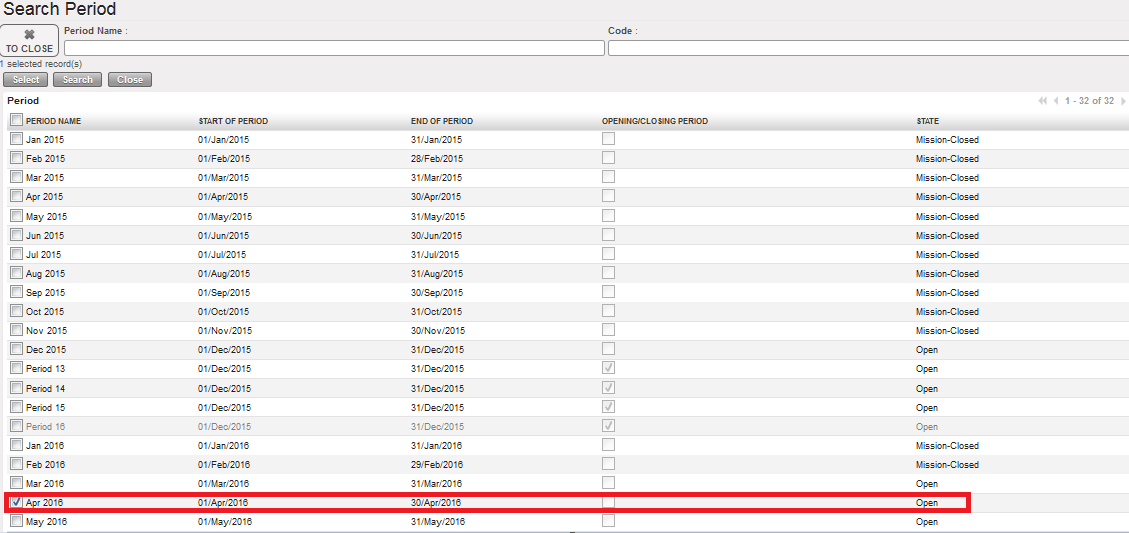
Click the button and select the period(s) you would like to view.
Select period in Analytic Selector
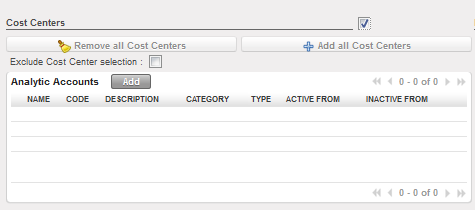
Tick the checkbox next to Cost Centers to expand the search screen
Expand search view in the Analytic Selector to set cost center criteria
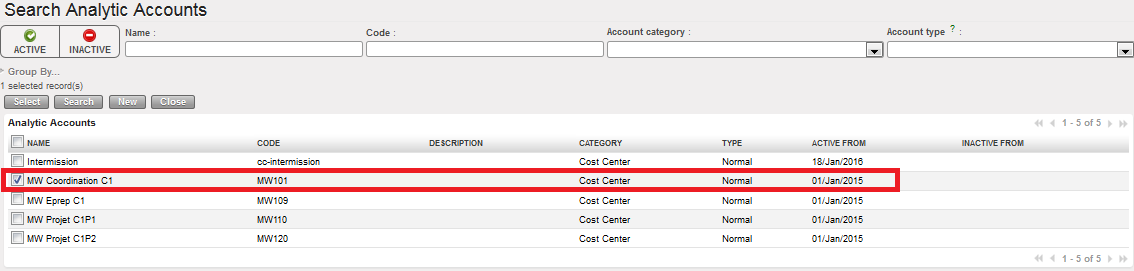
Click {Add}. Select the cost centers that you want to search
Select cost center in Analytic Selector
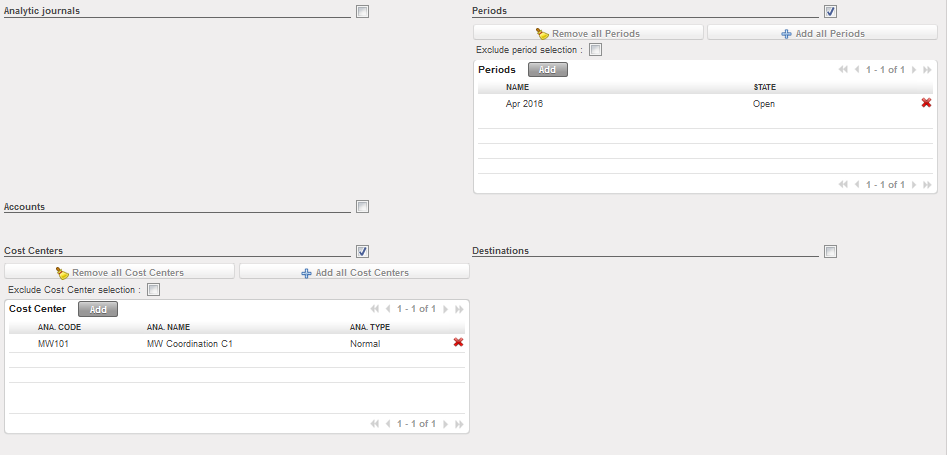
As a result, you have set the criteria for period, cost center and destination as showed next page:
Search criteria set in Analytic Selector
Click Search at the bottom of the screen.
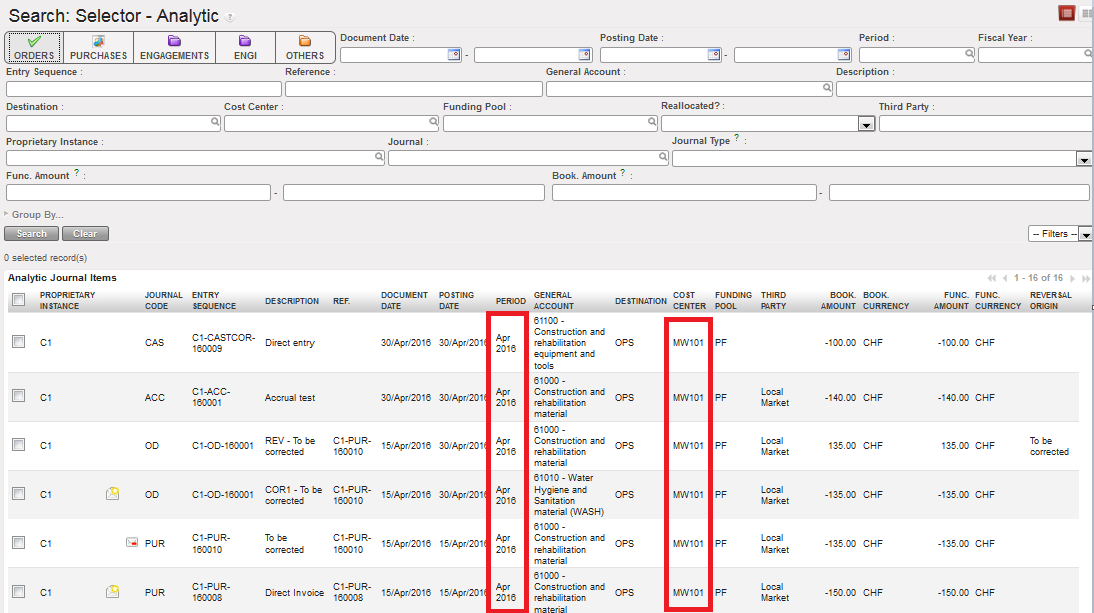
A new tab opens to display the search results. You can further refine your results by using the default search fields. As you can see the selected period, Cost Center and additionally Funding Pool and Destinations are visible.
Analytic Selector – Search results
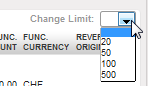
If necessary, change the limit so all records display. Please remember, if you have a large number of entries, do not use the Unlimited option as it will cause a long delay. You can choose to sort by a column header by clicking on the column header.
Change number of entries displayed on the screen
Select all entries by clicking the top checkbox on the header row and to export, go to the Actions menu. Select {Export search results}.
Export search results
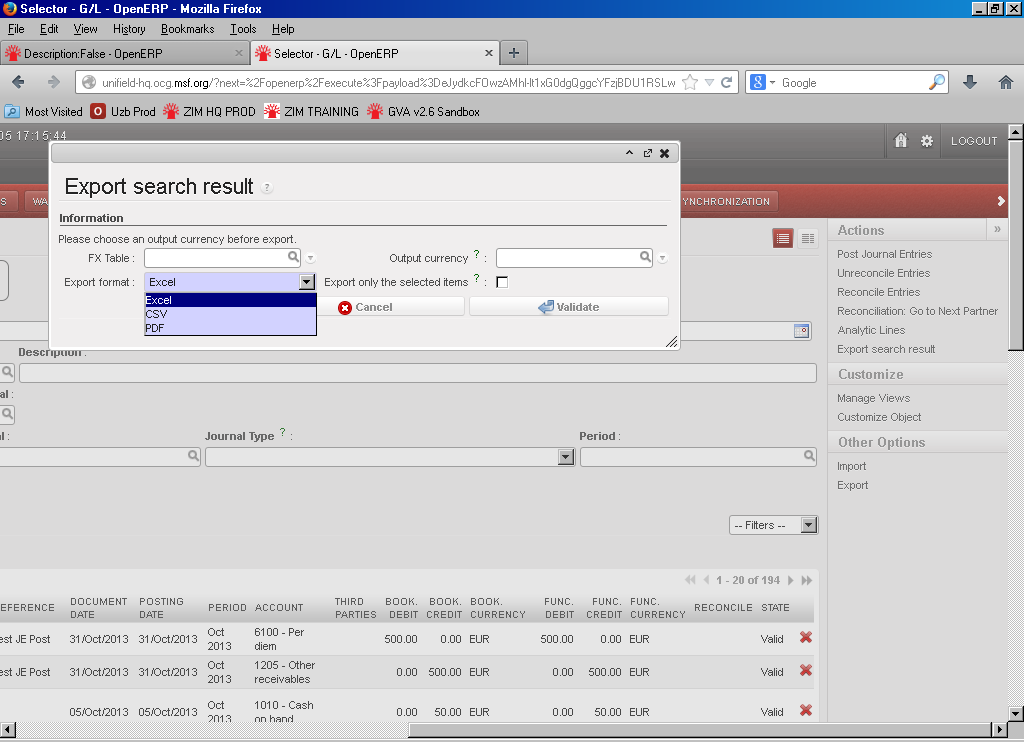
A new window will appear with additional export options to select if desired, e.g. currency, format. Click {Validate}.
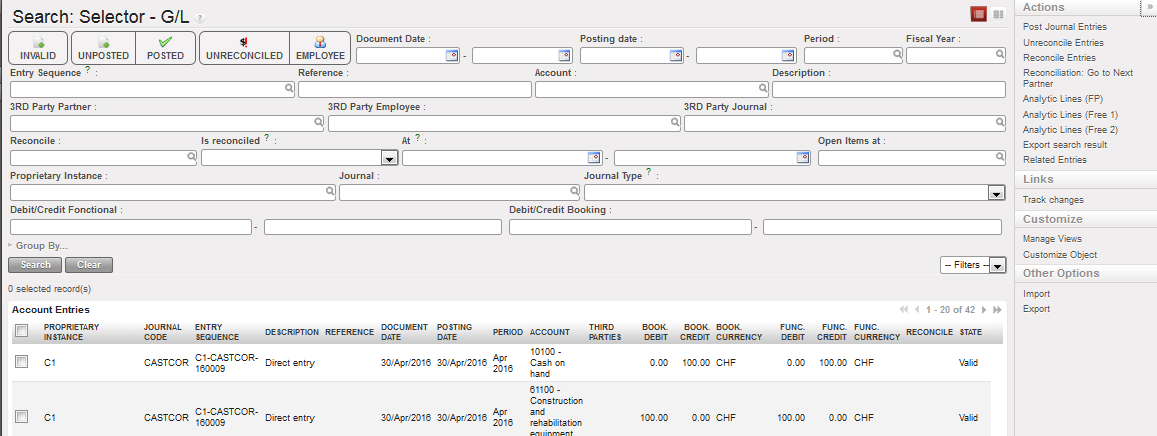
The General Ledger Selector is available in Accounting/Selector/G/L Selector
The G/L Selector is a tool to search Journal items when you need to use multiple or complex criteria that cannot be easily done in Journal Items. You can use it for the following actions once the Search G/L selector was performed:
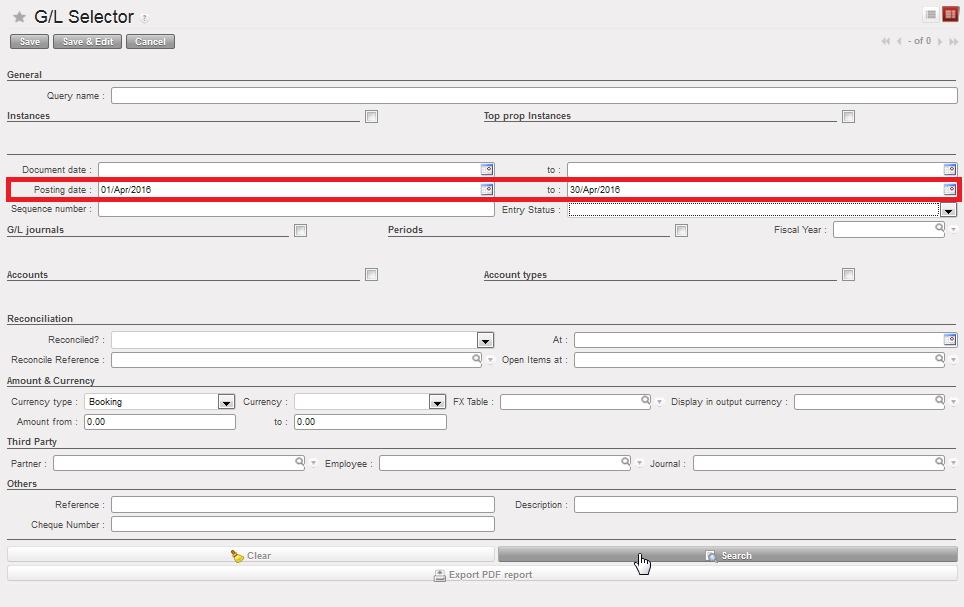
G/L Selector used to look for entries based on the posting dates
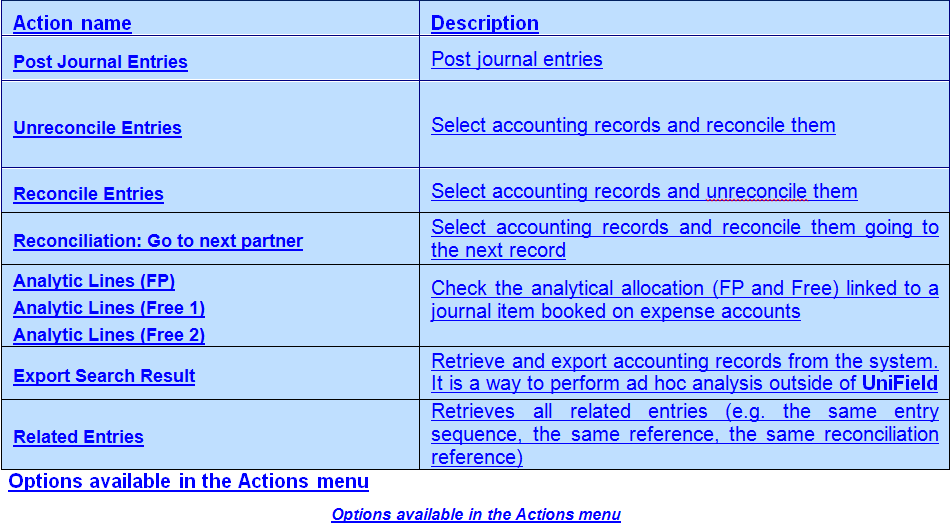
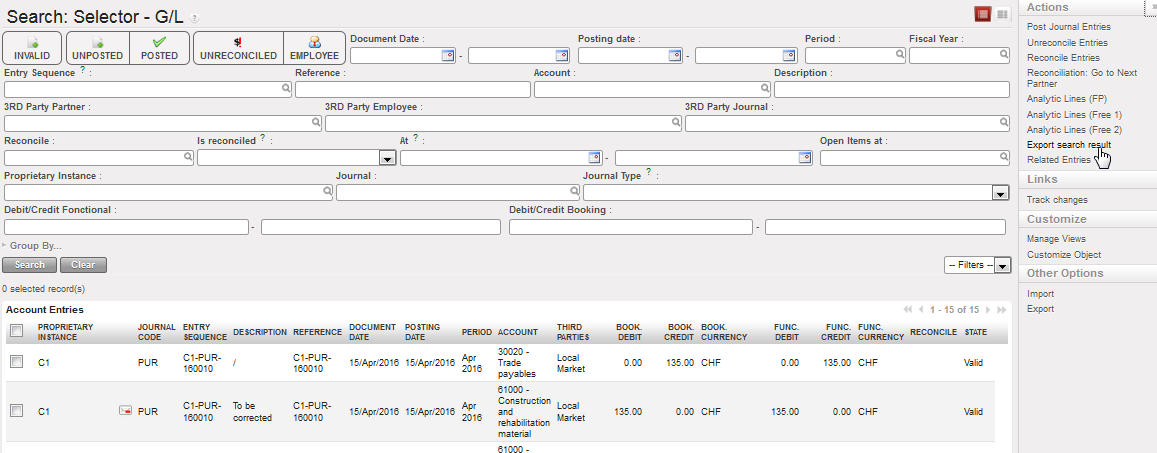
G/L Selector search output and related Actions menu
Action name
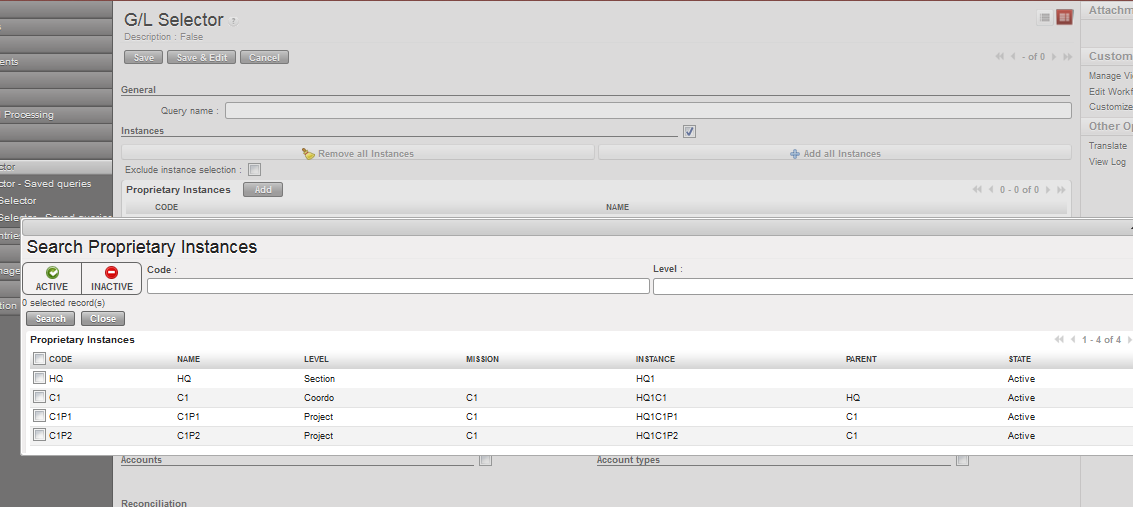
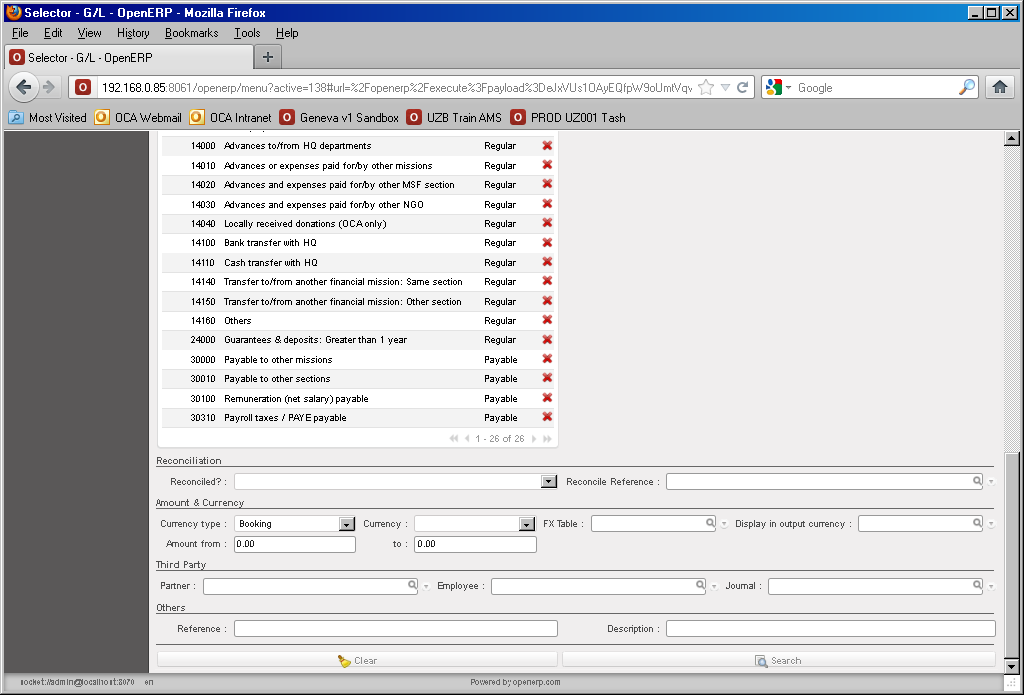
You have a wide range of possibilities to search for data in the G/L selector. Ticking the checkbox for a selected heading will expand the screen for the user to select specific criteria (e.g. periods, proprietary instances, accounts). Similar to default search fields in other modules, you can enter data manually or use the magnifying glass to select from a drop-down list.
Ticking the Instances checkbox in the G/L Selector expands the view to select criteria for Instances
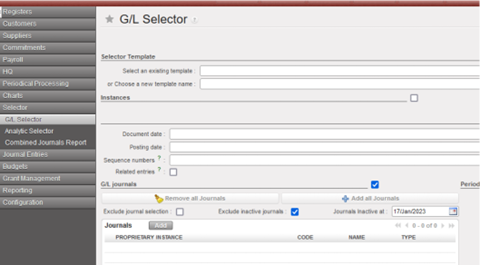
Also you have the option to exclude inactive journals by ticking on checkbox “Excluded inactive journals” by defining the date also:
Excluded inactive journals by date
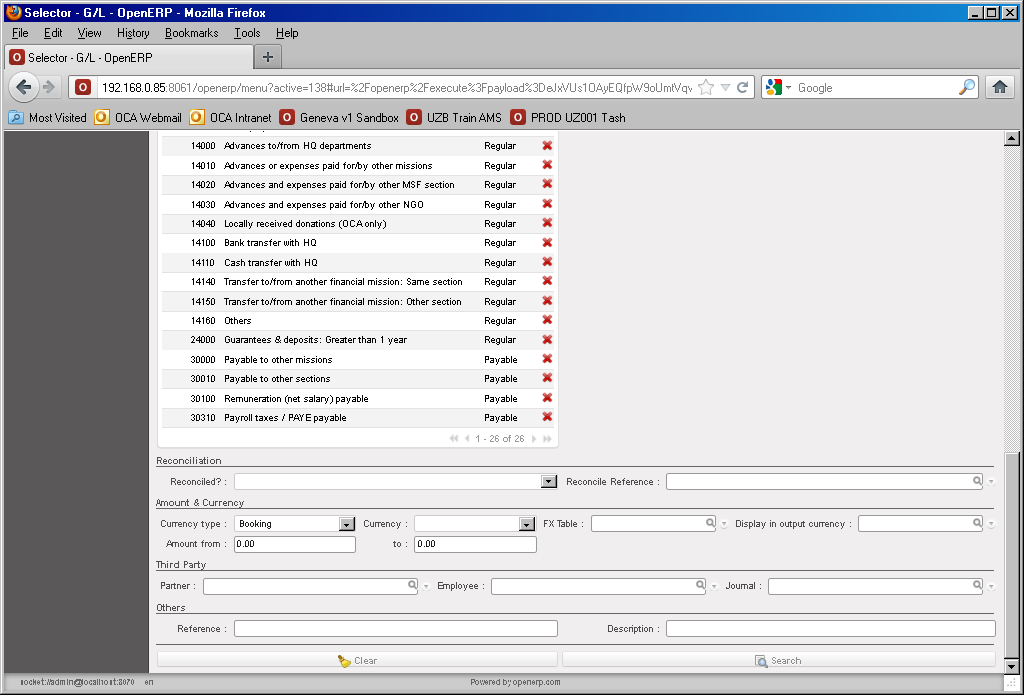
Search criteria
The field Sequence Numbers has a limit of 360 characters, and you can specify about 26 entries. Note that the total number of characters includes the character ( , )
The search results will be displayed on a new tab as showed next page.
How to Perform a G/L Selector Search
Go to: Accounting/Selector/Selector G/L
In this example we will search for entries for a specified period for a specific journal and export the search results.
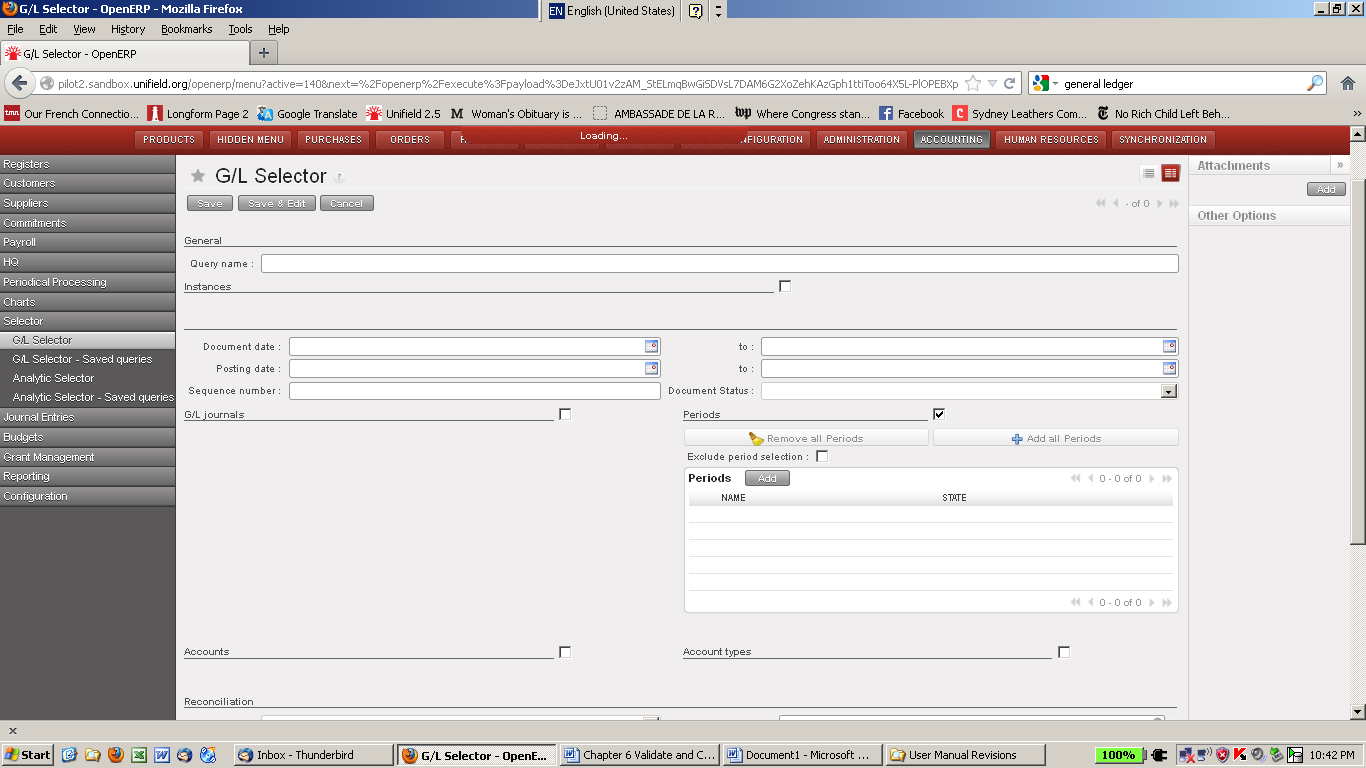
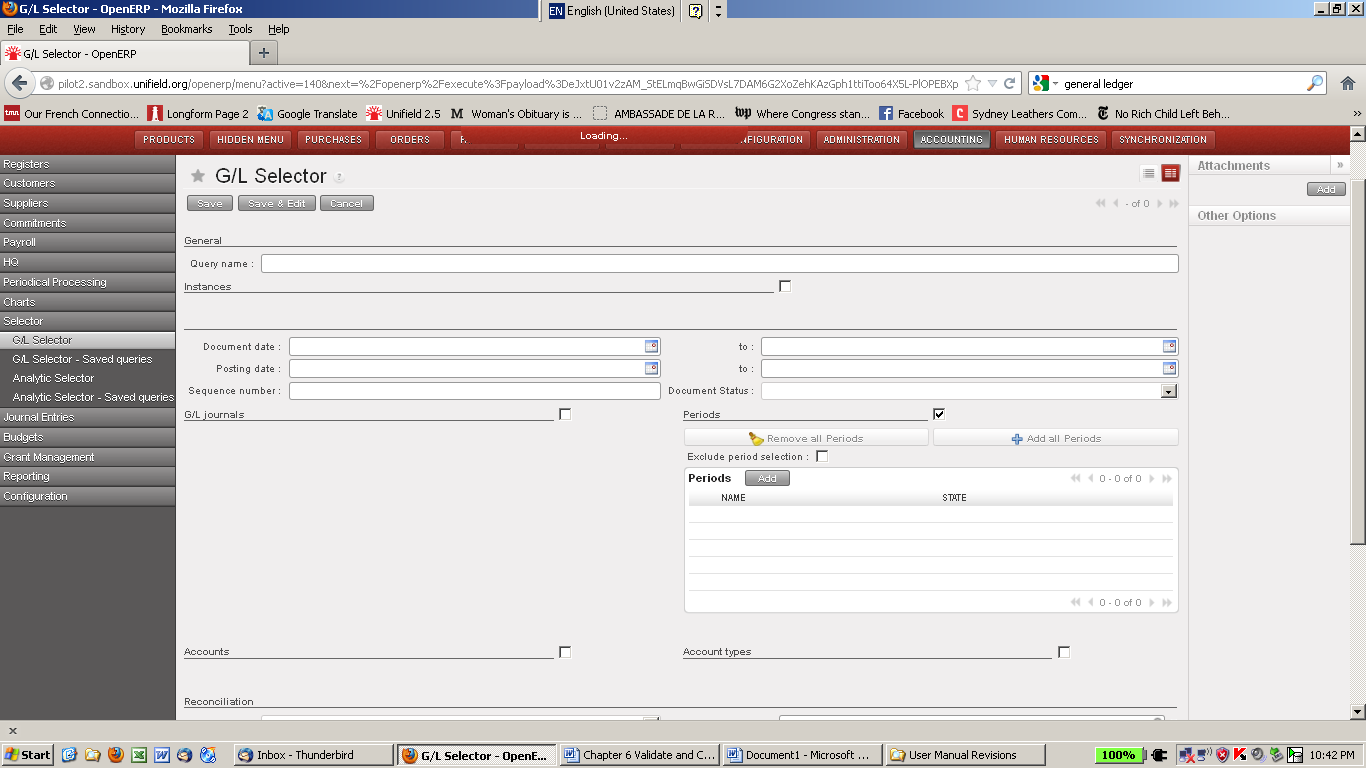
Tick the checkbox next to Periods to expand the search view.
Expand search view in the G/L Selector to set period criteria
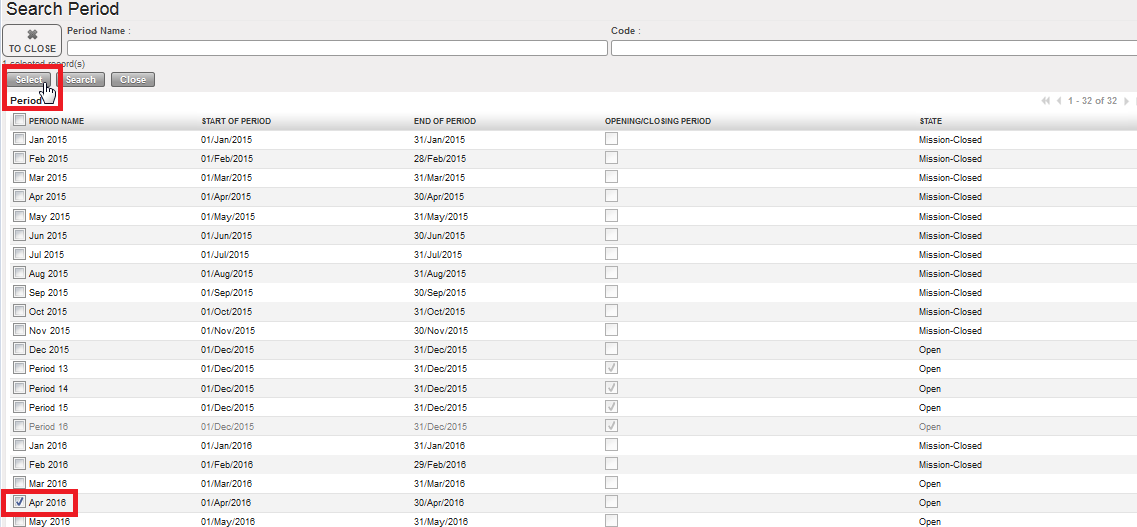
Click the button and select the period(s) you would like to view.
Select period in G/L Selector
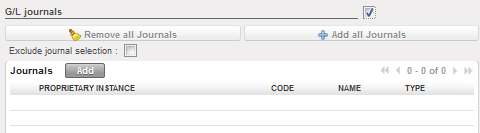
Tick the checkbox next to G/L Journals to expand the search view.
Expand search view in the G/L Selector to set G/L journals criteria
Click the button and select the account (s) you would like to view.
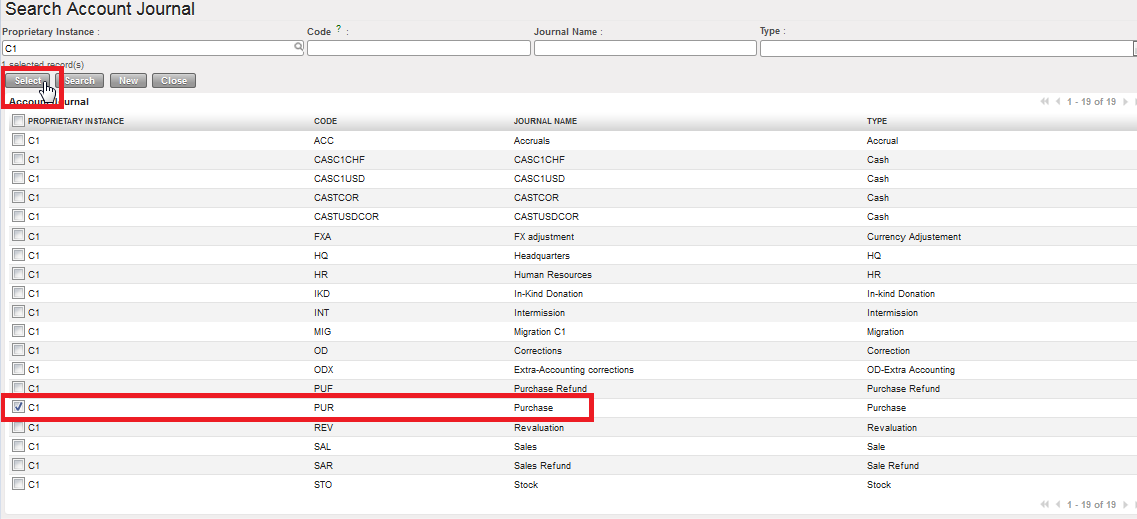
Select Purchase journal in the G/L Selector
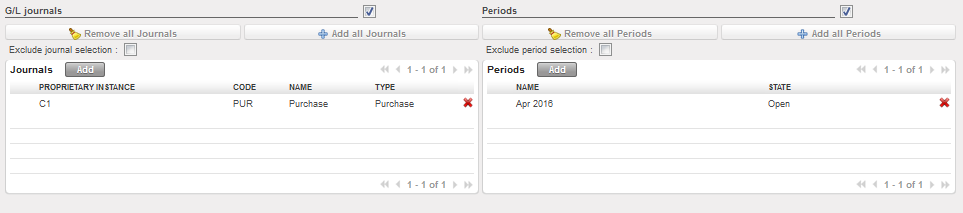
Search criteria Periods and G/L Journals set
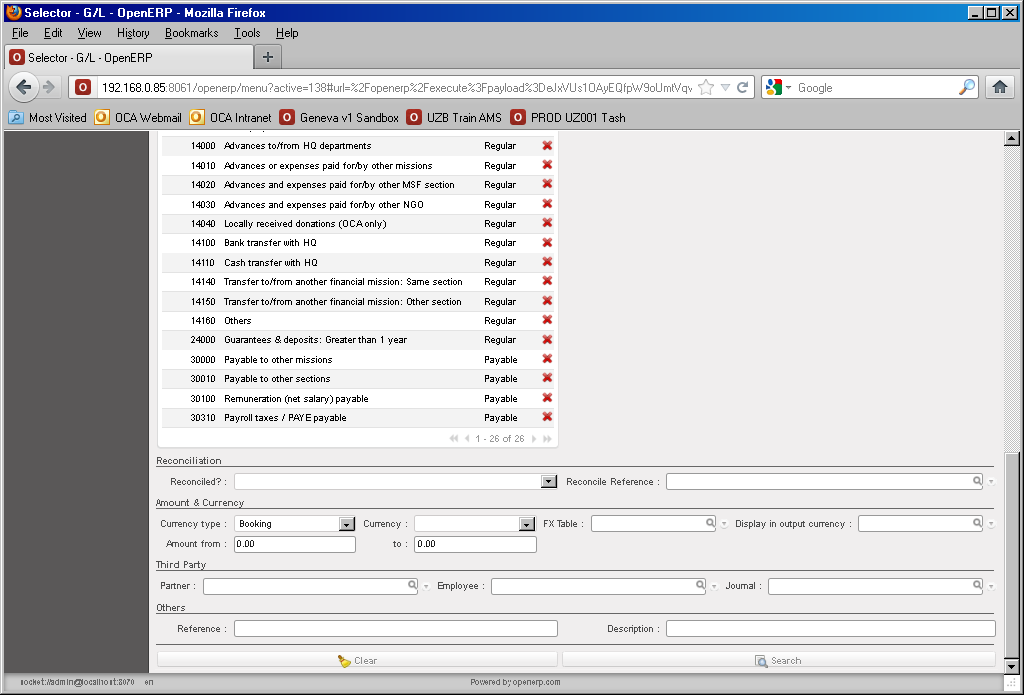
Optional search to display both columns “Output amount” & “Output curr.”:
Go to Accounting > Selector > GL Selector,
Update “Display in output currency “ with a currency.
Both “Analytic Journal Items” & “Journal Items” interfaces will appear with two columns and their totals “Output amount” & “Output curr.”:
Total output amount at the end in the entries interface when using the Analytic selector
Total Output Credit and Output Debit at the end in the entries interface when using the G/L Selector
Now that you have filtered by period and expense accounts, click {Search} at the bottom of the screen.
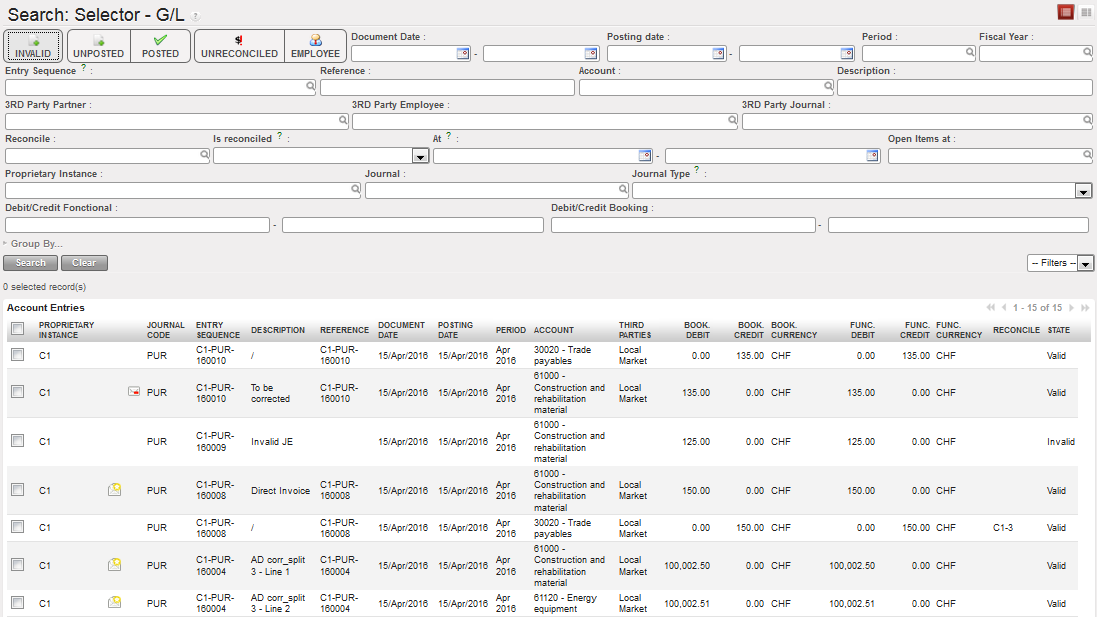
A new tab opens to display the search results.
G/L Selector – Search output
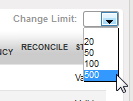
Change limit to display more records. You can display up to 500 records at a time. You can choose to sort by a column header by clicking on the column header.
Go to the Actions menu and select {Export search result}
Click the top checkbox to select all entries and select {Export search result}
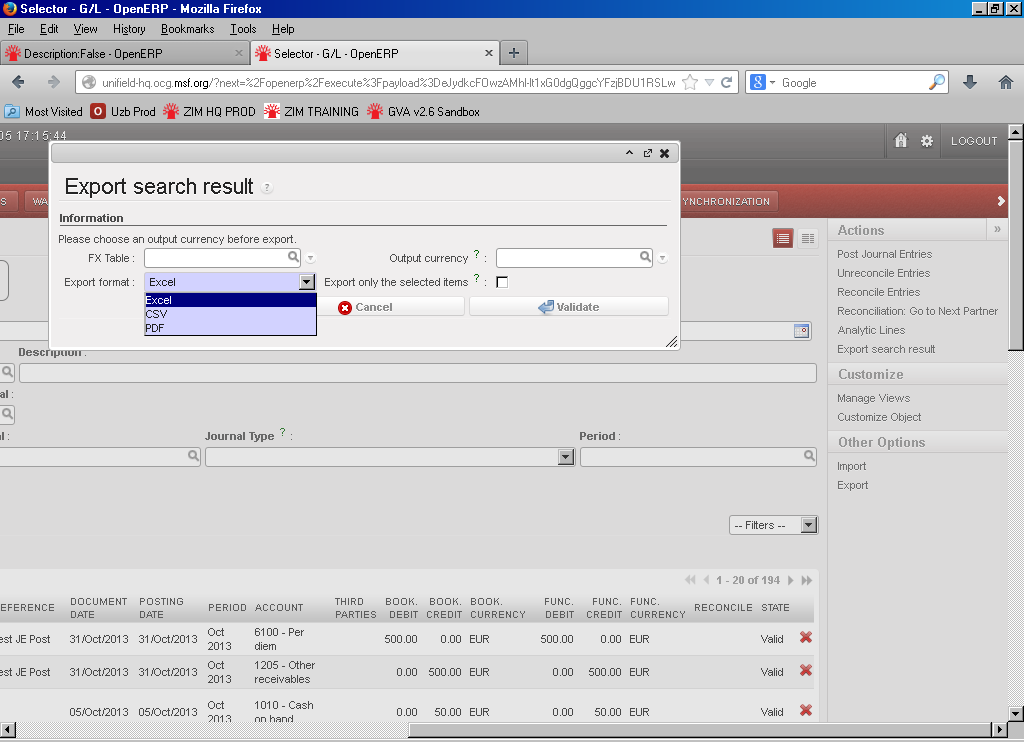
A new window will display with additional export options to select if desired, e.g. currency, format. Click {Validate}.
Export options
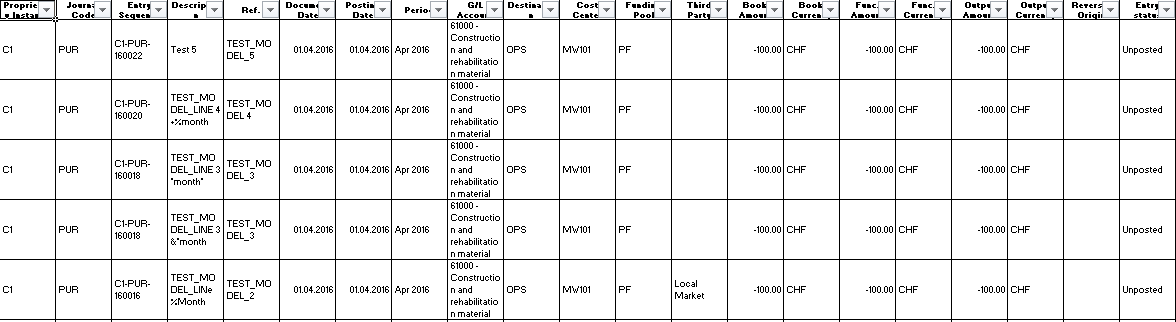
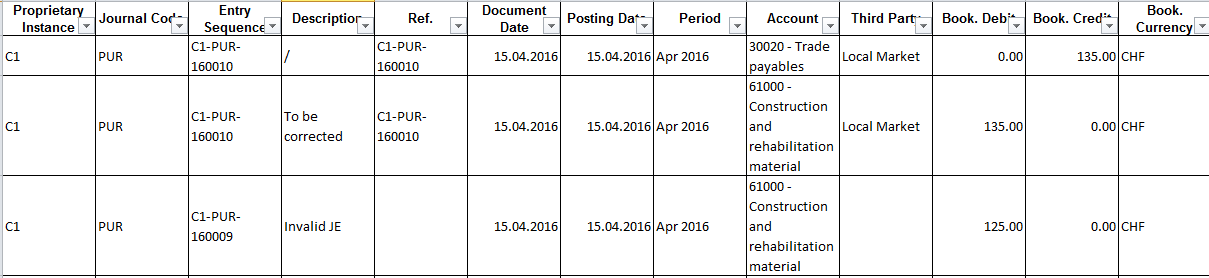
G/L Selector – Excel export file
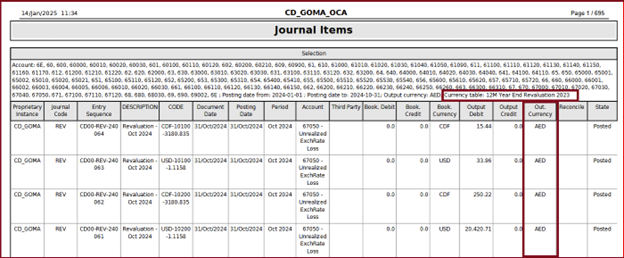
In GL Selector it is possible to extract PDF report including both Output currency and currency table as below:
To include currency table add it through filter in FX Table
To include Output currency add it through filter Display in output currency.
Journal items, journal entries and analytical journal items are accessible from the module {Journal Entries}. Chapter 2 – Configurations explains which financial and analytical journals you can find in your instance.
How to Search in the Journal Items
The sub-module {Journal Items} displays accounting lines either as debit or credit transactions. You will notice that each entry is displayed in booking and functional currency.
Accounting reconciliations and corrections are performed in this sub-module.
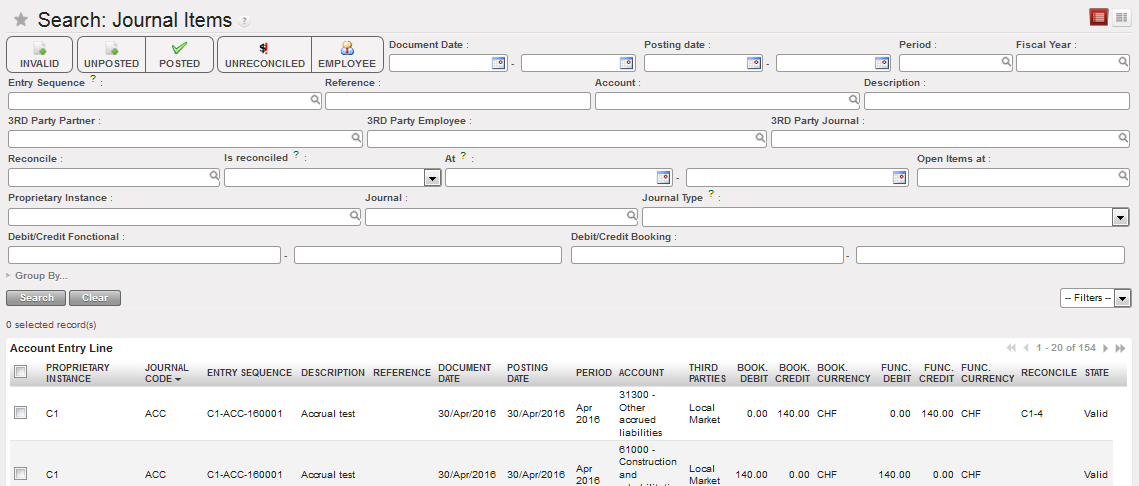
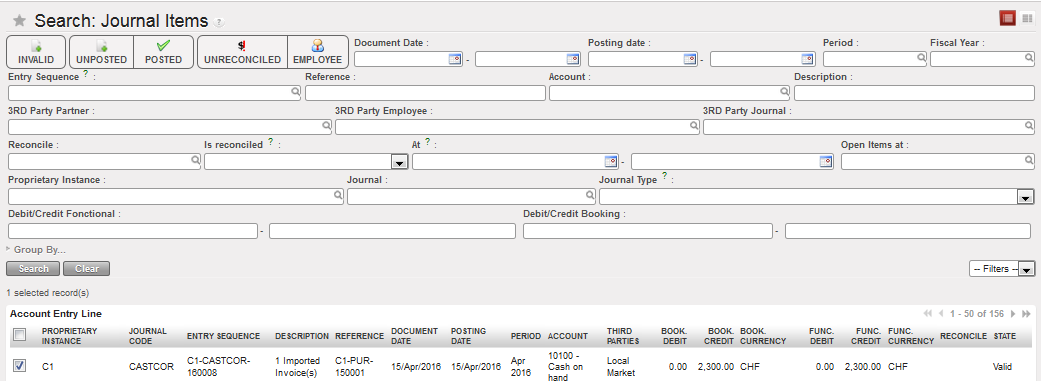
Journal Items Search view
Go to: Accounting/Journal Entries/Journal Items
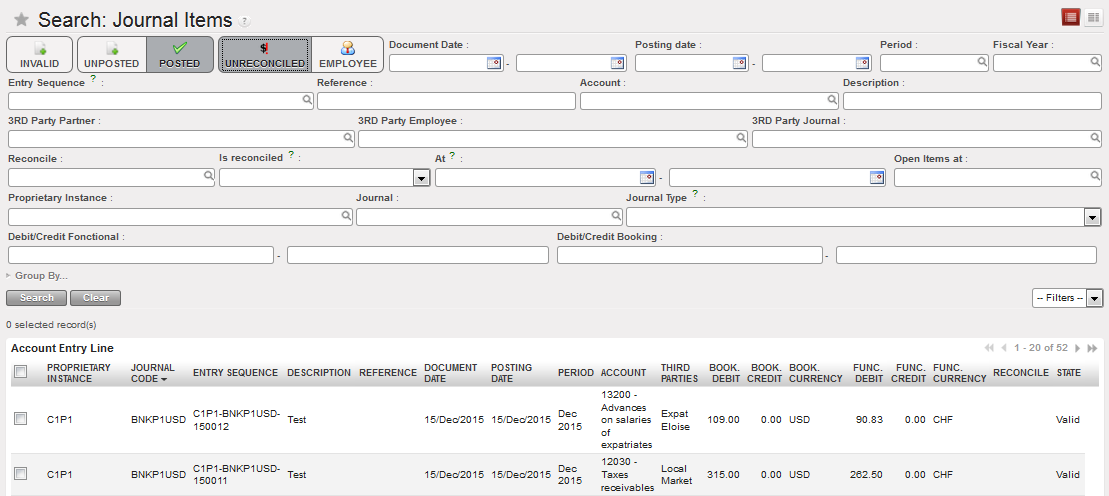
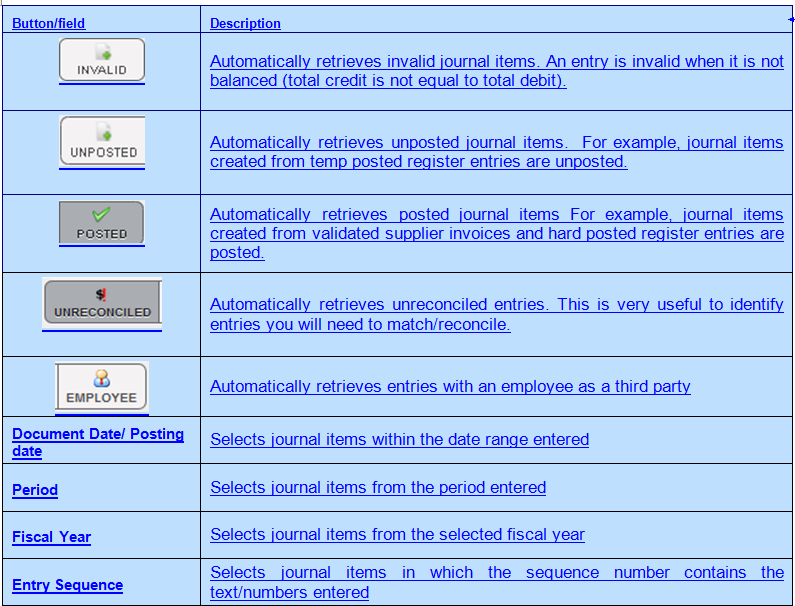
In the Journal Items Search view, you can enter criteria using the filter buttons, search fields, custom filters and group by options to search for journal items. In this example, we want to search for unreconciled posted entries to reconcile them. Toggle on the search filters {Posted} and {Unreconciled} and click {Search}.
Journal Items – search options Posted and Unreconciled selected
Related Entries Search in Journal Items:
In journal items view it is possible to directly search for all related entries linked to a specific journal item. This function is especially useful when searching for entries that have been included in the same supplier invoice, that are linked to a specific payment, that have been reconciled together or that have been corrected.
Go to: Accounting/Journal Entries/Journal Items
In journal items search view, select a journal item. In this example we use a payment entry line.
Payment JI line selected
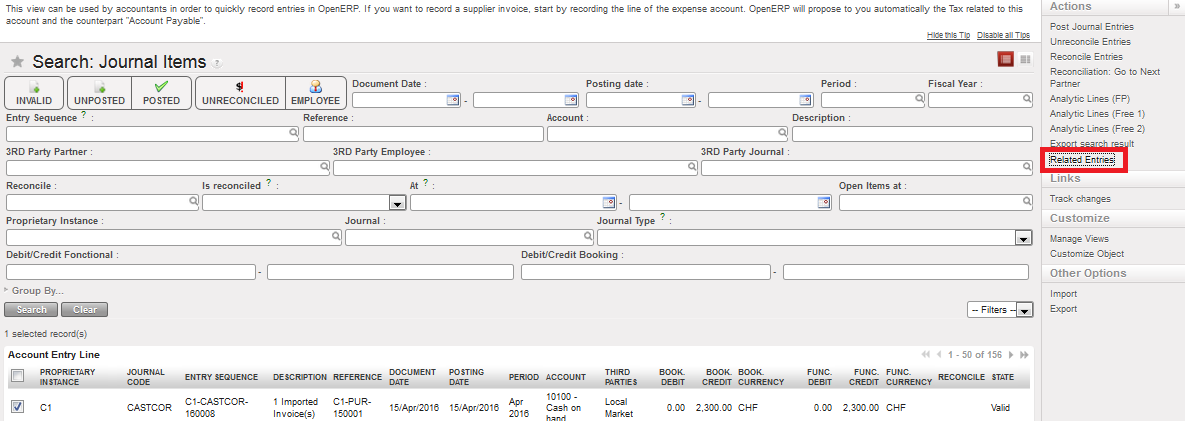
In the Actions menu on the right hand side, click on {Related Entries}
Related Entries in the Actions menu
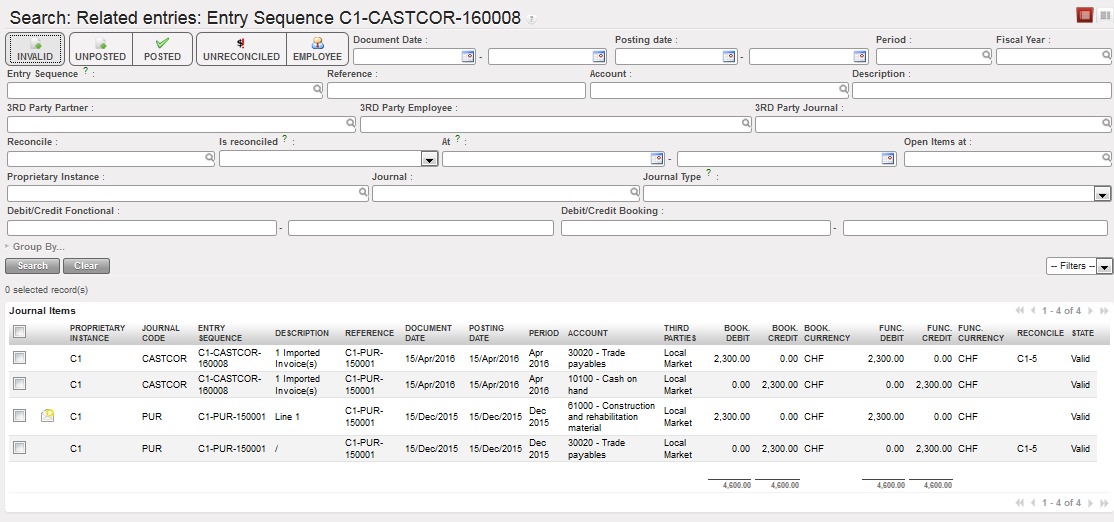
A new view called {Search: Related Entries} is opened in a new tab with a list of all related entries. In this example, the user can see which expense lines were paid with the payment from cash register and which trade payable lines were included in the same reconciliation.
Search results for all related entries to the selected journal item:
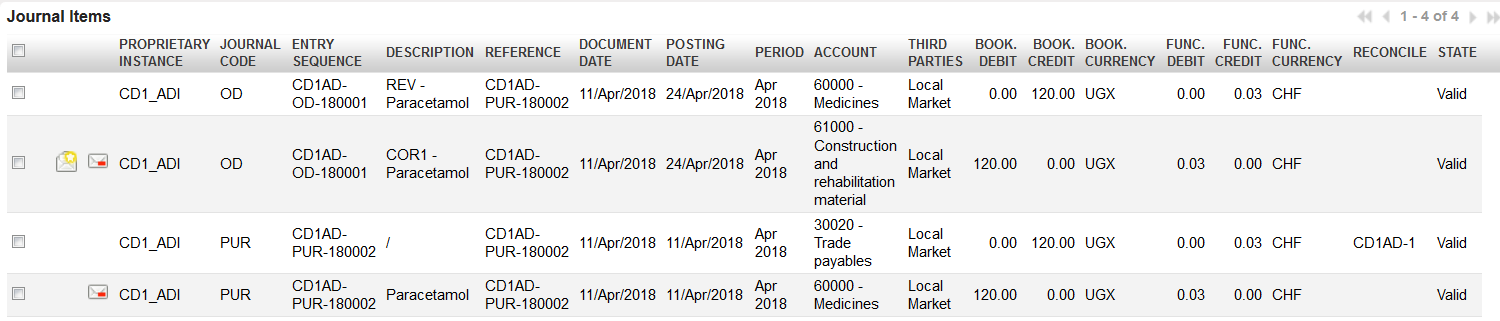
It is also possible from corrected entries to find back the original entries as UniField search for all entries that have an entry sequence matching the reference of the original entry.
Searching for the original entry related to the correction COR1- Paracetamol (reference CD1AD-PUR-180002)
Original entry CD1AD-PUR-180002 (reference CD1AD-PUR-180002) related to COR1- Paracetamol
How to Search in the Journal Entries
A journal entry consists of all the journal items that form one, balanced entry. Each journal item is either a debit or a credit transaction. Within any journal entry, the total amount of debit equals the total amount of credit.
Journal entry view can be used for example to check the accounting lines automatically created from a financial document (temp- or hard-posted register entry, validated supplier invoice, operational advance delivered and closed). Depending on the user rights, an advanced user can also manually create journal entries in the financial journals, e.g. payroll booking for the sections not using Homere. For further information please see Chapter 3 – Payments LUFI-30312.
When Journal Entries is opened in Search view, no filter button is set by default so all journal entries are listed. Unposted entries will be displayed in blue font. Entries are displayed in both, booking and functional currency.
Go to: Accounting/Journal Entries/Journal Entries
In the Journal Entries Search view, you can enter criteria using the filter buttons, search fields, custom filters and group by options to search for journal items. Click {Search}.
Journal Entries Search Options
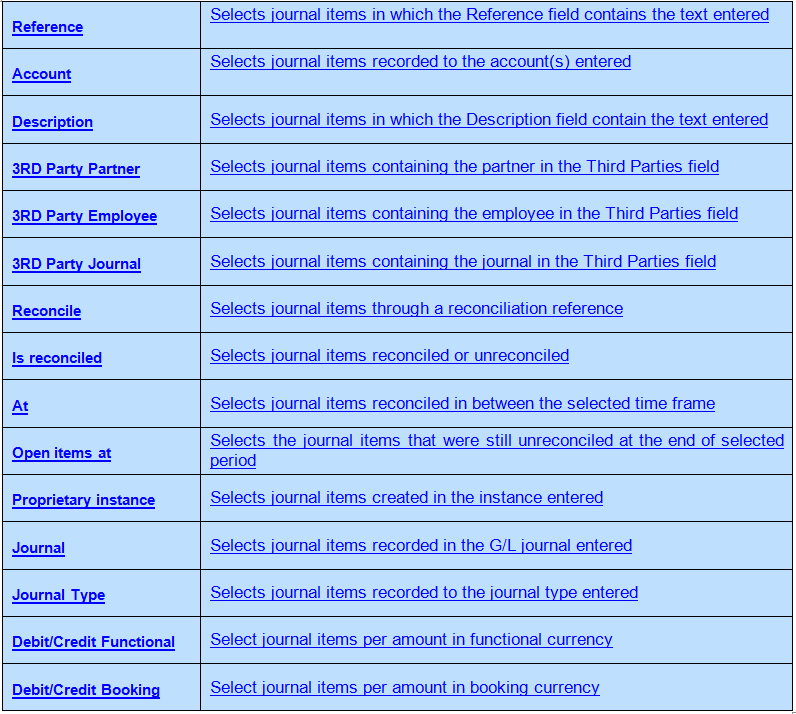
Button/field
Description
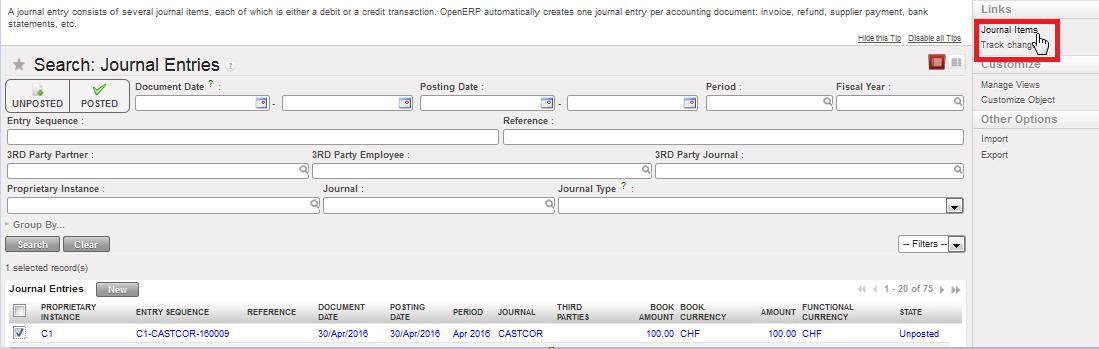
To view the batch of journal items related to a journal entry, tick the checkbox of a journal entry. Go to the Links menu on the right side and select {Journal Items}. It is important to note that only one journal entry can be selected at a time to display the related journal items.
Linking journal entries to the related journal items
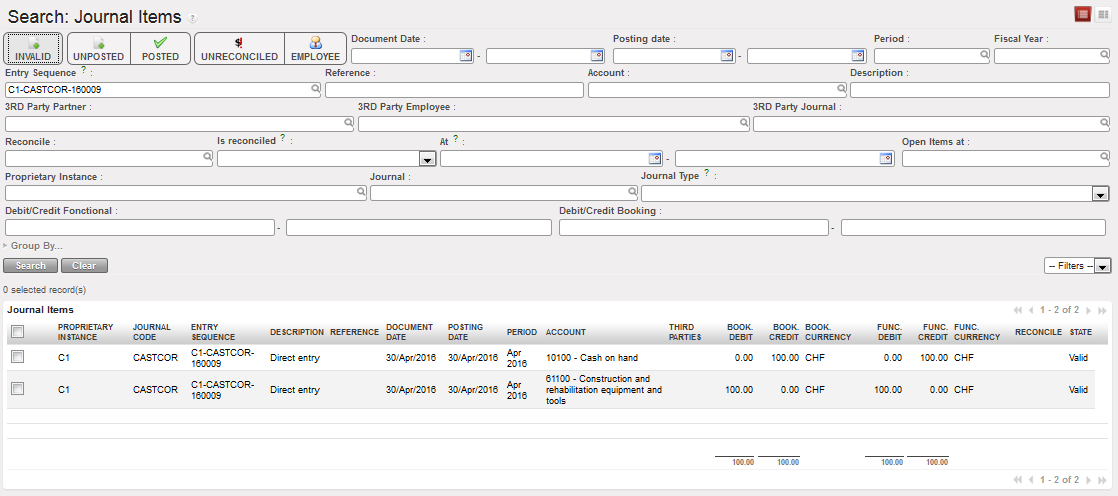
A new window opens in Journal Items with the linked entries. You can further refine the results by using the search fields available. It is important to note that you cannot perform general searches in Journal Items in this linked window. It will only display the journal items related to the original journal entry selected in Journal Entries.
Journal Items related to journal entry
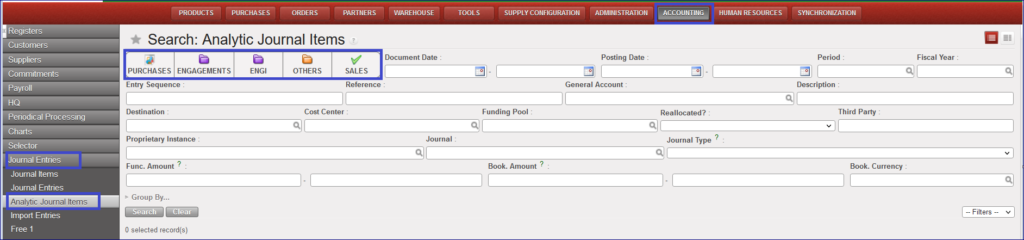
How to Search in the Analytic Journal Items:
Analytic journal items are expense or income entries allocated to the analytic accounts (Destination, Cost Center, Funding Pool). Analytic journal items are created whenever an entry to an expense or revenue accounts is generated. Analytic journal items are used to determine expenses in budget control reports and donor reports. Analytic journal items are displayed in booking and in functional currency. Analytic Journal Items only relate to expense / income entries and do not have any counterpart entry.
Go to: Accounting/Journal Entries/Analytic Journal Items
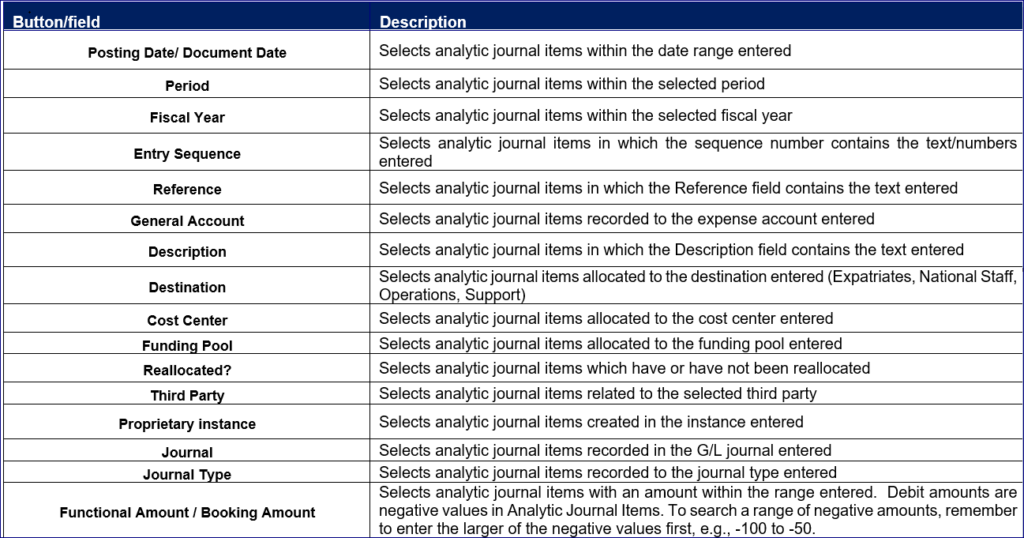
In the Analytic Journal Items Search view, you can enter criteria using the filter buttons, search fields, custom filters and group by options to search for journal items. Click {Search}.
Example:
Go to Accounting >Journal Entries > Analytic Journal Items
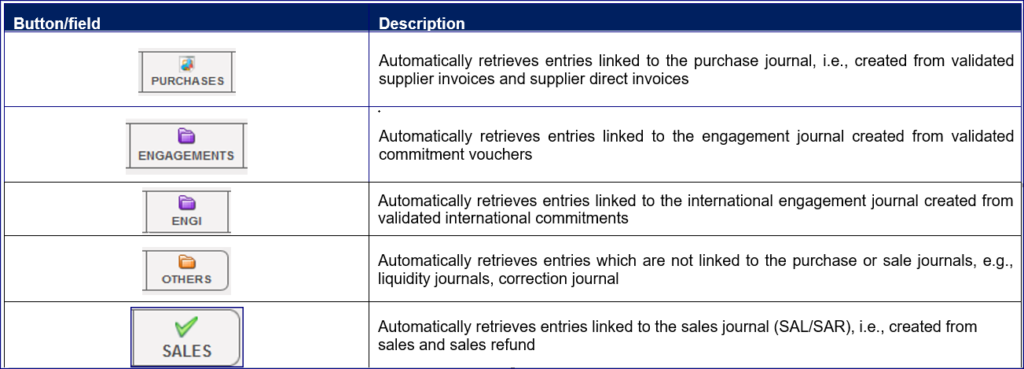
If we toggle on search button “ENGAGEMENTS”, the result of the search will be the journal code column with “ENG” only.
If we toggle on search button “ENGI”, the result of the search will be the journal code column with “ENGI” only
If we toggle on both search buttons “ENGAGEMENTS” and “ENGI”, the result of the search will be the journal code column with both “ENG” and “ENGI”
The ENGI will be seen in the filter of the ordinary periods (Jan-Dec) only.
Analytical Journal Item Search Options
Button/field
Description
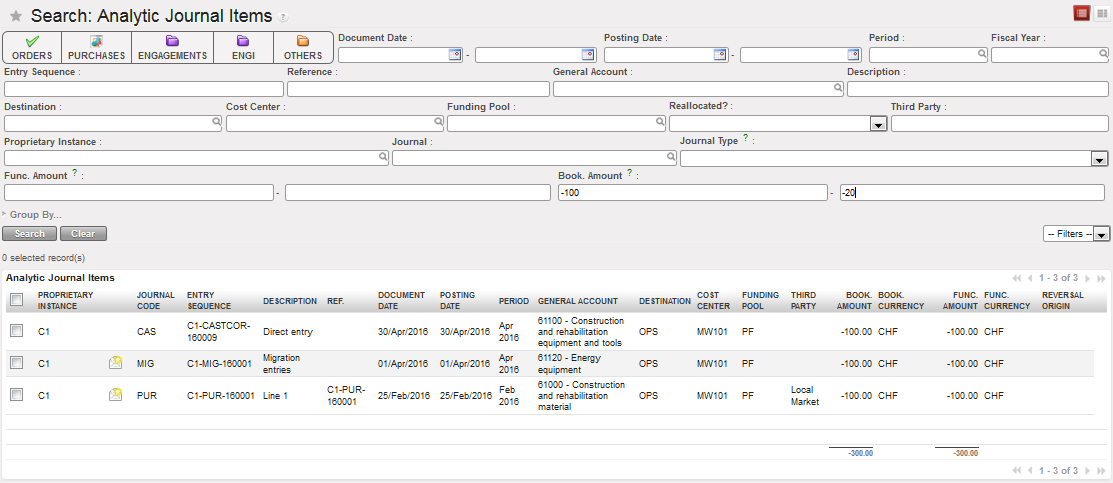
Searching a negative range of amounts in Analytic Journal Items Search view
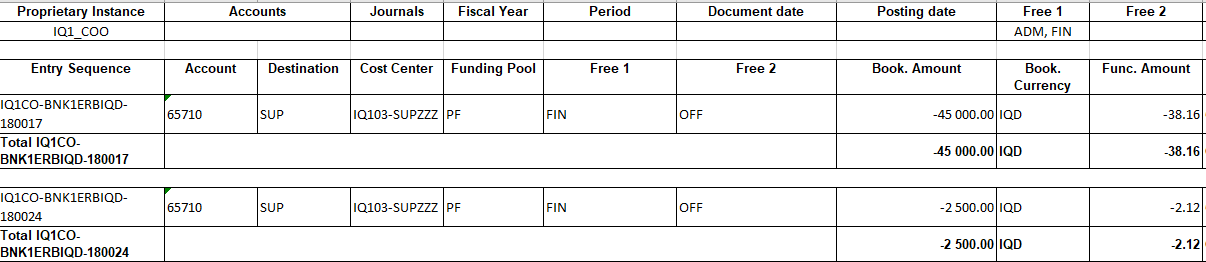
Analytic Allocation with Free1/2 Report:
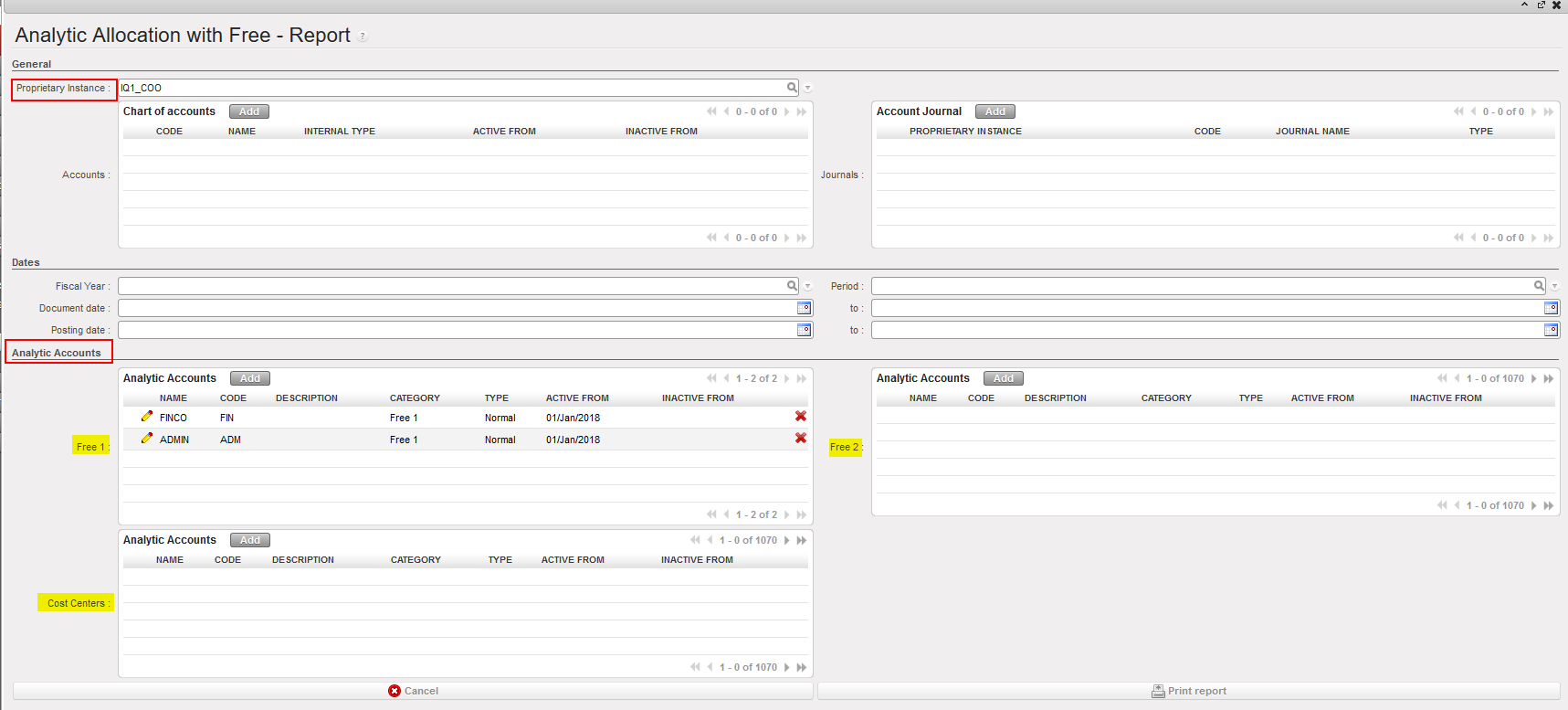
The analytic Allocation with Free Report is an excel report that combined the analytic distributions “Destination/Cost Centers/Funding Pools” and Free axis. It is located in Free sub menu, in the windows action wizard and it is possible to save the queries.
How to Produce Analytic Allocation with Free 1/2 Report:
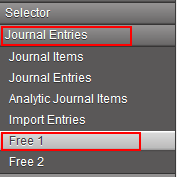
From Journal Entries, select {Free 1}
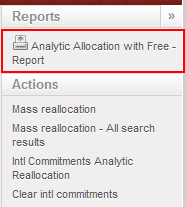
From the right-side menu, click on {Analytic Allocation with Free Report}
Make your selection, unless you want all information to be in your report.
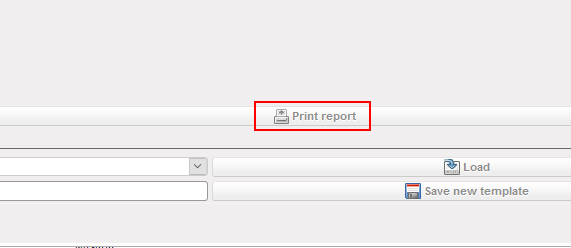
In order to export the report, you need to click on {Print Report}
Then you will get the report based on the selection you made
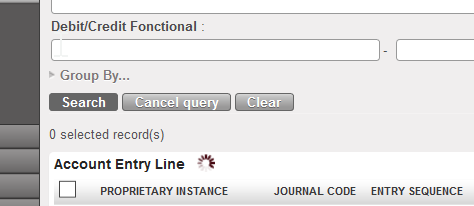
Clear/Cancel the request when loading:
When a query/search is launched from a Search view, there is a button that appears while the search is loading and called “Cancel Query”. This button enables to cancel the query that is running in background when it keeps loading.
Use the cancel Query button that appears when the search takes time and the system is loading.
This button will cancel the query that is running in background, so space is freed in the server. This is useful when the search keeps on running because there are no results matching with the search.
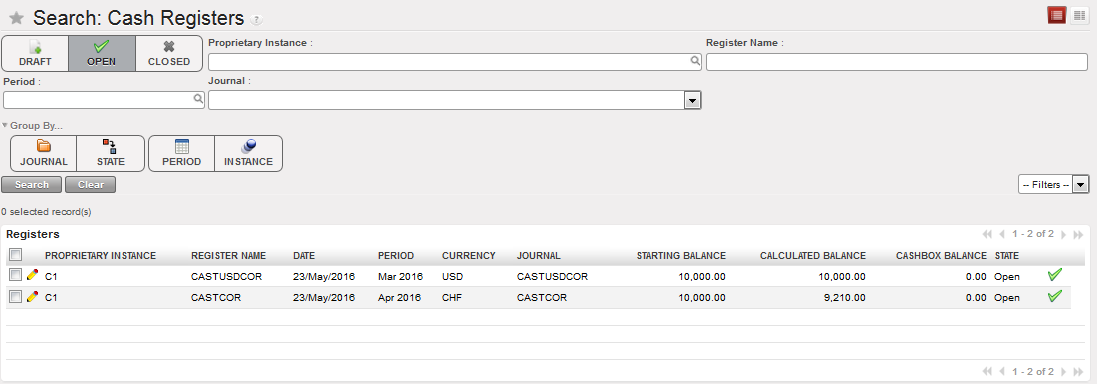
In Registers, there are two types of searches. You can search for registers, but more importantly, you can search the register lines, i.e. the entries made within a register. This is useful when you need to correct or review specific entries in a register with a large number of lines.
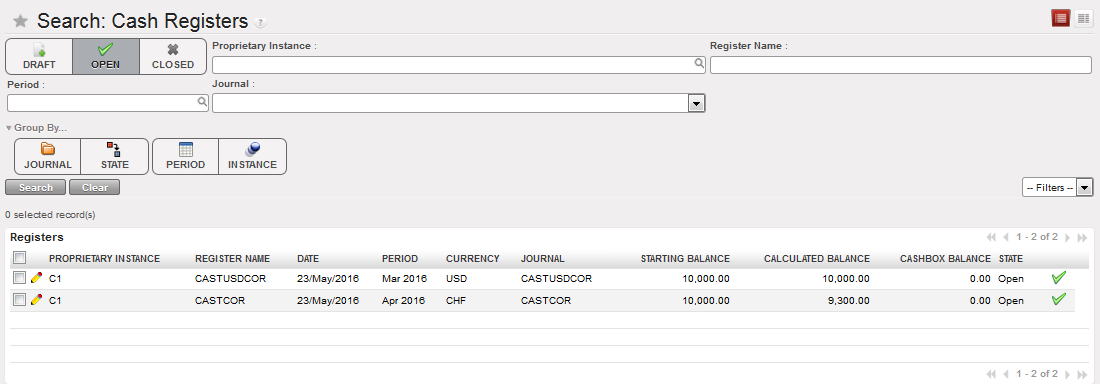
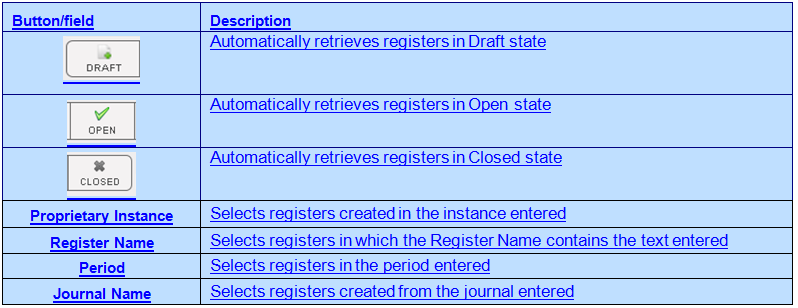
When any register module is opened (cash, bank or cheque), the {Open} filter button is active by default so only open registers are listed. This allows you to easily find a register to make or review entries. Otherwise, without this filter, all registers for closed periods and draft registers will display. You can further refine your search by entering criteria in the search fields, using the Group by buttons, or creating a custom filter.
Cash registers Search view and Search options
Button/field
Description
How to Search Register Lines
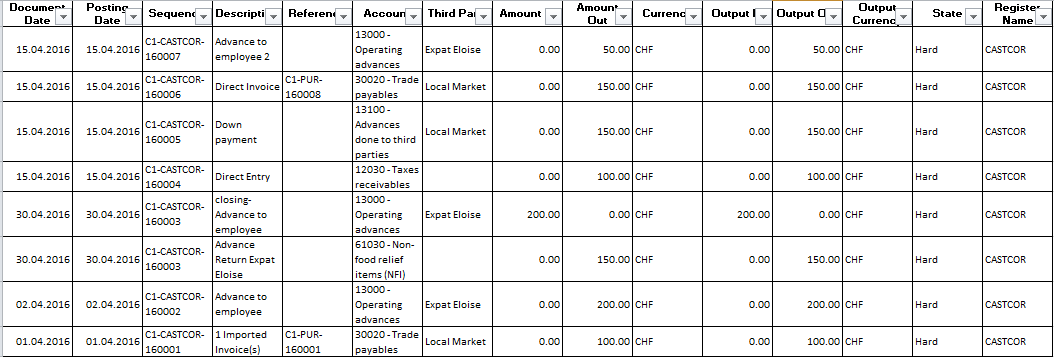
In this example, we want to select all register lines made in a specific cash register for invoice payments and export the results to Excel.
Go to: Accounting/Registers/Cash Registers
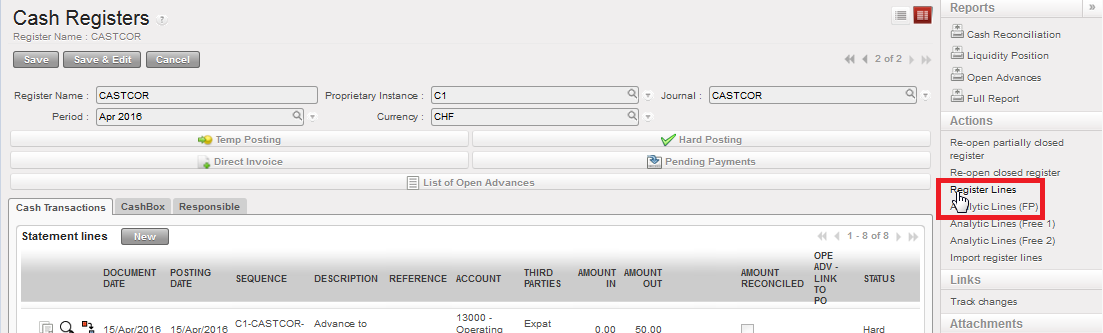
Open a register in Form view
Click on {Register Lines} on the Actions menu on the right side.
Cash Register – Form view and Actions menu
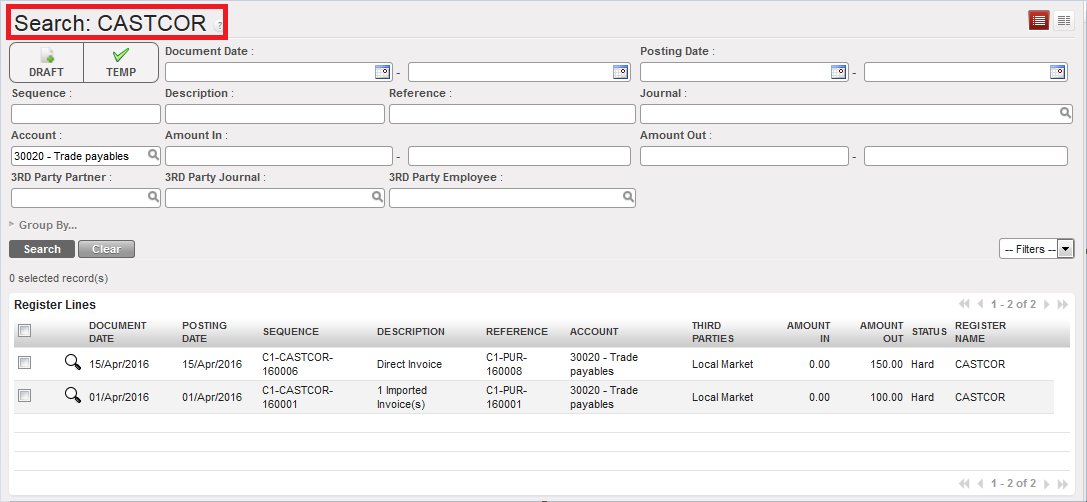
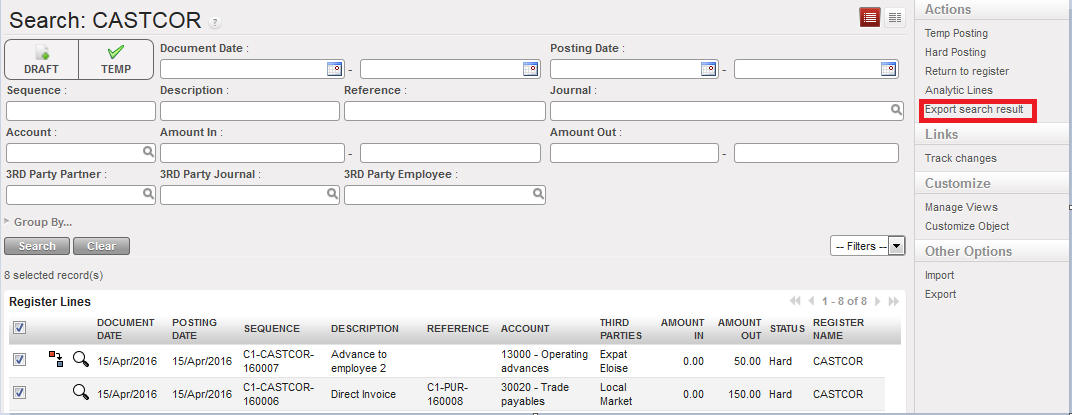
A new search tab displays with the entries (register lines) in your selected register. You can enter criteria using the filter buttons, search fields, custom filters and group by options to search for specific entries made in this register. For invoice payments, we enter {30020 – Trade payables} in the Account search field. Click {Search}.
Cash Register Lines – search options
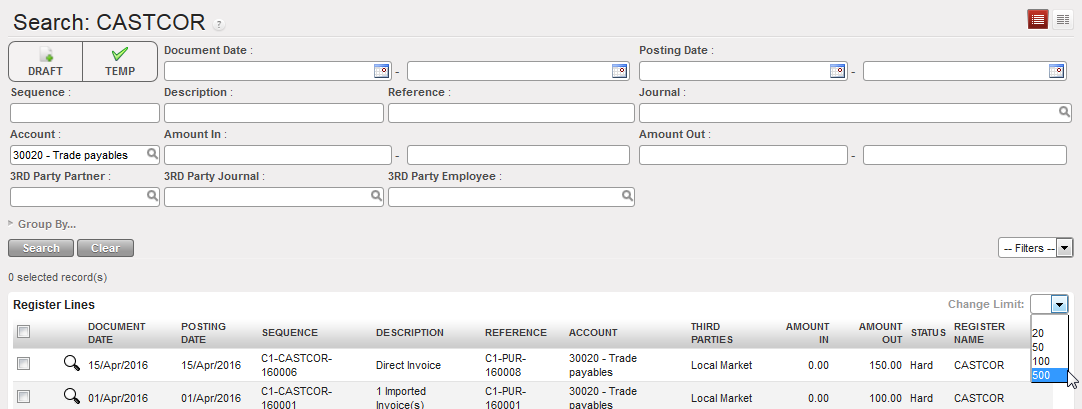
By default, the first 20 lines will display. If necessary, change the limit to display up to 500 entries. You can choose to sort by a column header by clicking on the column header.
Change Limit
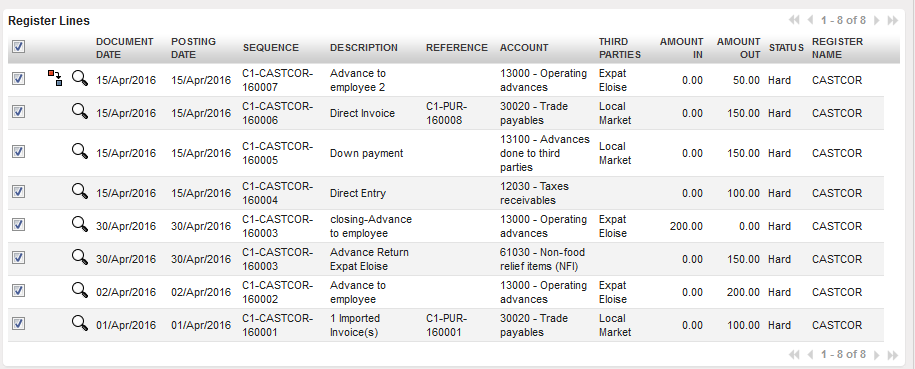
To select all entries, tick the checkbox in the header row on the top left of the screen. Unticking will deselect all entries.
Tick top checkbox to select all entries
To export, go to the {Actions} menu and select {Export search results}.
Export search results
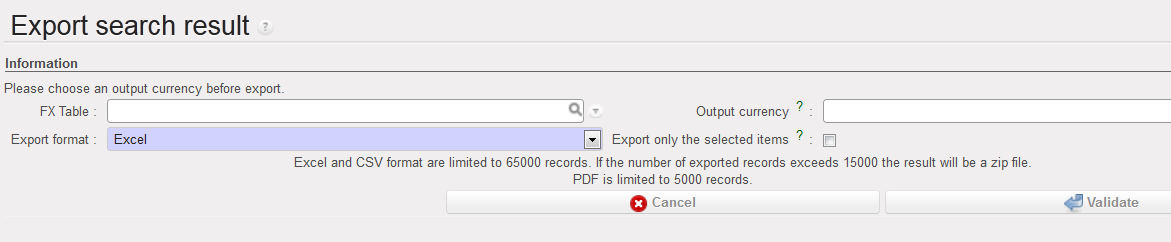
A new window will display with additional export options to select. Click {Validate} once you have input the relevant criteria.
Options for export
–Button/field
–Description
–FX Table
If you would like the export to display amounts converted to a currency on a currency table, then select the table and select the currency in Output Currency
Output Currency
In the “Output Currency” column of the export, the amount converted to selected currency will display; if this field is left blank, the “Output Currency”column in the export will display the amount in the functional currency
Export format
Select from Excel, CSV or PDF
Export only the selected items
If the checkbox on the register line is ticked, it will be exported
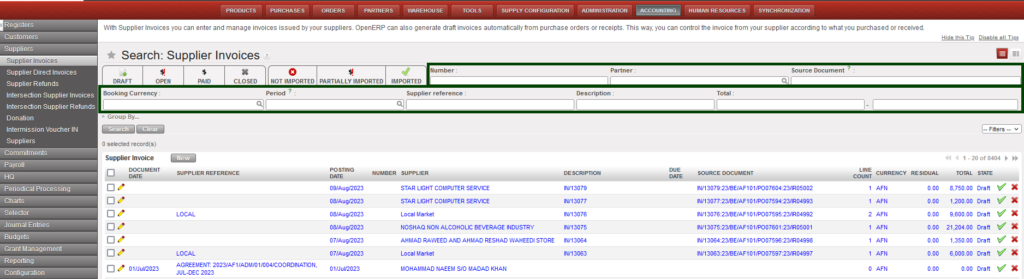
Many options are given to users to optimize their searches. The system facilitates filtering and searching for groups of important documents using the relevant buttons.
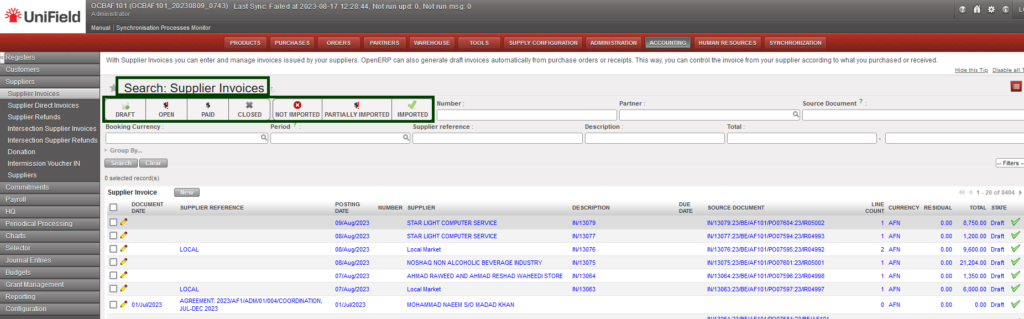
Filter buttons on a supplier invoice form
When active, filter buttons turn dark grey; click again to deselect. The system’s searching options are based on “And”, not “Or”, so in this example pressing the filter buttons {Draft} and {Paid} will not return any result as an invoice cannot be both Draft and Paid.
Cash registers Search view and Open filter button activated when the view opens
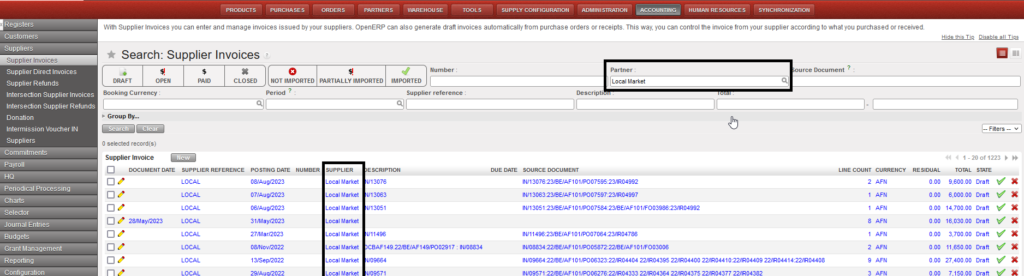
Search fields on a supplier invoice form
Searching the supplier invoices of Local Market
In all search views, there are default search fields which provide a quick way to search. Because UniField has the capacity to search for free text, you can enter any text into a search field. By entering a few characters, the system will display a list to choose from as can be seen in the next figure. To search the database, the user can also use the magnifying glass to get a full list of options available.
Only one value per search field is allowed
Text fields execute a “contains” search
Date or numeric ranges: if the ending value is left blank, there is no maximum limit; if the starting value is left blank, there is no minimum limit on the search
If multiple fields have search values, then all criteria must be satisfied, i.e. operates as an “and” search
Filter buttons and search fields can be used together and operate as an “And” search
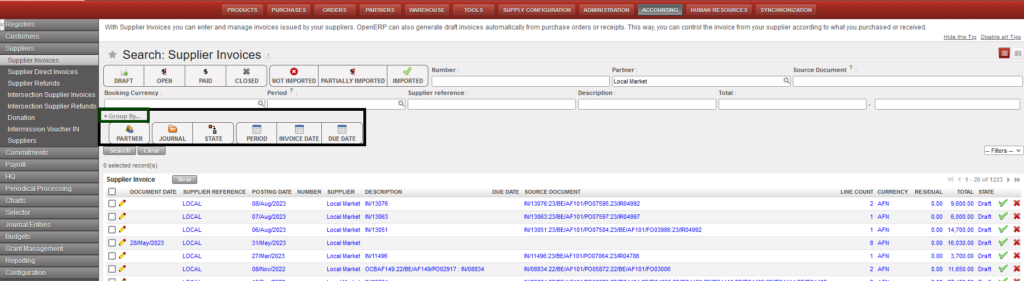
Group by filters
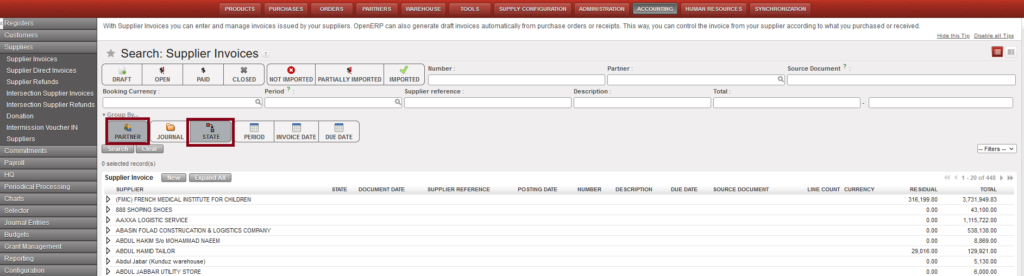
Group filters output: Grouping by PARTNER and DUE DATE
Clicking on the arrow next to {Group by} displays options to group the search results by particular fields.
These buttons behave similar to the filter buttons, i.e. they are active when grey, and clicking again deselects the filter and turns the button back to white.
Subtotals per grouping are displayed where numeric fields are applicable, e.g. Residual and Total for Supplier Invoices.
Selecting multiple buttons groups the next level of records within your initial grouping. In the example below, supplier invoices are first grouped by Partner then by State{Draft}, {Open}, {Closed} within each Partner.
Clicking {Expand All} will display all search results by grouping.
Group by can be used in conjunction with filter buttons and search fields and operates as an “And” search.
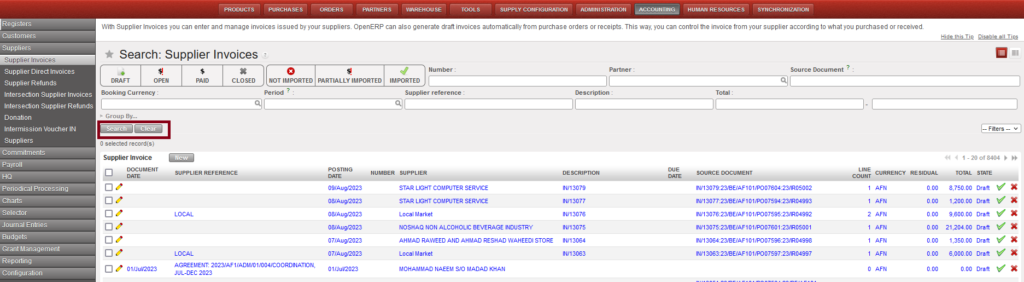
Search and Clear buttons
{Search} button executes the search, while the {Clear} button clears all filters so all records are returned.
How to Create a Custom Search Filter
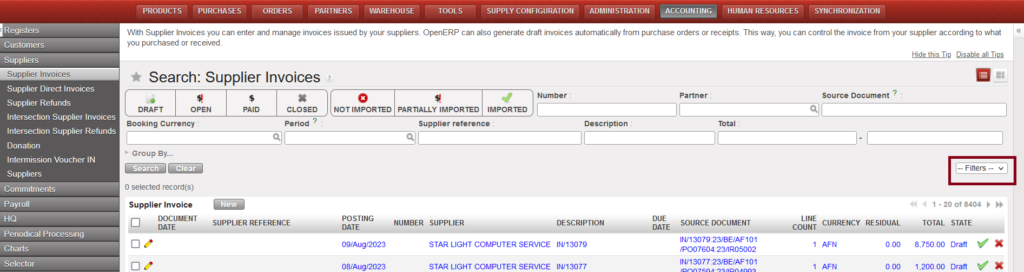
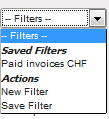
UniField allows creating custom filters, which can be used repeatedly. Clicking on the arrow next to {–Filters–} displays the possible actions.
Click on the arrow next to {–Filters–} to open the drop-down list.
Creating a custom filter
From the list, select {New Filter}.
Filter Actions
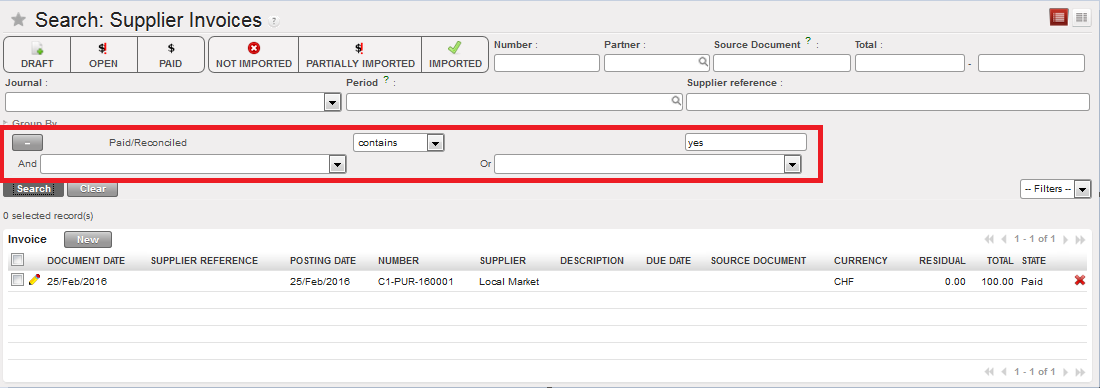
Two extra search fields will appear: “And” and “Or”.
Custom filter – selecting search field
In the “And” field, select from the drop-down list of available fields to search.
In the next drop-down list, select how you would like it to search e.g. “less than” “doesn’t contain”, “is equal to”, etc.
Custom filter – search expression
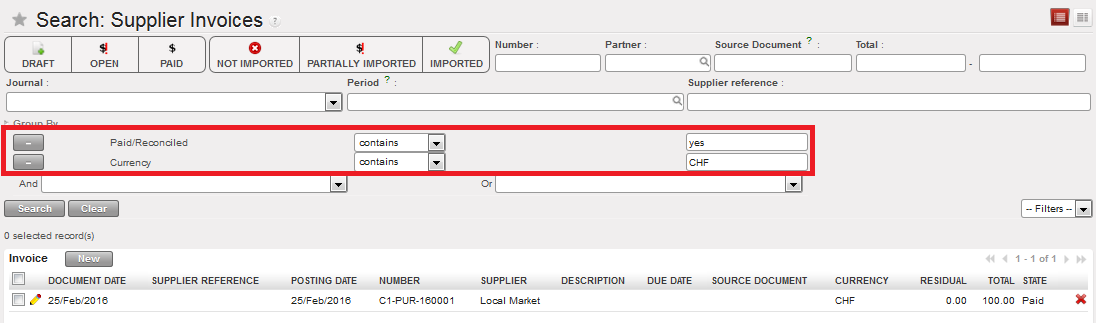
And in the final field, enter the value which you would like the system to use to perform the search. In the example above, the system will search for all reconciled supply invoices for which the {Paid/Reconciled} field contains “yes”.
The user can add multiple search expressions using the And or Or operators. To delete an expression, use the button.
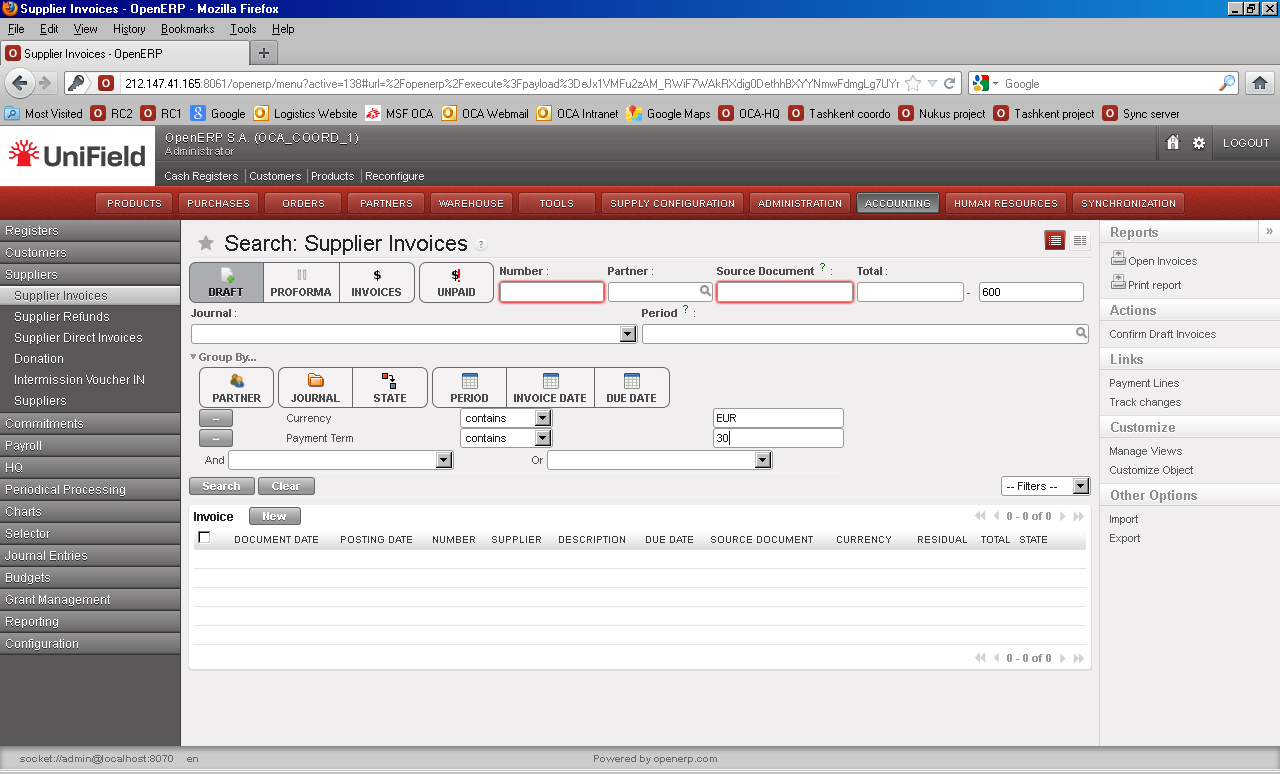
Multiple search expressions
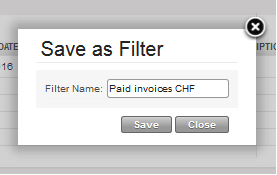
Save the filter by clicking again on the Filters drop-down list, and select {Save filter}. Enter the name that you would like to call this filter, and then click {Save}.
Saving new search filters
Saved filters are then available to select from the Filters drop-down list.
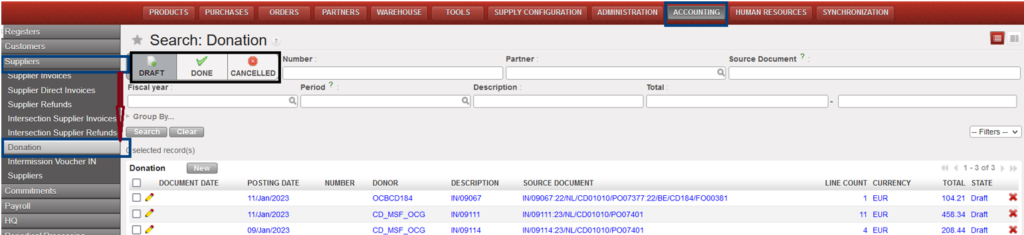
Go to Accounting > Suppliers > Donation:
How to search in Donation:
The default search of the donations is the “Draft” state:
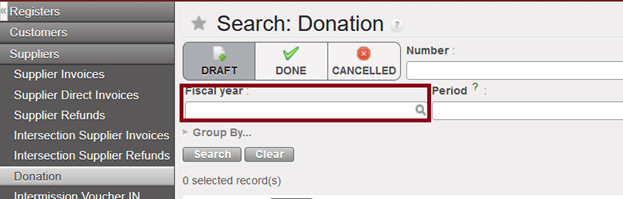
Below the 3 states of donation filters, we have added a new filter named “Fiscal year”, to allow to filter by year:
Search Donation states
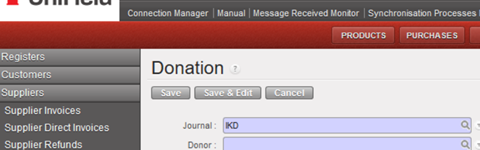
The only journal available is now the IKD journal -In kind donations- (it is not possible to select the ODX journal in manual. This ODX journal will be used just for automatic entries):
We use cookies to ensure that we give you the best experience on our website. If you continue to use this site we will assume that you are happy with it.