D. LU-SU1102: How to de-activate a partner

Supply User Manual ENG->Supply Configurations->2.2 LU-SU1102:Partners(customers and suppliers)-> D. LU-SU1102: How to de-activate a partner

D. LU-SU1102: How to de-activate a partner

It may be necessary to de-activate a partner, so that it cannot be used for future transactions. By removing the tick from the “Active” checkbox, the system will hide the partner, so that it cannot be selected or used in any new transactions. In order for a partner to be de-activated, it should not be currently used in any open transaction. If the partner is used in an open transaction, the system will not allow you to de-activate it.

Go to: Partners / Suppliers / Suppliers or Customers / Customers

Partner – De-activation
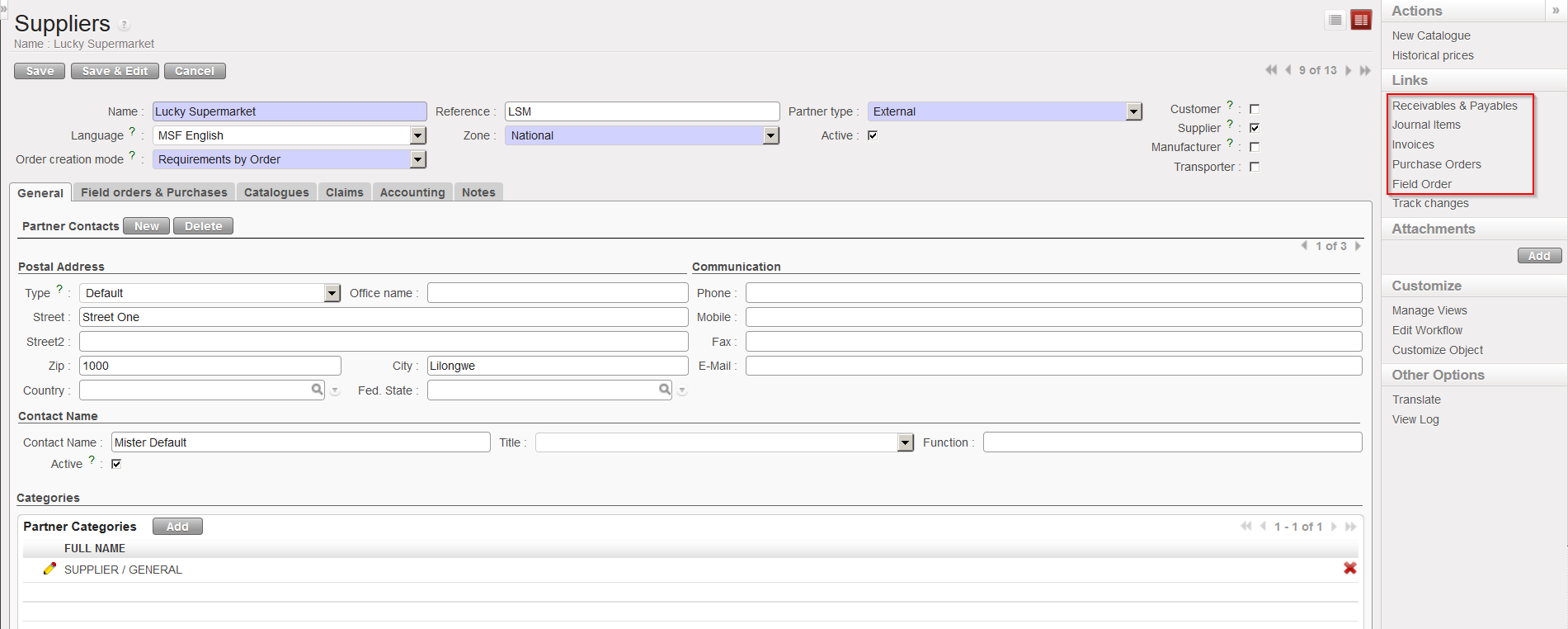
  1. Click on the pencil lapiz next to the partner which you want to de-activate.
  2. Untick the “Active” check box on the partner header.
  3. Once complete, click on the “Save” button at the top of the screen.
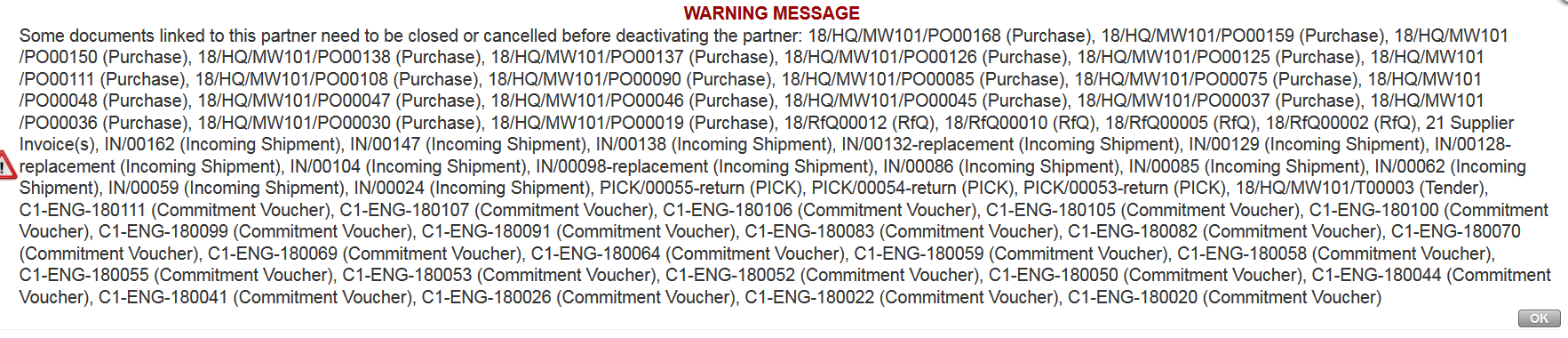
  4. If there are any open documents involving this partner, the system will display a warning message (see figure below) and will not allow the de-activation.
Impossibility to de-activate a partner

C. LU-SU1102: How to update a partner

Supply User Manual ENG->Supply Configurations->2.2 LU-SU1102:Partners(customers and suppliers)-> C. LU-SU1102: How to update a partner 

C. LU-SU1102: How to update a partner

Go to: Partners / Suppliers / Suppliers or Customers / Customers

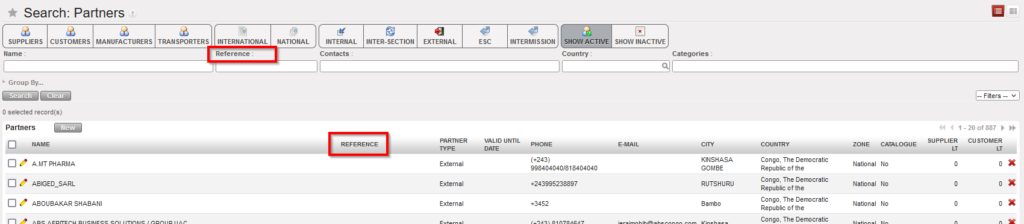
The Supplier and Customer main screens contain filters to refine your search and grouping options. The lower part of the search screen shows existing partners and displays information such as name, reference, partner type, phone number, e-mail address, city, country, …


Search: Suppliers” screen

  1. Click on the pencil lapiz next to the partner which you want to modify.
  2. The Supplier or Customer page opens in edit mode. Make the necessary changes.
  3. Once complete, click on the “Save” button at the top of the screen.

B. LU-SU1102: How to create a new partner

Supply User Manual ENG->Supply Configurations->2.2 LU-SU1102:Partners(customers and suppliers)-> B. LU-SU1102: How to create a new partner

B. LU-SU1102: How to create a new partner

The creation process for customers and suppliers is quite similar. The partner type selected will trigger the system to request specific information and will also impact processes in which partners can be involved. The partner type can be:

  • Internal, MSF entities which are on the UniField network within the same MSF mission are considered customers/suppliers and are created by the synchronization.
  • Intermission, coordination instances of your OC on the UniField network, they are created by the synchronization but need to be activated when needed. They are also considered as customers/suppliers.
  • Inter-section, coordination instances from other OCs on the UniField network, they are created by the synchronization but need to be activated when needed. They are also considered as customers/suppliers.
  • External, refers to all suppliers and customers outside of the UniField network. They must be created manually. Note that all external partners created on a coordination/project instance will be synchronized (as inactive) to all instances belonging to the same mission. This means that before creating an external partner manually, a check should be carried out to see if it has already been created (by the synchronization) and should simply be activated. Note that finance is also creating suppliers. Supply and finance should work in collaboration in partners creation/maintenance to avoid duplicates or data base hic-ups.
  • ESC, European Supply Centers such as such MSF Logistique, MSF Supply or APU are considered suppliers. They must be created on the HQ instance, are synchronized down to all coordinations and projects and need to be activated manually.

Internal, Intermission and Inter-section partners always correspond with a UniField instance. They are created automatically via the synchronization during the instance. Intermission and Inter-section partners must be activated if needed.

If you want to create a supplier, go to: Partners / Suppliers/ Suppliers

If you want to create a customer, go to: Partners / Customers / Customers

The example below shows how to create an external supplier.

Go to: Partners / Suppliers / Suppliers

  1. Click on the “New” button to create a new supplier. A supplier form appears (the Supplier checkbox is automatically ticked).
  2. Enter the supplier name in the “Name” field. A supplier name must be unique. You cannot name an external partner with the name of an existing instance.
  3. Enter the reference in the “Reference” field. This field is usually used to enter the acronym of the partner.
  4. As “Partner type”, select “External”.
  5. Set the “Language” of communication. All documents related to this partner will be printed in this language.
  6. Set the “Zone” field to “National”. “National” is for all-in country partners while “International” is for all partners based abroad.
  7. The field “Order creation mode” is actually used by the Order Sourcing Tool (which is explained in details in the Procurement chapter). By default, when creating a Purchase Order, UniField will always try to gather all requests sourced to the same supplier on the same Purchase Order. However, you might prefer to segregate you requests on different POs according to the project which issued the request, the category of the request or even make sure that each request will be managed on a separate Purchase Order. This field helps to pilot this.
    • “All requirements” is set by default. All requests (even if for different projects) sourced to a same supplier are merged on a single PO.
    • “Requirements by project”. All requests from a same project sourced to a same supplier are merged on a single PO.
    • “Requirements by Category”. All requests with the same category sourced to a same supplier are merged on a single PO.
    • “Requirements by Category and Project”. All requests from a same project and with the same category sourced to a same supplier are merged on a single PO.
    • “Requirement by Order”. Different requests are never merged on a single PO. The relationship between request and PO is 1:1.
  8. The “Active” checkbox is ticked by default. The partner becomes operational as soon as you save the form.
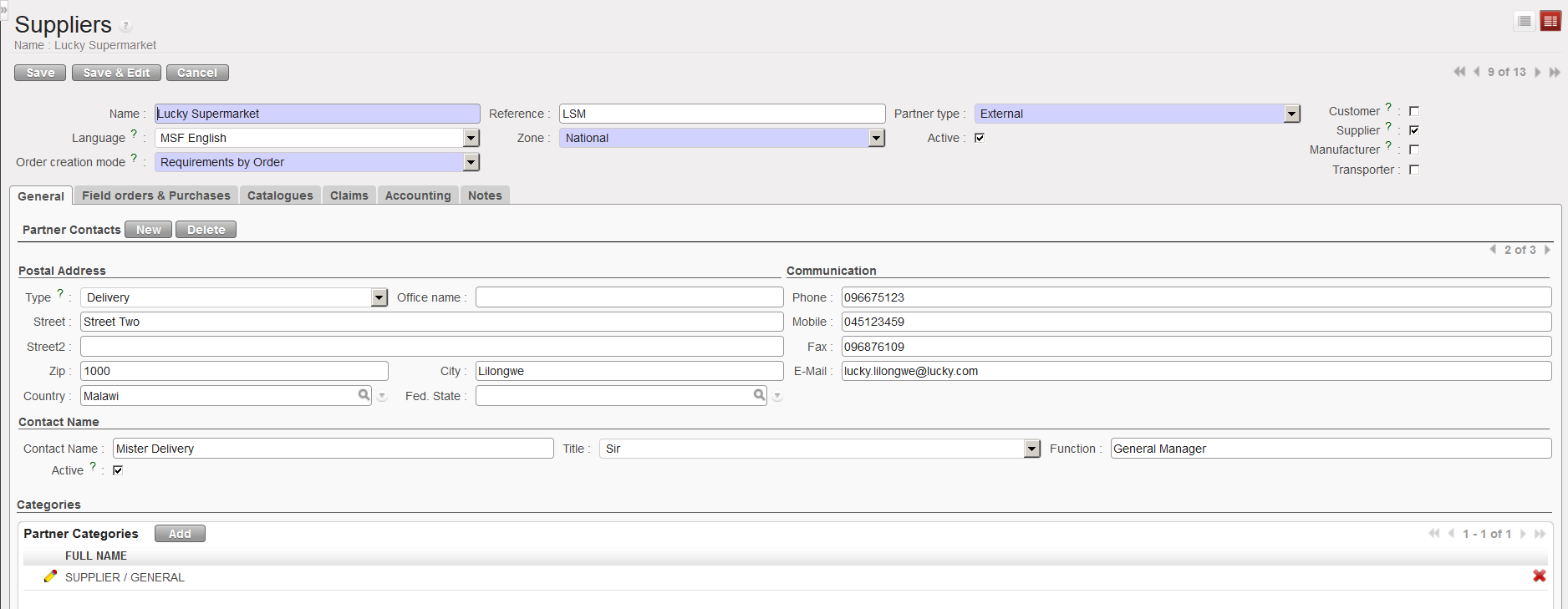
  9. In the “General” tab, in the “Postal address” section, complete the address of the supplier.
  10. On the same tab, in the “Communication” section, enter phone numbers, e-mail address,…
  11. On the same tab, in the “Contact Name” section, enter the name of your contact in “Contact Name” and his/her “Title” and “Function”
  12. Note that it is possible to enter multiple contacts/addresses, by clicking on the “New” button next to “Partner Contacts”. This option is important, as a partner can have different addresses for delivery invoice,… (e.g. in the case where the warehouse is not in the same location as the office).
  13. In the “Categories” section, it is possible to link a supplier/customer to partner categories which can be defined in configuration. Click on the “Add” button and select the partner categories related to the partner. You can select as many categories as needed. If you use this section, you will be able to retrieve your partner using the filter “Categories” available on the partners search screens.

Partner – General tab

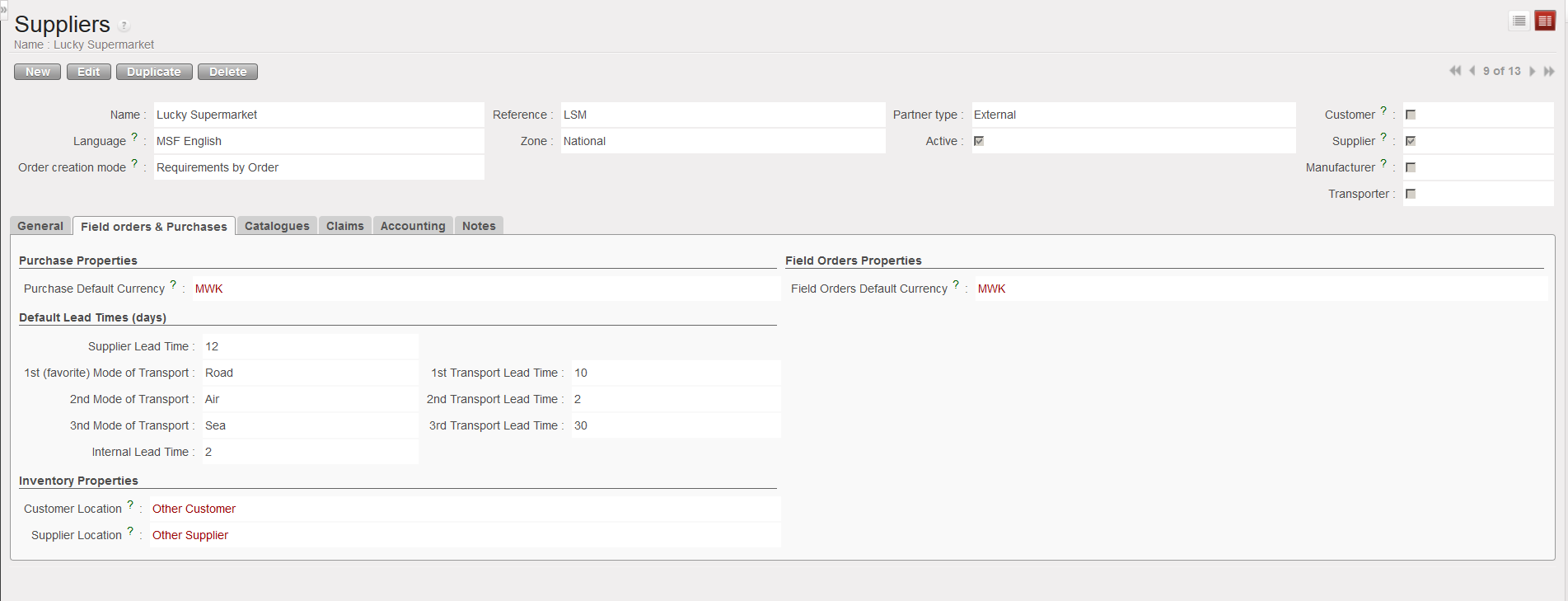
    14. On the “Field orders & Purchases” tab, section “Purchase Properties”, select the currency used by the supplier, for both “Purchase Default Currency” and “Field Orders Default Currency”.

Please note that this currency have to be defined thoroughly (functional, local or other) according to your needs especially for Internal, Inter-mission and Inter-section partners which are subject to synchronization. Indeed, this currency cannot be changed at document level (PO or FO) and in case of discrepancy form one instance to the other, a blocking synchronization message (Not Run) can be generated and therefore prevent the creation of an expected new document in the other instance.

This is why it is extremely important that within the same mission, all instances (intra-mission) are all defined with the same currency.

   15. In the “Default Lead Times (days)” section enter information about the default lead times of the supplier and the preferred transport methods. This information is required for the system to estimate delivery dates.

   16. The “Inventory Properties” section is usually left as default. The “Customer Location” is the destination location which will be used when goods will be distributed to this partner. The “Supplier Location” is the source location which will be used when goods will be received from this partner.

Partner – Field orders & Purchases tab

   17. If catalogues are created for the supplier, they will appear on the “Catalogues” tab. See chapters on Products and Procurement for further details.

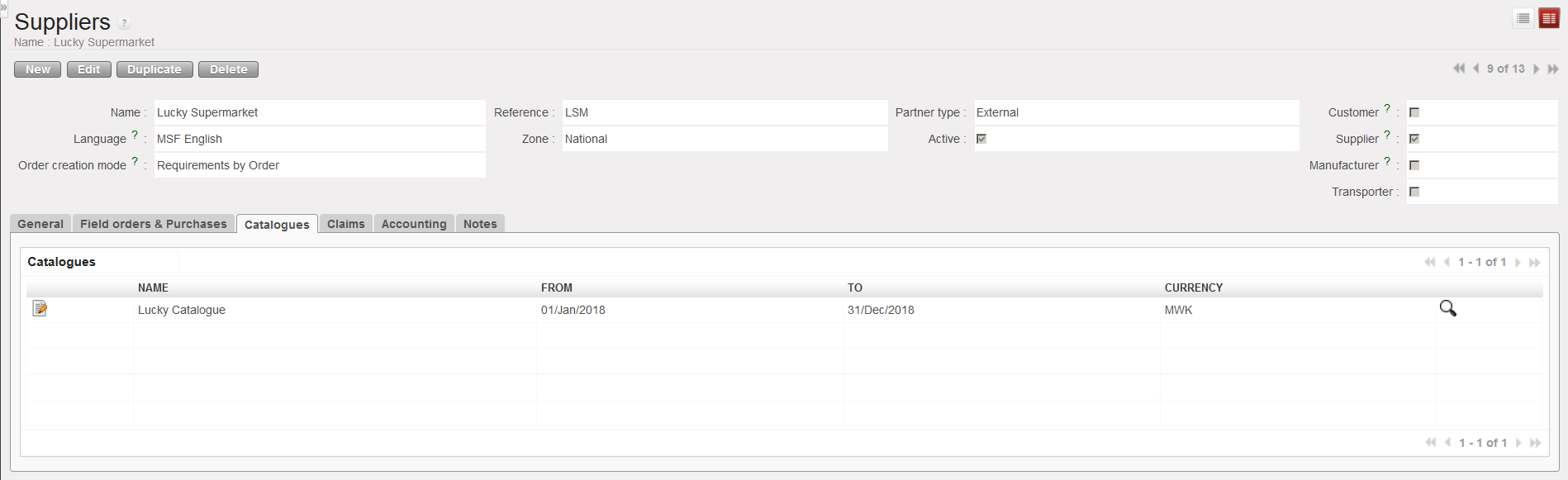
Partner – Catalogues tab

   18. The “Claims” tab will list all claims which have been raised to a partner. See section on claims in the Warehouse chapter for further details.

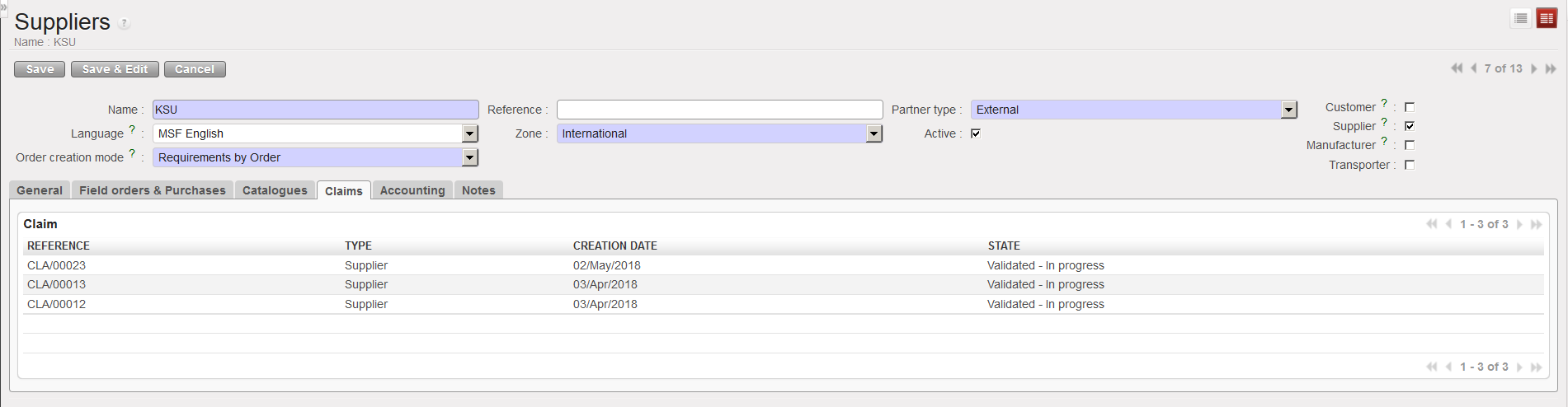
Partner – Claims tab

   19. On the “Accounting” tab, enter the appropriate account codes provided by Finance. These codes will vary according to the partner type. Do not enter any codes without being advised by Finance before as a wrong account will impact the accuracy of the financial statements.

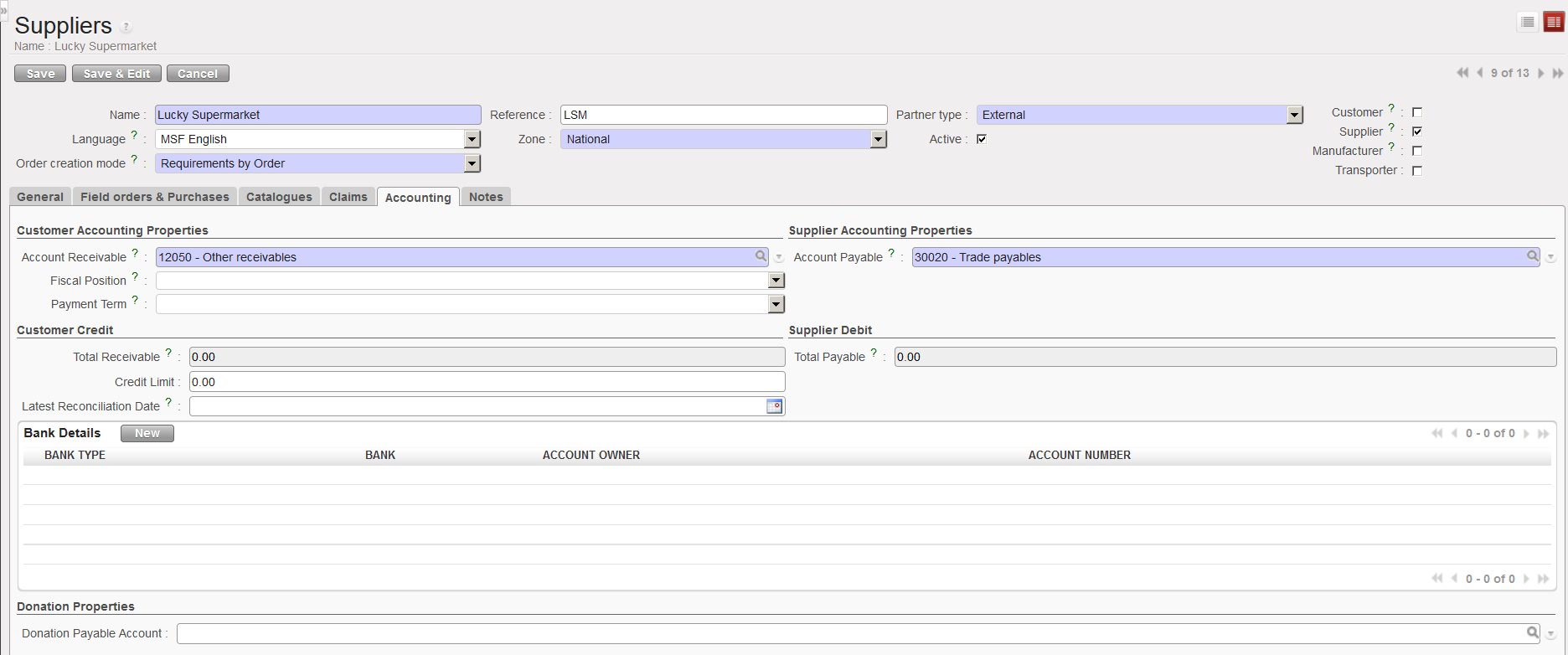
Partner – Accounting tab

20. Complete the “Accounts Receivable” and “Account Payable” fields. The fiscal position remains blank as well as the payment term.

21. In the “Customer Credit” section, the “Total Receivable” is automatically computed and shows the outstanding debt your customer owes you. “Credit Limit” remains blank, as well as “Latest Reconciliation Date”. In the “Supplier Debit” section, the “Total Payable” indicates the outstanding debt you owe to your supplier.

22.  Finally, you can complete the partner “Banking Details” upon input from Finance.

23.  In the “Donation Properties” section, you need to complete the “Donation Payable Account” to record extra-accounting transactions (e.g. in-kind donations) for this supplier if relevant.

24. In the “Notes” tab, enter any additional relevant information related to the partner.

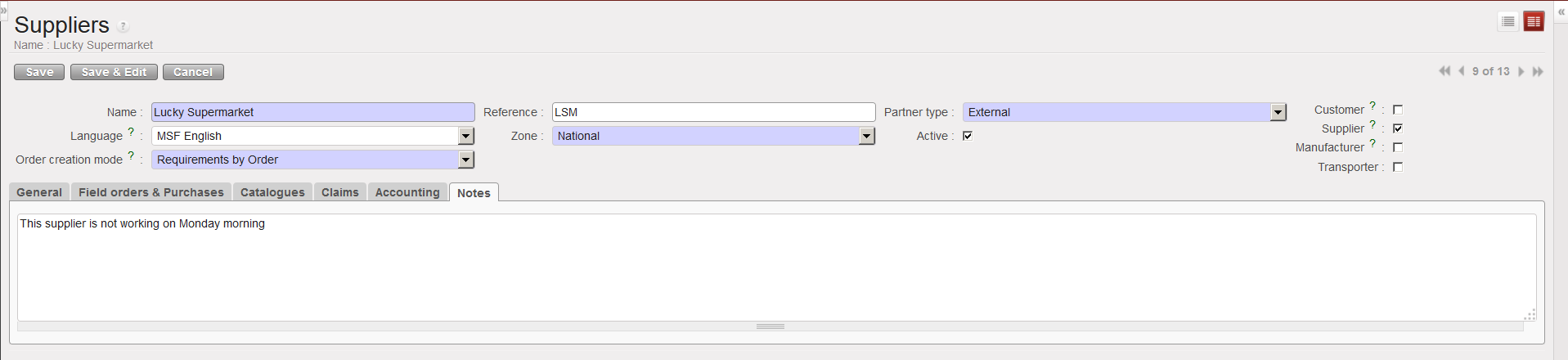
Partner – Notes tab

25. Click on the “Save” button.

The Action Menu on the right-hand side contains additional links to other transactions such as Purchase Orders, Field Orders and Invoices which may involve the partner.

Partner – Action menu

Via the action menu, you also have the possibility to create a catalogue for the partner via the option “New Catalogue“.

A. LU-SU1102: PARTNERS

Supply User Manual ENG-> Supply Configurations-> 2.2 LU-SU1102:Partners(customers and suppliers)-> A. LU-SU1102: PARTNERS

LU Introduction

In UniField, a partner represents an entity that you do business with, such as a company or an organization.

A partner can be: Customer (a project or an organization you support), Supplier (any entity internal or external, which supplies the instance with goods), Transporter (partner providing logistics services) and Manufacturer (which may be relevant for certain drugs).

The partner type can be Internal (within the UF network and the mission), Intermission (within the UF network but from another mission of your OC) Inter-section (within the UF network but from another OC), External (all entities, MSF or not, not on the UniField network) or ESC (an MSF European Supply Center).

Example of external partner which is customer and supplier

H. LU-SU1101: How to inactivate configurable locations

Supply User Manual ENG -> Supply Configurations -> 2.1 LU-SU1101: Instance set-up -> H. LU-SU1101: How to inactivate configurable locations

H. LU-SU1101: How to inactivate configurable locations

The menu “Advanced Warehouse Management” should not be used but configurable locations which are not needed anymore can be inactivated.

Go to: Supply Configuration / Warehouse Configuration / Regular Warehouse Management / Remove a stock location

  1. In the field “Choose a location”, enter the name of the location you wish to inactivate.
  2. Click on the “Inactivate the location” button.
Inactivation of location

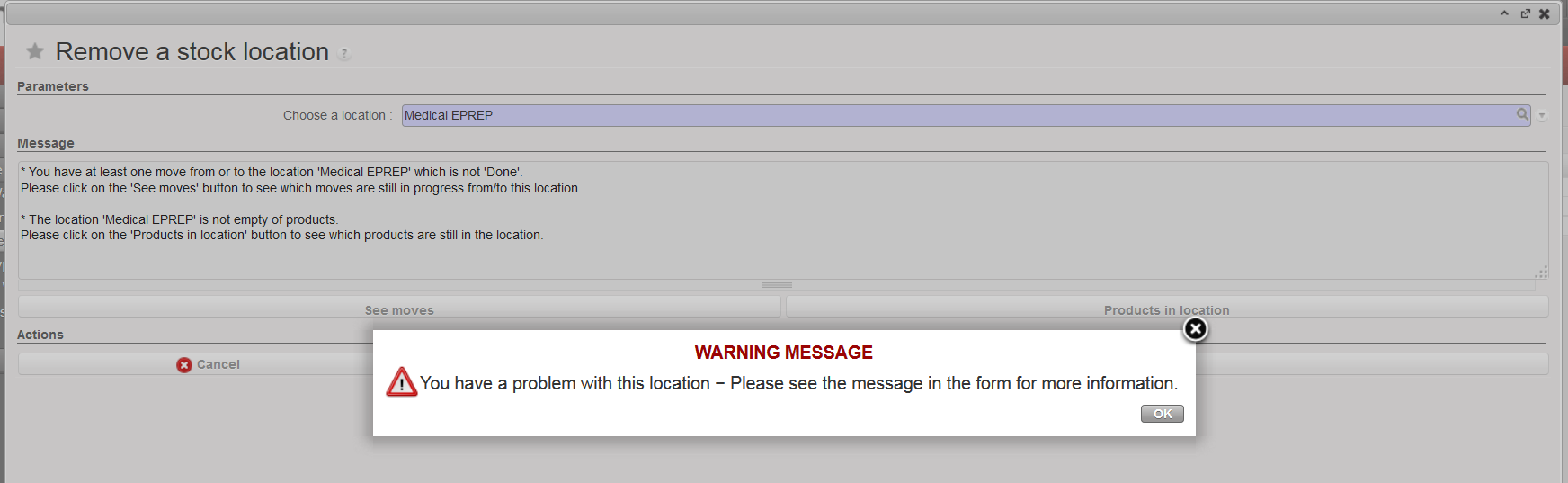
A location can only be inactivated if no stock movements related to this location are open and if no products are stored in this location. If this this not the case, when trying to inactivate a location, you will get the below message.

Inactivation of location not possible

The button “See moves” allows to see which stock movements related to this location are open.

The button “Products in location” allows to see which products are currently stored in the location.

If you want to inactivate a location, you will need to process the open stock movements and move the products out of the location.

F. LU-SU1101: Movements to/from the different type of locations.

Supply User Manual ENG-> Supply Configurations-> 2.1 LU-SU1101: Instance set-up-> F. LU-SU1101: Movements to/from the different type of locations.

F. LU-SU1101: Movements to/from the different type of locations.

How the different types of locations can be used can also be explained by listing the possibilities of movements to (destination) and from (source) these locations. This is what we try to do below. Note that the list of movements is not exhaustive. We only list the most commonly used movements. Additional information may be found in the Procurement chapter and in the Warehouse chapter.

1. Main stock (“Stock/MED/LOG”) as destination

If a PO is created from scratch, goods are received in the main stock “Stock/MED/LOG” (location selected according to the main type of the products) via the “Input” location after manual/automatic processing of the INT.

If a PO is created following the sourcing on order of an IR whose Location Requestor is a location of the main stock (“Stock/MED/LOG”), goods are received in the main stock “Stock/MED/LOG” (location selected according to the Location Requestor of the IR) via the “Input” location after manual/automatic processing of the INT.

Goods can be transferred to the main stock (locations “Stock/MED/LOG”) via an INT created from scratch.

Goods can be transferred to the main stock (locations “Stock/MED/LOG”) via an INT created following the sourcing from stock of an IR whose Location Requestor is a location from the main stock (“Stock/MED/LOG”).

Goods can be integrated into the main stock (locations “Stock/MED/LOG”) via an IN created from scratch.

2. Main stock (“Stock/MED/LOG”) as source

The main stock (“Stock/MED/LOG”) can be used as Source Location on a RCR.

The main stock (“Stock/MED/LOG”) can be used as Source Location in the OST when sourcing IR and FO.

The main stock (“Stock/MED/LOG”) can be used as Source Location on an INT created from scratch.

The main stock (“Stock/MED/LOG”) can be used as Source Location on an OUT created from scratch.

3. Intermediate Stock (IS) as destination

If a PO is created following the sourcing on order of an IR whose Location Requestor is an IS, goods are received in this IS via the “Input” location after manual/automatic processing of the INT.

Goods can be transferred to an IS via an INT created from scratch.

Goods can be transferred to an IS via an INT created following the sourcing from stock of an IR whose Location Requestor is this IS.

Goods can be integrated in an IS via an IN created from scratch.

4. Intermediate Stock (IS) as source

An IS can be used as Source Location on a RCR.

An IS can be used as Source Location in the OST when sourcing IR and FO.

An IS can be used as Source Location on an INT created from scratch.

An IS can be used as Source Location on an OUT created from scratch.

5. Internal Consumption Unit (ICU) as destination

If a PO is created following the sourcing on order of an IR whose Location Requestor is an ICU, goods are received in this ICU via the “Input” location after manual/automatic processing of the INT.

Goods can be transferred to an ICU via an INT created from scratch.

Goods can be transferred to an ICU via an INT created following the sourcing from stock of an IR whose Location Requestor is this ICU.

Goods can be integrated in an ICU via an IN created from scratch.

6. Internal Consumption Unit (ICU) as source

An ICU can be used as Source Location on a RCR.

An ICU can be used as Source Location in the OST when sourcing IR and FO.

An ICU can be used as Source Location on an INT created from scratch.

An ICU can be used as Source Location on an OUT created from scratch.

7. External Consumption Unit (ECU) as destination

If a PO is created following the sourcing on order of an IR whose Location Requestor is an ECU, goods are received in this ECU via the “Cross docking” location after manual processing of the OUT.

An ECU can be used as Destination Location on a RCR.

Goods can be transferred to an ECU via an OUT (or pick/pack/ship) created following the sourcing from stock of an IR whose Location Requestor is this ECU.

8. External Consumption Unit (ECU) as source

An ECU can be used as Source Location on an IN created from scratch in order to register a return to stock from a unit.

    PO from scratch PO < IR

RCR

Sourcing IR/FO in OST INT from scratch INT <IR sourced IN from scratch OUT from scratch OUT <IR sourced

Stock/MED/LOG

Destination

YES (1)

YES (1)

NO

YES

YES

YES

NO

NO

Stock/MED/LOG

Source

YES

YES

YES

NO

YES

IS

Destination

NO

YES (1)

NO

YES

YES

YES

NO

NO

IS

Source

YES

YES

YES

NO

YES

ICU

Destination

NO

YES (1)

NO

YES

YES

YES

NO

NO

ICU

Source

YES

YES

YES

NO

YES

ECU

Destination

NO

YES (2)

YES

NO

NO

NO

NO

YES

ECU

Source

NO

NO

NO

YES (3)

NO

  1. The destination is actually the destination of the INT linked to the IN (whose destination is “Input”) linked to the PO
  2. The destination is actually the destination of the OUT linked to the IN (whose destination is “Cross docking”) linked to the PO
  3. Used to return goods to stock from an ECU

The analysis could be pushed further by listing the possibilities of movements from/to:

-the “Input” location

-the “Cross docking” location

-the locations “Output”, “Packing”, “Dispatch”, “Distribution”

-the quarantine locations ” Quarantine (analyze)” and “Quarantine (before scrap)”

-the supplier locations “MSF Supplier” and “Other Supplier”

-the customer locations “MSF Customer” and “Other Customer”

-the virtual locations “Service”, “Procurement”, “Kitting”, “Inventory (loss & profit)”, “Destruction” and “Non stockable”.

Use cases for these locations are explained in the chapter Warehouse and in the chapter Procurement.

G. LU-SU1101: How to create configurable locations.

Supply User Manual ENG-> Supply Configurations-> 2.1 LU-SU1101: Instance set-up-> G. LU-SU1101: How to create configurable locations.

G. LU-SU1101: How to create configurable locations.

Go to: Supply Configuration / Warehouse Configuration / Regular Warehouse Management / Create new stock location

     1. Select the Location usage

  • Stock – to create an Intermediate Stock
  • Consumption Unit – to create a (Internal or External) Consumption Unit
  • EPREP – to create an emergency contingency stock

2. If you have selected Consumption Unit, you must specify the Location type

  • Internal – to create an Internal Consumption Unit
  • External – to create an External Consumption Unit

     3. Enter the Location Name

Note that as locations will often be sorted alphabetically in the system, it may be helpful to codify them properly.

4. Click on the Confirm button to create the location

Creation of location

Note that the menu “Advanced Warehouse Management” should not be used.

E. LU-SU1101: How to set-up configurable locations.

Supply User Manual ENG-> Supply Configurations-> 2.1 LU-SU1101: Instance set-up-> E. LU-SU1101: How to set-up configurable locations

E. LU-SU1101: How to set-up configurable locations.

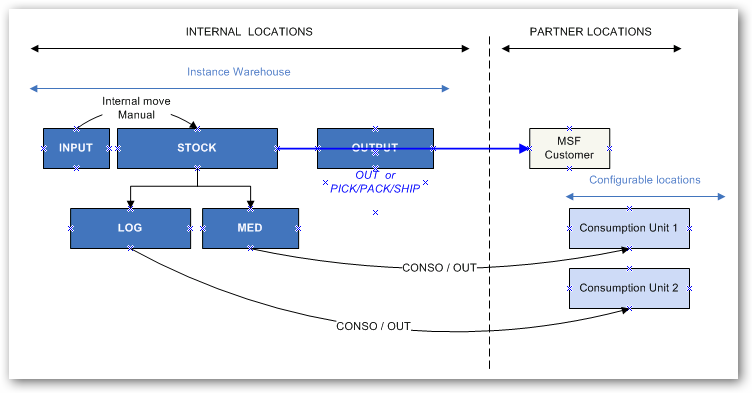
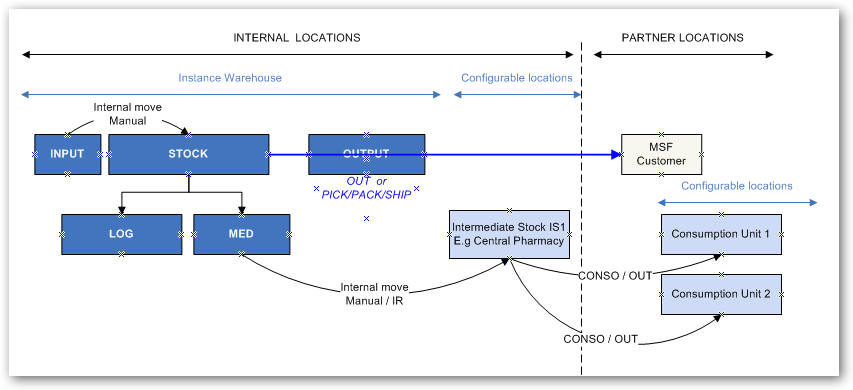
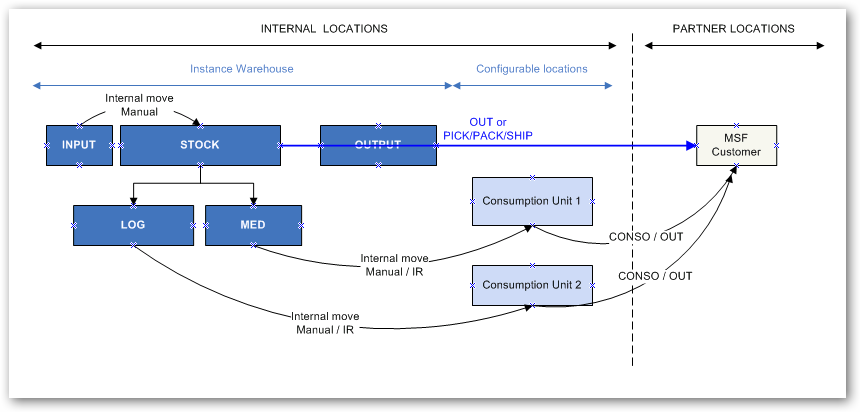
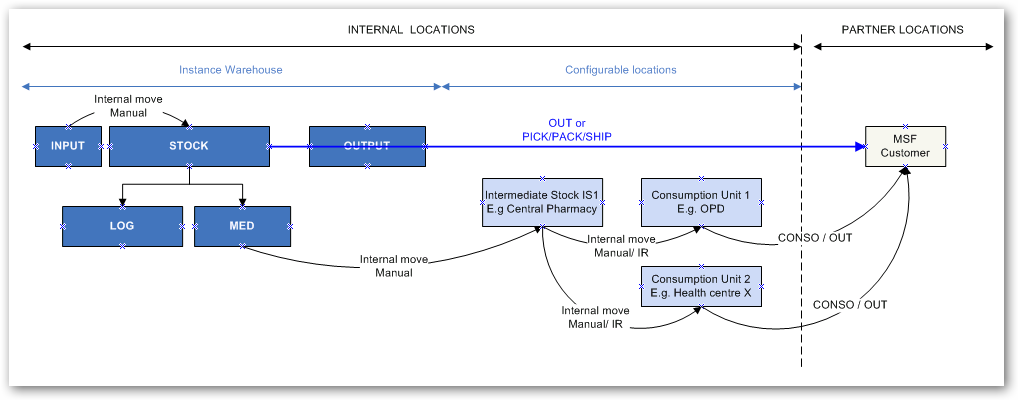
Intermediate Stock locations and Internal/External Consumption Units can be created on an instance in order to reflect the physical stocks organization of a project/coordination office and support the physical flows which occur on the ground.

6 possible set-ups (from basic to complex) are illustrated below. These 6 set-ups focus on a consumption done from stock (i.e. not on order). Note that hybrid set-ups are also possible.

  1. Minimal set-up (no additional configurable locations)

Goods are received and kept in the main stock (Stock/MED/LOG).

If goods are consumed locally (on the instance) by an MSF requester, the consumption is recorded via a Real Consumption Report with the main stock (Stock/MED/LOG) as Source Location and the generic partner location “MSF Customer” as Destination Location. If goods are consumed by a non-MSF requester, the generic partner location “Other Customer” can be used as Destination Location. Internal Requests are not used to register local consumption with this set-up.

If goods are dispatched to a partner (a customer, via the sourcing of an FO), the consumption is recorded via a Delivery Order (OUT) or via PICK/PACK/SHIP. The Source Location of the OUT or the PICK is the main stock (Stock/MED/LOG). The Destination Location of the OUT or the SHIP is the partner location “MSF Customer” (or “Other Customer” if the customer is an external partner).
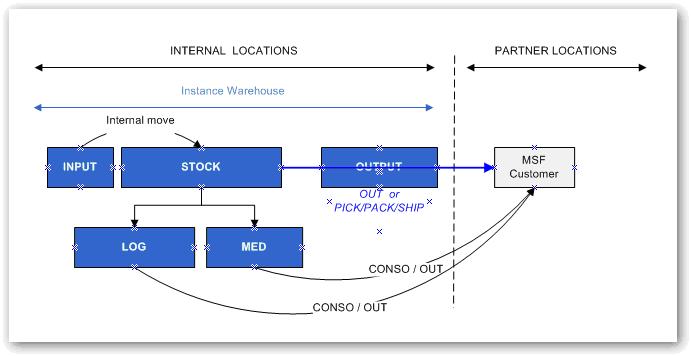
Minimal set-up

AdvantagesDisadvantagesConstraint/Effort
Quick and easy to manage and understand.


Minimal resources required.

Stock visibility on warehouse (quantity, value, expiry dates).

Goods delivered from the W.H are considered consumed.


General follow up: no online details on intermediate stocks or consumption/activities.

Minimum

2. Intermediate Stocks (IS)

When purchased, goods are:

  • Either received in the main stock (Stock/MED/LOG) but transferred to an Intermediate Stock (with an Internal Move created from scratch or with an Internal Move created from IR sourcing) from where they’ll be consumed.
  • Either received directly in an Intermediate Stock. This is possible if the replenishment of this IS starts with an IR which has the IS as Location Requester.

If goods are consumed locally (on the instance) by an MSF requester, the consumption is recorded via a Real Consumption Report with an IS as Source Location and the generic partner location “MSF Customer” as Destination Location. If goods are consumed by a non-MSF requester, the generic partner location “Other Customer” can be used as Destination Location. Internal Requests are not used to register local consumption with this set-up.

If goods are dispatched to a partner (a customer, via the sourcing of an FO), the consumption is recorded via a Delivery Order (OUT) or via PICK/PACK/SHIP. The Source Location of the OUT or the PICK is an IS. The Destination Location of the OUT or the SHIP is the partner location “MSF Customer” (or “Other Customer” if the customer is an external partner).
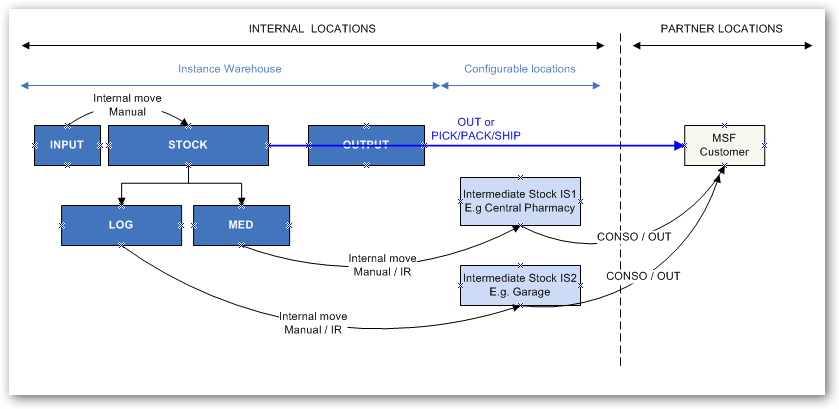
Intermediate Stocks

AdvantagesDisadvantagesConstraint/Effort
Fairly simple to manage.


Good visibility of stock after it has left Warehouse until it reaches intermediate stocks (quantity, value, expiry dates).

Goods delivered from Intermediate stocks are considered consumed.


More demanding in terms of input (transactions & updates) required for system.

Average

3. External Consumption Units (ECU)

This configuration is similar to the minimal set-up but with further details on the destination of the goods.

Goods are received and kept in the main stock (Stock/MED/LOG).

If goods are consumed locally (on the instance) by an MSF requester, the consumption is recorded via a Real Consumption Report with the main stock (Stock/MED/LOG) as Source Location and a specific ECU as Destination Location. Note that the partner locations “MSF Customer” and “Other customer” can also be used as Destination Location if needed.

As an alternative to the RCR, local consumption can also be recorded through Internal Requests with an ECU as Location Requester. Their sourcing generates a Delivery Order with the ECU as Destination Location.

If goods are dispatched to a partner (a customer, via the sourcing of an FO), the consumption is recorded via a Delivery Order (OUT) or via PICK/PACK/SHIP. The Source Location of the OUT or the PICK is the main stock (Stock/MED/LOG). The Destination Location of the OUT or the SHIP is the partner location “MSF Customer” (or “Other Customer” if the customer is an external partner).

An alternative is to link a partner (customer) to an ECU (thanks to the field “Customer Location” available on the “Field orders & Purchases” tab of the partner sheet). In this case, all goods shipped to this partner have this ECU as Destination Location of the OUT or the SHIP.

Note that the stocks of the ECUs are not integrated (no visibility) as these locations are considered as “end customers”.
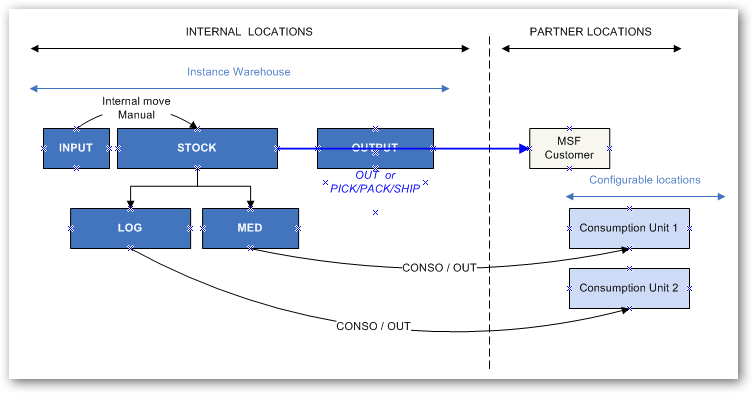
External Consumption Units

AdvantagesDisadvantagesConstraint/Effort
Quick and easy to manage.


Quite low volume of transactions.

Minimal resources required.

Stock visibility on warehouse (quantity, value, expiry dates)

Goods delivered from the WH are considered as consumed*.


General follow up and consumption information only on destinations (consumption units = end consumers)

Average low

4. Intermediate Stocks (IS) and External Consumption Units (ECU)

This configuration is a mixture of set-ups 2 and 3.

When purchased, goods are:

  • Either received in the main stock (Stock/MED/LOG) but transferred to an Intermediate Stock (with an Internal Move created from scratch or with an Internal Move created from IR sourcing) from where they’ll be consumed.
  • Either received directly in an Intermediate Stock. This is possible if the replenishment of this IS starts with an IR which has the IS as Location Requester.

If goods are consumed locally (on the instance) by an MSF requester, the consumption is recorded via a Real Consumption Report with an IS as Source Location and a specific ECU as Destination Location. Note that the partner locations “MSF Customer” and “Other customer” can also be used as Destination Location if needed.

As an alternative to the RCR, local consumption can also be recorded through Internal Requests with an ECU as Location Requester. Their sourcing generates a Delivery Order with the ECU as Destination Location.

If goods are dispatched to a partner (a customer, via the sourcing of an FO), the consumption is recorded via a Delivery Order (OUT) or via PICK/PACK/SHIP. The Source Location of the OUT or the PICK is an IS. The Destination Location of the OUT or the SHIP is the partner location “MSF Customer” (or “Other Customer” if the customer is an external partner).

An alternative is to link a partner (customer) to an ECU (thanks to the field “Customer Location” available on the “Field orders & Purchases” tab of the partner sheet). In this case, all goods shipped to this partner have this ECU as Destination Location of the OUT or the SHIP.

Note that the stocks of the ECUs are not integrated (no visibility) as these locations are considered as “end customers”.
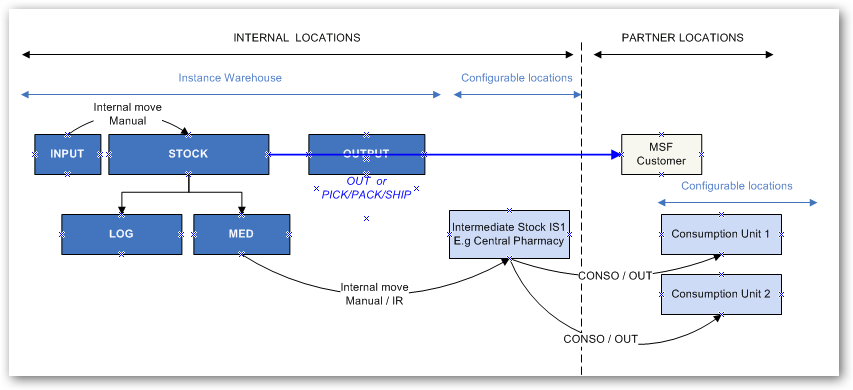
Intermediate Stocks and External Consumption Units

AdvantagesDisadvantagesConstraint/Effort
Good overview of stock management and general follow up for Intermediate Stocks (quantity, value, expiry dates).


Consumption information by destination/consumer.

More complex.


Needs more input to manage: Moves from stock to intermediate stocks plus one consumption report by destination (consumer).

Stock of consumption units is not integrated (no visibility).

Average

5. Internal Consumption Units (ICU)

This configuration is very close to set-up 2.

When purchased, goods are:

  • Either received in the main stock (Stock/MED/LOG) but transferred to an Internal Consumption Unit (with an Internal Move created from scratch or with an Internal Move created from IR sourcing) from where they’ll be consumed.
  • Either received directly in an Internal Consumption Unit. This is possible if the replenishment of this ICU starts with an IR which has the ICU as Location Requester.

If goods are consumed locally (on the instance) by an MSF requester, the consumption is recorded via a Real Consumption Report with an ICU as Source Location and the generic partner location “MSF Customer” as Destination Location. If goods are consumed by a non-MSF requester, the generic partner location “Other Customer” can be used as Destination Location. Internal Requests are not used to register local consumption with this set-up.

If goods are dispatched to a partner (a customer, via the sourcing of an FO), the consumption is recorded via a Delivery Order (OUT) or via PICK/PACK/SHIP. The Source Location of the OUT or the PICK is an ICU. The Destination Location of the OUT or the SHIP is the partner location “MSF Customer” (or “Other Customer” if the customer is an external partner).
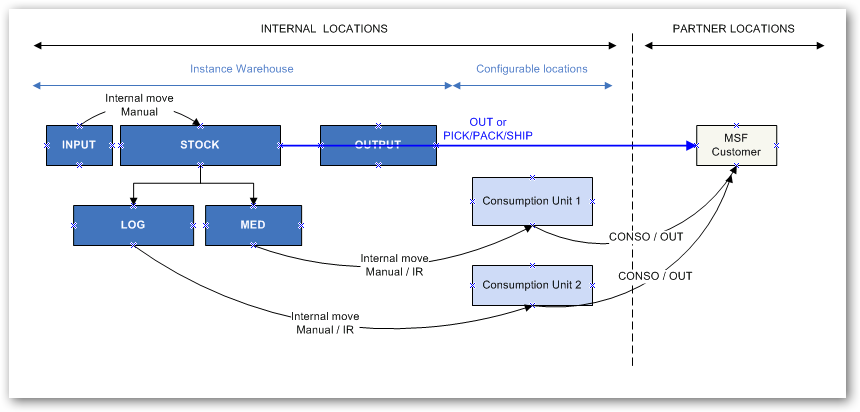
Internal Consumption Units

AdvantagesDisadvantagesConstraint/Effort
Fairly good overview of consumption of stocks.


Visibility of consumption units’ stock (quantity, value, expiry dates)

Some resources needed to ensure system is up to date (frequent consumption of consumption unit).Average

6. Full set-up

In this configuration, Intermediate Stocks, Internal Consumption Units and External Consumption Units are used. This set-up is more complex and requires much more transactions, meaning resources, to maintain the system.

When purchased, goods are:

  • Either received in the main stock Stock/MED/LOG (via the Input location and the manual/automatic processing of an INT)
  • Either received in an Intermediate Stock (via the Input location and the manual/automatic processing of an INT)
  • Either received in an Internal Consumption Units (via the Input location and the manual/automatic processing of an INT)

Goods can be moved between these 3 types of locations using Internal Move created from scratch or Internal Moves created from IR sourcing.

Local consumption is registered via RCR. The 3 types of locations can be used as Source Location. The Destination Location can be an ECU, “MSF Customer” or “Other Customer”.

As an alternative to the RCR, local consumption can also be recorded through Internal Requests with an ECU as Location Requester. Their sourcing (from one of the 3 types of locations) generates a Delivery Order with the ECU as Destination Location.

If goods are dispatched to a partner (a customer, via the sourcing of an FO), the consumption is recorded via a Delivery Order (OUT) or via PICK/PACK/SHIP. The 3 types of locations can be used as Source Location on the OUT or the PICK. The Destination Location of the OUT or the SHIP is the partner location “MSF Customer” (or “Other Customer” if the customer is an external partner).

An alternative is to link a partner (customer) to an ECU (thanks to the field “Customer Location” available on the “Field orders & Purchases” tab of the partner sheet). In this case, all goods shipped to this partner have this ECU as Destination Location of the OUT or the SHIP.
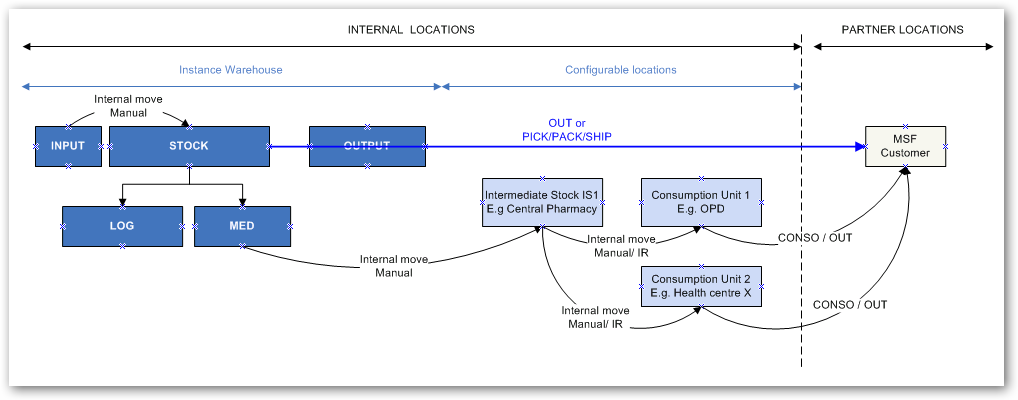
Full set-up

AdvantagesDisadvantagesConstraint/Effort
Very precise follow up of goods at the different stages (quantity, value, expiry dates,) of the supply chain until they’re consumed by the end consumer.


Closer to real consumption.

Complex to understand.


Increased number of transactions (meaning also of resources needed to maintain the system).

Delay in the time frame when goods are considered “consumed”.

Maximal

In general, goods are considered consumed once they have left internal locations for external (partner) locations. Consumption in the system reflects either consumption reports or outgoing delivery of shipments (we exclude loans, donations, loss and discrepancies as consumption and we also deduct returns). The Warehouse Chapter details how consumption (real by location or monthly average for the instance) are calculated.

Configurable Stock Locations can be created at Coordination and Project instance levels but the decision should be taken on case by case basis according to Mission/OC decision.


D. LU-SU1101: Configurable locations.

Supply User Manual ENG-> Supply Configurations-> 2.1 LU-SU1101: Instance set-up-> D. LU-SU1101: Configurable locations

D. LU-SU1101: Configurable locations.

UniField has been designed to be “scalable” in order to fit various contexts in the field where it is implemented (from small projects to coordination). Additional locations can be created on an instance: Intermediate Stocks (IS), Internal Consumption Units (ICU) and External Consumption Units (ECU).

The decision on whether to create and how to configure these additional locations should be taken considering the following factors:

  • Resources available to maintain records (on or offline)
  • Need for online visibility of stock and stock movements
  • Volume and value of supplies
  • Connectivity of other locations
  • Consumption rate of goods
  • Supply chain flow of goods following their dispatch from warehouse
  1. Intermediate Stocks

Intermediate Stocks are stocks which need to be managed separately from the main stock. Their management is usually done by the supply team.

Intermediate Stocks are not considered as final consumers. These stocks are “integrated” (they are part of the internal inventory and valued) and must be issued regularly.

2. Consumption Units (Internal vs External)

In UniField, a Consumption Unit is a location where goods are dispatched to be used or consumed. Consumption Units can either be internal or external locations. How the consumption units are configured depends on the situation and should be decided on a case by case basis.

Internal: If it is internal, we have full visibility on the stock level and its value in the location. Someone (probably based in that location) must update the system regularly with all stock movements when goods are consumed, and therefore the availability of resources and time to maintain the data for an Internal Consumption Unit should be a prime consideration before deciding on this option.

Internal Consumption Units are not considered as “last customers”.

External: If the destination is external, as soon as the stock has been dispatched, the stock leaves the UniField system, and other than knowing that it has been delivered to the consignee, we do not know any further details about it. Of course the location can continue to track movements using whatever system (e.g. excel or paper based), which may be a more flexible option for instances where there are time, resource or connectivity constraints.

External Consumption Units are considered as “last customers” (when goods are delivered to an ECU, they are assumed to be consumed).

The difference between an Intermediate Stock and an Internal Consumption Unit is tiny. An Intermediate Stock is used when a stock should be managed separately from the main stock (and this is usually done by the supply team). An Internal Consumption Unit is used when goods have already been sent to a unit but have not been used (consumed) yet. Their consumption can be recorded by the staff working in this unit (e.g. medical staff) if they have access to the system.

As we will see below, UniField allows creating locations for EPREP usage. Technically, there is no difference with the Intermediate Stocks. Functionally, these locations are used to keep emergency preparedness stocks.

How to set-up configurable locations

Intermediate Stock locations and Internal/External Consumptions Units can be created on an instance in order to reflect the physical stocks organization of a project/coordination office and support the physical flows which occur on the ground.

6 possible set-ups (from basic to complex) are illustrated below. These 6 set-ups focus on a consumption done from stock (i.e. not on order). Note that hybrid set-ups are also possible.

  1. Minimal set-up (no additional configurable locations)

Goods are received and kept in the main stock (Stock/MED/LOG).

If goods are consumed locally (on the instance) by an MSF requestor, the consumption is recorded via a Real Consumption Report with the main stock (Stock/MED/LOG) as Source Location and the generic partner location “MSF Customer” as Destination Location. If goods are consumed by a non-MSF requestor, the generic partner location “Other Customer” can be used as Destination Location. Internal Requests are not used to register local consumptions with this set-up.

If goods are dispatched to a partner (a customer, via the sourcing of an FO), the consumption is recorded via a Delivery Order (OUT) or via PICK/PACK/SHIP. The Source Location of the OUT or the PICK is the main stock (Stock/MED/LOG). The Destination Location of the OUT or the SHIP is the partner location “MSF Customer” (or “Other Customer” if the customer is an external partner).

Minimal set-up

Advantages Disadvantages Constraint/Effort
Quick and easy to manage and understand.


Minimal resources required.

Stock visibility on warehouse (quantity, value, expiry dates).

Goods delivered from the WH are considered consumed.


General follow up: no online details on intermediate stocks or consumptions/activities.

Minimum

2. Intermediate Stocks (IS)

When purchased, goods are:

  • Either received in the main stock (Stock/MED/LOG) but transferred to an Intermediate Stock (with an Internal Move created from scratch or with an Internal Move created from IR sourcing) from where they’ll be consumed.
  • Either received directly in an Intermediate Stock. This is possible if the replenishment of this IS starts with an IR which has the IS as Location Requestor.

If goods are consumed locally (on the instance) by an MSF requestor, the consumption is recorded via a Real Consumption Report with an IS as Source Location and the generic partner location “MSF Customer” as Destination Location. If goods are consumed by a non-MSF requestor, the generic partner location “Other Customer” can be used as Destination Location. Internal Requests are not used to register local consumptions with this set-up.

If goods are dispatched to a partner (a customer, via the sourcing of an FO), the consumption is recorded via a Delivery Order (OUT) or via PICK/PACK/SHIP. The Source Location of the OUT or the PICK is an IS. The Destination Location of the OUT or the SHIP is the partner location “MSF Customer” (or “Other Customer” if the customer is an external partner).

Intermediate Stocks

Advantages Disadvantages Constraint/Effort
Fairly simple to manage.


Good visibility of stock after it has left Warehouse until it reaches intermediate stocks (quantity, value, expiry dates).

Goods delivered from Intermediate stocks are considered consumed.


More demanding in terms of input (transactions & updates) required for system.

Average

3. External Consumption Units (ECU)

This configuration is similar to the minimal set-up but with further details on the destination of the goods.

Goods are received and kept in the main stock (Stock/MED/LOG).

If goods are consumed locally (on the instance) by an MSF requestor, the consumption is recorded via a Real Consumption Report with the main stock (Stock/MED/LOG) as Source Location and a specific ECU as Destination Location. Note that the partner locations “MSF Customer” and “Other customer” can also be used as Destination Location if needed.

As an alternative to the RCR, local consumption can also be recorded through Internal Requests with an ECU as Location Requestor. Their sourcing generates a Delivery Order with the ECU as Destination Location.

If goods are dispatched to a partner (a customer, via the sourcing of an FO), the consumption is recorded via a Delivery Order (OUT) or via PICK/PACK/SHIP. The Source Location of the OUT or the PICK is the main stock (Stock/MED/LOG). The Destination Location of the OUT or the SHIP is the partner location “MSF Customer” (or “Other Customer” if the customer is an external partner).

An alternative is to link a partner (customer) to an ECU (thanks to the field “Customer Location” available on the “Field orders & Purchases” tab of the partner sheet). In this case, all goods shipped to this partner have this ECU as Destination Location of the OUT or the SHIP.

Note that the stocks of the ECUs are not integrated (no visibility) as these locations are considered as “end customers”.

External Consumption Units

Advantages Disadvantages Constraint/Effort
Quick and easy to manage.


Quite low volume of transactions.

Minimal resources required.

Stock visibility on warehouse (quantity, value, expiry dates)

Goods delivered from the WH are considered as consumed*.


General follow up and consumption information only on destinations (consumption units = end consumers)

Average low

4. Intermediate Stocks (IS) and External Consumption Units (ECU)

This configuration is a mixture of set-ups 2 and 3.

When purchased, goods are:

  • Either received in the main stock (Stock/MED/LOG) but transferred to an Intermediate Stock (with an Internal Move created from scratch or with an Internal Move created from IR sourcing) from where they’ll be consumed.
  • Either received directly in an Intermediate Stock. This is possible if the replenishment of this IS starts with an IR which has the IS as Location Requestor.

If goods are consumed locally (on the instance) by an MSF requestor, the consumption is recorded via a Real Consumption Report with an IS as Source Location and a specific ECU as Destination Location. Note that the partner locations “MSF Customer” and “Other customer” can also be used as Destination Location if needed.

As an alternative to the RCR, local consumption can also be recorded through Internal Requests with an ECU as Location Requestor. Their sourcing generates a Delivery Order with the ECU as Destination Location.

If goods are dispatched to a partner (a customer, via the sourcing of an FO), the consumption is recorded via a Delivery Order (OUT) or via PICK/PACK/SHIP. The Source Location of the OUT or the PICK is an IS. The Destination Location of the OUT or the SHIP is the partner location “MSF Customer” (or “Other Customer” if the customer is an external partner).

An alternative is to link a partner (customer) to an ECU (thanks to the field “Customer Location” available on the “Field orders & Purchases” tab of the partner sheet). In this case, all goods shipped to this partner have this ECU as Destination Location of the OUT or the SHIP.

Note that the stocks of the ECUs are not integrated (no visibility) as these locations are considered as “end customers”.

Intermediate Stocks and External Consumption Units

Advantages Disadvantages Constraint/Effort
Good overview of stock management and general follow up for Intermediate Stocks (quantity, value, expiry dates).


Consumption information by destination/consumer.

More complex.


Needs more input to manage: Moves from stock to intermediate stocks plus one consumption report by destination (consumer).

Stock of consumption units is not integrated (no visibility).

Average

5. Internal Consumption Units (ICU)

This configuration is very close to set-up 2.

When purchased, goods are:

  • Either received in the main stock (Stock/MED/LOG) but transferred to an Internal Consumption Unit (with an Internal Move created from scratch or with an Internal Move created from IR sourcing) from where they’ll be consumed.
  • Either received directly in an Internal Consumption Unit. This is possible if the replenishment of this ICU starts with an IR which has the ICU as Location Requestor.

If goods are consumed locally (on the instance) by an MSF requestor, the consumption is recorded via a Real Consumption Report with an ICU as Source Location and the generic partner location “MSF Customer” as Destination Location. If goods are consumed by a non-MSF requestor, the generic partner location “Other Customer” can be used as Destination Location. Internal Requests are not used to register local consumptions with this set-up.

If goods are dispatched to a partner (a customer, via the sourcing of an FO), the consumption is recorded via a Delivery Order (OUT) or via PICK/PACK/SHIP. The Source Location of the OUT or the PICK is an ICU. The Destination Location of the OUT or the SHIP is the partner location “MSF Customer” (or “Other Customer” if the customer is an external partner).

Internal Consumption Units

Advantages Disadvantages Constraint/Effort
Fairly good overview of consumption of stocks.


Visibility of consumption units’ stock (quantity, value, expiry dates)

Some resources needed to ensure system is up to date (frequent consumption of consumption unit). Average

6. Full set-up

In this configuration, Intermediate Stocks, Internal Consumption Units and External Consumption Units are used. This set-up is more complex and requires much more transactions, meaning resources, to maintain the system.

When purchased, goods are:

  • Either received in the main stock Stock/MED/LOG (via the Input location and the manual/automatic processing of an INT)
  • Either received in an Intermediate Stock (via the Input location and the manual/automatic processing of an INT)
  • Either received in an Internal Consumption Units (via the Input location and the manual/automatic processing of an INT)

Goods can be moved between these 3 types of locations using Internal Move created from scratch or Internal Moves created from IR sourcing.

Local consumption is registered via RCR. The 3 types of locations can be used as Source Location. The Destination Location can be an ECU, “MSF Customer” or “Other Customer”.

As an alternative to the RCR, local consumption can also be recorded through Internal Requests with an ECU as Location Requestor. Their sourcing (from one of the 3 types of locations) generates a Delivery Order with the ECU as Destination Location.

If goods are dispatched to a partner (a customer, via the sourcing of an FO), the consumption is recorded via a Delivery Order (OUT) or via PICK/PACK/SHIP. The 3 types of locations can be used as Source Location on the OUT or the PICK. The Destination Location of the OUT or the SHIP is the partner location “MSF Customer” (or “Other Customer” if the customer is an external partner).

An alternative is to link a partner (customer) to an ECU (thanks to the field “Customer Location” available on the “Field orders & Purchases” tab of the partner sheet). In this case, all goods shipped to this partner have this ECU as Destination Location of the OUT or the SHIP.

Full set-up

Advantages Disadvantages Constraint/Effort
Very precise follow up of goods at the different stages (quantity, value, expiry dates,) of the supply chain until they’re consumed by the end consumer.


Closer to real consumption.

Complex to understand.


Increased number of transactions (meaning also of resources needed to maintain the system).

Delay in the timeframe when goods are considered “consumed”.

Maximal

In general, goods are considered consumed once they have left internal locations for external (partner) locations. Consumption in the system reflects either consumption reports or outgoing delivery of shipments (we exclude loans, donations, loss and discrepancies as consumption and we also deduct returns). The Warehouse Chapter details how consumptions (real by location or monthly average for the instance) are calculated.

Configurable Stock Locations can be created at Coordination and Project instance levels but the decision should be taken on case by case basis according to Mission/OC decision.

C. LU-SU1101: Default Locations

Supply User Manual ENG-> Supply Configurations-> 2.1 LU-SU1101: Instance set-up-> C. LU-SU1101: Default Locations

C. LU-SU1101: Default Locations

The structure of locations within UniField facilitates the organization of stocks and also supports the double entry principle, which is explained in details in the Warehouse chapter. Any stackable products received will be part of the internal inventory until they are issued to an external party at which point, they will be removed from any internal locations and will exit UniField. Products which are non-stockable or services with reception will not figure in internal locations but will be received in specific virtual locations. The exception is where non-stockable products are in transit to another internal partner (e.g. project), in which case they will transit through the (coordination) Cross docking location before to be dispatched.

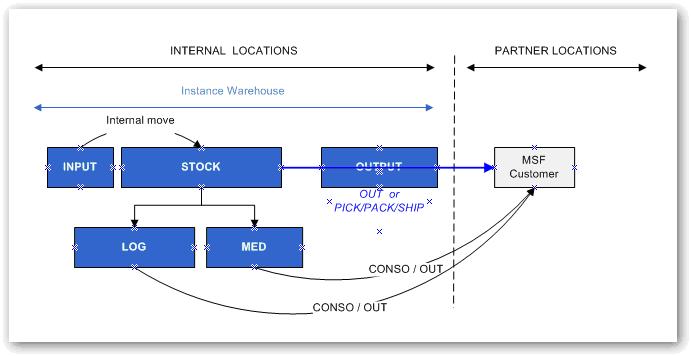
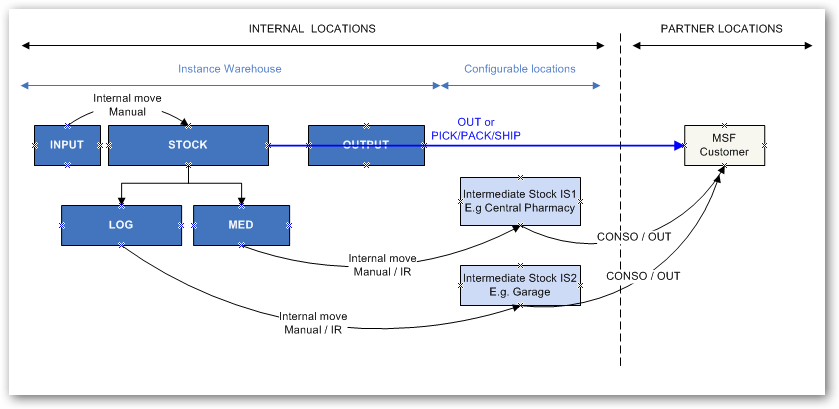
A warehouse in UniField is an entity which represents one or more physical storage locations from a project/coordination office. This warehouse includes a “point of entry” of goods (destination of most of POs) and a “point of exit” of goods intended for a customer (through an FO). Each instance has a warehouse created by default at the instance creation. The warehouse is divided into 4 main parts: Input, Stock (with children locations), Cross docking and Output (also with children locations).

Instance Warehouse
Instance Warehouse (minimal set-up)
Instance warehouse (including examples of configurable locations)

Input is a transition location through which received products transit (and where a quantitative/qualitative check can be performed) before being available in stock. It is the destination location of an Incoming Shipment/Purchase Order which is not received in cross-docking.

Stock reflects the main stock from a coordination/project. This location has 2 children location, MED for the storage of medical items and LOG for the storage of logistical items. MED products are stored in the MED location. LOG products are stored in the LOG location. LIB products are stored directly in the Stock location (if they are declared as stockable products).

When an Incoming Shipment (IN) is processed and goods are received in the Input location, the system creates an Internal Move (INT) to transfer the goods from the Input location to the stock. This Internal Move is processed automatically if the goods are received directly in the requesting location (checkbox “Direct to Requesting location” ticked when IN processed) or manually if the goods actually transit through Input for quantitative/qualitative control (checkbox “Direct to Requesting Location” unticked when IN processed).

Goods present in Stock or children (MED/LOG) are considered as available (unless reserved) for any request.

Output is a transition location through which products being distributed to customers transit when the full shipment process (pick/pack/ship) is used. The Output location itself is not used but goods transit through its children locations (Packing/Dispatch/Distribution) during picking/packing/shipment.

Cross docking is a transition location through which received products transit when they are received on an instance but should be dispatched to a customer. An Incoming Shipment/Purchase Order linked to a Field Order has Cross docking as default destination location. An Incoming Shipment/Purchase Order linked to an Internal Request (whose Location Requestor is an External Consumption Unit) has Cross docking as destination location.