Finance User Manual ENG -> 3. Payments -> 3.3 Finance Payments and Registers -> LUFI-30301 Register Entries Statuses
LUFI-30301 Register Entries Statuses
LU Introduction
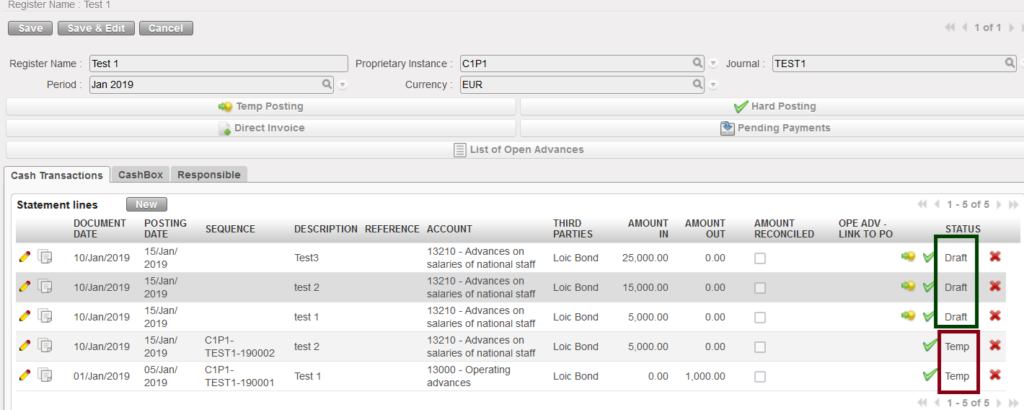
UniField manages 3 types of register entry statuses:
- Draft entries
 : When created, direct register entries are recorded as Draft. They are created in the register only, are not posted, and do not exist in the journals. They are editable and can be deleted; they don’t have a sequence number yet.
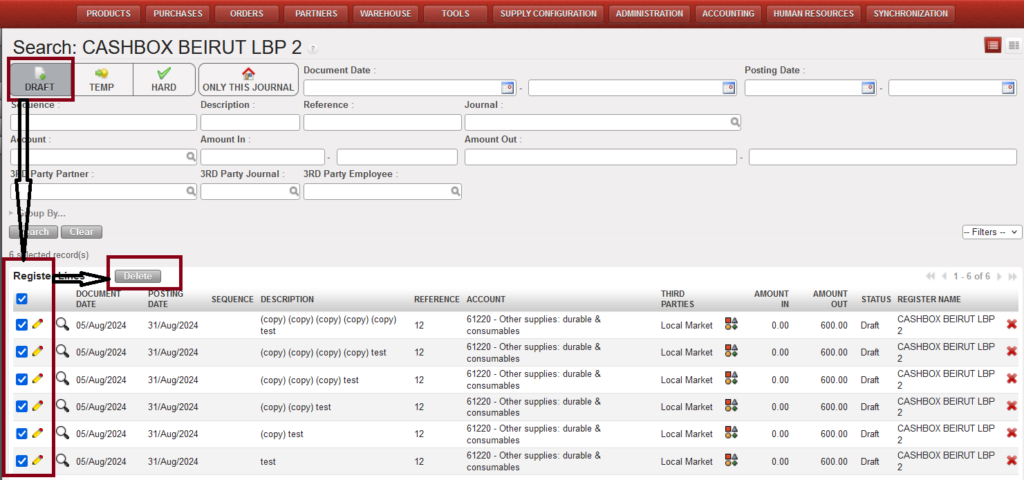
Only in draft entries you have the option to do mass delete of draft entries as below:
• In the register go to the right menu list, under “Actions” click on “Register lines”

• In the “Search view” toggle on “Draft” button, select all draft lines and click the “Delete” button, all lines will be deleted.
- Temp-posted entries
 : Entries are created in the register and assigned a sequence number. They are reflected in the corresponding journals and the accounts balances with their counterpart accounts (double-entry bookkeeping). They are editable and can be deleted. Temp posting means that an authorised user is validating an accounting entry. The user can do it individually or by grouping several entries.

- Hard-posted entries
 : Entries are created in the register. They are reflected in the corresponding journal and the account balances with their counterpart accounts (double-entry bookkeeping). They are not editable (except through accounting corrections performed by an authorized user). The user can change the status of an entry to {Hard} individually or by grouping several entries together.
The below table summarizes the impact of register entries statuses on the creation of accounting lines in a journal and the possibility to edit them.

| Register lines state | Journal entries state | Modification allowed? |
| Draft | None | Yes (in register) |
| Temp-posted | Valid / Unposted | Yes (in register) |
| Hard-posted | Valid / Posted | No, only via the correction system process. See chapter 5 |
Correspondence between register entries status and journal entries status
Draft entries always shown in the top of the statement lines as below: