10.5 Transfer the UniField instance from one computer to another.

10.5 Transfer the UniField Instance From One Computer to Another.

The project is small, so I have had UniField on a computer that is not very powerful, but now the project is going to grow. How can I transfer my instance from one computer to the other?
  • You ask all the users to stop working on the instance (or you cut the instance from the network).
  • You need to backup the database and the following configuration files:
    • openerp-server.conf in C:\Program Files (x86)\msf\Unifield\Server
    • openerp-web-oc.cfg in C:\Program Files (x86)\msf\Unifield\Web\conf
    • copy the directory “C:\Program Files (x86)\msf\SSH_CONFIG” to the new computer
    • pg_hba.conf and postgresql.conf in D:\MSF data\Unifield\PostgreSQL
  • You need to install UniField on the new computer.
  • You restore the configuration files from the old instance on the new instance.
  • You reboot the computer.
  • You restore the database using the UniField password from the old instance.
  • You login as an admin and enter the synchronization password.
  • You connect the instance to the synchronization server.

The new instance keeps its old instance ID and thus is already validated at synchronization server side. The users can now continue with their work.
If the UniField machine gets its IP address from a DHCP server, you may consider updating the latter as the machine is different, so is its MAC address.

10.4 Web page

10.4 Web page

How do I connect to the UniField interface?
Use a web browser like Firefox, and enter in the address field, the IP of the machine running UniField and the port 8061: e.g. http://IpAddress:8061
I know the UniField address and port of the local instance, I can connect locally using localhost instead of the IP address but I cannot connect remotely.
Check if the Web port 8061 is opened in Windows Firewall. Refer to the installation procedure to know how to open it.
I cannot connect locally to UniField with http://localhost:8061, what should I do?
Maybe the default port has been changed by your OC. Check the value of “server.socket_port = PPPP” in the file C:\Program Files (x86)\msf\Unifield\Web\conf\openerp-web.cfg
If instead of PPPP there is a value such as 80, then try to connect to http://localhost:80
If it still does not connect, check if the OpenERP services are running: click on the Windows logo.
In the “Search program and files” field, enter “services” and click on “services” in the options suggested
Check the status for OpenERP Server, OpenERP Web and Postgres. If they are not started, start them.
I know the web port of my local instance is correct and the firewall authorized the access to that port and yet, I get an error “Unable to connect. Firefox can’t establish a connection to the server at […]”
The web service may be down. Check if the OpenERP services are running:
Click on the Windows logo
In the “Search program and files” field, enter “services” and click on “services” in the options suggested
Check the status for OpenERP Server, Postgres. If they are not started, start them.
I’m connected to the UniField interface but when I try to log in, no database appears in the drop down list
It seems the OpenERP server process cannot connect to the database. On Linux, it needs a local user while on Windows OpenERP needs a login and a password to connect to PostgreSQL. Have they been changed since the installation? If you backed up the configuration files right after the installation, you could have a look in those. Otherwise, if you did change the password intentionally, you need to update the OpenERP server configuration file. The path can be found in the “Backing up and Restoring” documentation.
Can I make certain users log in to certain instances by default?
You can help them to make a bookmark on their computer that makes their preferred instance the default. First, have them log out from Unifield. Navigate to the login page, and note that in the URL bar there is something like http://unifield/openerp/login?db=&user=
You can edit this to include the database name you want between the db= and the &, for example:
http://unifield/openerp/login?db=HQ1&user=finref
Hit return to test that the database popup is set like you want. Then make a bookmark. The bookmark will include the preferred database that you just set in the URL.

10.3 Installation

10.3 Installation

When I start the UniField installer, a Windows screen prompted me for a login and password, what should I enter?
You need to enter the Windows credentials of an account with administrative rights to be able to install UniField.
I just installed UniField and I successfully connected to the web page but I cannot see any databases.
You’re not done with the installation process. You need to create the database and then set-up the instance. Refer to the installation documentation and the initial set-up documentation
I would like to change the groups of my instance. How should I do?
Beware that the instance will not be able to synchronize as long as the modifications are not validated on the synchronization server. Start the registration process in the synchronization menu, do NOT change the uuid, select the groups and register. You must now inform the rightful persons to validate the changes.

10.2 General FAQ

10.2 General FAQ

What is OpenERP? What is UniField? OpenERP is an open source integrated enterprise resource planning (ERP) software. UniField is based on OpenERP with extra features developed for and by MSF to meet our specific needs. UniField is the new integrated supply and finance system, which is intended to replace the current systems used in the field (i.e. Log7 and Boox for examples). The system has been a joint effort of all the OCs by a team based in Geneva.What is an instance? What is the synchronization server?An instance is an installation of UniField. It could be a project, coordination or an HQ. The instances exchange data through the synchronization server, which is designed to compensate for bad or unreliable connectivity. The instances have been designed to work offline.
Synchronization has to be performed regularly, either on an automatic or manual basis. For production instances the best practice is to do at least one per day and if possible during the out of business hours (e.g. do not wait 1 month to synchronize your instance as the process would take long time).
To save bandwidth, only data matching rules are sent to the synchronization server. It means not all the data are sent – this means the synchronization process is not a backup solution as it does not create a database duplicate.I’m not administrator on the server, can I install UniField anyway?No, you need administrator rights.What Windows 7 Pro specificities do I need to know to install UniField?You need administrator rights, the system user openpgsvc created when installing the All-in-one must have English US as Format in the regional settings.What is PostgreSQL?It’s an open source RDBMS (Relational Database Management System), just like MySQL, Oracle, MS SQL Server, … It’s the program which stores the data into databases.Which browser is recommended for UniField?Firefox is our browser of choice when developing and supporting UniField. As a result, we advise you to use the last version of this browser.Where should I install UniField?The best practice is to install UniField on a dedicated machine and work on UniField remotely with a browser. As for the paths, it is recommended to leave the default ones.What is the minimum specification for the UniField machine?The OS target is Windows 7 Pro 64 Bits. The recommendation is to have at least 4 GB of RAM and of course the best CPU possible.What is the UniField password?The UniField password is used to interact with anything regarding the databases (creation, backup, restore, drop). It must be changed right after the UniField installation followed by a backup of the configuration files.What is a log?A log is a journal where events are written. It helps to understand what happened or what went wrong at a particular time.Where are the logs?To avoid having a log file with a big size, UniField has a log rotate. This means that there will be several files over the time. The logs can be found in C:\Program Files (x86)\msf\Unifield\ServerLog. The latest log file is openerp-server.log while the older are named openerp-server.log.2012-12-17 for example.How do I preselect a specific instance and user on the URL?It is possible to provide a specific URL to your users so when they connect to the UniField interface the instance and the user will automatically be preselected. The URL could be then saved as a bookmark.
e.g. we would like to have the instance to HQ1C1 and the user to fin_hr
http://localhost:8061/openerp/login?db=HQ1C1&user=fin_hr

10. Troubleshooting

10. Troubleshooting

9.7 How to import User Rights in the sand box

9.7 How to Import User Rights in the Sandbox

User Rights are imported in the SYNC_SERVER. It would be applied first by the HQs once they synchronise and then to its respective children instance by synchronisation.

Click on Menu Administration 1, Synchronization 2, Instance User Rights 3.
Click on the top right arrow 4 to expand the right menu.
Click on Add new file 1
a pop up window opens
Fill in the information:


  • Version 1: User Right v.currentversion
  • File 2: Browse the User Right file
  • Click on Import 3
All User Rights files download automatically.
Once it’s completed you will see the Message Import Done 1
Click on Deploy on server 2
Once done you will be redirected to the Instance User Rights page where you could see the latest User Rights imported and deployed 1

Next time your HQ instance synchronises it would get the latest User Rights. Its children instances would get it after synchronising too (after HQ finishes first)

9.6 How to Patch the Sandbox

9.6 How to Patch the Sandbox

When you need to patch a sandbox, you have to:

  • Add the patch in your SYNC_SERVER – refer to 9.6.1 below
  • Deploy the patch at least in one instance – refer to 9.6.2 below

9.6.1 Creating a patch on the SYNC_SERVER

First of all, you would need to have the .zip file that contains the patch. This .zip file is made up of:

  • A file that describes the release. This file is called py and is saved in the root directory of the zip file.
  • All the source code files that have to be updated or created. The structure is the same as in a UniField instance.

When a patch needs to be deployed, you need to define this patch at the SYNC_SERVER level.

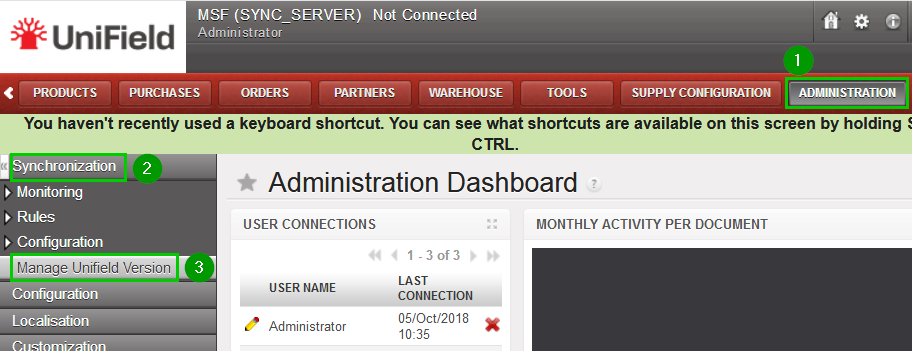
Click on Menu Administration 1, Synchronization 2, Manage Unifield Version 3
A pop up window opens.
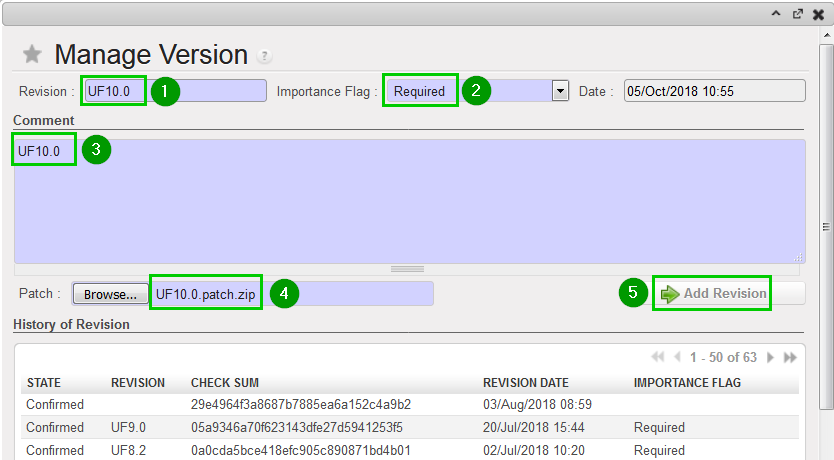
Fill in:
Revision 1: Enter the revision version
Importance Flag 2: Select Required (Optional will warn the users but won’t force the upgrade)
Comment 3: Fill in (e.g. with the revision number)
Patch 4: Browse the .zip file
Click on Add Revision 5
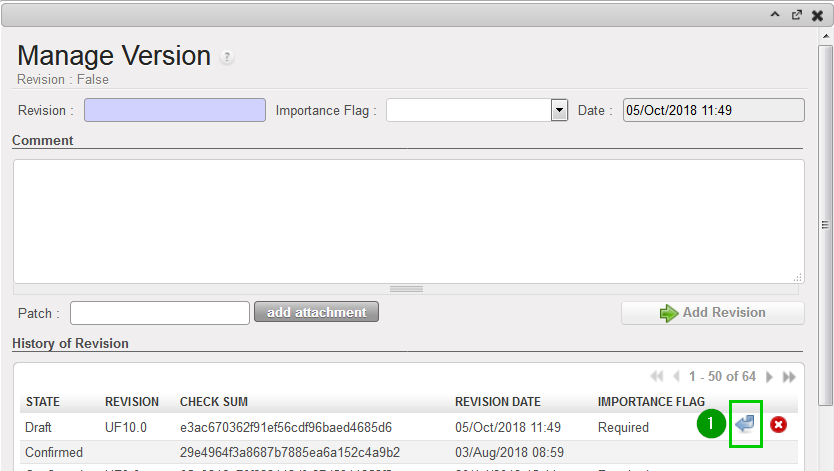
In the bottom section “History of Revision” table, click on the blue arrow 1 to activate the patch.
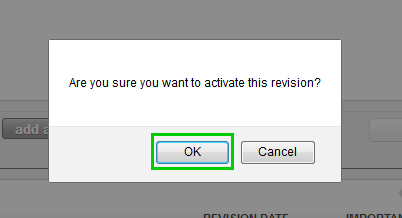
A pop up window will ask you to confirm.
Click on OK

The patch is now activated in your SYNC_SERVER. All instances connected to this SYNC_SERVER are going to be upgraded the next time they synchronize.
Please keep in mind that the SYNC_SERVER has not been upgraded yet. What you have just done is to provide the other instances that connect to this SYNC_SERVER with a new patch.

9.6.2  Deploy the patch at least in one instance which is on the same computer

You can follow the steps described in chapter 6.1 Applying a patch on instances.

9.5 Update the Hardware Identifier in the SYNC_SERVER

9.5 Update the Hardware Identifier in the SYNC_SERVER

The last step before starting a synchronisation is to update the Hardware identifier of your instances in the SYNC_SERVER because if you don’t do it and you try to start a synchronisation from any instances in your Sandbox you would face an error.

Where to find the Hardware identifier.
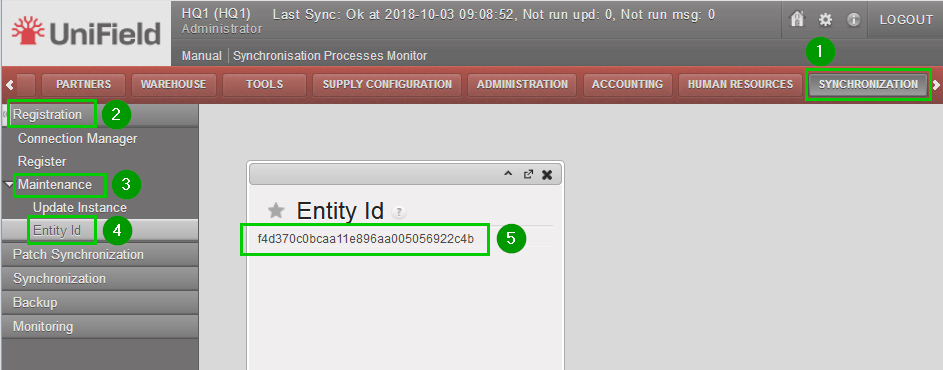
Log in in one of your instance of the sandbox and click on menu Synchronization 1, Registration 2, Maintenance 3, Entity Id 4
A pop up window opens with the Entity Id 5 which is your Hardware identifier.
Copy this value.
Log out from your instance and log in your_SYNC_SERVER.
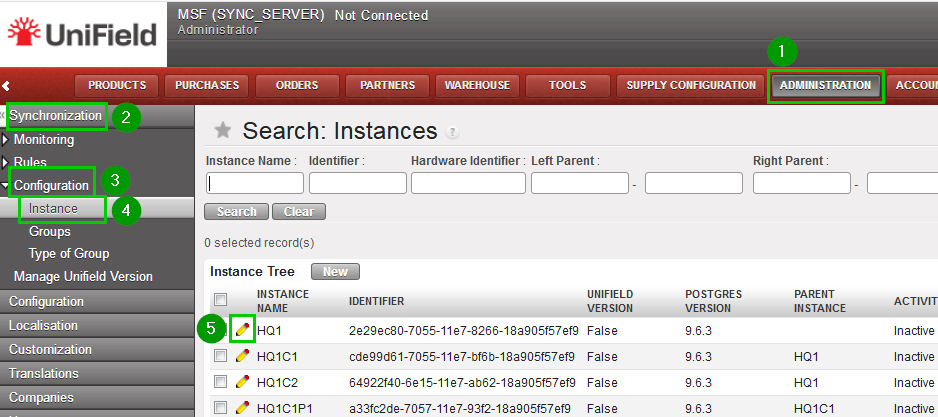
Click on menu Administration 1, Synchronization 2, Configuration 3, Instance 4.
Click on the edit icon 5 of the instance you previously copied the Entity Id.
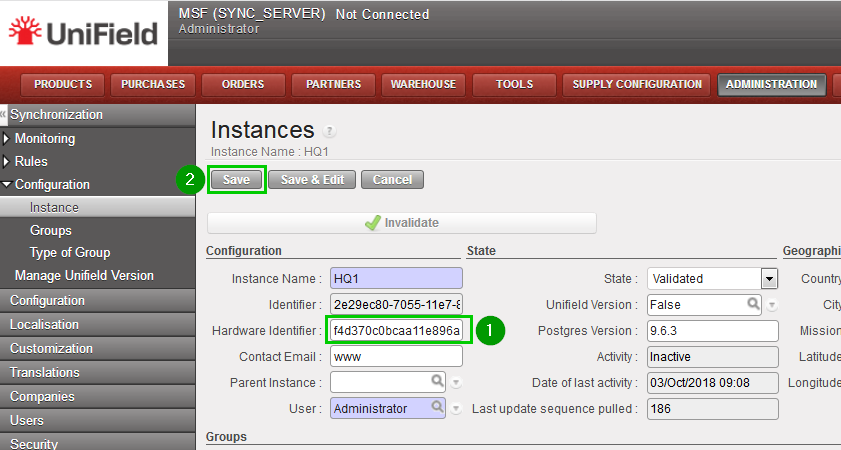
Hardware Identifier 1: paste the Entity Id you copied previously.
Click on Save 2

Perform the same previous steps for the other instances.
The Sandbox is now ready to be used !!!

9.4 Connect Instances with your SYNC_SERVER

9.4 Connect Instances with your SYNC_SERVER

The final step is to connect every instances in your sandbox to your_SYNC_SERVER.

Click on Menu Synchronization 1, Registration 2, Connection Manager 3
Click on the edit icon 4 and to edit the Current Connection:


  • Host: Address of the machine where your_SYNC_SERVER is installed – code>localhost if installed on the same machine
  • Port: Default (8069) or as per your Sandbox configuration
  • Protocol: XMLRPC
  • Database Name: your_SYNC_SERVER_name
  • Login on synchro server your_SYNC_SERVER_login
  • Password: your_SYNC_SERVER_password
  • Max Packet Size: 500
  • Timeout: 600 – The number of seconds the instance will wait during a sync before raising a timeout error
  • XmlRPC retry: 10 – The number of retry during a sync when the instance don’t receive the acknowledge from the SYNC_SERVER with the XmlRPC protocol.
  • Silent upgrade: The instance will patch automatically during the time slot defined if an automatic synchronisation is performed. Only useful if testing patches.

Click on Connect the State switches to connected
Click on Save